@ McGraw-Hill Education
1
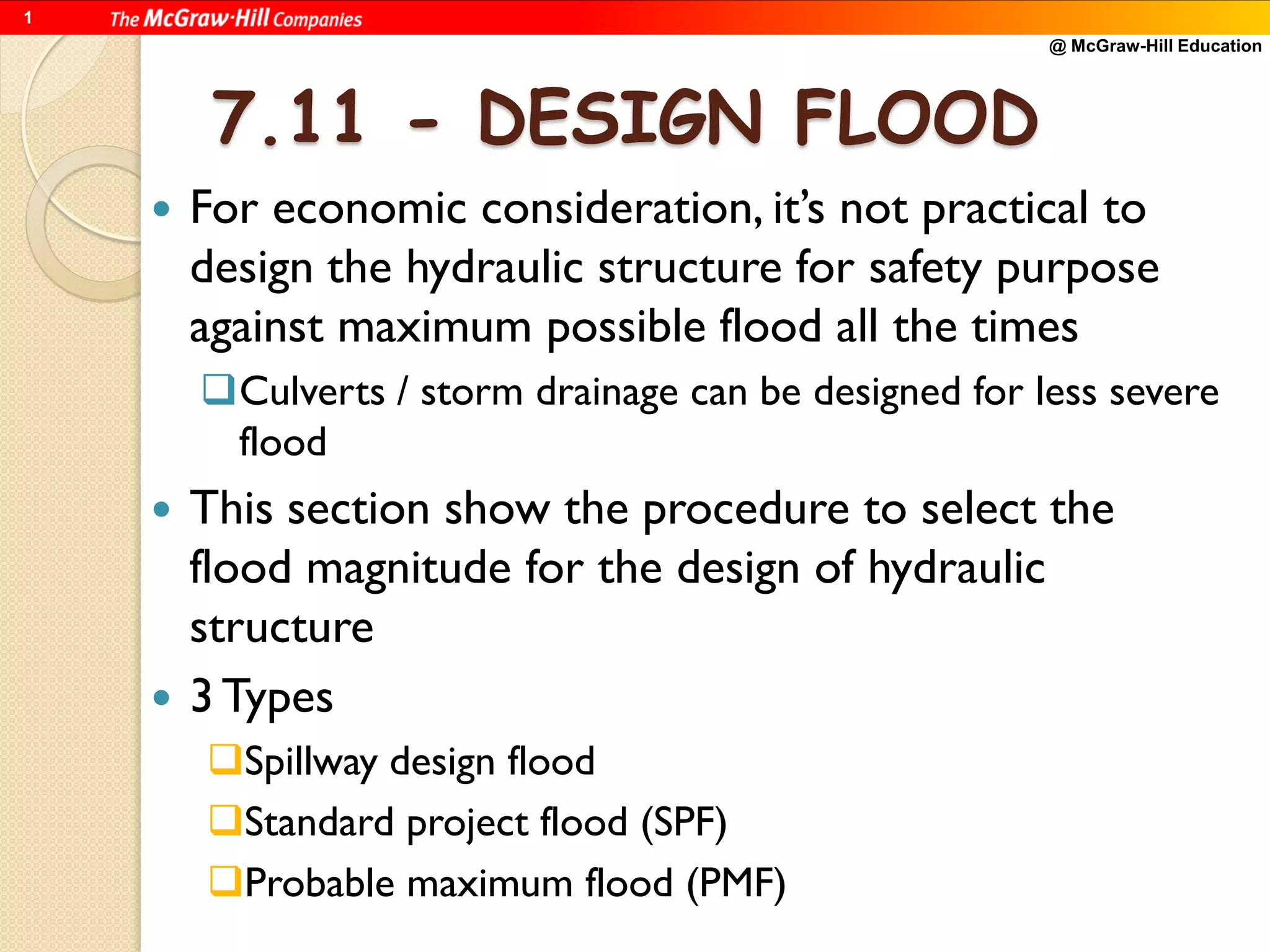
7.11 - DESIGN FLOOD
 For economic consideration, it’s not practical to
design the hydraulic structure for safety purpose
against maximum possible flood all the times
Culverts / storm drainage can be designed for less severe
flood
 This section show the procedure to select the
flood magnitude for the design of hydraulic
structure
 3Types
Spillway design flood
Standard project flood (SPF)
Probable maximum flood (PMF)
@ McGraw-Hill Education
2
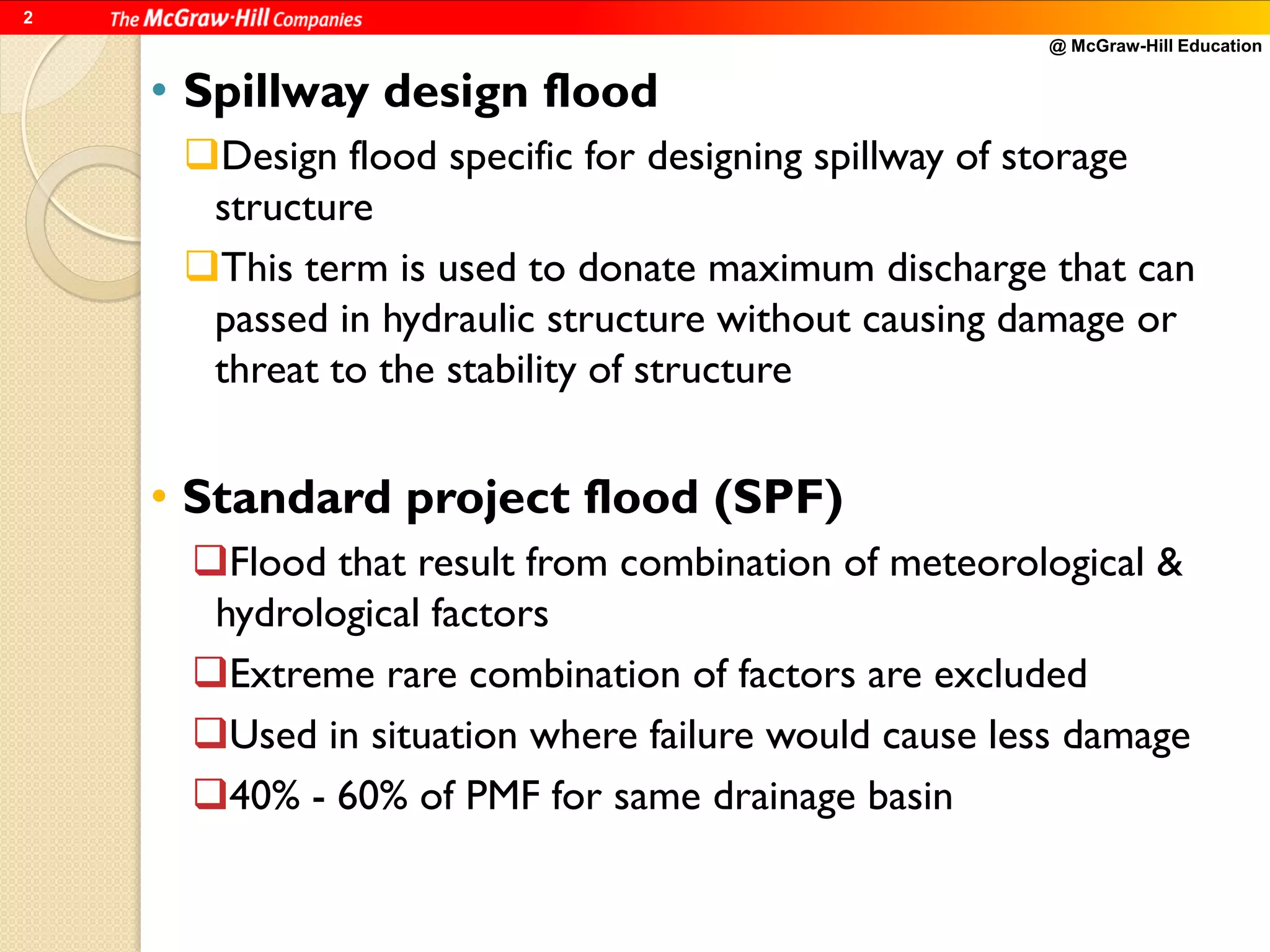
• Spillway design flood
Design flood specific for designing spillway of storage
structure
This term is used to donate maximum discharge that can
passed in hydraulic structure without causing damage or
threat to the stability of structure
• Standard project flood (SPF)
Flood that result from combination of meteorological &
hydrological factors
Extreme rare combination of factors are excluded
Used in situation where failure would cause less damage
40% - 60% of PMF for same drainage basin
@ McGraw-Hill Education
3
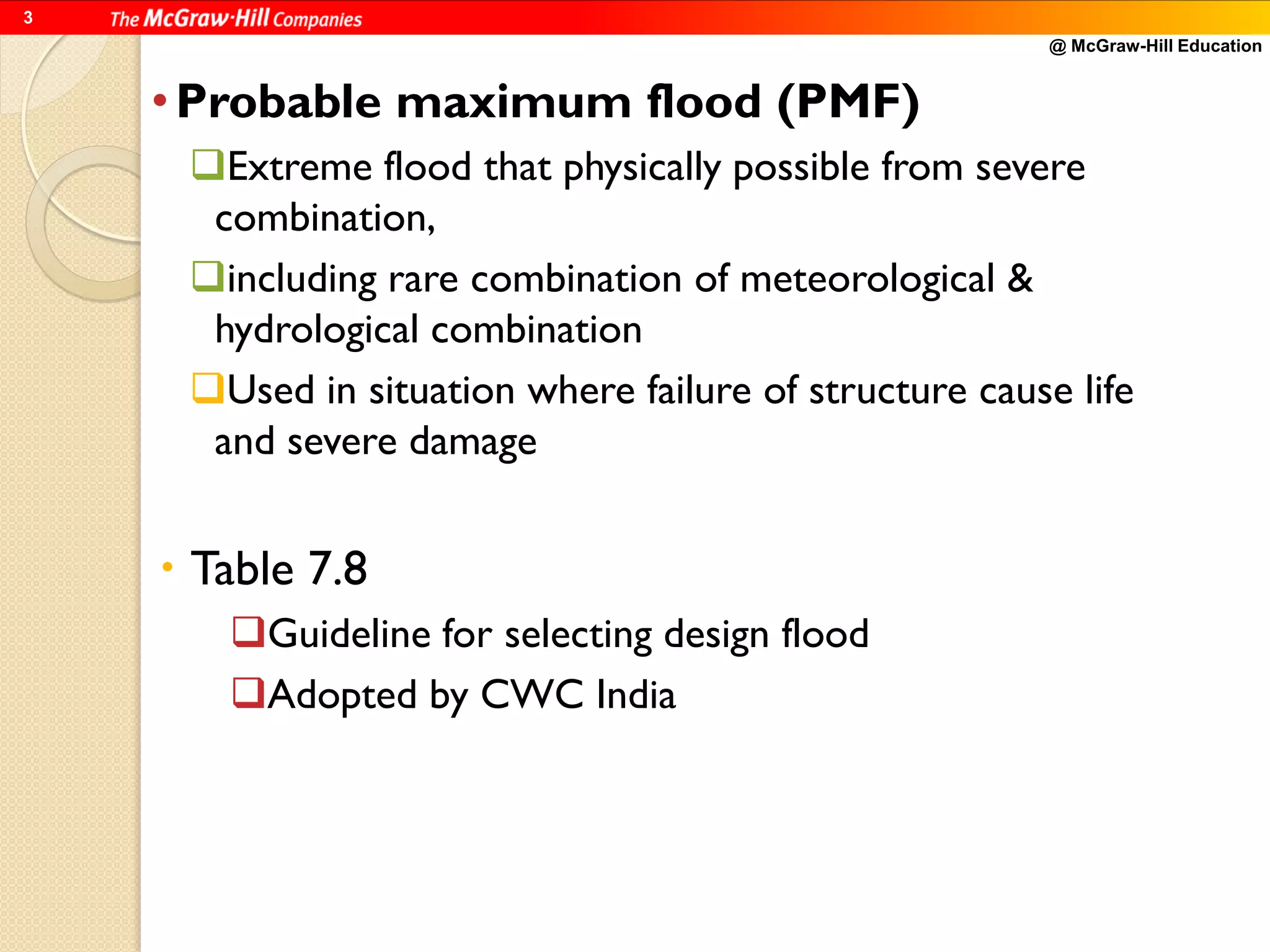
•Probable maximum flood (PMF)
Extreme flood that physically possible from severe
combination,
including rare combination of meteorological &
hydrological combination
Used in situation where failure of structure cause life
and severe damage
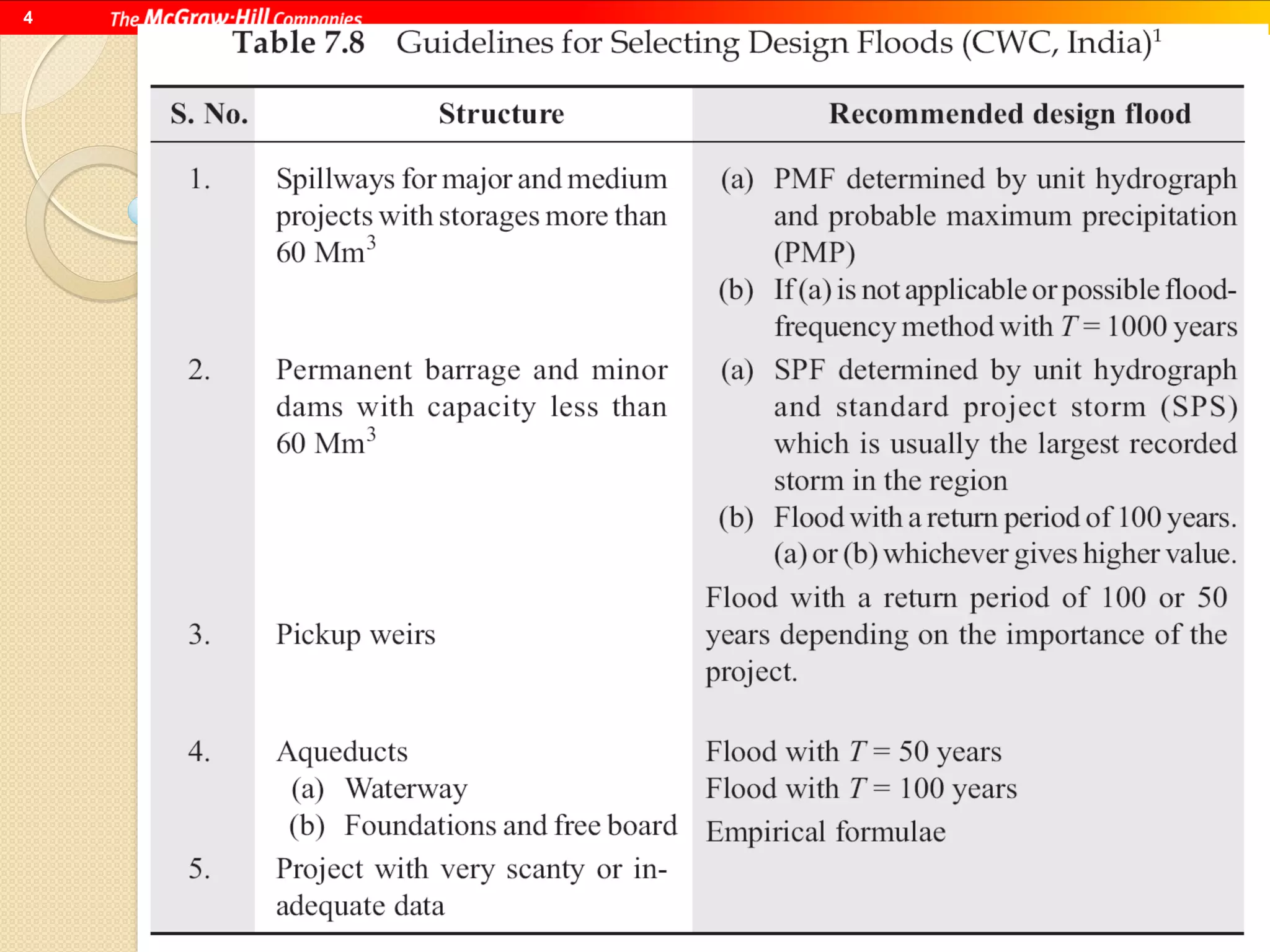
 Table 7.8
Guideline for selecting design flood
Adopted by CWC India
@ McGraw-Hill Education
4
@ McGraw-Hill Education
5
INDIAN STANDARD GUIDELINE
FOR DESIGN OF FLOOD FOR
DAMS
 Classification of dams
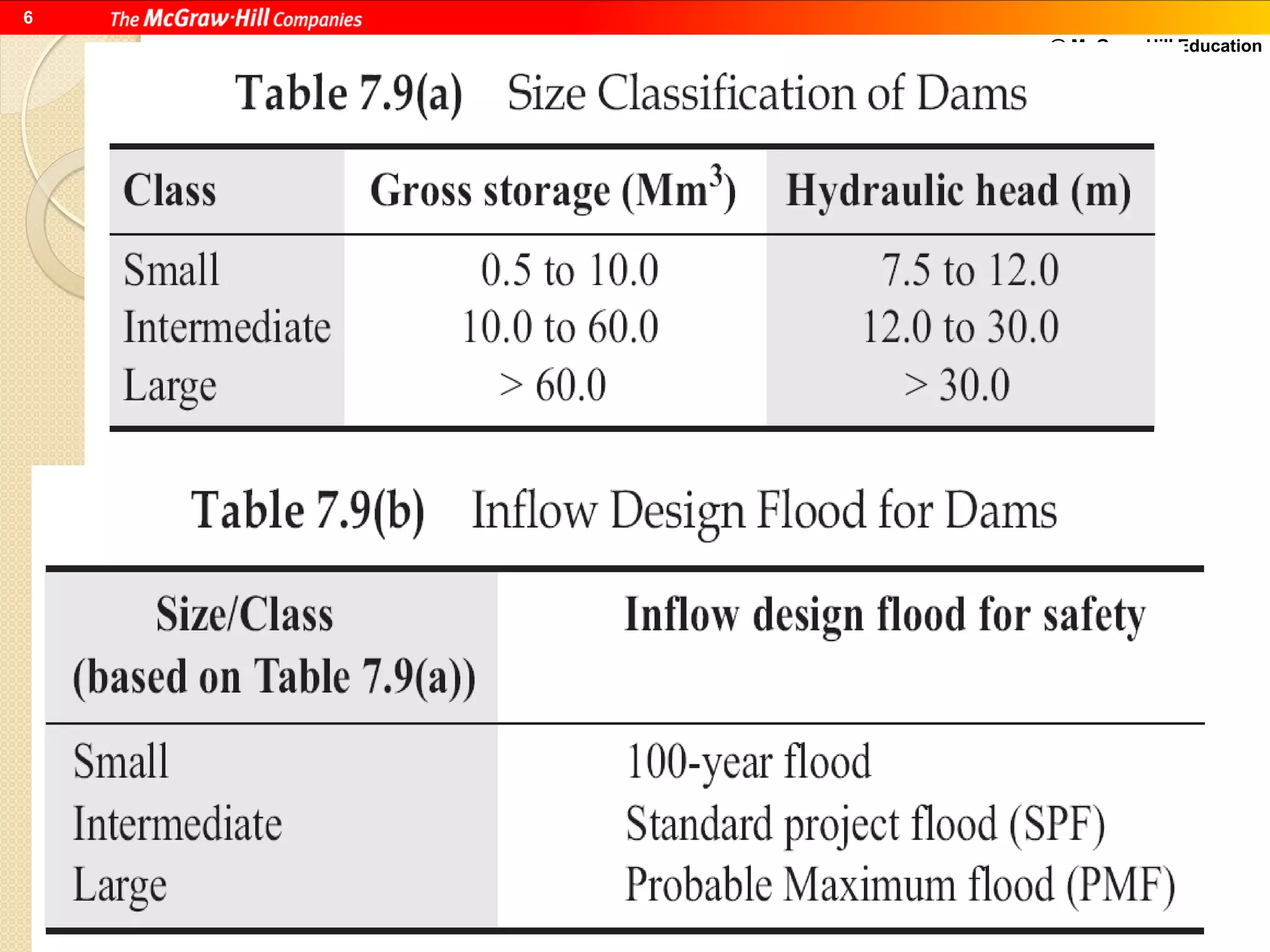
According to size (table 7.9(a))
By using hydraulic heads & gross storage
• Hydraulic head define as
Difference between maximum water level on
upstream & normal annual average flood level
downstream
• For safety of dam
The inflow design flood (IDF) is considered
Given byTable 7.9 (b)
@ McGraw-Hill Education
6
@ McGraw-Hill Education
7
7.12 – DESIGN STORM
 To estimate the design flood by using unit
hydrograph
• Computation of design storm
By hydrometeorologist by using meteorological data
Various method use which depend on availability of
reliable data and expertise
 2 method
Storm-producing probable maximum
precipitation (PMP) derived from PMF
Standard project storm (SPS) for SPF calculation
@ McGraw-Hill Education
8
 Below show procedure from India
1. Find the critical rainfall.
This will be the basin lag if the flood peak is of
interest
If flood volume is of interest, find duration of the
longest storm experienced in the basin
2. Find the past major storm
DAD analysis is performed and the enveloping
curve represent max depth-duration relation for
the study is obtained
@ McGraw-Hill Education
9
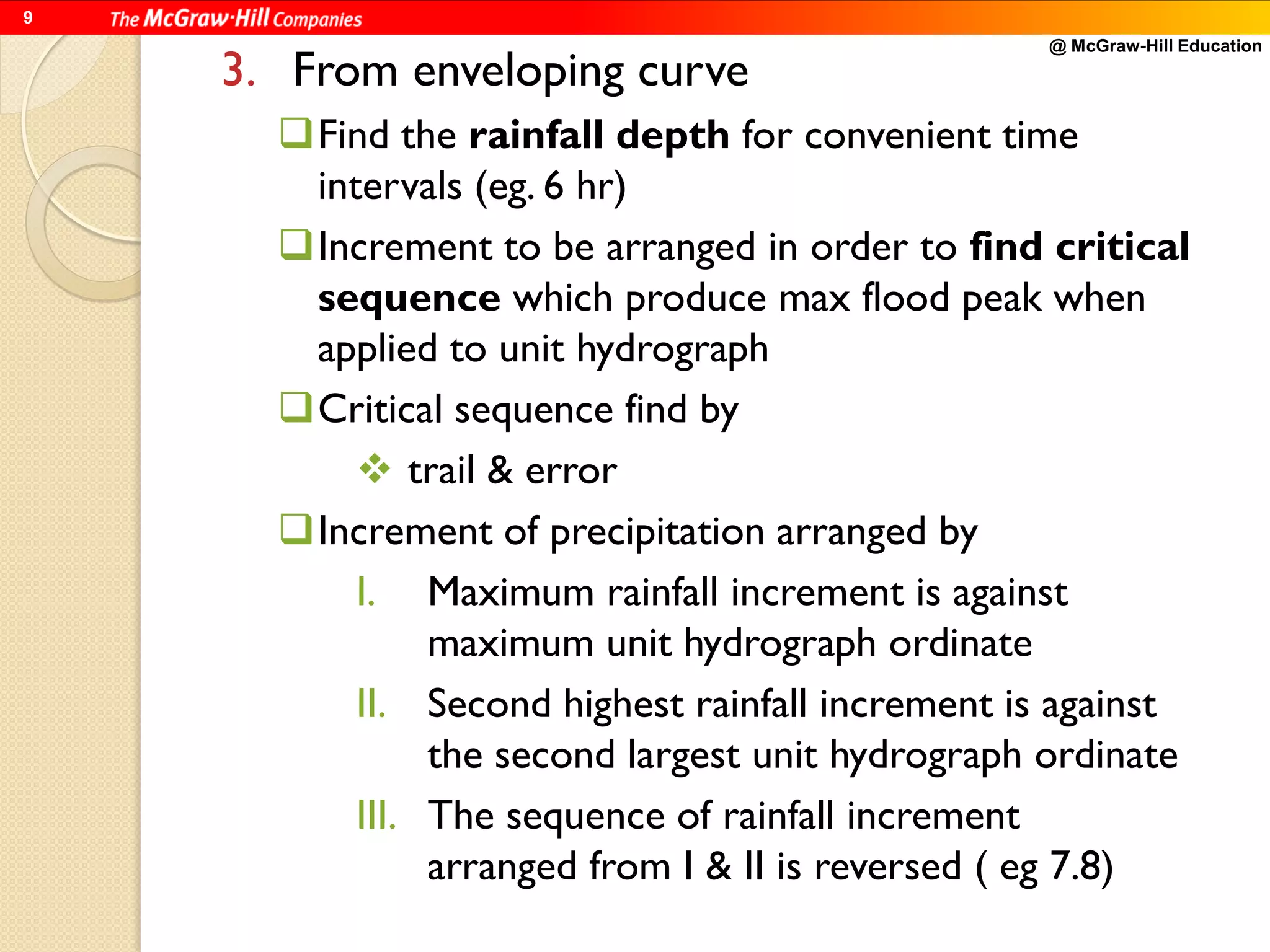
3. From enveloping curve
Find the rainfall depth for convenient time
intervals (eg. 6 hr)
Increment to be arranged in order to find critical
sequence which produce max flood peak when
applied to unit hydrograph
Critical sequence find by
 trail & error
Increment of precipitation arranged by
I. Maximum rainfall increment is against
maximum unit hydrograph ordinate
II. Second highest rainfall increment is against
the second largest unit hydrograph ordinate
III. The sequence of rainfall increment
arranged from I & II is reversed ( eg 7.8)
@ McGraw-Hill Education
10
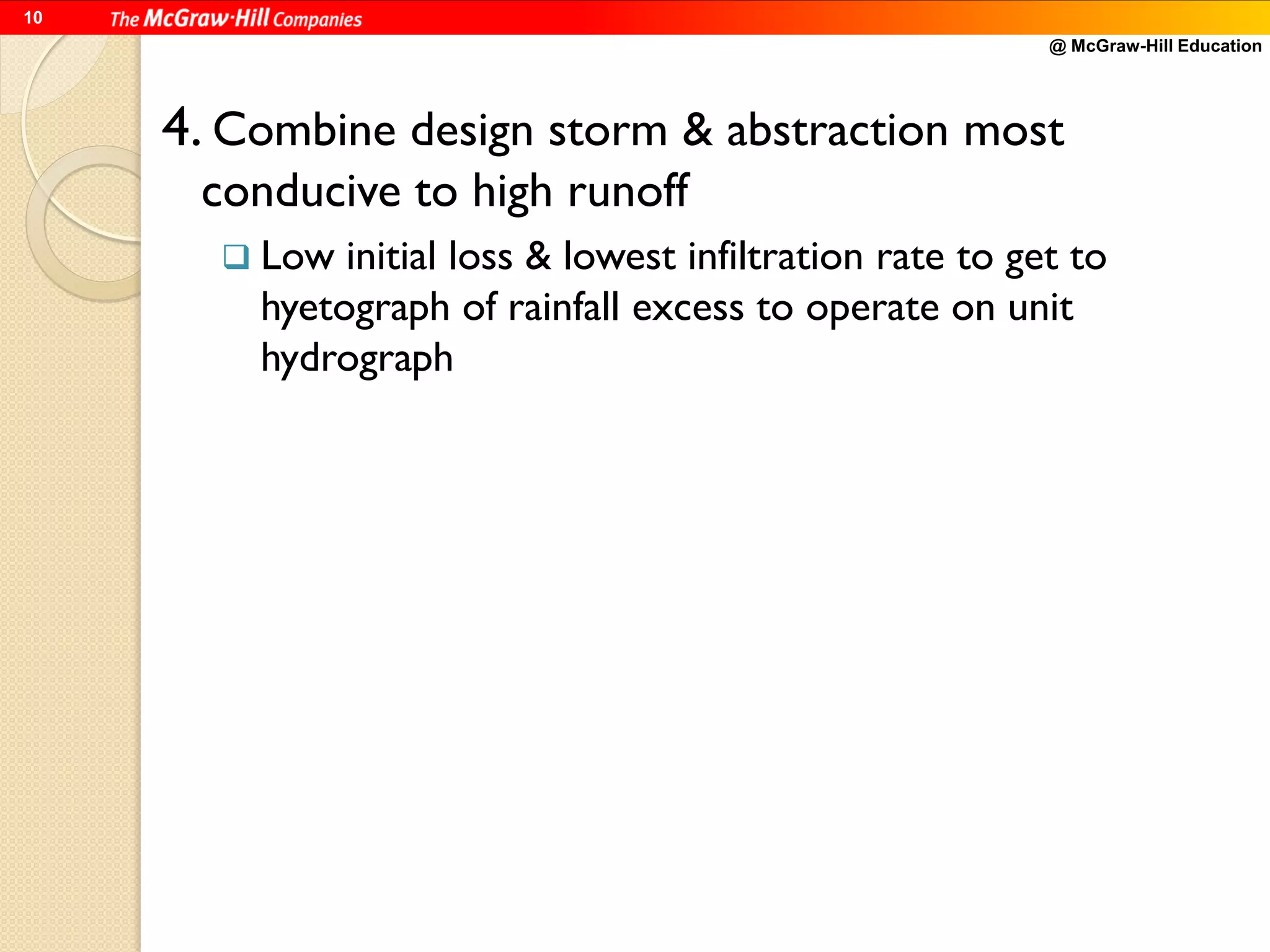
4. Combine design storm & abstraction most
conducive to high runoff
 Low initial loss & lowest infiltration rate to get to
hyetograph of rainfall excess to operate on unit
hydrograph
@ McGraw-Hill Education
11
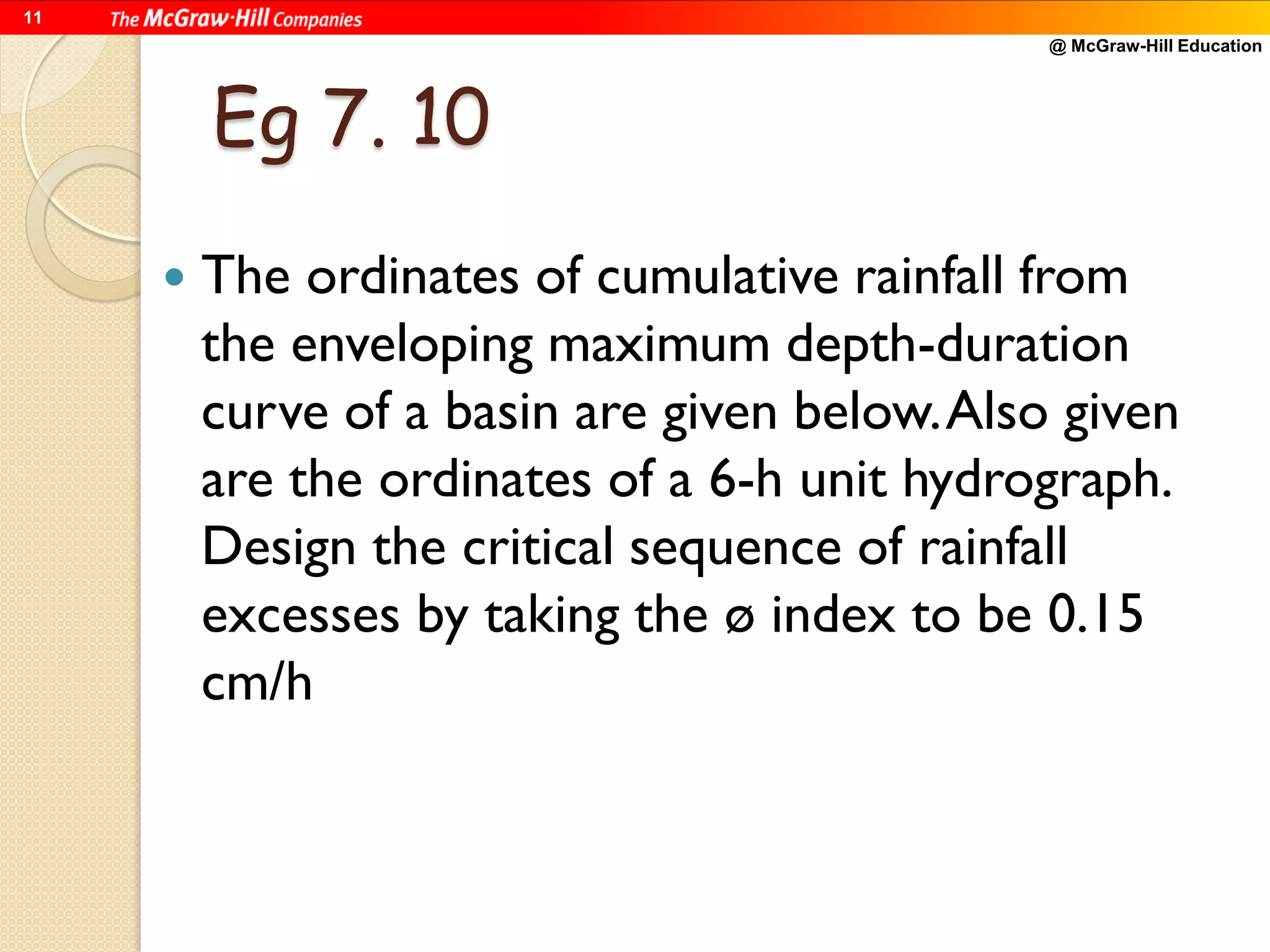
Eg 7. 10
 The ordinates of cumulative rainfall from
the enveloping maximum depth-duration
curve of a basin are given below.Also given
are the ordinates of a 6-h unit hydrograph.
Design the critical sequence of rainfall
excesses by taking the ø index to be 0.15
cm/h
@ McGraw-Hill Education
12
@ McGraw-Hill Education
13
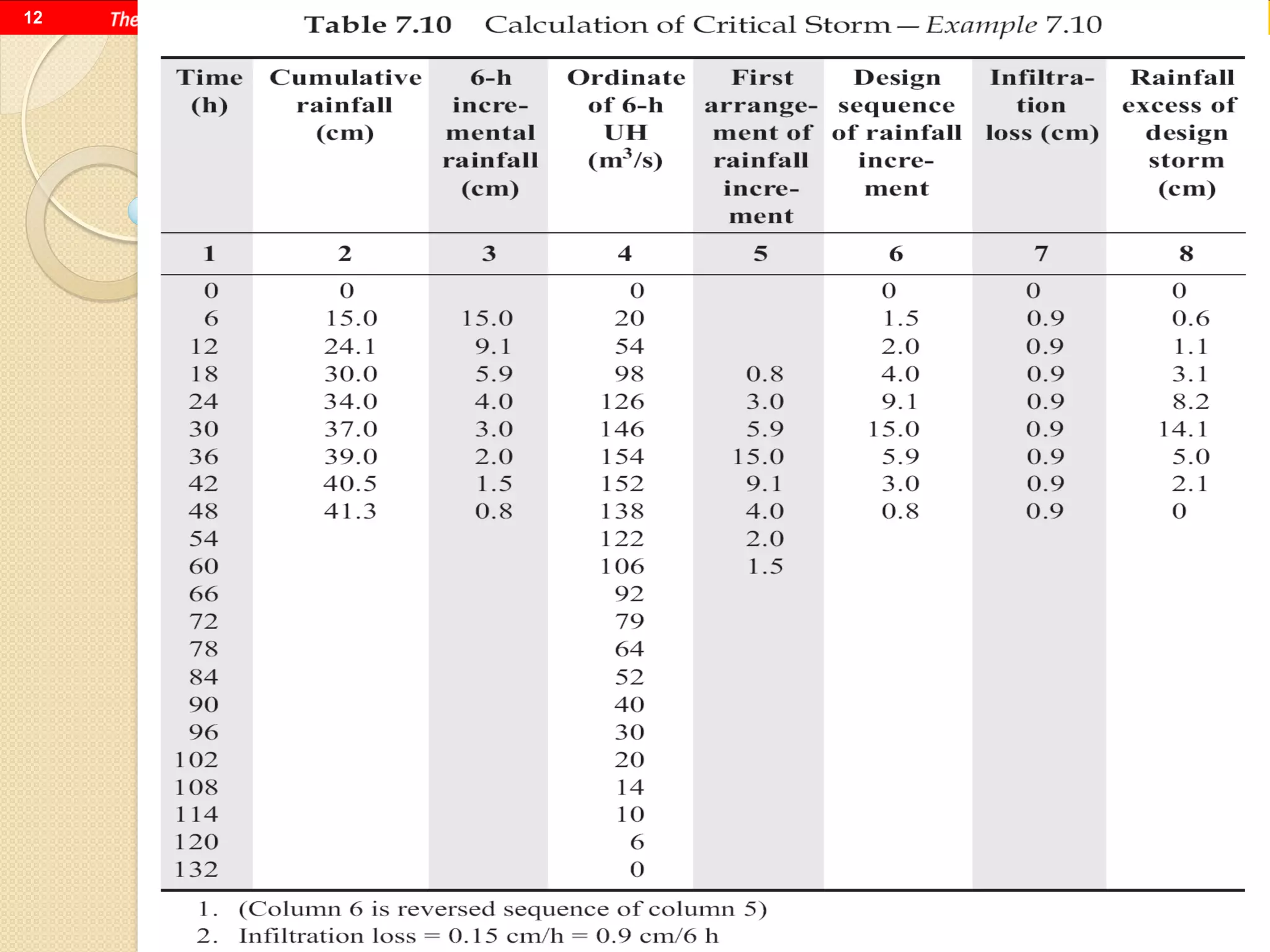
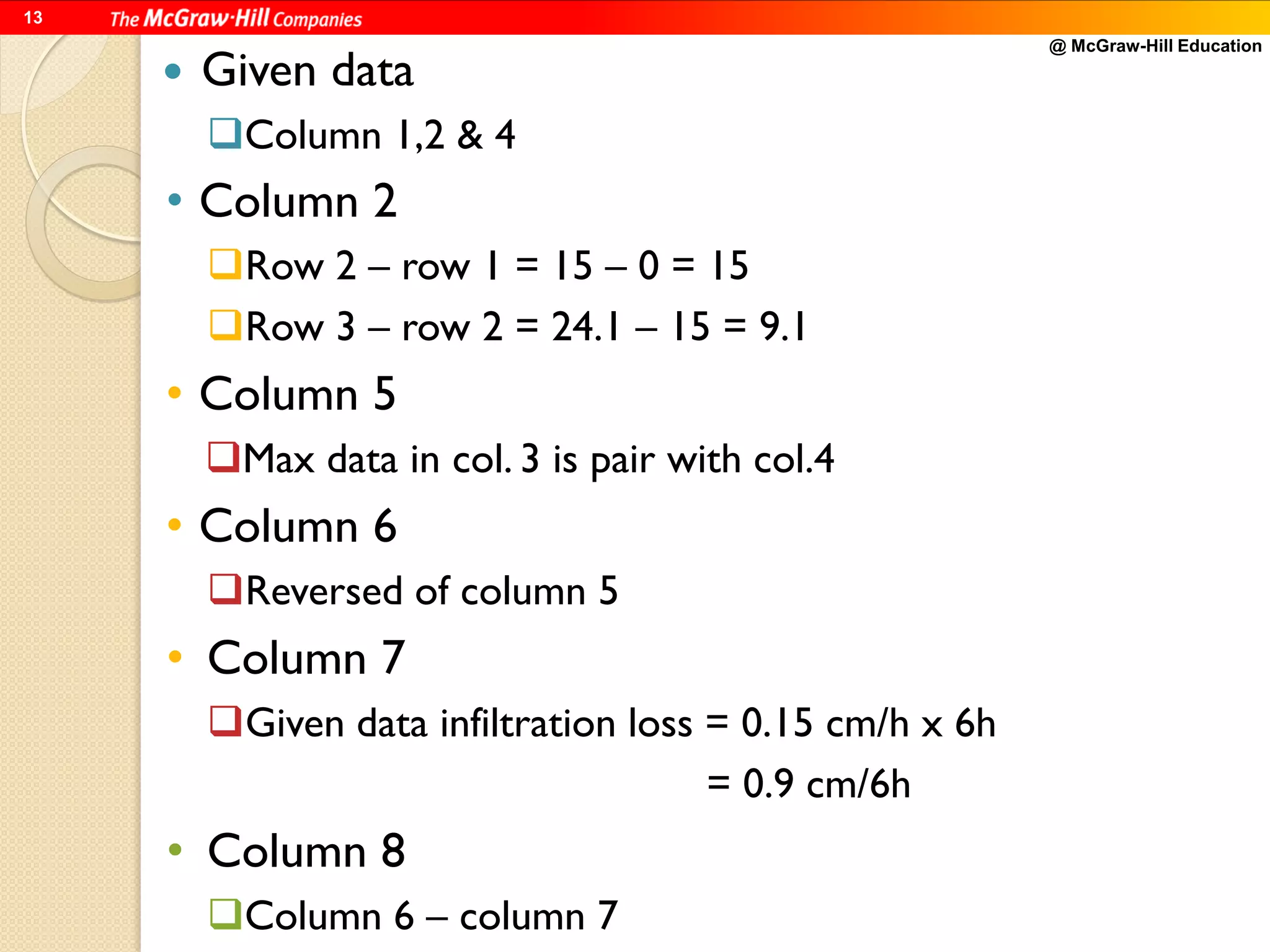
 Given data
Column 1,2 & 4
• Column 2
Row 2 – row 1 = 15 – 0 = 15
Row 3 – row 2 = 24.1 – 15 = 9.1
• Column 5
Max data in col. 3 is pair with col.4
• Column 6
Reversed of column 5
• Column 7
Given data infiltration loss = 0.15 cm/h x 6h
= 0.9 cm/6h
• Column 8
Column 6 – column 7
@ McGraw-Hill Education
14
7.13 – RISK, RELIABILITY AND
SAFETY FACTORS
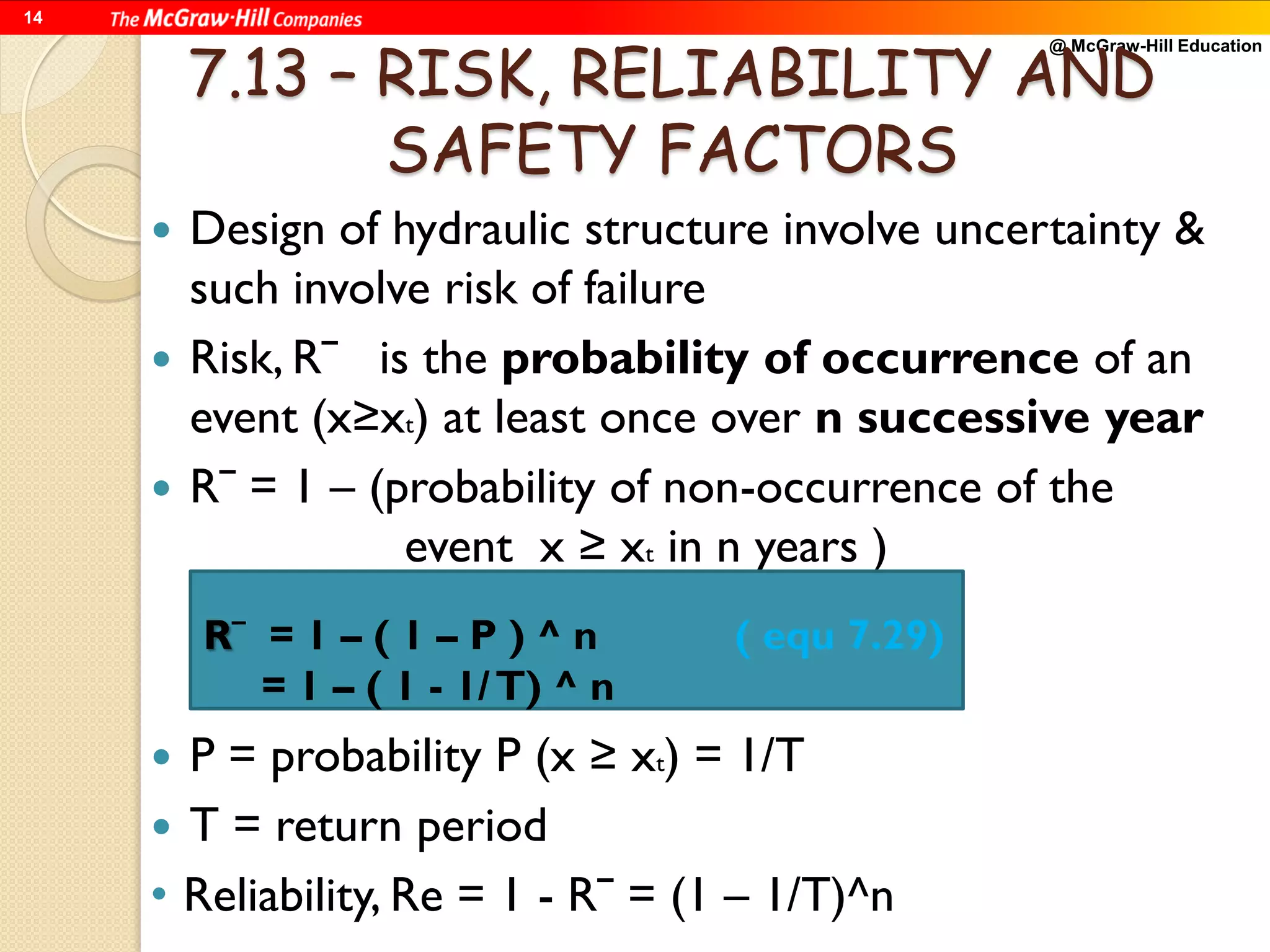
 Design of hydraulic structure involve uncertainty &
such involve risk of failure
 Risk, Rˉ is the probability of occurrence of an
event (x≥xt) at least once over n successive year
 Rˉ = 1 – (probability of non-occurrence of the
event x ≥ xt in n years )
 P = probability P (x ≥ xt) = 1/T
 T = return period
• Reliability, Re = 1 - Rˉ = (1 – 1/T)^n
Rˉ = 1 – ( 1 – P ) ^ n ( equ 7.29)
= 1 – ( 1 - 1/T) ^ n
@ McGraw-Hill Education
15
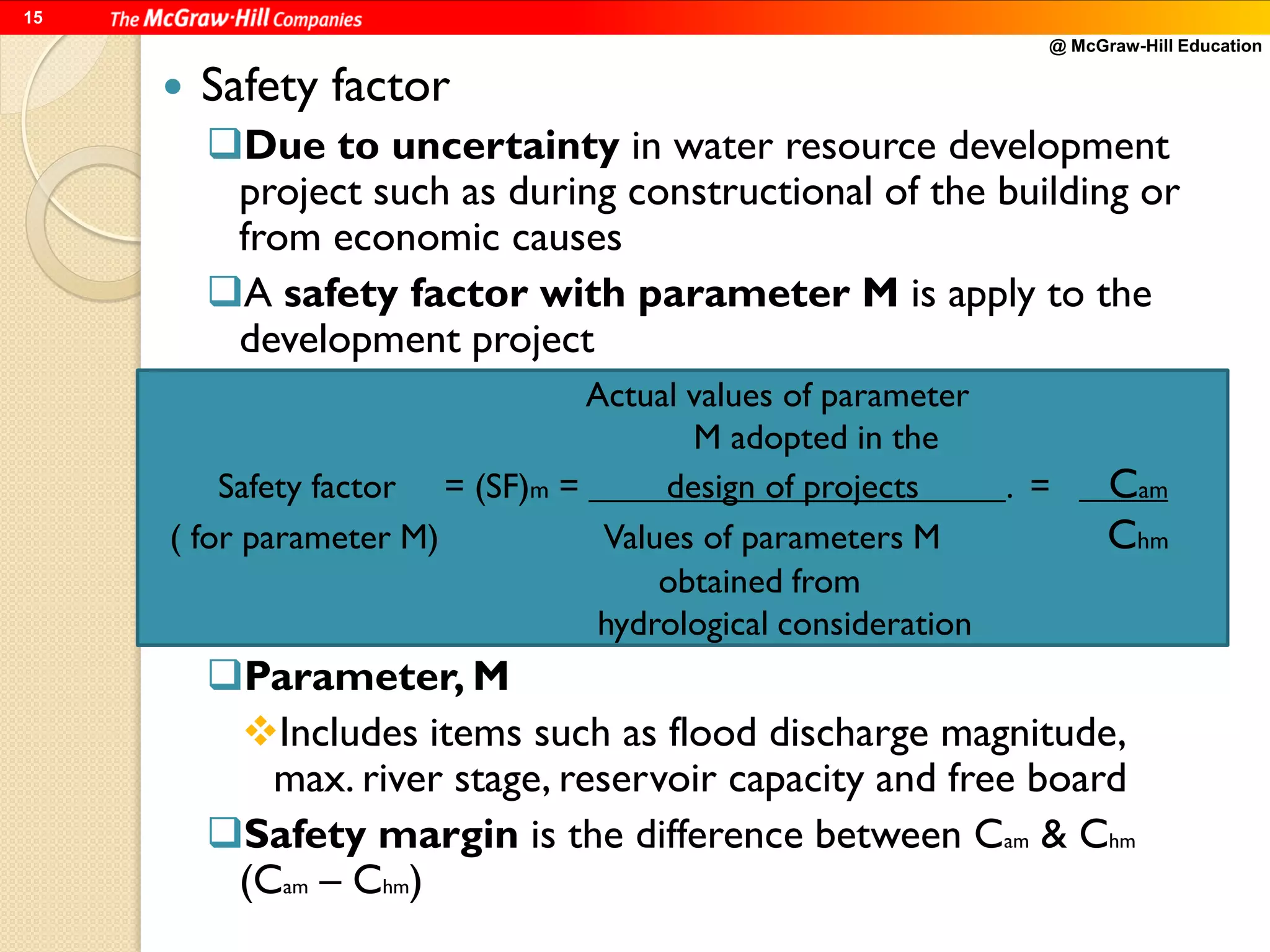
 Safety factor
Due to uncertainty in water resource development
project such as during constructional of the building or
from economic causes
A safety factor with parameter M is apply to the
development project
Parameter, M
Includes items such as flood discharge magnitude,
max. river stage, reservoir capacity and free board
Safety margin is the difference between Cam & Chm
(Cam – Chm)
Actual values of parameter
M adopted in the
Safety factor = (SF)m = design of projects . = Cam
( for parameter M) Values of parameters M Chm
obtained from
hydrological consideration
@ McGraw-Hill Education
16
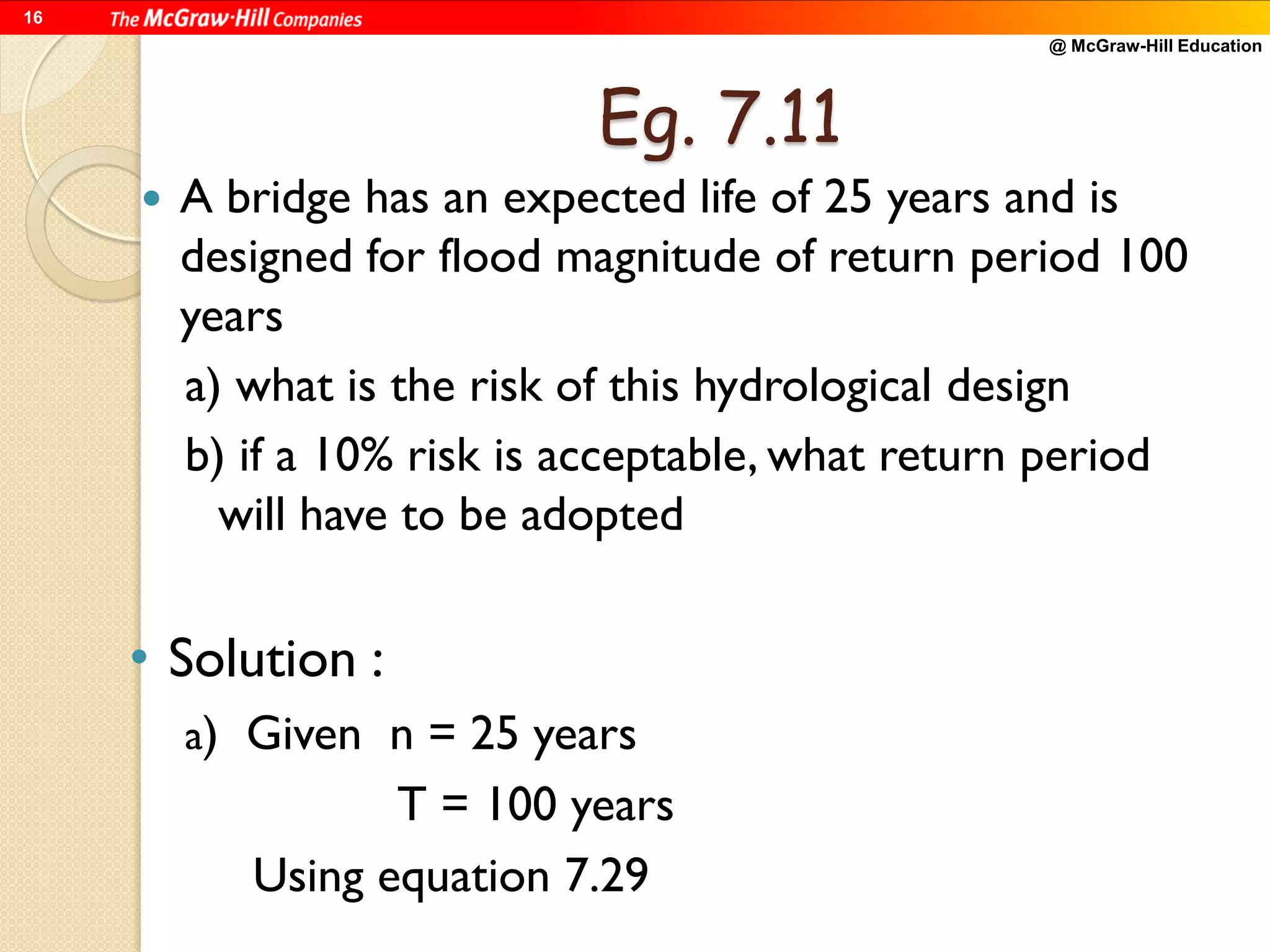
Eg. 7.11
 A bridge has an expected life of 25 years and is
designed for flood magnitude of return period 100
years
a) what is the risk of this hydrological design
b) if a 10% risk is acceptable, what return period
will have to be adopted
• Solution :
a) Given n = 25 years
T = 100 years
Using equation 7.29
@ McGraw-Hill Education
17
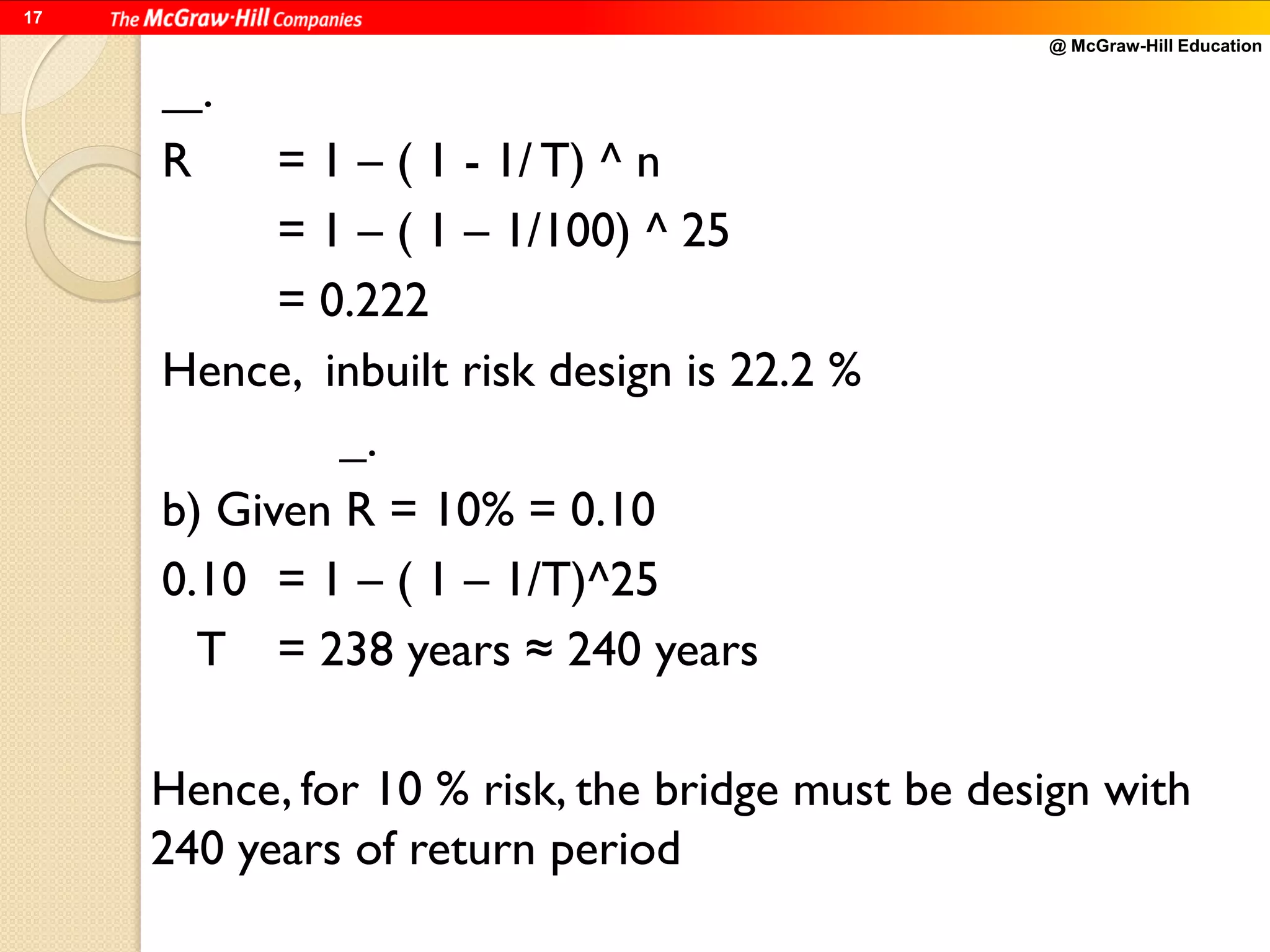
.
R = 1 – ( 1 - 1/ T) ^ n
= 1 – ( 1 – 1/100) ^ 25
= 0.222
Hence, inbuilt risk design is 22.2 %
.
b) Given R = 10% = 0.10
0.10 = 1 – ( 1 – 1/T)^25
T = 238 years ≈ 240 years
Hence, for 10 % risk, the bridge must be design with
240 years of return period
@ McGraw-Hill Education
18
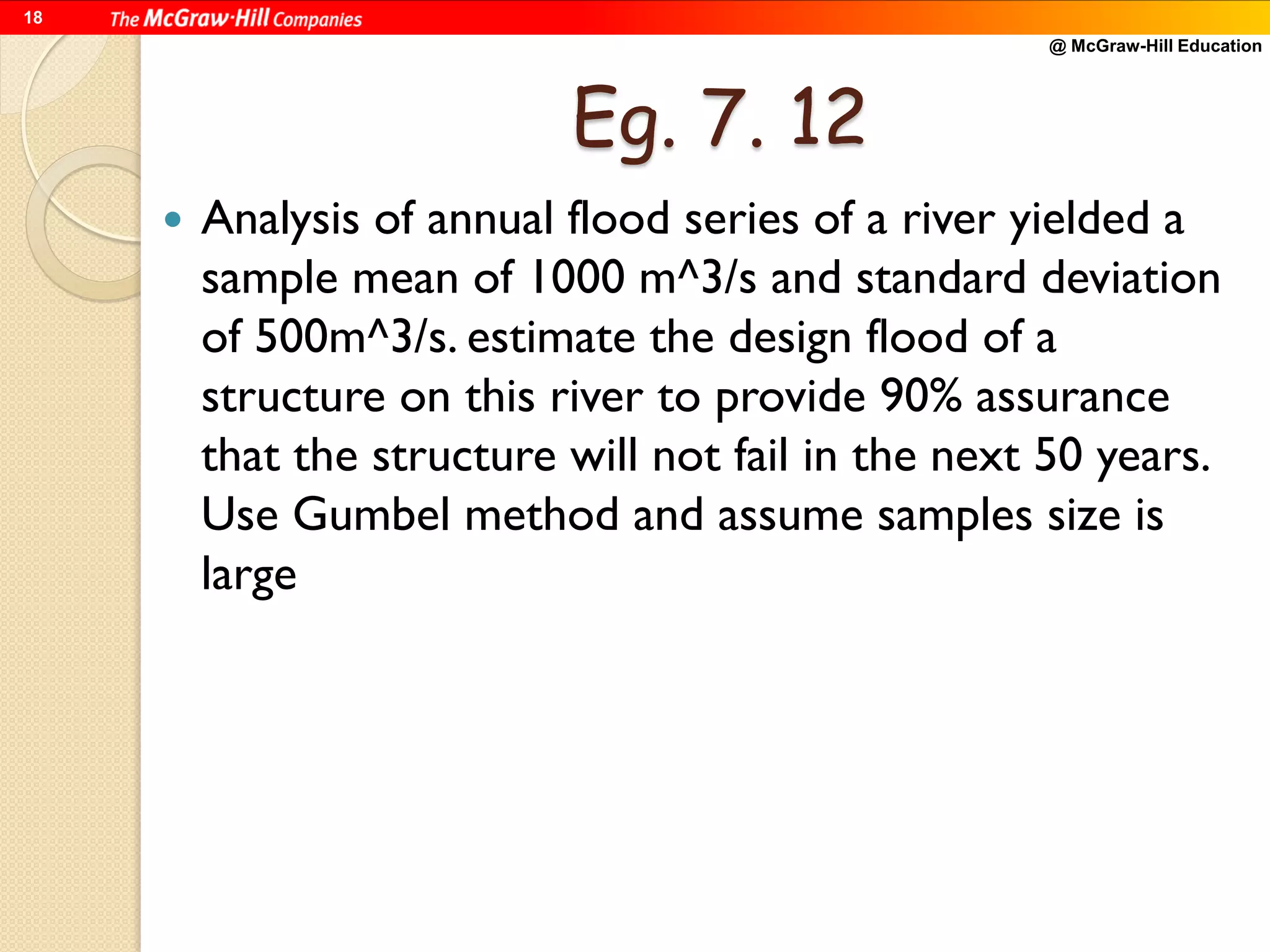
Eg. 7. 12
 Analysis of annual flood series of a river yielded a
sample mean of 1000 m^3/s and standard deviation
of 500m^3/s. estimate the design flood of a
structure on this river to provide 90% assurance
that the structure will not fail in the next 50 years.
Use Gumbel method and assume samples size is
large
@ McGraw-Hill Education
19
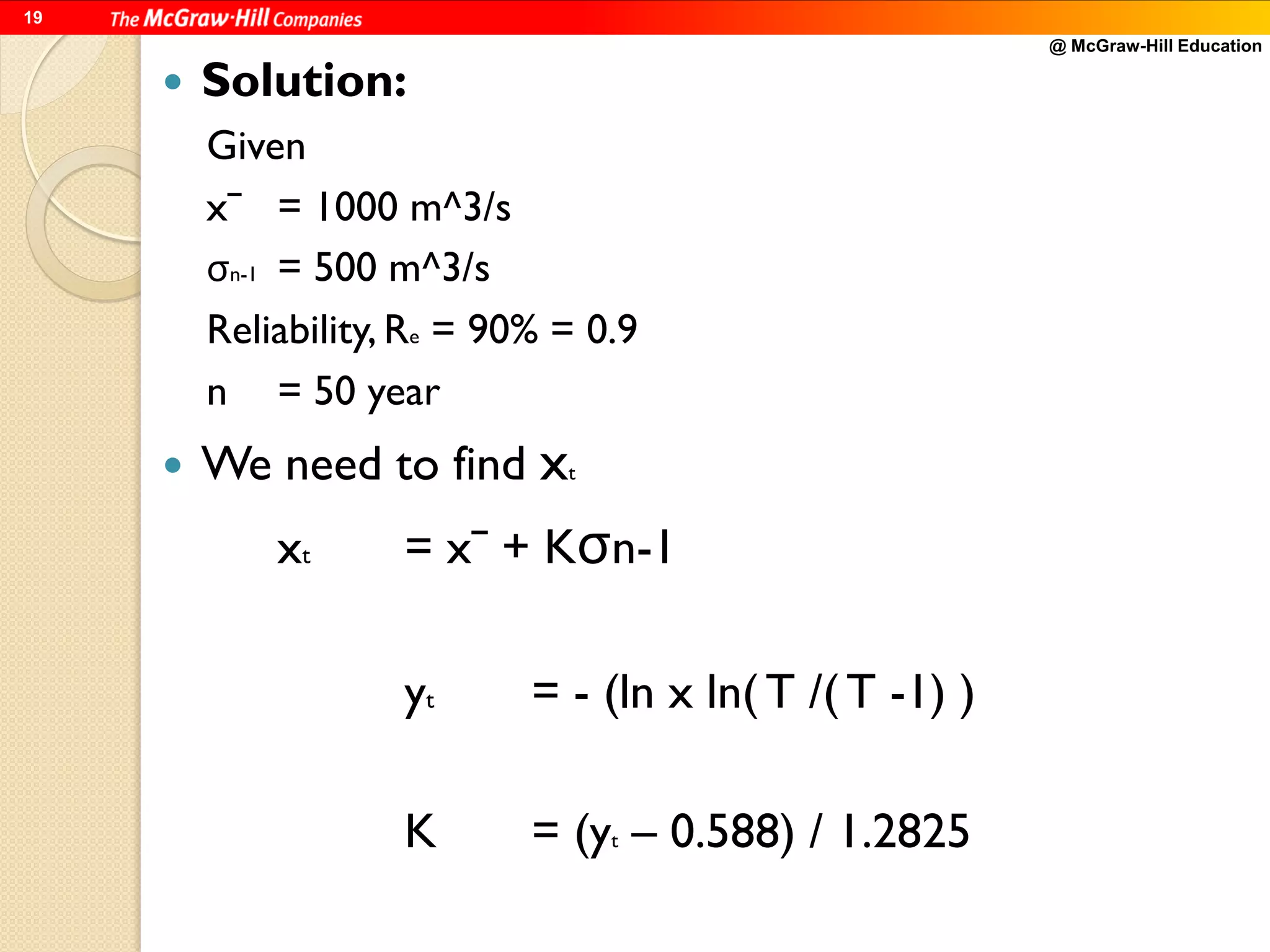
 Solution:
Given
xˉ = 1000 m^3/s
σn-1 = 500 m^3/s
Reliability, Re = 90% = 0.9
n = 50 year
 We need to find xt
xt = xˉ + Kσn-1
yt = - (ln x ln( T /( T -1) )
K = (yt – 0.588) / 1.2825
@ McGraw-Hill Education
20
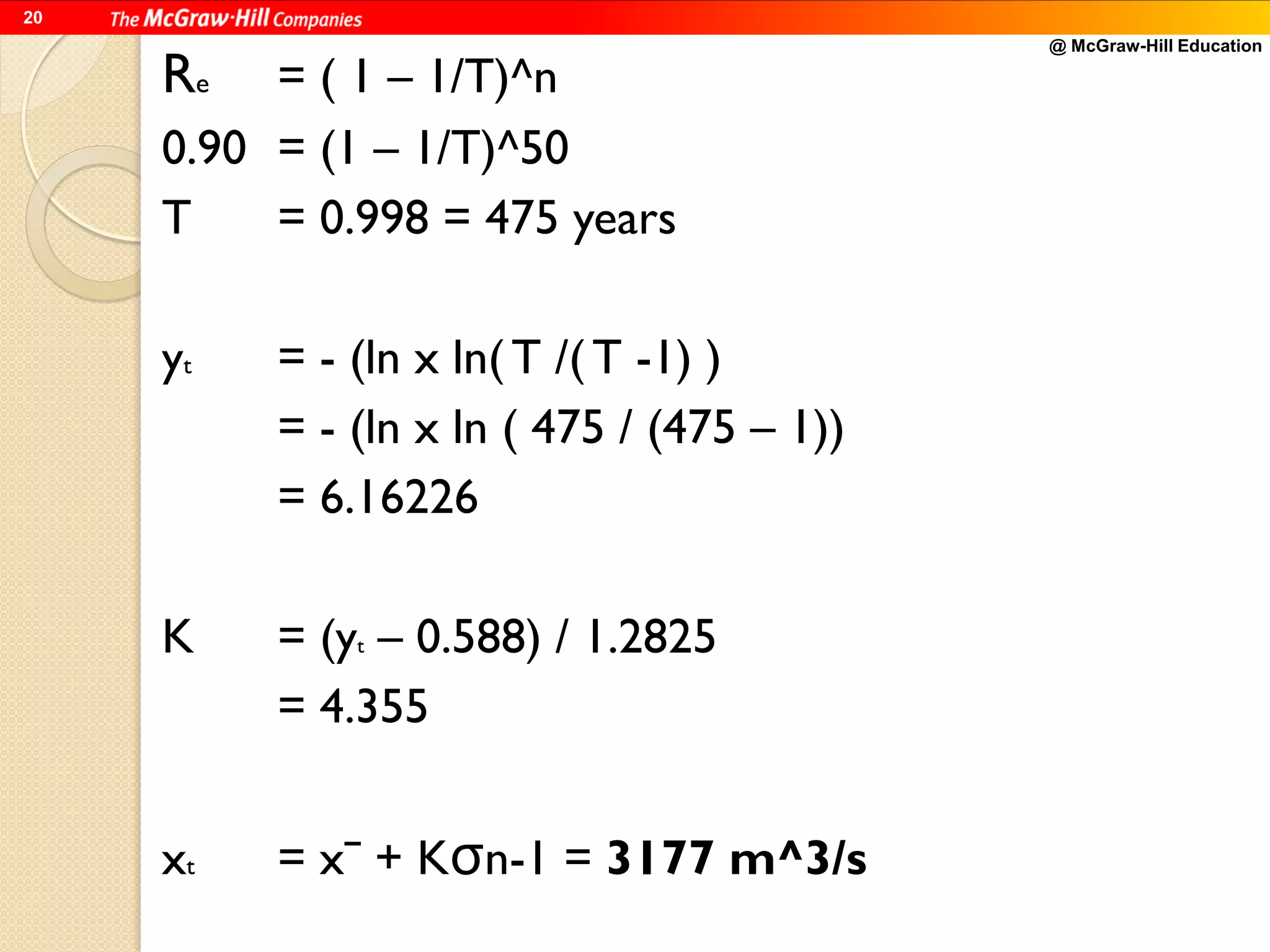
Re = ( 1 – 1/T)^n
0.90 = (1 – 1/T)^50
T = 0.998 = 475 years
yt = - (ln x ln( T /( T -1) )
= - (ln x ln ( 475 / (475 – 1))
= 6.16226
K = (yt – 0.588) / 1.2825
= 4.355
xt = xˉ + Kσn-1 = 3177 m^3/s
@ McGraw-Hill Education
21
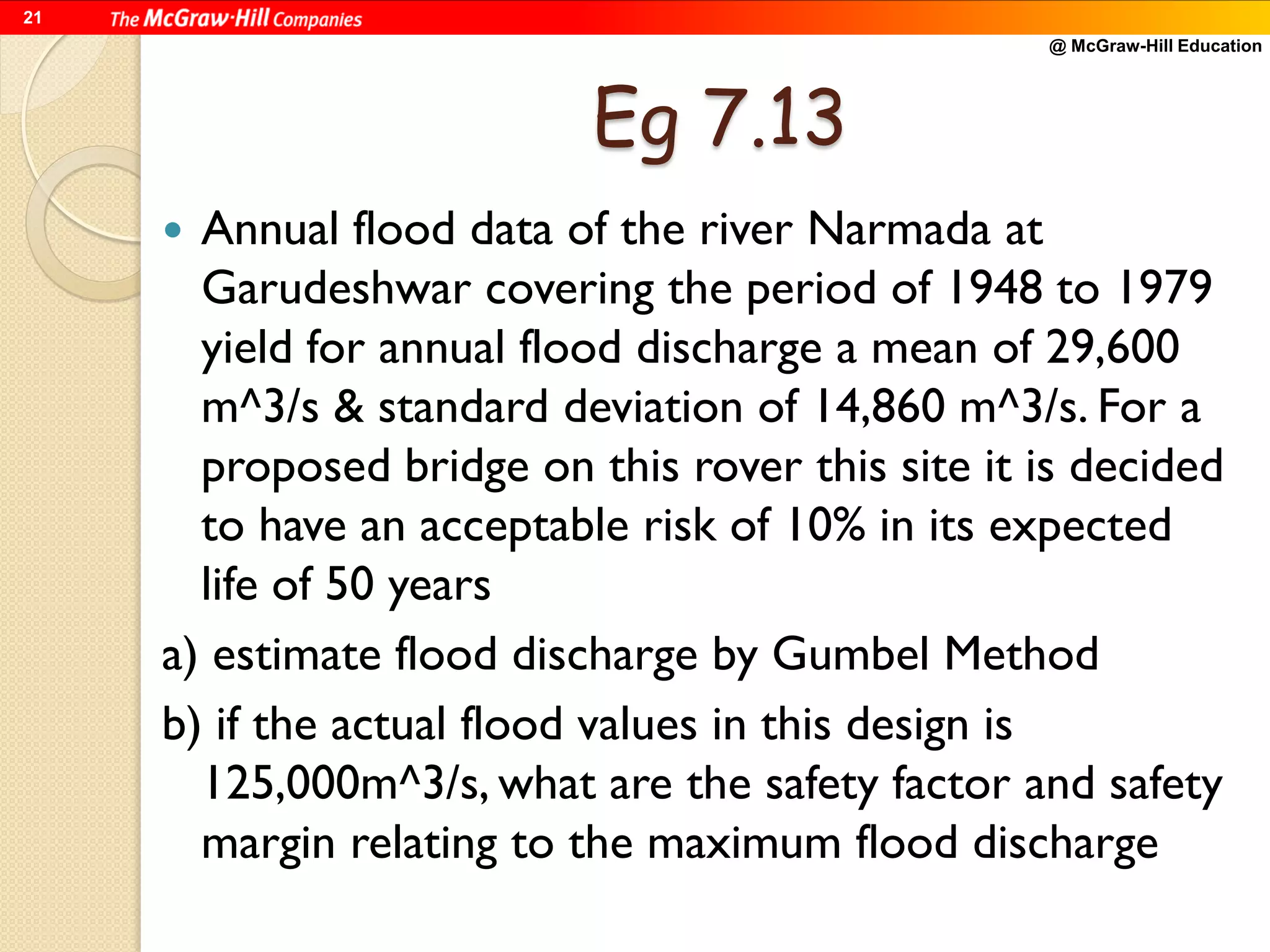
Eg 7.13
 Annual flood data of the river Narmada at
Garudeshwar covering the period of 1948 to 1979
yield for annual flood discharge a mean of 29,600
m^3/s & standard deviation of 14,860 m^3/s. For a
proposed bridge on this rover this site it is decided
to have an acceptable risk of 10% in its expected
life of 50 years
a) estimate flood discharge by Gumbel Method
b) if the actual flood values in this design is
125,000m^3/s, what are the safety factor and safety
margin relating to the maximum flood discharge
@ McGraw-Hill Education
22
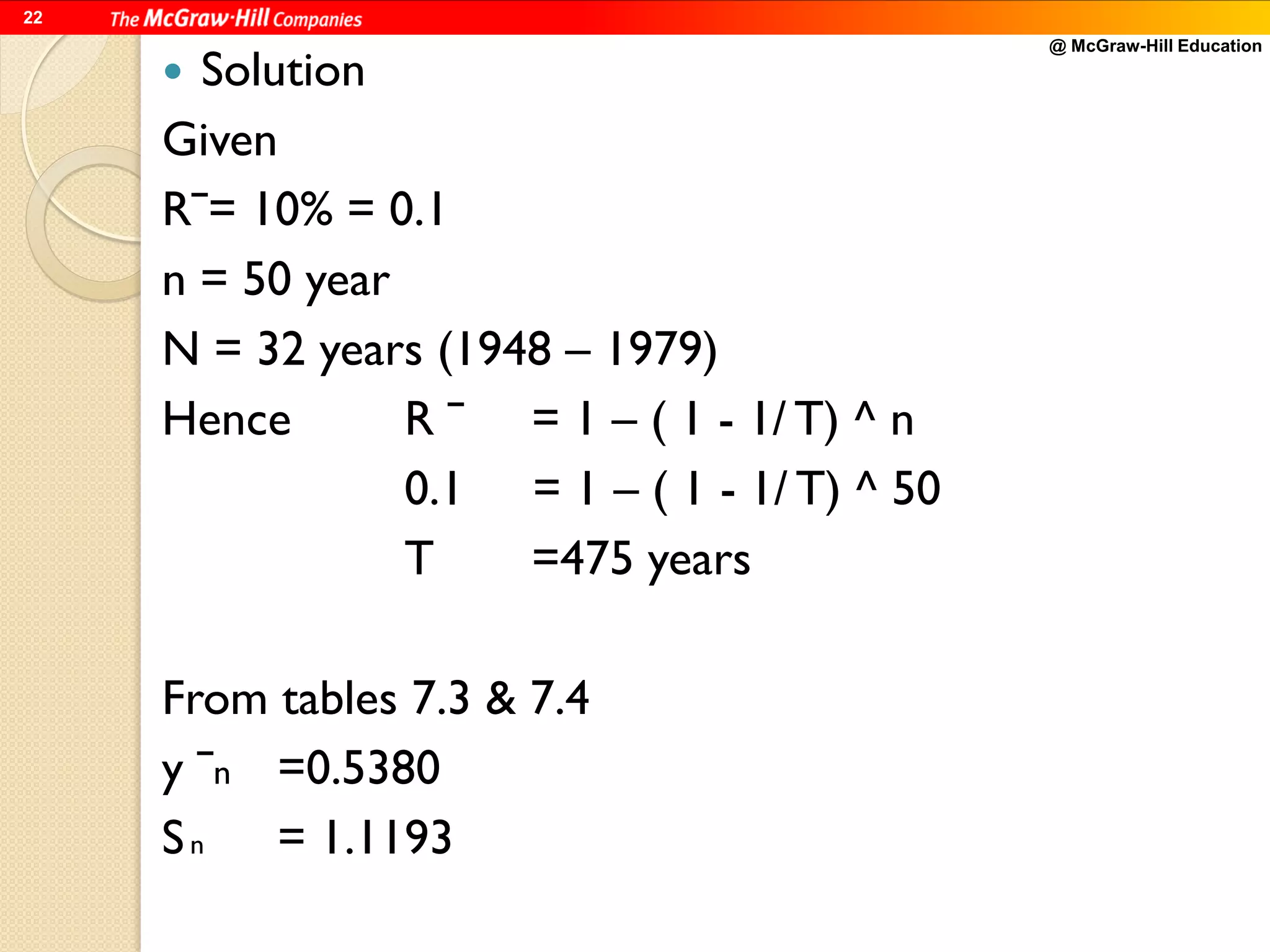
 Solution
Given
Rˉ= 10% = 0.1
n = 50 year
N = 32 years (1948 – 1979)
Hence R ˉ = 1 – ( 1 - 1/ T) ^ n
0.1 = 1 – ( 1 - 1/ T) ^ 50
T =475 years
From tables 7.3 & 7.4
y ˉn =0.5380
Sn = 1.1193
@ McGraw-Hill Education
23
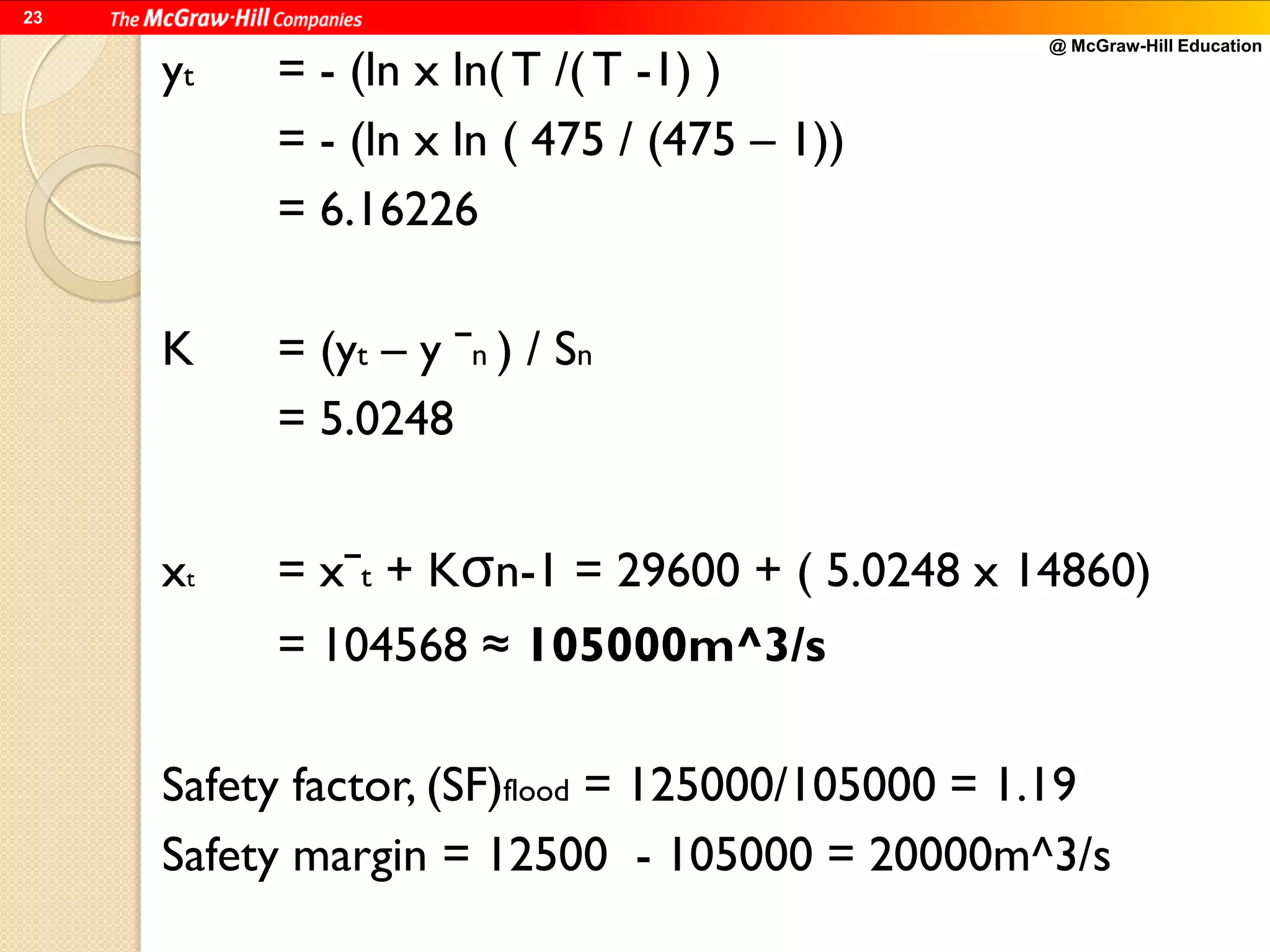
yt = - (ln x ln( T /( T -1) )
= - (ln x ln ( 475 / (475 – 1))
= 6.16226
K = (yt – y ˉn ) / Sn
= 5.0248
xt = xˉt + Kσn-1 = 29600 + ( 5.0248 x 14860)
= 104568 ≈ 105000m^3/s
Safety factor, (SF)flood = 125000/105000 = 1.19
Safety margin = 12500 - 105000 = 20000m^3/s

River engineering flood design

  • 1.
    @ McGraw-Hill Education 1 7.11- DESIGN FLOOD  For economic consideration, it’s not practical to design the hydraulic structure for safety purpose against maximum possible flood all the times Culverts / storm drainage can be designed for less severe flood  This section show the procedure to select the flood magnitude for the design of hydraulic structure  3Types Spillway design flood Standard project flood (SPF) Probable maximum flood (PMF)
  • 2.
    @ McGraw-Hill Education 2 •Spillway design flood Design flood specific for designing spillway of storage structure This term is used to donate maximum discharge that can passed in hydraulic structure without causing damage or threat to the stability of structure • Standard project flood (SPF) Flood that result from combination of meteorological & hydrological factors Extreme rare combination of factors are excluded Used in situation where failure would cause less damage 40% - 60% of PMF for same drainage basin
  • 3.
    @ McGraw-Hill Education 3 •Probablemaximum flood (PMF) Extreme flood that physically possible from severe combination, including rare combination of meteorological & hydrological combination Used in situation where failure of structure cause life and severe damage  Table 7.8 Guideline for selecting design flood Adopted by CWC India
  • 4.
  • 5.
    @ McGraw-Hill Education 5 INDIANSTANDARD GUIDELINE FOR DESIGN OF FLOOD FOR DAMS  Classification of dams According to size (table 7.9(a)) By using hydraulic heads & gross storage • Hydraulic head define as Difference between maximum water level on upstream & normal annual average flood level downstream • For safety of dam The inflow design flood (IDF) is considered Given byTable 7.9 (b)
  • 6.
  • 7.
    @ McGraw-Hill Education 7 7.12– DESIGN STORM  To estimate the design flood by using unit hydrograph • Computation of design storm By hydrometeorologist by using meteorological data Various method use which depend on availability of reliable data and expertise  2 method Storm-producing probable maximum precipitation (PMP) derived from PMF Standard project storm (SPS) for SPF calculation
  • 8.
    @ McGraw-Hill Education 8 Below show procedure from India 1. Find the critical rainfall. This will be the basin lag if the flood peak is of interest If flood volume is of interest, find duration of the longest storm experienced in the basin 2. Find the past major storm DAD analysis is performed and the enveloping curve represent max depth-duration relation for the study is obtained
  • 9.
    @ McGraw-Hill Education 9 3.From enveloping curve Find the rainfall depth for convenient time intervals (eg. 6 hr) Increment to be arranged in order to find critical sequence which produce max flood peak when applied to unit hydrograph Critical sequence find by  trail & error Increment of precipitation arranged by I. Maximum rainfall increment is against maximum unit hydrograph ordinate II. Second highest rainfall increment is against the second largest unit hydrograph ordinate III. The sequence of rainfall increment arranged from I & II is reversed ( eg 7.8)
  • 10.
    @ McGraw-Hill Education 10 4.Combine design storm & abstraction most conducive to high runoff  Low initial loss & lowest infiltration rate to get to hyetograph of rainfall excess to operate on unit hydrograph
  • 11.
    @ McGraw-Hill Education 11 Eg7. 10  The ordinates of cumulative rainfall from the enveloping maximum depth-duration curve of a basin are given below.Also given are the ordinates of a 6-h unit hydrograph. Design the critical sequence of rainfall excesses by taking the ø index to be 0.15 cm/h
  • 12.
  • 13.
    @ McGraw-Hill Education 13 Given data Column 1,2 & 4 • Column 2 Row 2 – row 1 = 15 – 0 = 15 Row 3 – row 2 = 24.1 – 15 = 9.1 • Column 5 Max data in col. 3 is pair with col.4 • Column 6 Reversed of column 5 • Column 7 Given data infiltration loss = 0.15 cm/h x 6h = 0.9 cm/6h • Column 8 Column 6 – column 7
  • 14.
    @ McGraw-Hill Education 14 7.13– RISK, RELIABILITY AND SAFETY FACTORS  Design of hydraulic structure involve uncertainty & such involve risk of failure  Risk, Rˉ is the probability of occurrence of an event (x≥xt) at least once over n successive year  Rˉ = 1 – (probability of non-occurrence of the event x ≥ xt in n years )  P = probability P (x ≥ xt) = 1/T  T = return period • Reliability, Re = 1 - Rˉ = (1 – 1/T)^n Rˉ = 1 – ( 1 – P ) ^ n ( equ 7.29) = 1 – ( 1 - 1/T) ^ n
  • 15.
    @ McGraw-Hill Education 15 Safety factor Due to uncertainty in water resource development project such as during constructional of the building or from economic causes A safety factor with parameter M is apply to the development project Parameter, M Includes items such as flood discharge magnitude, max. river stage, reservoir capacity and free board Safety margin is the difference between Cam & Chm (Cam – Chm) Actual values of parameter M adopted in the Safety factor = (SF)m = design of projects . = Cam ( for parameter M) Values of parameters M Chm obtained from hydrological consideration
  • 16.
    @ McGraw-Hill Education 16 Eg.7.11  A bridge has an expected life of 25 years and is designed for flood magnitude of return period 100 years a) what is the risk of this hydrological design b) if a 10% risk is acceptable, what return period will have to be adopted • Solution : a) Given n = 25 years T = 100 years Using equation 7.29
  • 17.
    @ McGraw-Hill Education 17 . R= 1 – ( 1 - 1/ T) ^ n = 1 – ( 1 – 1/100) ^ 25 = 0.222 Hence, inbuilt risk design is 22.2 % . b) Given R = 10% = 0.10 0.10 = 1 – ( 1 – 1/T)^25 T = 238 years ≈ 240 years Hence, for 10 % risk, the bridge must be design with 240 years of return period
  • 18.
    @ McGraw-Hill Education 18 Eg.7. 12  Analysis of annual flood series of a river yielded a sample mean of 1000 m^3/s and standard deviation of 500m^3/s. estimate the design flood of a structure on this river to provide 90% assurance that the structure will not fail in the next 50 years. Use Gumbel method and assume samples size is large
  • 19.
    @ McGraw-Hill Education 19 Solution: Given xˉ = 1000 m^3/s σn-1 = 500 m^3/s Reliability, Re = 90% = 0.9 n = 50 year  We need to find xt xt = xˉ + Kσn-1 yt = - (ln x ln( T /( T -1) ) K = (yt – 0.588) / 1.2825
  • 20.
    @ McGraw-Hill Education 20 Re= ( 1 – 1/T)^n 0.90 = (1 – 1/T)^50 T = 0.998 = 475 years yt = - (ln x ln( T /( T -1) ) = - (ln x ln ( 475 / (475 – 1)) = 6.16226 K = (yt – 0.588) / 1.2825 = 4.355 xt = xˉ + Kσn-1 = 3177 m^3/s
  • 21.
    @ McGraw-Hill Education 21 Eg7.13  Annual flood data of the river Narmada at Garudeshwar covering the period of 1948 to 1979 yield for annual flood discharge a mean of 29,600 m^3/s & standard deviation of 14,860 m^3/s. For a proposed bridge on this rover this site it is decided to have an acceptable risk of 10% in its expected life of 50 years a) estimate flood discharge by Gumbel Method b) if the actual flood values in this design is 125,000m^3/s, what are the safety factor and safety margin relating to the maximum flood discharge
  • 22.
    @ McGraw-Hill Education 22 Solution Given Rˉ= 10% = 0.1 n = 50 year N = 32 years (1948 – 1979) Hence R ˉ = 1 – ( 1 - 1/ T) ^ n 0.1 = 1 – ( 1 - 1/ T) ^ 50 T =475 years From tables 7.3 & 7.4 y ˉn =0.5380 Sn = 1.1193
  • 23.
    @ McGraw-Hill Education 23 yt= - (ln x ln( T /( T -1) ) = - (ln x ln ( 475 / (475 – 1)) = 6.16226 K = (yt – y ˉn ) / Sn = 5.0248 xt = xˉt + Kσn-1 = 29600 + ( 5.0248 x 14860) = 104568 ≈ 105000m^3/s Safety factor, (SF)flood = 125000/105000 = 1.19 Safety margin = 12500 - 105000 = 20000m^3/s