UNIT I :
INTRODUCTION TO
HYDROLOGY
HYDROLOGY
➢ Hydrology may be defined as applied science
concerned with water of the Earth in all its states,
their occurrences, distribution and circulation through
the unending hydrologic cycle of precipitation,
consequent runoff, stream flow, infiltration and storage,
eventual evaporation and reprecipitation.
➢ Hydrology concerns itself with three forms of water –
1. Above land as atmospheric water or precipitation.
2. On land or surface as stored water or runoff
3. Below the land surface as ground water or percolation
2
Prepared by : Mr. Vaidya O. A.
HYDROLOGIC CYCLE
➢ Hydrologic cycle was defined by the National Research Council
(NRC, 1982) the as “the pathway of water as it moves in its
various phases to the atmosphere, to the earth, over and
through the land, to the ocean and back to the
atmosphere”.
➢ Water can occur in three physical phases: solid, liquid, and gas
and is found in nature in all these phases in large quantities.
➢ Depending upon the environment of the place of occurrence,
water can quickly change its phase.
➢ A number of cycles are operating in nature, such as the carbon
cycle, the nitrogen cycle, and several biogeochemical cycles.
➢ The Hydrologic Cycle, also known as the water cycle, is one such
cycle which forms the fundamental concept in hydrology. ground
water or percolation 3
Prepared by : Mr. Vaidya O. A.
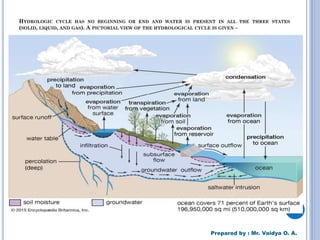
HYDROLOGIC CYCLE HAS NO BEGINNING OR END AND WATER IS PRESENT IN ALL THE THREE STATES
(SOLID, LIQUID, AND GAS). A PICTORIAL VIEW OF THE HYDROLOGICAL CYCLE IS GIVEN –
4
Prepared by : Mr. Vaidya O. A.
COMPONENTS OF HYDROLOGIC CYCLE
➢ The hydrologic cycle can be subdivided into three major
systems:
The oceans being the major reservoir and source of
water, the Atmosphere functioning as the carrier and
deliverer of water and the land as the user of water.
➢ The major components of the hydrologic cycle are
(i) precipitation (rainfall, snowfall, hale, sleet, fog, dew, drizzle
etc.),
(ii) interception, (iii) depression storage,
(iv) evaporation, transpiration,
(v) infiltration, percolation, moisture storage in the
unsaturated zone,
(vi) and runoff (surface runoff, interflow, and base flow).
5
Prepared by : Mr. Vaidya O. A.
APPLICATIONS OF HYDROLOGY
1. Design of Hydraulic Structures: - Structures such
as bridges, causeways, dams, spillways etc. are in
contact with water.
Accurate hydrological predictions are necessary
for their proper functioning.
Due to a storm, the flow below a bridge has to be
properly predicted. Improper prediction may cause failure
of the structure.
Similarly the spillway in case of a dam which is
meant for disposing excess water in a dam should also be
designed properly otherwise flooding water may overtop
the dam.
6
Prepared by : Mr. Vaidya O. A.
2. Municipal and Industrial Water supply: -
Growth of towns and cities and also industries around
them is often dependent on fresh water availability in
their vicinity. Water should be drawn from rivers,
streams, ground water.
Proper estimation of water resources in a
place will help planning and implementation of
facilities for municipal (domestic) and industrial water
supply.
7
Prepared by : Mr. Vaidya O. A.
3. Irrigation: - Dams are constructed to store water for
multiple uses. For estimating maximum storage
capacity, seepage, evaporation and other losses should be
properly estimated.
These can be done with proper understanding of
hydrology of a given river basin and thus making the
irrigation project a successful one. Artificial
recharge will also increase ground water storage. It has
been estimated that ground water potential of Gangetic
basin is 40 times more than its surface flow.
8
Prepared by : Mr. Vaidya O. A.
4. Hydroelectric Power Generation: - A hydroelectric
power plant need continuous water supply without much
variations in the stream flow. Variations will affect the
functioning of turbines in the electric plant.
Hence proper estimation of river flow and also
flood occurrences will help to construct efficient
balancing reservoirs and these will supply water to
turbines at a constant rate.
9
Prepared by : Mr. Vaidya O. A.
5. Flood control in rivers: - Controlling floods in a
river is a complicated task. The flow occurring due to a
storm can be predicted if the catchment characteristics
are properly known.
In many cases damages due to floods are high.
Joint work of hydrologist and meteorologists in
threatening areas may reduce damage due to floods.
Flood prone zones maybe demarked to avoid losses.
10
Prepared by : Mr. Vaidya O. A.
6. Navigation: - Big canals in an irrigation scheme can
be used for inland navigation. The depth of water should
be maintained at a constant level.
This can be achieved by lock gates provided and
proper draft to be maintained. If the river water contains
sediments, they will settle in the channel and cause
problems for navigation. Hence the catchment
characteristics should be considered and sediment entry
into the canals should be done.
11
Prepared by : Mr. Vaidya O. A.
7. Pollution control: - It is an easy way to dispose
sewage generated in a city or town into streams and
rivers. If large stream flow is available compared to the
sewage discharge, pollution problems do not arise as
sewage gets diluted and flowing water also has self-
purifying capacity. The problem arises when each of the
flows are not properly estimated. In case sewage flow is
high it should be treated before disposal into a river or
stream.
12
Prepared by : Mr. Vaidya O. A.

Unit I_Introduction to Hydrology.pdf

  • 1.
  • 2.
    HYDROLOGY ➢ Hydrology maybe defined as applied science concerned with water of the Earth in all its states, their occurrences, distribution and circulation through the unending hydrologic cycle of precipitation, consequent runoff, stream flow, infiltration and storage, eventual evaporation and reprecipitation. ➢ Hydrology concerns itself with three forms of water – 1. Above land as atmospheric water or precipitation. 2. On land or surface as stored water or runoff 3. Below the land surface as ground water or percolation 2 Prepared by : Mr. Vaidya O. A.
  • 3.
    HYDROLOGIC CYCLE ➢ Hydrologiccycle was defined by the National Research Council (NRC, 1982) the as “the pathway of water as it moves in its various phases to the atmosphere, to the earth, over and through the land, to the ocean and back to the atmosphere”. ➢ Water can occur in three physical phases: solid, liquid, and gas and is found in nature in all these phases in large quantities. ➢ Depending upon the environment of the place of occurrence, water can quickly change its phase. ➢ A number of cycles are operating in nature, such as the carbon cycle, the nitrogen cycle, and several biogeochemical cycles. ➢ The Hydrologic Cycle, also known as the water cycle, is one such cycle which forms the fundamental concept in hydrology. ground water or percolation 3 Prepared by : Mr. Vaidya O. A.
  • 4.
    HYDROLOGIC CYCLE HASNO BEGINNING OR END AND WATER IS PRESENT IN ALL THE THREE STATES (SOLID, LIQUID, AND GAS). A PICTORIAL VIEW OF THE HYDROLOGICAL CYCLE IS GIVEN – 4 Prepared by : Mr. Vaidya O. A.
  • 5.
    COMPONENTS OF HYDROLOGICCYCLE ➢ The hydrologic cycle can be subdivided into three major systems: The oceans being the major reservoir and source of water, the Atmosphere functioning as the carrier and deliverer of water and the land as the user of water. ➢ The major components of the hydrologic cycle are (i) precipitation (rainfall, snowfall, hale, sleet, fog, dew, drizzle etc.), (ii) interception, (iii) depression storage, (iv) evaporation, transpiration, (v) infiltration, percolation, moisture storage in the unsaturated zone, (vi) and runoff (surface runoff, interflow, and base flow). 5 Prepared by : Mr. Vaidya O. A.
  • 6.
    APPLICATIONS OF HYDROLOGY 1.Design of Hydraulic Structures: - Structures such as bridges, causeways, dams, spillways etc. are in contact with water. Accurate hydrological predictions are necessary for their proper functioning. Due to a storm, the flow below a bridge has to be properly predicted. Improper prediction may cause failure of the structure. Similarly the spillway in case of a dam which is meant for disposing excess water in a dam should also be designed properly otherwise flooding water may overtop the dam. 6 Prepared by : Mr. Vaidya O. A.
  • 7.
    2. Municipal andIndustrial Water supply: - Growth of towns and cities and also industries around them is often dependent on fresh water availability in their vicinity. Water should be drawn from rivers, streams, ground water. Proper estimation of water resources in a place will help planning and implementation of facilities for municipal (domestic) and industrial water supply. 7 Prepared by : Mr. Vaidya O. A.
  • 8.
    3. Irrigation: -Dams are constructed to store water for multiple uses. For estimating maximum storage capacity, seepage, evaporation and other losses should be properly estimated. These can be done with proper understanding of hydrology of a given river basin and thus making the irrigation project a successful one. Artificial recharge will also increase ground water storage. It has been estimated that ground water potential of Gangetic basin is 40 times more than its surface flow. 8 Prepared by : Mr. Vaidya O. A.
  • 9.
    4. Hydroelectric PowerGeneration: - A hydroelectric power plant need continuous water supply without much variations in the stream flow. Variations will affect the functioning of turbines in the electric plant. Hence proper estimation of river flow and also flood occurrences will help to construct efficient balancing reservoirs and these will supply water to turbines at a constant rate. 9 Prepared by : Mr. Vaidya O. A.
  • 10.
    5. Flood controlin rivers: - Controlling floods in a river is a complicated task. The flow occurring due to a storm can be predicted if the catchment characteristics are properly known. In many cases damages due to floods are high. Joint work of hydrologist and meteorologists in threatening areas may reduce damage due to floods. Flood prone zones maybe demarked to avoid losses. 10 Prepared by : Mr. Vaidya O. A.
  • 11.
    6. Navigation: -Big canals in an irrigation scheme can be used for inland navigation. The depth of water should be maintained at a constant level. This can be achieved by lock gates provided and proper draft to be maintained. If the river water contains sediments, they will settle in the channel and cause problems for navigation. Hence the catchment characteristics should be considered and sediment entry into the canals should be done. 11 Prepared by : Mr. Vaidya O. A.
  • 12.
    7. Pollution control:- It is an easy way to dispose sewage generated in a city or town into streams and rivers. If large stream flow is available compared to the sewage discharge, pollution problems do not arise as sewage gets diluted and flowing water also has self- purifying capacity. The problem arises when each of the flows are not properly estimated. In case sewage flow is high it should be treated before disposal into a river or stream. 12 Prepared by : Mr. Vaidya O. A.