Govt. Engg. College Ajmer
SEMINAR
ON
“E-WASTE”
GUIDED BY:- SUBMITTED BY:-
Mr MUKESH GUPTA SHUBHAM GUPTA
VIII SEMESTER
12EC79
CONTENTS
1. What is e-waste ?
2. Sources of e-waste
3. Categories of e-waste
4. Composition of e-waste
5. Hazards associated with e-waste
6. E-waste scenario in India
7. State & City wise e-waste scenario
8. E-waste Disposal
9. Recycling of E-waste
10.Conclusion
E-waste ?
It may be defined as, computers, office electronic
equipment, entertainment devices & many other
electronic or electrical devices which are
unwanted, broken & discarded by their original
users are known as ‘E-Waste’ or ‘Electronic Waste’
E-waste
Sources of E-waste
Categories of E-Waste
 Large household appliances
 Small household appliances
 IT & Telecommunication equipment
 Consumer equipment
 Lighting equipment
 Electrical and electronic tools
 Toys and sport equipment
 Medical devices
 Monitoring and control instruments
 automatic dispensers
Gadgets,
Waste !!!
How these become E-Waste?
Reasons:-
 Advancement in technology
 Changes in Style, Fashion & Status
 Nearing the end of their useful life
 Not taking precautions while handling them
Composition of E-waste
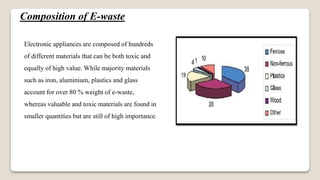
Electronic appliances are composed of hundreds
of different materials that can be both toxic and
equally of high value. While majority materials
such as iron, aluminium, plastics and glass
account for over 80 % weight of e-waste,
whereas valuable and toxic materials are found in
smaller quantities but are still of high importance.
Hazards associated with E-waste
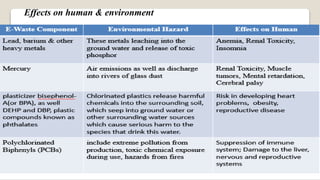
There are many harmful materials used in consumer
electronics include :
 Lead
 Mercury
 Cadmium
 Hexavalent chromium
 Plastic including PVC etc.
Effects on human & environment
E-waste scenario in India
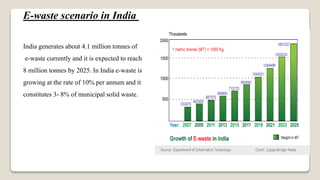
India generates about 4.1 million tonnes of
e-waste currently and it is expected to reach
8 million tonnes by 2025. In India e-waste is
growing at the rate of 10% per annum and it
constitutes 3- 8% of municipal solid waste.
State & City wise E-waste scenario
E-Waste Disposal
Methods of treatment & disposal
 Landfilling
 Incineration
 Pyrolysis
Existing E-Waste Management Practices in India
 Plastic Waste
Products made from plastics such as keyboards, casing, front or real panel.
Miscellaneous parts encased in plastics Management Practice - The shredding & melting
 Printed Circuit Board Waste
Used in electronic parts such as motherboard, TV internal circuits, etc.
Management Practice – De soldering & open burning to remove metals.
 Miscellaneous Waste
Chips, electronic wires, broken glass waste, copper containing waste.
Management Practice- Chemical stripping & open burning & some of the waste is mixed with the
municipal solid waste
 Liquid Waste
It contains internal chemicals, general waste, acid stripping waste. Management Practice
-Sewerage system
Recycling of E-Waste
 Disassembly/dismantling
Disassembly is the systematic removal of components, parts, a group of parts or a
subassembly from a product which is in E-Waste.
 Upgrading
It includes comminuting and separation of materials using mechanical / physical and/or
metallurgical processing. Methods to recover materials include incineration and refining.
 Materials Recovery
The material are recovered by recycling facilities. The plastic, glass, metals can be
recovered by sorting them before mixing with other waste.
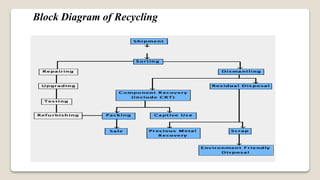
Block Diagram of Recycling
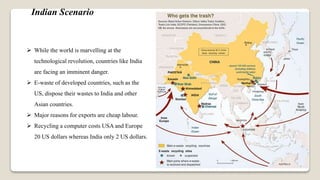
 While the world is marvelling at the
technological revolution, countries like India
are facing an imminent danger.
 E-waste of developed countries, such as the
US, dispose their wastes to India and other
Asian countries.
 Major reasons for exports are cheap labour.
 Recycling a computer costs USA and Europe
20 US dollars whereas India only 2 US dollars.
Indian Scenario
Advantages of Recycling E-Waste
• Asset recovery
• Reduction of need for landfills
• Reduction of junks and clutters
• Resale and Reuse
• Creation of jobs
CONCLUSION
1. As far as e-waste is concerned, it has emerged as one of the fastest growing waste streams world
wide today.
2. Electronic equipment is one of the largest know sources of heavy metals without effective
collection, reuse, and recycling systems, they will be dangerous to environment
3. Reuse and recycling of electronic equipment is a beneficial alternative than disposal
4. Product design by using safe and environment friendly raw materials and most emerging
technologies
THANK YOU

E waste ppt seminar

  • 1.
    Govt. Engg. CollegeAjmer SEMINAR ON “E-WASTE” GUIDED BY:- SUBMITTED BY:- Mr MUKESH GUPTA SHUBHAM GUPTA VIII SEMESTER 12EC79
  • 2.
    CONTENTS 1. What ise-waste ? 2. Sources of e-waste 3. Categories of e-waste 4. Composition of e-waste 5. Hazards associated with e-waste 6. E-waste scenario in India 7. State & City wise e-waste scenario 8. E-waste Disposal 9. Recycling of E-waste 10.Conclusion
  • 3.
    E-waste ? It maybe defined as, computers, office electronic equipment, entertainment devices & many other electronic or electrical devices which are unwanted, broken & discarded by their original users are known as ‘E-Waste’ or ‘Electronic Waste’ E-waste
  • 4.
  • 5.
    Categories of E-Waste Large household appliances  Small household appliances  IT & Telecommunication equipment  Consumer equipment  Lighting equipment  Electrical and electronic tools  Toys and sport equipment  Medical devices  Monitoring and control instruments  automatic dispensers
  • 6.
  • 7.
    How these becomeE-Waste? Reasons:-  Advancement in technology  Changes in Style, Fashion & Status  Nearing the end of their useful life  Not taking precautions while handling them
  • 8.
    Composition of E-waste Electronicappliances are composed of hundreds of different materials that can be both toxic and equally of high value. While majority materials such as iron, aluminium, plastics and glass account for over 80 % weight of e-waste, whereas valuable and toxic materials are found in smaller quantities but are still of high importance.
  • 9.
    Hazards associated withE-waste There are many harmful materials used in consumer electronics include :  Lead  Mercury  Cadmium  Hexavalent chromium  Plastic including PVC etc.
  • 10.
    Effects on human& environment
  • 11.
    E-waste scenario inIndia India generates about 4.1 million tonnes of e-waste currently and it is expected to reach 8 million tonnes by 2025. In India e-waste is growing at the rate of 10% per annum and it constitutes 3- 8% of municipal solid waste.
  • 12.
    State & Citywise E-waste scenario
  • 13.
    E-Waste Disposal Methods oftreatment & disposal  Landfilling  Incineration  Pyrolysis Existing E-Waste Management Practices in India  Plastic Waste Products made from plastics such as keyboards, casing, front or real panel. Miscellaneous parts encased in plastics Management Practice - The shredding & melting
  • 14.
     Printed CircuitBoard Waste Used in electronic parts such as motherboard, TV internal circuits, etc. Management Practice – De soldering & open burning to remove metals.  Miscellaneous Waste Chips, electronic wires, broken glass waste, copper containing waste. Management Practice- Chemical stripping & open burning & some of the waste is mixed with the municipal solid waste  Liquid Waste It contains internal chemicals, general waste, acid stripping waste. Management Practice -Sewerage system
  • 15.
    Recycling of E-Waste Disassembly/dismantling Disassembly is the systematic removal of components, parts, a group of parts or a subassembly from a product which is in E-Waste.  Upgrading It includes comminuting and separation of materials using mechanical / physical and/or metallurgical processing. Methods to recover materials include incineration and refining.  Materials Recovery The material are recovered by recycling facilities. The plastic, glass, metals can be recovered by sorting them before mixing with other waste.
  • 16.
  • 17.
     While theworld is marvelling at the technological revolution, countries like India are facing an imminent danger.  E-waste of developed countries, such as the US, dispose their wastes to India and other Asian countries.  Major reasons for exports are cheap labour.  Recycling a computer costs USA and Europe 20 US dollars whereas India only 2 US dollars. Indian Scenario
  • 18.
    Advantages of RecyclingE-Waste • Asset recovery • Reduction of need for landfills • Reduction of junks and clutters • Resale and Reuse • Creation of jobs
  • 19.
    CONCLUSION 1. As faras e-waste is concerned, it has emerged as one of the fastest growing waste streams world wide today. 2. Electronic equipment is one of the largest know sources of heavy metals without effective collection, reuse, and recycling systems, they will be dangerous to environment 3. Reuse and recycling of electronic equipment is a beneficial alternative than disposal 4. Product design by using safe and environment friendly raw materials and most emerging technologies
  • 20.