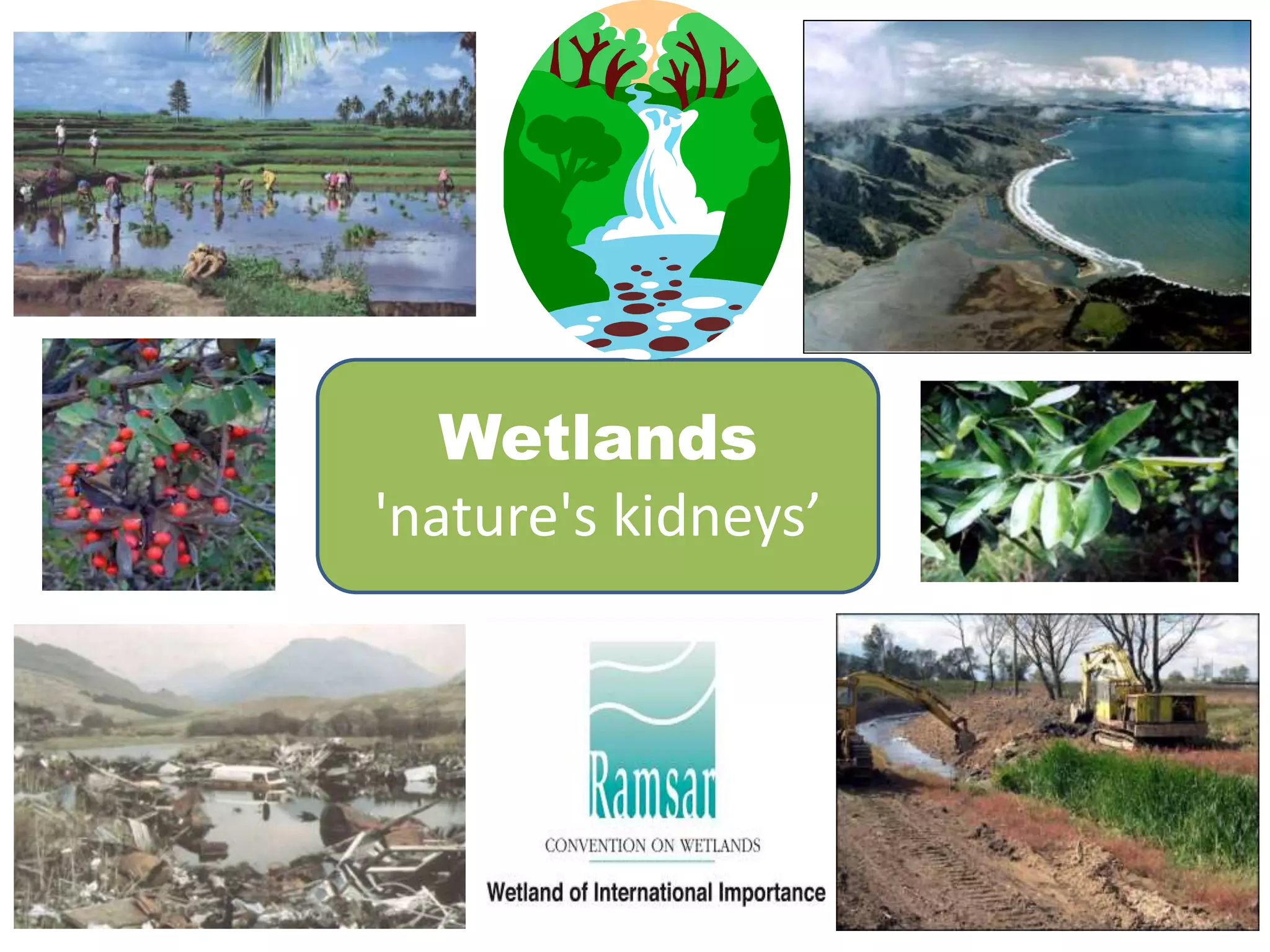
Wetlands 
'nature's kidneys’
 Definition of wetland(s) 
-Lands covered with water all or part of a year 
-Interface between Terrestrial and aquatic ecosystems 
- They have been called as 'nature's kidneys’ 
 Characteristics of wetlands 
• There are three characteristics that describe a wetland: 
1. Hydrology 
– There must be water at or near the surface of the land for a 
designated amount of time. 
2. Soils 
– Must be hydric or saturated with water to create an anaerobic 
(oxygen-free environment). 
3. Plants 
– Must be “wetland plants,” meaning that they require lots of 
water and the anaerobic conditions that the hydric soil creates. 
(Smith & Smith, 2001)
Hydrology 
Two components of hydrology 
1. Physical 
Characteristics 
– Precipitation, surface 
and subsurface flow, 
direction, chemistry, 
and kinetic energy of 
the water. 
2. Hydroperiod 
– Duration, frequency, 
depth, and flood 
season
Classification of wetland on the basis of hydrology 
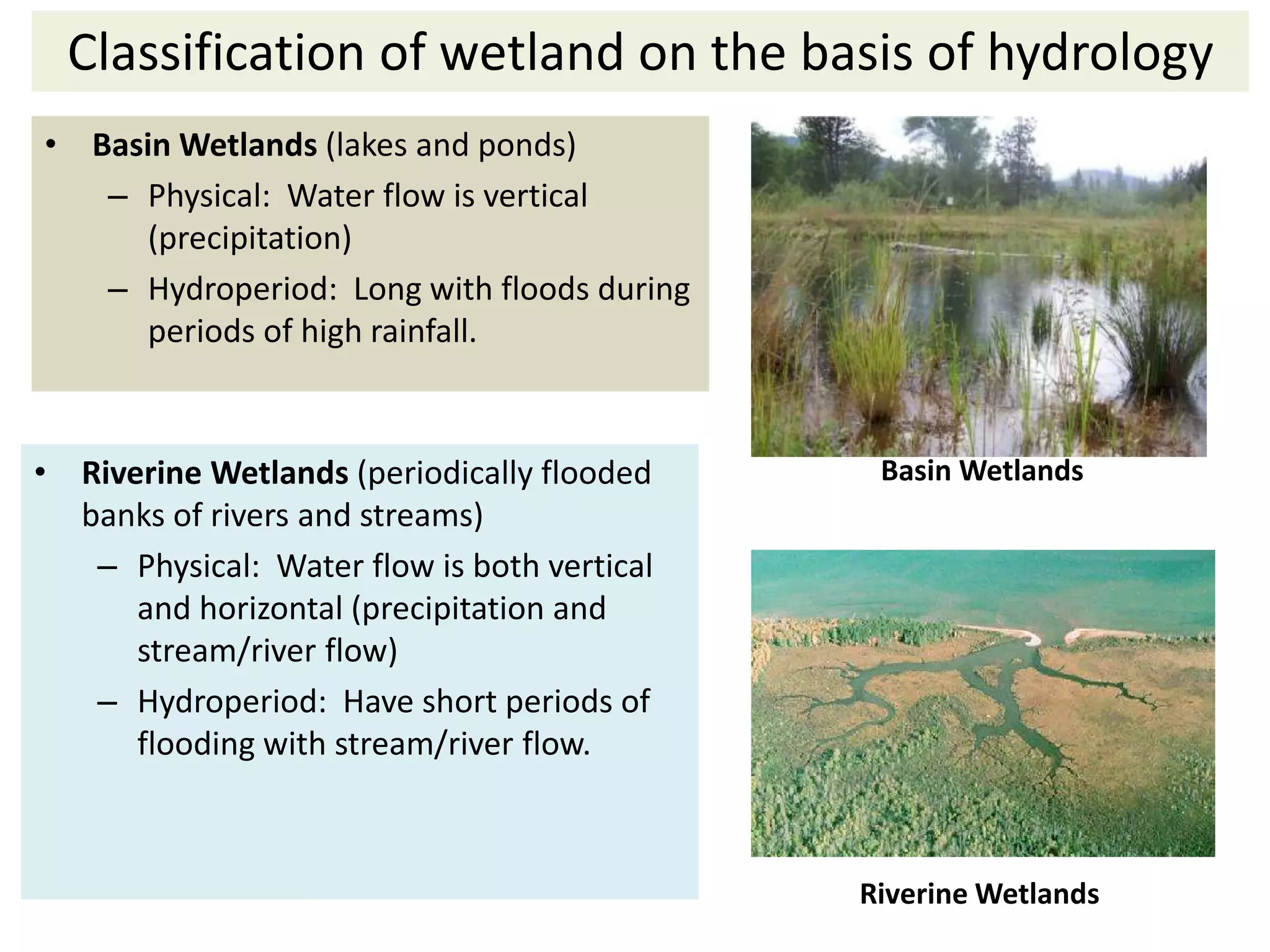
• Basin Wetlands (lakes and ponds) 
– Physical: Water flow is vertical 
(precipitation) 
– Hydroperiod: Long with floods during 
periods of high rainfall. 
• Riverine Wetlands (periodically flooded 
banks of rivers and streams) 
– Physical: Water flow is both vertical 
and horizontal (precipitation and 
stream/river flow) 
– Hydroperiod: Have short periods of 
flooding with stream/river flow. 
Basin Wetlands 
Riverine Wetlands
Classification of wetland on the basis of hydrology 
• Fringe Wetlands (along 
coastal areas of large lakes 
and oceans) 
– Physical: Water flow is 
both vertical and 
horizontal (precipitation 
and tidal flow) 
– Hydroperiod: May be 
short and regular. Is not 
seasonal like basin 
wetlands.
Three types of soils 
1. Sandy soils 
– Contain mineral grains ranging from 0.05-2 mm 
in diameter. 
2. Silt soils 
– Soils that have grains ranging from 0.002-0.05 
mm in diameter. 
3. Clay soils 
– Contain mineral grains smaller than 0.002 mm in 
diameter. 
Soil
Soil Properties 
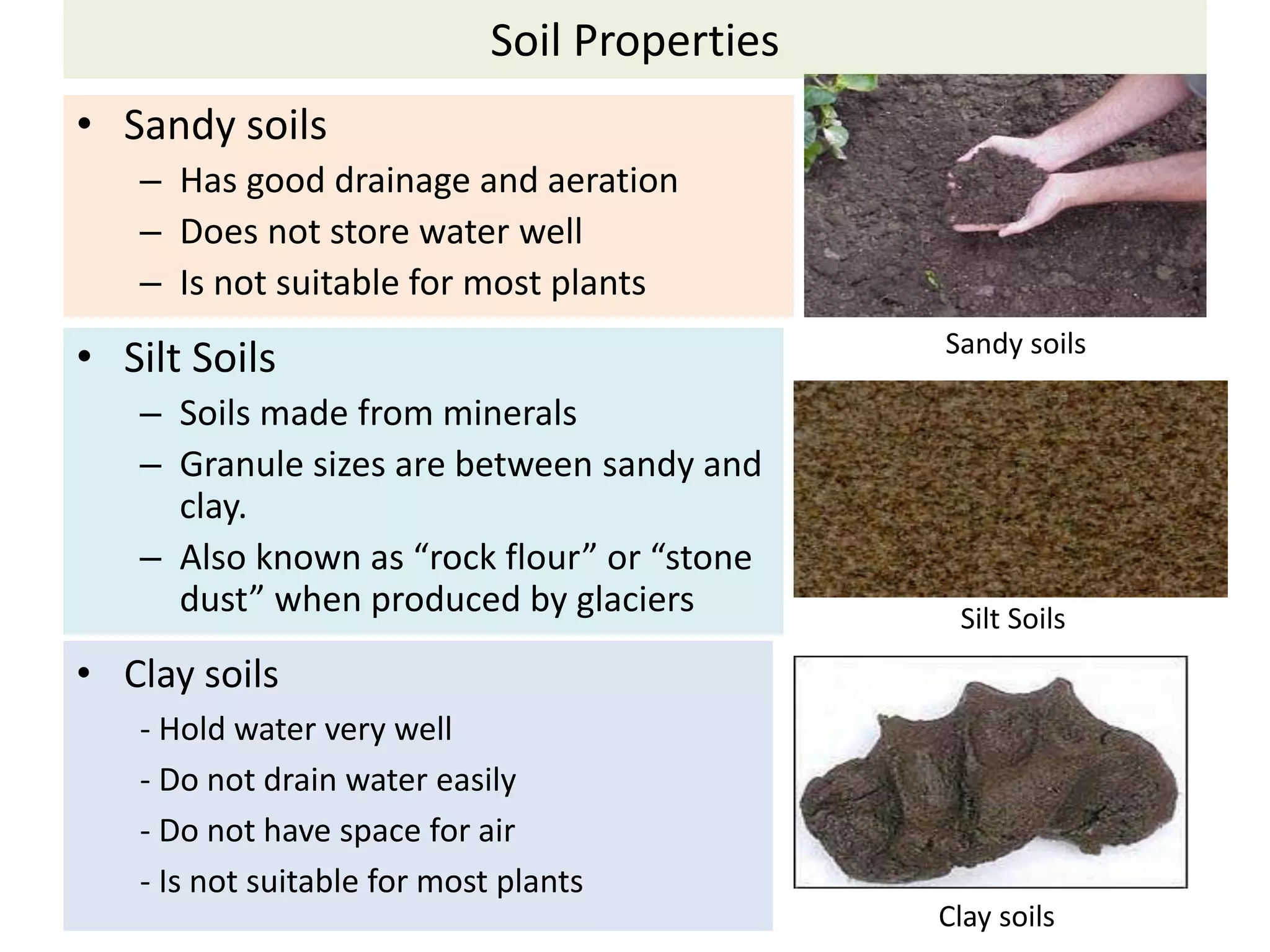
• Sandy soils 
– Has good drainage and aeration 
– Does not store water well 
– Is not suitable for most plants 
• Silt Soils 
– Soils made from minerals 
– Granule sizes are between sandy and 
clay. 
– Also known as “rock flour” or “stone 
dust” when produced by glaciers 
• Clay soils 
- Hold water very well 
- Do not drain water easily 
- Do not have space for air 
- Is not suitable for most plants 
Sandy soils 
Silt Soils 
Clay soils
Wetland Plants 
Native vs. Exotic 
• If a plant is native to a particular area, then it is 
originally from that area 
– Native plants provide food and habitat for native animals. 
Without this, the native animals may be forced to migrate to 
areas. 
– Native plants also keep local genes viable and in the gene 
pool. 
• Exotic plants were not originally in the area and have 
been carried to the area in some way. 
– Exotic plants can become invasive where they dominate the 
ecosystem preventing opportunities for growth for the native 
plants. 
– Exotic plants also out grow native plants because they have no 
native predators. 
– Invasive exotic species are the second leading cause of native 
species extinction (habitat loss being number one).
Benefits of Aquatic Plants 
• Primary Production 
– Wildlife Food 
– Oxygen Production 
• Shelter 
– Protection from predation for small fish 
• Fish Spawning 
– Several fish attach eggs to aquatic macrophytes 
– Some fish build nests in plant beds 
• Water Treatment 
– Wetland plants are very effective at removing 
nitrogen and phosphorous from polluted waters 
Phytoremediation
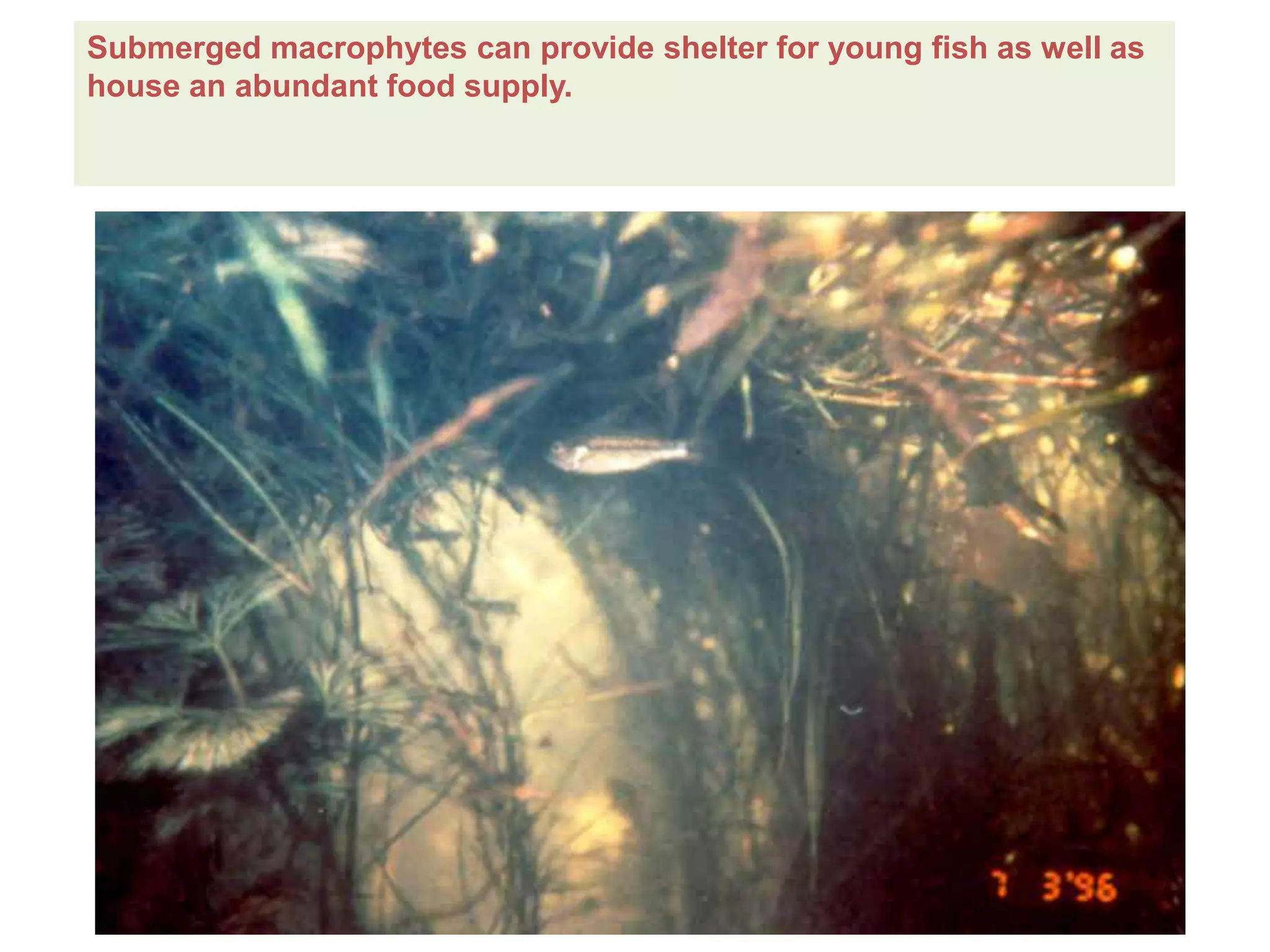
Submerged macrophytes can provide shelter for young fish as well as 
house an abundant food supply.
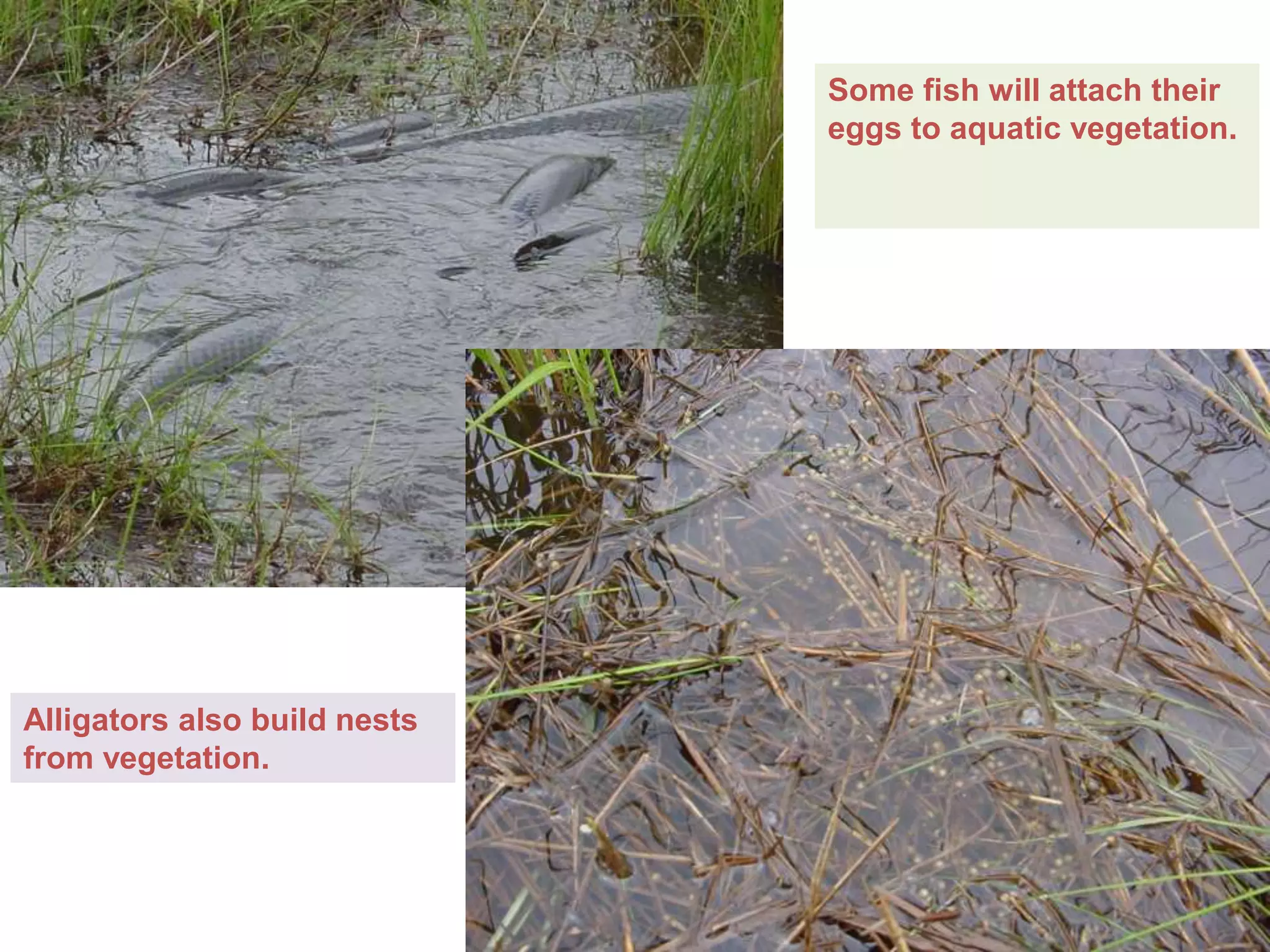
Some fish will attach their 
eggs to aquatic vegetation. 
Alligators also build nests 
from vegetation.
Wetland Life – The Protists 
• One celled organisms (algae, bacteria) 
– Often have to deal with a lack of oxygen 
• Desulfovibrio – genus of bacteria that can 
use sulfur, in place of oxygen, as a final 
electron acceptor 
– Produces sulfides (rotten-egg smell) 
• Other bacteria important in nutrient cycling 
– Denitrification
Phytoplankton 
• Single celled 
• Base of aquatic food web 
• Oxygen production 
Photosynthesis: 
Solar Energy + CO2 + H20  C6H12O2 + O2 
CO2 + H20  H2CO3 
 H+ + HCO3 
-  2H+ + CO3 
2- 
As CO2 is removed from the water pH increases.
General Types of Aquatic Macrophytes 
• Submergent – Plants that grow entirely under water. Most are 
rooted at the bottom and some may have flowers that extend 
above the water surface. 
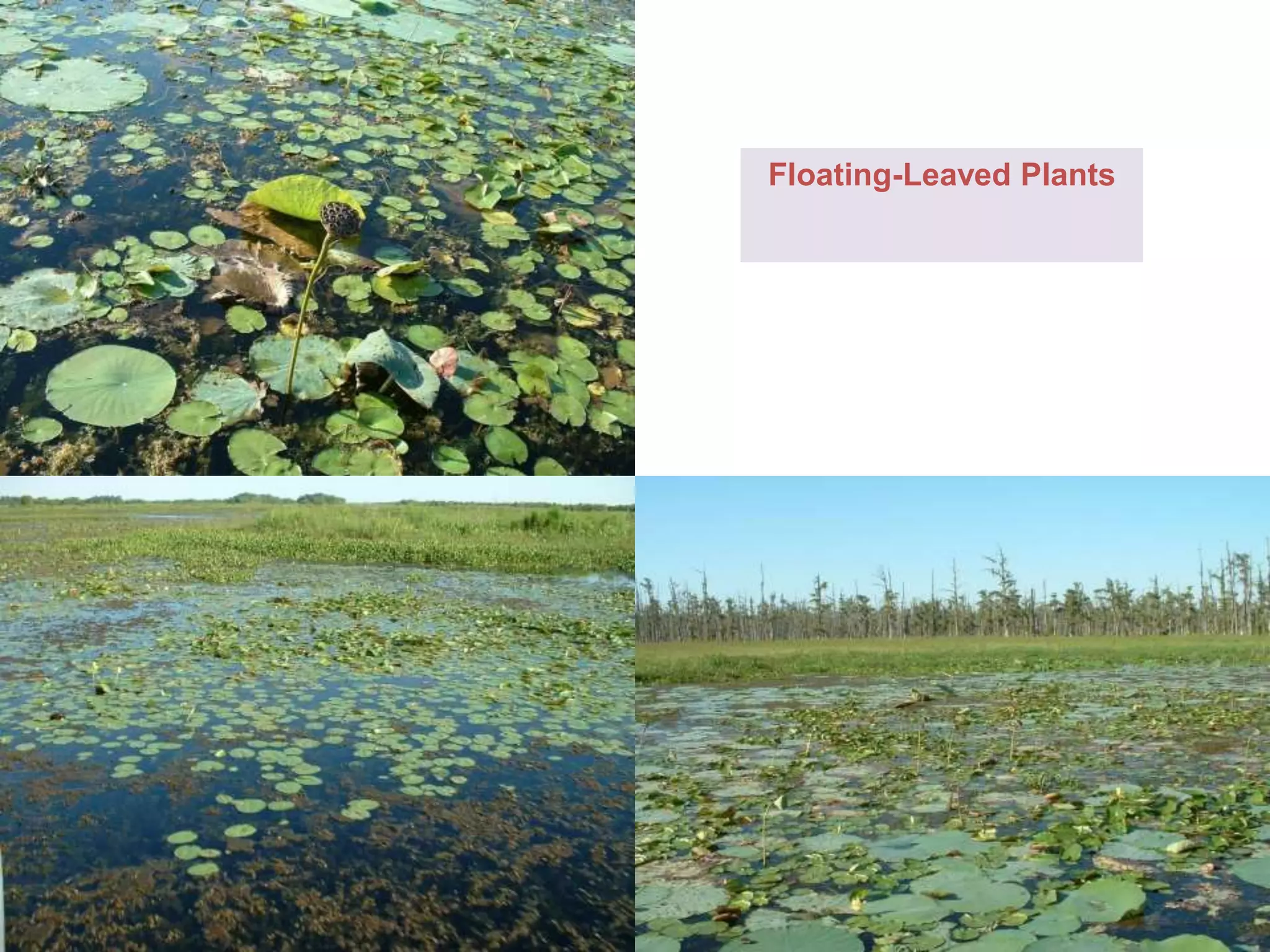
• Floating-leaved – Plants rooted to the bottom with leaves that 
float on the water surface. Flowers are normally above water. 
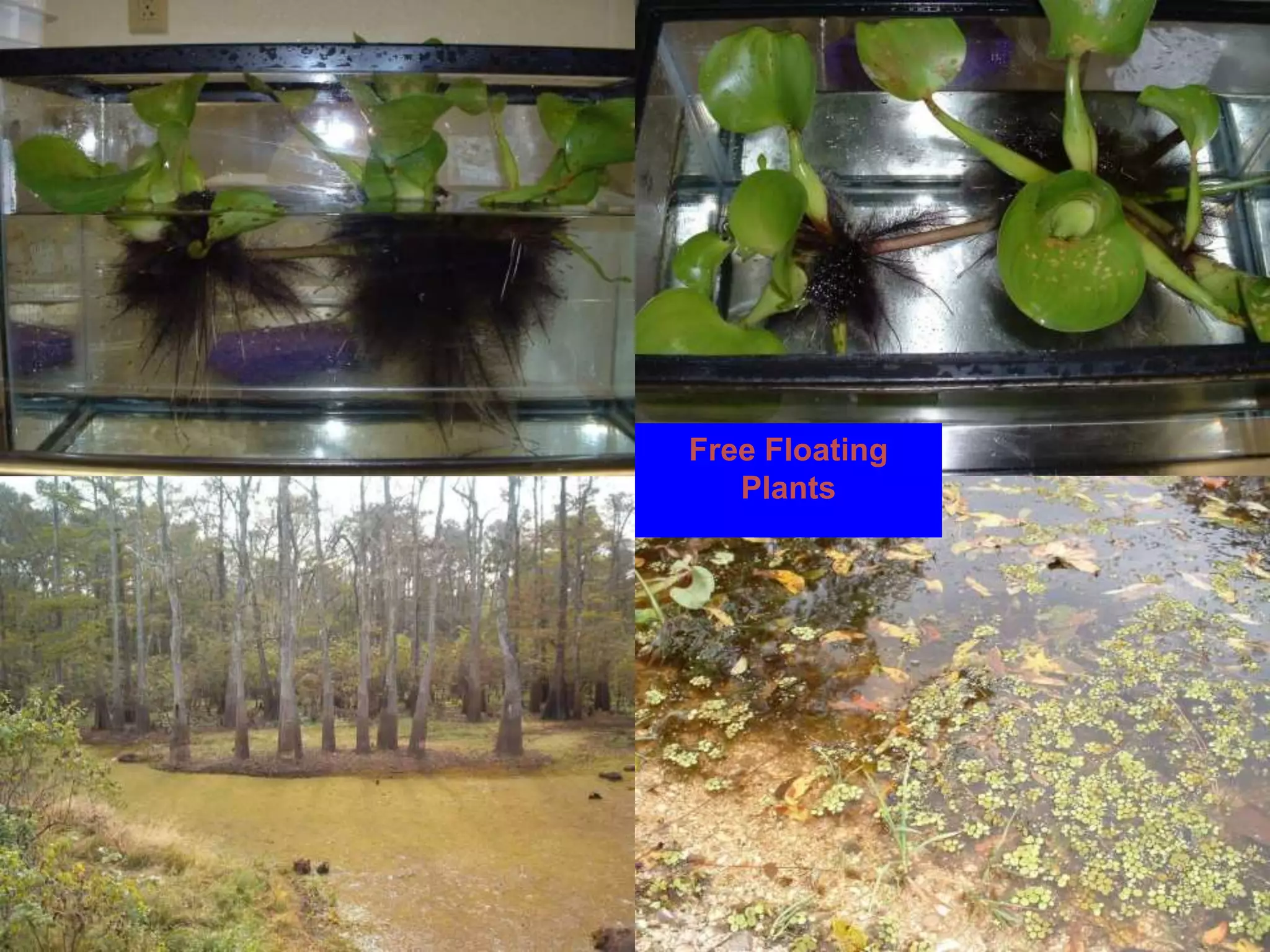
• Free Floating – Plants not rooted to the bottom and float on the 
surface. 
• Emergent – herbaceous or woody plants that have the majority 
of their vegetative parts above the surface of the water.
Floating-Leaved Plants
Free Floating 
Plants
Emergent 
Plants
Human-made wetlands 
– Aquaculture ponds (e.g., fish/shrimp); 
– Irrigated land (rice fields); 
– Seasonally flooded agricultural 
land (pastures); 
– Salt exploitation sites; 
– Water storage areas; 
– Excavations (gravel/brick/ 
clay pits); 
– Canals and drainage channels; 
– Wastewater treatment areas;
Description of some wetlands 
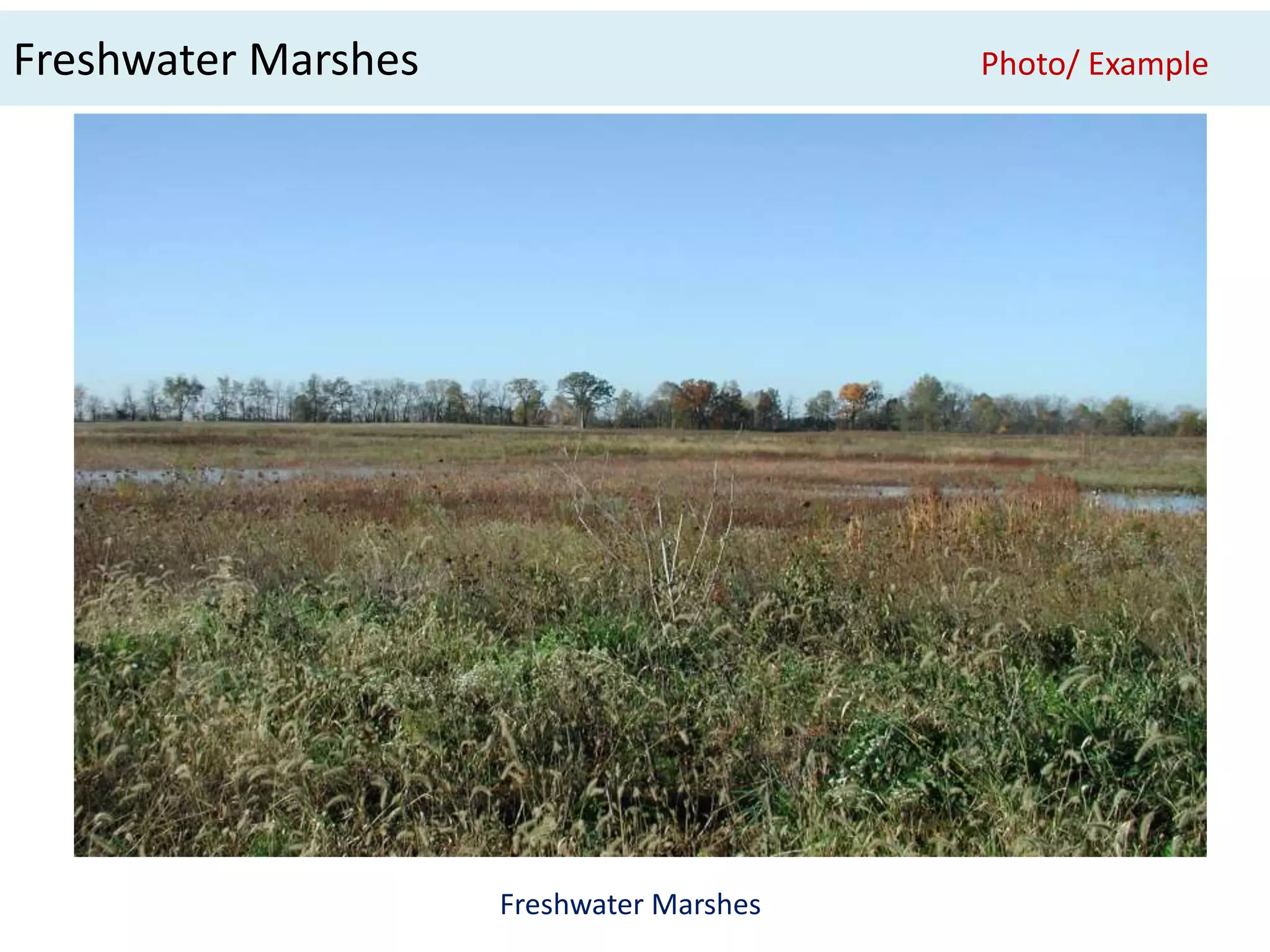
Freshwater Marshes 
• Very diverse group 
• Non-tidal, freshwater systems 
• Dominated by grasses, sedges, and other 
freshwater emergent hydrophytes (non-forested) 
• High productivity 
• Approximately 20% of world’s wetlands
Freshwater Marshes Photo/ Example 
Freshwater Marshes
Chemical Functions of Wetlands 
• Pollution Interception 
– Nutrient uptake by plants 
– Settle in anaerobic soil and become reduced 
– Processed by bacterial action 
• Toxic Residue Processing 
– Buried and neutralized in soils, taken up by 
plants, reduced through ion exchange 
– Large-scale / long-term additions can exceed a 
wetland’s capacity 
– Some chemicals can become more dangerous 
in wetlands (Mercury)
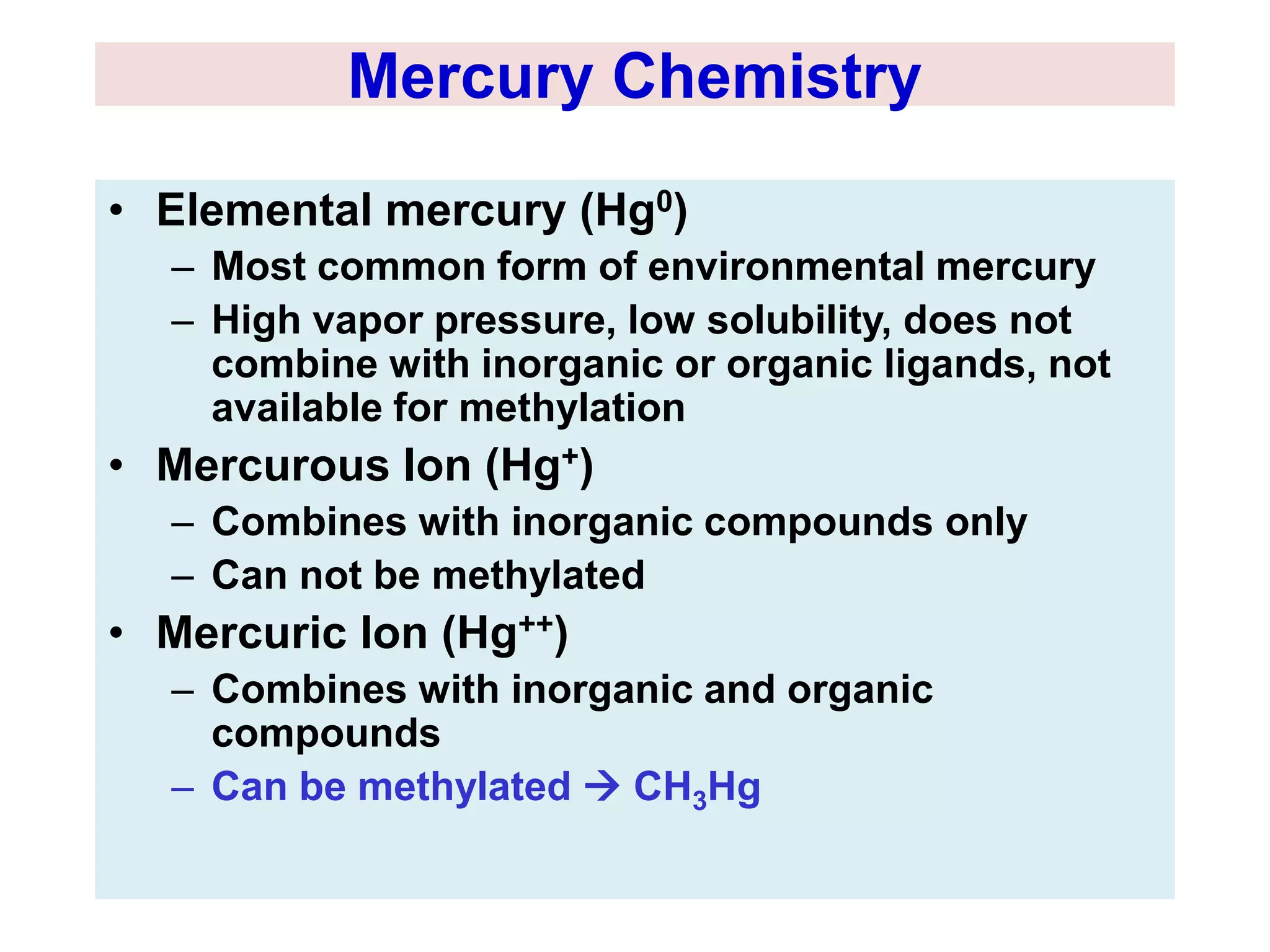
Mercury Chemistry 
• Elemental mercury (Hg0) 
– Most common form of environmental mercury 
– High vapor pressure, low solubility, does not 
combine with inorganic or organic ligands, not 
available for methylation 
• Mercurous Ion (Hg+) 
– Combines with inorganic compounds only 
– Can not be methylated 
• Mercuric Ion (Hg++) 
– Combines with inorganic and organic 
compounds 
– Can be methylated  CH3Hg
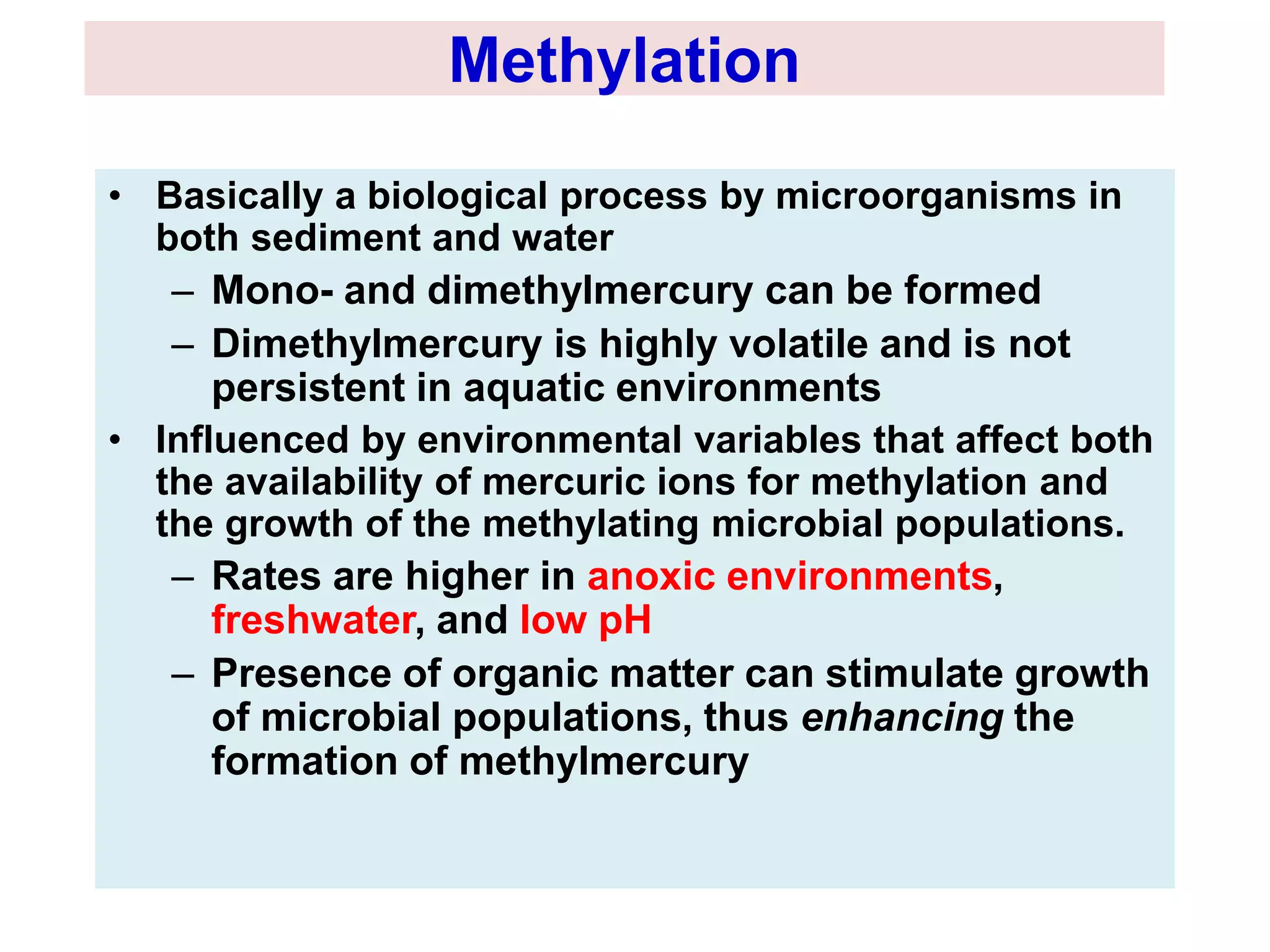
Methylation 
• Basically a biological process by microorganisms in 
both sediment and water 
– Mono- and dimethylmercury can be formed 
– Dimethylmercury is highly volatile and is not 
persistent in aquatic environments 
• Influenced by environmental variables that affect both 
the availability of mercuric ions for methylation and 
the growth of the methylating microbial populations. 
– Rates are higher in anoxic environments, 
freshwater, and low pH 
– Presence of organic matter can stimulate growth 
of microbial populations, thus enhancing the 
formation of methylmercury
Methylmercury Bioaccumulation 
• Mercury is accumulated by fish, invertebrates, 
mammals, and aquatic plants. 
• Inorganic mercury is the dominate environmental 
form of mercury, it is depurated about as fast as it is 
taken up so it does not accumulate. 
• Methylmercury can accumulate quickly but depurates 
slowly, so it accumulates 
– Also biomagnifies 
• Percentage of methylmercury increases with 
organism’s age.
Chemical Functions of Wetlands 
• Waste Treatment 
• High rate of biological activity 
• Can consume a lot of waste 
• Heavy deposition of sediments that bury waste 
• High level of bacterial activity that breaks down and 
neutralizes waste 
• Several cities have begun to use wetlands for waste treatment
Biological Functions of Wetlands 
• Biological Production 
– 6.4% of the Earth’s surface  24% of total 
global productivity 
– Detritus based food webs 
• Habitat 
– 80% of all breeding bird populations along with 
>50% of the protected migratory bird species 
rely on wetlands at some point in their life 
– 95% of all U.S. commercial fish and shellfish 
species depends on wetlands to some extent
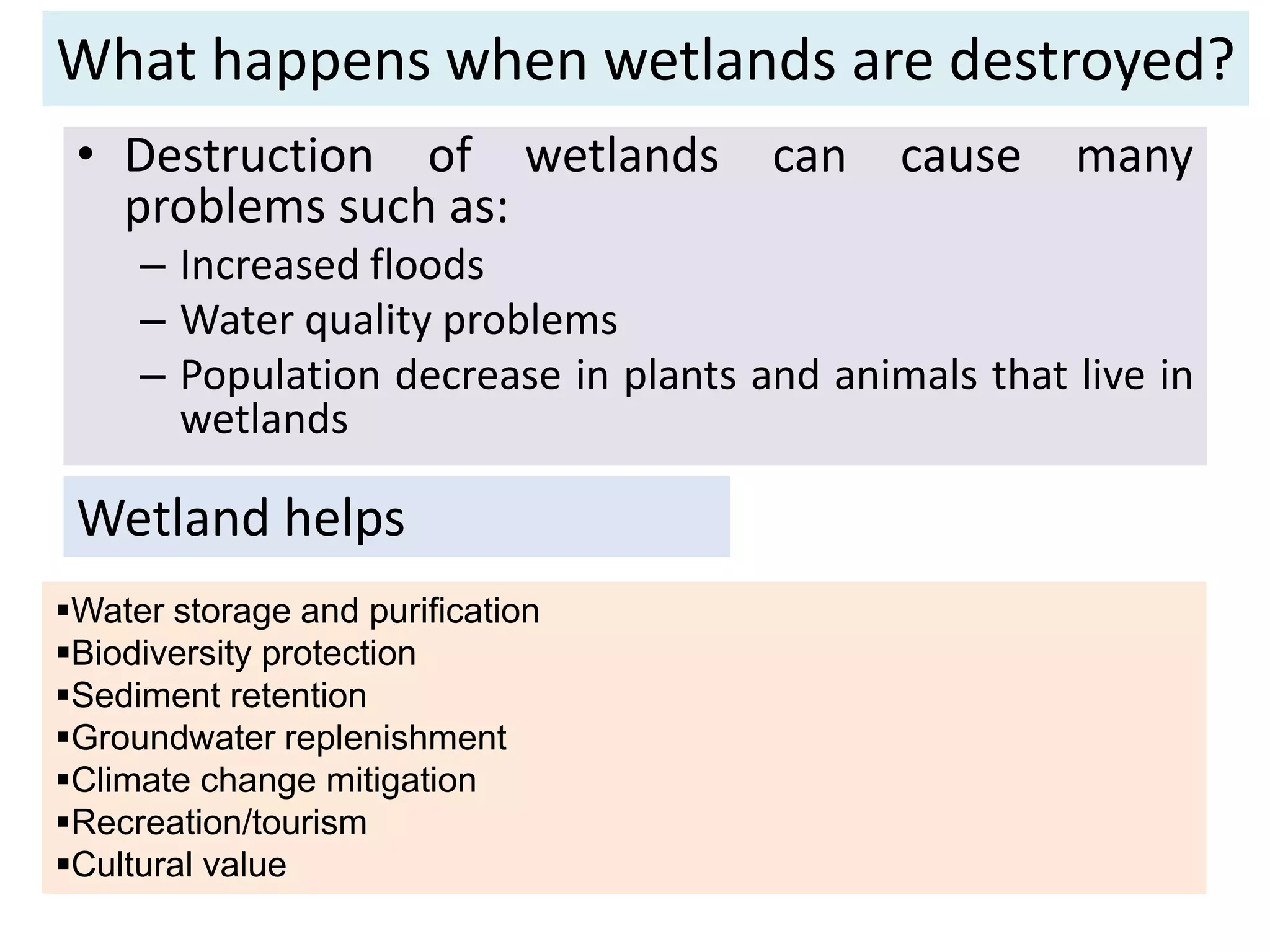
What happens when wetlands are destroyed? 
• Destruction of wetlands can cause many 
problems such as: 
– Increased floods 
– Water quality problems 
– Population decrease in plants and animals that live in 
wetlands 
Wetland helps 
Water storage and purification 
Biodiversity protection 
Sediment retention 
Groundwater replenishment 
Climate change mitigation 
Recreation/tourism 
Cultural value
Loss of wetlands 
• Building of dams 
• Channelization of riverbeds 
• Overexploitation of wetlands resources 
• Introduction of invasive species 
• Developmental activities and population pressure 
• Water pollution and dumping of waste 
• We have lost an estimated 50% of our 
original wetlands in the world.
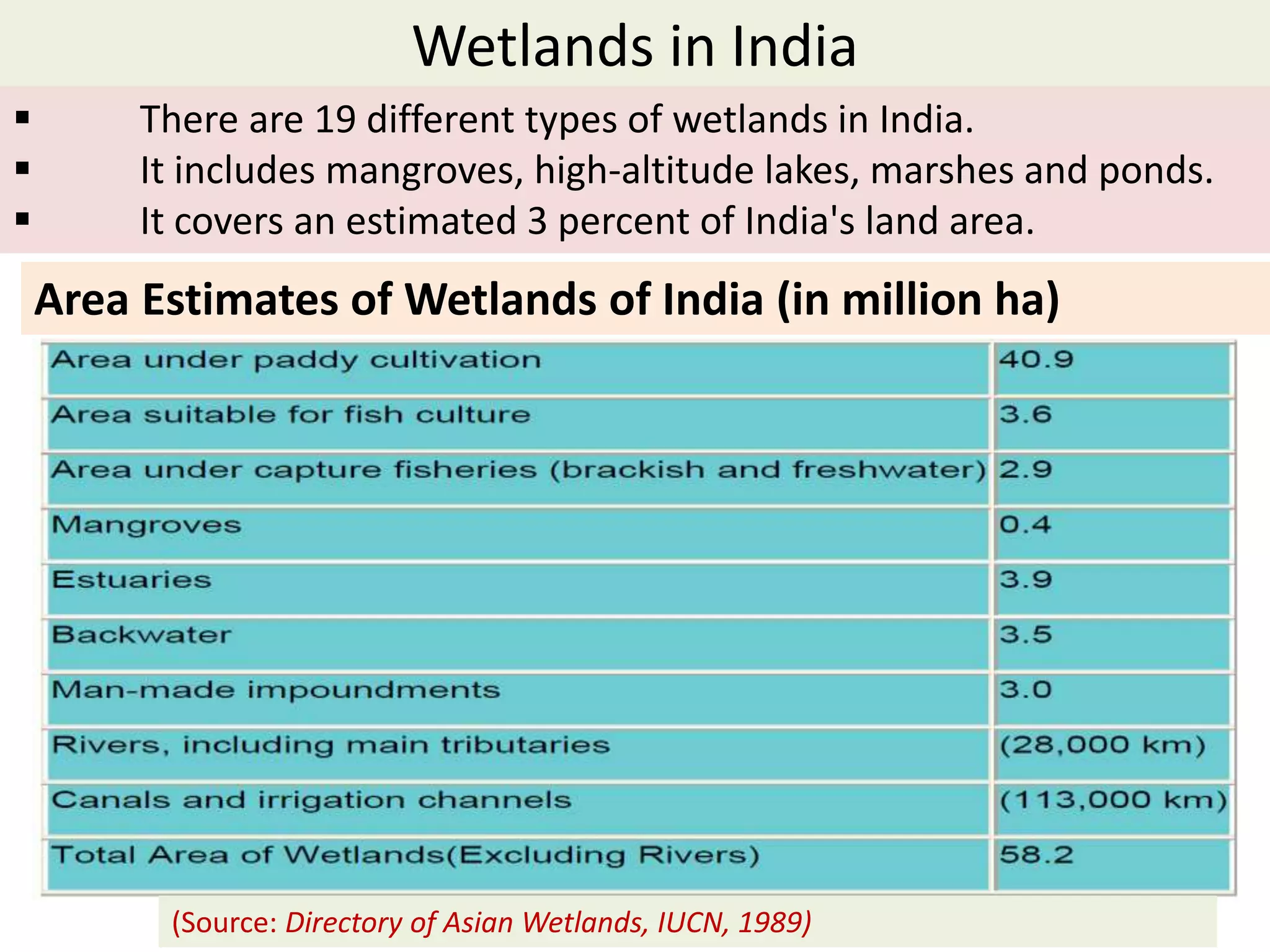
Wetlands in India 
 There are 19 different types of wetlands in India. 
 It includes mangroves, high-altitude lakes, marshes and ponds. 
 It covers an estimated 3 percent of India's land area. 
Area Estimates of Wetlands of India (in million ha) 
(Source: Directory of Asian Wetlands, IUCN, 1989)
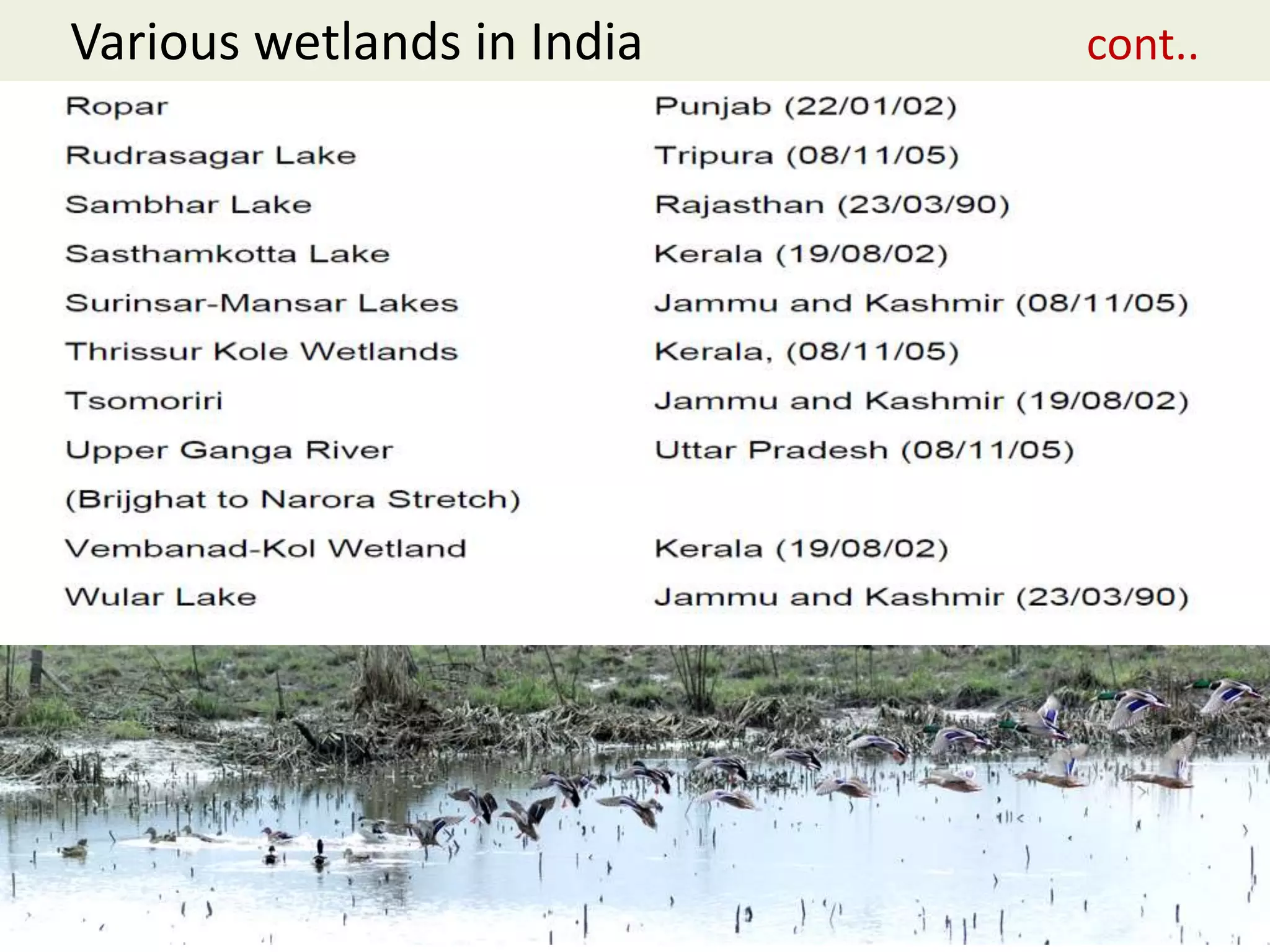
Various wetlands in India
Various wetlands in India cont..
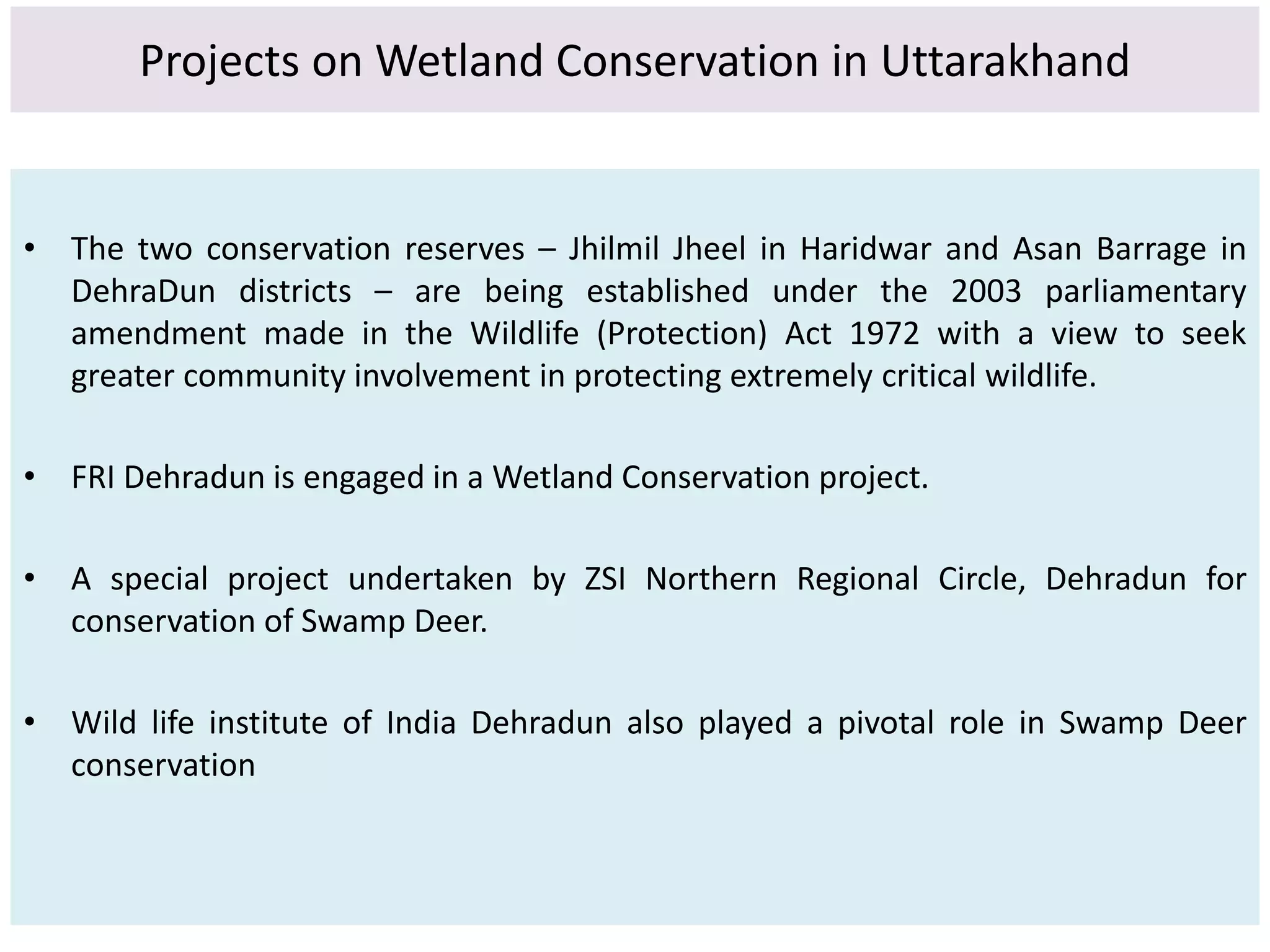
Projects on Wetland Conservation in Uttarakhand 
• The two conservation reserves – Jhilmil Jheel in Haridwar and Asan Barrage in 
DehraDun districts – are being established under the 2003 parliamentary 
amendment made in the Wildlife (Protection) Act 1972 with a view to seek 
greater community involvement in protecting extremely critical wildlife. 
• FRI Dehradun is engaged in a Wetland Conservation project. 
• A special project undertaken by ZSI Northern Regional Circle, Dehradun for 
conservation of Swamp Deer. 
• Wild life institute of India Dehradun also played a pivotal role in Swamp Deer 
conservation
THANK YOU

Wetlands bp

  • 1.
  • 2.
     Definition ofwetland(s) -Lands covered with water all or part of a year -Interface between Terrestrial and aquatic ecosystems - They have been called as 'nature's kidneys’  Characteristics of wetlands • There are three characteristics that describe a wetland: 1. Hydrology – There must be water at or near the surface of the land for a designated amount of time. 2. Soils – Must be hydric or saturated with water to create an anaerobic (oxygen-free environment). 3. Plants – Must be “wetland plants,” meaning that they require lots of water and the anaerobic conditions that the hydric soil creates. (Smith & Smith, 2001)
  • 3.
    Hydrology Two componentsof hydrology 1. Physical Characteristics – Precipitation, surface and subsurface flow, direction, chemistry, and kinetic energy of the water. 2. Hydroperiod – Duration, frequency, depth, and flood season
  • 4.
    Classification of wetlandon the basis of hydrology • Basin Wetlands (lakes and ponds) – Physical: Water flow is vertical (precipitation) – Hydroperiod: Long with floods during periods of high rainfall. • Riverine Wetlands (periodically flooded banks of rivers and streams) – Physical: Water flow is both vertical and horizontal (precipitation and stream/river flow) – Hydroperiod: Have short periods of flooding with stream/river flow. Basin Wetlands Riverine Wetlands
  • 5.
    Classification of wetlandon the basis of hydrology • Fringe Wetlands (along coastal areas of large lakes and oceans) – Physical: Water flow is both vertical and horizontal (precipitation and tidal flow) – Hydroperiod: May be short and regular. Is not seasonal like basin wetlands.
  • 6.
    Three types ofsoils 1. Sandy soils – Contain mineral grains ranging from 0.05-2 mm in diameter. 2. Silt soils – Soils that have grains ranging from 0.002-0.05 mm in diameter. 3. Clay soils – Contain mineral grains smaller than 0.002 mm in diameter. Soil
  • 7.
    Soil Properties •Sandy soils – Has good drainage and aeration – Does not store water well – Is not suitable for most plants • Silt Soils – Soils made from minerals – Granule sizes are between sandy and clay. – Also known as “rock flour” or “stone dust” when produced by glaciers • Clay soils - Hold water very well - Do not drain water easily - Do not have space for air - Is not suitable for most plants Sandy soils Silt Soils Clay soils
  • 8.
    Wetland Plants Nativevs. Exotic • If a plant is native to a particular area, then it is originally from that area – Native plants provide food and habitat for native animals. Without this, the native animals may be forced to migrate to areas. – Native plants also keep local genes viable and in the gene pool. • Exotic plants were not originally in the area and have been carried to the area in some way. – Exotic plants can become invasive where they dominate the ecosystem preventing opportunities for growth for the native plants. – Exotic plants also out grow native plants because they have no native predators. – Invasive exotic species are the second leading cause of native species extinction (habitat loss being number one).
  • 9.
    Benefits of AquaticPlants • Primary Production – Wildlife Food – Oxygen Production • Shelter – Protection from predation for small fish • Fish Spawning – Several fish attach eggs to aquatic macrophytes – Some fish build nests in plant beds • Water Treatment – Wetland plants are very effective at removing nitrogen and phosphorous from polluted waters Phytoremediation
  • 10.
    Submerged macrophytes canprovide shelter for young fish as well as house an abundant food supply.
  • 11.
    Some fish willattach their eggs to aquatic vegetation. Alligators also build nests from vegetation.
  • 12.
    Wetland Life –The Protists • One celled organisms (algae, bacteria) – Often have to deal with a lack of oxygen • Desulfovibrio – genus of bacteria that can use sulfur, in place of oxygen, as a final electron acceptor – Produces sulfides (rotten-egg smell) • Other bacteria important in nutrient cycling – Denitrification
  • 13.
    Phytoplankton • Singlecelled • Base of aquatic food web • Oxygen production Photosynthesis: Solar Energy + CO2 + H20  C6H12O2 + O2 CO2 + H20  H2CO3  H+ + HCO3 -  2H+ + CO3 2- As CO2 is removed from the water pH increases.
  • 14.
    General Types ofAquatic Macrophytes • Submergent – Plants that grow entirely under water. Most are rooted at the bottom and some may have flowers that extend above the water surface. • Floating-leaved – Plants rooted to the bottom with leaves that float on the water surface. Flowers are normally above water. • Free Floating – Plants not rooted to the bottom and float on the surface. • Emergent – herbaceous or woody plants that have the majority of their vegetative parts above the surface of the water.
  • 15.
  • 16.
  • 17.
  • 18.
    Human-made wetlands –Aquaculture ponds (e.g., fish/shrimp); – Irrigated land (rice fields); – Seasonally flooded agricultural land (pastures); – Salt exploitation sites; – Water storage areas; – Excavations (gravel/brick/ clay pits); – Canals and drainage channels; – Wastewater treatment areas;
  • 19.
    Description of somewetlands Freshwater Marshes • Very diverse group • Non-tidal, freshwater systems • Dominated by grasses, sedges, and other freshwater emergent hydrophytes (non-forested) • High productivity • Approximately 20% of world’s wetlands
  • 20.
    Freshwater Marshes Photo/Example Freshwater Marshes
  • 21.
    Chemical Functions ofWetlands • Pollution Interception – Nutrient uptake by plants – Settle in anaerobic soil and become reduced – Processed by bacterial action • Toxic Residue Processing – Buried and neutralized in soils, taken up by plants, reduced through ion exchange – Large-scale / long-term additions can exceed a wetland’s capacity – Some chemicals can become more dangerous in wetlands (Mercury)
  • 22.
    Mercury Chemistry •Elemental mercury (Hg0) – Most common form of environmental mercury – High vapor pressure, low solubility, does not combine with inorganic or organic ligands, not available for methylation • Mercurous Ion (Hg+) – Combines with inorganic compounds only – Can not be methylated • Mercuric Ion (Hg++) – Combines with inorganic and organic compounds – Can be methylated  CH3Hg
  • 23.
    Methylation • Basicallya biological process by microorganisms in both sediment and water – Mono- and dimethylmercury can be formed – Dimethylmercury is highly volatile and is not persistent in aquatic environments • Influenced by environmental variables that affect both the availability of mercuric ions for methylation and the growth of the methylating microbial populations. – Rates are higher in anoxic environments, freshwater, and low pH – Presence of organic matter can stimulate growth of microbial populations, thus enhancing the formation of methylmercury
  • 24.
    Methylmercury Bioaccumulation •Mercury is accumulated by fish, invertebrates, mammals, and aquatic plants. • Inorganic mercury is the dominate environmental form of mercury, it is depurated about as fast as it is taken up so it does not accumulate. • Methylmercury can accumulate quickly but depurates slowly, so it accumulates – Also biomagnifies • Percentage of methylmercury increases with organism’s age.
  • 26.
    Chemical Functions ofWetlands • Waste Treatment • High rate of biological activity • Can consume a lot of waste • Heavy deposition of sediments that bury waste • High level of bacterial activity that breaks down and neutralizes waste • Several cities have begun to use wetlands for waste treatment
  • 27.
    Biological Functions ofWetlands • Biological Production – 6.4% of the Earth’s surface  24% of total global productivity – Detritus based food webs • Habitat – 80% of all breeding bird populations along with >50% of the protected migratory bird species rely on wetlands at some point in their life – 95% of all U.S. commercial fish and shellfish species depends on wetlands to some extent
  • 28.
    What happens whenwetlands are destroyed? • Destruction of wetlands can cause many problems such as: – Increased floods – Water quality problems – Population decrease in plants and animals that live in wetlands Wetland helps Water storage and purification Biodiversity protection Sediment retention Groundwater replenishment Climate change mitigation Recreation/tourism Cultural value
  • 29.
    Loss of wetlands • Building of dams • Channelization of riverbeds • Overexploitation of wetlands resources • Introduction of invasive species • Developmental activities and population pressure • Water pollution and dumping of waste • We have lost an estimated 50% of our original wetlands in the world.
  • 30.
    Wetlands in India  There are 19 different types of wetlands in India.  It includes mangroves, high-altitude lakes, marshes and ponds.  It covers an estimated 3 percent of India's land area. Area Estimates of Wetlands of India (in million ha) (Source: Directory of Asian Wetlands, IUCN, 1989)
  • 31.
  • 32.
    Various wetlands inIndia cont..
  • 33.
    Projects on WetlandConservation in Uttarakhand • The two conservation reserves – Jhilmil Jheel in Haridwar and Asan Barrage in DehraDun districts – are being established under the 2003 parliamentary amendment made in the Wildlife (Protection) Act 1972 with a view to seek greater community involvement in protecting extremely critical wildlife. • FRI Dehradun is engaged in a Wetland Conservation project. • A special project undertaken by ZSI Northern Regional Circle, Dehradun for conservation of Swamp Deer. • Wild life institute of India Dehradun also played a pivotal role in Swamp Deer conservation
  • 34.