z
E-WASTE MANAGEMENT
Presented By: Sonali Patel
20mcomrc30
M.COM
Department of Financial Administration
Central University of Punjab
Under the guidance of:
Dr.Dhanraj Sharma
z
CONTENTS
 What is E-waste
 Categories of E-waste
 How these becomes E-waste
 Composition of E-waste
 Impacts of E-waste
 Disposal Methods
 E-waste scenario in India
 Legislatory framework of EWM
 Conclusion
z
What is E-waste:
Electronic waste or e-waste, is a term for electronic products that have become
unwanted, non-working or outmoded, and have essentially reached the end of their
useful life. E-waste includes almost any household or business item containing
electrical components with either power supply or battery supply.
E-waste is a term used to cover items of all types of electrical and electronic
equipment (EEE) and its parts that have been discarded by the owner as waste
without the intention to use.
Due to the rapid change in the technology a high rate of obsolescence in
electronic industry and other factors E-waste are growing day by day. Many of the
components have toxic materials in it, so it is very necessary to make a safe
disposal of the e-waste.
z
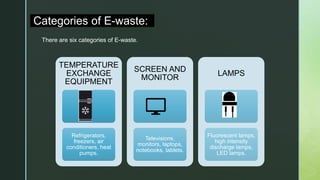
Categories of E-waste:
TEMPERATURE
EXCHANGE
EQUIPMENT
Refrigerators,
freezers, air
conditioners, heat
pumps.
SCREEN AND
MONITOR
Televisions,
monitors, laptops,
notebooks, tablets.
LAMPS
Fluorescent lamps,
high intensity
discharge lamps,
LED lamps.
There are six categories of E-waste.
z
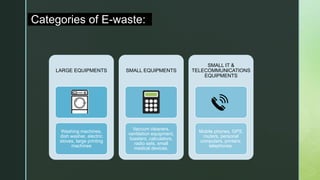
Categories of E-waste:
LARGE EQUIPMENTS
Washing machines,
dish washer, electric
stoves, large printing
machines
SMALL EQUIPMENTS
Vaccum cleaners,
ventilation equipment,
toasters, calculators,
radio sets, small
medical devices.
SMALL IT &
TELECOMMUNICATIONS
EQUIPMENTS
Mobile phones, GPS,
routers, personal
computers, printers,
telephones.
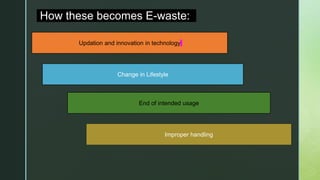
How these becomes E-waste:
Updation and innovation in technology
Change in Lifestyle
End of intended usage
Improper handling
z
Composition of E-waste:
E-waste normally contains valuable, as well as potentially toxic materials. The composition
of e-waste depends strongly on factors such as the type of electronic device, the model,
manufacturer, date of manufacture, and the age of the scrap. Scrap from IT and
telecommunication systems contain a higher amount of precious metals than scrap from
household appliances.
 A mobile phone contains more than 40 elements, base metals such as copper (Cu) and
tin (Sn); special metals such as lithium (Li) cobalt (Co), indium (In), and antimony (Sb);
and precious metals such as silver (Ag), gold (Au), and palladium (Pd).
 Circuit boards found in most of the electronic devices may contain arsenic (As),
cadmium (Cd), chromium (Cr), lead (Pb), mercury (Hg), and other toxic chemicals.
Typical printed circuit boards treated with lead solder in electronic devices contain
approximately 50gm of tin-lead solder per square meter of circuit board.
 Obsolete refrigerators, freezers, and air conditioning units contain ozone depleting
Chlorofluorocarbons (CFCs).
z
.
o The prominent materials such as barium, cadmium, copper, lead, zinc, and other rare earth
metals are contained in cathode ray tubes (CRTs) in computer monitors,
and televisions. The average lead in CTR monitors is 1.6-3.2 kg.
o Several factors influence the composition of e-waste, including economic conditions,
availability of a reuse market, and infrastructure of the recycling industry, waste
segregation programs, and regulation enforcement.
z
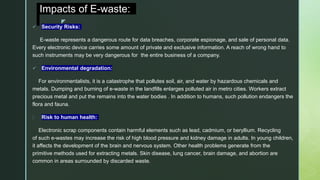
Impacts of E-waste:
 Security Risks:
E-waste represents a dangerous route for data breaches, corporate espionage, and sale of personal data.
Every electronic device carries some amount of private and exclusive information. A reach of wrong hand to
such instruments may be very dangerous for the entire business of a company.
 Environmental degradation:
For environmentalists, it is a catastrophe that pollutes soil, air, and water by hazardous chemicals and
metals. Dumping and burning of e-waste in the landfills enlarges polluted air in metro cities. Workers extract
precious metal and put the remains into the water bodies . In addition to humans, such pollution endangers the
flora and fauna.
 Risk to human health:
Electronic scrap components contain harmful elements such as lead, cadmium, or beryllium. Recycling
of such e-wastes may increase the risk of high blood pressure and kidney damage in adults. In young children,
it affects the development of the brain and nervous system. Other health problems generate from the
primitive methods used for extracting metals. Skin disease, lung cancer, brain damage, and abortion are
common in areas surrounded by discarded waste.
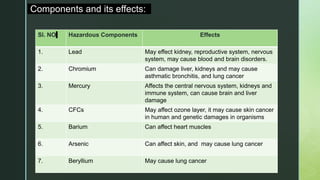
Components and its effects:
Sl. NO Hazardous Components Effects
1. Lead May effect kidney, reproductive system, nervous
system, may cause blood and brain disorders.
2. Chromium Can damage liver, kidneys and may cause
asthmatic bronchitis, and lung cancer
3. Mercury Affects the central nervous system, kidneys and
immune system, can cause brain and liver
damage
4. CFCs May affect ozone layer, it may cause skin cancer
in human and genetic damages in organisms
5. Barium Can affect heart muscles
6. Arsenic Can affect skin, and may cause lung cancer
7. Beryllium May cause lung cancer
z
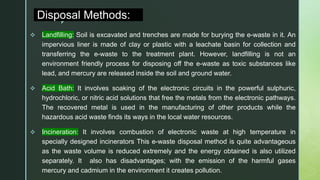
Disposal Methods:
 Landfilling: Soil is excavated and trenches are made for burying the e-waste in it. An
impervious liner is made of clay or plastic with a leachate basin for collection and
transferring the e-waste to the treatment plant. However, landfilling is not an
environment friendly process for disposing off the e-waste as toxic substances like
lead, and mercury are released inside the soil and ground water.
 Acid Bath: It involves soaking of the electronic circuits in the powerful sulphuric,
hydrochloric, or nitric acid solutions that free the metals from the electronic pathways.
The recovered metal is used in the manufacturing of other products while the
hazardous acid waste finds its ways in the local water resources.
 Incineration: It involves combustion of electronic waste at high temperature in
specially designed incinerators This e-waste disposal method is quite advantageous
as the waste volume is reduced extremely and the energy obtained is also utilized
separately. It also has disadvantages; with the emission of the harmful gases
mercury and cadmium in the environment it creates pollution.
z
.
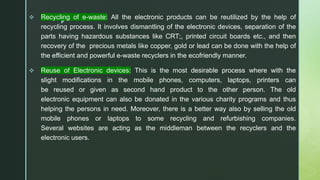
 Recycling of e-waste: All the electronic products can be reutilized by the help of
recycling process. It involves dismantling of the electronic devices, separation of the
parts having hazardous substances like CRT;, printed circuit boards etc., and then
recovery of the precious metals like copper, gold or lead can be done with the help of
the efficient and powerful e-waste recyclers in the ecofriendly manner.
 Reuse of Electronic devices: This is the most desirable process where with the
slight modifications in the mobile phones, computers, laptops, printers can
be reused or given as second hand product to the other person. The old
electronic equipment can also be donated in the various charity programs and thus
helping the persons in need. Moreover, there is a better way also by selling the old
mobile phones or laptops to some recycling and refurbishing companies.
Several websites are acting as the middleman between the recyclers and the
electronic users.
z
E-waste Scenario in India:
The Global E-waste Monitor 2020 report found that the world dumped a record 53.6
million tonnes of e-waste last year. Just 17.4% was recycled. According to The
Global E-waste Monitor India, with 3.2 million tonnes, is the third largest contributor
of E-waste.
Annually, computer devices account for nearly 70% of e-waste, 12% comes from the
telecom sector, 8% from medical equipment and 7% from electric equipment. The
government, public sector companies, and private sector companies generate nearly
75% of electronic waste, with the contribution of individual household being only
16%.
According to ASSOCHAM an industrial body in India the, Compound Annual Growth
Rate of electronic waste is 30%. With changing consumer behavior and rapid
economic growth, ASSOCHAM estimates that India will generate 5.2 million tonnes
of e-waste by 2025.
z
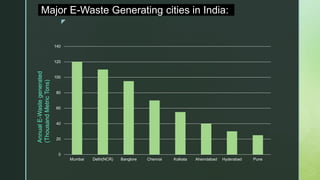
Major E-Waste Generating cities in India:
.
0
20
40
60
80
100
120
140
Mumbai Delhi(NCR) Banglore Chennai Kolkata Ahemdabad Hyderabad Pune
Annual
E-Waste
generated
(Thousand
Metric
Tons)
z
Legislatory framework of EWM:
The Ministry of Environment, Forests, and Climate Change (MOEFCC) is primarily responsible for
regulations regarding electronic waste. Additionally, the Central Pollution Control Board (CPCB) and
State Pollution Control Board (SPCB) produce implementation procedures to ensure proper
management of rules set forth by the MoEFCC.
A) E-Waste Management and Handling Rules, 2011
An addition to the Environmental Protection Act of 1986, the E-Waste Management and Handling
Rules of 2011 came into effect in May 2012. The rules stated that all manufacturers and importers
of electronic goods were required to come up with a plan to manage their electronic waste.
Producers or importers had to establish e-waste collection centers or employ take back systems.
These rules also mandated that sellers of electronic goods must provide consumers with
information on how to properly dispose of the electronics in order to prevent people from dumping
their electronics with domestic waste. Further, companies that produce electronics which have the
potential to become e-waste must make the consumer aware of the hazardous materials in their
product. These rules established and placed specific responsibilities for each party involved in the
production, disposal, and management of electronic waste. Specific responsibilities were given to
the producer, collection centers, consumer or bulk consumer, dismantlers, and recyclers. These
rules also mandated that commercial consumers and government departments must keep records
of their electronic waste and make them available to state and federal Pollution Control Boards.
B) E-Waste Management Rules, 2016
In October 2016, the E-Waste Management Rules, 2016 replaced the E-Waste Management and
Handling Rules, 2011. This set of rules clarifies duties of responsible parties, enacts more
stringent regulations on e-waste production, as well as clarifies the general definition of e-waste.
In these rules, e-waste is defined as “ectrical and electronic equipment, whole or in part discarded
as waste by the consumer or bulk consumer as well as rejects from manufacturing, refurbishment
and repair processes”. ‘Electrical and electronic equipment” in turn has been defined to mean
equipment which are dependent on electric current or electro-magnetic field in order to become
functional. A major concept presented in these rules is the idea of Extended Producer
Responsibility (EPR). Producers of electronic products must implement EPR in order to ensure
that their electronic waste is delivered to authorized recyclers or dismantlers. These rules
establish and plays specific responsibilities for each party involved in the production, disposal,
and management of electronic waste. Specific responsibilities were given to the
manufacturer, producer, collection centers, dealers, refurbisher, consumer or bulk consumer,
recycler, and the state government. These rules also stated target goals for certain industries to
drastically reduce their collection of electronic waste.
C) Amendment to the E-Waste Management Rules, 2018
This amendment relaxes certain aspects of the strict E- Waste Management Rules of
2016. Specifically, the amendment focusses on the e-waste collection targets by 10% during
2017–2018, 20% during 2018–2019, 30% during 2019–2020, and so on. This amendment also
gives the Central Pollution Control Board power to randomly select electronic equipment on the
market to test for compliance of rules. The financial cost associated with this testing shall be
the responsibility of the government, whereas previously, this responsibility was of the
producer.
z
CONCLUSION:
• E-waste has emerged as one of the fastest growing waste streams worldwide today.
• Electronic gadgets without proper disposal can cause environmental harm as well
as can affect the human health.
• Reuse and recycle are more beneficial than simple disposal.
• Designing of products using environment friendly raw materials can make a change.
• Awareness of E-waste should be given.
• Government shall take steps to reduce e-waste disposal.
z

Presentation on E-waste Management or Electronic Waste Management

  • 1.
    z E-WASTE MANAGEMENT Presented By:Sonali Patel 20mcomrc30 M.COM Department of Financial Administration Central University of Punjab Under the guidance of: Dr.Dhanraj Sharma
  • 2.
    z CONTENTS  What isE-waste  Categories of E-waste  How these becomes E-waste  Composition of E-waste  Impacts of E-waste  Disposal Methods  E-waste scenario in India  Legislatory framework of EWM  Conclusion
  • 3.
    z What is E-waste: Electronicwaste or e-waste, is a term for electronic products that have become unwanted, non-working or outmoded, and have essentially reached the end of their useful life. E-waste includes almost any household or business item containing electrical components with either power supply or battery supply. E-waste is a term used to cover items of all types of electrical and electronic equipment (EEE) and its parts that have been discarded by the owner as waste without the intention to use. Due to the rapid change in the technology a high rate of obsolescence in electronic industry and other factors E-waste are growing day by day. Many of the components have toxic materials in it, so it is very necessary to make a safe disposal of the e-waste.
  • 4.
    z Categories of E-waste: TEMPERATURE EXCHANGE EQUIPMENT Refrigerators, freezers,air conditioners, heat pumps. SCREEN AND MONITOR Televisions, monitors, laptops, notebooks, tablets. LAMPS Fluorescent lamps, high intensity discharge lamps, LED lamps. There are six categories of E-waste.
  • 5.
    z Categories of E-waste: LARGEEQUIPMENTS Washing machines, dish washer, electric stoves, large printing machines SMALL EQUIPMENTS Vaccum cleaners, ventilation equipment, toasters, calculators, radio sets, small medical devices. SMALL IT & TELECOMMUNICATIONS EQUIPMENTS Mobile phones, GPS, routers, personal computers, printers, telephones.
  • 6.
    How these becomesE-waste: Updation and innovation in technology Change in Lifestyle End of intended usage Improper handling
  • 7.
    z Composition of E-waste: E-wastenormally contains valuable, as well as potentially toxic materials. The composition of e-waste depends strongly on factors such as the type of electronic device, the model, manufacturer, date of manufacture, and the age of the scrap. Scrap from IT and telecommunication systems contain a higher amount of precious metals than scrap from household appliances.  A mobile phone contains more than 40 elements, base metals such as copper (Cu) and tin (Sn); special metals such as lithium (Li) cobalt (Co), indium (In), and antimony (Sb); and precious metals such as silver (Ag), gold (Au), and palladium (Pd).  Circuit boards found in most of the electronic devices may contain arsenic (As), cadmium (Cd), chromium (Cr), lead (Pb), mercury (Hg), and other toxic chemicals. Typical printed circuit boards treated with lead solder in electronic devices contain approximately 50gm of tin-lead solder per square meter of circuit board.  Obsolete refrigerators, freezers, and air conditioning units contain ozone depleting Chlorofluorocarbons (CFCs).
  • 8.
    z . o The prominentmaterials such as barium, cadmium, copper, lead, zinc, and other rare earth metals are contained in cathode ray tubes (CRTs) in computer monitors, and televisions. The average lead in CTR monitors is 1.6-3.2 kg. o Several factors influence the composition of e-waste, including economic conditions, availability of a reuse market, and infrastructure of the recycling industry, waste segregation programs, and regulation enforcement.
  • 9.
    z Impacts of E-waste: Security Risks: E-waste represents a dangerous route for data breaches, corporate espionage, and sale of personal data. Every electronic device carries some amount of private and exclusive information. A reach of wrong hand to such instruments may be very dangerous for the entire business of a company.  Environmental degradation: For environmentalists, it is a catastrophe that pollutes soil, air, and water by hazardous chemicals and metals. Dumping and burning of e-waste in the landfills enlarges polluted air in metro cities. Workers extract precious metal and put the remains into the water bodies . In addition to humans, such pollution endangers the flora and fauna.  Risk to human health: Electronic scrap components contain harmful elements such as lead, cadmium, or beryllium. Recycling of such e-wastes may increase the risk of high blood pressure and kidney damage in adults. In young children, it affects the development of the brain and nervous system. Other health problems generate from the primitive methods used for extracting metals. Skin disease, lung cancer, brain damage, and abortion are common in areas surrounded by discarded waste.
  • 10.
    Components and itseffects: Sl. NO Hazardous Components Effects 1. Lead May effect kidney, reproductive system, nervous system, may cause blood and brain disorders. 2. Chromium Can damage liver, kidneys and may cause asthmatic bronchitis, and lung cancer 3. Mercury Affects the central nervous system, kidneys and immune system, can cause brain and liver damage 4. CFCs May affect ozone layer, it may cause skin cancer in human and genetic damages in organisms 5. Barium Can affect heart muscles 6. Arsenic Can affect skin, and may cause lung cancer 7. Beryllium May cause lung cancer
  • 11.
    z Disposal Methods:  Landfilling:Soil is excavated and trenches are made for burying the e-waste in it. An impervious liner is made of clay or plastic with a leachate basin for collection and transferring the e-waste to the treatment plant. However, landfilling is not an environment friendly process for disposing off the e-waste as toxic substances like lead, and mercury are released inside the soil and ground water.  Acid Bath: It involves soaking of the electronic circuits in the powerful sulphuric, hydrochloric, or nitric acid solutions that free the metals from the electronic pathways. The recovered metal is used in the manufacturing of other products while the hazardous acid waste finds its ways in the local water resources.  Incineration: It involves combustion of electronic waste at high temperature in specially designed incinerators This e-waste disposal method is quite advantageous as the waste volume is reduced extremely and the energy obtained is also utilized separately. It also has disadvantages; with the emission of the harmful gases mercury and cadmium in the environment it creates pollution.
  • 12.
    z .  Recycling ofe-waste: All the electronic products can be reutilized by the help of recycling process. It involves dismantling of the electronic devices, separation of the parts having hazardous substances like CRT;, printed circuit boards etc., and then recovery of the precious metals like copper, gold or lead can be done with the help of the efficient and powerful e-waste recyclers in the ecofriendly manner.  Reuse of Electronic devices: This is the most desirable process where with the slight modifications in the mobile phones, computers, laptops, printers can be reused or given as second hand product to the other person. The old electronic equipment can also be donated in the various charity programs and thus helping the persons in need. Moreover, there is a better way also by selling the old mobile phones or laptops to some recycling and refurbishing companies. Several websites are acting as the middleman between the recyclers and the electronic users.
  • 13.
    z E-waste Scenario inIndia: The Global E-waste Monitor 2020 report found that the world dumped a record 53.6 million tonnes of e-waste last year. Just 17.4% was recycled. According to The Global E-waste Monitor India, with 3.2 million tonnes, is the third largest contributor of E-waste. Annually, computer devices account for nearly 70% of e-waste, 12% comes from the telecom sector, 8% from medical equipment and 7% from electric equipment. The government, public sector companies, and private sector companies generate nearly 75% of electronic waste, with the contribution of individual household being only 16%. According to ASSOCHAM an industrial body in India the, Compound Annual Growth Rate of electronic waste is 30%. With changing consumer behavior and rapid economic growth, ASSOCHAM estimates that India will generate 5.2 million tonnes of e-waste by 2025.
  • 14.
    z Major E-Waste Generatingcities in India: . 0 20 40 60 80 100 120 140 Mumbai Delhi(NCR) Banglore Chennai Kolkata Ahemdabad Hyderabad Pune Annual E-Waste generated (Thousand Metric Tons)
  • 15.
    z Legislatory framework ofEWM: The Ministry of Environment, Forests, and Climate Change (MOEFCC) is primarily responsible for regulations regarding electronic waste. Additionally, the Central Pollution Control Board (CPCB) and State Pollution Control Board (SPCB) produce implementation procedures to ensure proper management of rules set forth by the MoEFCC. A) E-Waste Management and Handling Rules, 2011 An addition to the Environmental Protection Act of 1986, the E-Waste Management and Handling Rules of 2011 came into effect in May 2012. The rules stated that all manufacturers and importers of electronic goods were required to come up with a plan to manage their electronic waste. Producers or importers had to establish e-waste collection centers or employ take back systems. These rules also mandated that sellers of electronic goods must provide consumers with information on how to properly dispose of the electronics in order to prevent people from dumping their electronics with domestic waste. Further, companies that produce electronics which have the potential to become e-waste must make the consumer aware of the hazardous materials in their product. These rules established and placed specific responsibilities for each party involved in the production, disposal, and management of electronic waste. Specific responsibilities were given to the producer, collection centers, consumer or bulk consumer, dismantlers, and recyclers. These rules also mandated that commercial consumers and government departments must keep records of their electronic waste and make them available to state and federal Pollution Control Boards.
  • 16.
    B) E-Waste ManagementRules, 2016 In October 2016, the E-Waste Management Rules, 2016 replaced the E-Waste Management and Handling Rules, 2011. This set of rules clarifies duties of responsible parties, enacts more stringent regulations on e-waste production, as well as clarifies the general definition of e-waste. In these rules, e-waste is defined as “ectrical and electronic equipment, whole or in part discarded as waste by the consumer or bulk consumer as well as rejects from manufacturing, refurbishment and repair processes”. ‘Electrical and electronic equipment” in turn has been defined to mean equipment which are dependent on electric current or electro-magnetic field in order to become functional. A major concept presented in these rules is the idea of Extended Producer Responsibility (EPR). Producers of electronic products must implement EPR in order to ensure that their electronic waste is delivered to authorized recyclers or dismantlers. These rules establish and plays specific responsibilities for each party involved in the production, disposal, and management of electronic waste. Specific responsibilities were given to the manufacturer, producer, collection centers, dealers, refurbisher, consumer or bulk consumer, recycler, and the state government. These rules also stated target goals for certain industries to drastically reduce their collection of electronic waste.
  • 17.
    C) Amendment tothe E-Waste Management Rules, 2018 This amendment relaxes certain aspects of the strict E- Waste Management Rules of 2016. Specifically, the amendment focusses on the e-waste collection targets by 10% during 2017–2018, 20% during 2018–2019, 30% during 2019–2020, and so on. This amendment also gives the Central Pollution Control Board power to randomly select electronic equipment on the market to test for compliance of rules. The financial cost associated with this testing shall be the responsibility of the government, whereas previously, this responsibility was of the producer.
  • 18.
    z CONCLUSION: • E-waste hasemerged as one of the fastest growing waste streams worldwide today. • Electronic gadgets without proper disposal can cause environmental harm as well as can affect the human health. • Reuse and recycle are more beneficial than simple disposal. • Designing of products using environment friendly raw materials can make a change. • Awareness of E-waste should be given. • Government shall take steps to reduce e-waste disposal.
  • 19.