E-Waste and its
Management
Presented by Dr. Bikramjeet Mitra
Mentored by Dr. Shubanshu Gupta
Did you Know
• According to recent data, India had 554.8 million mobile users
actively using 643.4 million SIMs, and it is estimated that by
2040, the number of smartphone users in India will reach 1.55
billion.
• Getting a SIM card in India for tourists is now pretty easy, and
there are different international SIM card packages available in
India.
• The average lifespan of a computer has dropped from 6 years in
2002 to just 2 years in 2007, while mobile phones have a
lifecycle of less than 2 years in developed countries.
• In 2014, 674 million mobile phones were sold worldwide,
which is 30% more than in 2008.
Contents
 Introduction
 What is Electronic Waste?
 Magnitude of the problem: Indian & global scenario
 Sources & Composition of E-Waste
 Hazards of E-Waste
 Waste minimization techniques
 E-Waste Disposal
 Policies & initiatives
 References
Introduction
Electronic waste, popularly known as ‘e-waste’ can be defined as
electronic equipments or products connects with power plug,
batteries which have become obsolete due to:
1. Advancement in technology
2. Changes in fashion, style and status
3. Nearing the end of their useful life.
There is generally no accepted definition of e-waste.
 A number of countries have come out with their own definitions,
interpretation and usage of the term “E-waste/WEEE”. The most widely
accepted definition and description of WEEE/ E-waste is as per the
European Union directive:
1. ‘Electrical and electronic equipment’ or ‘EEE’ means
equipment which is dependent on electric currents or electromagnetic
fields in order to work properly and equipment for the generation, transfer
and measurement of such currents and fields falling under different
categories and designed for use with a voltage rating not exceeding
1000 Volt for alternating current and 1 500 Volt for direct current;
• 2. ‘Waste electrical and electronic equipment’ or ‘WEEE’ means
electrical or electronic equipment which is waste within the
meaning including all components, subassemblies and consumables
which are part of the product at the time of discarding.
 Waste Electrical and Electronic Equipment (WEEE) consists of
all waste from electronic and electrical appliances which have
reached their end- of- life period or are no longer fit for their
original intended use and are destined for recovery, recycling or
disposal. It includes computer and its accessories.
Magnitude of the problem
Global Scenario
• E-waste is the fastest growing solid waste stream in the world .
• In 2019, an estimated 53.6 million tonnes of e-waste were
produced globally, but only 17.4% was documented as formally
collected and recycled.
• Lead is one of the common substances released into the
environment if e-waste is recycled, stored or dumped using
inferior activities, such as open burning .
• E-waste recycling activities may have several adverse impacts on
human health. Children and pregnant women are particularly
vulnerable.
• ILO and WHO estimate that millions of women and child
labourers working in the informal recycling sector around the
world may be at risk of e-waste exposure .
Indian Scenario
• India's e-waste problem is growing rapidly, with the volume of
e-waste increasing from 700,000 tonnes in 2017-18 to 1.6
million tonnes in 2021.
• The increase in e-waste is due to the parallel increase in
electronic goods consumption in India, with millions of
devices being sold annually.
• E-waste consists of various hazardous substances, including
lead, mercury, and cadmium, which can contaminate the
environment and lead to health problems if not disposed of
properly.
• 85% of burgeoning e-waste is managed by the unorganized
sector, primarily consisting of scrap dealers scattered across the
country.
• India currently ranks third among the largest generators of e-
waste globally, behind only China and the US
• In India, e-waste management assumes greater significance not
only due to the generation of its own e-waste but also because of
the dumping of e-waste from developed countries.
• This is coupled with India's lack of appropriate infrastructure and
procedures for its disposal and recycling.
Classification of E-waste
E-waste encompasses ever growing range of obsolete products
classified as
1. Electronic devices such as computers, servers, main
frames, monitors, TVs & display devices
2. Telecommunication devices such as cellular phones &
pagers, calculators, audio and video devices, printers,
scanners, fax machines, refrigerators, air conditioners,
washing machines, and microwave ovens.
3. Recording devices such as DVDs, CDs, floppies, tapes,
printing cartridges, military electronic waste, automobile
catalytic converters.
4. Electronic components such as chips, processors, mother
boards, printed circuit boards, industrial electronics such as
sensors, alarms, sirens, security devices, automobile
electronic devices.
Need of E-Waste Management
• Industrial Revolution.
• Advancement in Information Technology.
• Their mismanagement can lead to the pollution.
• From the data collected, in a single year the production is around
1200 tons of electronic scrap.
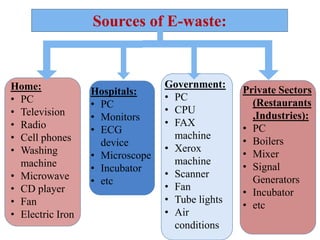
Sources of E-waste:
Home:
• PC
• Television
• Radio
• Cell phones
• Washing
machine
• Microwave
• CD player
• Fan
• Electric Iron
Hospitals:
• PC
• Monitors
• ECG
device
• Microscope
• Incubator
• etc
Government:
• PC
• CPU
• FAX
machine
• Xerox
machine
• Scanner
• Fan
• Tube lights
• Air
conditions
Private Sectors
(Restaurants
,Industries):
• PC
• Boilers
• Mixer
• Signal
Generators
• Incubator
• etc
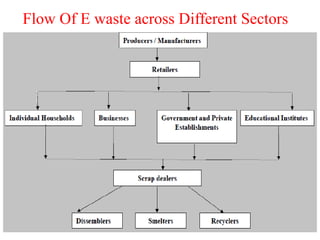
Flow Of E waste across Different Sectors
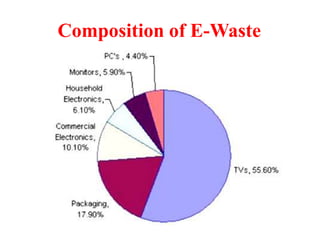
Composition of E-Waste
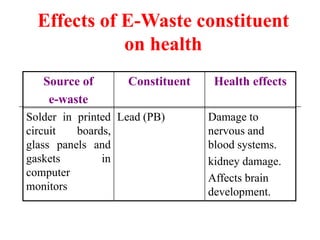
Effects of E-Waste constituent
on health
Source of
e-waste
Constituent Health effects
Solder in printed
circuit boards,
glass panels and
gaskets in
computer
monitors
Lead (PB) Damage to
nervous and
blood systems.
kidney damage.
Affects brain
development.
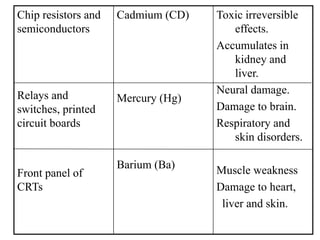
Chip resistors and
semiconductors
Relays and
switches, printed
circuit boards
Front panel of
CRTs
Cadmium (CD)
Mercury (Hg)
Barium (Ba)
Toxic irreversible
effects.
Accumulates in
kidney and
liver.
Neural damage.
Damage to brain.
Respiratory and
skin disorders.
Muscle weakness
Damage to heart,
liver and skin.
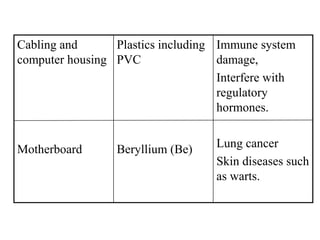
Cabling and
computer housing
Motherboard
Plastics including
PVC
Beryllium (Be)
Immune system
damage,
Interfere with
regulatory
hormones.
Lung cancer
Skin diseases such
as warts.
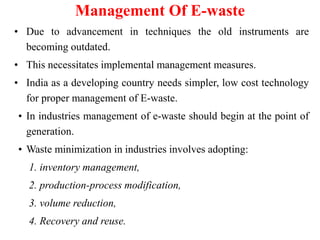
Management Of E-waste
• Due to advancement in techniques the old instruments are
becoming outdated.
• This necessitates implemental management measures.
• India as a developing country needs simpler, low cost technology
for proper management of E-waste.
• In industries management of e-waste should begin at the point of
generation.
• Waste minimization in industries involves adopting:
1. inventory management,
2. production-process modification,
3. volume reduction,
4. Recovery and reuse.
Existing E-waste Management Practices in India
Plastic Waste Management:
• Products like keyboards, casings, and panels made from plastics are
common in e-waste.
• Management practice involves shredding and melting these plastic
components.
Printed Circuit Board Waste:
• Found in electronic parts like motherboards and TV circuits.
• Management practice includes desoldering and open burning to extract
metals.
Miscellaneous Waste:
• Includes chips, electronic wires, broken glass, and copper-containing waste.
• Managed through chemical stripping, open burning, and sometimes mixed
with municipal solid waste.
Liquid Waste Management:
• Contains internal chemicals, general waste, and acid stripping waste.
• Managed through the sewerage system for disposal
Methods of E-waste disposal:
1. Recycling
2. Landfilling
3. Incineration
4. Reuse
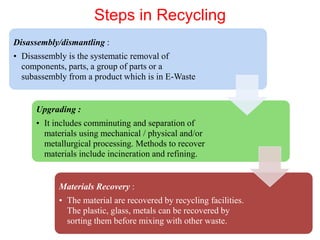
Steps in Recycling
Disassembly/dismantling :
• Disassembly is the systematic removal of
components, parts, a group of parts or a
subassembly from a product which is in E-Waste
Upgrading :
• It includes comminuting and separation of
materials using mechanical / physical and/or
metallurgical processing. Methods to recover
materials include incineration and refining.
Materials Recovery :
• The material are recovered by recycling facilities.
The plastic, glass, metals can be recovered by
sorting them before mixing with other waste.
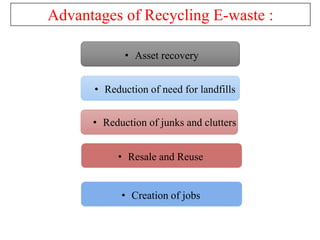
Advantages of Recycling E-waste :
• Asset recovery
• Reduction of need for landfills
• Reduction of junks and clutters
• Resale and Reuse
• Creation of jobs
Landfilling
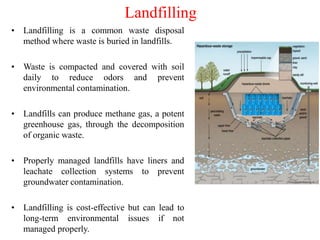
• Landfilling is a common waste disposal
method where waste is buried in landfills.
• Waste is compacted and covered with soil
daily to reduce odors and prevent
environmental contamination.
• Landfills can produce methane gas, a potent
greenhouse gas, through the decomposition
of organic waste.
• Properly managed landfills have liners and
leachate collection systems to prevent
groundwater contamination.
• Landfilling is cost-effective but can lead to
long-term environmental issues if not
managed properly.
Advantages and Disadvantages of Landfilling
Advantages:
• Landfills occupy less space than
other forms of waste disposal due
to compacting and layering waste
materials.
• When properly constructed and
maintained, landfills can minimize
leachate formation and gas
emissions, reducing potential risks
to public health and the
environment.
Disadvantages:
• Limited capacity: As landfills fill up
over time, they require expansion or
closure, leading to increased costs
and loss of valuable land resources.
• Leachate and greenhouse gases:
Improperly managed landfills may
generate hazardous leachate and
methane, contributing to
groundwater contamination and
climate change if not adequately
controlled.
Incineration
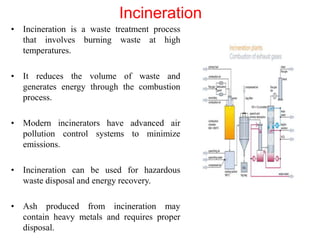
• Incineration is a waste treatment process
that involves burning waste at high
temperatures.
• It reduces the volume of waste and
generates energy through the combustion
process.
• Modern incinerators have advanced air
pollution control systems to minimize
emissions.
• Incineration can be used for hazardous
waste disposal and energy recovery.
• Ash produced from incineration may
contain heavy metals and requires proper
disposal.
Advantages and Disadvantages of Incineration
Advantages
• Incineration significantly reduces
the volume of solid waste,
allowing for easier transportation
and disposal.
• Modern incinerators produce
steam or electricity using heat
generated from combustion,
providing renewable energy
sources.
Disadvantages
• Incineration produces pollutants
like dioxins, furans, nitrogen
oxides, sulfur dioxide, particulate
matter, and carbon monoxide,
requiring strict emission controls to
safeguard public health and the
environment.
• After incineration, ash remains
must be treated and disposed of
safely, posing challenges regarding
disposal and long-term stability.
Reuse
Definition :
It constitute direct use or use
after slight modifications to
the original function
equipment.
Advantages :
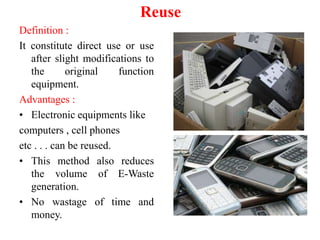
• Electronic equipments like
computers , cell phones
etc . . . can be reused.
• This method also reduces
the volume of E-Waste
generation.
• No wastage of time and
money.
Policy level initiatives: global & India
Basel Convention
• The Basel Convention on the Control of Transboundary Movements of
Hazardous Wastes and Their Disposal is a global environmental agreement
aimed at protecting human health and the environment from the adverse
effects of hazardous wastes. It was signed by 173 countries on March 22,
1989, and entered into force on May 5, 1992
• As of November 2020, 187 countries and the European Commission are
parties to the Convention.
• The United States is a signatory to the Basel Convention but has not yet
become a party to the Convention
The three main objectives of the Basel Convention are:
• Setting up a framework for controlling the transboundary
movement of hazardous wastes across international borders.
• Developing criteria for environmentally sound management
(ESM) of hazardous wastes.
• Establishing a control system based on prior written
notification, with an emphasis on minimizing the generation of
hazardous waste.
Policy Initiatives in India
• E-Waste Management Rules 2018: Revised to enhance collection,
recycling, and environmentally sound management of e-waste, setting
targets for e-waste collection and recycling, especially for new producers
• E-Waste (Management) Rules, 2022: Came into effect from April 1, 2023,
expanding the scope of e-waste policy to include over 100 types of
equipment, such as solar panels, emphasizing responsible disposal as
demand for renewable energy sources increases.
• Guidelines for Environmentally Sound Management of E-Waste, 2008:
Approved by the Ministry of Environment and Forest and Central Pollution
Control Board, classified e-waste according to its components and
compositions, focusing on management and treatment practices with
concepts like “Extended Producer Responsibility”
Extended Producer Responsibility (EPR)
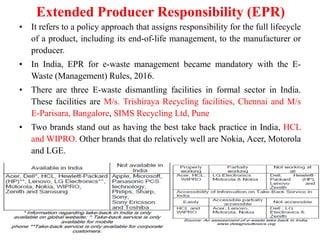
• It refers to a policy approach that assigns responsibility for the full lifecycle
of a product, including its end-of-life management, to the manufacturer or
producer.
• In India, EPR for e-waste management became mandatory with the E-
Waste (Management) Rules, 2016.
• There are three E-waste dismantling facilities in formal sector in India.
These facilities are M/s. Trishiraya Recycling facilities, Chennai and M/s
E-Parisara, Bangalore, SIMS Recycling Ltd, Pune
• Two brands stand out as having the best take back practice in India, HCL
and WIPRO. Other brands that do relatively well are Nokia, Acer, Motorola
and LGE.
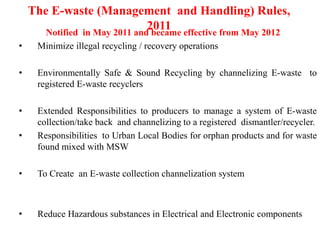
The E-waste (Management and Handling) Rules,
2011
Notified in May 2011 and became effective from May 2012
• Minimize illegal recycling / recovery operations
• Environmentally Safe & Sound Recycling by channelizing E-waste to
registered E-waste recyclers
• Extended Responsibilities to producers to manage a system of E-waste
collection/take back and channelizing to a registered dismantler/recycler.
• Responsibilities to Urban Local Bodies for orphan products and for waste
found mixed with MSW
• To Create an E-waste collection channelization system
• Reduce Hazardous substances in Electrical and Electronic components
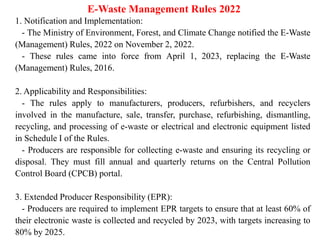
Six Chapters, Three Schedule
• Chapter 1 – Has definitions of various terms
• Chapter 2 – Responsibilities of Producers, Collection Centers,
Dismantler, Recycler and Bulk Consumer
• Chapter 3 - Procedure for seeking Authorization & Registration
• Chapter 4 - Storage of E-Waste
• Chapter 5 - RoHS
• Chapter 6 – Duties of Regulatory Authorities, Annual Report from Producers,
Collection Centers, Dismantlers Recyclers, Transportation, Accident Reporting.
• Schedule – I : List of Equipment,
• Schedule – II : Exemptions list for RoHS
• Schedule – III: Duties of Regulatory Authorities
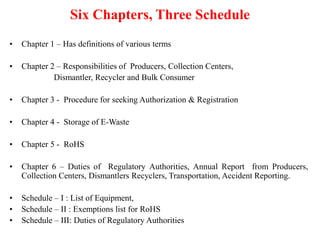
E-Waste Management Rules 2022
1. Notification and Implementation:
- The Ministry of Environment, Forest, and Climate Change notified the E-Waste
(Management) Rules, 2022 on November 2, 2022.
- These rules came into force from April 1, 2023, replacing the E-Waste
(Management) Rules, 2016.
2. Applicability and Responsibilities:
- The rules apply to manufacturers, producers, refurbishers, and recyclers
involved in the manufacture, sale, transfer, purchase, refurbishing, dismantling,
recycling, and processing of e-waste or electrical and electronic equipment listed
in Schedule I of the Rules.
- Producers are responsible for collecting e-waste and ensuring its recycling or
disposal. They must fill annual and quarterly returns on the Central Pollution
Control Board (CPCB) portal.
3. Extended Producer Responsibility (EPR):
- Producers are required to implement EPR targets to ensure that at least 60% of
their electronic waste is collected and recycled by 2023, with targets increasing to
80% by 2025.
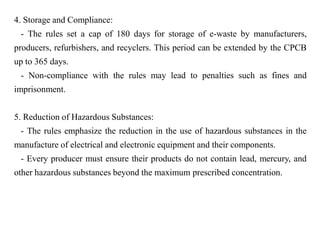
4. Storage and Compliance:
- The rules set a cap of 180 days for storage of e-waste by manufacturers,
producers, refurbishers, and recyclers. This period can be extended by the CPCB
up to 365 days.
- Non-compliance with the rules may lead to penalties such as fines and
imprisonment.
5. Reduction of Hazardous Substances:
- The rules emphasize the reduction in the use of hazardous substances in the
manufacture of electrical and electronic equipment and their components.
- Every producer must ensure their products do not contain lead, mercury, and
other hazardous substances beyond the maximum prescribed concentration.
Management of E-Waste
Responsibility of Producer:
• Collection of e-waste generated from the 'end of life' of their
products in line with Extended Producer Responsibility (EPR).
• Setting up collection centers.
• Financing and organizing a system.
• Creating awareness through publications, advertisements,
posters.
Responsibilities of Collection Centers:
• Obtain authorization.
• Ensure secure storage.
• Ensure safe transportation of e-waste.
• Maintain records.
Responsibilities of Dismantler & Recycler:
• Obtain authorization and registration from the State Pollution
Control Boards (SPCB).
• Ensure no environmental damage during storage and
transportation.
• Ensure dismantling/recycling processes are environmentally safe.
Responsibilities of Bulk Consumer:
• Channelize e-waste to authorized collection centers, registered
dismantlers, recyclers, or return to producers' take-back services.
Responsibility of State Pollution Control Boards/ Pollution Control
Committees:
• Prepare inventory of e-waste.
• Grant authorization and registration.
• Monitor compliance and conditions.
• Take action against violations.
Responsibility of Central Pollution Control Boards:
• Coordinate with State Pollution Control Boards/Committees.
• Prepare guidelines for e-waste management.
• Conduct assessments.
• Recommend standards for processing and recycling.
• Document and compile data on e-waste.
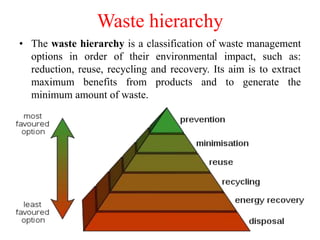
Waste hierarchy
• The waste hierarchy is a classification of waste management
options in order of their environmental impact, such as:
reduction, reuse, recycling and recovery. Its aim is to extract
maximum benefits from products and to generate the
minimum amount of waste.
WEEE Directive
• It is a European Community Directive, numbered 2012/19/EU,
concerned with waste electrical and electronic equipment
(WEEE).
• The directive sets collection, recycling, and recovery targets for
all types of electrical goods, with a minimum rate of 4 kilograms
(9 lb) per head of population per annum recovered for recycling
by 2009.
• The WEEE Directive obliges EU member states to transpose its
provisions into national law, and the directive was transposed
into UK law in 2006.
• The WEEE Directive aims to encourage the design of electronic
products with environmentally safe recycling and recovery in
mind
Environmental Protection Agency(EPA)
• List of EPA - Worldwide:
1. Earth System Governance
Project
2. Global Environment
Facility(GEF)
3. Intergovernmental Panel on
Climate Change(IPCC)
4. United Nations Environment
Program me(UNEP)
5. World Nature
Organization(WNO)
6. World Wide Fund For
Nature(WWF)
• List of EPA - INDIA:
1. Central Pollution Control
Board(CPCB)
2. Gujarat Pollution Control
Board
3. Ministry of Environment and
Forests
4. Andhra Pradesh Pollution
Control Board(APPCB)
References
• Financial Express. E-waste management in India: Dimensions, regulations, and
challenges in the current scenario. The Financial Express.
https://www.financialexpress.com/lifestyle/e-waste-management-in-india-
dimensions-regulations-and-challenges-in-the-current-scenario/3297401/
(Accessed: 25 February 2024)
• Key Topics: Office of Environmental Quality and Transboundary Issues. Basel
Convention on Hazardous Wastes. U.S. Department of State.
https://www.state.gov/key-topics-office-of-environmental-quality-and-
transboundary-issues/basel-convention-on-hazardous-wastes/ (Accessed: 25
February 2024)
• Pandya, Viral, 'E-Waste Management: Global Outlook and Lessons for India', in
Bimal N. Patel, and Ranita Nagar (eds), Sustainable Development and India:
Convergence of Law, Economics, Science, and Politics (Delhi, 2018; online edn,
Oxford Academic, 17 Apr. 2019),
https://doi.org/10.1093/oso/9780199474622.003.0010, accessed 26 Feb. 2024.
• RoHS & WEEE Compliance. RoHS Guide. https://www.rohsguide.com/rohs-
weee.htm (Accessed: 25 February 2024).
• Lakshmikumaran & Sridharan. E-waste (Management) Rules, 2022 - An analysis.
TerraLex. https://www.example.com/article (Accessed: 25 February 2024)
• Forecast of smartphone users in India. Statista.
https://www.statista.com/statistics/467163/forecast-of-smartphone-users-in-india/
(Accessed: 25 February 2024).
Electronic waste and its management.pptx

Electronic waste and its management.pptx

  • 1.
    E-Waste and its Management Presentedby Dr. Bikramjeet Mitra Mentored by Dr. Shubanshu Gupta
  • 2.
    Did you Know •According to recent data, India had 554.8 million mobile users actively using 643.4 million SIMs, and it is estimated that by 2040, the number of smartphone users in India will reach 1.55 billion. • Getting a SIM card in India for tourists is now pretty easy, and there are different international SIM card packages available in India. • The average lifespan of a computer has dropped from 6 years in 2002 to just 2 years in 2007, while mobile phones have a lifecycle of less than 2 years in developed countries. • In 2014, 674 million mobile phones were sold worldwide, which is 30% more than in 2008.
  • 3.
    Contents  Introduction  Whatis Electronic Waste?  Magnitude of the problem: Indian & global scenario  Sources & Composition of E-Waste  Hazards of E-Waste  Waste minimization techniques  E-Waste Disposal  Policies & initiatives  References
  • 4.
    Introduction Electronic waste, popularlyknown as ‘e-waste’ can be defined as electronic equipments or products connects with power plug, batteries which have become obsolete due to: 1. Advancement in technology 2. Changes in fashion, style and status 3. Nearing the end of their useful life.
  • 5.
    There is generallyno accepted definition of e-waste.  A number of countries have come out with their own definitions, interpretation and usage of the term “E-waste/WEEE”. The most widely accepted definition and description of WEEE/ E-waste is as per the European Union directive: 1. ‘Electrical and electronic equipment’ or ‘EEE’ means equipment which is dependent on electric currents or electromagnetic fields in order to work properly and equipment for the generation, transfer and measurement of such currents and fields falling under different categories and designed for use with a voltage rating not exceeding 1000 Volt for alternating current and 1 500 Volt for direct current;
  • 6.
    • 2. ‘Wasteelectrical and electronic equipment’ or ‘WEEE’ means electrical or electronic equipment which is waste within the meaning including all components, subassemblies and consumables which are part of the product at the time of discarding.  Waste Electrical and Electronic Equipment (WEEE) consists of all waste from electronic and electrical appliances which have reached their end- of- life period or are no longer fit for their original intended use and are destined for recovery, recycling or disposal. It includes computer and its accessories.
  • 7.
    Magnitude of theproblem Global Scenario • E-waste is the fastest growing solid waste stream in the world . • In 2019, an estimated 53.6 million tonnes of e-waste were produced globally, but only 17.4% was documented as formally collected and recycled. • Lead is one of the common substances released into the environment if e-waste is recycled, stored or dumped using inferior activities, such as open burning .
  • 8.
    • E-waste recyclingactivities may have several adverse impacts on human health. Children and pregnant women are particularly vulnerable. • ILO and WHO estimate that millions of women and child labourers working in the informal recycling sector around the world may be at risk of e-waste exposure .
  • 9.
    Indian Scenario • India'se-waste problem is growing rapidly, with the volume of e-waste increasing from 700,000 tonnes in 2017-18 to 1.6 million tonnes in 2021. • The increase in e-waste is due to the parallel increase in electronic goods consumption in India, with millions of devices being sold annually. • E-waste consists of various hazardous substances, including lead, mercury, and cadmium, which can contaminate the environment and lead to health problems if not disposed of properly.
  • 10.
    • 85% ofburgeoning e-waste is managed by the unorganized sector, primarily consisting of scrap dealers scattered across the country. • India currently ranks third among the largest generators of e- waste globally, behind only China and the US • In India, e-waste management assumes greater significance not only due to the generation of its own e-waste but also because of the dumping of e-waste from developed countries. • This is coupled with India's lack of appropriate infrastructure and procedures for its disposal and recycling.
  • 11.
    Classification of E-waste E-wasteencompasses ever growing range of obsolete products classified as 1. Electronic devices such as computers, servers, main frames, monitors, TVs & display devices 2. Telecommunication devices such as cellular phones & pagers, calculators, audio and video devices, printers, scanners, fax machines, refrigerators, air conditioners, washing machines, and microwave ovens.
  • 12.
    3. Recording devicessuch as DVDs, CDs, floppies, tapes, printing cartridges, military electronic waste, automobile catalytic converters. 4. Electronic components such as chips, processors, mother boards, printed circuit boards, industrial electronics such as sensors, alarms, sirens, security devices, automobile electronic devices.
  • 13.
    Need of E-WasteManagement • Industrial Revolution. • Advancement in Information Technology. • Their mismanagement can lead to the pollution. • From the data collected, in a single year the production is around 1200 tons of electronic scrap.
  • 14.
    Sources of E-waste: Home: •PC • Television • Radio • Cell phones • Washing machine • Microwave • CD player • Fan • Electric Iron Hospitals: • PC • Monitors • ECG device • Microscope • Incubator • etc Government: • PC • CPU • FAX machine • Xerox machine • Scanner • Fan • Tube lights • Air conditions Private Sectors (Restaurants ,Industries): • PC • Boilers • Mixer • Signal Generators • Incubator • etc
  • 15.
    Flow Of Ewaste across Different Sectors
  • 16.
  • 17.
    Effects of E-Wasteconstituent on health Source of e-waste Constituent Health effects Solder in printed circuit boards, glass panels and gaskets in computer monitors Lead (PB) Damage to nervous and blood systems. kidney damage. Affects brain development.
  • 18.
    Chip resistors and semiconductors Relaysand switches, printed circuit boards Front panel of CRTs Cadmium (CD) Mercury (Hg) Barium (Ba) Toxic irreversible effects. Accumulates in kidney and liver. Neural damage. Damage to brain. Respiratory and skin disorders. Muscle weakness Damage to heart, liver and skin.
  • 19.
    Cabling and computer housing Motherboard Plasticsincluding PVC Beryllium (Be) Immune system damage, Interfere with regulatory hormones. Lung cancer Skin diseases such as warts.
  • 20.
    Management Of E-waste •Due to advancement in techniques the old instruments are becoming outdated. • This necessitates implemental management measures. • India as a developing country needs simpler, low cost technology for proper management of E-waste. • In industries management of e-waste should begin at the point of generation. • Waste minimization in industries involves adopting: 1. inventory management, 2. production-process modification, 3. volume reduction, 4. Recovery and reuse.
  • 21.
    Existing E-waste ManagementPractices in India Plastic Waste Management: • Products like keyboards, casings, and panels made from plastics are common in e-waste. • Management practice involves shredding and melting these plastic components. Printed Circuit Board Waste: • Found in electronic parts like motherboards and TV circuits. • Management practice includes desoldering and open burning to extract metals. Miscellaneous Waste: • Includes chips, electronic wires, broken glass, and copper-containing waste. • Managed through chemical stripping, open burning, and sometimes mixed with municipal solid waste. Liquid Waste Management: • Contains internal chemicals, general waste, and acid stripping waste. • Managed through the sewerage system for disposal
  • 22.
    Methods of E-wastedisposal: 1. Recycling 2. Landfilling 3. Incineration 4. Reuse
  • 23.
    Steps in Recycling Disassembly/dismantling: • Disassembly is the systematic removal of components, parts, a group of parts or a subassembly from a product which is in E-Waste Upgrading : • It includes comminuting and separation of materials using mechanical / physical and/or metallurgical processing. Methods to recover materials include incineration and refining. Materials Recovery : • The material are recovered by recycling facilities. The plastic, glass, metals can be recovered by sorting them before mixing with other waste.
  • 24.
    Advantages of RecyclingE-waste : • Asset recovery • Reduction of need for landfills • Reduction of junks and clutters • Resale and Reuse • Creation of jobs
  • 25.
    Landfilling • Landfilling isa common waste disposal method where waste is buried in landfills. • Waste is compacted and covered with soil daily to reduce odors and prevent environmental contamination. • Landfills can produce methane gas, a potent greenhouse gas, through the decomposition of organic waste. • Properly managed landfills have liners and leachate collection systems to prevent groundwater contamination. • Landfilling is cost-effective but can lead to long-term environmental issues if not managed properly.
  • 26.
    Advantages and Disadvantagesof Landfilling Advantages: • Landfills occupy less space than other forms of waste disposal due to compacting and layering waste materials. • When properly constructed and maintained, landfills can minimize leachate formation and gas emissions, reducing potential risks to public health and the environment. Disadvantages: • Limited capacity: As landfills fill up over time, they require expansion or closure, leading to increased costs and loss of valuable land resources. • Leachate and greenhouse gases: Improperly managed landfills may generate hazardous leachate and methane, contributing to groundwater contamination and climate change if not adequately controlled.
  • 27.
    Incineration • Incineration isa waste treatment process that involves burning waste at high temperatures. • It reduces the volume of waste and generates energy through the combustion process. • Modern incinerators have advanced air pollution control systems to minimize emissions. • Incineration can be used for hazardous waste disposal and energy recovery. • Ash produced from incineration may contain heavy metals and requires proper disposal.
  • 28.
    Advantages and Disadvantagesof Incineration Advantages • Incineration significantly reduces the volume of solid waste, allowing for easier transportation and disposal. • Modern incinerators produce steam or electricity using heat generated from combustion, providing renewable energy sources. Disadvantages • Incineration produces pollutants like dioxins, furans, nitrogen oxides, sulfur dioxide, particulate matter, and carbon monoxide, requiring strict emission controls to safeguard public health and the environment. • After incineration, ash remains must be treated and disposed of safely, posing challenges regarding disposal and long-term stability.
  • 29.
    Reuse Definition : It constitutedirect use or use after slight modifications to the original function equipment. Advantages : • Electronic equipments like computers , cell phones etc . . . can be reused. • This method also reduces the volume of E-Waste generation. • No wastage of time and money.
  • 30.
    Policy level initiatives:global & India Basel Convention • The Basel Convention on the Control of Transboundary Movements of Hazardous Wastes and Their Disposal is a global environmental agreement aimed at protecting human health and the environment from the adverse effects of hazardous wastes. It was signed by 173 countries on March 22, 1989, and entered into force on May 5, 1992 • As of November 2020, 187 countries and the European Commission are parties to the Convention. • The United States is a signatory to the Basel Convention but has not yet become a party to the Convention
  • 31.
    The three mainobjectives of the Basel Convention are: • Setting up a framework for controlling the transboundary movement of hazardous wastes across international borders. • Developing criteria for environmentally sound management (ESM) of hazardous wastes. • Establishing a control system based on prior written notification, with an emphasis on minimizing the generation of hazardous waste.
  • 32.
    Policy Initiatives inIndia • E-Waste Management Rules 2018: Revised to enhance collection, recycling, and environmentally sound management of e-waste, setting targets for e-waste collection and recycling, especially for new producers • E-Waste (Management) Rules, 2022: Came into effect from April 1, 2023, expanding the scope of e-waste policy to include over 100 types of equipment, such as solar panels, emphasizing responsible disposal as demand for renewable energy sources increases. • Guidelines for Environmentally Sound Management of E-Waste, 2008: Approved by the Ministry of Environment and Forest and Central Pollution Control Board, classified e-waste according to its components and compositions, focusing on management and treatment practices with concepts like “Extended Producer Responsibility”
  • 33.
    Extended Producer Responsibility(EPR) • It refers to a policy approach that assigns responsibility for the full lifecycle of a product, including its end-of-life management, to the manufacturer or producer. • In India, EPR for e-waste management became mandatory with the E- Waste (Management) Rules, 2016. • There are three E-waste dismantling facilities in formal sector in India. These facilities are M/s. Trishiraya Recycling facilities, Chennai and M/s E-Parisara, Bangalore, SIMS Recycling Ltd, Pune • Two brands stand out as having the best take back practice in India, HCL and WIPRO. Other brands that do relatively well are Nokia, Acer, Motorola and LGE.
  • 34.
    The E-waste (Managementand Handling) Rules, 2011 Notified in May 2011 and became effective from May 2012 • Minimize illegal recycling / recovery operations • Environmentally Safe & Sound Recycling by channelizing E-waste to registered E-waste recyclers • Extended Responsibilities to producers to manage a system of E-waste collection/take back and channelizing to a registered dismantler/recycler. • Responsibilities to Urban Local Bodies for orphan products and for waste found mixed with MSW • To Create an E-waste collection channelization system • Reduce Hazardous substances in Electrical and Electronic components
  • 35.
    Six Chapters, ThreeSchedule • Chapter 1 – Has definitions of various terms • Chapter 2 – Responsibilities of Producers, Collection Centers, Dismantler, Recycler and Bulk Consumer • Chapter 3 - Procedure for seeking Authorization & Registration • Chapter 4 - Storage of E-Waste • Chapter 5 - RoHS • Chapter 6 – Duties of Regulatory Authorities, Annual Report from Producers, Collection Centers, Dismantlers Recyclers, Transportation, Accident Reporting. • Schedule – I : List of Equipment, • Schedule – II : Exemptions list for RoHS • Schedule – III: Duties of Regulatory Authorities
  • 36.
    E-Waste Management Rules2022 1. Notification and Implementation: - The Ministry of Environment, Forest, and Climate Change notified the E-Waste (Management) Rules, 2022 on November 2, 2022. - These rules came into force from April 1, 2023, replacing the E-Waste (Management) Rules, 2016. 2. Applicability and Responsibilities: - The rules apply to manufacturers, producers, refurbishers, and recyclers involved in the manufacture, sale, transfer, purchase, refurbishing, dismantling, recycling, and processing of e-waste or electrical and electronic equipment listed in Schedule I of the Rules. - Producers are responsible for collecting e-waste and ensuring its recycling or disposal. They must fill annual and quarterly returns on the Central Pollution Control Board (CPCB) portal. 3. Extended Producer Responsibility (EPR): - Producers are required to implement EPR targets to ensure that at least 60% of their electronic waste is collected and recycled by 2023, with targets increasing to 80% by 2025.
  • 37.
    4. Storage andCompliance: - The rules set a cap of 180 days for storage of e-waste by manufacturers, producers, refurbishers, and recyclers. This period can be extended by the CPCB up to 365 days. - Non-compliance with the rules may lead to penalties such as fines and imprisonment. 5. Reduction of Hazardous Substances: - The rules emphasize the reduction in the use of hazardous substances in the manufacture of electrical and electronic equipment and their components. - Every producer must ensure their products do not contain lead, mercury, and other hazardous substances beyond the maximum prescribed concentration.
  • 38.
    Management of E-Waste Responsibilityof Producer: • Collection of e-waste generated from the 'end of life' of their products in line with Extended Producer Responsibility (EPR). • Setting up collection centers. • Financing and organizing a system. • Creating awareness through publications, advertisements, posters. Responsibilities of Collection Centers: • Obtain authorization. • Ensure secure storage. • Ensure safe transportation of e-waste. • Maintain records.
  • 39.
    Responsibilities of Dismantler& Recycler: • Obtain authorization and registration from the State Pollution Control Boards (SPCB). • Ensure no environmental damage during storage and transportation. • Ensure dismantling/recycling processes are environmentally safe. Responsibilities of Bulk Consumer: • Channelize e-waste to authorized collection centers, registered dismantlers, recyclers, or return to producers' take-back services.
  • 40.
    Responsibility of StatePollution Control Boards/ Pollution Control Committees: • Prepare inventory of e-waste. • Grant authorization and registration. • Monitor compliance and conditions. • Take action against violations. Responsibility of Central Pollution Control Boards: • Coordinate with State Pollution Control Boards/Committees. • Prepare guidelines for e-waste management. • Conduct assessments. • Recommend standards for processing and recycling. • Document and compile data on e-waste.
  • 41.
    Waste hierarchy • Thewaste hierarchy is a classification of waste management options in order of their environmental impact, such as: reduction, reuse, recycling and recovery. Its aim is to extract maximum benefits from products and to generate the minimum amount of waste.
  • 42.
    WEEE Directive • Itis a European Community Directive, numbered 2012/19/EU, concerned with waste electrical and electronic equipment (WEEE). • The directive sets collection, recycling, and recovery targets for all types of electrical goods, with a minimum rate of 4 kilograms (9 lb) per head of population per annum recovered for recycling by 2009. • The WEEE Directive obliges EU member states to transpose its provisions into national law, and the directive was transposed into UK law in 2006. • The WEEE Directive aims to encourage the design of electronic products with environmentally safe recycling and recovery in mind
  • 43.
    Environmental Protection Agency(EPA) •List of EPA - Worldwide: 1. Earth System Governance Project 2. Global Environment Facility(GEF) 3. Intergovernmental Panel on Climate Change(IPCC) 4. United Nations Environment Program me(UNEP) 5. World Nature Organization(WNO) 6. World Wide Fund For Nature(WWF) • List of EPA - INDIA: 1. Central Pollution Control Board(CPCB) 2. Gujarat Pollution Control Board 3. Ministry of Environment and Forests 4. Andhra Pradesh Pollution Control Board(APPCB)
  • 44.
    References • Financial Express.E-waste management in India: Dimensions, regulations, and challenges in the current scenario. The Financial Express. https://www.financialexpress.com/lifestyle/e-waste-management-in-india- dimensions-regulations-and-challenges-in-the-current-scenario/3297401/ (Accessed: 25 February 2024) • Key Topics: Office of Environmental Quality and Transboundary Issues. Basel Convention on Hazardous Wastes. U.S. Department of State. https://www.state.gov/key-topics-office-of-environmental-quality-and- transboundary-issues/basel-convention-on-hazardous-wastes/ (Accessed: 25 February 2024) • Pandya, Viral, 'E-Waste Management: Global Outlook and Lessons for India', in Bimal N. Patel, and Ranita Nagar (eds), Sustainable Development and India: Convergence of Law, Economics, Science, and Politics (Delhi, 2018; online edn, Oxford Academic, 17 Apr. 2019), https://doi.org/10.1093/oso/9780199474622.003.0010, accessed 26 Feb. 2024. • RoHS & WEEE Compliance. RoHS Guide. https://www.rohsguide.com/rohs- weee.htm (Accessed: 25 February 2024). • Lakshmikumaran & Sridharan. E-waste (Management) Rules, 2022 - An analysis. TerraLex. https://www.example.com/article (Accessed: 25 February 2024) • Forecast of smartphone users in India. Statista. https://www.statista.com/statistics/467163/forecast-of-smartphone-users-in-india/ (Accessed: 25 February 2024).