E-WASTE
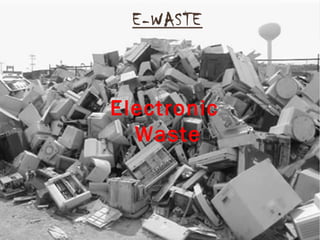
Electronic
Waste
What is E-Waste ???
 Electronic waste or e-
waste is any broken or
unwanted electrical or
electronic appliance.
 E-waste includes
computers,
entertainment
electronics, mobile
phones and other
items that have been
discarded by their
original users.
Why is E-Waste a big problem ?
 Most rapidly growing waste problem in the
world.
 Toxics ingredients, posing a threat to the
occupational health as well as the environment.
 Legal framework, proper collection system
missing.
 Imports regularly coming to the recycling
markets.
 Inhumane working conditions for recycling.
E-Waste Growth
IT and Telecom are two fastest growing industries in
our country
India, by 2011, should achieve a PC penetration of 90
per 1,000 from the existing 34 per 1,000
At present, India has 20 million computers. The target
being 85 million computers by 2011.
Over 3 million old PCs ready for disposal in India.
Life of a computer reduced from 7 years to 3-4 years
Over 200 million current mobile users, expected to
increase to 500 million by 2010 end.
Effect of E-Waste
A Chinese child sits amongst a pile of wires and e-waste. Children can
often be found dismantling e-waste containing many hazardous
chemicals known to be potentially very damaging to children's health.
E-Waste effects
 If toxic chemicals and heavy metals cannot be
disposed of or recycled safely they can end up
polluting the environment if they are burnt or left
in the ground to decay.
 Workers at scrap yards, some of whom are
children, are exposed to a cocktail of toxic
chemicals and poisons.
Element Use in Wireless Technology Harmful Effects
Lead Used primarily in soldering of
circuit boards and other device components
Extremely harmful to the human body; damages
both the central and peripheral nervous systems;
can cause seizures, retardation, high blood
pressure, damage to the kidneys and liver;
adversely affects child development
Beryllium Forms significant portions of electrical connectors
and
battery contacts
Long term exposure can be carcinogenic,
especially for the lungs. Extreme exposure can
lead to a potentially fatal condition known as
Acute Beryllium Disease
Arsenic Used in some integrated circuits
and semiconductors
Arsenic is a notoriously potent poison; causes
severe damage to the digestive tract
Mercury Can be found to a degree in
batteries and circuit boards
Attacks the central nervous and endocrine
systems; harmful to mouth, teeth and gums;
poses risk in the neurological development of
unborn fetuses
Antimony Used in production of diodes
and batteries. Pure form used
in semiconductor production
Toxic to humans in ways similar to arsenic; fatal
in large doses
Cadmium Used in soldering, semiconductors and chip
resistors
Potentially carcinogenic; Repeated exposure can
damage the lungs, kidneys and liver
What can I do ?
Change your Lifestyle
 Recycle, Reduce, Re-use.
 Dispose of objects correctly.
 Look at the sorts of things you throw away
and brainstorm the things you could make
with the rubbish instead.
 Look for companies that offer customers
environment friendly products. Many now
recognise the importance of being aware.
E-Waste Management
Akshay UrjaAkshay Urja
TeamTeam
THANK YOU

E-Waste

  • 1.
  • 2.
    What is E-Waste???  Electronic waste or e- waste is any broken or unwanted electrical or electronic appliance.  E-waste includes computers, entertainment electronics, mobile phones and other items that have been discarded by their original users.
  • 3.
    Why is E-Wastea big problem ?  Most rapidly growing waste problem in the world.  Toxics ingredients, posing a threat to the occupational health as well as the environment.  Legal framework, proper collection system missing.  Imports regularly coming to the recycling markets.  Inhumane working conditions for recycling.
  • 4.
    E-Waste Growth IT andTelecom are two fastest growing industries in our country India, by 2011, should achieve a PC penetration of 90 per 1,000 from the existing 34 per 1,000 At present, India has 20 million computers. The target being 85 million computers by 2011. Over 3 million old PCs ready for disposal in India. Life of a computer reduced from 7 years to 3-4 years Over 200 million current mobile users, expected to increase to 500 million by 2010 end.
  • 5.
    Effect of E-Waste AChinese child sits amongst a pile of wires and e-waste. Children can often be found dismantling e-waste containing many hazardous chemicals known to be potentially very damaging to children's health.
  • 6.
    E-Waste effects  Iftoxic chemicals and heavy metals cannot be disposed of or recycled safely they can end up polluting the environment if they are burnt or left in the ground to decay.  Workers at scrap yards, some of whom are children, are exposed to a cocktail of toxic chemicals and poisons.
  • 7.
    Element Use inWireless Technology Harmful Effects Lead Used primarily in soldering of circuit boards and other device components Extremely harmful to the human body; damages both the central and peripheral nervous systems; can cause seizures, retardation, high blood pressure, damage to the kidneys and liver; adversely affects child development Beryllium Forms significant portions of electrical connectors and battery contacts Long term exposure can be carcinogenic, especially for the lungs. Extreme exposure can lead to a potentially fatal condition known as Acute Beryllium Disease Arsenic Used in some integrated circuits and semiconductors Arsenic is a notoriously potent poison; causes severe damage to the digestive tract Mercury Can be found to a degree in batteries and circuit boards Attacks the central nervous and endocrine systems; harmful to mouth, teeth and gums; poses risk in the neurological development of unborn fetuses Antimony Used in production of diodes and batteries. Pure form used in semiconductor production Toxic to humans in ways similar to arsenic; fatal in large doses Cadmium Used in soldering, semiconductors and chip resistors Potentially carcinogenic; Repeated exposure can damage the lungs, kidneys and liver
  • 12.
  • 13.
    Change your Lifestyle Recycle, Reduce, Re-use.  Dispose of objects correctly.  Look at the sorts of things you throw away and brainstorm the things you could make with the rubbish instead.  Look for companies that offer customers environment friendly products. Many now recognise the importance of being aware.
  • 14.
  • 15.