INVENTORY
AND
INVENTORY CONTROL
PRESENTATION ON: Chapter
Content:
1. Inventory:- Stock of items kept to meet
future demand.
2. Types of Inventory:- Raw materials,
Purchased parts and supplies,Work-in-
process (partially completed) products
(WIP), Items being transported,Tools and
equipment
3. Two forms of Demand:- dependent and
independent.
4. Functions of inventory.
5. Inventory Control.
11. Types of Ordering System.
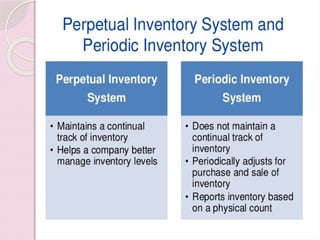
◦ Periodic inventory system.
◦ Perpetual Inventory System
12. Methods of Inventory Control.
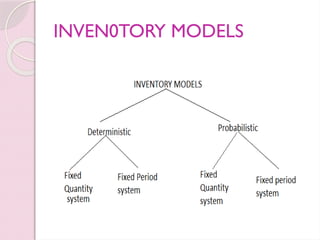
◦ Deterministic Methods
◦ Probabilistic Methods
13. Economic Order Quantity (EOQ).
14. Example of EOQ.
15. Case Study on AMAZON INDIA.
Inventory Management
Inventories today: a curse, a blessing, a must..?
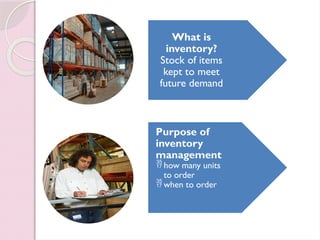
What is
inventory?
Stock of items
kept to meet
future demand
Purpose of
inventory
management
 how many units
to order
 when to order
INVENTORY
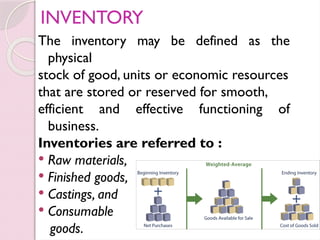
The inventory may be defined as the
physical
stock of good, units or economic resources
that are stored or reserved for smooth,
efficient and effective functioning of
business.
Inventories are referred to :
 Raw materials,
 Finished goods,
 Castings, and
 Consumable
goods.
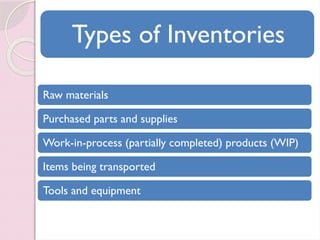
Types of Inventories
Raw materials
Purchased parts and supplies
Work-in-process (partially completed) products (WIP)
Items being transported
Tools and equipment
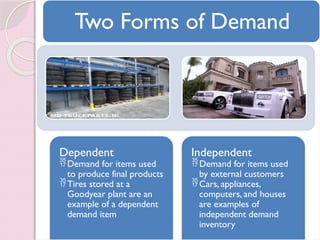
Two Forms of Demand
Dependent
Demand for items used
to produce final products
Tires stored at a
Goodyear plant are an
example of a dependent
demand item
Independent
Demand for items used
by external customers
Cars, appliances,
computers, and houses
are examples of
independent demand
inventory
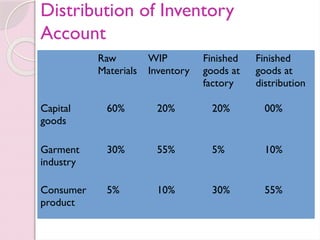
Distribution of Inventory
Account
Raw
Materials
WIP
Inventory
Finished
goods at
factory
Finished
goods at
distribution
Capital
goods
60% 20% 20% 00%
Garment
industry
30% 55% 5% 10%
Consumer
product
5% 10% 30% 55%
WHY DO WE KEEP
INVENTORIES
 Financial Objectives.
 To create a buffer stock b/w the input and
output.
 To ensure against delay in deliveries.
 To allow for a possible increase in output
if so required.
 To ensure against scarcity of material in
the marked.
 To make use of quantity discounts.
 To utilize to advantage price fluctuations.
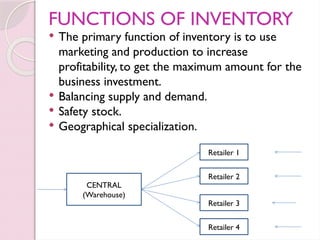
FUNCTIONS OF INVENTORY
 The primary function of inventory is to use
marketing and production to increase
profitability, to get the maximum amount for the
business investment.
 Balancing supply and demand.
 Safety stock.
 Geographical specialization.
CENTRAL
(Warehouse)
Retailer 1
Retailer 2
Retailer 3
Retailer 4
INVENTORY CONTROL
 OBJECTIVE :
(a)To minimize capital
investment.
(b)To ensure availability
of needed inventory for
uninterrupted production
and for meeting
consumer demand.
(c)To provide scientific
basis for planning of
inventory needs.
(d)To tiding over the demand
fluctuation.
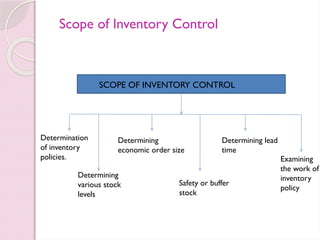
SCOPE OF INVENTORY CONTROL
Determination
of inventory
policies.
Determining
various stock
levels
Determining
economic order size
Safety or buffer
stock
Determining lead
time
Examining
the work of
inventory
policy
Scope of Inventory Control
ADVANTAGES AND DISADVANTAGES
OF INVENTORY CONTROL
ADVANTAGES
 Ensures smooth
production.
 Regular and timely
supply.
 Protects the firm
against variation in
raw materials delivery
time.
 Avoid shortage of
material.
 Minimize loss by
damage, deterioration.
DISADVANTAGES
 Reduce but can’t
eliminate business
risk.
 Control of inventory
is complex.
 Expensive software
and technology.
 It requires constant
attention.
TERMINOLOGY USED IN INVENTORY
 MAXIMUM LIMIT : Upper limit to which the stock of
an inventory item shall be allowed.
 MINIMUM LIMIT : Lower limit to which the stock can
be allowed to fall in the course of replenishment of the
stock of an item.
 SAFETY STOCK : Stock to counter the variation in
demand of an item.
 DEMAND OR USAGE :Average quantity of an item
consumed in a particular period of time.
 LEAD TIME : It is the total time taken from the day
procurement action has been initiated to the day the
stock is replenished.
Thus; Total Lead time (LT) = Internal Lead time +
External Lead time.
Inventory Control Policy of an
Organization
This article throws light upon the four main
factors affecting inventory control policy
of an organization.
The factors are:
1. Manufacturing Characteristics.
2. Amount of Protection against
Shortages.
3. Organizational Factors.
4. Miscellaneous Factors.
1. Manufacturing Characteristics:
The nature of the manufacturing process,
product development & design, process
planning, production planning, layout design has
significant impact on inventory control policy.
Some of these factors are:
a) Degree of specialization and processing stages
of the product.
b) Process capability and flexibility.
c) Production Capacity and Storage Facilities.
d) Quality requirements, obsolescence risk and
shelf life of the product.
e) Number of Production Stages.
2.Amount of Protection against Shortages:
The variation in demand and supply is a routine
phenomenon.The protection against such
unpredictable variations is possible by providing safety
or buffer stocks.
The factors responsible for such variations are:
a) Changes in Size and Frequency of Orders.
b) Unpredictable Sales.
c) Physical and Economical Structure of the Distribution
Pattern.
d) Cost of Shortages.
e) The Accuracy of Demand Forecasts:
f) Protection against interruptions in production process.
3. Organizational Factors:
There are some factors related to the
policies, traditions and working Environment
of any organization/enterprise.
Some of these are listed as follows:
a) Human relations policies of the organization
b) Amount of capital available for inventory
purposes and
c) Rate of returns on un-invested capital or if
capital is invested somewhere else.
4. Miscellaneous Factors:
These are the factors related with the
overall business environment of the
region or area like:
a) Inflation rate.
b) Wars or some unforeseen natural
calamities, floods, earthquakes etc.
c) Uncertainties in communication
facilities.
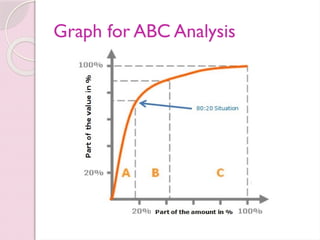
ABC analysis
ABC(Always Better Control)
Group A : Group A consist of costly items
which are 10% to 20% of the total items and
may account for about 50% of the total
values of the store.
Group B : Group B consist of 20% to 30% of
the store items and represent about 30% of
the total value of stores.
Group C: Group C consists of 70% to 80% of
the items covered costing about 20% of the
total value of the store.
Graph for ABC Analysis
Advantages of ABC Analysis
 It provides better control over the costly
items in which a large amount of capital is
invested.
 It ensures considerable reduction in the
storage charges.
 It help in maintaining enough safety stock
of ‘C’ category of items.
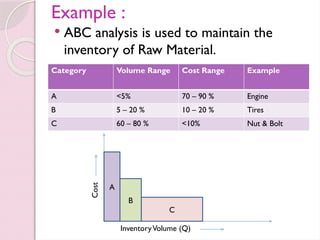
Example :
 ABC analysis is used to maintain the
inventory of Raw Material.
Category Volume Range Cost Range Example
A <5% 70 – 90 % Engine
B 5 – 20 % 10 – 20 % Tires
C 60 – 80 % <10% Nut & Bolt
A
B
C
Cost
InventoryVolume (Q)
Cost Structure In Inventory
 Ordering Cost.
a) cost of ordering excess.
b) cost of ordering too less.
[cost of ordering excess + cost of
ordering too less =Total stocking cost]
Example :Transportation cost ,Salary of
purchase demand ,Loading & unloading
charge etc.
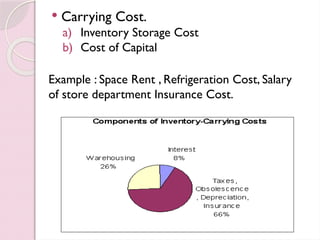
 Carrying Cost.
a) Inventory Storage Cost
b) Cost of Capital
Example : Space Rent , Refrigeration Cost, Salary
of store department Insurance Cost.
 Shortage of stock out Cost & Cost of
Replenishment.
a) Cost of Loss, pilferage, shrinkage and
obsolescence etc.
b) Cost of Logistics
c) Sales Discounts,Volume discounts and other
related costs.
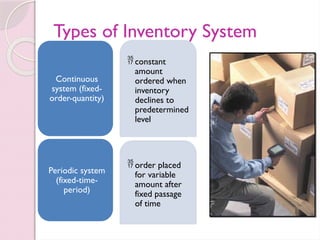
Types of Inventory System
constant
amount
ordered when
inventory
declines to
predetermined
level
Continuous
system (fixed-
order-quantity)
order placed
for variable
amount after
fixed passage
of time
Periodic system
(fixed-time-
period)
A) Periodic Inventory
System
Under this method, the merchandise
company does not maintain a detailed
record of inventory for the result the cost
of goods sold is calculated at the end of the
accounting period (periodically).
Characteristics
 Easier to operate in relatively small firms.
 Lack of control over inventory.
 Less cost to handle the method.
 Does not keep inventory record up-to-
date.
 The system applies to those concerns
usually that sell low-value items (such as
stationery items) in large quantity.
Example
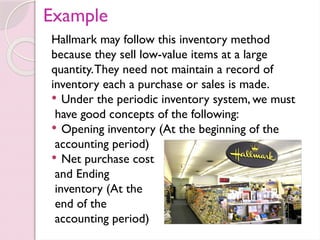
Hallmark may follow this inventory method
because they sell low-value items at a large
quantity.They need not maintain a record of
inventory each a purchase or sales is made.
 Under the periodic inventory system, we must
have good concepts of the following:
 Opening inventory (At the beginning of the
accounting period)
 Net purchase cost
and Ending
inventory (At the
end of the
accounting period)
B) Perpetual Inventory
System
 Under this method, a detailed record of
the cost of inventory is maintained each
time a purchase or a sale is made.
 As a result, the system consciously shows
the up-to-date record of inventory that
should be on hand.The cost of goods sold
is calculated each time a purchase or a sale
is made, not at the end of an accounting
period.
Characteristics
 It requires more efforts to maintain
inventory under this method.
 Close control over inventory
 The method is comparatively costly
 Keeps inventory record up-to-date and
decent.
 The method applies to those concerns
usually that sell high-value items (Such as
car, personal computer, equipment etc.)
not at a large quantity as compared to
items under the periodic system.
Example
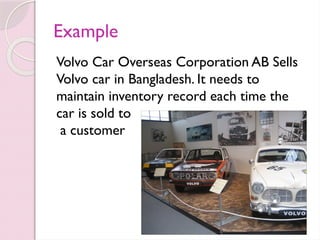
Volvo Car Overseas Corporation AB Sells
Volvo car in Bangladesh. It needs to
maintain inventory record each time the
car is sold to
a customer
INVEN0TORY MODELS
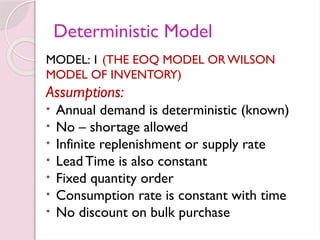
Deterministic Model
MODEL: 1 (THE EOQ MODEL ORWILSON
MODEL OF INVENTORY)
Assumptions:
• Annual demand is deterministic (known)
• No – shortage allowed
• Infinite replenishment or supply rate
• Lead Time is also constant
• Fixed quantity order
• Consumption rate is constant with time
• No discount on bulk purchase
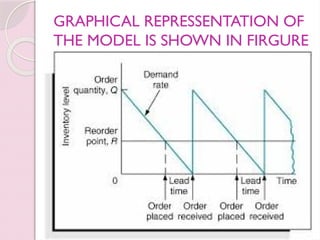
GRAPHICAL REPRESSENTATION OF
THE MODEL IS SHOWN IN FIRGURE
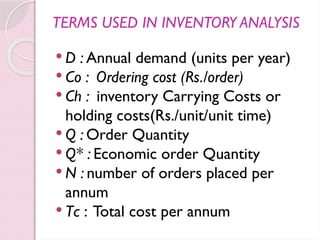
TERMS USED IN INVENTORY ANALYSIS
 D : Annual demand (units per year)
 Co : Ordering cost (Rs./order)
 Ch : inventory Carrying Costs or
holding costs(Rs./unit/unit time)
 Q : Order Quantity
 Q* : Economic order Quantity
 N : number of orders placed per
annum
 Tc : Total cost per annum
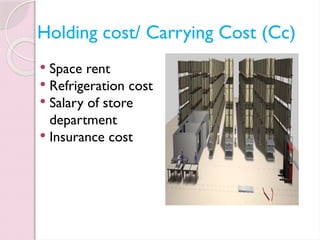
Holding cost/ Carrying Cost (Cc)
 Space rent
 Refrigeration cost
 Salary of store
department
 Insurance cost
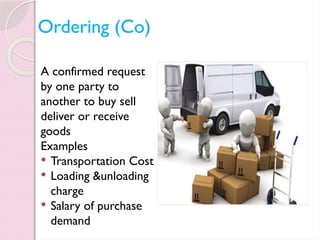
Ordering (Co)
A confirmed request
by one party to
another to buy sell
deliver or receive
goods
Examples
 Transportation Cost
 Loading &unloading
charge
 Salary of purchase
demand
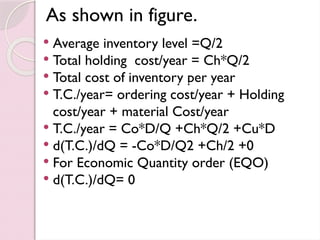
As shown in figure.
 Average inventory level =Q/2
 Total holding cost/year = Ch*Q/2
 Total cost of inventory per year
 T.C./year= ordering cost/year + Holding
cost/year + material Cost/year
 T.C./year = Co*D/Q +Ch*Q/2 +Cu*D
 d(T.C.)/dQ = -Co*D/Q2 +Ch/2 +0
 For Economic Quantity order (EQO)
 d(T.C.)/dQ= 0
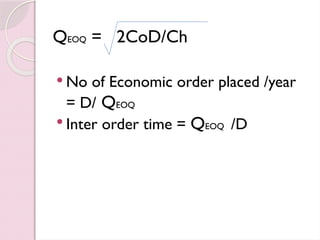
QEOQ = 2CoD/Ch
 No of Economic order placed /year
= D/ QEOQ
 Inter order time = QEOQ /D
MODEL : 2 (Economic order
Quantity when Stock Replenishment is
Non Instantaneous (production
Model)
Assumptions
 All assumption as per model (1)
Expect Infinite replenishment rate
TERMS USED IN ANLYSIS OF
MODEL :2
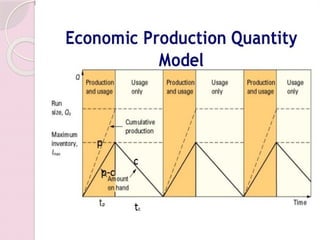
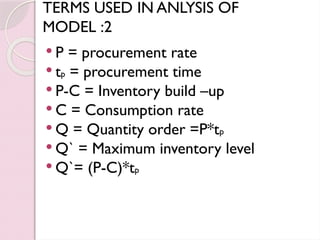
 P = procurement rate
 tp = procurement time
 P-C = Inventory build –up
 C = Consumption rate
 Q = Quantity order =P*tp
 Q` = Maximum inventory level
 Q`= (P-C)*tp
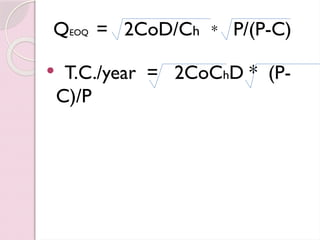
QEOQ = 2CoD/Ch * P/(P-C)
 T.C./year = 2CoChD * (P-
C)/P
MODEL 3:
Assumptions
 All assumption as per as Model (1)
expect shortage allowed
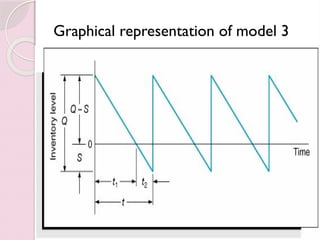
Graphical representation of model 3
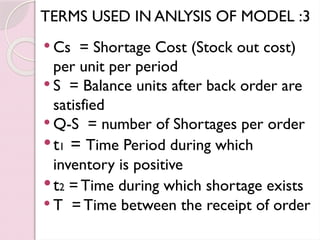
TERMS USED IN ANLYSIS OF MODEL :3
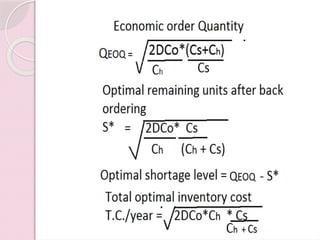
 Cs = Shortage Cost (Stock out cost)
per unit per period
 S = Balance units after back order are
satisfied
 Q-S = number of Shortages per order
t1 = Time Period during which
inventory is positive
t2 = Time during which shortage exists
 T = Time between the receipt of order
MODEL 4: (Discount available
on bulk purchase)
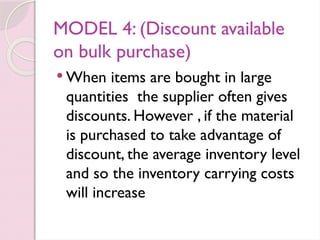
 When items are bought in large
quantities the supplier often gives
discounts. However , if the material
is purchased to take advantage of
discount, the average inventory level
and so the inventory carrying costs
will increase
PRICE DISCOUNT MODEL
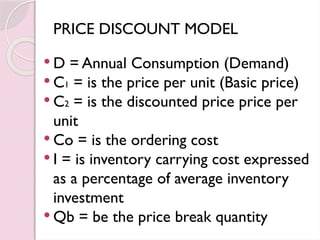
 D = Annual Consumption (Demand)
 C1 = is the price per unit (Basic price)
 C2 = is the discounted price price per
unit
 Co = is the ordering cost
 I = is inventory carrying cost expressed
as a percentage of average inventory
investment
 Qb = be the price break quantity
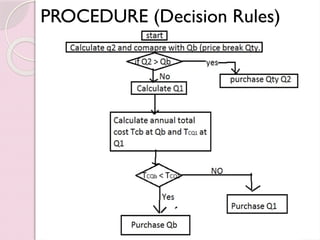
PROCEDURE (Decision Rules)
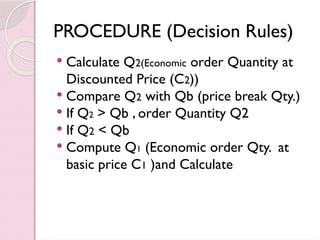
 Calculate Q2(Economic order Quantity at
Discounted Price (C2))
 Compare Q2 with Qb (price break Qty.)
 If Q2 > Qb , order Quantity Q2
 If Q2 < Qb
 Compute Q1 (Economic order Qty. at
basic price C1 )and Calculate
PROCEDURE (Decision Rules)
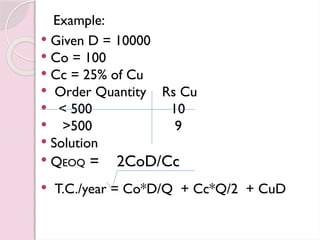
Example:
 Given D = 10000
 Co = 100
 Cc = 25% of Cu
 Order Quantity Rs Cu
 < 500 10
 >500 9
 Solution
 QEOQ = 2CoD/Cc
 T.C./year = Co*D/Q + Cc*Q/2 + CuD
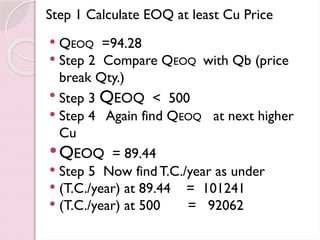
Step 1 Calculate EOQ at least Cu Price
 QEOQ =94.28
 Step 2 Compare QEOQ with Qb (price
break Qty.)
 Step 3 QEOQ < 500
 Step 4 Again find QEOQ at next higher
Cu
QEOQ = 89.44
 Step 5 Now findT.C./year as under
 (T.C./year) at 89.44 = 101241
 (T.C./year) at 500 = 92062
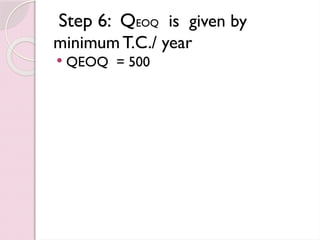
Step 6: QEOQ is given by
minimum T.C./ year
 QEOQ = 500
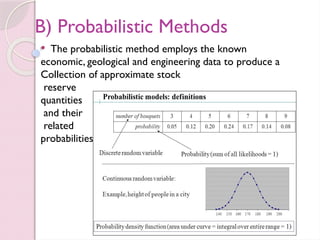
B) Probabilistic Methods
 The probabilistic method employs the known
economic, geological and engineering data to produce a
Collection of approximate stock
reserve
quantities
and their
related
probabilities.
CASE STUDY:AMAZON TODAY
One of the
first
shopping site
launched in
year 1995
Initially
started as
online book
store, later
added
considerable
items to
consolidate
its position
On an
average,
added a new
product
once in
every six
week (from
year 1999).
Inventory Management at AMAZON
Company
was negative
on spending
time in
opening
stores and
warehouse
Later started
maintaining
its own
warehouse
Each ware
house
establishmen
t cost was
estimated to
be $50
million
Established
10
warehouse
in U.S.A by
making its
bonds worth
$2 billion
public
Innovative Inventory Management
In early
2001,
Amazon
decided to
outsource
its inventory
management
.
The step
was in order
to increase
the profit
margin.
Stocked only
popular
items and
request less
popular
item to
dealer
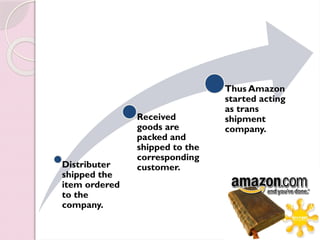
Distributer
shipped the
item ordered
to the
company.
Received
goods are
packed and
shipped to the
corresponding
customer.
Thus Amazon
started acting
as trans
shipment
company.
THE END

Chapter 6 Inventory Management production management.pptx

  • 1.
  • 2.
    Content: 1. Inventory:- Stockof items kept to meet future demand. 2. Types of Inventory:- Raw materials, Purchased parts and supplies,Work-in- process (partially completed) products (WIP), Items being transported,Tools and equipment 3. Two forms of Demand:- dependent and independent. 4. Functions of inventory. 5. Inventory Control.
  • 3.
    11. Types ofOrdering System. ◦ Periodic inventory system. ◦ Perpetual Inventory System 12. Methods of Inventory Control. ◦ Deterministic Methods ◦ Probabilistic Methods 13. Economic Order Quantity (EOQ). 14. Example of EOQ. 15. Case Study on AMAZON INDIA.
  • 4.
    Inventory Management Inventories today:a curse, a blessing, a must..?
  • 5.
    What is inventory? Stock ofitems kept to meet future demand Purpose of inventory management  how many units to order  when to order
  • 6.
    INVENTORY The inventory maybe defined as the physical stock of good, units or economic resources that are stored or reserved for smooth, efficient and effective functioning of business. Inventories are referred to :  Raw materials,  Finished goods,  Castings, and  Consumable goods.
  • 7.
    Types of Inventories Rawmaterials Purchased parts and supplies Work-in-process (partially completed) products (WIP) Items being transported Tools and equipment
  • 8.
    Two Forms ofDemand Dependent Demand for items used to produce final products Tires stored at a Goodyear plant are an example of a dependent demand item Independent Demand for items used by external customers Cars, appliances, computers, and houses are examples of independent demand inventory
  • 9.
    Distribution of Inventory Account Raw Materials WIP Inventory Finished goodsat factory Finished goods at distribution Capital goods 60% 20% 20% 00% Garment industry 30% 55% 5% 10% Consumer product 5% 10% 30% 55%
  • 10.
    WHY DO WEKEEP INVENTORIES  Financial Objectives.  To create a buffer stock b/w the input and output.  To ensure against delay in deliveries.  To allow for a possible increase in output if so required.  To ensure against scarcity of material in the marked.  To make use of quantity discounts.  To utilize to advantage price fluctuations.
  • 11.
    FUNCTIONS OF INVENTORY The primary function of inventory is to use marketing and production to increase profitability, to get the maximum amount for the business investment.  Balancing supply and demand.  Safety stock.  Geographical specialization. CENTRAL (Warehouse) Retailer 1 Retailer 2 Retailer 3 Retailer 4
  • 12.
    INVENTORY CONTROL  OBJECTIVE: (a)To minimize capital investment. (b)To ensure availability of needed inventory for uninterrupted production and for meeting consumer demand. (c)To provide scientific basis for planning of inventory needs. (d)To tiding over the demand fluctuation.
  • 13.
    SCOPE OF INVENTORYCONTROL Determination of inventory policies. Determining various stock levels Determining economic order size Safety or buffer stock Determining lead time Examining the work of inventory policy Scope of Inventory Control
  • 14.
    ADVANTAGES AND DISADVANTAGES OFINVENTORY CONTROL ADVANTAGES  Ensures smooth production.  Regular and timely supply.  Protects the firm against variation in raw materials delivery time.  Avoid shortage of material.  Minimize loss by damage, deterioration. DISADVANTAGES  Reduce but can’t eliminate business risk.  Control of inventory is complex.  Expensive software and technology.  It requires constant attention.
  • 15.
    TERMINOLOGY USED ININVENTORY  MAXIMUM LIMIT : Upper limit to which the stock of an inventory item shall be allowed.  MINIMUM LIMIT : Lower limit to which the stock can be allowed to fall in the course of replenishment of the stock of an item.  SAFETY STOCK : Stock to counter the variation in demand of an item.  DEMAND OR USAGE :Average quantity of an item consumed in a particular period of time.  LEAD TIME : It is the total time taken from the day procurement action has been initiated to the day the stock is replenished. Thus; Total Lead time (LT) = Internal Lead time + External Lead time.
  • 16.
    Inventory Control Policyof an Organization This article throws light upon the four main factors affecting inventory control policy of an organization. The factors are: 1. Manufacturing Characteristics. 2. Amount of Protection against Shortages. 3. Organizational Factors. 4. Miscellaneous Factors.
  • 17.
    1. Manufacturing Characteristics: Thenature of the manufacturing process, product development & design, process planning, production planning, layout design has significant impact on inventory control policy. Some of these factors are: a) Degree of specialization and processing stages of the product. b) Process capability and flexibility. c) Production Capacity and Storage Facilities. d) Quality requirements, obsolescence risk and shelf life of the product. e) Number of Production Stages.
  • 18.
    2.Amount of Protectionagainst Shortages: The variation in demand and supply is a routine phenomenon.The protection against such unpredictable variations is possible by providing safety or buffer stocks. The factors responsible for such variations are: a) Changes in Size and Frequency of Orders. b) Unpredictable Sales. c) Physical and Economical Structure of the Distribution Pattern. d) Cost of Shortages. e) The Accuracy of Demand Forecasts: f) Protection against interruptions in production process.
  • 19.
    3. Organizational Factors: Thereare some factors related to the policies, traditions and working Environment of any organization/enterprise. Some of these are listed as follows: a) Human relations policies of the organization b) Amount of capital available for inventory purposes and c) Rate of returns on un-invested capital or if capital is invested somewhere else.
  • 20.
    4. Miscellaneous Factors: Theseare the factors related with the overall business environment of the region or area like: a) Inflation rate. b) Wars or some unforeseen natural calamities, floods, earthquakes etc. c) Uncertainties in communication facilities.
  • 21.
    ABC analysis ABC(Always BetterControl) Group A : Group A consist of costly items which are 10% to 20% of the total items and may account for about 50% of the total values of the store. Group B : Group B consist of 20% to 30% of the store items and represent about 30% of the total value of stores. Group C: Group C consists of 70% to 80% of the items covered costing about 20% of the total value of the store.
  • 22.
    Graph for ABCAnalysis
  • 23.
    Advantages of ABCAnalysis  It provides better control over the costly items in which a large amount of capital is invested.  It ensures considerable reduction in the storage charges.  It help in maintaining enough safety stock of ‘C’ category of items.
  • 24.
    Example :  ABCanalysis is used to maintain the inventory of Raw Material. Category Volume Range Cost Range Example A <5% 70 – 90 % Engine B 5 – 20 % 10 – 20 % Tires C 60 – 80 % <10% Nut & Bolt A B C Cost InventoryVolume (Q)
  • 25.
    Cost Structure InInventory  Ordering Cost. a) cost of ordering excess. b) cost of ordering too less. [cost of ordering excess + cost of ordering too less =Total stocking cost] Example :Transportation cost ,Salary of purchase demand ,Loading & unloading charge etc.
  • 26.
     Carrying Cost. a)Inventory Storage Cost b) Cost of Capital Example : Space Rent , Refrigeration Cost, Salary of store department Insurance Cost.
  • 27.
     Shortage ofstock out Cost & Cost of Replenishment. a) Cost of Loss, pilferage, shrinkage and obsolescence etc. b) Cost of Logistics c) Sales Discounts,Volume discounts and other related costs.
  • 28.
    Types of InventorySystem constant amount ordered when inventory declines to predetermined level Continuous system (fixed- order-quantity) order placed for variable amount after fixed passage of time Periodic system (fixed-time- period)
  • 29.
    A) Periodic Inventory System Underthis method, the merchandise company does not maintain a detailed record of inventory for the result the cost of goods sold is calculated at the end of the accounting period (periodically).
  • 30.
    Characteristics  Easier tooperate in relatively small firms.  Lack of control over inventory.  Less cost to handle the method.  Does not keep inventory record up-to- date.  The system applies to those concerns usually that sell low-value items (such as stationery items) in large quantity.
  • 31.
    Example Hallmark may followthis inventory method because they sell low-value items at a large quantity.They need not maintain a record of inventory each a purchase or sales is made.  Under the periodic inventory system, we must have good concepts of the following:  Opening inventory (At the beginning of the accounting period)  Net purchase cost and Ending inventory (At the end of the accounting period)
  • 32.
    B) Perpetual Inventory System Under this method, a detailed record of the cost of inventory is maintained each time a purchase or a sale is made.  As a result, the system consciously shows the up-to-date record of inventory that should be on hand.The cost of goods sold is calculated each time a purchase or a sale is made, not at the end of an accounting period.
  • 33.
    Characteristics  It requiresmore efforts to maintain inventory under this method.  Close control over inventory  The method is comparatively costly  Keeps inventory record up-to-date and decent.  The method applies to those concerns usually that sell high-value items (Such as car, personal computer, equipment etc.) not at a large quantity as compared to items under the periodic system.
  • 34.
    Example Volvo Car OverseasCorporation AB Sells Volvo car in Bangladesh. It needs to maintain inventory record each time the car is sold to a customer
  • 36.
  • 37.
    Deterministic Model MODEL: 1(THE EOQ MODEL ORWILSON MODEL OF INVENTORY) Assumptions: • Annual demand is deterministic (known) • No – shortage allowed • Infinite replenishment or supply rate • Lead Time is also constant • Fixed quantity order • Consumption rate is constant with time • No discount on bulk purchase
  • 38.
    GRAPHICAL REPRESSENTATION OF THEMODEL IS SHOWN IN FIRGURE
  • 39.
    TERMS USED ININVENTORY ANALYSIS  D : Annual demand (units per year)  Co : Ordering cost (Rs./order)  Ch : inventory Carrying Costs or holding costs(Rs./unit/unit time)  Q : Order Quantity  Q* : Economic order Quantity  N : number of orders placed per annum  Tc : Total cost per annum
  • 40.
    Holding cost/ CarryingCost (Cc)  Space rent  Refrigeration cost  Salary of store department  Insurance cost
  • 41.
    Ordering (Co) A confirmedrequest by one party to another to buy sell deliver or receive goods Examples  Transportation Cost  Loading &unloading charge  Salary of purchase demand
  • 42.
    As shown infigure.  Average inventory level =Q/2  Total holding cost/year = Ch*Q/2  Total cost of inventory per year  T.C./year= ordering cost/year + Holding cost/year + material Cost/year  T.C./year = Co*D/Q +Ch*Q/2 +Cu*D  d(T.C.)/dQ = -Co*D/Q2 +Ch/2 +0  For Economic Quantity order (EQO)  d(T.C.)/dQ= 0
  • 43.
    QEOQ = 2CoD/Ch No of Economic order placed /year = D/ QEOQ  Inter order time = QEOQ /D
  • 44.
    MODEL : 2(Economic order Quantity when Stock Replenishment is Non Instantaneous (production Model) Assumptions  All assumption as per model (1) Expect Infinite replenishment rate
  • 46.
    TERMS USED INANLYSIS OF MODEL :2  P = procurement rate  tp = procurement time  P-C = Inventory build –up  C = Consumption rate  Q = Quantity order =P*tp  Q` = Maximum inventory level  Q`= (P-C)*tp
  • 47.
    QEOQ = 2CoD/Ch* P/(P-C)  T.C./year = 2CoChD * (P- C)/P
  • 48.
    MODEL 3: Assumptions  Allassumption as per as Model (1) expect shortage allowed
  • 49.
  • 50.
    TERMS USED INANLYSIS OF MODEL :3  Cs = Shortage Cost (Stock out cost) per unit per period  S = Balance units after back order are satisfied  Q-S = number of Shortages per order t1 = Time Period during which inventory is positive t2 = Time during which shortage exists  T = Time between the receipt of order
  • 52.
    MODEL 4: (Discountavailable on bulk purchase)  When items are bought in large quantities the supplier often gives discounts. However , if the material is purchased to take advantage of discount, the average inventory level and so the inventory carrying costs will increase
  • 53.
    PRICE DISCOUNT MODEL D = Annual Consumption (Demand)  C1 = is the price per unit (Basic price)  C2 = is the discounted price price per unit  Co = is the ordering cost  I = is inventory carrying cost expressed as a percentage of average inventory investment  Qb = be the price break quantity
  • 54.
    PROCEDURE (Decision Rules) Calculate Q2(Economic order Quantity at Discounted Price (C2))  Compare Q2 with Qb (price break Qty.)  If Q2 > Qb , order Quantity Q2  If Q2 < Qb  Compute Q1 (Economic order Qty. at basic price C1 )and Calculate
  • 55.
  • 56.
    Example:  Given D= 10000  Co = 100  Cc = 25% of Cu  Order Quantity Rs Cu  < 500 10  >500 9  Solution  QEOQ = 2CoD/Cc  T.C./year = Co*D/Q + Cc*Q/2 + CuD
  • 57.
    Step 1 CalculateEOQ at least Cu Price  QEOQ =94.28  Step 2 Compare QEOQ with Qb (price break Qty.)  Step 3 QEOQ < 500  Step 4 Again find QEOQ at next higher Cu QEOQ = 89.44  Step 5 Now findT.C./year as under  (T.C./year) at 89.44 = 101241  (T.C./year) at 500 = 92062
  • 58.
    Step 6: QEOQis given by minimum T.C./ year  QEOQ = 500
  • 59.
    B) Probabilistic Methods The probabilistic method employs the known economic, geological and engineering data to produce a Collection of approximate stock reserve quantities and their related probabilities.
  • 60.
    CASE STUDY:AMAZON TODAY Oneof the first shopping site launched in year 1995 Initially started as online book store, later added considerable items to consolidate its position On an average, added a new product once in every six week (from year 1999).
  • 61.
    Inventory Management atAMAZON Company was negative on spending time in opening stores and warehouse Later started maintaining its own warehouse Each ware house establishmen t cost was estimated to be $50 million Established 10 warehouse in U.S.A by making its bonds worth $2 billion public
  • 62.
    Innovative Inventory Management Inearly 2001, Amazon decided to outsource its inventory management . The step was in order to increase the profit margin. Stocked only popular items and request less popular item to dealer
  • 63.
    Distributer shipped the item ordered tothe company. Received goods are packed and shipped to the corresponding customer. Thus Amazon started acting as trans shipment company.
  • 64.