06/08/09
Inventory Definition A stock of items held to meet future demand Inventory is a list for goods and materials, or those goods and materials themselves, held available in stock by a business . 06/08/09
Introduction Constitute significant part of current assets On an average approximately 60% of current assets in Public Limited Companies in India A considerable amount of fund is required Effective and efficient management is imperative to avoid unnecessary investment Improper inventory management affects long term profitability and may fail ultimately 10 to 20% of inventory can be reduced without any adverse effect on production and sales by using simple inventory planning and control techniques 06/08/09
Types of Inventory 06/08/09 Work in process Work in process Work in process Finished goods Raw Materials Vendors Customer
Nature of Inventories Raw Materials  – Basic inputs that are converted into finished product through the manufacturing process Work-in-progress  – Semi-manufactured products need some more works before they become finished goods for sale Finished Goods  – Completely manufactured products ready for sale Supplies  – Office and plant cleaning materials not directly enter production but are necessary for production process and do not involve significant investment.  06/08/09
Reasons  To Hold  Inventory Meet variations in customer demand: Meet unexpected demand Smooth seasonal or cyclical demand Pricing related: Temporary price discounts Hedge against price increases Take advantage of quantity discounts Process & supply surprises Internal – upsets in parts of or our own processes External – delays in incoming goods 06/08/09
Objective of Inventory Management To maintain a optimum size of inventory for efficient and smooth production and sales operations To maintain a minimum investment in inventories to maximize the profitability Effort should be made to place an order at the  right time  with  right source  to acquire the  right quantity  at the  right price  and  right quality  06/08/09
An effective inventory management should Ensure a continuous supply of raw materials to facilitate uninterrupted production Maintain sufficient stocks of raw materials in periods of short supply and anticipate price changes Maintain sufficient finished goods inventory for smooth sales operation, and efficient customer service Minimize the carrying cost and time Control investment in inventories and keep it at an optimum level 06/08/09
An optimum inventory level involves three types of costs Ordering costs:- Quotation or tendering Requisitioning Order placing Transportation Receiving, inspecting and storing Quality control Clerical and staff Stock-out cost Loss of sale Failure to meet delivery commitments Carrying costs:- Warehousing or storage Handling Clerical and staff Insurance Interest Deterioration,shrinkage, evaporation and obsolescence Taxes Cost of capital 06/08/09
Dangers of Over investment Unnecessary tie-up of firm’s fund and loss of profit – involves opportunity cost Excessive carrying cost Risk of liquidity- difficult to convert into cash Physical deterioration of inventories while in storage due to mishandling and improper storage facilities 06/08/09
Dangers of under-investment Production hold-ups – loss of labor hours Failure to meet delivery commitments Customers may shift to competitors which will amount to a permanent loss to the firm May affect the goodwill and image of the firm 06/08/09
Functions of Inventory Management 06/08/09 -Track inventory  How much to order When to order
Classification of inventory ABC Classification HML Classification XYZ Classification VED Classification FSN Classification SDF Classification GOLF Classification SOS Classification
ABC Classification In most of the cases 10 to 20 % of the inventory account for 70 to 80% of the annual activity. A typical manufacturing operation shows that the top 15% of the line items, in terms of annual rupees usage, represent 80% of total annual rupees usage. Next 15% of items reflect 15% of annual rupees Next 70% accounts only for 5% usage A B C
XYZ Classification On the basis of value of inventory stored Whereas ABC was on the basis of value of consumption to value. X – High Value Y – Medium value Z – Least value Aimed to identify items which are extensively stocked.
HML Classification On the basis of unit value of item There is 1000 unit of Q @ Rs. 10 and 10,000 units of W @ Rs. 5. Aimed to control the purchase of raw materials. H – High, M- Medium, L - Low
VED Classification Mainly for spare parts because their consumption pattern is different from raw materials. Raw materials on market demand Spare parts on performance of plant and machinery. V – Vital, E – Essential, D – Desirable Therefore V items has to be stocked more  and D Items has to be less stocked
FSN Classification According to the consumption pattern To combat obsolete items F – Fast moving S – Slow moving N – Non Moving
SDF & GOLF Classification Based on source of procurement S – Scarce, D- Difficult, E- Easy. GOLF G – Government, O – Ordinary, L – Local, F – Foreign.
SOS Classification Raw materials especially for agriculture units S – Seasonal OS – Off seasonal
Deciding on the inventory model Assume an analyst applies an inventory model that does not allow for spoilage to a grocery chain’s ordering policy for lettuce and formulates the strategy of ordering lettuce in large amounts every 14 days. A little thought will show that this is obliviously foolish. This strategy implies that lettuce will be spoiled. However it is not a failure of inventory, it is a failure to apply the correct model.
Different approaches Certainty approach Uncertain variables and risk are addressed separately Uncertainty approach Uncertain variables and risk are addressed simultaneously Deterministic approach Probabilistic approach
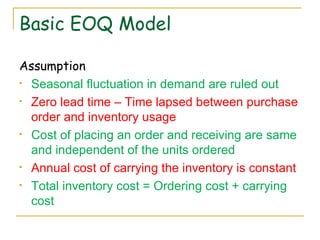
Basic EOQ Model Assumption Seasonal fluctuation in demand are ruled out Zero lead time – Time lapsed between purchase order and inventory usage Cost of placing an order and receiving are same and independent of the units ordered Annual cost of carrying the inventory is constant Total inventory cost = Ordering cost + carrying cost
EOQ – Three Approaches Trial and Error method Order-formula approach Graphical approach 06/08/09
EOQ & Re-order point EOQ – gives answer to question “How much to Order” Re-order point – gives answer to question “when to order” 06/08/09
Trial & Error Method Assumptions:- Annual requirement (C)=1200 units Carrying cost (I) = Rs.1 Ordering cost (O) =Rs.37.5 06/08/09 Order size Q  1200 600 400 300 240 200 150 120 100 Average inventory Q/2  600 300 200 150 120 100 75 60 50 No. of orders C/Q  1 2 3 4 5 6 8 10 12 Annual carrying cost I* Q/2  600 300 200 150 120 100 75 60 50 Annual ordering cost O*C/Q  37.5 75 112.5 150 187.5 225 300 375 450 Total annual cost  637.5 375 312.5 300 307.5 325 375 435 500
Order- Formula approach 1/2 EOQ =(2CO/I) C = Annual demand O = Ordering cost per order I  = Carrying cost per unit 1/2 EOQ =(2*1200*37.5/1)  = 300 units 06/08/09
Q 0 T1 T2 T3 T4 Average inventory = Q/2 Time Inventory  level order quantity Certainty case of the inventory cycle Here the negative slope from Q to T1 represents the inventory being used up T1, T2, T3, T4 represents the replenishment points The inventory varies between 0 and Q
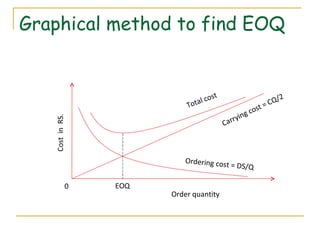
Graphical method to find EOQ Cost  in  RS. Order quantity 0 Ordering cost = DS/Q Carrying cost = CQ/2 Total cost  EOQ
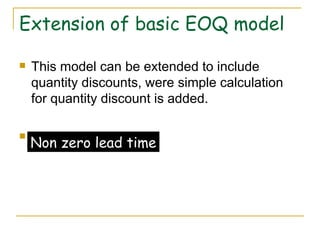
Extension of basic EOQ model This model can be extended to include quantity discounts, were simple calculation for quantity discount is added. Non zero lead time Non zero lead time
Extension of basic EOQ model Non – zero lead time If the lead time is ‘n’ then procurement must be done prior to ‘n’ days, i.e. T-n as shown in the figure T1 - n T2 - n T3 - n T4 - n T1  T2  T3  T4  Time Q 0 Reorder point Placement of a order
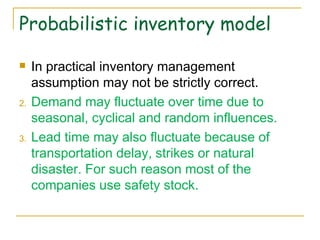
Probabilistic inventory model In practical inventory management assumption may not be strictly correct.  Demand may fluctuate over time due to seasonal, cyclical and random influences.  Lead time may also fluctuate because of transportation delay, strikes or natural disaster. For such reason most of the companies use safety stock.
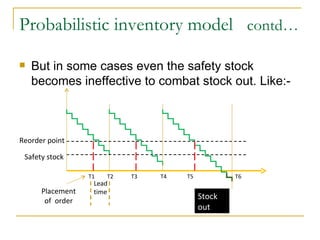
But in some cases even the safety stock becomes ineffective to combat stock out. Like:- Probabilistic inventory model  contd… Reorder point Safety stock Placement of  order Lead time T1 T2 T3 T4 T5 T6 Stock out
A Review So we have dealt with  EOQ model Its extension Probabilistic model And now we will be dealing with  special inventory models
Special inventory model Non – Instantaneous replenishment Quantity Discount One – period decision
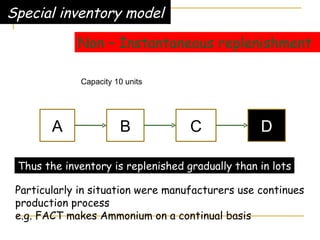
Non – Instantaneous replenishment Special inventory model A B C D A B C Thus the inventory is replenished gradually than in lots Particularly in situation were manufacturers use continues  production process e.g. FACT makes Ammonium on a continual basis Capacity 10 units
Discount Quantities If discount increases with the order quantity, then the price of inventory is no more constant Special inventory model Hence a new approach is needed to find the best lot size Total cost Annual holding cost Annual ordering cost Annual cost of materials = + +
One period decisions If a newspaper seller does not buy enough papers to resell on the street corner, sales opportunity is lost. If the seller buys too many, the overage cannot be sold because nobody wants yesterdays newspaper. Special inventory model Applicable to fashion goods, seasonal goods and  due to change in technology The  newsboy  problem
Inventory management under uncertainty Option price model Risk adjusted discount cash flow (DFC) Model Dynamic inventory model
Option price model Option is a contract that gives the holder a right to acquire or sell certain things at a predetermined price without any obligation. Calculated by integrating the market information and inventory control.
Risk adjusted discount cash flow (DFC) Model Inventory control problem is converted to capital budget problem Suppose a television dealer decides to hold an additional inventory of 1000 television per month. The cost of holding inventory is spread overtime. Inflows = no: of units × probability × present value Beneficial for projects like oil drilling were the  benefit is acquired only after a long time  but  once oil is struck the additional expanse is covered.
Dynamic inventory model Uncertain variables are identified Probability associated with them is taken Simulation techniques are applied
Emerging trends in inventory management Entering into log term contract at a fixed price to reduce uncertainties Just-in-time Kanbans – Japanese technique (Only produce when demand comes) Internet based ordering system Supply chain management Vendor development Investment in plant and machinery
Inventory control responsibility Purchasing naturally has vest interest in inventories, even to the extend that in some companies the purchasing and stores functions are combined. Production looks after the work in progress Logistics plays a major role in inventory control Inventories are economic importance to finance department The fact that materials must be moved from one place to another is of importance to materials department In effect the responsibility cannot be kept  on one head since inventory management  is a integrated effort
THANK YOU

Inventory Management

  • 1.
  • 2.
    Inventory Definition Astock of items held to meet future demand Inventory is a list for goods and materials, or those goods and materials themselves, held available in stock by a business . 06/08/09
  • 3.
    Introduction Constitute significantpart of current assets On an average approximately 60% of current assets in Public Limited Companies in India A considerable amount of fund is required Effective and efficient management is imperative to avoid unnecessary investment Improper inventory management affects long term profitability and may fail ultimately 10 to 20% of inventory can be reduced without any adverse effect on production and sales by using simple inventory planning and control techniques 06/08/09
  • 4.
    Types of Inventory06/08/09 Work in process Work in process Work in process Finished goods Raw Materials Vendors Customer
  • 5.
    Nature of InventoriesRaw Materials – Basic inputs that are converted into finished product through the manufacturing process Work-in-progress – Semi-manufactured products need some more works before they become finished goods for sale Finished Goods – Completely manufactured products ready for sale Supplies – Office and plant cleaning materials not directly enter production but are necessary for production process and do not involve significant investment. 06/08/09
  • 6.
    Reasons ToHold Inventory Meet variations in customer demand: Meet unexpected demand Smooth seasonal or cyclical demand Pricing related: Temporary price discounts Hedge against price increases Take advantage of quantity discounts Process & supply surprises Internal – upsets in parts of or our own processes External – delays in incoming goods 06/08/09
  • 7.
    Objective of InventoryManagement To maintain a optimum size of inventory for efficient and smooth production and sales operations To maintain a minimum investment in inventories to maximize the profitability Effort should be made to place an order at the right time with right source to acquire the right quantity at the right price and right quality 06/08/09
  • 8.
    An effective inventorymanagement should Ensure a continuous supply of raw materials to facilitate uninterrupted production Maintain sufficient stocks of raw materials in periods of short supply and anticipate price changes Maintain sufficient finished goods inventory for smooth sales operation, and efficient customer service Minimize the carrying cost and time Control investment in inventories and keep it at an optimum level 06/08/09
  • 9.
    An optimum inventorylevel involves three types of costs Ordering costs:- Quotation or tendering Requisitioning Order placing Transportation Receiving, inspecting and storing Quality control Clerical and staff Stock-out cost Loss of sale Failure to meet delivery commitments Carrying costs:- Warehousing or storage Handling Clerical and staff Insurance Interest Deterioration,shrinkage, evaporation and obsolescence Taxes Cost of capital 06/08/09
  • 10.
    Dangers of Overinvestment Unnecessary tie-up of firm’s fund and loss of profit – involves opportunity cost Excessive carrying cost Risk of liquidity- difficult to convert into cash Physical deterioration of inventories while in storage due to mishandling and improper storage facilities 06/08/09
  • 11.
    Dangers of under-investmentProduction hold-ups – loss of labor hours Failure to meet delivery commitments Customers may shift to competitors which will amount to a permanent loss to the firm May affect the goodwill and image of the firm 06/08/09
  • 12.
    Functions of InventoryManagement 06/08/09 -Track inventory How much to order When to order
  • 13.
    Classification of inventoryABC Classification HML Classification XYZ Classification VED Classification FSN Classification SDF Classification GOLF Classification SOS Classification
  • 14.
    ABC Classification Inmost of the cases 10 to 20 % of the inventory account for 70 to 80% of the annual activity. A typical manufacturing operation shows that the top 15% of the line items, in terms of annual rupees usage, represent 80% of total annual rupees usage. Next 15% of items reflect 15% of annual rupees Next 70% accounts only for 5% usage A B C
  • 15.
    XYZ Classification Onthe basis of value of inventory stored Whereas ABC was on the basis of value of consumption to value. X – High Value Y – Medium value Z – Least value Aimed to identify items which are extensively stocked.
  • 16.
    HML Classification Onthe basis of unit value of item There is 1000 unit of Q @ Rs. 10 and 10,000 units of W @ Rs. 5. Aimed to control the purchase of raw materials. H – High, M- Medium, L - Low
  • 17.
    VED Classification Mainlyfor spare parts because their consumption pattern is different from raw materials. Raw materials on market demand Spare parts on performance of plant and machinery. V – Vital, E – Essential, D – Desirable Therefore V items has to be stocked more and D Items has to be less stocked
  • 18.
    FSN Classification Accordingto the consumption pattern To combat obsolete items F – Fast moving S – Slow moving N – Non Moving
  • 19.
    SDF & GOLFClassification Based on source of procurement S – Scarce, D- Difficult, E- Easy. GOLF G – Government, O – Ordinary, L – Local, F – Foreign.
  • 20.
    SOS Classification Rawmaterials especially for agriculture units S – Seasonal OS – Off seasonal
  • 21.
    Deciding on theinventory model Assume an analyst applies an inventory model that does not allow for spoilage to a grocery chain’s ordering policy for lettuce and formulates the strategy of ordering lettuce in large amounts every 14 days. A little thought will show that this is obliviously foolish. This strategy implies that lettuce will be spoiled. However it is not a failure of inventory, it is a failure to apply the correct model.
  • 22.
    Different approaches Certaintyapproach Uncertain variables and risk are addressed separately Uncertainty approach Uncertain variables and risk are addressed simultaneously Deterministic approach Probabilistic approach
  • 23.
    Basic EOQ ModelAssumption Seasonal fluctuation in demand are ruled out Zero lead time – Time lapsed between purchase order and inventory usage Cost of placing an order and receiving are same and independent of the units ordered Annual cost of carrying the inventory is constant Total inventory cost = Ordering cost + carrying cost
  • 24.
    EOQ – ThreeApproaches Trial and Error method Order-formula approach Graphical approach 06/08/09
  • 25.
    EOQ & Re-orderpoint EOQ – gives answer to question “How much to Order” Re-order point – gives answer to question “when to order” 06/08/09
  • 26.
    Trial & ErrorMethod Assumptions:- Annual requirement (C)=1200 units Carrying cost (I) = Rs.1 Ordering cost (O) =Rs.37.5 06/08/09 Order size Q 1200 600 400 300 240 200 150 120 100 Average inventory Q/2 600 300 200 150 120 100 75 60 50 No. of orders C/Q 1 2 3 4 5 6 8 10 12 Annual carrying cost I* Q/2 600 300 200 150 120 100 75 60 50 Annual ordering cost O*C/Q 37.5 75 112.5 150 187.5 225 300 375 450 Total annual cost 637.5 375 312.5 300 307.5 325 375 435 500
  • 27.
    Order- Formula approach1/2 EOQ =(2CO/I) C = Annual demand O = Ordering cost per order I = Carrying cost per unit 1/2 EOQ =(2*1200*37.5/1) = 300 units 06/08/09
  • 28.
    Q 0 T1T2 T3 T4 Average inventory = Q/2 Time Inventory level order quantity Certainty case of the inventory cycle Here the negative slope from Q to T1 represents the inventory being used up T1, T2, T3, T4 represents the replenishment points The inventory varies between 0 and Q
  • 29.
    Graphical method tofind EOQ Cost in RS. Order quantity 0 Ordering cost = DS/Q Carrying cost = CQ/2 Total cost EOQ
  • 30.
    Extension of basicEOQ model This model can be extended to include quantity discounts, were simple calculation for quantity discount is added. Non zero lead time Non zero lead time
  • 31.
    Extension of basicEOQ model Non – zero lead time If the lead time is ‘n’ then procurement must be done prior to ‘n’ days, i.e. T-n as shown in the figure T1 - n T2 - n T3 - n T4 - n T1 T2 T3 T4 Time Q 0 Reorder point Placement of a order
  • 32.
    Probabilistic inventory modelIn practical inventory management assumption may not be strictly correct. Demand may fluctuate over time due to seasonal, cyclical and random influences. Lead time may also fluctuate because of transportation delay, strikes or natural disaster. For such reason most of the companies use safety stock.
  • 33.
    But in somecases even the safety stock becomes ineffective to combat stock out. Like:- Probabilistic inventory model contd… Reorder point Safety stock Placement of order Lead time T1 T2 T3 T4 T5 T6 Stock out
  • 34.
    A Review Sowe have dealt with EOQ model Its extension Probabilistic model And now we will be dealing with special inventory models
  • 35.
    Special inventory modelNon – Instantaneous replenishment Quantity Discount One – period decision
  • 36.
    Non – Instantaneousreplenishment Special inventory model A B C D A B C Thus the inventory is replenished gradually than in lots Particularly in situation were manufacturers use continues production process e.g. FACT makes Ammonium on a continual basis Capacity 10 units
  • 37.
    Discount Quantities Ifdiscount increases with the order quantity, then the price of inventory is no more constant Special inventory model Hence a new approach is needed to find the best lot size Total cost Annual holding cost Annual ordering cost Annual cost of materials = + +
  • 38.
    One period decisionsIf a newspaper seller does not buy enough papers to resell on the street corner, sales opportunity is lost. If the seller buys too many, the overage cannot be sold because nobody wants yesterdays newspaper. Special inventory model Applicable to fashion goods, seasonal goods and due to change in technology The newsboy problem
  • 39.
    Inventory management underuncertainty Option price model Risk adjusted discount cash flow (DFC) Model Dynamic inventory model
  • 40.
    Option price modelOption is a contract that gives the holder a right to acquire or sell certain things at a predetermined price without any obligation. Calculated by integrating the market information and inventory control.
  • 41.
    Risk adjusted discountcash flow (DFC) Model Inventory control problem is converted to capital budget problem Suppose a television dealer decides to hold an additional inventory of 1000 television per month. The cost of holding inventory is spread overtime. Inflows = no: of units × probability × present value Beneficial for projects like oil drilling were the benefit is acquired only after a long time but once oil is struck the additional expanse is covered.
  • 42.
    Dynamic inventory modelUncertain variables are identified Probability associated with them is taken Simulation techniques are applied
  • 43.
    Emerging trends ininventory management Entering into log term contract at a fixed price to reduce uncertainties Just-in-time Kanbans – Japanese technique (Only produce when demand comes) Internet based ordering system Supply chain management Vendor development Investment in plant and machinery
  • 44.
    Inventory control responsibilityPurchasing naturally has vest interest in inventories, even to the extend that in some companies the purchasing and stores functions are combined. Production looks after the work in progress Logistics plays a major role in inventory control Inventories are economic importance to finance department The fact that materials must be moved from one place to another is of importance to materials department In effect the responsibility cannot be kept on one head since inventory management is a integrated effort
  • 45.