Ozone is…
Ozone is a form of oxygen with 3 oxygen atoms (O3).
Ozone is highly corrosive and toxic and is used as a disinfectant.
It can be found in small concentrations in the troposphere where it is considered a pollutant.
Ozone at ground level is a pollutant.
Ozone layer at stratosphere serves an important function
• The existence of ozone (O3 : 3 oxygen atoms) is a
natural process in the atmosphere. The earth's
atmosphere is composed of several layers.
• We live in the "Troposphere" where most of the
weather occurs; such as rain, snow and clouds.
Above the troposphere is the "Stratosphere"; an
important region in which effects such as the
Ozone Hole and Global Warming originate.
Supersonic jet airliners such as Concorde fly in the
lower stratosphere whereas subsonic commercial
airliners are usually in the troposphere. The narrow
region between these two parts of the atmosphere is
called the “Tropopause”. Ozone forms a layer in
the stratosphere, thinnest in the tropics (around the
equator) and denser towards the poles.
•It's ironic that at ground level, ozone is a health
hazard - it is a major constituent of photochemical
smog. However, in the stratosphere we could not
survive without it. Up in the stratosphere it absorbs
some of the potentially harmful ultra-violet (UV)
radiation from the sun which can cause skin cancer
and damage vegetation, among other things.
How is Ozone Formed
WHAT IS OZONE LAYER
 The ozone layer refers to a region of Earth's stratosphere that absorbs most of the Sun's
ultraviolet (UV) radiation. It contains high concentrations of ozone (O3) relative to other
parts of the atmosphere. The ozone layer contains less than 10 parts per million of ozone
 The ozone layer absorbs 97–99% of the Sun's medium-frequency ultraviolet light (from
about 200 nm to 315 nm wavelength), which otherwise would potentially damage
exposed life forms near the surface
 The ozone layer was discovered in 1913 by the French physicists Charles Fabry and
Henri Buisson.
CAUSES OF OZONE DEPLETION
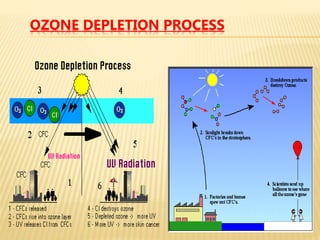
 The Ozone Hole is caused by chemicals called CFCs,
short for chlorofluorocarbons. CFCs escape into the
atmosphere from refrigeration and propellant devices
and processes, and they are so stable they last for
decades. This long life allows some CFCs to
eventually reach the stratosphere. The chemicals that
make up CFCs, mainly chlorine and fluorine, float
around the stratosphere, breaking up ozone
molecules.
 One molecule of CFC can destroy more than
100,000 molecules of stratospheric ozone.
Natural Causes include Volcanic eruptions, as they
release carbon monoxide and decrease nitrogen oxides in
the atmosphere., Methane from rotting vegetation etc.
CAUSES OF OZONE DEPLETION
OZONE DEPLETION PROCESS
WHAT IS THE OZONE HOLE?
• The ozone hole is not technically a
“hole” where no ozone is present, but
is actually a region of depleted ozone
in the stratosphere over the Antarctic
that happens at the beginning of
Southern Hemisphere spring (August-
October).
• The average concentration of ozone
in the atmosphere is about 300
Dobson Units; any area where the
concentration drops below 220
Dobson Units is considered part of
the ozone hole.
WHO DISCOVERED THE OZONE HOLE?
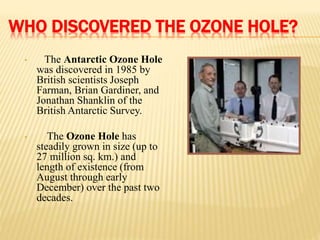
• The Antarctic Ozone Hole
was discovered in 1985 by
British scientists Joseph
Farman, Brian Gardiner, and
Jonathan Shanklin of the
British Antarctic Survey.
• The Ozone Hole has
steadily grown in size (up to
27 million sq. km.) and
length of existence (from
August through early
December) over the past two
decades.
OZONE HOLE OVER THE YEARS
EFFECTS OF OZONE LAYER DEPLETION
 Ozone layer absorbs most of the harmful UV-B radiation; The
depletion of the ozone layer leads to higher levels of ultraviolet
radiation reaching Earth's surface. More of ultraviolet radiation
means:
 more melanoma and non-melanoma skin cancers
 more eye cataracts
 weakened immune systems
 reduced plant yields
 damage to ocean eco-ecosystems
 Large amounts of UV radiation can kill plankton found in oceans,
which absorbs carbon dioxide, thus increasing the rate of global
warming.
EFFECTS OF OZONE LAYER DEPLETION
SOLUTIONS: PROTECTING THE OZONE LAYER
CFC substitutes
Legislations like Montreal Protocol
ALTERNATIVES TO CFCS
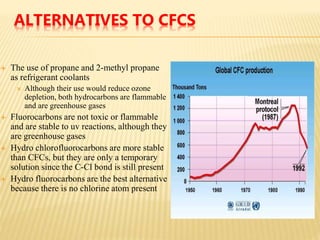
 The use of propane and 2-methyl propane
as refrigerant coolants
 Although their use would reduce ozone
depletion, both hydrocarbons are flammable
and are greenhouse gases
 Fluorocarbons are not toxic or flammable
and are stable to uv reactions, although they
are greenhouse gases
 Hydro chlorofluorocarbons are more stable
than CFCs, but they are only a temporary
solution since the C-Cl bond is still present
 Hydro fluorocarbons are the best alternative
because there is no chlorine atom present
MONTREAL PROTOCOL
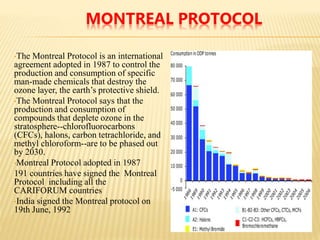
•The Montreal Protocol is an international
agreement adopted in 1987 to control the
production and consumption of specific
man-made chemicals that destroy the
ozone layer, the earth’s protective shield.
•The Montreal Protocol says that the
production and consumption of
compounds that deplete ozone in the
stratosphere--chlorofluorocarbons
(CFCs), halons, carbon tetrachloride, and
methyl chloroform--are to be phased out
by 2030.
•Montreal Protocol adopted in 1987
191 countries have signed the Montreal
Protocol including all the
CARIFORUM countries
•India signed the Montreal protocol on
19th June, 1992
MONTREAL PROTOCOL
Avoid using and buying products that might be made with CFCs
For example: use a reusable cup instead of a plastic foam one.
Have home and car air conditioners checked for leaks
Use air conditioners only if needed for health or safety reasons.
When serving your car, take it to a station that can recycle the air
conditioning coolant
Make sure that old refrigerators and air conditioners are disposed of
safely by giving them to a recycling yard. Take care not to damage the
cooling circuit which contains the ODS.
HOW CAN WE MAKE A DIFFERENCE
September 16 was designated by the United Nations General Assembly as the
International Day for the Preservation of the Ozone Layer.
This designation was made on December 19, 1994, in commemoration of the date, in
1987, on which nations signed the Montreal Protocol on Substances that Deplete the
Ozone Layer.
International Day for the Preservation of the Ozone
Layer
FUTURE EVOLUTION OF OZONE
 Remains unclear
 Current models are unable to reproduce ozone variability
accurately
 Rates of future increases in greenhouse gases are not yet
established
 Interactions between ozone depletion and climate change
not yet fully understood
 Continued monitoring of ozone and ozone-depleting
substances is essential
 Ozone layer recovery expected by 2050
 Hinges on the complete elimination of atmospheric ozone-
depleting substances
 Replacements for HCFCs, methyl bromide, and halons are still
being sought, and studies of the new compounds must continue
(U.N.E..P. Progress Report, 2003)
EFFORTS NEED TO BE CONTINUED
 Create reliable models
 To gain a better understanding of the effects ozone
depletion has on organisms living within different
ecosystems
 Enforcement of Montreal Protocol
 To reduce concentrations of chemicals responsible for
ozone depletion
 Monitoring chemicals being emitted
 Gain a better overall understanding on just how ozone
depletion is affecting our planet
...

Ozone depletion

  • 2.
    Ozone is… Ozone isa form of oxygen with 3 oxygen atoms (O3). Ozone is highly corrosive and toxic and is used as a disinfectant. It can be found in small concentrations in the troposphere where it is considered a pollutant. Ozone at ground level is a pollutant. Ozone layer at stratosphere serves an important function
  • 3.
    • The existenceof ozone (O3 : 3 oxygen atoms) is a natural process in the atmosphere. The earth's atmosphere is composed of several layers. • We live in the "Troposphere" where most of the weather occurs; such as rain, snow and clouds. Above the troposphere is the "Stratosphere"; an important region in which effects such as the Ozone Hole and Global Warming originate. Supersonic jet airliners such as Concorde fly in the lower stratosphere whereas subsonic commercial airliners are usually in the troposphere. The narrow region between these two parts of the atmosphere is called the “Tropopause”. Ozone forms a layer in the stratosphere, thinnest in the tropics (around the equator) and denser towards the poles. •It's ironic that at ground level, ozone is a health hazard - it is a major constituent of photochemical smog. However, in the stratosphere we could not survive without it. Up in the stratosphere it absorbs some of the potentially harmful ultra-violet (UV) radiation from the sun which can cause skin cancer and damage vegetation, among other things. How is Ozone Formed
  • 4.
    WHAT IS OZONELAYER  The ozone layer refers to a region of Earth's stratosphere that absorbs most of the Sun's ultraviolet (UV) radiation. It contains high concentrations of ozone (O3) relative to other parts of the atmosphere. The ozone layer contains less than 10 parts per million of ozone  The ozone layer absorbs 97–99% of the Sun's medium-frequency ultraviolet light (from about 200 nm to 315 nm wavelength), which otherwise would potentially damage exposed life forms near the surface  The ozone layer was discovered in 1913 by the French physicists Charles Fabry and Henri Buisson.
  • 5.
    CAUSES OF OZONEDEPLETION  The Ozone Hole is caused by chemicals called CFCs, short for chlorofluorocarbons. CFCs escape into the atmosphere from refrigeration and propellant devices and processes, and they are so stable they last for decades. This long life allows some CFCs to eventually reach the stratosphere. The chemicals that make up CFCs, mainly chlorine and fluorine, float around the stratosphere, breaking up ozone molecules.  One molecule of CFC can destroy more than 100,000 molecules of stratospheric ozone. Natural Causes include Volcanic eruptions, as they release carbon monoxide and decrease nitrogen oxides in the atmosphere., Methane from rotting vegetation etc.
  • 6.
    CAUSES OF OZONEDEPLETION
  • 7.
  • 8.
    WHAT IS THEOZONE HOLE? • The ozone hole is not technically a “hole” where no ozone is present, but is actually a region of depleted ozone in the stratosphere over the Antarctic that happens at the beginning of Southern Hemisphere spring (August- October). • The average concentration of ozone in the atmosphere is about 300 Dobson Units; any area where the concentration drops below 220 Dobson Units is considered part of the ozone hole.
  • 9.
    WHO DISCOVERED THEOZONE HOLE? • The Antarctic Ozone Hole was discovered in 1985 by British scientists Joseph Farman, Brian Gardiner, and Jonathan Shanklin of the British Antarctic Survey. • The Ozone Hole has steadily grown in size (up to 27 million sq. km.) and length of existence (from August through early December) over the past two decades.
  • 10.
    OZONE HOLE OVERTHE YEARS
  • 11.
    EFFECTS OF OZONELAYER DEPLETION  Ozone layer absorbs most of the harmful UV-B radiation; The depletion of the ozone layer leads to higher levels of ultraviolet radiation reaching Earth's surface. More of ultraviolet radiation means:  more melanoma and non-melanoma skin cancers  more eye cataracts  weakened immune systems  reduced plant yields  damage to ocean eco-ecosystems  Large amounts of UV radiation can kill plankton found in oceans, which absorbs carbon dioxide, thus increasing the rate of global warming.
  • 12.
    EFFECTS OF OZONELAYER DEPLETION
  • 13.
    SOLUTIONS: PROTECTING THEOZONE LAYER CFC substitutes Legislations like Montreal Protocol
  • 14.
    ALTERNATIVES TO CFCS The use of propane and 2-methyl propane as refrigerant coolants  Although their use would reduce ozone depletion, both hydrocarbons are flammable and are greenhouse gases  Fluorocarbons are not toxic or flammable and are stable to uv reactions, although they are greenhouse gases  Hydro chlorofluorocarbons are more stable than CFCs, but they are only a temporary solution since the C-Cl bond is still present  Hydro fluorocarbons are the best alternative because there is no chlorine atom present
  • 15.
    MONTREAL PROTOCOL •The MontrealProtocol is an international agreement adopted in 1987 to control the production and consumption of specific man-made chemicals that destroy the ozone layer, the earth’s protective shield. •The Montreal Protocol says that the production and consumption of compounds that deplete ozone in the stratosphere--chlorofluorocarbons (CFCs), halons, carbon tetrachloride, and methyl chloroform--are to be phased out by 2030. •Montreal Protocol adopted in 1987 191 countries have signed the Montreal Protocol including all the CARIFORUM countries •India signed the Montreal protocol on 19th June, 1992
  • 16.
  • 17.
    Avoid using andbuying products that might be made with CFCs For example: use a reusable cup instead of a plastic foam one. Have home and car air conditioners checked for leaks Use air conditioners only if needed for health or safety reasons. When serving your car, take it to a station that can recycle the air conditioning coolant Make sure that old refrigerators and air conditioners are disposed of safely by giving them to a recycling yard. Take care not to damage the cooling circuit which contains the ODS. HOW CAN WE MAKE A DIFFERENCE
  • 18.
    September 16 wasdesignated by the United Nations General Assembly as the International Day for the Preservation of the Ozone Layer. This designation was made on December 19, 1994, in commemoration of the date, in 1987, on which nations signed the Montreal Protocol on Substances that Deplete the Ozone Layer. International Day for the Preservation of the Ozone Layer
  • 19.
    FUTURE EVOLUTION OFOZONE  Remains unclear  Current models are unable to reproduce ozone variability accurately  Rates of future increases in greenhouse gases are not yet established  Interactions between ozone depletion and climate change not yet fully understood  Continued monitoring of ozone and ozone-depleting substances is essential  Ozone layer recovery expected by 2050  Hinges on the complete elimination of atmospheric ozone- depleting substances  Replacements for HCFCs, methyl bromide, and halons are still being sought, and studies of the new compounds must continue (U.N.E..P. Progress Report, 2003)
  • 20.
    EFFORTS NEED TOBE CONTINUED  Create reliable models  To gain a better understanding of the effects ozone depletion has on organisms living within different ecosystems  Enforcement of Montreal Protocol  To reduce concentrations of chemicals responsible for ozone depletion  Monitoring chemicals being emitted  Gain a better overall understanding on just how ozone depletion is affecting our planet ...