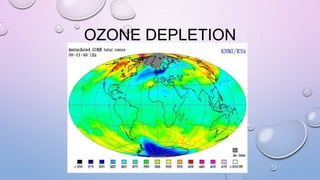
OZONE DEPLETION
OZONE
• Ozone is a molecule consisting of oxygen
atoms.
• Ozone gas can be created or destroyed by
the sun’s ultraviolet rays as shown in the
picture to the right.
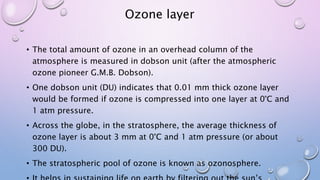
Ozone layer
• The total amount of ozone in an overhead column of the
atmosphere is measured in dobson unit (after the atmospheric
ozone pioneer G.M.B. Dobson).
• One dobson unit (DU) indicates that 0.01 mm thick ozone layer
would be formed if ozone is compressed into one layer at 0°C and
1 atm pressure.
• Across the globe, in the stratosphere, the average thickness of
ozone layer is about 3 mm at 0°C and 1 atm pressure (or about
300 DU).
• The stratospheric pool of ozone is known as ozonosphere.
Ozone hole
• When level of ozone in the stratosphere falls below 200
DU, it is considered to represent the beginnings of an
ozone hole.
CAUSES OF OZONE LAYER DEPLETION
• The gradual thinning of ozone layer and ozone hole formation
occurs by the destruction of ozone due to its reactions with nitric
oxide, chlorine, hydroxyl radicals etc. in the stratosphere.
• Flying of supersonic aircrafts, nuclear explosions and various
chemical/photochemical reactions in the atmosphere generate nitric
oxide.
• Burning of biomass generates hydroxyl radicals.
• Volcanic activity releases chlorine in the atmosphere.
• Chloro fluoro carbons (CFCs), fluorochloro methane (freons), difluoro
dichloro methane (CF2CL2) and fluoro chloroform (CFCL3) release
chlorine by ultraviolet radiation in the atmosphere.
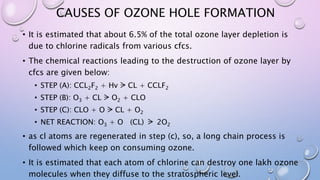
CAUSES OF OZONE HOLE FORMATION
• It is estimated that about 6.5% of the total ozone layer depletion is
due to chlorine radicals from various cfcs.
• The chemical reactions leading to the destruction of ozone layer by
cfcs are given below:
• STEP (A): CCL2F2 + Hv ᗒ CL + CCLF2
• STEP (B): O3 + CL ᗒ O2 + CLO
• STEP (C): CLO + O ᗒ CL + O2
• NET REACTION: O3 + O (CL) ᗒ 2O2
• as cl atoms are regenerated in step (c), so, a long chain process is
followed which keep on consuming ozone.
• It is estimated that each atom of chlorine can destroy one lakh ozone
molecules when they diffuse to the stratospheric level.
PROBLEMS ASSOCIATED WITH OZONE LAYER
DEPLETION
• The ozone layer absorbs most of the harmful ultra-violet
radiations coming from the sun in the region (220–330) nm.
• In the absence of ozone layer, these ultraviolet radiations could
cause following problems:
• (i) damage to plants; reduction in crop yields.
• (Ii) faster deterioration of paints, fabrics, plastics.
• (Iii) DNA mutation.
• (Iv) swelling of skins and skin cancer; skin aging, burning
sensation.
PROBLEMS ASSOCIATED WITH OZONE LAYER
DEPLETION
• (V) premature aging.
• (Vi) visual impairment, dizziness, cataracts of eyes.
• (Vii) inhibition and alteration of DNA’s replication and formation of
DNA adduct.
• (Viii) leukamia, breast cancer.
• (ix) Death of phytoplanktons in marine environment (the sole
producers) so the entire ecosystem could collapse.
• (x) Reduction in the body’s ability to fight off disease, as UV
suppresses the immune system.
REMEDIAL MEASURES TO CONTROL THE
DEPLETION OF OZONE LAYER
• (I) avoid any fire extinguisher that contain bromine based halons.
Preferably use water, carbon dioxide or dry chemical fire extinguishers.
• (Ii) spread awareness about the restricted use of cfcs for the healthy
survival of mankind.
• (Iii) avoid purchasing and using refrigerators, air conditioners etc. Which
use cfcs, freons etc. As coolant.
• (Iv) avoid purchasing and using pressurized aerosol cans which use cfcs,
freons etc. As propellants.
• (V) ban atmospheric nuclear explosions, as they emit NO and deplete
ozone layer.
• (Vi) reduce the air trafic of supersonic aircrafts that fly at the ozonosphere
SO, WHY IS THE OZONE LAYER IMPORTANT
TO LIFE ON EARTH?
• THE STRATOSPHERIC
OZONE LAYER
COMPLETELY STOPS THE
PENETRATION OF UV-C
RAYS AND ELIMINATES
MOST OF THE UV-B
RAYS.
• THEREFORE, THE OZONE
LAYER PROTECTS LIFE
ON EARTH FROM THE
HARMFUL EFFECTS OF
SOLAR RADIATION ON A
DAILY BASIS.
HOW ARE WE AS HUMANS AFFECTING
THE OZONE LAYER?
• SINCE 1928, CHLOROFLUOROCARBONS
HAVE BEEN PRODUCED, ORIGINALLY AS
NONFLAMMABLE REFRIGERANTS FOR USE
IN REFRIGERATORS, AND EVENTUALLY
FOR USE IN FIRE EXTINGUISHERS, DRY
CLEANING AGENTS, PESTICIDES,
DEGREASERS, ADHESIVES, AND AS
PROPELLANTS FOR AEROSOL PRODUCTS.
• AS THESE CFCS HAVE BEEN RELEASED
INTO THE ATMOSPHERE, THE LEVEL OF
OZONE IN THE STRATOSPHERE HAS
DECREASED.
• CFCS HAVE AN ESTIMATED LIFESPAN OF
CFCS AND OZONE
AND THE EFFECTS OF ALL THOSE
CFCS...
What is CFCs? [1]
 Chlorofluorocarbons (CFCs)
 Composed of elements chlorine, fluorine, and
carbon
 Developed in 1930 by DuPont
 CFCs were welcomed by industries:
– Low toxicity
– Chemical stability
– Cheap
 Usage:
– As refrigerants
– As blowing agents
– For making flexible foam
– As cleaning agents
– As propellants
What is CFCs? [2]
CFCs are used in aerosol sprays
(Sources: http://www.yahoo.com) CFCs were used as refrigerants in the
past (Sources: http://www.yahoo.com )
Present situation
 Stratospheric ozone over Antarctica:
– Has been depleted over the last 15 years
– The ozone hole:
 enlarging
 large enough to cover most of the North America
 would take at least 50 years to restore
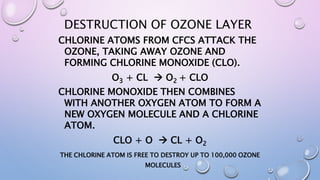
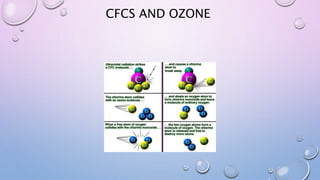
DESTRUCTION OF OZONE LAYER
CHLORINE ATOMS FROM CFCS ATTACK THE
OZONE, TAKING AWAY OZONE AND
FORMING CHLORINE MONOXIDE (CLO).
O3 + CL  O2 + CLO
CHLORINE MONOXIDE THEN COMBINES
WITH ANOTHER OXYGEN ATOM TO FORM A
NEW OXYGEN MOLECULE AND A CHLORINE
ATOM.
CLO + O  CL + O2
THE CHLORINE ATOM IS FREE TO DESTROY UP TO 100,000 OZONE
MOLECULES
Causes of ozone depletion
 Details are not fully understood
 Catalyzed by halocarbons (carbon compounds
containing fluorine, chlorine, bromine and iodine)
– Examples: CFCs and ClONO2
 Halogen atoms catalyze ozone layer depletion by
destroying ozone molecules and forming oxygen
molecules.
 Much more serious in Antarctica than other regions
on the planet
CONSEQUENCES OF LESS OZONE
•BECAUSE CFCS HAS LONG LIFE SPAN
AND VERY STABLE, IT CONTINUOUS TO
ATTACK THE OZONE LAYER AND MORE
UV-B REACH OUR EARTH.
HEALTH
• SUNBURN, EYE DISEASES (CATARACT),
SKIN CANCER.
• REDUCE OUR IMMUNE SYSTEM 
OTHER DISEASES
Impacts on human health
 Skin Cancer
 Cataracts and Other Eye Damages
 Suppression of Immunity
FOOD SUPPLY
• REDUCE PHOTOSYNTHESIS - CROPS
AFFECTED.
• KILLS PLANKTON  FISH 
Impacts on other animals
 Reduces plankton population
 Reduces penguin population
 Reduces the percentage of hatching of
frog eggs
AIR POLLUTION
• FORMING PHOTOCHEMICAL SMOG
• DEGRADES BUILDING MATERIALS
What has been done? [1]
 Ban the use of CFCs as aerosol propellants
 The Vienna Convention on the Protection of the
Ozone Layer in 1985
– Governments committed themselves to protect the ozone
layer and to co-operate with each other to improve
understanding of ozone crisis.
 The Montreal Protocol on Substances that deplete
the Ozone Layer
– Adopted by Governments in 1987
– Aims to reduce and eventually eliminate the emissions of
man-made ozone-depleting substances.
International cooperation:
What has been done? [2]
 Phaseout of production of CFCs
 Substitutes for CFCs
Discussion
 Naturally, there is a balance of ozone
formation and depletion. What disturb this
balance?
 What are the functions of the ozone layer?
 How to reduce emission of ozone depleting
substances?
 Do you agree that people living in the
southern hemisphere are more prone to skin
cancer than those living in the northern
hemisphere? Why?

12 ozone depletion

  • 1.
  • 2.
    OZONE • Ozone isa molecule consisting of oxygen atoms. • Ozone gas can be created or destroyed by the sun’s ultraviolet rays as shown in the picture to the right.
  • 3.
    Ozone layer • Thetotal amount of ozone in an overhead column of the atmosphere is measured in dobson unit (after the atmospheric ozone pioneer G.M.B. Dobson). • One dobson unit (DU) indicates that 0.01 mm thick ozone layer would be formed if ozone is compressed into one layer at 0°C and 1 atm pressure. • Across the globe, in the stratosphere, the average thickness of ozone layer is about 3 mm at 0°C and 1 atm pressure (or about 300 DU). • The stratospheric pool of ozone is known as ozonosphere.
  • 4.
    Ozone hole • Whenlevel of ozone in the stratosphere falls below 200 DU, it is considered to represent the beginnings of an ozone hole.
  • 5.
    CAUSES OF OZONELAYER DEPLETION • The gradual thinning of ozone layer and ozone hole formation occurs by the destruction of ozone due to its reactions with nitric oxide, chlorine, hydroxyl radicals etc. in the stratosphere. • Flying of supersonic aircrafts, nuclear explosions and various chemical/photochemical reactions in the atmosphere generate nitric oxide. • Burning of biomass generates hydroxyl radicals. • Volcanic activity releases chlorine in the atmosphere. • Chloro fluoro carbons (CFCs), fluorochloro methane (freons), difluoro dichloro methane (CF2CL2) and fluoro chloroform (CFCL3) release chlorine by ultraviolet radiation in the atmosphere.
  • 6.
    CAUSES OF OZONEHOLE FORMATION • It is estimated that about 6.5% of the total ozone layer depletion is due to chlorine radicals from various cfcs. • The chemical reactions leading to the destruction of ozone layer by cfcs are given below: • STEP (A): CCL2F2 + Hv ᗒ CL + CCLF2 • STEP (B): O3 + CL ᗒ O2 + CLO • STEP (C): CLO + O ᗒ CL + O2 • NET REACTION: O3 + O (CL) ᗒ 2O2 • as cl atoms are regenerated in step (c), so, a long chain process is followed which keep on consuming ozone. • It is estimated that each atom of chlorine can destroy one lakh ozone molecules when they diffuse to the stratospheric level.
  • 7.
    PROBLEMS ASSOCIATED WITHOZONE LAYER DEPLETION • The ozone layer absorbs most of the harmful ultra-violet radiations coming from the sun in the region (220–330) nm. • In the absence of ozone layer, these ultraviolet radiations could cause following problems: • (i) damage to plants; reduction in crop yields. • (Ii) faster deterioration of paints, fabrics, plastics. • (Iii) DNA mutation. • (Iv) swelling of skins and skin cancer; skin aging, burning sensation.
  • 8.
    PROBLEMS ASSOCIATED WITHOZONE LAYER DEPLETION • (V) premature aging. • (Vi) visual impairment, dizziness, cataracts of eyes. • (Vii) inhibition and alteration of DNA’s replication and formation of DNA adduct. • (Viii) leukamia, breast cancer. • (ix) Death of phytoplanktons in marine environment (the sole producers) so the entire ecosystem could collapse. • (x) Reduction in the body’s ability to fight off disease, as UV suppresses the immune system.
  • 9.
    REMEDIAL MEASURES TOCONTROL THE DEPLETION OF OZONE LAYER • (I) avoid any fire extinguisher that contain bromine based halons. Preferably use water, carbon dioxide or dry chemical fire extinguishers. • (Ii) spread awareness about the restricted use of cfcs for the healthy survival of mankind. • (Iii) avoid purchasing and using refrigerators, air conditioners etc. Which use cfcs, freons etc. As coolant. • (Iv) avoid purchasing and using pressurized aerosol cans which use cfcs, freons etc. As propellants. • (V) ban atmospheric nuclear explosions, as they emit NO and deplete ozone layer. • (Vi) reduce the air trafic of supersonic aircrafts that fly at the ozonosphere
  • 10.
    SO, WHY ISTHE OZONE LAYER IMPORTANT TO LIFE ON EARTH? • THE STRATOSPHERIC OZONE LAYER COMPLETELY STOPS THE PENETRATION OF UV-C RAYS AND ELIMINATES MOST OF THE UV-B RAYS. • THEREFORE, THE OZONE LAYER PROTECTS LIFE ON EARTH FROM THE HARMFUL EFFECTS OF SOLAR RADIATION ON A DAILY BASIS.
  • 11.
    HOW ARE WEAS HUMANS AFFECTING THE OZONE LAYER? • SINCE 1928, CHLOROFLUOROCARBONS HAVE BEEN PRODUCED, ORIGINALLY AS NONFLAMMABLE REFRIGERANTS FOR USE IN REFRIGERATORS, AND EVENTUALLY FOR USE IN FIRE EXTINGUISHERS, DRY CLEANING AGENTS, PESTICIDES, DEGREASERS, ADHESIVES, AND AS PROPELLANTS FOR AEROSOL PRODUCTS. • AS THESE CFCS HAVE BEEN RELEASED INTO THE ATMOSPHERE, THE LEVEL OF OZONE IN THE STRATOSPHERE HAS DECREASED. • CFCS HAVE AN ESTIMATED LIFESPAN OF
  • 12.
  • 13.
    AND THE EFFECTSOF ALL THOSE CFCS...
  • 14.
    What is CFCs?[1]  Chlorofluorocarbons (CFCs)  Composed of elements chlorine, fluorine, and carbon  Developed in 1930 by DuPont  CFCs were welcomed by industries: – Low toxicity – Chemical stability – Cheap  Usage: – As refrigerants – As blowing agents – For making flexible foam – As cleaning agents – As propellants
  • 15.
    What is CFCs?[2] CFCs are used in aerosol sprays (Sources: http://www.yahoo.com) CFCs were used as refrigerants in the past (Sources: http://www.yahoo.com )
  • 16.
    Present situation  Stratosphericozone over Antarctica: – Has been depleted over the last 15 years – The ozone hole:  enlarging  large enough to cover most of the North America  would take at least 50 years to restore
  • 18.
    DESTRUCTION OF OZONELAYER CHLORINE ATOMS FROM CFCS ATTACK THE OZONE, TAKING AWAY OZONE AND FORMING CHLORINE MONOXIDE (CLO). O3 + CL  O2 + CLO CHLORINE MONOXIDE THEN COMBINES WITH ANOTHER OXYGEN ATOM TO FORM A NEW OXYGEN MOLECULE AND A CHLORINE ATOM. CLO + O  CL + O2 THE CHLORINE ATOM IS FREE TO DESTROY UP TO 100,000 OZONE MOLECULES
  • 19.
    Causes of ozonedepletion  Details are not fully understood  Catalyzed by halocarbons (carbon compounds containing fluorine, chlorine, bromine and iodine) – Examples: CFCs and ClONO2  Halogen atoms catalyze ozone layer depletion by destroying ozone molecules and forming oxygen molecules.  Much more serious in Antarctica than other regions on the planet
  • 20.
    CONSEQUENCES OF LESSOZONE •BECAUSE CFCS HAS LONG LIFE SPAN AND VERY STABLE, IT CONTINUOUS TO ATTACK THE OZONE LAYER AND MORE UV-B REACH OUR EARTH.
  • 21.
    HEALTH • SUNBURN, EYEDISEASES (CATARACT), SKIN CANCER. • REDUCE OUR IMMUNE SYSTEM  OTHER DISEASES
  • 22.
    Impacts on humanhealth  Skin Cancer  Cataracts and Other Eye Damages  Suppression of Immunity
  • 23.
    FOOD SUPPLY • REDUCEPHOTOSYNTHESIS - CROPS AFFECTED. • KILLS PLANKTON  FISH 
  • 24.
    Impacts on otheranimals  Reduces plankton population  Reduces penguin population  Reduces the percentage of hatching of frog eggs
  • 25.
    AIR POLLUTION • FORMINGPHOTOCHEMICAL SMOG • DEGRADES BUILDING MATERIALS
  • 26.
    What has beendone? [1]  Ban the use of CFCs as aerosol propellants  The Vienna Convention on the Protection of the Ozone Layer in 1985 – Governments committed themselves to protect the ozone layer and to co-operate with each other to improve understanding of ozone crisis.  The Montreal Protocol on Substances that deplete the Ozone Layer – Adopted by Governments in 1987 – Aims to reduce and eventually eliminate the emissions of man-made ozone-depleting substances. International cooperation:
  • 27.
    What has beendone? [2]  Phaseout of production of CFCs  Substitutes for CFCs
  • 28.
    Discussion  Naturally, thereis a balance of ozone formation and depletion. What disturb this balance?  What are the functions of the ozone layer?  How to reduce emission of ozone depleting substances?  Do you agree that people living in the southern hemisphere are more prone to skin cancer than those living in the northern hemisphere? Why?