

GREEN HOUSE EFFECT
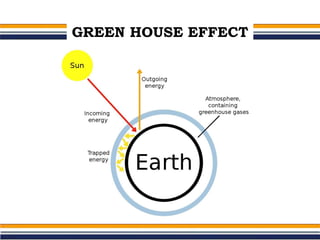
• The atmosphere allows most of the visible light from the Sun to pass
through and reach Earth’s surface.
• As Earth’s surface is heated by sunlight, it radiates part of this
energy back toward space as infrared radiation.
• This radiation, unlike visible light, tends to be absorbed by the
greenhouse gases in the atmosphere, raising its temperature.
• The heated atmosphere in turn radiates infrared radiation back
toward Earth’s surface heating it further.
• The greenhouse effect is a warming of the earth's surface and
lower atmosphere by green house gases.
GREEN HOUSE EFFECT
• Although the greenhouse effect is a naturally occurring
phenomenon, it is possible that the effect could be intensified by the
emission of greenhouse gases into the atmosphere as the result of
human activity.
• The magnitude of the enhanced greenhouse effect is influenced by
various complex interactions in the earth-ocean-atmosphere system.
• Runaway Greenhouse Effect is a phenomenon occurs when the
planet absorbs more radiations than it can radiate back. Thus, the
heat lost from the earth’s surface is less and the temperature of the
planet keeps rising.
GREEN HOUSE EFFECT
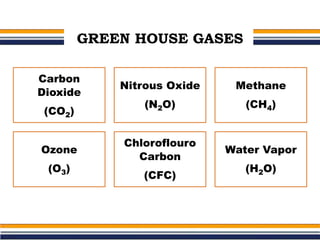
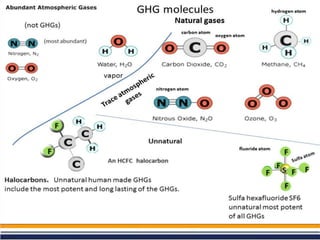
GREEN HOUSE GASES
Carbon
Dioxide
(CO2)
Nitrous Oxide
(N2O)
Methane
(CH4)
Ozone
(O3)
Chloroflouro
Carbon
(CFC)
Water Vapor
(H2O)
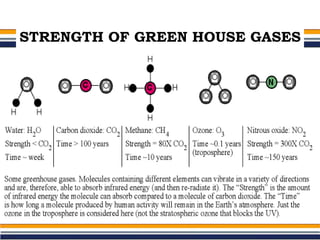
STRENGTH OF GREEN HOUSE GASES
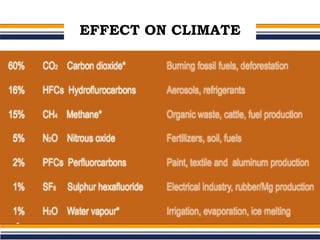
EFFECT ON CLIMATE
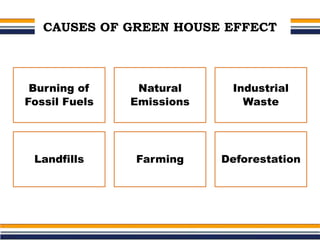
CAUSES OF GREEN HOUSE EFFECT
Burning of
Fossil Fuels
Natural
Emissions
Industrial
Waste
Landfills Farming Deforestation
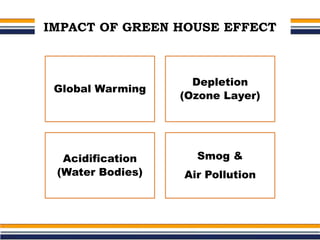
IMPACT OF GREEN HOUSE EFFECT
Global Warming
Depletion
(Ozone Layer)
Acidification
(Water Bodies)
Smog &
Air Pollution
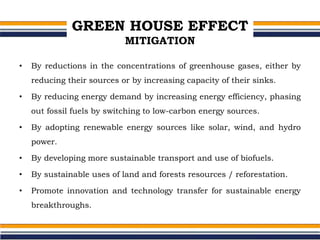
GREEN HOUSE EFFECT
MITIGATION
• By reductions in the concentrations of greenhouse gases, either by
reducing their sources or by increasing capacity of their sinks.
• By reducing energy demand by increasing energy efficiency, phasing
out fossil fuels by switching to low-carbon energy sources.
• By adopting renewable energy sources like solar, wind, and hydro
power.
• By developing more sustainable transport and use of biofuels.
• By sustainable uses of land and forests resources / reforestation.
• Promote innovation and technology transfer for sustainable energy
breakthroughs.
Green house effect

Green house effect

  • 2.
    GREEN HOUSE EFFECT •The atmosphere allows most of the visible light from the Sun to pass through and reach Earth’s surface. • As Earth’s surface is heated by sunlight, it radiates part of this energy back toward space as infrared radiation. • This radiation, unlike visible light, tends to be absorbed by the greenhouse gases in the atmosphere, raising its temperature. • The heated atmosphere in turn radiates infrared radiation back toward Earth’s surface heating it further. • The greenhouse effect is a warming of the earth's surface and lower atmosphere by green house gases.
  • 3.
    GREEN HOUSE EFFECT •Although the greenhouse effect is a naturally occurring phenomenon, it is possible that the effect could be intensified by the emission of greenhouse gases into the atmosphere as the result of human activity. • The magnitude of the enhanced greenhouse effect is influenced by various complex interactions in the earth-ocean-atmosphere system. • Runaway Greenhouse Effect is a phenomenon occurs when the planet absorbs more radiations than it can radiate back. Thus, the heat lost from the earth’s surface is less and the temperature of the planet keeps rising.
  • 4.
  • 5.
    GREEN HOUSE GASES Carbon Dioxide (CO2) NitrousOxide (N2O) Methane (CH4) Ozone (O3) Chloroflouro Carbon (CFC) Water Vapor (H2O)
  • 7.
    STRENGTH OF GREENHOUSE GASES
  • 8.
  • 10.
    CAUSES OF GREENHOUSE EFFECT Burning of Fossil Fuels Natural Emissions Industrial Waste Landfills Farming Deforestation
  • 11.
    IMPACT OF GREENHOUSE EFFECT Global Warming Depletion (Ozone Layer) Acidification (Water Bodies) Smog & Air Pollution
  • 12.
    GREEN HOUSE EFFECT MITIGATION •By reductions in the concentrations of greenhouse gases, either by reducing their sources or by increasing capacity of their sinks. • By reducing energy demand by increasing energy efficiency, phasing out fossil fuels by switching to low-carbon energy sources. • By adopting renewable energy sources like solar, wind, and hydro power. • By developing more sustainable transport and use of biofuels. • By sustainable uses of land and forests resources / reforestation. • Promote innovation and technology transfer for sustainable energy breakthroughs.