OZONE DEPLECTION
AND CLIMATE
CHANGE
What roles does ozone play in the
atmosphere and how are humans affected?
Stratospheric ozone (sometimes referred to as "good
ozone") plays a beneficial role by absorbing most of the
biologically damaging ultraviolet sunlight (called UV-B),
allowing only a small amount to reach the Earth's surface. The
absorption of ultraviolet radiation by ozone creates a source of
heat, which actually forms the stratosphere itself (a region in
which the temperature rises as one goes to higher altitudes).
Ozone thus plays a key role in the temperature structure of the
Earth's atmosphere. Without the filtering action of the ozone
layer, more of the Sun's UV-B radiation would penetrate the
atmosphere and would reach the Earth's surface. Many
experimental studies of plants and animals and clinical studies of
humans have shown the harmful effects of excessive exposure to
UV-B radiation.
What are the environmental issues associated
with ozone?
The dual role of ozone leads to two separate environmental issues.
There is concern about increases in ozone in the troposphere. Near-
surface ozone is a key component of photochemical "smog," a
familiar problem in the atmosphere of many cities around the
world. Higher amounts of surface-level ozone are increasingly
being observed in rural areas as well.
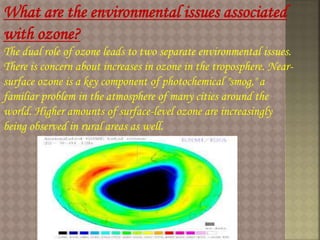
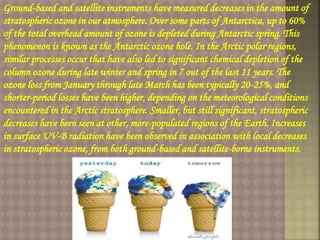
Ground-based and satellite instruments have measured decreases in the amount of
stratospheric ozone in our atmosphere. Over some parts of Antarctica, up to 60%
of the total overhead amount of ozone is depleted during Antarctic spring. This
phenomenon is known as the Antarctic ozone hole. In the Arctic polar regions,
similar processes occur that have also led to significant chemical depletion of the
column ozone during late winter and spring in 7 out of the last 11 years. The
ozone loss from January through late March has been typically 20-25%, and
shorter-period losses have been higher, depending on the meteorological conditions
encountered in the Arctic stratosphere. Smaller, but still significant, stratospheric
decreases have been seen at other, more-populated regions of the Earth. Increases
in surface UV-B radiation have been observed in association with local decreases
in stratospheric ozone, from both ground-based and satellite-borne instruments.
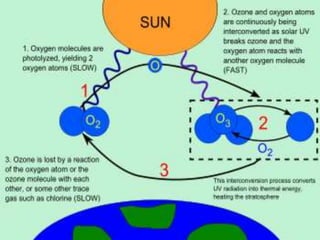
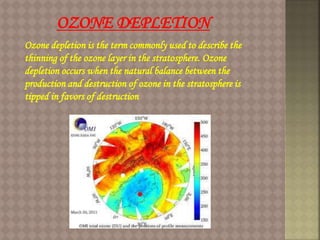
Ozone depletion is the term commonly used to describe the
thinning of the ozone layer in the stratosphere. Ozone
depletion occurs when the natural balance between the
production and destruction of ozone in the stratosphere is
tipped in favors of destruction
OZONE DEPLETION
The Impacts of Ozone Depletion
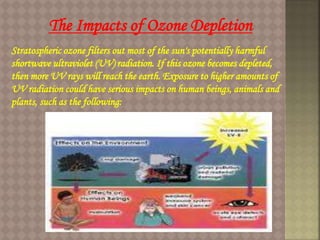
Stratospheric ozone filters out most of the sun's potentially harmful
shortwave ultraviolet (UV) radiation. If this ozone becomes depleted,
then more UV rays will reach the earth. Exposure to higher amounts of
UV radiation could have serious impacts on human beings, animals and
plants, such as the following:
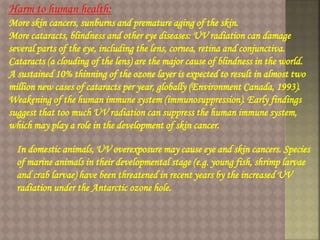
Harm to human health:
More skin cancers, sunburns and premature aging of the skin.
More cataracts, blindness and other eye diseases: UV radiation can damage
several parts of the eye, including the lens, cornea, retina and conjunctiva.
Cataracts (a clouding of the lens) are the major cause of blindness in the world.
A sustained 10% thinning of the ozone layer is expected to result in almost two
million new cases of cataracts per year, globally (Environment Canada, 1993).
Weakening of the human immune system (immunosuppression). Early findings
suggest that too much UV radiation can suppress the human immune system,
which may play a role in the development of skin cancer.
In domestic animals, UV overexposure may cause eye and skin cancers. Species
of marine animals in their developmental stage (e.g. young fish, shrimp larvae
and crab larvae) have been threatened in recent years by the increased UV
radiation under the Antarctic ozone hole.
•Adverse impacts on agriculture, forestry and natural ecosystems:
Several of the world's major crop species are particularly vulnerable to increased
UV, resulting in reduced growth, photosynthesis and flowering. These species
include wheat, rice, barley, oats, corn, soybeans, peas, tomatoes, cucumbers,
cauliflower, broccoli and carrots.
•The effect of ozone depletion on the Canadian agricultural sector could be
significant.
•Only a few commercially important trees have been tested for UV (UV-B)
sensitivity, but early results suggest that plant growth, especially in seedlings, is
harmed by more intense UV radiation.
•In particular, plankton (tiny organisms in the surface layer of oceans) are
threatened by increased UV radiation. Plankton are the first vital step in aquatic
food chains.
•Decreases in plankton could disrupt the fresh and saltwater food chains, and lead
to a species shift in Canadian waters.
•Loss of biodiversity in our oceans, rivers and lakes could reduce fish yields for
commercial and sport fisheries.
ozone-depleting chemicals
•chlorofluorocarbons (CFCs);
•halons;
•1,1,1-trichloroethane (methyl chloroform);
•carbon tetrachloride;
•methyl bromide;
•hydrobromofluorocarbons (HBFCs);
•hydrochlorofluorocarbons (HCFCs); and
•bromochloromethane (BCM
Ozone Layer Protection
Buy air-conditioning and refrigeration equipment that do not use HCFCs as
refrigerant.
Buy aerosol products that do not use HCFCs or CFCs as propellants.
Conduct regular inspection and maintenance of air-conditioning and
refrigeration appliances to prevent and minimize refrigerant leakage.
For existing air-conditioning and refrigeration appliances that operate on
HCFCs or CFCs, the refrigerant should be recovered or recycled whenever an
overhaul of equipment is to be carried out. Replacing or retrofitting such
equipment to operate on non-HCFCs refrigerant should also be considered.
When motor vehicle air-conditioners need servicing, make sure that the
refrigerants are properly recovered and recycled instead of being vented to the
atmosphere.
The Montreal Protocol on Substances That Deplete
the Ozone Layer
The Montreal Protocol on Substances That Deplete the Ozone Layer is a
landmark international agreement designed to protect the stratospheric ozone
layer. The treaty was originally signed in 1987 and substantially amended in
1990 and 1992. The Montreal Protocol stipulates that the production and
consumption of compounds that deplete ozone in the stratosphere--
chlorofluorocarbons (CFCs), halons, carbon tetrachloride, and methyl
chloroform--are to be phased out by 2000 (2005 for methyl chloroform).
Scientific theory and evidence suggest that, once emitted to the atmosphere,
these compounds could significantly deplete the stratospheric ozone layer that
shields the planet from damaging UV-B radiation. The United Nations
Environment Programme (UNEP) has prepared a Montreal Protocol
Handbook that provides additional detail and explanation of the provisions.
Presentation1
Presentation1
Presentation1
Presentation1
Presentation1
Presentation1
Presentation1

Presentation1

  • 1.
  • 3.
    What roles doesozone play in the atmosphere and how are humans affected? Stratospheric ozone (sometimes referred to as "good ozone") plays a beneficial role by absorbing most of the biologically damaging ultraviolet sunlight (called UV-B), allowing only a small amount to reach the Earth's surface. The absorption of ultraviolet radiation by ozone creates a source of heat, which actually forms the stratosphere itself (a region in which the temperature rises as one goes to higher altitudes). Ozone thus plays a key role in the temperature structure of the Earth's atmosphere. Without the filtering action of the ozone layer, more of the Sun's UV-B radiation would penetrate the atmosphere and would reach the Earth's surface. Many experimental studies of plants and animals and clinical studies of humans have shown the harmful effects of excessive exposure to UV-B radiation.
  • 4.
    What are theenvironmental issues associated with ozone? The dual role of ozone leads to two separate environmental issues. There is concern about increases in ozone in the troposphere. Near- surface ozone is a key component of photochemical "smog," a familiar problem in the atmosphere of many cities around the world. Higher amounts of surface-level ozone are increasingly being observed in rural areas as well.
  • 5.
    Ground-based and satelliteinstruments have measured decreases in the amount of stratospheric ozone in our atmosphere. Over some parts of Antarctica, up to 60% of the total overhead amount of ozone is depleted during Antarctic spring. This phenomenon is known as the Antarctic ozone hole. In the Arctic polar regions, similar processes occur that have also led to significant chemical depletion of the column ozone during late winter and spring in 7 out of the last 11 years. The ozone loss from January through late March has been typically 20-25%, and shorter-period losses have been higher, depending on the meteorological conditions encountered in the Arctic stratosphere. Smaller, but still significant, stratospheric decreases have been seen at other, more-populated regions of the Earth. Increases in surface UV-B radiation have been observed in association with local decreases in stratospheric ozone, from both ground-based and satellite-borne instruments.
  • 6.
    Ozone depletion isthe term commonly used to describe the thinning of the ozone layer in the stratosphere. Ozone depletion occurs when the natural balance between the production and destruction of ozone in the stratosphere is tipped in favors of destruction OZONE DEPLETION
  • 7.
    The Impacts ofOzone Depletion Stratospheric ozone filters out most of the sun's potentially harmful shortwave ultraviolet (UV) radiation. If this ozone becomes depleted, then more UV rays will reach the earth. Exposure to higher amounts of UV radiation could have serious impacts on human beings, animals and plants, such as the following:
  • 8.
    Harm to humanhealth: More skin cancers, sunburns and premature aging of the skin. More cataracts, blindness and other eye diseases: UV radiation can damage several parts of the eye, including the lens, cornea, retina and conjunctiva. Cataracts (a clouding of the lens) are the major cause of blindness in the world. A sustained 10% thinning of the ozone layer is expected to result in almost two million new cases of cataracts per year, globally (Environment Canada, 1993). Weakening of the human immune system (immunosuppression). Early findings suggest that too much UV radiation can suppress the human immune system, which may play a role in the development of skin cancer. In domestic animals, UV overexposure may cause eye and skin cancers. Species of marine animals in their developmental stage (e.g. young fish, shrimp larvae and crab larvae) have been threatened in recent years by the increased UV radiation under the Antarctic ozone hole.
  • 9.
    •Adverse impacts onagriculture, forestry and natural ecosystems: Several of the world's major crop species are particularly vulnerable to increased UV, resulting in reduced growth, photosynthesis and flowering. These species include wheat, rice, barley, oats, corn, soybeans, peas, tomatoes, cucumbers, cauliflower, broccoli and carrots. •The effect of ozone depletion on the Canadian agricultural sector could be significant. •Only a few commercially important trees have been tested for UV (UV-B) sensitivity, but early results suggest that plant growth, especially in seedlings, is harmed by more intense UV radiation. •In particular, plankton (tiny organisms in the surface layer of oceans) are threatened by increased UV radiation. Plankton are the first vital step in aquatic food chains. •Decreases in plankton could disrupt the fresh and saltwater food chains, and lead to a species shift in Canadian waters. •Loss of biodiversity in our oceans, rivers and lakes could reduce fish yields for commercial and sport fisheries.
  • 10.
    ozone-depleting chemicals •chlorofluorocarbons (CFCs); •halons; •1,1,1-trichloroethane(methyl chloroform); •carbon tetrachloride; •methyl bromide; •hydrobromofluorocarbons (HBFCs); •hydrochlorofluorocarbons (HCFCs); and •bromochloromethane (BCM
  • 11.
    Ozone Layer Protection Buyair-conditioning and refrigeration equipment that do not use HCFCs as refrigerant. Buy aerosol products that do not use HCFCs or CFCs as propellants. Conduct regular inspection and maintenance of air-conditioning and refrigeration appliances to prevent and minimize refrigerant leakage. For existing air-conditioning and refrigeration appliances that operate on HCFCs or CFCs, the refrigerant should be recovered or recycled whenever an overhaul of equipment is to be carried out. Replacing or retrofitting such equipment to operate on non-HCFCs refrigerant should also be considered. When motor vehicle air-conditioners need servicing, make sure that the refrigerants are properly recovered and recycled instead of being vented to the atmosphere.
  • 12.
    The Montreal Protocolon Substances That Deplete the Ozone Layer The Montreal Protocol on Substances That Deplete the Ozone Layer is a landmark international agreement designed to protect the stratospheric ozone layer. The treaty was originally signed in 1987 and substantially amended in 1990 and 1992. The Montreal Protocol stipulates that the production and consumption of compounds that deplete ozone in the stratosphere-- chlorofluorocarbons (CFCs), halons, carbon tetrachloride, and methyl chloroform--are to be phased out by 2000 (2005 for methyl chloroform). Scientific theory and evidence suggest that, once emitted to the atmosphere, these compounds could significantly deplete the stratospheric ozone layer that shields the planet from damaging UV-B radiation. The United Nations Environment Programme (UNEP) has prepared a Montreal Protocol Handbook that provides additional detail and explanation of the provisions.