International Day for the Preservation
of the Ozone Layer, 16 September
'32 years and Healing'
Components of Earth
Earth is composed of three components
 Lithosphere, Hydrosphere and Atmosphere.
According to Temperature, Atmosphere have
four different layers
 Troposphere,
 Stratosphere (Comprising Ozone Layer),
 Mesosphere and
 Thermosphere.
Location of ozone layer
• Stratosphere: The stratosphere is a layer of Earth's atmosphere that is stratified
in temperature, with warmer layers higher up and cooler layers farther down.
• Ozone Layer: The layer with the highest concentration of ozone molecules, is
found in the stratosphere. The ozone layer filters much out of the sun's
ultraviolet radiation that would be harmful to most forms of life.
• Troposphere: The troposphere is the lowermost portion of the Earth's
atmosphere and the one in which most weather and the "greenhouse" effect
occurs.
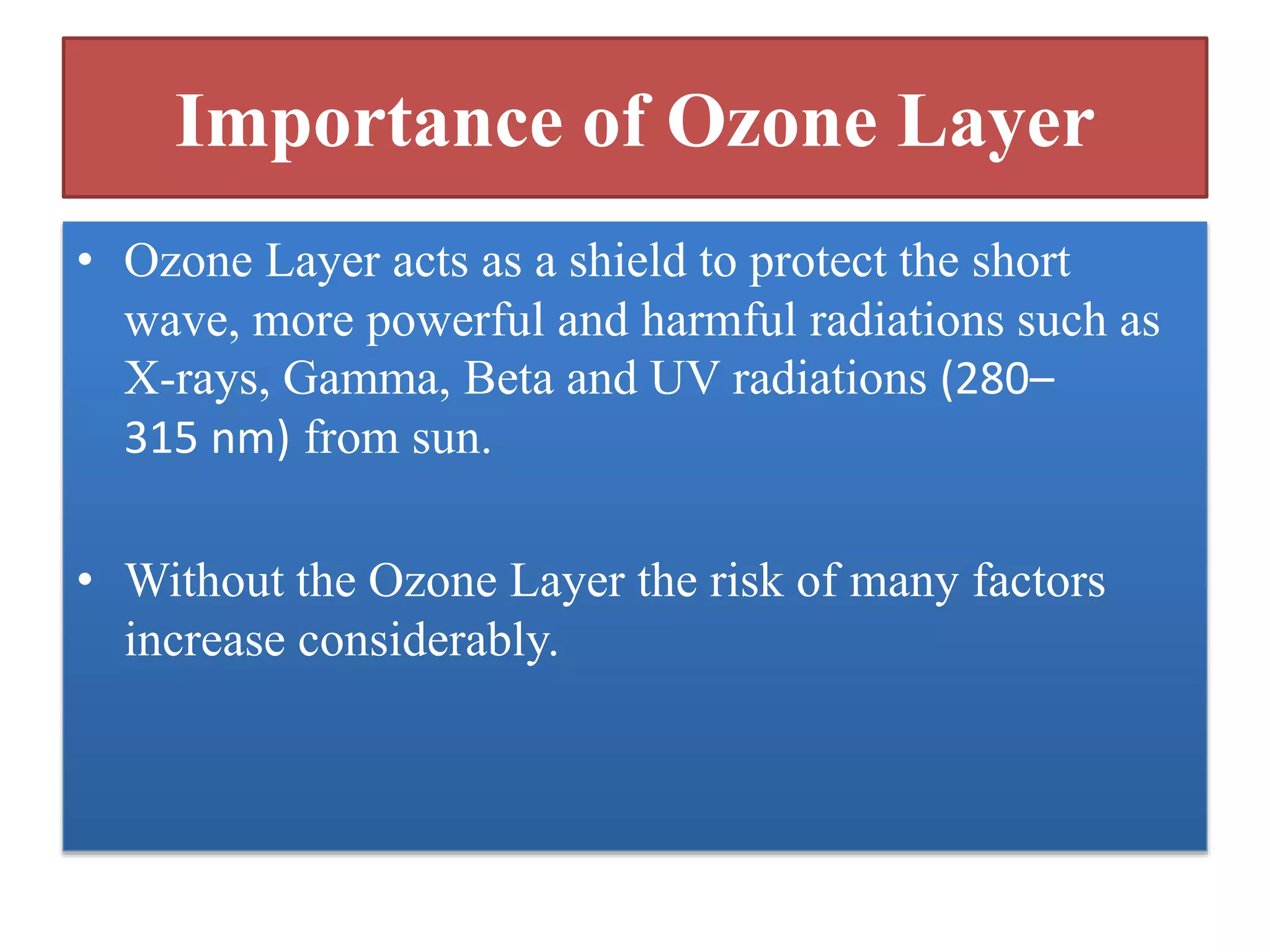
Importance of Ozone Layer
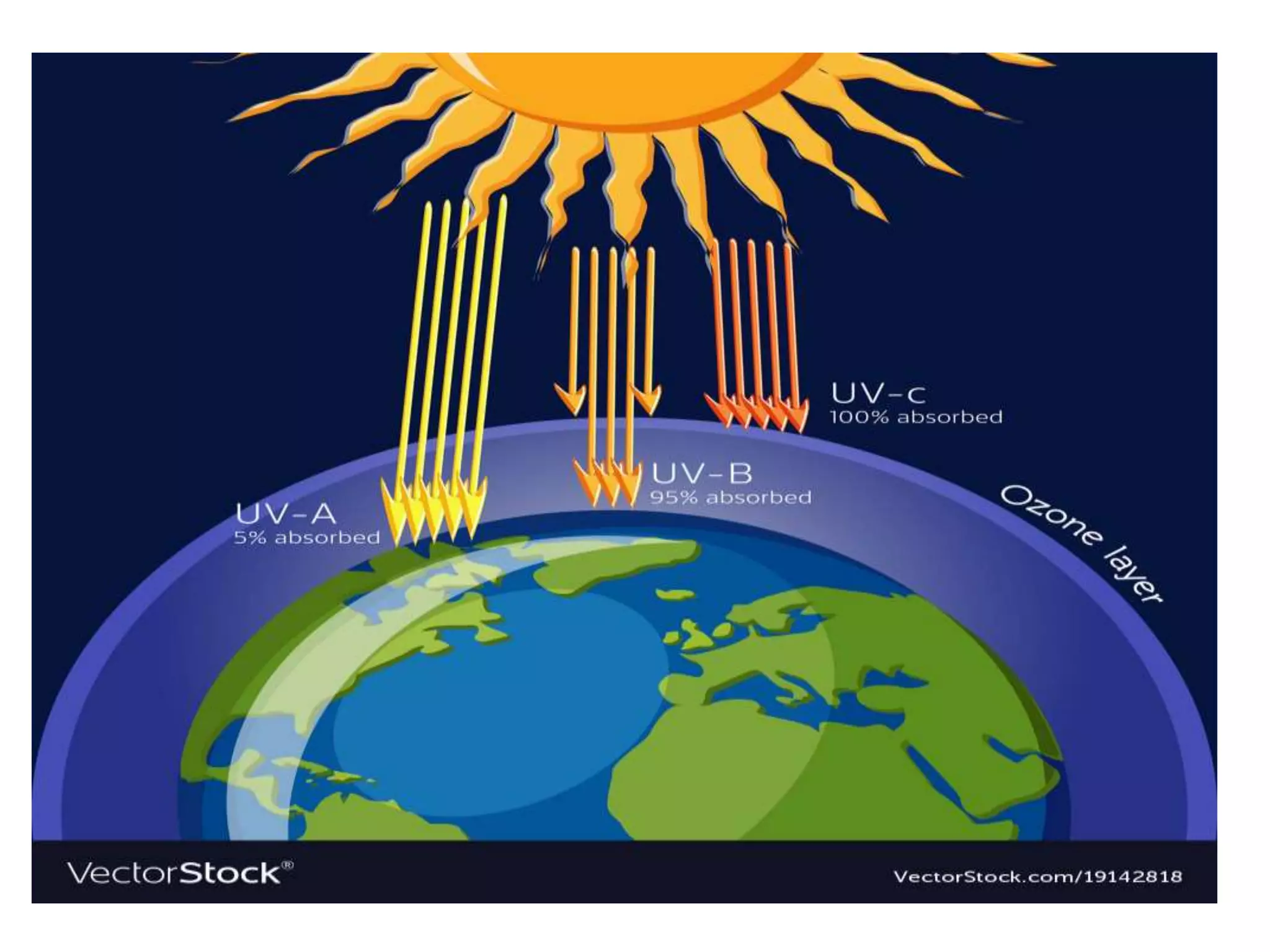
• Ozone Layer acts as a shield to protect the short
wave, more powerful and harmful radiations such as
X-rays, Gamma, Beta and UV radiations (280–
315 nm) from sun.
• Without the Ozone Layer the risk of many factors
increase considerably.
How ozone is
formed?
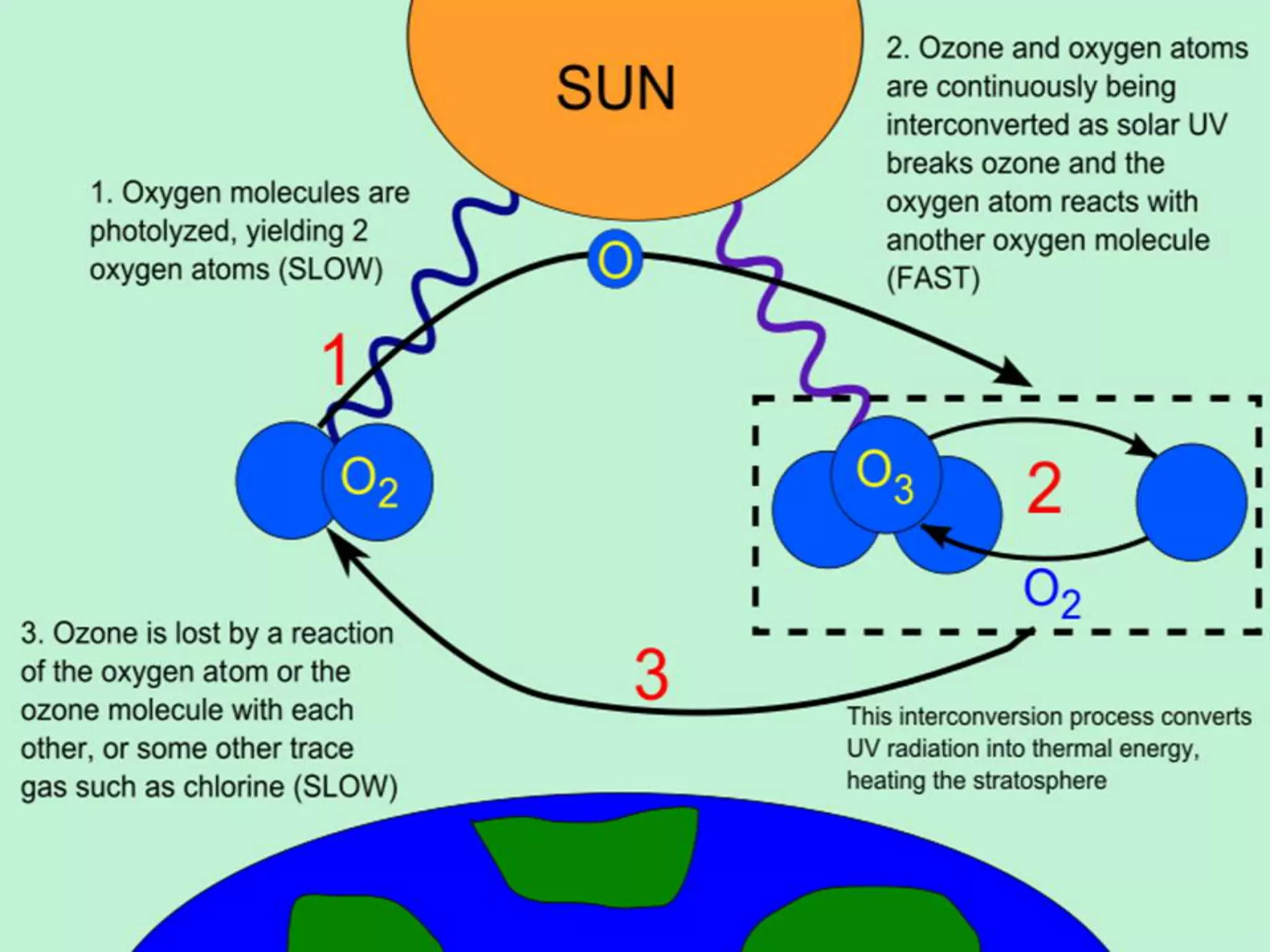
 In the stratosphere ozone molecule is dissociated into
molecular oxygen and oxygen molecules when absorbs a
photon from ultraviolet radiation (>240 nm). These singlet
oxygen atoms combines with a oxygen molecule forms a
ozone molecule.
O2 + O →O3
O3 UV radiation → O2 + O
(photon molecule)
 This is a continuous process that take place in the ozone layer.
 The overall amount of ozone in the stratosphere is determined
by a balance between photochemical production and
recombination.
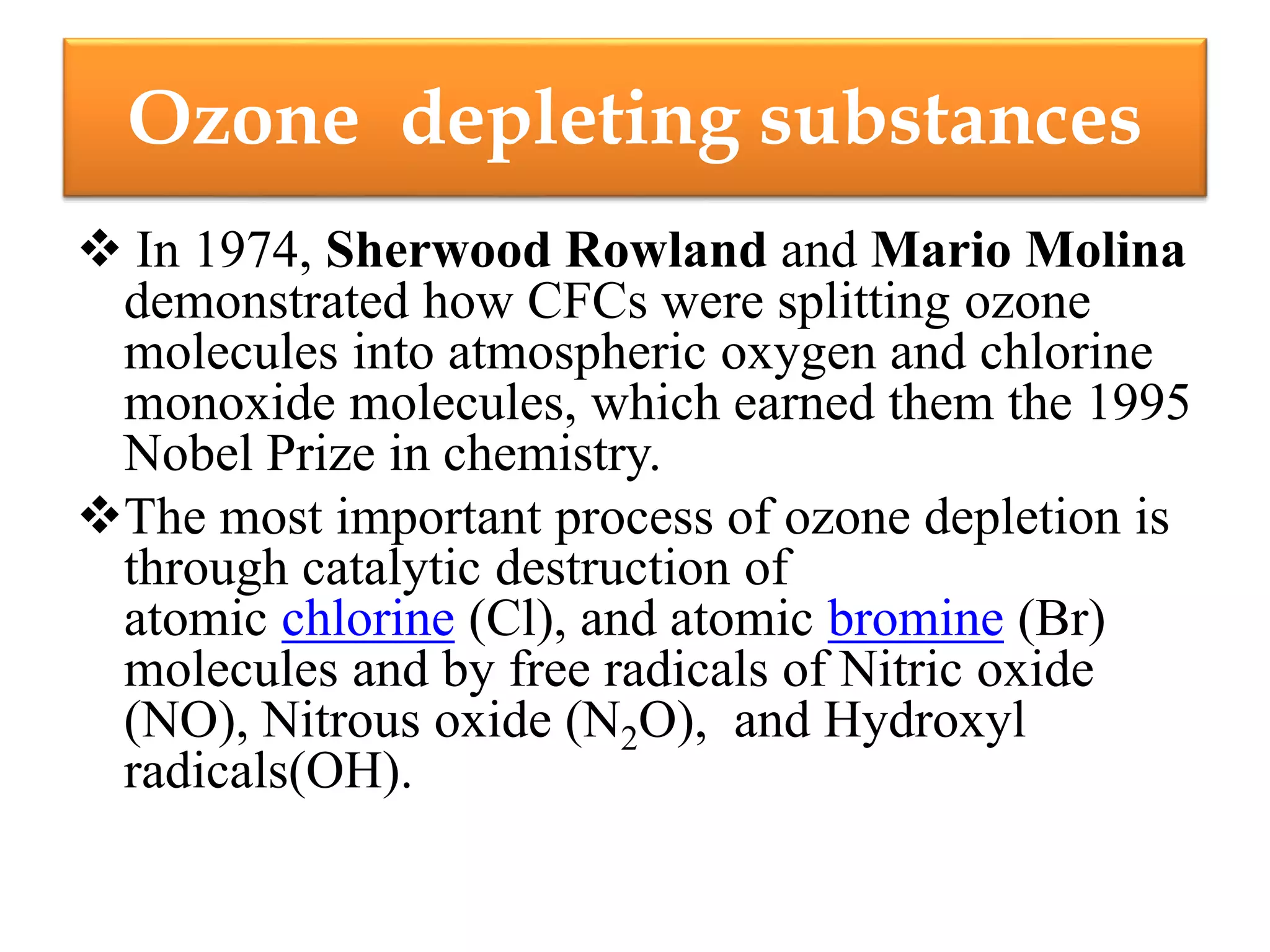
Ozone depleting substances
 In 1974, Sherwood Rowland and Mario Molina
demonstrated how CFCs were splitting ozone
molecules into atmospheric oxygen and chlorine
monoxide molecules, which earned them the 1995
Nobel Prize in chemistry.
The most important process of ozone depletion is
through catalytic destruction of
atomic chlorine (Cl), and atomic bromine (Br)
molecules and by free radicals of Nitric oxide
(NO), Nitrous oxide (N2O), and Hydroxyl
radicals(OH).
 The main source of these compounds in the stratosphere is
photo-dissociation of Chloro-fluro-carbon (CFC) compounds
and Bromo-fluro-carbon (BFC) compounds. They are
commonly referred to as Freons and Halons respectively.
CFCl3+electro magnetic radiation Cl +CFCl2
Cl+O3→ClO+O2:
 The chlorine atom changes an ozone molecule to ordinary
oxygen
 These highly stable compounds released on the earth are
transported to stratosphere.
 Bromine is more reactive than Chlorine but Br concentration
is less in the atmosphere.
 A CFC molecule takes an average of about five to seven
years to go from the ground level to the upper atmosphere,
and it can stay there for about a century, destroying up to
one hundred thousand ozone molecules in this period.
 The breakdown of ozone in the stratosphere results in
decrease in the ozone concentration thus reducing the
absorption of ultraviolet radiation. This leads to increase in
the temperatures in the troposphere(Earth).
 1.1.1 trichloro-2,2,2 trifluroethane also known as CFC113a
is one of four man-made chemicals discovered in the
atmosphere. It is increasing and source is unknown.
Ozone depletion
Ozone hole formation
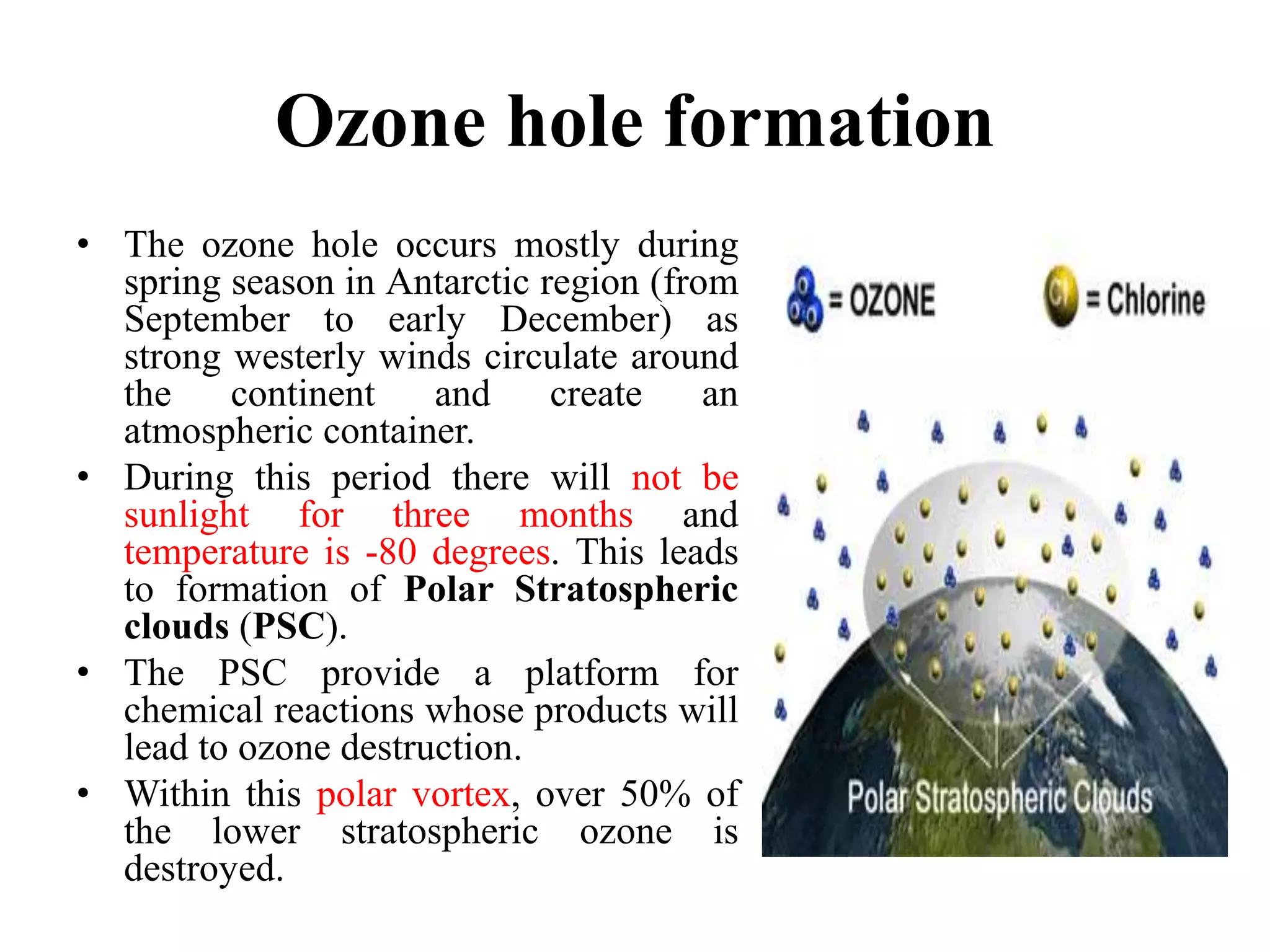
• The ozone hole occurs mostly during
spring season in Antarctic region (from
September to early December) as
strong westerly winds circulate around
the continent and create an
atmospheric container.
• During this period there will not be
sunlight for three months and
temperature is -80 degrees. This leads
to formation of Polar Stratospheric
clouds (PSC).
• The PSC provide a platform for
chemical reactions whose products will
lead to ozone destruction.
• Within this polar vortex, over 50% of
the lower stratospheric ozone is
destroyed.
• The photochemical processes involved are complex but
well understood.
• Most of the chlorine in the stratosphere resides in
"reservoir" compounds, primarily as chlorine nitrate,
and as HCl.
• The formation of end products essentially remove Cl
from the ozone depletion process.
• During the change in the seasons (Antarctic winter and
spring) reactions on the surface of the polar
stratospheric cloud particles convert these "reservoir"
compounds into reactive free radicals (Cl and ClO).
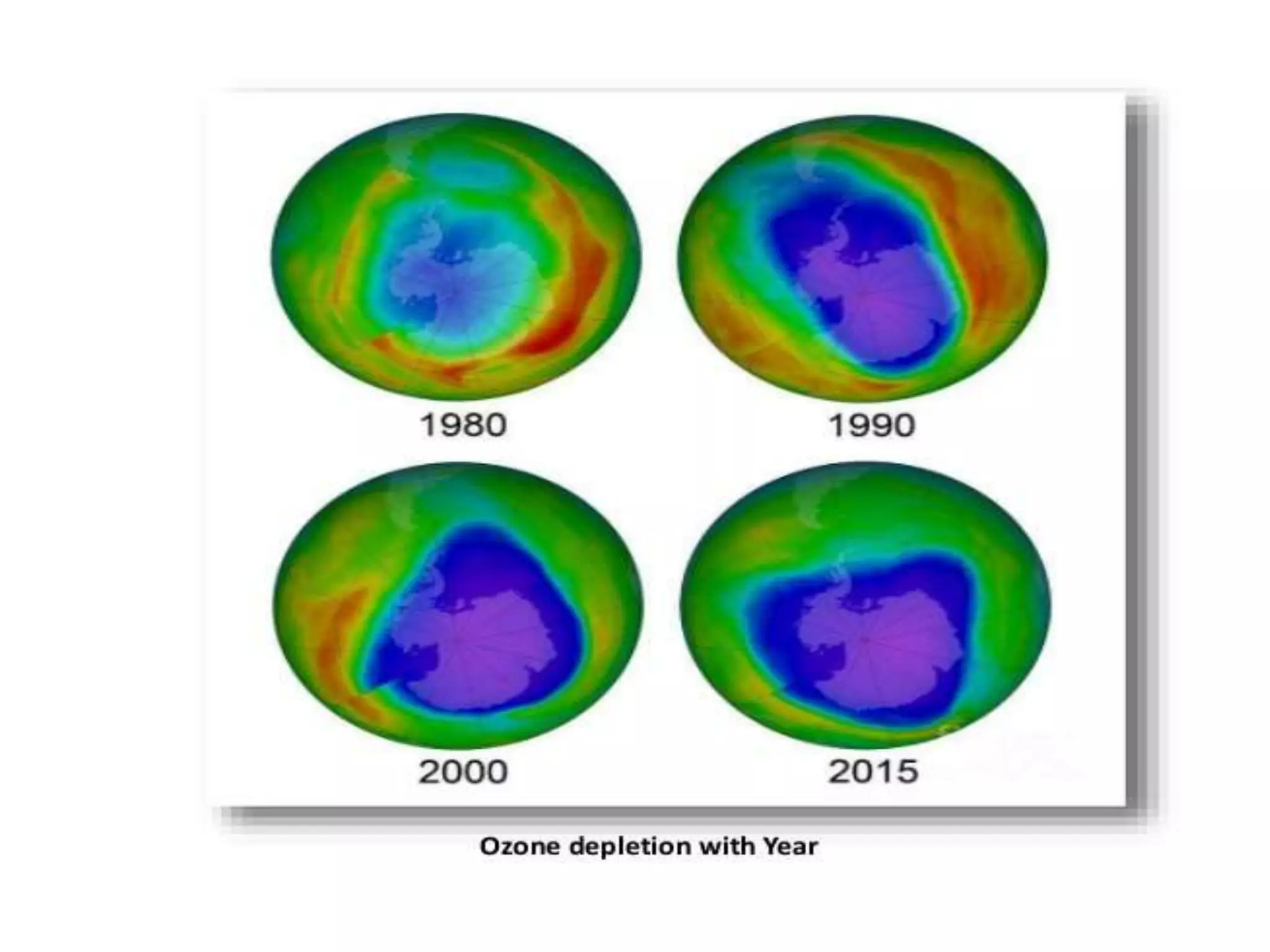
• A major hole is now over Antarctica, where
there are ice sheets. If these Ice sheets melt, it
could increase coastal flooding causing a violent
shift in climate.
Treaty and Protocols
 Montreal protocol, on substances
that deplete the ozone layer, an
International treaty protocol to the
Vienna Convention (1985) for the
protection of ozone layer, was
negotiated and signed by 24
countries and by the European
Economic Community in September
1987.
 This protocol agreed on 16
September, 1987
 Entered into force on 1 January,
1989. • First meeting was held in
Helsinki, on May 1989.
 On December 19,1994, the United Nations General
Assembly, proclaimed September 16 to be the International
day for the preservation of the ozone layer,
commemorating the date when Montreal protocol was
signed.
 The World Ozone Day was first celebrated on September
16, 1995.
 On this day, a number of special events such as talks
and seminars are held in Canadian city of Montreal
and allmost all countries regarding ozone.
 This day is mainly intended to spread awareness of
the depletion of the ozone layer and search for the
solution to preserve it.
 People from all over the world are expected to gather
in Montreal on September, 16 to join the talks and
seminars.
 This year's theme(“32 years and Healing”) celebrates
three decades of remarkable international
cooperation to protect the Ozone Layer and the
climate under the Montreal Protocol.
 This year's theme(“32 years and Healing”) celebrates three
decades of remarkable international cooperation to protect the
Ozone Layer and the climate under the Montreal Protocol.
 It also reminds the people to keep up the momentum to ensure
healthy people and a healthy planet. In 2018, the latest
Scientific Assessment of Ozone Depletion was completed.
 This assessment shows that the parts of the Ozone Layer have
recovered at a rate of 1-3% per decade since 2000.
 Even at the protected rates, Northern hemisphere and mid-
latitude ozone will heal completely by the 2030s.
 The Southern Hemisphere will follow in the 2050s and Polar
Regions by 2060. No doubt Ozone Layer protection efforts also
contribute in fighting with the climate change.
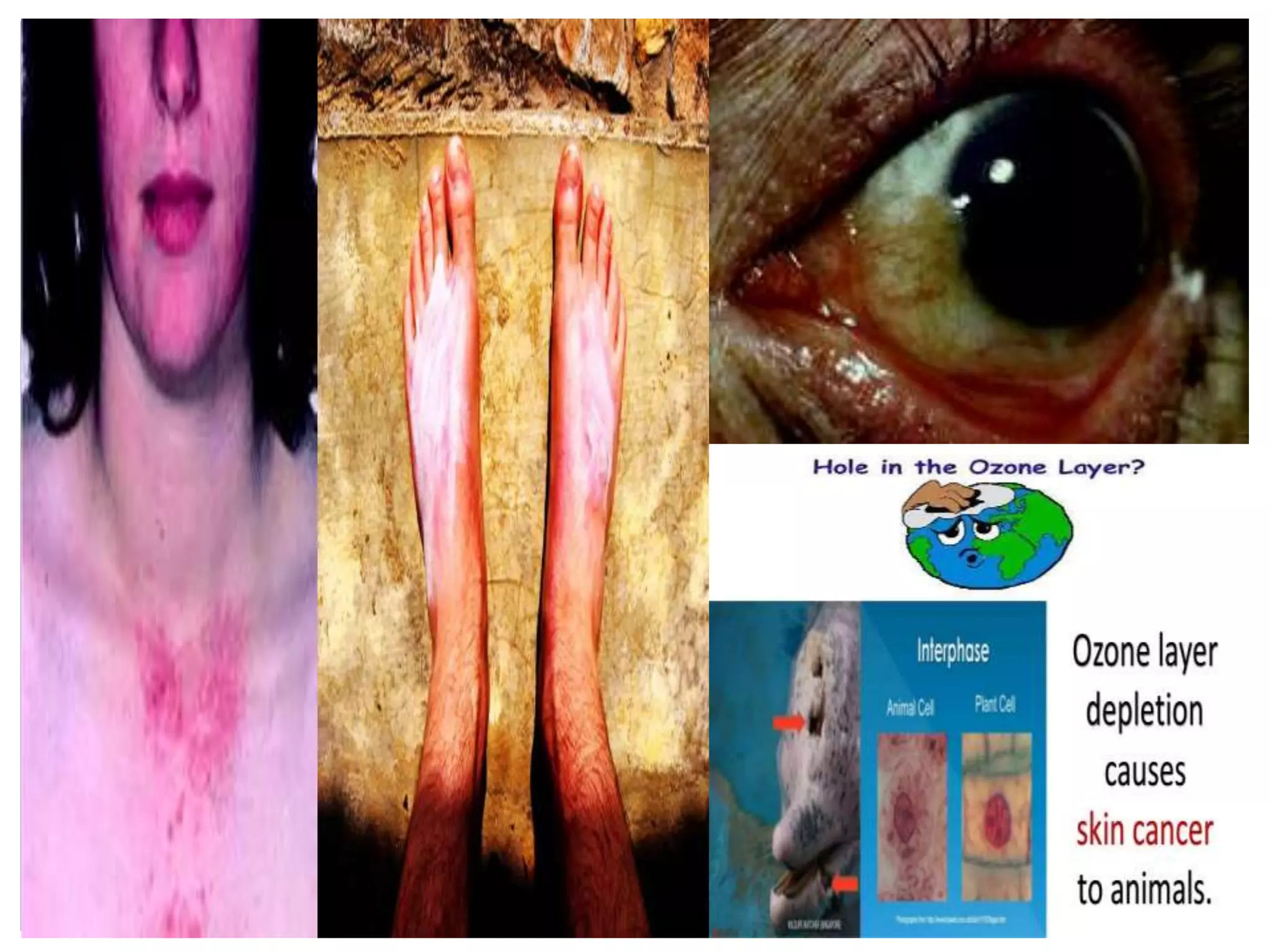
Effects of Ozone Layer Depletion
 squamous cell carcinomas and Malignant melanoma (less frequent
but more lethal) are two type of cancers caused by UVB radiation.
These cancers are relatively mild and rarely fatal.
 absorption of UVB radiation causes the pyrimidine bases in the
DNA molecule to form dimers, resulting in transcription errors
when the DNA replicates.
 Cortical cataracts
 The risks are particularly high for young children, the elderly, and
those with asthma or other respiratory difficulties.
 whales off the coast of California have shown a sharp rise in sun
damage.
Human and Animal Health:
Plant Health
A number of economically important species of plants,
such as rice, depend on cyanobacteria residing on their
roots for the retention of nitrogen.
Cyanobacteria are sensitive to UV radiation and would be
affected.
Despite mechanisms to reduce or repair the effects of
increased ultraviolet radiation, plants have limited ability
to adapt to increased levels of UVB, therefore plant
growth can be directly affected by UVB radiation.
Aquatic Ecosystems:
Damage to phytoplankton, fish larvae, shrimp, crabs
reproduction.
Affects marine food chain, resulting in decreased
fish production.
Materials:
Paints, rubber, wood and plastic are degraded faster,
especially in tropical regions
Such damages accounts to billions of dollars
annually.
 Limit private vehicle driving- A very easy way to control
ozone depletion would be to limit or reduce the amount of
driving as vehicular emissions eventually result in smog
which is a culprit in the deterioration of the ozone layer.
 Reduce the source of Nitrous oxide and CFC.
 Minimize high altitude aircraft flights
 Minimize rocket flights
 Encourage growth of plants that produce oxygen.
 Eliminate production and release of ozone depleting chemicals
(such as CFCs and BFCs).
Ways to prevent ozone depletion
 At Global level
1. Many environmental organization, such as EPA and
treaties must be signed to phase out the use of harmful
substances like CFCs that contribute ozone depletion.
2. Developing stringent regulations for rocket launches.
 Climate 101- Ozone Depletion - National
Geographic.mp4
World ozone day presentation

World ozone day presentation

  • 1.
    International Day forthe Preservation of the Ozone Layer, 16 September '32 years and Healing'
  • 2.
    Components of Earth Earthis composed of three components  Lithosphere, Hydrosphere and Atmosphere. According to Temperature, Atmosphere have four different layers  Troposphere,  Stratosphere (Comprising Ozone Layer),  Mesosphere and  Thermosphere.
  • 3.
    Location of ozonelayer • Stratosphere: The stratosphere is a layer of Earth's atmosphere that is stratified in temperature, with warmer layers higher up and cooler layers farther down. • Ozone Layer: The layer with the highest concentration of ozone molecules, is found in the stratosphere. The ozone layer filters much out of the sun's ultraviolet radiation that would be harmful to most forms of life. • Troposphere: The troposphere is the lowermost portion of the Earth's atmosphere and the one in which most weather and the "greenhouse" effect occurs.
  • 4.
    Importance of OzoneLayer • Ozone Layer acts as a shield to protect the short wave, more powerful and harmful radiations such as X-rays, Gamma, Beta and UV radiations (280– 315 nm) from sun. • Without the Ozone Layer the risk of many factors increase considerably.
  • 6.
    How ozone is formed? In the stratosphere ozone molecule is dissociated into molecular oxygen and oxygen molecules when absorbs a photon from ultraviolet radiation (>240 nm). These singlet oxygen atoms combines with a oxygen molecule forms a ozone molecule. O2 + O →O3 O3 UV radiation → O2 + O (photon molecule)  This is a continuous process that take place in the ozone layer.  The overall amount of ozone in the stratosphere is determined by a balance between photochemical production and recombination.
  • 8.
    Ozone depleting substances In 1974, Sherwood Rowland and Mario Molina demonstrated how CFCs were splitting ozone molecules into atmospheric oxygen and chlorine monoxide molecules, which earned them the 1995 Nobel Prize in chemistry. The most important process of ozone depletion is through catalytic destruction of atomic chlorine (Cl), and atomic bromine (Br) molecules and by free radicals of Nitric oxide (NO), Nitrous oxide (N2O), and Hydroxyl radicals(OH).
  • 9.
     The mainsource of these compounds in the stratosphere is photo-dissociation of Chloro-fluro-carbon (CFC) compounds and Bromo-fluro-carbon (BFC) compounds. They are commonly referred to as Freons and Halons respectively. CFCl3+electro magnetic radiation Cl +CFCl2 Cl+O3→ClO+O2:  The chlorine atom changes an ozone molecule to ordinary oxygen  These highly stable compounds released on the earth are transported to stratosphere.  Bromine is more reactive than Chlorine but Br concentration is less in the atmosphere.
  • 11.
     A CFCmolecule takes an average of about five to seven years to go from the ground level to the upper atmosphere, and it can stay there for about a century, destroying up to one hundred thousand ozone molecules in this period.  The breakdown of ozone in the stratosphere results in decrease in the ozone concentration thus reducing the absorption of ultraviolet radiation. This leads to increase in the temperatures in the troposphere(Earth).  1.1.1 trichloro-2,2,2 trifluroethane also known as CFC113a is one of four man-made chemicals discovered in the atmosphere. It is increasing and source is unknown. Ozone depletion
  • 12.
    Ozone hole formation •The ozone hole occurs mostly during spring season in Antarctic region (from September to early December) as strong westerly winds circulate around the continent and create an atmospheric container. • During this period there will not be sunlight for three months and temperature is -80 degrees. This leads to formation of Polar Stratospheric clouds (PSC). • The PSC provide a platform for chemical reactions whose products will lead to ozone destruction. • Within this polar vortex, over 50% of the lower stratospheric ozone is destroyed.
  • 13.
    • The photochemicalprocesses involved are complex but well understood. • Most of the chlorine in the stratosphere resides in "reservoir" compounds, primarily as chlorine nitrate, and as HCl. • The formation of end products essentially remove Cl from the ozone depletion process. • During the change in the seasons (Antarctic winter and spring) reactions on the surface of the polar stratospheric cloud particles convert these "reservoir" compounds into reactive free radicals (Cl and ClO).
  • 14.
    • A majorhole is now over Antarctica, where there are ice sheets. If these Ice sheets melt, it could increase coastal flooding causing a violent shift in climate.
  • 16.
    Treaty and Protocols Montreal protocol, on substances that deplete the ozone layer, an International treaty protocol to the Vienna Convention (1985) for the protection of ozone layer, was negotiated and signed by 24 countries and by the European Economic Community in September 1987.  This protocol agreed on 16 September, 1987  Entered into force on 1 January, 1989. • First meeting was held in Helsinki, on May 1989.
  • 17.
     On December19,1994, the United Nations General Assembly, proclaimed September 16 to be the International day for the preservation of the ozone layer, commemorating the date when Montreal protocol was signed.  The World Ozone Day was first celebrated on September 16, 1995.
  • 18.
     On thisday, a number of special events such as talks and seminars are held in Canadian city of Montreal and allmost all countries regarding ozone.  This day is mainly intended to spread awareness of the depletion of the ozone layer and search for the solution to preserve it.  People from all over the world are expected to gather in Montreal on September, 16 to join the talks and seminars.  This year's theme(“32 years and Healing”) celebrates three decades of remarkable international cooperation to protect the Ozone Layer and the climate under the Montreal Protocol.
  • 19.
     This year'stheme(“32 years and Healing”) celebrates three decades of remarkable international cooperation to protect the Ozone Layer and the climate under the Montreal Protocol.  It also reminds the people to keep up the momentum to ensure healthy people and a healthy planet. In 2018, the latest Scientific Assessment of Ozone Depletion was completed.  This assessment shows that the parts of the Ozone Layer have recovered at a rate of 1-3% per decade since 2000.  Even at the protected rates, Northern hemisphere and mid- latitude ozone will heal completely by the 2030s.  The Southern Hemisphere will follow in the 2050s and Polar Regions by 2060. No doubt Ozone Layer protection efforts also contribute in fighting with the climate change.
  • 20.
    Effects of OzoneLayer Depletion
  • 21.
     squamous cellcarcinomas and Malignant melanoma (less frequent but more lethal) are two type of cancers caused by UVB radiation. These cancers are relatively mild and rarely fatal.  absorption of UVB radiation causes the pyrimidine bases in the DNA molecule to form dimers, resulting in transcription errors when the DNA replicates.  Cortical cataracts  The risks are particularly high for young children, the elderly, and those with asthma or other respiratory difficulties.  whales off the coast of California have shown a sharp rise in sun damage. Human and Animal Health:
  • 23.
    Plant Health A numberof economically important species of plants, such as rice, depend on cyanobacteria residing on their roots for the retention of nitrogen. Cyanobacteria are sensitive to UV radiation and would be affected. Despite mechanisms to reduce or repair the effects of increased ultraviolet radiation, plants have limited ability to adapt to increased levels of UVB, therefore plant growth can be directly affected by UVB radiation.
  • 25.
    Aquatic Ecosystems: Damage tophytoplankton, fish larvae, shrimp, crabs reproduction. Affects marine food chain, resulting in decreased fish production. Materials: Paints, rubber, wood and plastic are degraded faster, especially in tropical regions Such damages accounts to billions of dollars annually.
  • 27.
     Limit privatevehicle driving- A very easy way to control ozone depletion would be to limit or reduce the amount of driving as vehicular emissions eventually result in smog which is a culprit in the deterioration of the ozone layer.  Reduce the source of Nitrous oxide and CFC.  Minimize high altitude aircraft flights  Minimize rocket flights  Encourage growth of plants that produce oxygen.  Eliminate production and release of ozone depleting chemicals (such as CFCs and BFCs). Ways to prevent ozone depletion
  • 29.
     At Globallevel 1. Many environmental organization, such as EPA and treaties must be signed to phase out the use of harmful substances like CFCs that contribute ozone depletion. 2. Developing stringent regulations for rocket launches.
  • 31.
     Climate 101-Ozone Depletion - National Geographic.mp4