The definition                     The effects of ozone depletion

   of the ozone
       layer                        Teamwork
                                  Resources


                                           The main ozone-
                                              depleting
The ozone
                                             substances
 analysis

                        The
                   importance
                   of the ozone
                       layer
The definition of the ozone layer:
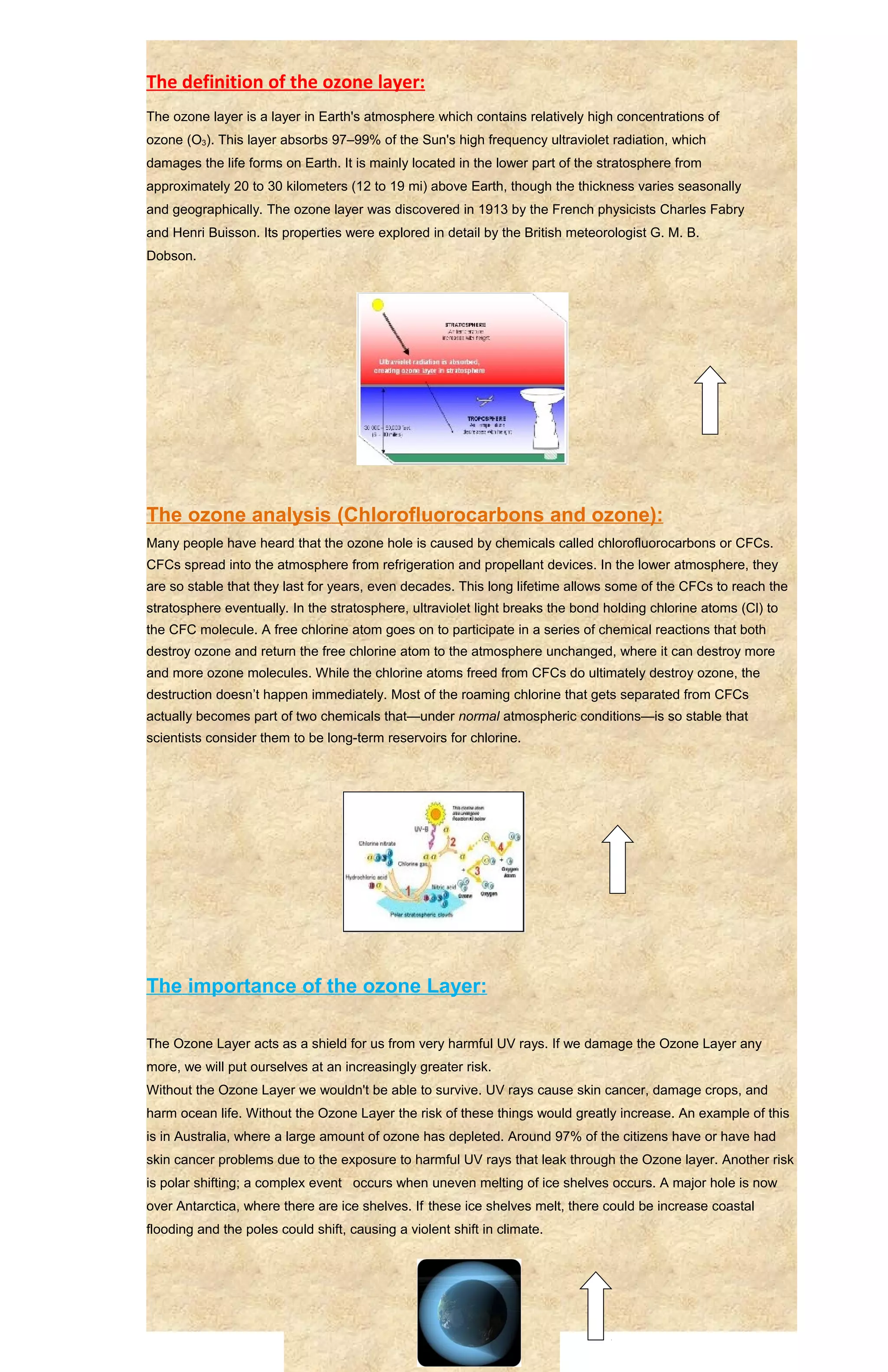
The ozone layer is a layer in Earth's atmosphere which contains relatively high concentrations of
ozone (O3). This layer absorbs 97–99% of the Sun's high frequency ultraviolet radiation, which
damages the life forms on Earth. It is mainly located in the lower part of the stratosphere from
approximately 20 to 30 kilometers (12 to 19 mi) above Earth, though the thickness varies seasonally
and geographically. The ozone layer was discovered in 1913 by the French physicists Charles Fabry
and Henri Buisson. Its properties were explored in detail by the British meteorologist G. M. B.
Dobson.


The ozone analysis (Chlorofluorocarbons and ozone):
Many people have heard that the ozone hole is caused by chemicals called chlorofluorocarbons or CFCs.
CFCs spread into the atmosphere from refrigeration and propellant devices. In the lower atmosphere, they
are so stable that they last for years, even decades. This long lifetime allows some of the CFCs to reach the
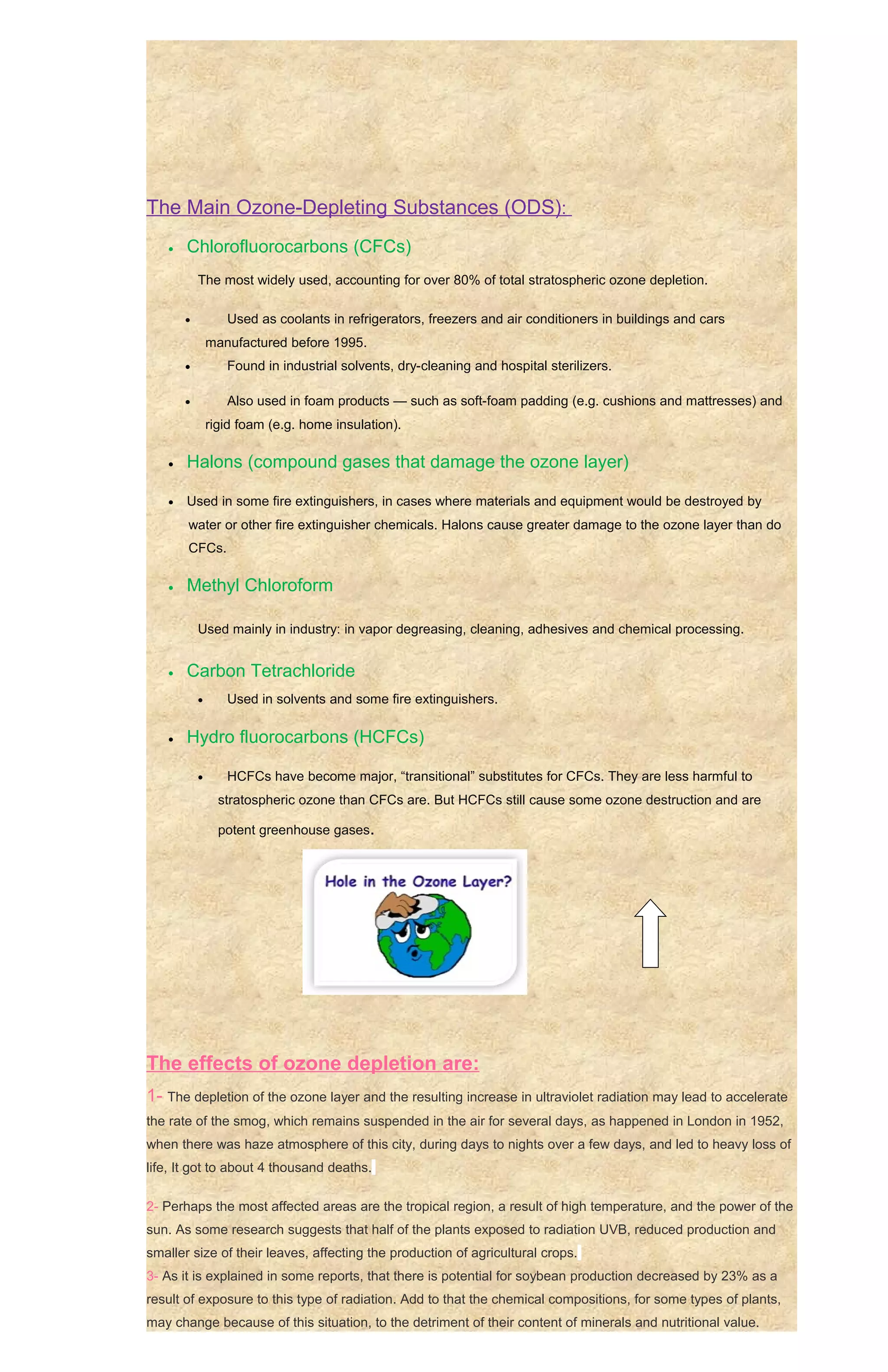
stratosphere eventually. In the stratosphere, ultraviolet light breaks the bond holding chlorine atoms (Cl) to
the CFC molecule. A free chlorine atom goes on to participate in a series of chemical reactions that both
destroy ozone and return the free chlorine atom to the atmosphere unchanged, where it can destroy more
and more ozone molecules. While the chlorine atoms freed from CFCs do ultimately destroy ozone, the
destruction doesn’t happen immediately. Most of the roaming chlorine that gets separated from CFCs
actually becomes part of two chemicals that—under normal atmospheric conditions—is so stable that
scientists consider them to be long-term reservoirs for chlorine.


The importance of the ozone Layer:

The Ozone Layer acts as a shield for us from very harmful UV rays. If we damage the Ozone Layer any
more, we will put ourselves at an increasingly greater risk.
Without the Ozone Layer we wouldn't be able to survive. UV rays cause skin cancer, damage crops, and
harm ocean life. Without the Ozone Layer the risk of these things would greatly increase. An example of this
is in Australia, where a large amount of ozone has depleted. Around 97% of the citizens have or have had
skin cancer problems due to the exposure to harmful UV rays that leak through the Ozone layer. Another risk
is polar shifting; a complex event occurs when uneven melting of ice shelves occurs. A major hole is now
over Antarctica, where there are ice shelves. If these ice shelves melt, there could be increase coastal
flooding and the poles could shift, causing a violent shift in climate.
The Main Ozone-Depleting Substances (ODS):
   •   Chlorofluorocarbons (CFCs)
           The most widely used, accounting for over 80% of total stratospheric ozone depletion.

       •          Used as coolants in refrigerators, freezers and air conditioners in buildings and cars
               manufactured before 1995.
       •          Found in industrial solvents, dry-cleaning and hospital sterilizers.

       •          Also used in foam products — such as soft-foam padding (e.g. cushions and mattresses) and
               rigid foam (e.g. home insulation).

   •   Halons (compound gases that damage the ozone layer)

   •   Used in some fire extinguishers, in cases where materials and equipment would be destroyed by
       water or other fire extinguisher chemicals. Halons cause greater damage to the ozone layer than do
       CFCs.

   •   Methyl Chloroform

           Used mainly in industry: in vapor degreasing, cleaning, adhesives and chemical processing.


   •   Carbon Tetrachloride
           •      Used in solvents and some fire extinguishers.

   •   Hydro fluorocarbons (HCFCs)

           •      HCFCs have become major, “transitional” substitutes for CFCs. They are less harmful to
                 stratospheric ozone than CFCs are. But HCFCs still cause some ozone destruction and are

                 potent greenhouse gases.


The effects of ozone depletion are:
1- The depletion of the ozone layer and the resulting increase in ultraviolet radiation may lead to accelerate
the rate of the smog, which remains suspended in the air for several days, as happened in London in 1952,
when there was haze atmosphere of this city, during days to nights over a few days, and led to heavy loss of
life, It got to about 4 thousand deaths.

2- Perhaps the most affected areas are the tropical region, a result of high temperature, and the power of the
sun. As some research suggests that half of the plants exposed to radiation UVB, reduced production and
smaller size of their leaves, affecting the production of agricultural crops.
3- As it is explained in some reports, that there is potential for soybean production decreased by 23% as a
result of exposure to this type of radiation. Add to that the chemical compositions, for some types of plants,
may change because of this situation, to the detriment of their content of minerals and nutritional value.
4- The ultraviolet rays of the type of UVB, plays a major role in the formation of skin diseases, and that
means an almost 300 thousand cases of skin cancer every year.

5- Some disease such as: cataracts in the lens of the eye, in addition to injuring the eye disease glaucoma, in
which the eye is unable to resist these rays, and that weakens the effectiveness of the immune system in
humans, and this is what makes people more susceptible to infectious diseases, caused by viruses such as
scabies, as well as the resulting Tuberculosis as a disease by bacteria.

6- Do not stop the negative effects of reducing the ozone layer on humans alone, Contributes destruction of
the ozone layer and the widening hole in this layer to increase the temperature of the earth's surface, and
thus lead to the so-called global warming.

7- On the other hand, there are fears of a weakening of clusters of micro-organisms in the seas and oceans,
known as plankton plant, because of exposure to UV radiation. These objects are an important basis for the
food chain in ecosystems in fresh and salt water, primarily fish.


       Resources

       1-http://www.research.noaa.gov/climate/t_ozonelayer.html

       2-www.oar.noaa.gov/climate/t-ozonelayer.html

       Teamwork:

      Editor: Hala Alnashed

      Designer: Batool Abdeen

      Publisher: Marwa Attar& Afaf Alkhalil


  Alkods High School/Grade: Second secondary scientific


Supervisor: Mrs. Tonia Bitar


        Toniabitar@gmail.com
Newsletter the ozone

Newsletter the ozone

  • 1.
    The definition The effects of ozone depletion of the ozone layer Teamwork Resources The main ozone- depleting The ozone substances analysis The importance of the ozone layer
  • 2.
    The definition ofthe ozone layer: The ozone layer is a layer in Earth's atmosphere which contains relatively high concentrations of ozone (O3). This layer absorbs 97–99% of the Sun's high frequency ultraviolet radiation, which damages the life forms on Earth. It is mainly located in the lower part of the stratosphere from approximately 20 to 30 kilometers (12 to 19 mi) above Earth, though the thickness varies seasonally and geographically. The ozone layer was discovered in 1913 by the French physicists Charles Fabry and Henri Buisson. Its properties were explored in detail by the British meteorologist G. M. B. Dobson. The ozone analysis (Chlorofluorocarbons and ozone): Many people have heard that the ozone hole is caused by chemicals called chlorofluorocarbons or CFCs. CFCs spread into the atmosphere from refrigeration and propellant devices. In the lower atmosphere, they are so stable that they last for years, even decades. This long lifetime allows some of the CFCs to reach the stratosphere eventually. In the stratosphere, ultraviolet light breaks the bond holding chlorine atoms (Cl) to the CFC molecule. A free chlorine atom goes on to participate in a series of chemical reactions that both destroy ozone and return the free chlorine atom to the atmosphere unchanged, where it can destroy more and more ozone molecules. While the chlorine atoms freed from CFCs do ultimately destroy ozone, the destruction doesn’t happen immediately. Most of the roaming chlorine that gets separated from CFCs actually becomes part of two chemicals that—under normal atmospheric conditions—is so stable that scientists consider them to be long-term reservoirs for chlorine. The importance of the ozone Layer: The Ozone Layer acts as a shield for us from very harmful UV rays. If we damage the Ozone Layer any more, we will put ourselves at an increasingly greater risk. Without the Ozone Layer we wouldn't be able to survive. UV rays cause skin cancer, damage crops, and harm ocean life. Without the Ozone Layer the risk of these things would greatly increase. An example of this is in Australia, where a large amount of ozone has depleted. Around 97% of the citizens have or have had skin cancer problems due to the exposure to harmful UV rays that leak through the Ozone layer. Another risk is polar shifting; a complex event occurs when uneven melting of ice shelves occurs. A major hole is now over Antarctica, where there are ice shelves. If these ice shelves melt, there could be increase coastal flooding and the poles could shift, causing a violent shift in climate.
  • 3.
    The Main Ozone-DepletingSubstances (ODS): • Chlorofluorocarbons (CFCs) The most widely used, accounting for over 80% of total stratospheric ozone depletion. • Used as coolants in refrigerators, freezers and air conditioners in buildings and cars manufactured before 1995. • Found in industrial solvents, dry-cleaning and hospital sterilizers. • Also used in foam products — such as soft-foam padding (e.g. cushions and mattresses) and rigid foam (e.g. home insulation). • Halons (compound gases that damage the ozone layer) • Used in some fire extinguishers, in cases where materials and equipment would be destroyed by water or other fire extinguisher chemicals. Halons cause greater damage to the ozone layer than do CFCs. • Methyl Chloroform Used mainly in industry: in vapor degreasing, cleaning, adhesives and chemical processing. • Carbon Tetrachloride • Used in solvents and some fire extinguishers. • Hydro fluorocarbons (HCFCs) • HCFCs have become major, “transitional” substitutes for CFCs. They are less harmful to stratospheric ozone than CFCs are. But HCFCs still cause some ozone destruction and are potent greenhouse gases. The effects of ozone depletion are: 1- The depletion of the ozone layer and the resulting increase in ultraviolet radiation may lead to accelerate the rate of the smog, which remains suspended in the air for several days, as happened in London in 1952, when there was haze atmosphere of this city, during days to nights over a few days, and led to heavy loss of life, It got to about 4 thousand deaths. 2- Perhaps the most affected areas are the tropical region, a result of high temperature, and the power of the sun. As some research suggests that half of the plants exposed to radiation UVB, reduced production and smaller size of their leaves, affecting the production of agricultural crops. 3- As it is explained in some reports, that there is potential for soybean production decreased by 23% as a result of exposure to this type of radiation. Add to that the chemical compositions, for some types of plants, may change because of this situation, to the detriment of their content of minerals and nutritional value.
  • 4.
    4- The ultravioletrays of the type of UVB, plays a major role in the formation of skin diseases, and that means an almost 300 thousand cases of skin cancer every year. 5- Some disease such as: cataracts in the lens of the eye, in addition to injuring the eye disease glaucoma, in which the eye is unable to resist these rays, and that weakens the effectiveness of the immune system in humans, and this is what makes people more susceptible to infectious diseases, caused by viruses such as scabies, as well as the resulting Tuberculosis as a disease by bacteria. 6- Do not stop the negative effects of reducing the ozone layer on humans alone, Contributes destruction of the ozone layer and the widening hole in this layer to increase the temperature of the earth's surface, and thus lead to the so-called global warming. 7- On the other hand, there are fears of a weakening of clusters of micro-organisms in the seas and oceans, known as plankton plant, because of exposure to UV radiation. These objects are an important basis for the food chain in ecosystems in fresh and salt water, primarily fish. Resources 1-http://www.research.noaa.gov/climate/t_ozonelayer.html 2-www.oar.noaa.gov/climate/t-ozonelayer.html Teamwork: Editor: Hala Alnashed Designer: Batool Abdeen Publisher: Marwa Attar& Afaf Alkhalil Alkods High School/Grade: Second secondary scientific Supervisor: Mrs. Tonia Bitar Toniabitar@gmail.com