THE OZONE LAYER
BY
MR. NIKESH BANWADE
ENVIRONMENT DEPARTMENT
SAURASHTRA CEMENT LIMITED
THE PRESENTATION
ON
CONTENT OF THE PRESENTATION
 What is it ??
 Where is it?
 Why is it important to life on Earth?
 Why it is depleting
 What are the effects of the Ozone layer Depletion ?
 How can we save it
WHAT IS THE OZONE?
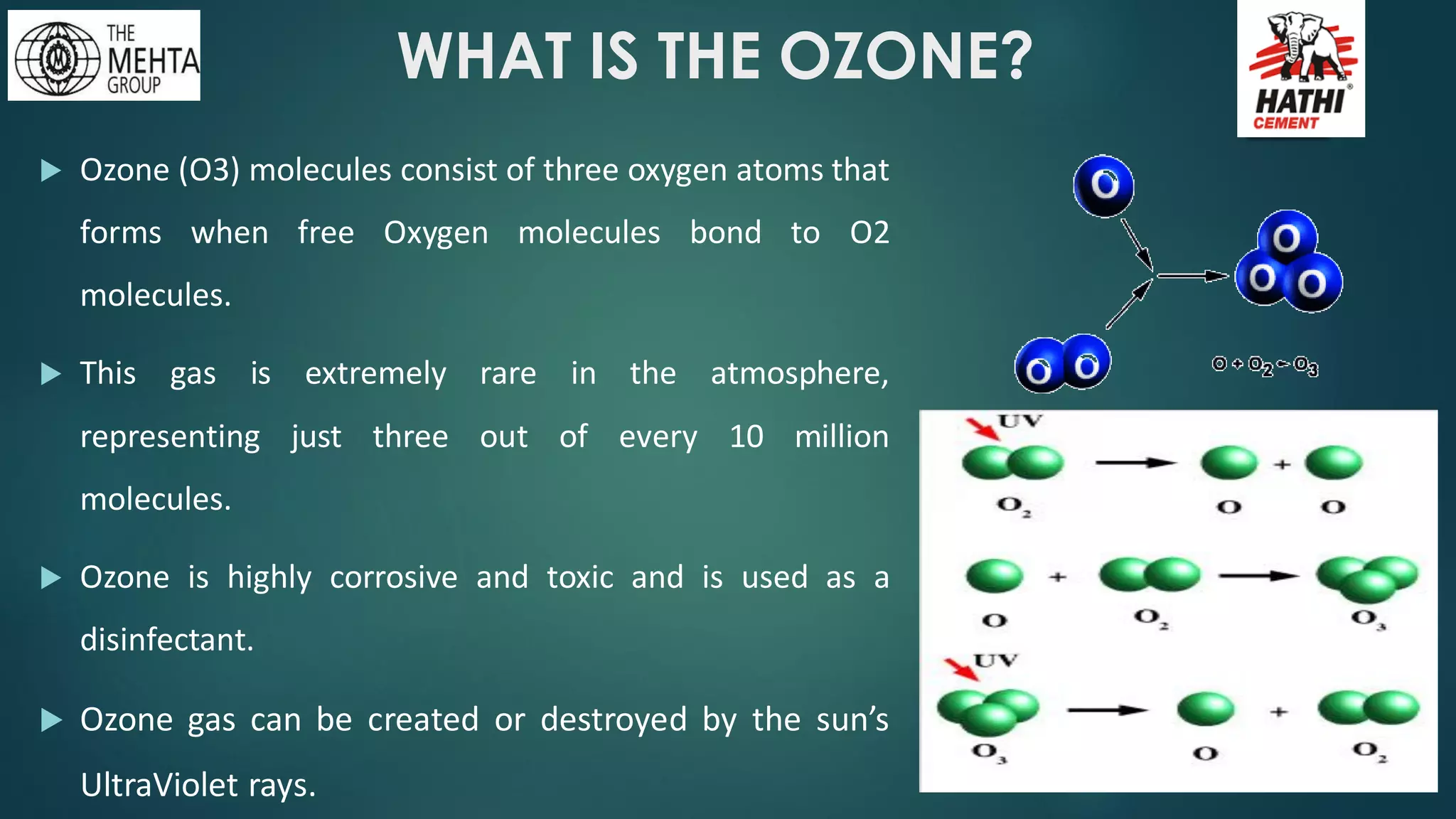
 Ozone (O3) molecules consist of three oxygen atoms that
forms when free Oxygen molecules bond to O2
molecules.
 This gas is extremely rare in the atmosphere,
representing just three out of every 10 million
molecules.
 Ozone is highly corrosive and toxic and is used as a
disinfectant.
 Ozone gas can be created or destroyed by the sun’s
UltraViolet rays.
THE OZONE – WHERE IT IS ?
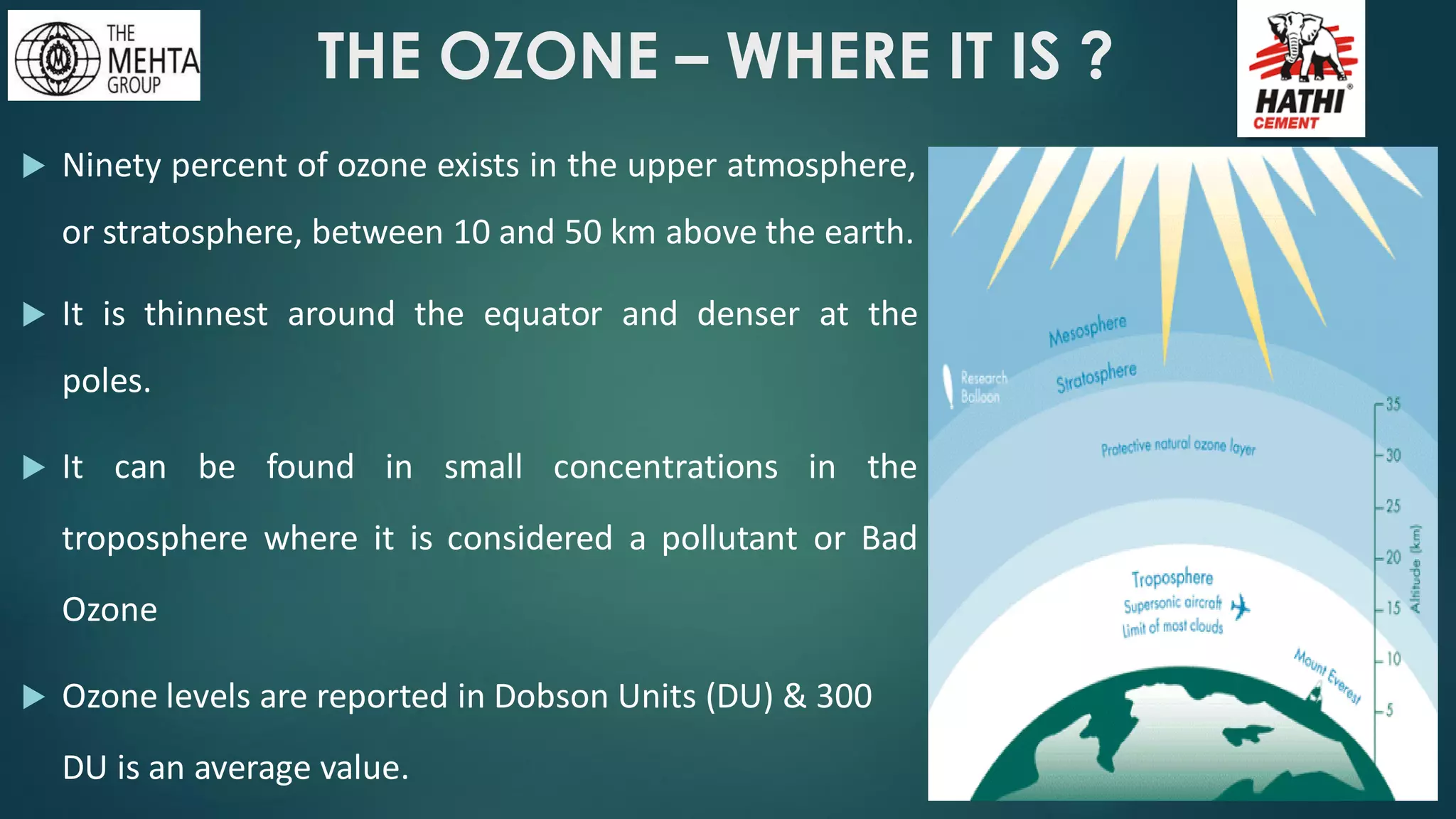
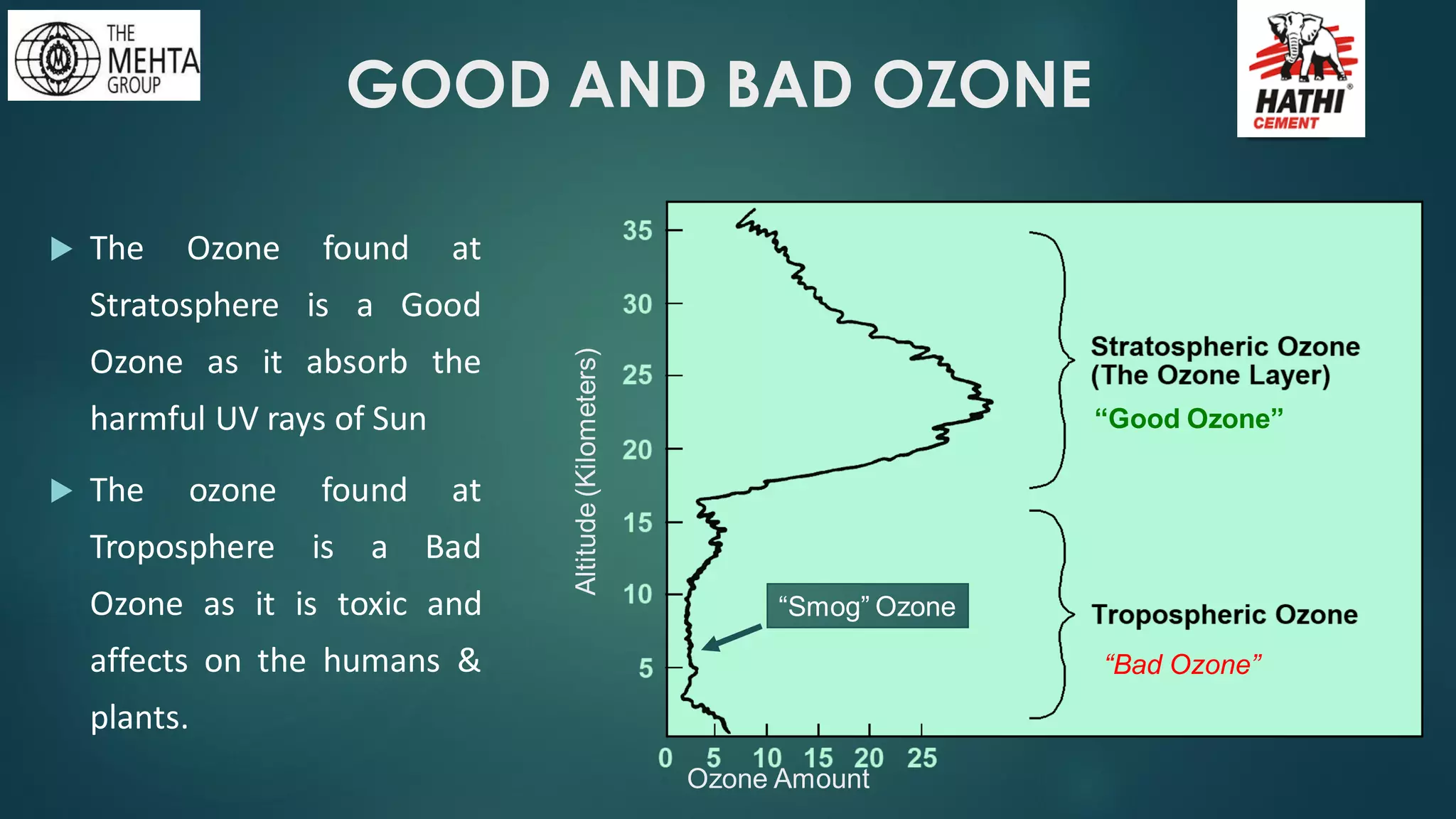
 Ninety percent of ozone exists in the upper atmosphere,
or stratosphere, between 10 and 50 km above the earth.
 It is thinnest around the equator and denser at the
poles.
 It can be found in small concentrations in the
troposphere where it is considered a pollutant or Bad
Ozone
 Ozone levels are reported in Dobson Units (DU) & 300
DU is an average value.
“Smog” Ozone
Ozone Amount
Altitude(Kilometers)
“Good Ozone”
“Bad Ozone”
GOOD AND BAD OZONE
 The Ozone found at
Stratosphere is a Good
Ozone as it absorb the
harmful UV rays of Sun
 The ozone found at
Troposphere is a Bad
Ozone as it is toxic and
affects on the humans &
plants.
OZONE FORMATION
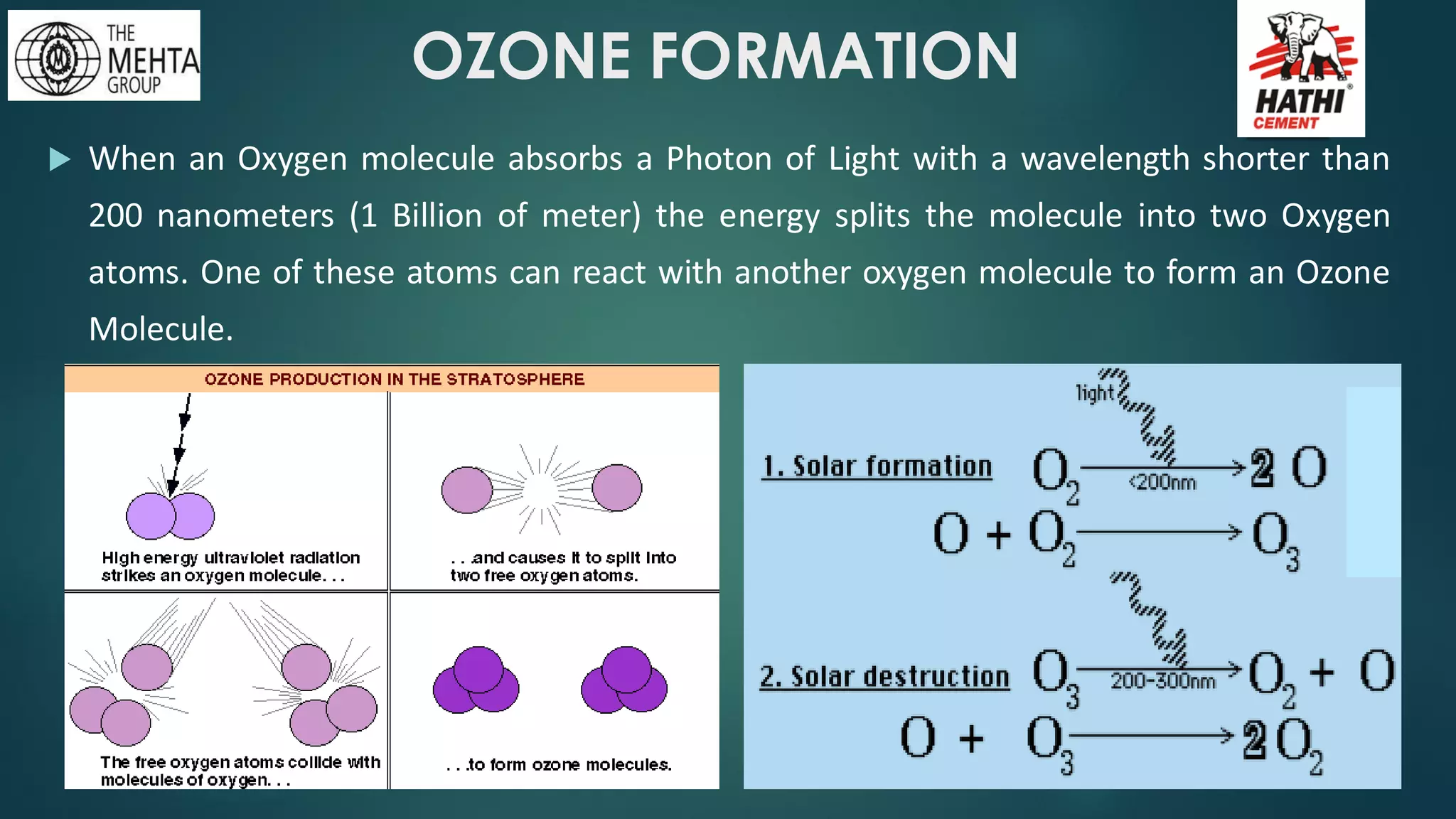
 When an Oxygen molecule absorbs a Photon of Light with a wavelength shorter than
200 nanometers (1 Billion of meter) the energy splits the molecule into two Oxygen
atoms. One of these atoms can react with another oxygen molecule to form an Ozone
Molecule.
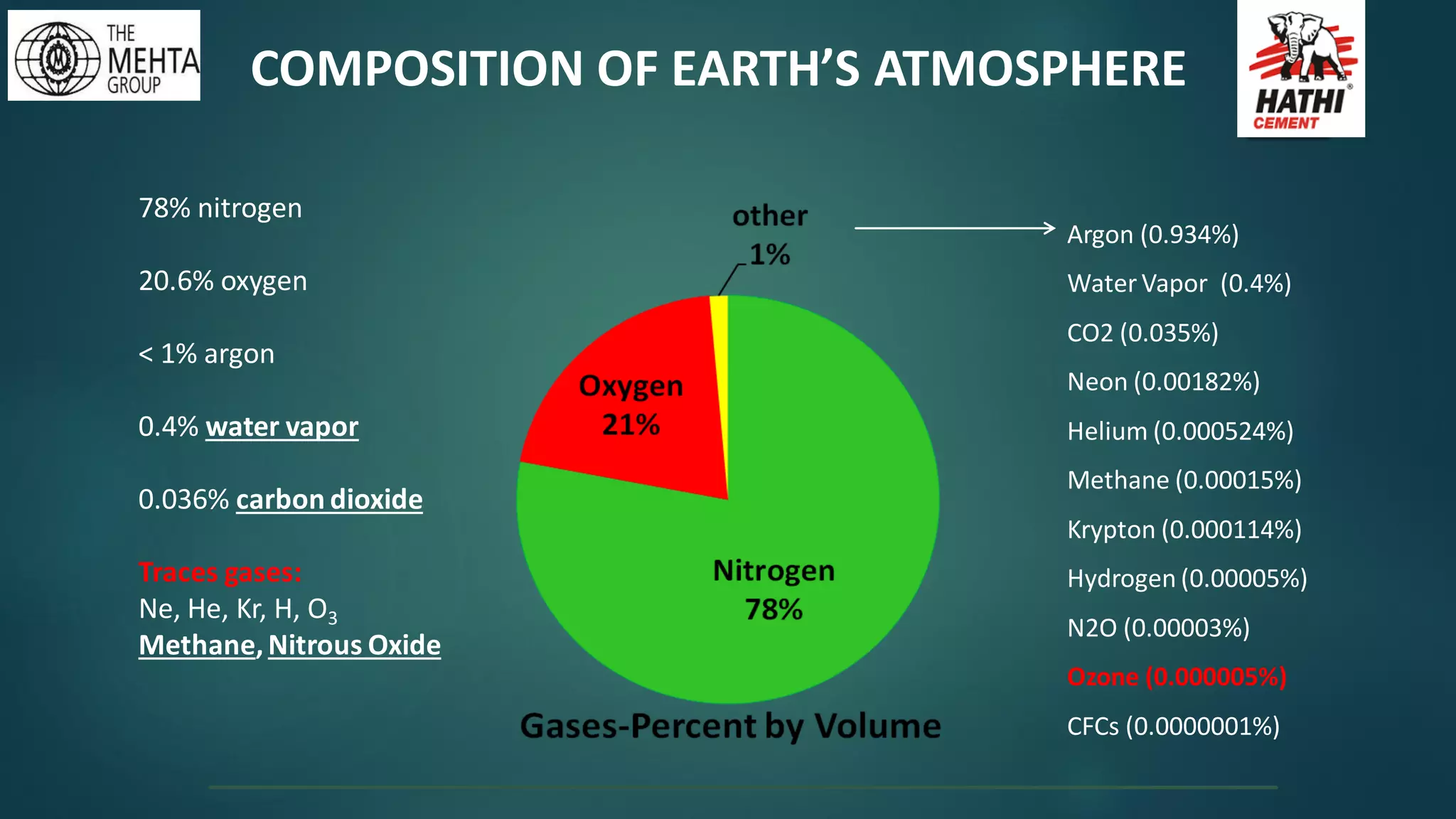
78% nitrogen
20.6% oxygen
< 1% argon
0.4% water vapor
0.036% carbon dioxide
Traces gases:
Ne, He, Kr, H, O3
Methane,Nitrous Oxide
Argon (0.934%)
Water Vapor (0.4%)
CO2 (0.035%)
Neon (0.00182%)
Helium (0.000524%)
Methane (0.00015%)
Krypton (0.000114%)
Hydrogen (0.00005%)
N2O (0.00003%)
Ozone (0.000005%)
CFCs (0.0000001%)
COMPOSITION OF EARTH’S ATMOSPHERE
WHY OZONE LAYER IS IMPORTANT
 On a daily basis, the sun radiates its energy
toward Earth. One form of this energy is
UltraViolet radiation, also known as UV rays.
 UV rays are relatively high energy waves that
provide Earth with the warmth it needs to support
life as we know it.
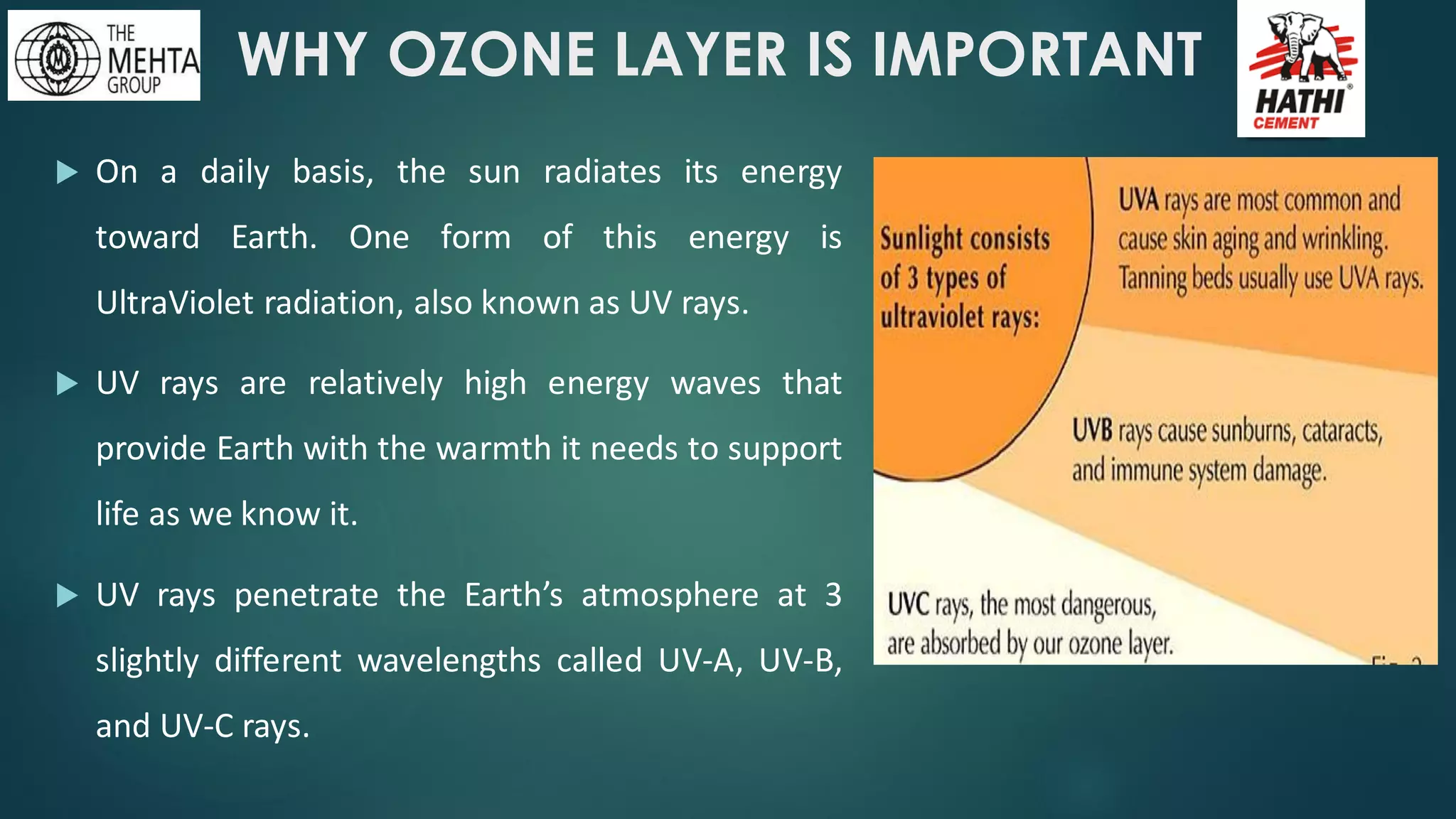
 UV rays penetrate the Earth’s atmosphere at 3
slightly different wavelengths called UV-A, UV-B,
and UV-C rays.
WHY OZONE LAYER IS IMPORTANT
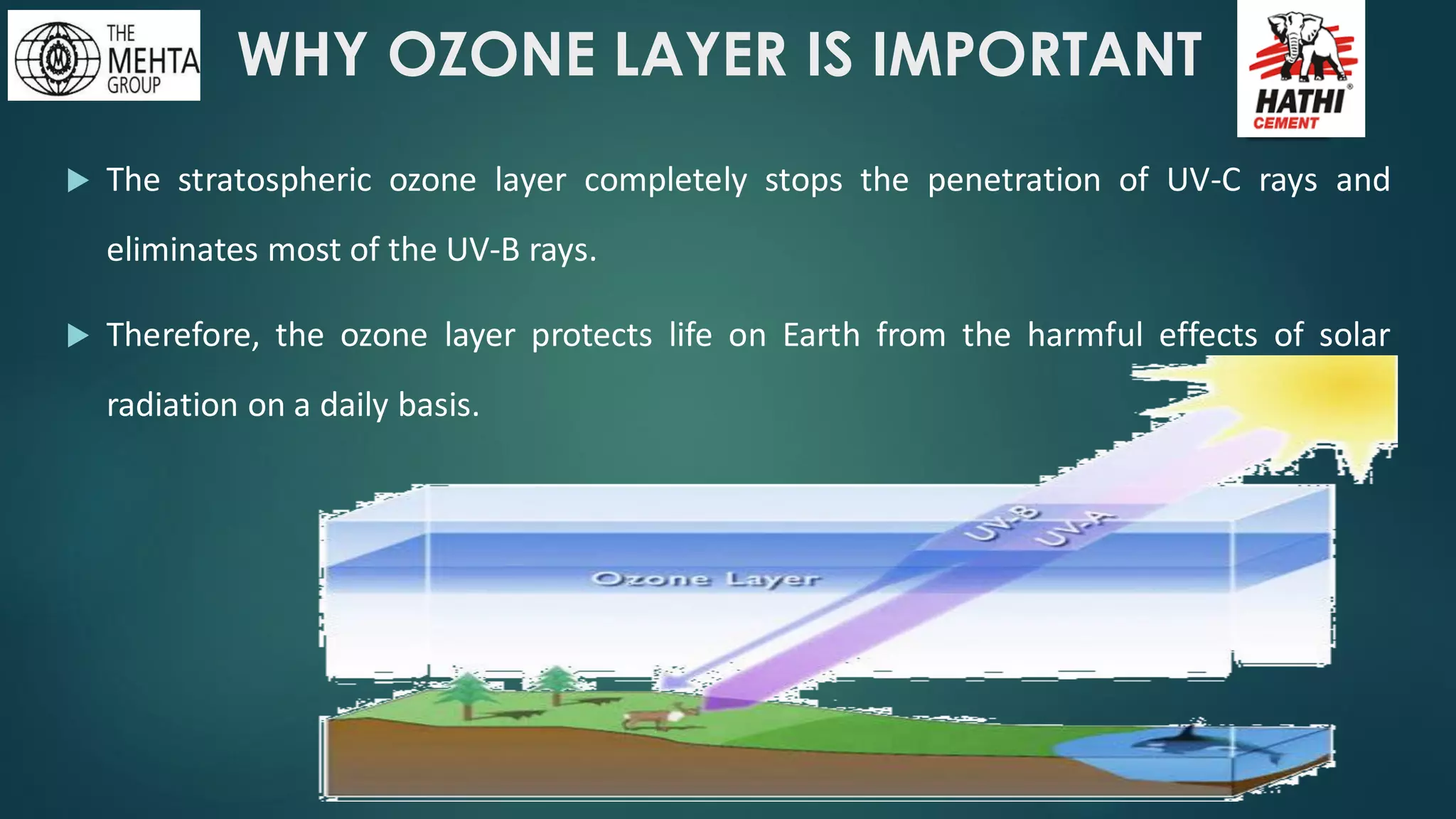
 The stratospheric ozone layer completely stops the penetration of UV-C rays and
eliminates most of the UV-B rays.
 Therefore, the ozone layer protects life on Earth from the harmful effects of solar
radiation on a daily basis.
OZONE LAYER DEPLETION
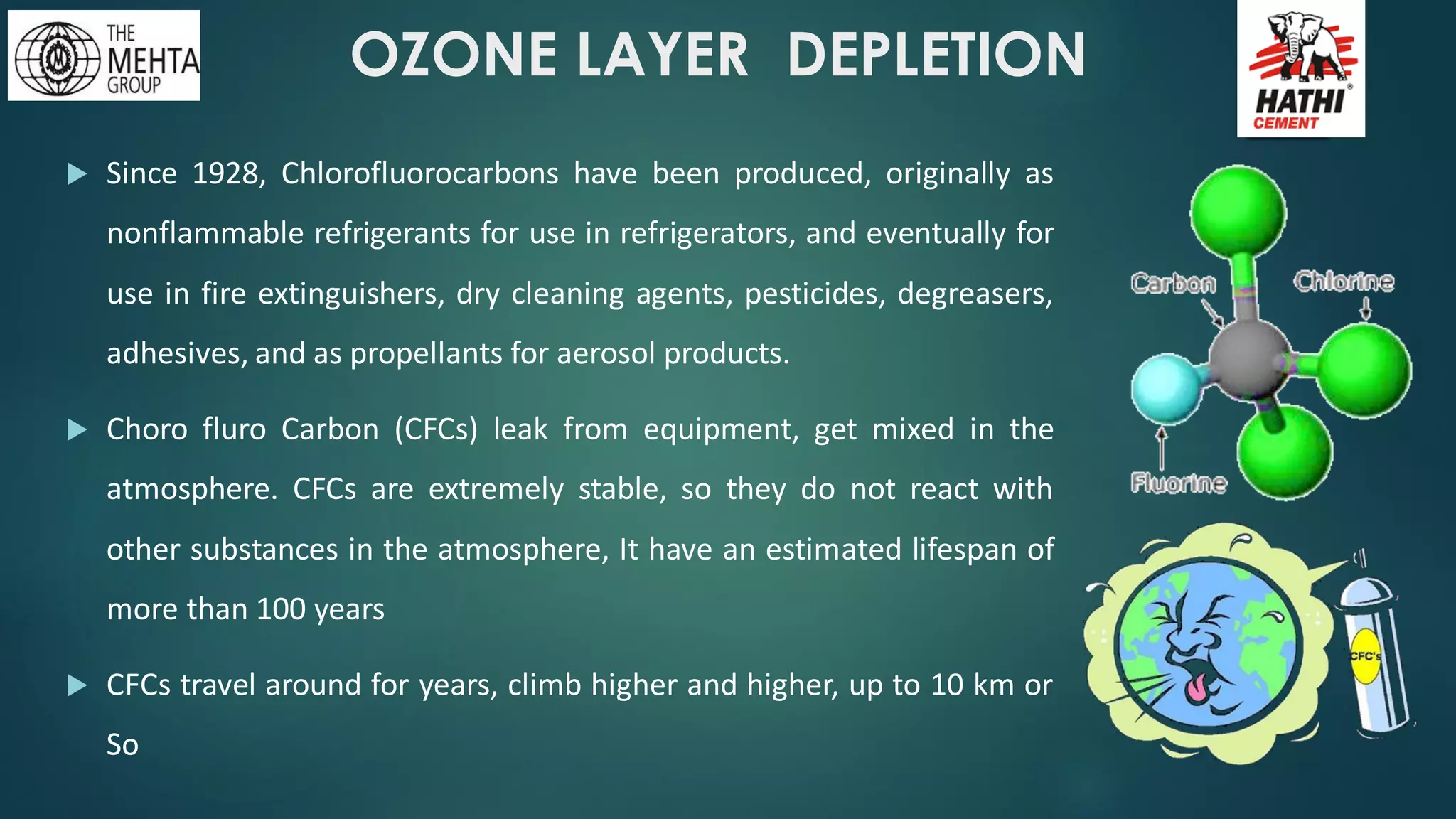
 Since 1928, Chlorofluorocarbons have been produced, originally as
nonflammable refrigerants for use in refrigerators, and eventually for
use in fire extinguishers, dry cleaning agents, pesticides, degreasers,
adhesives, and as propellants for aerosol products.
 Choro fluro Carbon (CFCs) leak from equipment, get mixed in the
atmosphere. CFCs are extremely stable, so they do not react with
other substances in the atmosphere, It have an estimated lifespan of
more than 100 years
 CFCs travel around for years, climb higher and higher, up to 10 km or
So
OZONE LAYER DEPLETION
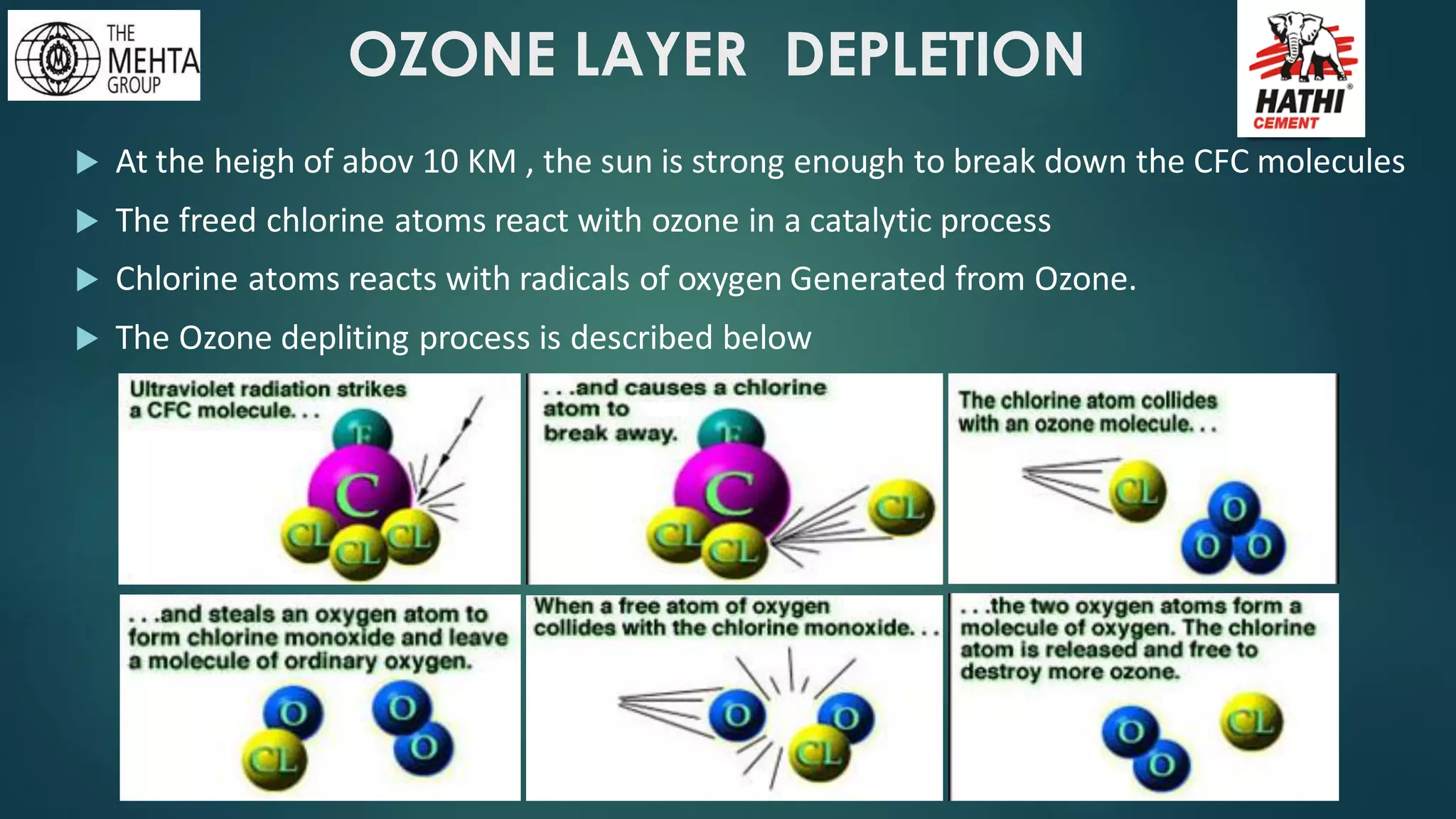
 At the heigh of abov 10 KM , the sun is strong enough to break down the CFC molecules
 The freed chlorine atoms react with ozone in a catalytic process
 Chlorine atoms reacts with radicals of oxygen Generated from Ozone.
 The Ozone depliting process is described below
 As these CFCs have been released into the atmosphere, the level of ozone
in the stratosphere has decreased.
 One chlorine atom from CFC can destroy up to 100,000 ozone atoms in a
catalytic process
 As a result, continuous deplition of the ozone in the stratospere created
the hole in ozone layer “OZONE HOLE“
OZONE LAYER DEPLETION
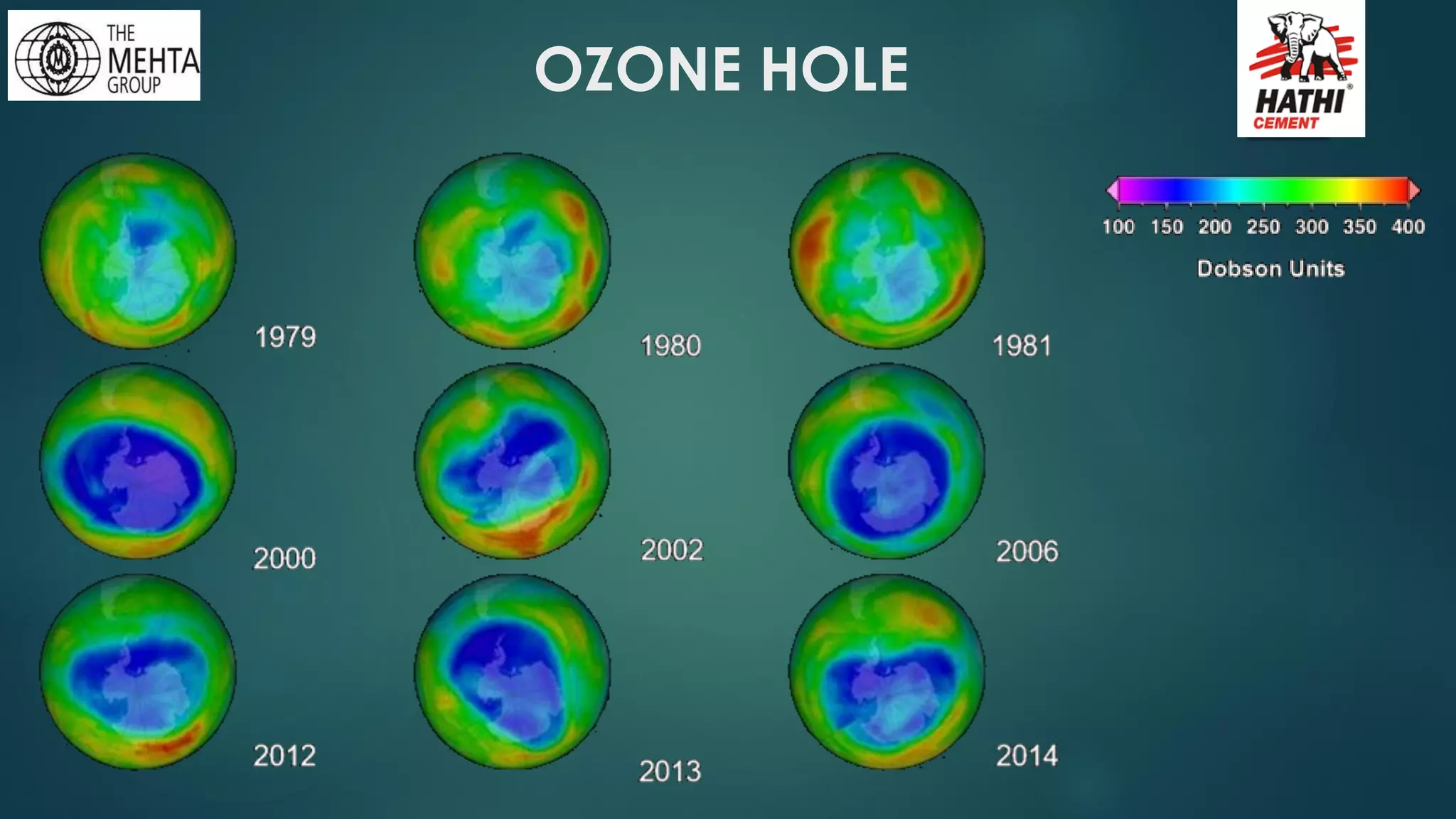
OZONE HOLE
 The Ozone Hole is Discovered first in” in 1985.
 Considered as one of this century’s major environmental disasters.
 The land area under the ozone depleted atmosphere increased steadily to more
than 20 million sq. km. in the early 1990s and has varied between 20 and 25
million sq. km.
 In 2008, the area of the ozone hole reached a record 29 million sq. km.
 The 2010 report found, "Over the past decade, global ozone and ozone in the
Arctic and Antarctic regions is no longer decreasing but is not yet increasing
 A gradual trend toward "healing" was reported in 2016-17
OZONE HOLE
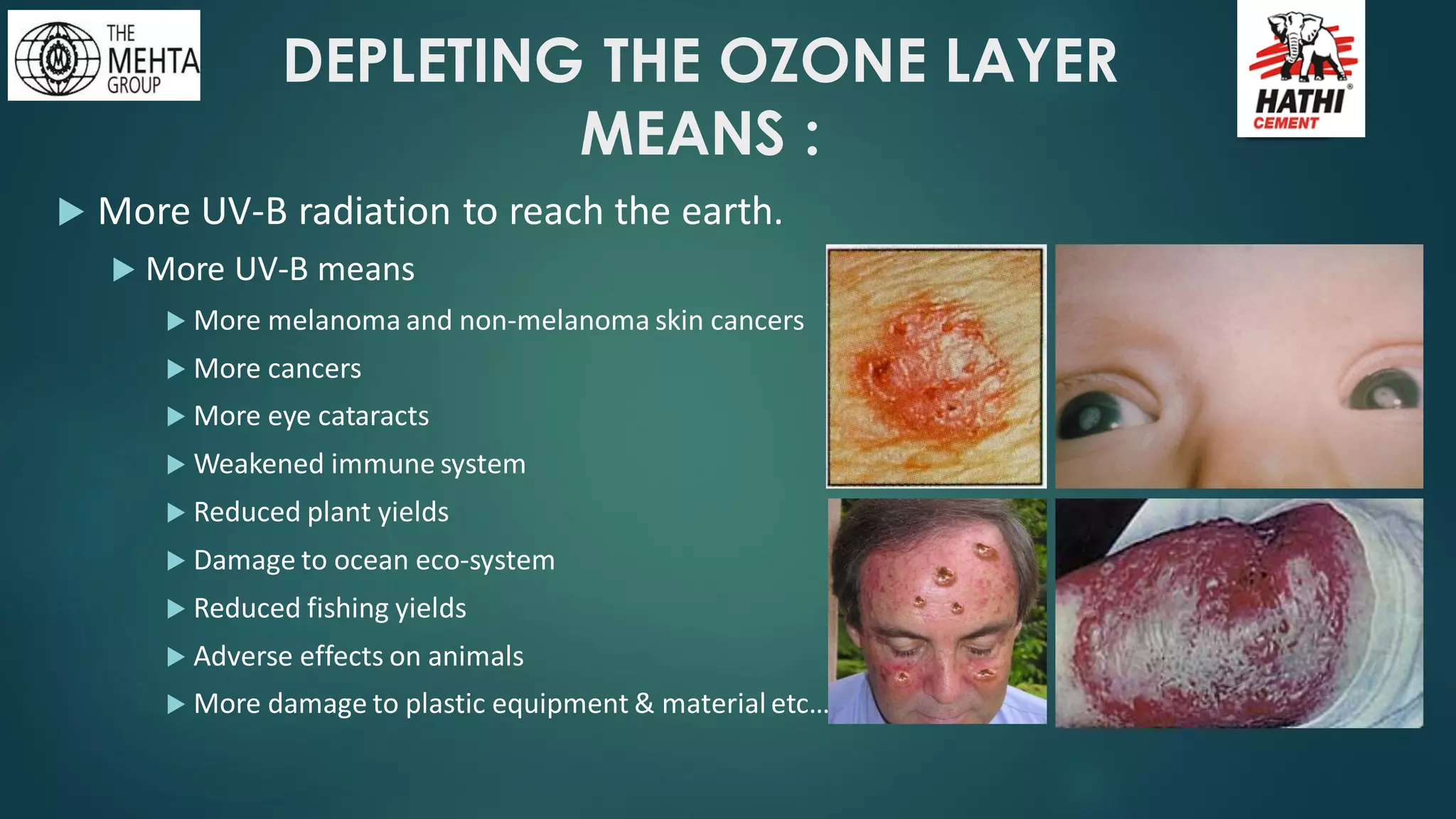
DEPLETING THE OZONE LAYER
MEANS :
 More UV-B radiation to reach the earth.
 More UV-B means
 More melanoma and non-melanoma skin cancers
 More cancers
 More eye cataracts
 Weakened immune system
 Reduced plant yields
 Damage to ocean eco-system
 Reduced fishing yields
 Adverse effects on animals
 More damage to plastic equipment & material etc……
OZONE DEPLETION AFFECTS
GLOBAL WARMING AND CLIMATE
CHANGE?
 As ozone levels in the stratosphere are depleted, more solar radiation penetrates the
Earth’s atmosphere.
 This affect results in an increase in solar radiation reaching the Earth’s surface adding
to an increase in surface temperature.
 In turn, global warming actually results in a warming of the troposphere, but a cooling
of the stratosphere, hindering the ozone layer’s natural chemistry for repairs.
Ozone depletion : What to do?
MONTREAL PROTOCOL
 After the discovery of ozone depletion in the late 1970’s, many countries agreed that something
must be done worldwide to stop the production of man-made, ozone harmful products.
 The international community adopted the Vienna Convention in 1985 followed by the Montreal
Protocol in 1987.
 Protocol on substances that deplete the ozone layer was adopted on 16/09/1987 , Governments
recognized the need for stronger measures to reduce the production and consumption of CFCs .
The latest reports confirm that it has led to the phasing out of about 95% of the consumption of
ozone-depleting substances (ODS) listed in the agreement. In turn, this has led to the prospect of
the ozone layer recovering by 2050 to 2075.
HOW YOU CAN CONTRIBUTE ?
Household Products
 Most modern household products do not contain CFCs, but some may.
 Buy air-conditioning and refrigeration equipment that do not use HCFCs as refrigerant
 Many aerosols, cleaning solvents and foam blowing agents (such as fire extinguishers) used to
contain CFCs and occasionally still do.
 Buy aerosol products that do not use HCFCs or CFCs as propellants
 The United Nations Environment Program releases a list of chemical products that contain
substances that deplete the ozone layer, as well as alternative products that do not harm the
ozone layer.
HOW YOU CAN CONTRIBUTE ?
 Refrigerators and freezers, especially those manufactured before 1995, often contain
CFCs. Air-conditioning units and dehumidifiers may also contain
hydrochlorofluorocarbons, which deplete the ozone layer.
 For existing air-conditioning and refrigeration appliances that operate on HCFCs or CFCs,
the refrigerant should be recovered or recycled whenever an overhaul of equipment is
to be carried out.
 Replacing or retrofitting such equipment to operate on non-HCFCs refrigerant should
also be considered.
HOW YOU CAN CONTRIBUTE ?
 Conduct regular inspection and maintenance of air-conditioning and refrigeration
appliances to prevent and minimize refrigerant leakage.
 When motor vehicle air-conditioners need servicing, make sure that the refrigerants
are properly recovered and recycled instead of being vented to the atmosphere
 Safe disposal of old appliances prevents CFCs and HCFCs from being released into the
environment.
“Be the change you want to see in others”
Children education
Awakening adults
Plant more trees and Save existing plantation
What can we do, as concerned citizens, to ensure that our
children have a viable planet to inhabit
HOW YOU CAN CONTRIBUTE ?
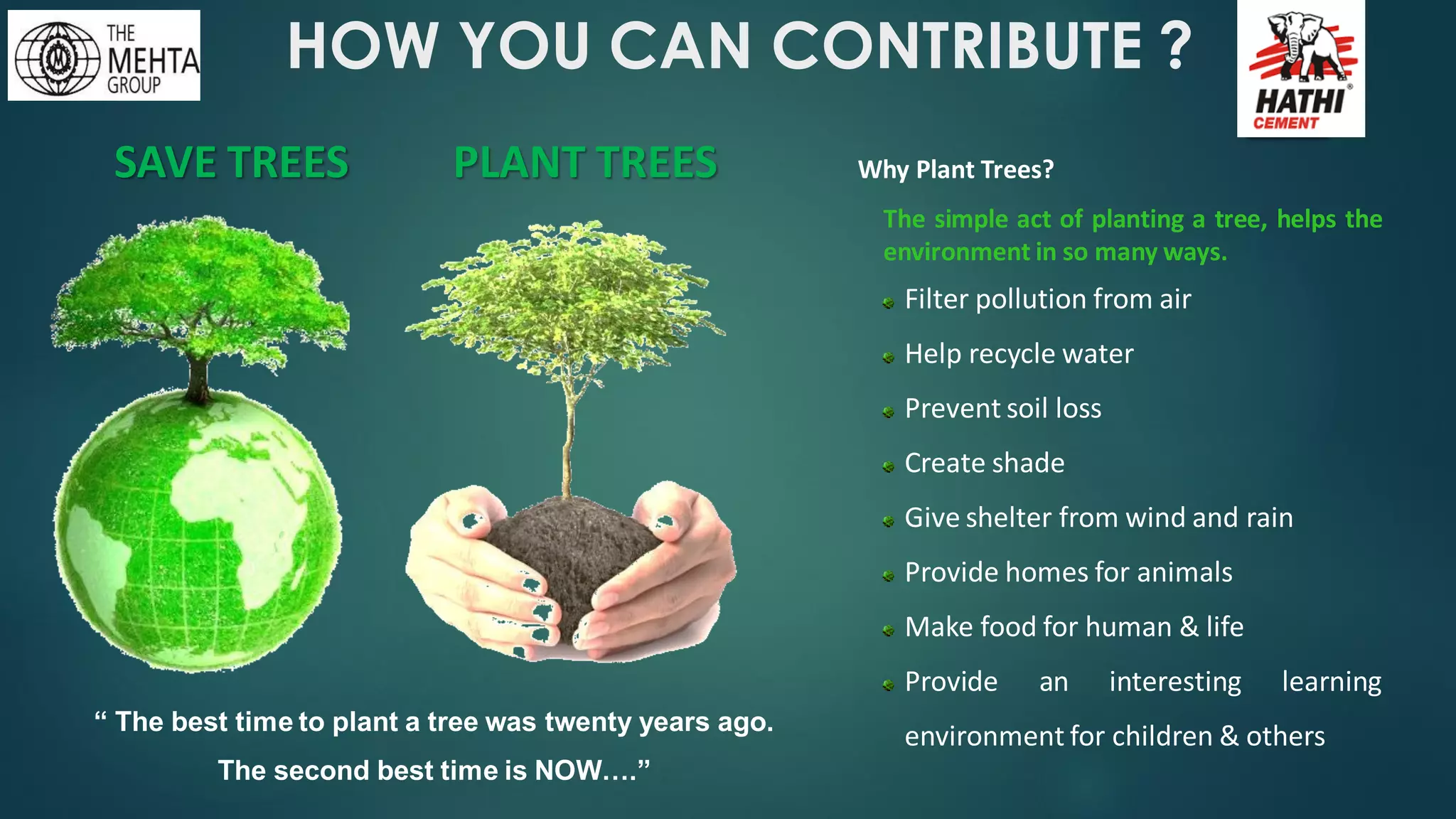
SAVE TREES PLANT TREES
“ The best time to plant a tree was twenty years ago.
The second best time is NOW….”
Why Plant Trees?
The simple act of planting a tree, helps the
environment in so many ways.
Filter pollution from air
Help recycle water
Prevent soil loss
Create shade
Give shelter from wind and rain
Provide homes for animals
Make food for human & life
Provide an interesting learning
environment for children & others
SAVE OZONE LAYER
SAVE EARTH, IT’S A ONLY PLANET WE HAVE
THANK
YOU
“Earth provides enough to satisfy every man's needs,
but not every man's greed.” ― Mahatma Gandhi

The ozone layer & Its Importance

  • 1.
    THE OZONE LAYER BY MR.NIKESH BANWADE ENVIRONMENT DEPARTMENT SAURASHTRA CEMENT LIMITED THE PRESENTATION ON
  • 2.
    CONTENT OF THEPRESENTATION  What is it ??  Where is it?  Why is it important to life on Earth?  Why it is depleting  What are the effects of the Ozone layer Depletion ?  How can we save it
  • 3.
    WHAT IS THEOZONE?  Ozone (O3) molecules consist of three oxygen atoms that forms when free Oxygen molecules bond to O2 molecules.  This gas is extremely rare in the atmosphere, representing just three out of every 10 million molecules.  Ozone is highly corrosive and toxic and is used as a disinfectant.  Ozone gas can be created or destroyed by the sun’s UltraViolet rays.
  • 4.
    THE OZONE –WHERE IT IS ?  Ninety percent of ozone exists in the upper atmosphere, or stratosphere, between 10 and 50 km above the earth.  It is thinnest around the equator and denser at the poles.  It can be found in small concentrations in the troposphere where it is considered a pollutant or Bad Ozone  Ozone levels are reported in Dobson Units (DU) & 300 DU is an average value.
  • 5.
    “Smog” Ozone Ozone Amount Altitude(Kilometers) “GoodOzone” “Bad Ozone” GOOD AND BAD OZONE  The Ozone found at Stratosphere is a Good Ozone as it absorb the harmful UV rays of Sun  The ozone found at Troposphere is a Bad Ozone as it is toxic and affects on the humans & plants.
  • 6.
    OZONE FORMATION  Whenan Oxygen molecule absorbs a Photon of Light with a wavelength shorter than 200 nanometers (1 Billion of meter) the energy splits the molecule into two Oxygen atoms. One of these atoms can react with another oxygen molecule to form an Ozone Molecule.
  • 7.
    78% nitrogen 20.6% oxygen <1% argon 0.4% water vapor 0.036% carbon dioxide Traces gases: Ne, He, Kr, H, O3 Methane,Nitrous Oxide Argon (0.934%) Water Vapor (0.4%) CO2 (0.035%) Neon (0.00182%) Helium (0.000524%) Methane (0.00015%) Krypton (0.000114%) Hydrogen (0.00005%) N2O (0.00003%) Ozone (0.000005%) CFCs (0.0000001%) COMPOSITION OF EARTH’S ATMOSPHERE
  • 8.
    WHY OZONE LAYERIS IMPORTANT  On a daily basis, the sun radiates its energy toward Earth. One form of this energy is UltraViolet radiation, also known as UV rays.  UV rays are relatively high energy waves that provide Earth with the warmth it needs to support life as we know it.  UV rays penetrate the Earth’s atmosphere at 3 slightly different wavelengths called UV-A, UV-B, and UV-C rays.
  • 9.
    WHY OZONE LAYERIS IMPORTANT  The stratospheric ozone layer completely stops the penetration of UV-C rays and eliminates most of the UV-B rays.  Therefore, the ozone layer protects life on Earth from the harmful effects of solar radiation on a daily basis.
  • 10.
    OZONE LAYER DEPLETION Since 1928, Chlorofluorocarbons have been produced, originally as nonflammable refrigerants for use in refrigerators, and eventually for use in fire extinguishers, dry cleaning agents, pesticides, degreasers, adhesives, and as propellants for aerosol products.  Choro fluro Carbon (CFCs) leak from equipment, get mixed in the atmosphere. CFCs are extremely stable, so they do not react with other substances in the atmosphere, It have an estimated lifespan of more than 100 years  CFCs travel around for years, climb higher and higher, up to 10 km or So
  • 11.
    OZONE LAYER DEPLETION At the heigh of abov 10 KM , the sun is strong enough to break down the CFC molecules  The freed chlorine atoms react with ozone in a catalytic process  Chlorine atoms reacts with radicals of oxygen Generated from Ozone.  The Ozone depliting process is described below
  • 12.
     As theseCFCs have been released into the atmosphere, the level of ozone in the stratosphere has decreased.  One chlorine atom from CFC can destroy up to 100,000 ozone atoms in a catalytic process  As a result, continuous deplition of the ozone in the stratospere created the hole in ozone layer “OZONE HOLE“ OZONE LAYER DEPLETION
  • 13.
    OZONE HOLE  TheOzone Hole is Discovered first in” in 1985.  Considered as one of this century’s major environmental disasters.  The land area under the ozone depleted atmosphere increased steadily to more than 20 million sq. km. in the early 1990s and has varied between 20 and 25 million sq. km.  In 2008, the area of the ozone hole reached a record 29 million sq. km.  The 2010 report found, "Over the past decade, global ozone and ozone in the Arctic and Antarctic regions is no longer decreasing but is not yet increasing  A gradual trend toward "healing" was reported in 2016-17
  • 14.
  • 15.
    DEPLETING THE OZONELAYER MEANS :  More UV-B radiation to reach the earth.  More UV-B means  More melanoma and non-melanoma skin cancers  More cancers  More eye cataracts  Weakened immune system  Reduced plant yields  Damage to ocean eco-system  Reduced fishing yields  Adverse effects on animals  More damage to plastic equipment & material etc……
  • 16.
    OZONE DEPLETION AFFECTS GLOBALWARMING AND CLIMATE CHANGE?  As ozone levels in the stratosphere are depleted, more solar radiation penetrates the Earth’s atmosphere.  This affect results in an increase in solar radiation reaching the Earth’s surface adding to an increase in surface temperature.  In turn, global warming actually results in a warming of the troposphere, but a cooling of the stratosphere, hindering the ozone layer’s natural chemistry for repairs.
  • 17.
    Ozone depletion :What to do?
  • 18.
    MONTREAL PROTOCOL  Afterthe discovery of ozone depletion in the late 1970’s, many countries agreed that something must be done worldwide to stop the production of man-made, ozone harmful products.  The international community adopted the Vienna Convention in 1985 followed by the Montreal Protocol in 1987.  Protocol on substances that deplete the ozone layer was adopted on 16/09/1987 , Governments recognized the need for stronger measures to reduce the production and consumption of CFCs . The latest reports confirm that it has led to the phasing out of about 95% of the consumption of ozone-depleting substances (ODS) listed in the agreement. In turn, this has led to the prospect of the ozone layer recovering by 2050 to 2075.
  • 19.
    HOW YOU CANCONTRIBUTE ? Household Products  Most modern household products do not contain CFCs, but some may.  Buy air-conditioning and refrigeration equipment that do not use HCFCs as refrigerant  Many aerosols, cleaning solvents and foam blowing agents (such as fire extinguishers) used to contain CFCs and occasionally still do.  Buy aerosol products that do not use HCFCs or CFCs as propellants  The United Nations Environment Program releases a list of chemical products that contain substances that deplete the ozone layer, as well as alternative products that do not harm the ozone layer.
  • 20.
    HOW YOU CANCONTRIBUTE ?  Refrigerators and freezers, especially those manufactured before 1995, often contain CFCs. Air-conditioning units and dehumidifiers may also contain hydrochlorofluorocarbons, which deplete the ozone layer.  For existing air-conditioning and refrigeration appliances that operate on HCFCs or CFCs, the refrigerant should be recovered or recycled whenever an overhaul of equipment is to be carried out.  Replacing or retrofitting such equipment to operate on non-HCFCs refrigerant should also be considered.
  • 21.
    HOW YOU CANCONTRIBUTE ?  Conduct regular inspection and maintenance of air-conditioning and refrigeration appliances to prevent and minimize refrigerant leakage.  When motor vehicle air-conditioners need servicing, make sure that the refrigerants are properly recovered and recycled instead of being vented to the atmosphere  Safe disposal of old appliances prevents CFCs and HCFCs from being released into the environment.
  • 22.
    “Be the changeyou want to see in others” Children education Awakening adults Plant more trees and Save existing plantation What can we do, as concerned citizens, to ensure that our children have a viable planet to inhabit HOW YOU CAN CONTRIBUTE ?
  • 23.
    HOW YOU CANCONTRIBUTE ? SAVE TREES PLANT TREES “ The best time to plant a tree was twenty years ago. The second best time is NOW….” Why Plant Trees? The simple act of planting a tree, helps the environment in so many ways. Filter pollution from air Help recycle water Prevent soil loss Create shade Give shelter from wind and rain Provide homes for animals Make food for human & life Provide an interesting learning environment for children & others
  • 24.
    SAVE OZONE LAYER SAVEEARTH, IT’S A ONLY PLANET WE HAVE THANK YOU “Earth provides enough to satisfy every man's needs, but not every man's greed.” ― Mahatma Gandhi