Presentedby
Prof.V. GURUMOORTHI
Department of commerce
Kaamadhenu arts and science college.
MANAGEMENT ACCOUNTING
Unit 2
Ratio analysis
24- DEC- 2016
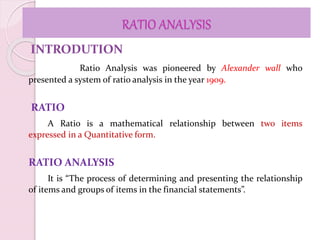
RATIO ANALYSIS
INTRODUTION
Ratio Analysis was pioneered by Alexander wall who
presented a system of ratio analysis in the year 1909.
RATIO
A Ratio is a mathematical relationship between two items
expressed in a Quantitative form.
RATIO ANALYSIS
It is “The process of determining and presenting the relationship
of items and groups of items in the financial statements”.
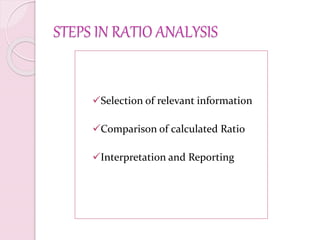
STEPS IN RATIO ANALYSIS
Selection of relevant information
Comparison of calculated Ratio
Interpretation and Reporting
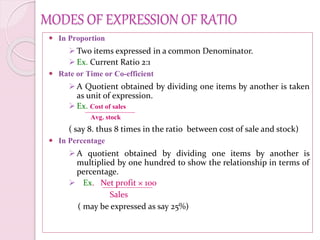
MODES OF EXPRESSION OF RATIO
 In Proportion
 Two items expressed in a common Denominator.
 Ex. Current Ratio 2:1
 Rate or Time or Co-efficient
 A Quotient obtained by dividing one items by another is taken
as unit of expression.
 Ex. Cost of sales
Avg. stock
( say 8. thus 8 times in the ratio between cost of sale and stock)
 In Percentage
 A quotient obtained by dividing one items by another is
multiplied by one hundred to show the relationship in terms of
percentage.
 Ex. Net profit × 100
Sales
( may be expressed as say 25%)
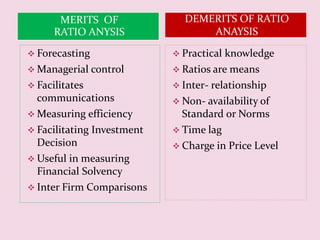
MERITS OF
RATIO ANYSIS
DEMERITS OF RATIO
ANAYSIS
 Forecasting
 Managerial control
 Facilitates
communications
 Measuring efficiency
 Facilitating Investment
Decision
 Useful in measuring
Financial Solvency
 Inter Firm Comparisons
 Practical knowledge
 Ratios are means
 Inter- relationship
 Non- availability of
Standard or Norms
 Time lag
 Charge in Price Level
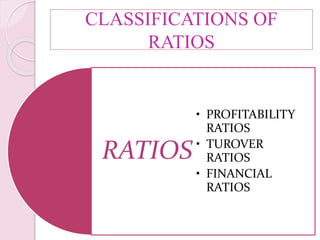
CLASSIFICATIONS OF
RATIOS
RATIOS
• PROFITABILITY
RATIOS
• TUROVER
RATIOS
• FINANCIAL
RATIOS
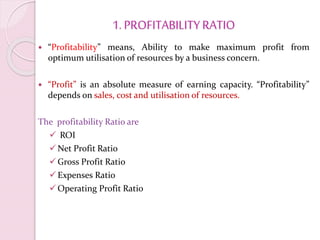
1. PROFITABILITYRATIO
 “Profitability” means, Ability to make maximum profit from
optimum utilisation of resources by a business concern.
 “Profit” is an absolute measure of earning capacity. “Profitability”
depends on sales, cost and utilisation of resources.
The profitability Ratio are
 ROI
Net Profit Ratio
Gross Profit Ratio
Expenses Ratio
Operating Profit Ratio
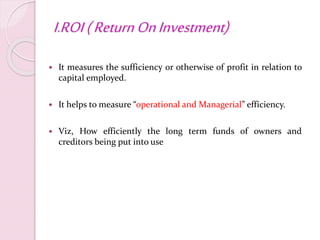
I.ROI(ReturnOnInvestment)
 It measures the sufficiency or otherwise of profit in relation to
capital employed.
 It helps to measure “operational and Managerial” efficiency.
 Viz, How efficiently the long term funds of owners and
creditors being put into use
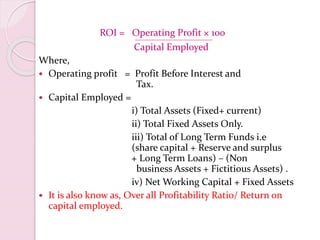
ROI = Operating Profit × 100
Capital Employed
Where,
 Operating profit = Profit Before Interest and
Tax.
 Capital Employed =
i) Total Assets (Fixed+ current)
ii) Total Fixed Assets Only.
iii) Total of Long Term Funds i.e
(share capital + Reserve and surplus
+ Long Term Loans) – (Non
business Assets + Fictitious Assets) .
iv) Net Working Capital + Fixed Assets
 It is also know as, Over all Profitability Ratio/ Return on
capital employed.
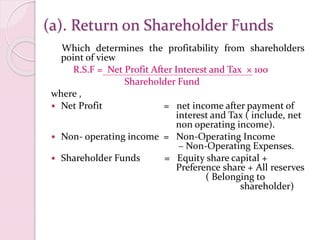
(a). Return on Shareholder Funds
Which determines the profitability from shareholders
point of view
R.S.F = Net Profit After Interest and Tax × 100
Shareholder Fund
where ,
 Net Profit = net income after payment of
interest and Tax ( include, net
non operating income).
 Non- operating income = Non-Operating Income
– Non-Operating Expenses.
 Shareholder Funds = Equity share capital +
Preference share + All reserves
( Belonging to
shareholder)
b). Return on Equity Shareholder Fund
 It is known as Return on Equity or Return Net worth.
 This ratio signifies the return on equity shareholder funds.
 The profit considered for computing the ratio is taken after
payment of preference dividend.
R.O.E.S.F = Net profit after Interest, Tax and
Preference dividend × 100
Equity Shareholders Fund
( Equity shareholder Fund: Equity share capital + Reserves + profits
– Accumulated Losses )
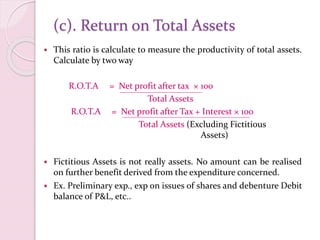
(c). Return on Total Assets
 This ratio is calculate to measure the productivity of total assets.
Calculate by two way
R.O.T.A = Net profit after tax × 100
Total Assets
R.O.T.A = Net profit after Tax + Interest × 100
Total Assets (Excluding Fictitious
Assets)
 Fictitious Assets is not really assets. No amount can be realised
on further benefit derived from the expenditure concerned.
 Ex. Preliminary exp., exp on issues of shares and debenture Debit
balance of P&L, etc..
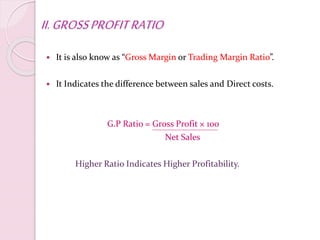
II.GROSSPROFITRATIO
 It is also know as “Gross Margin or Trading Margin Ratio”.
 It Indicates the difference between sales and Direct costs.
G.P Ratio = Gross Profit × 100
Net Sales
Higher Ratio Indicates Higher Profitability.
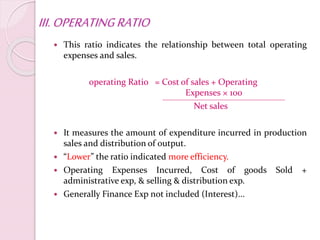
III.OPERATINGRATIO
 This ratio indicates the relationship between total operating
expenses and sales.
operating Ratio = Cost of sales + Operating
Expenses × 100
Net sales
 It measures the amount of expenditure incurred in production
sales and distribution of output.
 “Lower” the ratio indicated more efficiency.
 Operating Expenses Incurred, Cost of goods Sold +
administrative exp, & selling & distribution exp.
 Generally Finance Exp not included (Interest)...
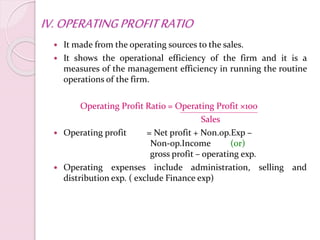
IV.OPERATINGPROFITRATIO
 It made from the operating sources to the sales.
 It shows the operational efficiency of the firm and it is a
measures of the management efficiency in running the routine
operations of the firm.
Operating Profit Ratio = Operating Profit ×100
Sales
 Operating profit = Net profit + Non.op.Exp –
Non-op.Income (or)
gross profit – operating exp.
 Operating expenses include administration, selling and
distribution exp. ( exclude Finance exp)
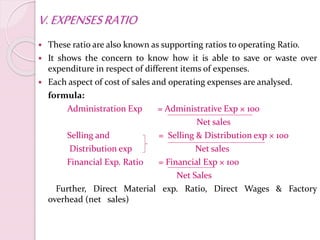
V.EXPENSESRATIO
 These ratio are also known as supporting ratios to operating Ratio.
 It shows the concern to know how it is able to save or waste over
expenditure in respect of different items of expenses.
 Each aspect of cost of sales and operating expenses are analysed.
formula:
Administration Exp = Administrative Exp × 100
Net sales
Selling and = Selling & Distribution exp × 100
Distribution exp Net sales
Financial Exp. Ratio = Financial Exp × 100
Net Sales
Further, Direct Material exp. Ratio, Direct Wages & Factory
overhead (net sales)
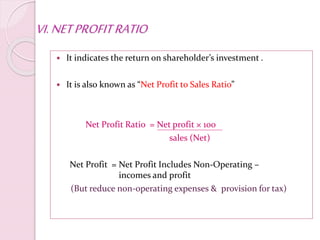
VI.NETPROFITRATIO
 It indicates the return on shareholder’s investment .
 It is also known as “Net Profit to Sales Ratio”
Net Profit Ratio = Net profit × 100
sales (Net)
Net Profit = Net Profit Includes Non-Operating –
incomes and profit
(But reduce non-operating expenses & provision for tax)
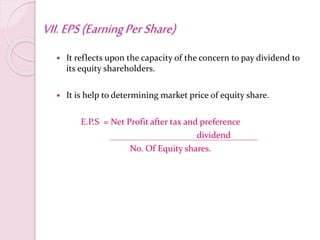
VII.EPS(EarningPerShare)
 It reflects upon the capacity of the concern to pay dividend to
its equity shareholders.
 It is help to determining market price of equity share.
E.P.S = Net Profit after tax and preference
dividend
No. Of Equity shares.
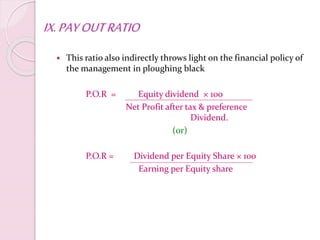
IX.PAYOUTRATIO
 This ratio also indirectly throws light on the financial policy of
the management in ploughing black
P.O.R = Equity dividend × 100
Net Profit after tax & preference
Dividend.
(or)
P.O.R = Dividend per Equity Share × 100
Earning per Equity share
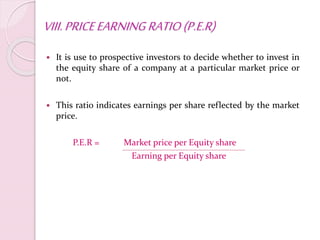
VIII.PRICEEARNINGRATIO(P.E.R)
 It is use to prospective investors to decide whether to invest in
the equity share of a company at a particular market price or
not.
 This ratio indicates earnings per share reflected by the market
price.
P.E.R = Market price per Equity share
Earning per Equity share
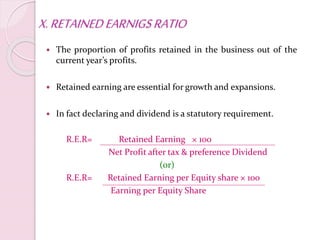
X.RETAINEDEARNIGSRATIO
 The proportion of profits retained in the business out of the
current year’s profits.
 Retained earning are essential for growth and expansions.
 In fact declaring and dividend is a statutory requirement.
R.E.R= Retained Earning × 100
Net Profit after tax & preference Dividend
(or)
R.E.R= Retained Earning per Equity share × 100
Earning per Equity Share
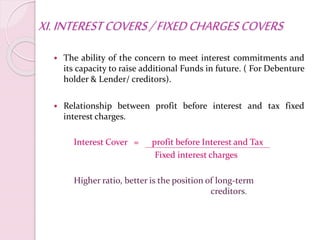
XI.INTERESTCOVERS/FIXEDCHARGESCOVERS
 The ability of the concern to meet interest commitments and
its capacity to raise additional Funds in future. ( For Debenture
holder & Lender/ creditors).
 Relationship between profit before interest and tax fixed
interest charges.
Interest Cover = profit before Interest and Tax
Fixed interest charges
Higher ratio, better is the position of long-term
creditors.
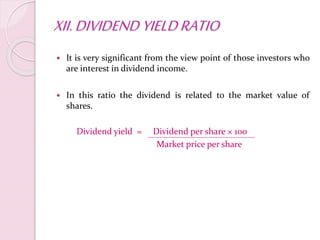
XII.DIVIDEND YIELDRATIO
 It is very significant from the view point of those investors who
are interest in dividend income.
 In this ratio the dividend is related to the market value of
shares.
Dividend yield = Dividend per share × 100
Market price per share
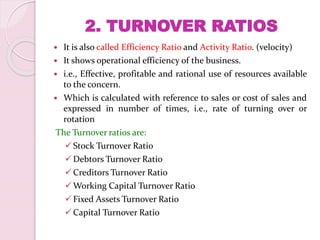
2. TURNOVER RATIOS
 It is also called Efficiency Ratio and Activity Ratio. (velocity)
 It shows operational efficiency of the business.
 i.e., Effective, profitable and rational use of resources available
to the concern.
 Which is calculated with reference to sales or cost of sales and
expressed in number of times, i.e., rate of turning over or
rotation
The Turnover ratios are:
Stock Turnover Ratio
Debtors Turnover Ratio
Creditors Turnover Ratio
Working Capital Turnover Ratio
Fixed Assets Turnover Ratio
Capital Turnover Ratio
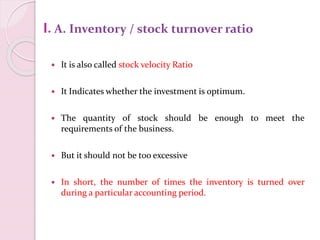
I.A. Inventory / stock turnover ratio
 It is also called stock velocity Ratio
 It Indicates whether the investment is optimum.
 The quantity of stock should be enough to meet the
requirements of the business.
 But it should not be too excessive
 In short, the number of times the inventory is turned over
during a particular accounting period.
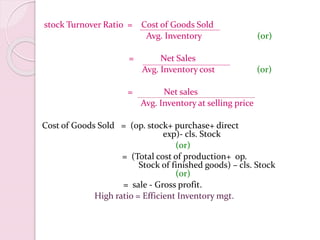
stock Turnover Ratio = Cost of Goods Sold
Avg. Inventory (or)
= Net Sales
Avg. Inventory cost (or)
= Net sales
Avg. Inventory at selling price
Cost of Goods Sold = (op. stock+ purchase+ direct
exp)- cls. Stock
(or)
= (Total cost of production+ op.
Stock of finished goods) – cls. Stock
(or)
= sale - Gross profit.
High ratio = Efficient Inventory mgt.
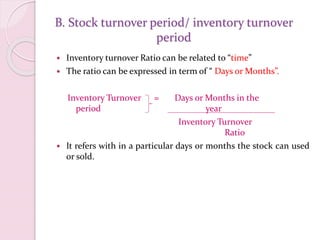
B. Stock turnover period/ inventory turnover
period
 Inventory turnover Ratio can be related to “time”
 The ratio can be expressed in term of “ Days or Months”.
Inventory Turnover = Days or Months in the
period year
Inventory Turnover
Ratio
 It refers with in a particular days or months the stock can used
or sold.
II.DEBTORTURNOVERRATIO
 It is also called, Receivable turnover Ratio or debtors velocity.
 It measures the number of times the receivables are rotated in a year in
terms of sales.
 It is relationship between total sales and closing balance of debtors.
D.T.R = Net Credit sales (total sales- [cash sales + sales
returns])
Avg. Debtors – avg. B/R (Trade Debtor)
Note: Bad debts & their provision are not deducted from total Debtors .
The higher ratio indicates that the debts are being collected
promptly.
AVERAGE COLLECTION PERIOD ( Avg. No of days for which a firm
has to wait before its receivables are collected into cash).
A.C.P= Months or days in a year
Debtors turnover Ratio
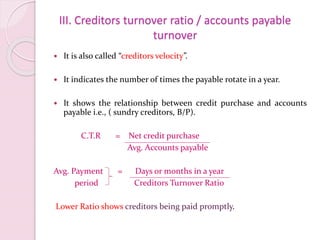
III. Creditors turnover ratio / accounts payable
turnover
 It is also called “creditors velocity”.
 It indicates the number of times the payable rotate in a year.
 It shows the relationship between credit purchase and accounts
payable i.e., ( sundry creditors, B/P).
C.T.R = Net credit purchase
Avg. Accounts payable
Avg. Payment = Days or months in a year
period Creditors Turnover Ratio
Lower Ratio shows creditors being paid promptly.
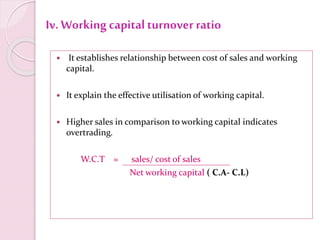
Iv. Working capitalturnover ratio
 It establishes relationship between cost of sales and working
capital.
 It explain the effective utilisation of working capital.
 Higher sales in comparison to working capital indicates
overtrading.
W.C.T = sales/ cost of sales
Net working capital ( C.A- C.L)
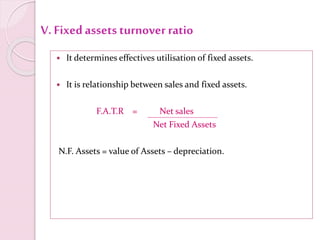
V. Fixedassets turnover ratio
 It determines effectives utilisation of fixed assets.
 It is relationship between sales and fixed assets.
F.A.T.R = Net sales
Net Fixed Assets
N.F. Assets = value of Assets – depreciation.
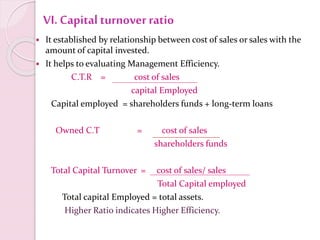
VI. Capital turnover ratio
 It established by relationship between cost of sales or sales with the
amount of capital invested.
 It helps to evaluating Management Efficiency.
C.T.R = cost of sales
capital Employed
Capital employed = shareholders funds + long-term loans
Owned C.T = cost of sales
shareholders funds
Total Capital Turnover = cost of sales/ sales
Total Capital employed
Total capital Employed = total assets.
Higher Ratio indicates Higher Efficiency.
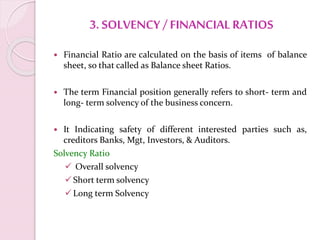
3. SOLVENCY / FINANCIAL RATIOS
 Financial Ratio are calculated on the basis of items of balance
sheet, so that called as Balance sheet Ratios.
 The term Financial position generally refers to short- term and
long- term solvency of the business concern.
 It Indicating safety of different interested parties such as,
creditors Banks, Mgt, Investors, & Auditors.
Solvency Ratio
 Overall solvency
Short term solvency
Long term Solvency
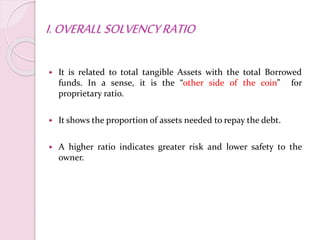
I.OVERALLSOLVENCYRATIO
 It is related to total tangible Assets with the total Borrowed
funds. In a sense, it is the “other side of the coin” for
proprietary ratio.
 It shows the proportion of assets needed to repay the debt.
 A higher ratio indicates greater risk and lower safety to the
owner.
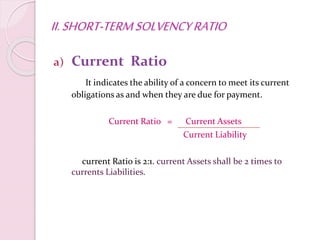
II.SHORT-TERMSOLVENCYRATIO
a) Current Ratio
It indicates the ability of a concern to meet its current
obligations as and when they are due for payment.
Current Ratio = Current Assets
Current Liability
current Ratio is 2:1. current Assets shall be 2 times to
currents Liabilities.
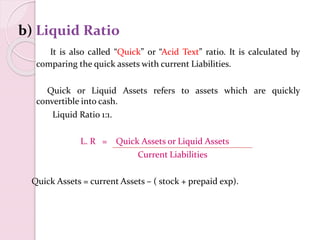
b) Liquid Ratio
It is also called “Quick” or “Acid Text” ratio. It is calculated by
comparing the quick assets with current Liabilities.
Quick or Liquid Assets refers to assets which are quickly
convertible into cash.
Liquid Ratio 1:1.
L. R = Quick Assets or Liquid Assets
Current Liabilities
Quick Assets = current Assets – ( stock + prepaid exp).
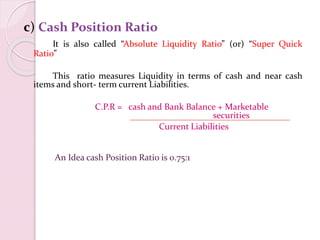
c) Cash Position Ratio
It is also called “Absolute Liquidity Ratio” (or) “Super Quick
Ratio”
This ratio measures Liquidity in terms of cash and near cash
items and short- term current Liabilities.
C.P.R = cash and Bank Balance + Marketable
securities
Current Liabilities
An Idea cash Position Ratio is 0.75:1
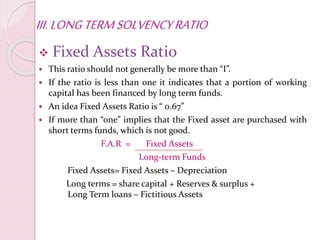
III.LONGTERMSOLVENCYRATIO
 Fixed Assets Ratio
 This ratio should not generally be more than “I”.
 If the ratio is less than one it indicates that a portion of working
capital has been financed by long term funds.
 An idea Fixed Assets Ratio is “ 0.67”
 If more than “one” implies that the Fixed asset are purchased with
short terms funds, which is not good.
F.A.R = Fixed Assets
Long-term Funds
Fixed Assets= Fixed Assets – Depreciation
Long terms = share capital + Reserves & surplus +
Long Term loans – Fictitious Assets
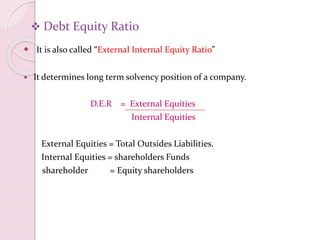
 Debt Equity Ratio
 It is also called “External Internal Equity Ratio”
 It determines long term solvency position of a company.
D.E.R = External Equities
Internal Equities
External Equities = Total Outsides Liabilities.
Internal Equities = shareholders Funds
shareholder = Equity shareholders
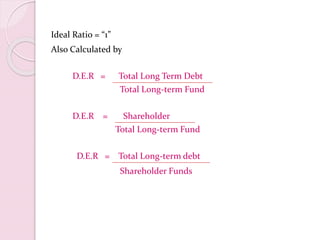
Ideal Ratio = “1”
Also Calculated by
D.E.R = Total Long Term Debt
Total Long-term Fund
D.E.R = Shareholder
Total Long-term Fund
D.E.R = Total Long-term debt
Shareholder Funds
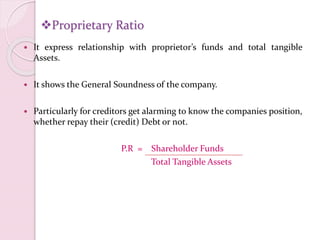
Proprietary Ratio
 It express relationship with proprietor’s funds and total tangible
Assets.
 It shows the General Soundness of the company.
 Particularly for creditors get alarming to know the companies position,
whether repay their (credit) Debt or not.
P.R = Shareholder Funds
Total Tangible Assets
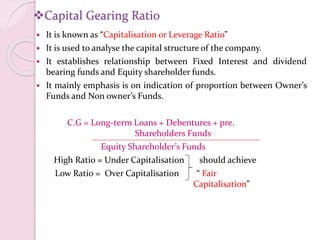
Capital Gearing Ratio
 It is known as “Capitalisation or Leverage Ratio”
 It is used to analyse the capital structure of the company.
 It establishes relationship between Fixed Interest and dividend
bearing funds and Equity shareholder funds.
 It mainly emphasis is on indication of proportion between Owner’s
Funds and Non owner’s Funds.
C.G = Long-term Loans + Debentures + pre.
Shareholders Funds
Equity Shareholder’s Funds
High Ratio = Under Capitalisation should achieve
Low Ratio = Over Capitalisation “ Fair
Capitalisation”

Ratio analysis

  • 1.
    Presentedby Prof.V. GURUMOORTHI Department ofcommerce Kaamadhenu arts and science college. MANAGEMENT ACCOUNTING Unit 2 Ratio analysis 24- DEC- 2016
  • 2.
    RATIO ANALYSIS INTRODUTION Ratio Analysiswas pioneered by Alexander wall who presented a system of ratio analysis in the year 1909. RATIO A Ratio is a mathematical relationship between two items expressed in a Quantitative form. RATIO ANALYSIS It is “The process of determining and presenting the relationship of items and groups of items in the financial statements”.
  • 3.
    STEPS IN RATIOANALYSIS Selection of relevant information Comparison of calculated Ratio Interpretation and Reporting
  • 4.
    MODES OF EXPRESSIONOF RATIO  In Proportion  Two items expressed in a common Denominator.  Ex. Current Ratio 2:1  Rate or Time or Co-efficient  A Quotient obtained by dividing one items by another is taken as unit of expression.  Ex. Cost of sales Avg. stock ( say 8. thus 8 times in the ratio between cost of sale and stock)  In Percentage  A quotient obtained by dividing one items by another is multiplied by one hundred to show the relationship in terms of percentage.  Ex. Net profit × 100 Sales ( may be expressed as say 25%)
  • 5.
    MERITS OF RATIO ANYSIS DEMERITSOF RATIO ANAYSIS  Forecasting  Managerial control  Facilitates communications  Measuring efficiency  Facilitating Investment Decision  Useful in measuring Financial Solvency  Inter Firm Comparisons  Practical knowledge  Ratios are means  Inter- relationship  Non- availability of Standard or Norms  Time lag  Charge in Price Level
  • 6.
  • 7.
    1. PROFITABILITYRATIO  “Profitability”means, Ability to make maximum profit from optimum utilisation of resources by a business concern.  “Profit” is an absolute measure of earning capacity. “Profitability” depends on sales, cost and utilisation of resources. The profitability Ratio are  ROI Net Profit Ratio Gross Profit Ratio Expenses Ratio Operating Profit Ratio
  • 8.
    I.ROI(ReturnOnInvestment)  It measuresthe sufficiency or otherwise of profit in relation to capital employed.  It helps to measure “operational and Managerial” efficiency.  Viz, How efficiently the long term funds of owners and creditors being put into use
  • 9.
    ROI = OperatingProfit × 100 Capital Employed Where,  Operating profit = Profit Before Interest and Tax.  Capital Employed = i) Total Assets (Fixed+ current) ii) Total Fixed Assets Only. iii) Total of Long Term Funds i.e (share capital + Reserve and surplus + Long Term Loans) – (Non business Assets + Fictitious Assets) . iv) Net Working Capital + Fixed Assets  It is also know as, Over all Profitability Ratio/ Return on capital employed.
  • 10.
    (a). Return onShareholder Funds Which determines the profitability from shareholders point of view R.S.F = Net Profit After Interest and Tax × 100 Shareholder Fund where ,  Net Profit = net income after payment of interest and Tax ( include, net non operating income).  Non- operating income = Non-Operating Income – Non-Operating Expenses.  Shareholder Funds = Equity share capital + Preference share + All reserves ( Belonging to shareholder)
  • 11.
    b). Return onEquity Shareholder Fund  It is known as Return on Equity or Return Net worth.  This ratio signifies the return on equity shareholder funds.  The profit considered for computing the ratio is taken after payment of preference dividend. R.O.E.S.F = Net profit after Interest, Tax and Preference dividend × 100 Equity Shareholders Fund ( Equity shareholder Fund: Equity share capital + Reserves + profits – Accumulated Losses )
  • 12.
    (c). Return onTotal Assets  This ratio is calculate to measure the productivity of total assets. Calculate by two way R.O.T.A = Net profit after tax × 100 Total Assets R.O.T.A = Net profit after Tax + Interest × 100 Total Assets (Excluding Fictitious Assets)  Fictitious Assets is not really assets. No amount can be realised on further benefit derived from the expenditure concerned.  Ex. Preliminary exp., exp on issues of shares and debenture Debit balance of P&L, etc..
  • 13.
    II.GROSSPROFITRATIO  It isalso know as “Gross Margin or Trading Margin Ratio”.  It Indicates the difference between sales and Direct costs. G.P Ratio = Gross Profit × 100 Net Sales Higher Ratio Indicates Higher Profitability.
  • 14.
    III.OPERATINGRATIO  This ratioindicates the relationship between total operating expenses and sales. operating Ratio = Cost of sales + Operating Expenses × 100 Net sales  It measures the amount of expenditure incurred in production sales and distribution of output.  “Lower” the ratio indicated more efficiency.  Operating Expenses Incurred, Cost of goods Sold + administrative exp, & selling & distribution exp.  Generally Finance Exp not included (Interest)...
  • 15.
    IV.OPERATINGPROFITRATIO  It madefrom the operating sources to the sales.  It shows the operational efficiency of the firm and it is a measures of the management efficiency in running the routine operations of the firm. Operating Profit Ratio = Operating Profit ×100 Sales  Operating profit = Net profit + Non.op.Exp – Non-op.Income (or) gross profit – operating exp.  Operating expenses include administration, selling and distribution exp. ( exclude Finance exp)
  • 16.
    V.EXPENSESRATIO  These ratioare also known as supporting ratios to operating Ratio.  It shows the concern to know how it is able to save or waste over expenditure in respect of different items of expenses.  Each aspect of cost of sales and operating expenses are analysed. formula: Administration Exp = Administrative Exp × 100 Net sales Selling and = Selling & Distribution exp × 100 Distribution exp Net sales Financial Exp. Ratio = Financial Exp × 100 Net Sales Further, Direct Material exp. Ratio, Direct Wages & Factory overhead (net sales)
  • 17.
    VI.NETPROFITRATIO  It indicatesthe return on shareholder’s investment .  It is also known as “Net Profit to Sales Ratio” Net Profit Ratio = Net profit × 100 sales (Net) Net Profit = Net Profit Includes Non-Operating – incomes and profit (But reduce non-operating expenses & provision for tax)
  • 18.
    VII.EPS(EarningPerShare)  It reflectsupon the capacity of the concern to pay dividend to its equity shareholders.  It is help to determining market price of equity share. E.P.S = Net Profit after tax and preference dividend No. Of Equity shares.
  • 19.
    IX.PAYOUTRATIO  This ratioalso indirectly throws light on the financial policy of the management in ploughing black P.O.R = Equity dividend × 100 Net Profit after tax & preference Dividend. (or) P.O.R = Dividend per Equity Share × 100 Earning per Equity share
  • 20.
    VIII.PRICEEARNINGRATIO(P.E.R)  It isuse to prospective investors to decide whether to invest in the equity share of a company at a particular market price or not.  This ratio indicates earnings per share reflected by the market price. P.E.R = Market price per Equity share Earning per Equity share
  • 21.
    X.RETAINEDEARNIGSRATIO  The proportionof profits retained in the business out of the current year’s profits.  Retained earning are essential for growth and expansions.  In fact declaring and dividend is a statutory requirement. R.E.R= Retained Earning × 100 Net Profit after tax & preference Dividend (or) R.E.R= Retained Earning per Equity share × 100 Earning per Equity Share
  • 22.
    XI.INTERESTCOVERS/FIXEDCHARGESCOVERS  The abilityof the concern to meet interest commitments and its capacity to raise additional Funds in future. ( For Debenture holder & Lender/ creditors).  Relationship between profit before interest and tax fixed interest charges. Interest Cover = profit before Interest and Tax Fixed interest charges Higher ratio, better is the position of long-term creditors.
  • 23.
    XII.DIVIDEND YIELDRATIO  Itis very significant from the view point of those investors who are interest in dividend income.  In this ratio the dividend is related to the market value of shares. Dividend yield = Dividend per share × 100 Market price per share
  • 24.
    2. TURNOVER RATIOS It is also called Efficiency Ratio and Activity Ratio. (velocity)  It shows operational efficiency of the business.  i.e., Effective, profitable and rational use of resources available to the concern.  Which is calculated with reference to sales or cost of sales and expressed in number of times, i.e., rate of turning over or rotation The Turnover ratios are: Stock Turnover Ratio Debtors Turnover Ratio Creditors Turnover Ratio Working Capital Turnover Ratio Fixed Assets Turnover Ratio Capital Turnover Ratio
  • 25.
    I.A. Inventory /stock turnover ratio  It is also called stock velocity Ratio  It Indicates whether the investment is optimum.  The quantity of stock should be enough to meet the requirements of the business.  But it should not be too excessive  In short, the number of times the inventory is turned over during a particular accounting period.
  • 26.
    stock Turnover Ratio= Cost of Goods Sold Avg. Inventory (or) = Net Sales Avg. Inventory cost (or) = Net sales Avg. Inventory at selling price Cost of Goods Sold = (op. stock+ purchase+ direct exp)- cls. Stock (or) = (Total cost of production+ op. Stock of finished goods) – cls. Stock (or) = sale - Gross profit. High ratio = Efficient Inventory mgt.
  • 27.
    B. Stock turnoverperiod/ inventory turnover period  Inventory turnover Ratio can be related to “time”  The ratio can be expressed in term of “ Days or Months”. Inventory Turnover = Days or Months in the period year Inventory Turnover Ratio  It refers with in a particular days or months the stock can used or sold.
  • 28.
    II.DEBTORTURNOVERRATIO  It isalso called, Receivable turnover Ratio or debtors velocity.  It measures the number of times the receivables are rotated in a year in terms of sales.  It is relationship between total sales and closing balance of debtors. D.T.R = Net Credit sales (total sales- [cash sales + sales returns]) Avg. Debtors – avg. B/R (Trade Debtor) Note: Bad debts & their provision are not deducted from total Debtors . The higher ratio indicates that the debts are being collected promptly. AVERAGE COLLECTION PERIOD ( Avg. No of days for which a firm has to wait before its receivables are collected into cash). A.C.P= Months or days in a year Debtors turnover Ratio
  • 29.
    III. Creditors turnoverratio / accounts payable turnover  It is also called “creditors velocity”.  It indicates the number of times the payable rotate in a year.  It shows the relationship between credit purchase and accounts payable i.e., ( sundry creditors, B/P). C.T.R = Net credit purchase Avg. Accounts payable Avg. Payment = Days or months in a year period Creditors Turnover Ratio Lower Ratio shows creditors being paid promptly.
  • 30.
    Iv. Working capitalturnoverratio  It establishes relationship between cost of sales and working capital.  It explain the effective utilisation of working capital.  Higher sales in comparison to working capital indicates overtrading. W.C.T = sales/ cost of sales Net working capital ( C.A- C.L)
  • 31.
    V. Fixedassets turnoverratio  It determines effectives utilisation of fixed assets.  It is relationship between sales and fixed assets. F.A.T.R = Net sales Net Fixed Assets N.F. Assets = value of Assets – depreciation.
  • 32.
    VI. Capital turnoverratio  It established by relationship between cost of sales or sales with the amount of capital invested.  It helps to evaluating Management Efficiency. C.T.R = cost of sales capital Employed Capital employed = shareholders funds + long-term loans Owned C.T = cost of sales shareholders funds Total Capital Turnover = cost of sales/ sales Total Capital employed Total capital Employed = total assets. Higher Ratio indicates Higher Efficiency.
  • 33.
    3. SOLVENCY /FINANCIAL RATIOS  Financial Ratio are calculated on the basis of items of balance sheet, so that called as Balance sheet Ratios.  The term Financial position generally refers to short- term and long- term solvency of the business concern.  It Indicating safety of different interested parties such as, creditors Banks, Mgt, Investors, & Auditors. Solvency Ratio  Overall solvency Short term solvency Long term Solvency
  • 34.
    I.OVERALLSOLVENCYRATIO  It isrelated to total tangible Assets with the total Borrowed funds. In a sense, it is the “other side of the coin” for proprietary ratio.  It shows the proportion of assets needed to repay the debt.  A higher ratio indicates greater risk and lower safety to the owner.
  • 35.
    II.SHORT-TERMSOLVENCYRATIO a) Current Ratio Itindicates the ability of a concern to meet its current obligations as and when they are due for payment. Current Ratio = Current Assets Current Liability current Ratio is 2:1. current Assets shall be 2 times to currents Liabilities.
  • 36.
    b) Liquid Ratio Itis also called “Quick” or “Acid Text” ratio. It is calculated by comparing the quick assets with current Liabilities. Quick or Liquid Assets refers to assets which are quickly convertible into cash. Liquid Ratio 1:1. L. R = Quick Assets or Liquid Assets Current Liabilities Quick Assets = current Assets – ( stock + prepaid exp).
  • 37.
    c) Cash PositionRatio It is also called “Absolute Liquidity Ratio” (or) “Super Quick Ratio” This ratio measures Liquidity in terms of cash and near cash items and short- term current Liabilities. C.P.R = cash and Bank Balance + Marketable securities Current Liabilities An Idea cash Position Ratio is 0.75:1
  • 38.
    III.LONGTERMSOLVENCYRATIO  Fixed AssetsRatio  This ratio should not generally be more than “I”.  If the ratio is less than one it indicates that a portion of working capital has been financed by long term funds.  An idea Fixed Assets Ratio is “ 0.67”  If more than “one” implies that the Fixed asset are purchased with short terms funds, which is not good. F.A.R = Fixed Assets Long-term Funds Fixed Assets= Fixed Assets – Depreciation Long terms = share capital + Reserves & surplus + Long Term loans – Fictitious Assets
  • 39.
     Debt EquityRatio  It is also called “External Internal Equity Ratio”  It determines long term solvency position of a company. D.E.R = External Equities Internal Equities External Equities = Total Outsides Liabilities. Internal Equities = shareholders Funds shareholder = Equity shareholders
  • 40.
    Ideal Ratio =“1” Also Calculated by D.E.R = Total Long Term Debt Total Long-term Fund D.E.R = Shareholder Total Long-term Fund D.E.R = Total Long-term debt Shareholder Funds
  • 41.
    Proprietary Ratio  Itexpress relationship with proprietor’s funds and total tangible Assets.  It shows the General Soundness of the company.  Particularly for creditors get alarming to know the companies position, whether repay their (credit) Debt or not. P.R = Shareholder Funds Total Tangible Assets
  • 42.
    Capital Gearing Ratio It is known as “Capitalisation or Leverage Ratio”  It is used to analyse the capital structure of the company.  It establishes relationship between Fixed Interest and dividend bearing funds and Equity shareholder funds.  It mainly emphasis is on indication of proportion between Owner’s Funds and Non owner’s Funds. C.G = Long-term Loans + Debentures + pre. Shareholders Funds Equity Shareholder’s Funds High Ratio = Under Capitalisation should achieve Low Ratio = Over Capitalisation “ Fair Capitalisation”