Cash Flow Statement
SIMPLIFIED!
Tolu AGUNBIADE
19 March 2015
1. What a cash flow statement is
2. How to prepare a Cash Flow
Statement
3. What Your Cash Flow Statement
says about your business
Today, we’ll learn:
What is a
Cash Flow Statement?
…and what is it
used for?
Simply put, a cash flow
statement is the
movement of money in
and out of your business.
A cash flow statement can
answer the questions:
‘Where did the money come from?’
and
‘Where did it go?’
The primary purpose is to
provide information
regarding a company’s cash
receipts and cash payments
It can be used to assess
the timing, amount and
predictability of future
cash flow.
How is the Cash Flow
Statement Different from The
Other Financial Statements?
The Cash Flow Statement
complements the income
statement and Balance Sheet.
It is designed to convert the
accrual basis of accounting
used in the income statement
and balance sheet back to a
cash basis.
While the income
statement tells you
if you are making a
profit or a loss and
by how much.
The Balance Sheet
tells you what you
own, what you owe
and who you’ve gotten
money from.
They are both prepared
on accrual basis.
The Cash Flow statement is the one
financial statement prepared strictly on a
cash basis and lets you know how much
liquid cash your company is making.
“As the number of corporate
failures has risen, there is one
line that bankers continue to
echo: it is not a fall in profits
that leads to failure, but a lack
of cash.”
Source: The Financial Times
“In too many situations,
companies and their investors
have been focused on profits,
but in an environment where
liquidity is tight and confidence
thin, cash is king.”
Source: The Financial Times
What Makes Up a
Cash Flow Statement?
Part 1:
Operating Activities

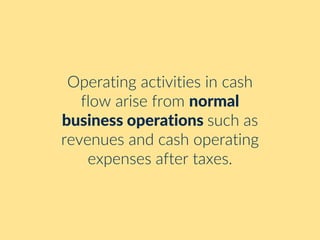
Operating activities in cash
flow arise from normal
business operations such as
revenues and cash operating
expenses after taxes.
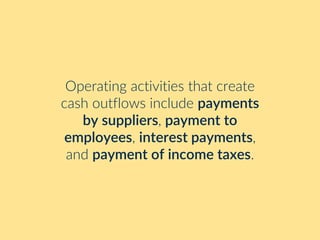
Operating activities that create
cash outflows include payments
by suppliers, payment to
employees, interest payments,
and payment of income taxes.
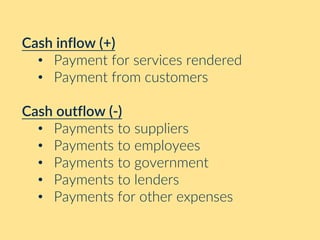
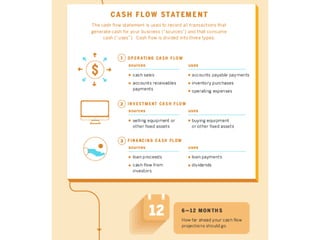
Cash inflow (+)
• Payment for services rendered
• Payment from customers
Cash outflow (-)
• Payments to suppliers
• Payments to employees
• Payments to government
• Payments to lenders
• Payments for other expenses
Part 2:
Investing
Activities
Investing activities
involve buying and
selling of current and
fixed assets.
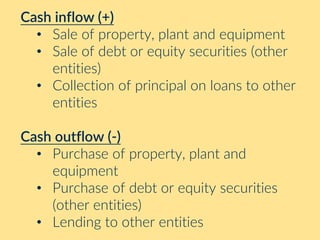
Cash inflow (+)
• Sale of property, plant and equipment
• Sale of debt or equity securities (other
entities)
• Collection of principal on loans to other
entities
Cash outflow (-)
• Purchase of property, plant and
equipment
• Purchase of debt or equity securities
(other entities)
• Lending to other entities
Part 3:
Financing Activities
Financing activities include
borrowing and repaying
money, issuing stock (equity)
and paying dividends
For example: If you borrow funds to
purchase equipment or pay off a
loan, the cash flow statement will
enable you to determine how much
cash was either generated or used as
a result of those transactions
How to Prepare a
Cash Flow Statement
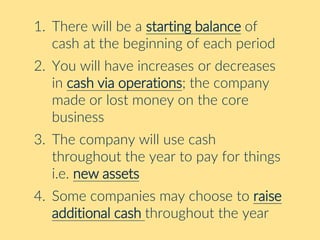
1. There will be a starting balance of
cash at the beginning of each period
2. You will have increases or decreases
in cash via operations; the company
made or lost money on the core
business
3. The company will use cash
throughout the year to pay for things
i.e. new assets
4. Some companies may choose to raise
additional cash throughout the year
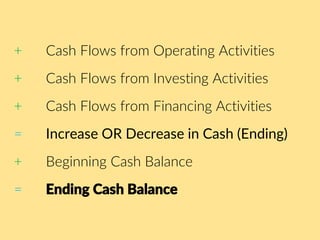
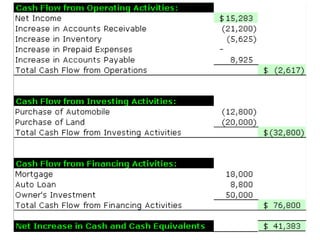
+ Cash Flows from Operating Activities
+ Cash Flows from Investing Activities
+ Cash Flows from Financing Activities
= Increase OR Decrease in Cash (Ending)
+ Beginning Cash Balance
= Ending Cash Balance
How to Analyze a
Cash Flow Statement
When analyzing cash flow,
the first place to look
is the cash flow for
operating activities
A large increase in use in cash may
be positive as it indicates a large
booking or deal has occurred for
which payment is expected
A lack of investing activities,
which is few purchases of new
equipment or other assets, may
indicate stagnant growth.
As a company expands, financing
activities will become
increasingly important.
It will tell outsiders how the
company has grown and the
financial strategies of management.
What do you do
when you have a
negative cash flow?
Make an effort to
increase sales!
Try and collect payment from
customers more quickly. This can help
you avoid long gaps and avoid
transactions dragging on.
Attempt to reduce monthly expenditure.
Buy supplies in bulk to get a discount, buy
from a more competitively priced supplier,
rent smaller premises, switch utility
companies to reduce monthly outgoings –
anything!
Thank You 

Cash Flow Statement Simplified

  • 1.
    Cash Flow Statement SIMPLIFIED! ToluAGUNBIADE 19 March 2015
  • 2.
    1. What acash flow statement is 2. How to prepare a Cash Flow Statement 3. What Your Cash Flow Statement says about your business Today, we’ll learn:
  • 3.
    What is a CashFlow Statement?
  • 4.
    …and what isit used for?
  • 5.
    Simply put, acash flow statement is the movement of money in and out of your business.
  • 6.
    A cash flowstatement can answer the questions: ‘Where did the money come from?’ and ‘Where did it go?’
  • 7.
    The primary purposeis to provide information regarding a company’s cash receipts and cash payments
  • 8.
    It can beused to assess the timing, amount and predictability of future cash flow.
  • 9.
    How is theCash Flow Statement Different from The Other Financial Statements?
  • 10.
    The Cash FlowStatement complements the income statement and Balance Sheet.
  • 11.
    It is designedto convert the accrual basis of accounting used in the income statement and balance sheet back to a cash basis.
  • 12.
    While the income statementtells you if you are making a profit or a loss and by how much.
  • 13.
    The Balance Sheet tellsyou what you own, what you owe and who you’ve gotten money from.
  • 14.
    They are bothprepared on accrual basis.
  • 15.
    The Cash Flowstatement is the one financial statement prepared strictly on a cash basis and lets you know how much liquid cash your company is making.
  • 16.
    “As the numberof corporate failures has risen, there is one line that bankers continue to echo: it is not a fall in profits that leads to failure, but a lack of cash.” Source: The Financial Times
  • 17.
    “In too manysituations, companies and their investors have been focused on profits, but in an environment where liquidity is tight and confidence thin, cash is king.” Source: The Financial Times
  • 18.
    What Makes Upa Cash Flow Statement?
  • 19.
  • 20.
    Operating activities incash flow arise from normal business operations such as revenues and cash operating expenses after taxes.
  • 21.
    Operating activities thatcreate cash outflows include payments by suppliers, payment to employees, interest payments, and payment of income taxes.
  • 22.
    Cash inflow (+) •Payment for services rendered • Payment from customers Cash outflow (-) • Payments to suppliers • Payments to employees • Payments to government • Payments to lenders • Payments for other expenses
  • 23.
  • 24.
    Investing activities involve buyingand selling of current and fixed assets.
  • 25.
    Cash inflow (+) •Sale of property, plant and equipment • Sale of debt or equity securities (other entities) • Collection of principal on loans to other entities Cash outflow (-) • Purchase of property, plant and equipment • Purchase of debt or equity securities (other entities) • Lending to other entities
  • 26.
  • 27.
    Financing activities include borrowingand repaying money, issuing stock (equity) and paying dividends
  • 28.
    For example: Ifyou borrow funds to purchase equipment or pay off a loan, the cash flow statement will enable you to determine how much cash was either generated or used as a result of those transactions
  • 30.
    How to Preparea Cash Flow Statement
  • 31.
    1. There willbe a starting balance of cash at the beginning of each period 2. You will have increases or decreases in cash via operations; the company made or lost money on the core business 3. The company will use cash throughout the year to pay for things i.e. new assets 4. Some companies may choose to raise additional cash throughout the year
  • 32.
    + Cash Flowsfrom Operating Activities + Cash Flows from Investing Activities + Cash Flows from Financing Activities = Increase OR Decrease in Cash (Ending) + Beginning Cash Balance = Ending Cash Balance
  • 34.
    How to Analyzea Cash Flow Statement
  • 35.
    When analyzing cashflow, the first place to look is the cash flow for operating activities
  • 36.
    A large increasein use in cash may be positive as it indicates a large booking or deal has occurred for which payment is expected
  • 37.
    A lack ofinvesting activities, which is few purchases of new equipment or other assets, may indicate stagnant growth.
  • 38.
    As a companyexpands, financing activities will become increasingly important.
  • 39.
    It will telloutsiders how the company has grown and the financial strategies of management.
  • 41.
    What do youdo when you have a negative cash flow?
  • 42.
    Make an effortto increase sales!
  • 43.
    Try and collectpayment from customers more quickly. This can help you avoid long gaps and avoid transactions dragging on.
  • 44.
    Attempt to reducemonthly expenditure. Buy supplies in bulk to get a discount, buy from a more competitively priced supplier, rent smaller premises, switch utility companies to reduce monthly outgoings – anything!
  • 45.