Cash Flow Statement
Chapter 4.1
Aim
To introduce to the students, cash flow statement
and its components so that students are able to
appropriately classify organisations cash flow into
operating, investing, and financing activities
Instructional Objectives
Objectives of this chapter are:
• Explain the meaning and objectives of Cash Flow statement
• List the advantages and disadvantages of Cash Flow
Statement
• Distinguish Cash Flow statement from Funds Flow statement
• Classify cash flows into operating, investing, and financing
activities
Cash Flow Statement
Meaning:
• Cash flow statement is one that reveals movement in cash from different
activities and in totality.
• A cash flow statement captures the changes in cash in between two accounting
periods as a result of the impact of different activities that a business carries.
• It spells out the effect on cash position of an enterprise as a result of various
business actions during a particular period.
• Cash that comes in the business is termed as cash inflow whereas that moves
out of the business is termed as cash outflow.
Objectives of Cash Flow Statement:
• Understand the overall liquidity position of the business
• Understand the impact of operating, investing and financing activities
• Ascertain the cash earning capacity of the business from its core operations
• Cash flow statement makes us understand the “real profit” – that is the profit that has finally got
converted into cash. It is important to note that profits on paper are different from profits realized
in cash.
• Apart from liquidity, cash flow statements aim at throwing light on the financial management
practices of a firm
• Another objective of a cash flow statement is to assist in cash flow planning. Cash budget is an
important operational budget concerned with liquidity aspect and a cash flow statement aims at
chalking out the cash flow road map for the future.
Advantages and disadvantages Cash
Flow Statement
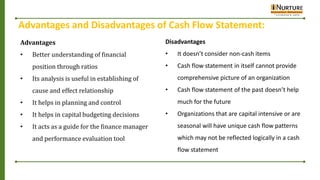
Advantages and Disadvantages of Cash Flow Statement:
Advantages
• Better understanding of financial
position through ratios
• Its analysis is useful in establishing of
cause and effect relationship
• It helps in planning and control
• It helps in capital budgeting decisions
• It acts as a guide for the finance manager
and performance evaluation tool
Disadvantages
• It doesn’t consider non-cash items
• Cash flow statement in itself cannot provide
comprehensive picture of an organization
• Cash flow statement of the past doesn’t help
much for the future
• Organizations that are capital intensive or are
seasonal will have unique cash flow patterns
which may not be reflected logically in a cash
flow statement
Difference between Cash Flow and
Funds Flow
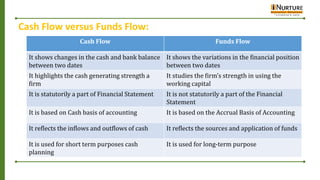
Cash Flow versus Funds Flow:
Cash Flow Funds Flow
It shows changes in the cash and bank balance
between two dates
It shows the variations in the financial position
between two dates
It highlights the cash generating strength a
firm
It studies the firm’s strength in using the
working capital
It is statutorily a part of Financial Statement It is not statutorily a part of the Financial
Statement
It is based on Cash basis of accounting It is based on the Accrual Basis of Accounting
It reflects the inflows and outflows of cash It reflects the sources and application of funds
It is used for short term purposes cash
planning
It is used for long-term purpose
Classification of cash flow
Classification of Cash Flow:
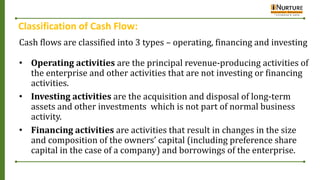
Cash flows are classified into 3 types – operating, financing and investing
• Operating activities are the principal revenue-producing activities of
the enterprise and other activities that are not investing or financing
activities.
• Investing activities are the acquisition and disposal of long-term
assets and other investments which is not part of normal business
activity.
• Financing activities are activities that result in changes in the size
and composition of the owners’ capital (including preference share
capital in the case of a company) and borrowings of the enterprise.
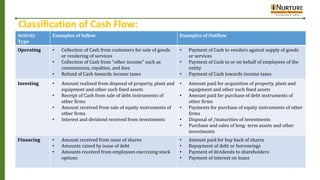
Classification of Cash Flow:
Activity
Type
Examples of Inflow Examples of Outflow
Operating • Collection of Cash from customers for sale of goods
or rendering of services
• Collection of Cash from “other income” such as
commissions, royalties, and fees
• Refund of Cash towards income taxes
• Payment of Cash to vendors against supply of goods
or services
• Payment of Cash to or on behalf of employees of the
entity
• Payment of Cash towards income taxes
Investing • Amount realized from disposal of property, plant and
equipment and other such fixed assets
• Receipt of Cash from sale of debt instruments of
other firms
• Amount received from sale of equity instruments of
other firms
• Interest and dividend received from investments
• Amount paid for acquisition of property, plant and
equipment and other such fixed assets
• Amount paid for purchase of debt instruments of
other firms
• Payments for purchase of equity instruments of other
firms
• Disposal of /maturities of investments
• Purchase and sales of long- term assets and other
investments
Financing • Amount received from issue of shares
• Amounts raised by issue of debt
• Amounts received from employees exercising stock
options
• Amount paid for buy back of shares
• Repayment of debt or borrowings
• Payment of dividends to shareholders
• Payment of interest on loans
Quiz / Assessment
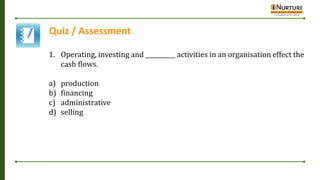
1. Operating, investing and __________ activities in an organisation effect the
cash flows.
a) production
b) financing
c) administrative
d) selling
Quiz / Assessment
2. ___________makes us understand the “real profit” – that is the profit that
has finally got converted into cash.
a) Cash Flow Statement
b) Funds flow statement
c) Both a and b
d) None of above
Quiz / Assessment
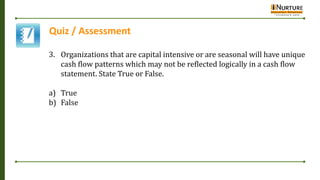
3. Organizations that are capital intensive or are seasonal will have unique
cash flow patterns which may not be reflected logically in a cash flow
statement. State True or False.
a) True
b) False
Quiz / Assessment
3. A) Cash Flow statement is based on Cash basis of accounting. B) On the
other hand, Fund Flow statement is based on the Accrual Basis of
Accounting.
State True or False.
a) A is True, B is False
b) A is False, B is True
c) Both A & B are True
d) Both A & B are False
Quiz / Assessment
5. Which of the following is an example of cash flow from investing
activities?
a) Payments for purchase of equity instruments of other firms
b) Amount paid for buy back of shares
c) Payment of interest on loans
d) Payment of dividends to shareholders
Brief description of activity
Activity
• Justify with reason whether the following will affect the
cash flows as well as the funds flow:
• Issue of shares for consideration other than cash
• Provision for tax
• Provision for bad and doubtful debt
• Issue of bonus shares
• Conversion of debentures into shares.
Online Activity
(60 min)
Summary
Cash flow statement reveals the movement in cash from different activities and in totality
The term cash includes cash equivalents which are highly liquid short-term investments
without any risk of reduction in value
The three activities under which various transactions of a firm are classified for the
purpose of cash flow are – operating, investing and financing
Basic objectives of cash flow is to assess the impact of various activities of a firm on its
liquidity
Advantages of cash flow include better analysis, planning and control, use in capital
budgeting etc.
Limitations of cash flow include non-inclusion of non-cash items, changes in decisions
affecting future cash flows etc.
Funds flow statement is a financial statement that analyses changes in the financial
position of a firm for a given period of time by considering sources and application of funds
Funds flow statement is broader in application as compared to cash flow statement
e-References
Classification of Cash flow statements. Retrieved on 28thDecember 2016 from
http://www.mca.gov.in/Ministry/notification/pdf/AS_3.pdf
Cash flow statement. Retrieved on 28thDecember 2016 from
http://www.fao.org/docrep/w4343e/w4343e04.htm
Statement of Cash Flows. Retrieved on 9th January 2017 from
http://www.accountingtools.com/statement-of-cash-flows
External Resources
Jain, S. P., & Narang, K. L. (2015). Corporate Accounting (4th ed.). Kalyani
Publishers.
Maheshwari, S. N., & Maheshwari, S. K. (2013). Introduction to Accountancy (11th
ed.). Jain Book Agency.
Prof H J Ghosh Roy. Dr. A. K. Singhal. (2012). A Textbook of Accounting for
Managers.(5th ed.). Vayu Education of India.

CA_M04_C01_PPT_Cash Flow Statement.pptx

  • 1.
  • 2.
    Aim To introduce tothe students, cash flow statement and its components so that students are able to appropriately classify organisations cash flow into operating, investing, and financing activities
  • 3.
    Instructional Objectives Objectives ofthis chapter are: • Explain the meaning and objectives of Cash Flow statement • List the advantages and disadvantages of Cash Flow Statement • Distinguish Cash Flow statement from Funds Flow statement • Classify cash flows into operating, investing, and financing activities
  • 4.
  • 5.
    Meaning: • Cash flowstatement is one that reveals movement in cash from different activities and in totality. • A cash flow statement captures the changes in cash in between two accounting periods as a result of the impact of different activities that a business carries. • It spells out the effect on cash position of an enterprise as a result of various business actions during a particular period. • Cash that comes in the business is termed as cash inflow whereas that moves out of the business is termed as cash outflow.
  • 6.
    Objectives of CashFlow Statement: • Understand the overall liquidity position of the business • Understand the impact of operating, investing and financing activities • Ascertain the cash earning capacity of the business from its core operations • Cash flow statement makes us understand the “real profit” – that is the profit that has finally got converted into cash. It is important to note that profits on paper are different from profits realized in cash. • Apart from liquidity, cash flow statements aim at throwing light on the financial management practices of a firm • Another objective of a cash flow statement is to assist in cash flow planning. Cash budget is an important operational budget concerned with liquidity aspect and a cash flow statement aims at chalking out the cash flow road map for the future.
  • 7.
    Advantages and disadvantagesCash Flow Statement
  • 8.
    Advantages and Disadvantagesof Cash Flow Statement: Advantages • Better understanding of financial position through ratios • Its analysis is useful in establishing of cause and effect relationship • It helps in planning and control • It helps in capital budgeting decisions • It acts as a guide for the finance manager and performance evaluation tool Disadvantages • It doesn’t consider non-cash items • Cash flow statement in itself cannot provide comprehensive picture of an organization • Cash flow statement of the past doesn’t help much for the future • Organizations that are capital intensive or are seasonal will have unique cash flow patterns which may not be reflected logically in a cash flow statement
  • 9.
    Difference between CashFlow and Funds Flow
  • 10.
    Cash Flow versusFunds Flow: Cash Flow Funds Flow It shows changes in the cash and bank balance between two dates It shows the variations in the financial position between two dates It highlights the cash generating strength a firm It studies the firm’s strength in using the working capital It is statutorily a part of Financial Statement It is not statutorily a part of the Financial Statement It is based on Cash basis of accounting It is based on the Accrual Basis of Accounting It reflects the inflows and outflows of cash It reflects the sources and application of funds It is used for short term purposes cash planning It is used for long-term purpose
  • 11.
  • 12.
    Classification of CashFlow: Cash flows are classified into 3 types – operating, financing and investing • Operating activities are the principal revenue-producing activities of the enterprise and other activities that are not investing or financing activities. • Investing activities are the acquisition and disposal of long-term assets and other investments which is not part of normal business activity. • Financing activities are activities that result in changes in the size and composition of the owners’ capital (including preference share capital in the case of a company) and borrowings of the enterprise.
  • 13.
    Classification of CashFlow: Activity Type Examples of Inflow Examples of Outflow Operating • Collection of Cash from customers for sale of goods or rendering of services • Collection of Cash from “other income” such as commissions, royalties, and fees • Refund of Cash towards income taxes • Payment of Cash to vendors against supply of goods or services • Payment of Cash to or on behalf of employees of the entity • Payment of Cash towards income taxes Investing • Amount realized from disposal of property, plant and equipment and other such fixed assets • Receipt of Cash from sale of debt instruments of other firms • Amount received from sale of equity instruments of other firms • Interest and dividend received from investments • Amount paid for acquisition of property, plant and equipment and other such fixed assets • Amount paid for purchase of debt instruments of other firms • Payments for purchase of equity instruments of other firms • Disposal of /maturities of investments • Purchase and sales of long- term assets and other investments Financing • Amount received from issue of shares • Amounts raised by issue of debt • Amounts received from employees exercising stock options • Amount paid for buy back of shares • Repayment of debt or borrowings • Payment of dividends to shareholders • Payment of interest on loans
  • 14.
    Quiz / Assessment 1.Operating, investing and __________ activities in an organisation effect the cash flows. a) production b) financing c) administrative d) selling
  • 15.
    Quiz / Assessment 2.___________makes us understand the “real profit” – that is the profit that has finally got converted into cash. a) Cash Flow Statement b) Funds flow statement c) Both a and b d) None of above
  • 16.
    Quiz / Assessment 3.Organizations that are capital intensive or are seasonal will have unique cash flow patterns which may not be reflected logically in a cash flow statement. State True or False. a) True b) False
  • 17.
    Quiz / Assessment 3.A) Cash Flow statement is based on Cash basis of accounting. B) On the other hand, Fund Flow statement is based on the Accrual Basis of Accounting. State True or False. a) A is True, B is False b) A is False, B is True c) Both A & B are True d) Both A & B are False
  • 18.
    Quiz / Assessment 5.Which of the following is an example of cash flow from investing activities? a) Payments for purchase of equity instruments of other firms b) Amount paid for buy back of shares c) Payment of interest on loans d) Payment of dividends to shareholders
  • 19.
    Brief description ofactivity Activity • Justify with reason whether the following will affect the cash flows as well as the funds flow: • Issue of shares for consideration other than cash • Provision for tax • Provision for bad and doubtful debt • Issue of bonus shares • Conversion of debentures into shares. Online Activity (60 min)
  • 20.
    Summary Cash flow statementreveals the movement in cash from different activities and in totality The term cash includes cash equivalents which are highly liquid short-term investments without any risk of reduction in value The three activities under which various transactions of a firm are classified for the purpose of cash flow are – operating, investing and financing Basic objectives of cash flow is to assess the impact of various activities of a firm on its liquidity Advantages of cash flow include better analysis, planning and control, use in capital budgeting etc. Limitations of cash flow include non-inclusion of non-cash items, changes in decisions affecting future cash flows etc. Funds flow statement is a financial statement that analyses changes in the financial position of a firm for a given period of time by considering sources and application of funds Funds flow statement is broader in application as compared to cash flow statement
  • 21.
    e-References Classification of Cashflow statements. Retrieved on 28thDecember 2016 from http://www.mca.gov.in/Ministry/notification/pdf/AS_3.pdf Cash flow statement. Retrieved on 28thDecember 2016 from http://www.fao.org/docrep/w4343e/w4343e04.htm Statement of Cash Flows. Retrieved on 9th January 2017 from http://www.accountingtools.com/statement-of-cash-flows
  • 22.
    External Resources Jain, S.P., & Narang, K. L. (2015). Corporate Accounting (4th ed.). Kalyani Publishers. Maheshwari, S. N., & Maheshwari, S. K. (2013). Introduction to Accountancy (11th ed.). Jain Book Agency. Prof H J Ghosh Roy. Dr. A. K. Singhal. (2012). A Textbook of Accounting for Managers.(5th ed.). Vayu Education of India.

Editor's Notes

  • #6 In terms of standardisation the various activities of an enterprise are classified into three types for the preparation of cash flow statements – a. Operating activities, b. Investing activities and c. Financing activities A cash flow statement systematically classifies the cash flows of an entity into these 3 types and finally presents the aggregate impact on the overall cash position of the entity. It can be prepared for a past accounting period or even a future accounting period. When prepared for a past period it will be the statement of actual cash flows and when prepared for a future period it will be the statement of projected cash flows. The latter can also be termed as a cash budget. Accounting Standard 3 Cash Flow Statements issued by the ICAI deals with the details of the cash flow statement including disclosure aspects. Cash thus is made-up of cash on hand, cash at bank (payable on demand) and short-term highly liquid investments readily convertible into certain amounts of cash.
  • #7 To understand the overall liquidity position of the business.   To understand the impact of various activities of an organization on its liquidity. These various activities as stated earlier are grouped under 3 heads – operating, investing and financing.   To ascertain the cash earning capacity of the business from its core operations. Lenders in particular are interested to get a feel of the cash earning capacity so as to find out the cover for debt servicing. Other investors too are concerned with operating cash flows of a business.   Cash flow statement makes us understand the “real profit” – that is the profit that has finally got converted into cash. It is important to note that profits on paper are different from profits realized in cash. Huge profits in the statement of profit and loss getting accumulated in debtors are revealed in a cash flow statement and they can provide warning signals. A cash flow statement provides the answer to tricky questions often faced by business houses – despite being highly profitable, why are we running short on cash? Where is all the money gone?   Apart from liquidity cash flow statements aim at throwing light on the financial management practices of a firm. Through a cash flow statement we can answer questions like – what kind of capital structure decisions the firm has taken? Is it more reliant on equity? Or is it funding through debt?   Another objective of the cash flow statement is to understand the cash management philosophy and practices of the enterprise. For example if we study the cash flow statements of Infosys over a period time, it will be revealed that the company has been steadily piling up cash year after year. The cash balance of Rs.10,993 crores as on 31st March, 2009 has gone up to Rs.29,176 crores as on 31st March, 2016. If you consider this as a small amount then you can take a look at the cash balance of Apple. It had $203 billion in cash on its balance sheet. (Source :Paul R La Monica on Stockswatch @money.cnn.com (22.7.15) Converted @ Rs.68 per dollar this works out to Rs.13,80,400 crores or 47 times that of Infosys’s cash!   Another objective of a cash flow statement is to assist in cash flow planning. Cash budget is an important operational budget concerned with liquidity aspect and a cash flow statement aims at chalking out the cash flow road map for the future.
  • #11 A funds flow statement is a broader statement than a cash flow and it shows changes in the financial position of the firm over a period of time. A funds flow statement has two parts – the sources of funds and the applications of funds. Sources and application of funds can be classified as short-term and long-term. As a matter of principle, short-term sources of funds should be used to fund short-term applications and long-term sources of funds should be used to fund long-term applications. A funds flow statement is useful to reveal amongst other things this important aspect of pattern of financing. It shows whether short-term sources have been used for long-term applications or vice versa.
  • #13 To understand the overall liquidity position of the business.  Operating cash flows can be defined as cash flows resulting from core operating activities of the entity. The operations of a business for which it exists lead to operating cash flows. Long-term applications of funds in the nature of fixed assets and investments are the principal investing cash flows. Further streams of income and expenses involving cash flows that are revenue in nature but linked with investing activities are also classified as investing cash flows. And long-term funding by way of equity and/or debt are the principal financing cash flows. Further streams of income and expenses involving cash flows that are revenue in nature and are linked with financing activities are also classified as financing cash flows. Taking a broad view, we can say that operating cash flows capture the statement of profit and loss including the working capital, investing cash flows capture the asset side of the balance sheet and financing cash flows capture the equity and liability side of the balance sheet. To understand the impact of various activities of an organization on its liquidity. These various activities as stated earlier are grouped under 3 heads – operating, investing and financing.   To ascertain the cash earning capacity of the business from its core operations. Lenders in particular are interested to get a feel of the cash earning capacity so as to find out the cover for debt servicing. Other investors too are concerned with operating cash flows of a business.   Cash flow statement makes us understand the “real profit” – that is the profit that has finally got converted into cash. It is important to note that profits on paper are different from profits realized in cash. Huge profits in the statement of profit and loss getting accumulated in debtors are revealed in a cash flow statement and they can provide warning signals. A cash flow statement provides the answer to tricky questions often faced by business houses – despite being highly profitable, why are we running short on cash? Where is all the money gone?   Apart from liquidity cash flow statements aim at throwing light on the financial management practices of a firm. Through a cash flow statement we can answer questions like – what kind of capital structure decisions the firm has taken? Is it more reliant on equity? Or is it funding through debt?   Another objective of the cash flow statement is to understand the cash management philosophy and practices of the enterprise. For example if we study the cash flow statements of Infosys over a period time, it will be revealed that the company has been steadily piling up cash year after year. The cash balance of Rs.10,993 crores as on 31st March, 2009 has gone up to Rs.29,176 crores as on 31st March, 2016. If you consider this as a small amount then you can take a look at the cash balance of Apple. It had $203 billion in cash on its balance sheet. (Source :Paul R La Monica on Stockswatch @money.cnn.com (22.7.15) Converted @ Rs.68 per dollar this works out to Rs.13,80,400 crores or 47 times that of Infosys’s cash!   Another objective of a cash flow statement is to assist in cash flow planning. Cash budget is an important operational budget concerned with liquidity aspect and a cash flow statement aims at chalking out the cash flow road map for the future.
  • #15 Correct answer: b
  • #16 Correct answer: a
  • #17 Correct answer: a
  • #18 Correct answer: c
  • #19 Correct answer: a