Statement of Changes in Financial
Position :Cash FlowStatement
The cash flow statement provides
information about:
• Cash Receipts (cash inflows)
• Uses of Cash (cash outflows)
• During a Period of Time
Inflows and outflows are reported for:
• Operating activities
• Investing activities
• Financing activities
The Cash Flow Statement
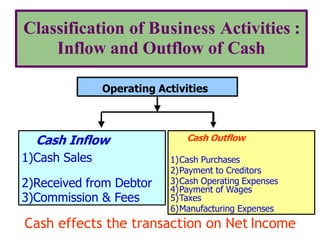
Classification of Business Activities :
Inflow and Outflow of Cash
Operating Activities
Cash Inflow
1)Cash Sales
2)Received from Debtor
3)Commission & Fees
Cash Outflow
1)Cash Purchases
2)Payment to Creditors
3)Cash Operating Expenses
4)Payment of Wages
5)Taxes
6)Manufacturing Expenses
Cash effects the transaction on Net Income
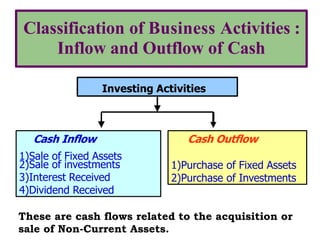
Investing Activities
Cash Inflow
1)Sale of Fixed Assets
2)Sale of investments
3)Interest Received
4)Dividend Received
Cash Outflow
1)Purchase of Fixed Assets
2)Purchase of Investments
Classification of Business Activities :
Inflow and Outflow of Cash
These are cash flows related to the acquisition or
sale of Non-Current Assets.
Classification of Business Activities :
Inflow and Outflow of Cash
Financing Activities
Cash Inflow
1)Issue of Shares in Cash
2)Issue of Debentures in
Cash
3)Proceeds from long-
term borrowings
Cash Outflow
1)Payment of Loans
2)Payment of Dividends
3)Interest Paid
4)Repayment of Finance/
Lease Liability
These are cash flows related to the owner’s equity and
borrowings.
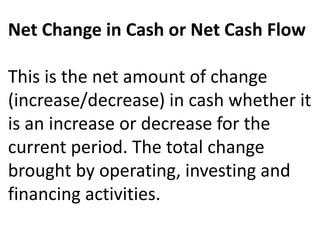
Net Change in Cash or Net Cash Flow
This is the net amount of change
(increase/decrease) in cash whether it
is an increase or decrease for the
current period. The total change
brought by operating, investing and
financing activities.
Beginning Cash Balance
This is the balance of the cash account at
the beginning of the accounting period.
Ending Cash Balance
This is the balance of the cash account at
the end of the accounting period
computed using the beginning balance
plus the Net Change in cash for the
current period.
The Benefits of Cash Flow
Information
1. A statement of cash flows, when used
along with other financial statements,
enables users to evaluate changes in net
assets of an entity, its financial structure and
its ability to affect the amounts and timing
of cash flows
The Benefits of Cash Flow
Information
2. A statement of cash flows is useful in assessing
the ability of the entity to generate cash and cash
equivalents and compare the present value of the
future cash flows of different entities
3. It enhances the comparability of the reporting of
operating performance as it eliminates the effects
of using different accounting treatments for the
same transactions and events
The usefulness of the Cash Flow
Statement
It provides information to assess:
 the ability to generate cash flow in the
future
 the ability of the organization to pay
dividends and debts/obligations
 the reasons for the difference in Net
Income and Net Cash
Preparing a Statement of Cash Flows
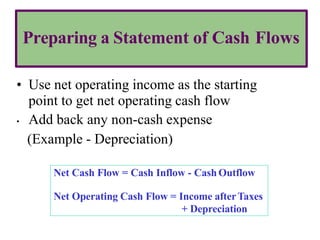
• Use net operating income as the starting
point to get net operating cash flow
• Add back any non-cash expense
(Example - Depreciation)
Net Cash Flow = Cash Inflow - CashOutflow
Net Operating Cash Flow = Income afterTaxes
+ Depreciation
Preparing a Statement of Cash Flows
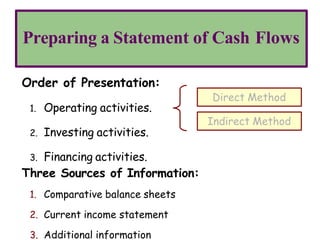
Order of Presentation:
1. Operating activities.
2. Investing activities.
3. Financing activities.
Direct Method
Indirect Method
Three Sources of Information:
1. Comparative balance sheets
2. Current income statement
3. Additional information
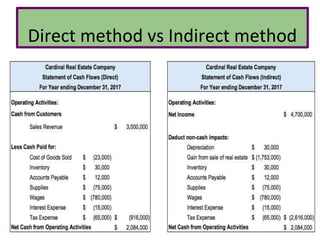
Direct method vs Indirect method
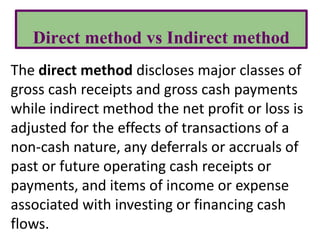
The direct method discloses major classes of
gross cash receipts and gross cash payments
while indirect method the net profit or loss is
adjusted for the effects of transactions of a
non-cash nature, any deferrals or accruals of
past or future operating cash receipts or
payments, and items of income or expense
associated with investing or financing cash
flows.
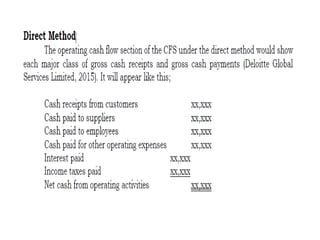
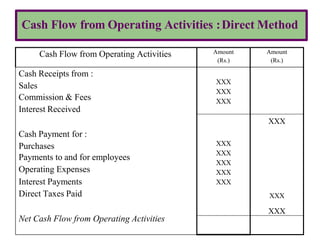
Cash Flow from Operating Activities :Direct Method
Cash Flow from Operating Activities Amount
(Rs.)
Amount
(Rs.)
Cash Receipts from :
Sales
Commission & Fees
Interest Received
XXX
XXX
XXX
XXX
Cash Payment for :
Purchases
Payments to and for employees
Operating Expenses
Interest Payments
Direct Taxes Paid
XXX
XXX
XXX
XXX
XXX
XXX
Net Cash Flow from Operating Activities
XXX
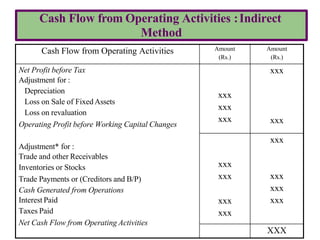
Cash Flow from Operating Activities :Indirect
Method
Cash Flow from Operating Activities Amount
(Rs.)
Amount
(Rs.)
Net Profit before Tax
Adjustment for :
Depreciation
Loss on Sale of Fixed Assets
Loss on revaluation
Operating Profit before Working Capital Changes
Adjustment* for :
Trade and other Receivables
Inventories or Stocks
Trade Payments or (Creditors and B/P)
Cash Generated from Operations
Interest Paid
Taxes Paid
Net Cash Flow from Operating Activities
xxx
xxx
xxx
xxx
xxx
xxx
xxx
xxx
xxx
xxx
xxx
xxx
xxx
XXX
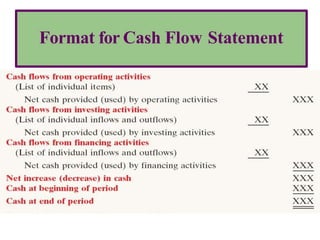
Format for Cash Flow Statement
Direct method vs Indirect method
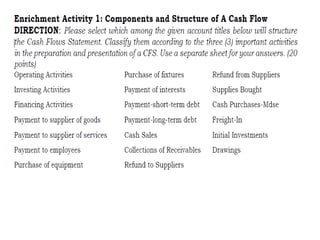
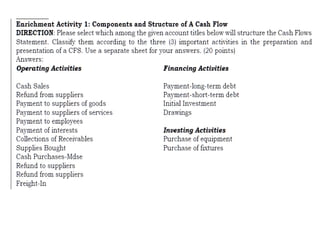
Enrichment Activity 1: Components and Structure of A Cash Flow
DIRECTION: Please select which among the given account titles below will structure the
Cash Flows Statement. Classify them according to the three (3) important activities in the
preparation and presentation of a CFS. Use a separate sheet for your answers. (20
points)
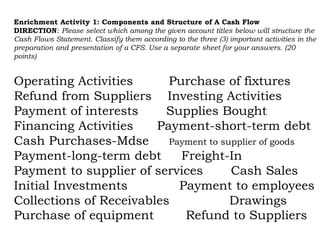
Operating Activities Purchase of fixtures
Refund from Suppliers Investing Activities
Payment of interests Supplies Bought
Financing Activities Payment-short-term debt
Cash Purchases-Mdse Payment to supplier of goods
Payment-long-term debt Freight-In
Payment to supplier of services Cash Sales
Initial Investments Payment to employees
Collections of Receivables Drawings
Purchase of equipment Refund to Suppliers
End of Presentation
**********************
Thank You

cash-flow-statement-1220159910575245-9.pptx

  • 1.
    Statement of Changesin Financial Position :Cash FlowStatement
  • 2.
    The cash flowstatement provides information about: • Cash Receipts (cash inflows) • Uses of Cash (cash outflows) • During a Period of Time Inflows and outflows are reported for: • Operating activities • Investing activities • Financing activities The Cash Flow Statement
  • 3.
    Classification of BusinessActivities : Inflow and Outflow of Cash Operating Activities Cash Inflow 1)Cash Sales 2)Received from Debtor 3)Commission & Fees Cash Outflow 1)Cash Purchases 2)Payment to Creditors 3)Cash Operating Expenses 4)Payment of Wages 5)Taxes 6)Manufacturing Expenses Cash effects the transaction on Net Income
  • 4.
    Investing Activities Cash Inflow 1)Saleof Fixed Assets 2)Sale of investments 3)Interest Received 4)Dividend Received Cash Outflow 1)Purchase of Fixed Assets 2)Purchase of Investments Classification of Business Activities : Inflow and Outflow of Cash These are cash flows related to the acquisition or sale of Non-Current Assets.
  • 5.
    Classification of BusinessActivities : Inflow and Outflow of Cash Financing Activities Cash Inflow 1)Issue of Shares in Cash 2)Issue of Debentures in Cash 3)Proceeds from long- term borrowings Cash Outflow 1)Payment of Loans 2)Payment of Dividends 3)Interest Paid 4)Repayment of Finance/ Lease Liability These are cash flows related to the owner’s equity and borrowings.
  • 6.
    Net Change inCash or Net Cash Flow This is the net amount of change (increase/decrease) in cash whether it is an increase or decrease for the current period. The total change brought by operating, investing and financing activities.
  • 7.
    Beginning Cash Balance Thisis the balance of the cash account at the beginning of the accounting period. Ending Cash Balance This is the balance of the cash account at the end of the accounting period computed using the beginning balance plus the Net Change in cash for the current period.
  • 8.
    The Benefits ofCash Flow Information 1. A statement of cash flows, when used along with other financial statements, enables users to evaluate changes in net assets of an entity, its financial structure and its ability to affect the amounts and timing of cash flows
  • 9.
    The Benefits ofCash Flow Information 2. A statement of cash flows is useful in assessing the ability of the entity to generate cash and cash equivalents and compare the present value of the future cash flows of different entities 3. It enhances the comparability of the reporting of operating performance as it eliminates the effects of using different accounting treatments for the same transactions and events
  • 10.
    The usefulness ofthe Cash Flow Statement It provides information to assess:  the ability to generate cash flow in the future  the ability of the organization to pay dividends and debts/obligations  the reasons for the difference in Net Income and Net Cash
  • 11.
    Preparing a Statementof Cash Flows • Use net operating income as the starting point to get net operating cash flow • Add back any non-cash expense (Example - Depreciation) Net Cash Flow = Cash Inflow - CashOutflow Net Operating Cash Flow = Income afterTaxes + Depreciation
  • 12.
    Preparing a Statementof Cash Flows Order of Presentation: 1. Operating activities. 2. Investing activities. 3. Financing activities. Direct Method Indirect Method Three Sources of Information: 1. Comparative balance sheets 2. Current income statement 3. Additional information
  • 13.
    Direct method vsIndirect method The direct method discloses major classes of gross cash receipts and gross cash payments while indirect method the net profit or loss is adjusted for the effects of transactions of a non-cash nature, any deferrals or accruals of past or future operating cash receipts or payments, and items of income or expense associated with investing or financing cash flows.
  • 15.
    Cash Flow fromOperating Activities :Direct Method Cash Flow from Operating Activities Amount (Rs.) Amount (Rs.) Cash Receipts from : Sales Commission & Fees Interest Received XXX XXX XXX XXX Cash Payment for : Purchases Payments to and for employees Operating Expenses Interest Payments Direct Taxes Paid XXX XXX XXX XXX XXX XXX Net Cash Flow from Operating Activities XXX
  • 16.
    Cash Flow fromOperating Activities :Indirect Method Cash Flow from Operating Activities Amount (Rs.) Amount (Rs.) Net Profit before Tax Adjustment for : Depreciation Loss on Sale of Fixed Assets Loss on revaluation Operating Profit before Working Capital Changes Adjustment* for : Trade and other Receivables Inventories or Stocks Trade Payments or (Creditors and B/P) Cash Generated from Operations Interest Paid Taxes Paid Net Cash Flow from Operating Activities xxx xxx xxx xxx xxx xxx xxx xxx xxx xxx xxx xxx xxx XXX
  • 17.
    Format for CashFlow Statement
  • 18.
    Direct method vsIndirect method
  • 20.
    Enrichment Activity 1:Components and Structure of A Cash Flow DIRECTION: Please select which among the given account titles below will structure the Cash Flows Statement. Classify them according to the three (3) important activities in the preparation and presentation of a CFS. Use a separate sheet for your answers. (20 points) Operating Activities Purchase of fixtures Refund from Suppliers Investing Activities Payment of interests Supplies Bought Financing Activities Payment-short-term debt Cash Purchases-Mdse Payment to supplier of goods Payment-long-term debt Freight-In Payment to supplier of services Cash Sales Initial Investments Payment to employees Collections of Receivables Drawings Purchase of equipment Refund to Suppliers
  • 22.