Measuring and Evaluating
Cash Flow
Cash Flow
Main topics
 Why cash flow analysis is useful;
 What the cash flow statement looks like and contains;
 How to prepare a simple cash flow statement from account
information;
 How to interpret a cash flow statement;
 Brief comments on the importance of cash flow to the manager;
 To continue the accounting analysis and reconciliation thread,
an example of reconciling cash and accrual figures.
Measuring and Evaluating Cash Flow
The Purpose of Cash Flow Analysis
 An important aspect of performance is managing the
inflow and outflow of cash so that the enterprise has
enough cash to pay bills, finance growth, and keep its
borrowing under control. This is just as important as
generating accrual income.
 It is important for present and potential investors and
creditors to have information about a firm’s cash
inflows and outflows and its resulting cash position.
Accrual Income vs. Cash Needs
 Many new and established firms have had positive
net income but have still run out of cash and had
serious, even fatal, liquidity or solvency problems.
E.g. High tech internet companies
 A positive accrual income does not necessarily mean
there is enough cash to cover immediate expenses
and accounts payable that are due, as we’ll see.
 As a result, it is important for present and potential
investors and creditors to have information about a
firm’s cash management and the resulting cash
position.
Two Important Cash Flow Terms
o Solvency:
The ability of a firm to meet all its debts and
other obligations whenever they become due
o Liquidity:
The ability of a firm to cover its immediate
debts and other obligations through the use of
cash and short-term assets
It is not efficient to have excess idle cash. Have to balance too much
versus too little. This is a central task of cash management.
 The cash flow statement (older name: statement of
changes in financial position (SCFP)) has been
developed to describe what has been going on in the
company’s cash during the year.
 The cash flow statement provides information about a
firm’s use of cash and highly liquid short-term assets,
and, therefore assists in evaluating the firm’s financial
viability.
The Cash Flow Statement
Cash Income- Does it tell the whole story?
 Cash income is not a complete measure of what
has happened to cash.
 Certain flows (such as dividends or a purchase of
land) are not part of the day-to-day process of
generating revenue and incurring expenses, so they
would not be covered even by a cash income
measure.
 They reflect management decisions beyond
generation of income in the current period.
How is the cash flow statement useful?
It generates a measure of performance based on the day-to-
day cash flow (cash generated by ordinary business
activities), instead of accrual accounting’s net income
performance measure.
It provides a complete description of how the firm’s cash
was managed during the period. This is accomplished by
incorporating other non-operating cash inflows and
outflows, and showing the beginning and ending balances
of cash.
Some Important Features of the Cash Flow
Statement Format!
Statement Format!
1) The cash flow statement covers the same time period as the IS.
2) Cash includes some equivalents that can be turned into cash
without any risk of loss, such as short-term bank deposits.
3) Cash may include temporary negative bank balances if the
bank balances regularly vary from positive to negative.
4) The cash flow statement has accompanying notes.
5) The CF stmt follows rules to ensure that its focus is on cash.
6) Non-cash transactions are excluded from the CF statement.
7) Any number in the CF statement may be positive or negative.
8) Deriving the cash flow from day-to-day operations is one of
the main reasons for having the cash flow analysis.
Cash Flow Statement Standard
Cash Flow Statement Standard Format
Format
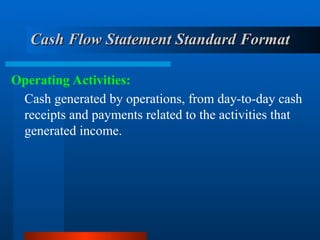
Operating Activities:
Cash generated by operations, from day-to-day cash
receipts and payments related to the activities that
generated income.
Cash Flow Statement Standard
Cash Flow Statement Standard Format
Format
Operating Activities
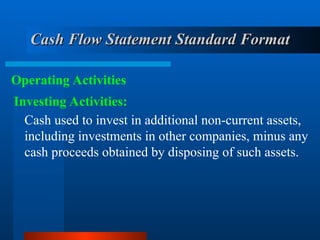
Cash used to invest in additional non-current assets,
including investments in other companies, minus any
cash proceeds obtained by disposing of such assets.
Investing Activities:
Operating Activities
Investing Activities
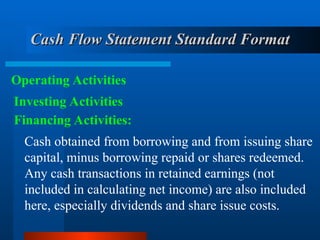
Cash obtained from borrowing and from issuing share
capital, minus borrowing repaid or shares redeemed.
Any cash transactions in retained earnings (not
included in calculating net income) are also included
here, especially dividends and share issue costs.
Financing Activities:
Cash Flow Statement Standard Format
Operating Activities
Investing Activities
Financing Activities
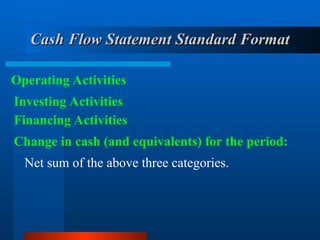
Net sum of the above three categories.
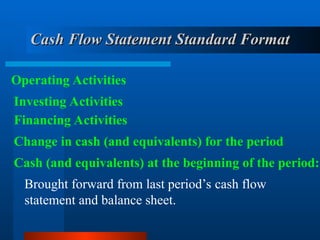
Change in cash (and equivalents) for the period:
Cash Flow Statement Standard Format
Operating Activities
Investing Activities
Financing Activities
Change in cash (and equivalents) for the period
Brought forward from last period’s cash flow
statement and balance sheet.
Cash (and equivalents) at the beginning of the period:
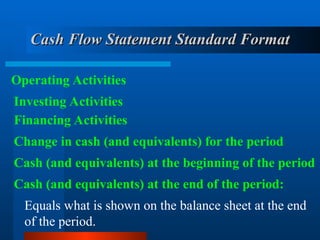
Cash Flow Statement Standard Format
Operating Activities
Investing Activities
Financing Activities
Change in cash (and equivalents) for the period
Cash (and equivalents) at the beginning of the period
Equals what is shown on the balance sheet at the end
of the period.
Cash (and equivalents) at the end of the period:
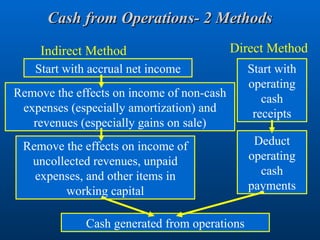
Cash from Operations- 2 Methods
Indirect Method Direct Method
Start with accrual net income Start with
operating
cash
receipts
Remove the effects on income of non-cash
expenses (especially amortization) and
revenues (especially gains on sale)
Remove the effects on income of
uncollected revenues, unpaid
expenses, and other items in
working capital
Cash generated from operations
Deduct
operating
cash
payments
Cash on hand at the beginning of the year $813,430
Cash receipts for the year:
Cash sales $73,320
Collections from customers for credit sales 17,894,530
Proceeds from sale of land 1,200,000
Proceeds from issue of new bonded debt 5,300,000
Proceeds from issue of new shares 840,000 25,307,850
$26,121,280
Roebuck Industries Inc.
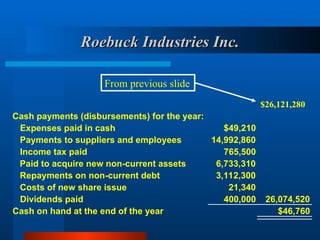
Cash payments (disbursements) for the year:
Expenses paid in cash $49,210
Payments to suppliers and employees 14,992,860
Income tax paid 765,500
Paid to acquire new non-current assets 6,733,310
Repayments on non-current debt 3,112,300
Costs of new share issue 21,340
Dividends paid 400,000 26,074,520
Cash on hand at the end of the year $46,760
$26,121,280
From previous slide
What is the Indirect Method?
 The indirect method relies on the fundamentals of
double entry accounting: change in accounts.
 We can analyze cash changes by looking at changes
in all the other accounts in the balance sheet: those
changes will tell us what the company did with its
cash.
Construct the cash flow statement by placing all
balance sheet account changes in the appropriate
categories of the cash flow statement, after adjusting
for all non-cash components of those account changes.
Basic Approach:
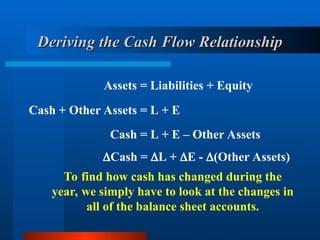
Deriving the Cash Flow Relationship
Assets = Liabilities + Equity
Cash + Other Assets = L + E
Cash = L + E – Other Assets
Cash = L + E - (Other Assets)
To find how cash has changed during the
year, we simply have to look at the changes in
all of the balance sheet accounts.
Why use the Indirect Method?
 Most companies use the indirect method in
preparing their cash flow statements (traditional
method).
 Digging out the details of cash receipts and
payments over a whole year (as required by the
direct method) can be a large task, especially if
there are several or many cash and bank accounts.
 The indirect method provides a detailed and
informative operations section.
The Cash Flow Statement (Indirect)
Operating Activities
Start with net income for the period (part of the retained
earnings change)
Adjustments to eliminate non-cash components of
income:
o Remove revenues and expenses that are entirely
non-cash:
1. Gains and losses
2. Write-downs and write-offs of investments
Start with net income for the period (part of the retained
earnings change)
Adjustments to eliminate non-cash components of
income:
o Remove revenues and expenses that relate to non-
current past or future cash flows:
1. Amortization (asset cost paid in the past)
2. Future costs to be paid (future income taxes,
warranties, pension costs, etc.)
Operating Activities
The Cash Flow Statement (Indirect)
Start with net income for the period (part of the retained
earnings change)
Adjustments to eliminate non-cash components of
income:
o Remove the effects on accrual income of working
capital account changes:
1. Accounts receivable
2. Inventories
3. Prepaid expenses
Operating Activities
4. Accounts payable
5. Estimated accrued liabilities
6. Prepaid expenses
The Cash Flow Statement (Indirect)
Additions to plant and equipment and intangible and
other assets, minus any amounts not yet (or ever) paid in
cash and so still showing as payable
Proceeds for disposal of plant and equipment and
intangible and other assets (accounts changes due to
elimination of cost and accumulated amortization of
disposed assets are ignored because they are not cash
items)
Investing Activities (same as direct method)
Additions to and proceeds of disposal of mainly non-
current investments
The Cash Flow Statement (Indirect)
Financing Activities (same as direct method)
Changes in current and non-current debt financing,
minus any parts not involving cash (such as exchanges
for shares or non-cash assets)
Changes in share capital, minus any parts not involving
cash (such as exchanges for debt or non-cash assets)
Changes in retained earnings other than net income for
this period: dividends, share issue costs, etc., minus any
parts not paid in cash (e.g. stock dividends or dividends
payable)
The Cash Flow Statement (Indirect)
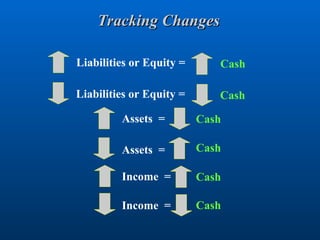
Tracking Changes
Tracking Changes
Liabilities or Equity = Cash
Assets = Cash
Cash
Assets =
Income = Cash
Cash
Income =
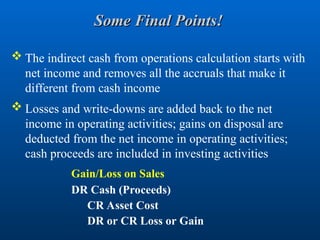
Some Final Points!
Some Final Points!
 The indirect cash from operations calculation starts with
net income and removes all the accruals that make it
different from cash income
 Losses and write-downs are added back to the net
income in operating activities; gains on disposal are
deducted from the net income in operating activities;
cash proceeds are included in investing activities
Gain/Loss on Sales
DR Cash (Proceeds)
CR Asset Cost
DR or CR Loss or Gain
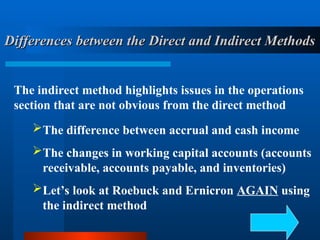
The indirect method highlights issues in the operations
section that are not obvious from the direct method
Differences between the Direct and Indirect Methods
The difference between accrual and cash income
The changes in working capital accounts (accounts
receivable, accounts payable, and inventories)
Let’s look at Roebuck and Ernicron AGAIN using
the indirect method
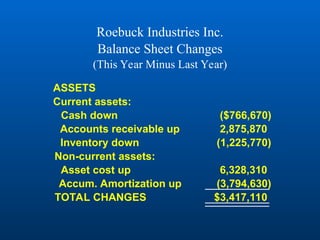
Roebuck Industries Inc.
Balance Sheet Changes
(This Year Minus Last Year)
ASSETS
Current assets:
Cash down ($766,670)
Accounts receivable up 2,875,870
Inventory down (1,225,770)
Non-current assets:
Asset cost up 6,328,310
Accum. Amortization up (3,794,630)
TOTAL CHANGES $3,417,110
Roebuck Industries Inc.
Balance Sheet Changes
(This Year Minus Last Year)
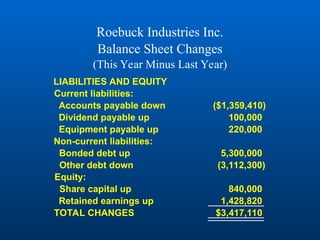
LIABILITIES AND EQUITY
Current liabilities:
Accounts payable down ($1,359,410)
Dividend payable up 100,000
Equipment payable up 220,000
Non-current liabilities:
Bonded debt up 5,300,000
Other debt down (3,112,300)
Equity:
Share capital up 840,000
Retained earnings up 1,428,820
TOTAL CHANGES $3,417,110
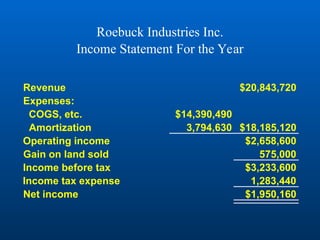
Roebuck Industries Inc.
Income Statement For the Year
Revenue $20,843,720
Expenses:
COGS, etc. $14,390,490
Gain on land sold 575,000
Income tax expense 1,283,440
Operating income $2,658,600
Income before tax $3,233,600
Net income $1,950,160
Amortization 3,794,630 $18,185,120
Roebuck Industries Inc.
Retained Earnings Changes For the Year
Add net income $1,950,160
Deduct dividends
declared (500,000)
Deduct costs of
share issue (21,340)
NET CHANGE $1,428,820
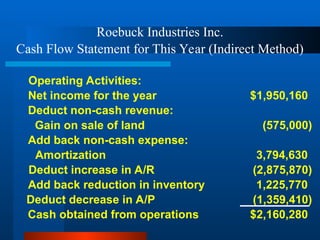
Roebuck Industries Inc.
Cash Flow Statement for This Year (Indirect Method)
Operating Activities:
Net income for the year $1,950,160
Deduct non-cash revenue:
Gain on sale of land (575,000)
Add back non-cash expense:
Amortization 3,794,630
Deduct increase in A/R (2,875,870)
Add back reduction in inventory 1,225,770
Deduct decrease in A/P (1,359,410)
Cash obtained from operations $2,160,280
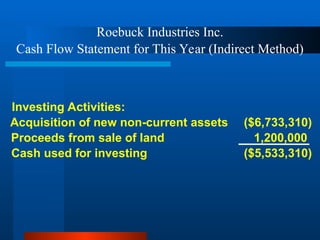
Roebuck Industries Inc.
Cash Flow Statement for This Year (Indirect Method)
Investing Activities:
Acquisition of new non-current assets ($6,733,310)
Proceeds from sale of land 1,200,000
Cash used for investing ($5,533,310)
Roebuck Industries Inc.
Cash Flow Statement for This Year (Indirect Method)
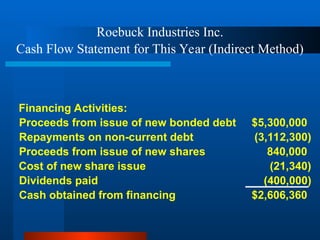
Financing Activities:
Proceeds from issue of new bonded debt $5,300,000
Repayments on non-current debt (3,112,300)
Proceeds from issue of new shares 840,000
Cost of new share issue (21,340)
Dividends paid (400,000)
Cash obtained from financing $2,606,360
Roebuck Industries Inc.
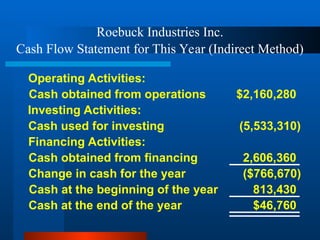
Cash Flow Statement for This Year (Indirect Method)
Operating Activities:
Cash obtained from operations $2,160,280
Investing Activities:
Cash used for investing (5,533,310)
Cash at the beginning of the year 813,430
Financing Activities:
Cash obtained from financing 2,606,360
Change in cash for the year ($766,670)
Cash at the end of the year $46,760
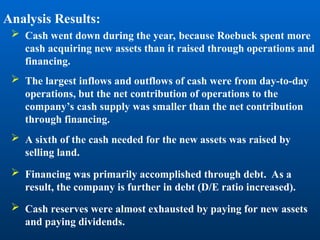
Analysis Results:
 Cash went down during the year, because Roebuck spent more
cash acquiring new assets than it raised through operations and
financing.
 The largest inflows and outflows of cash were from day-to-day
operations, but the net contribution of operations to the
company’s cash supply was smaller than the net contribution
through financing.
 A sixth of the cash needed for the new assets was raised by
selling land.
 Financing was primarily accomplished through debt. As a
result, the company is further in debt (D/E ratio increased).
 Cash reserves were almost exhausted by paying for new assets
and paying dividends.

Cash Flow Statement (Indirect) in office.ppt

  • 1.
    Measuring and Evaluating Measuringand Evaluating Cash Flow Cash Flow
  • 2.
    Main topics  Whycash flow analysis is useful;  What the cash flow statement looks like and contains;  How to prepare a simple cash flow statement from account information;  How to interpret a cash flow statement;  Brief comments on the importance of cash flow to the manager;  To continue the accounting analysis and reconciliation thread, an example of reconciling cash and accrual figures. Measuring and Evaluating Cash Flow
  • 3.
    The Purpose ofCash Flow Analysis The Purpose of Cash Flow Analysis  An important aspect of performance is managing the inflow and outflow of cash so that the enterprise has enough cash to pay bills, finance growth, and keep its borrowing under control. This is just as important as generating accrual income.  It is important for present and potential investors and creditors to have information about a firm’s cash inflows and outflows and its resulting cash position.
  • 4.
    Accrual Income vs.Cash Needs Accrual Income vs. Cash Needs  Many new and established firms have had positive net income but have still run out of cash and had serious, even fatal, liquidity or solvency problems. E.g. High tech internet companies  A positive accrual income does not necessarily mean there is enough cash to cover immediate expenses and accounts payable that are due, as we’ll see.  As a result, it is important for present and potential investors and creditors to have information about a firm’s cash management and the resulting cash position.
  • 5.
    Two Important CashFlow Terms Two Important Cash Flow Terms o Solvency: The ability of a firm to meet all its debts and other obligations whenever they become due o Liquidity: The ability of a firm to cover its immediate debts and other obligations through the use of cash and short-term assets It is not efficient to have excess idle cash. Have to balance too much versus too little. This is a central task of cash management.
  • 6.
     The cashflow statement (older name: statement of changes in financial position (SCFP)) has been developed to describe what has been going on in the company’s cash during the year.  The cash flow statement provides information about a firm’s use of cash and highly liquid short-term assets, and, therefore assists in evaluating the firm’s financial viability. The Cash Flow Statement The Cash Flow Statement
  • 7.
    Cash Income- Doesit tell the whole story? Cash Income- Does it tell the whole story?  Cash income is not a complete measure of what has happened to cash.  Certain flows (such as dividends or a purchase of land) are not part of the day-to-day process of generating revenue and incurring expenses, so they would not be covered even by a cash income measure.  They reflect management decisions beyond generation of income in the current period.
  • 8.
    How is thecash flow statement useful? How is the cash flow statement useful? It generates a measure of performance based on the day-to- day cash flow (cash generated by ordinary business activities), instead of accrual accounting’s net income performance measure. It provides a complete description of how the firm’s cash was managed during the period. This is accomplished by incorporating other non-operating cash inflows and outflows, and showing the beginning and ending balances of cash.
  • 9.
    Some Important Featuresof the Cash Flow Some Important Features of the Cash Flow Statement Format! Statement Format! 1) The cash flow statement covers the same time period as the IS. 2) Cash includes some equivalents that can be turned into cash without any risk of loss, such as short-term bank deposits. 3) Cash may include temporary negative bank balances if the bank balances regularly vary from positive to negative. 4) The cash flow statement has accompanying notes. 5) The CF stmt follows rules to ensure that its focus is on cash. 6) Non-cash transactions are excluded from the CF statement. 7) Any number in the CF statement may be positive or negative. 8) Deriving the cash flow from day-to-day operations is one of the main reasons for having the cash flow analysis.
  • 10.
    Cash Flow StatementStandard Cash Flow Statement Standard Format Format Operating Activities: Cash generated by operations, from day-to-day cash receipts and payments related to the activities that generated income.
  • 11.
    Cash Flow StatementStandard Cash Flow Statement Standard Format Format Operating Activities Cash used to invest in additional non-current assets, including investments in other companies, minus any cash proceeds obtained by disposing of such assets. Investing Activities:
  • 12.
    Operating Activities Investing Activities Cashobtained from borrowing and from issuing share capital, minus borrowing repaid or shares redeemed. Any cash transactions in retained earnings (not included in calculating net income) are also included here, especially dividends and share issue costs. Financing Activities: Cash Flow Statement Standard Format Cash Flow Statement Standard Format
  • 13.
    Cash Flow StatementStandard Format Cash Flow Statement Standard Format Operating Activities Investing Activities Financing Activities Net sum of the above three categories. Change in cash (and equivalents) for the period:
  • 14.
    Cash Flow StatementStandard Format Cash Flow Statement Standard Format Operating Activities Investing Activities Financing Activities Change in cash (and equivalents) for the period Brought forward from last period’s cash flow statement and balance sheet. Cash (and equivalents) at the beginning of the period:
  • 15.
    Cash Flow StatementStandard Format Cash Flow Statement Standard Format Operating Activities Investing Activities Financing Activities Change in cash (and equivalents) for the period Cash (and equivalents) at the beginning of the period Equals what is shown on the balance sheet at the end of the period. Cash (and equivalents) at the end of the period:
  • 16.
    Cash from Operations-2 Methods Cash from Operations- 2 Methods Indirect Method Direct Method Start with accrual net income Start with operating cash receipts Remove the effects on income of non-cash expenses (especially amortization) and revenues (especially gains on sale) Remove the effects on income of uncollected revenues, unpaid expenses, and other items in working capital Cash generated from operations Deduct operating cash payments
  • 17.
    Cash on handat the beginning of the year $813,430 Cash receipts for the year: Cash sales $73,320 Collections from customers for credit sales 17,894,530 Proceeds from sale of land 1,200,000 Proceeds from issue of new bonded debt 5,300,000 Proceeds from issue of new shares 840,000 25,307,850 $26,121,280 Roebuck Industries Inc. Roebuck Industries Inc.
  • 18.
    Roebuck Industries Inc. RoebuckIndustries Inc. Cash payments (disbursements) for the year: Expenses paid in cash $49,210 Payments to suppliers and employees 14,992,860 Income tax paid 765,500 Paid to acquire new non-current assets 6,733,310 Repayments on non-current debt 3,112,300 Costs of new share issue 21,340 Dividends paid 400,000 26,074,520 Cash on hand at the end of the year $46,760 $26,121,280 From previous slide
  • 19.
    What is theIndirect Method? What is the Indirect Method?  The indirect method relies on the fundamentals of double entry accounting: change in accounts.  We can analyze cash changes by looking at changes in all the other accounts in the balance sheet: those changes will tell us what the company did with its cash. Construct the cash flow statement by placing all balance sheet account changes in the appropriate categories of the cash flow statement, after adjusting for all non-cash components of those account changes. Basic Approach:
  • 20.
    Deriving the CashFlow Relationship Deriving the Cash Flow Relationship Assets = Liabilities + Equity Cash + Other Assets = L + E Cash = L + E – Other Assets Cash = L + E - (Other Assets) To find how cash has changed during the year, we simply have to look at the changes in all of the balance sheet accounts.
  • 21.
    Why use theIndirect Method? Why use the Indirect Method?  Most companies use the indirect method in preparing their cash flow statements (traditional method).  Digging out the details of cash receipts and payments over a whole year (as required by the direct method) can be a large task, especially if there are several or many cash and bank accounts.  The indirect method provides a detailed and informative operations section.
  • 22.
    The Cash FlowStatement (Indirect) The Cash Flow Statement (Indirect) Operating Activities Start with net income for the period (part of the retained earnings change) Adjustments to eliminate non-cash components of income: o Remove revenues and expenses that are entirely non-cash: 1. Gains and losses 2. Write-downs and write-offs of investments
  • 23.
    Start with netincome for the period (part of the retained earnings change) Adjustments to eliminate non-cash components of income: o Remove revenues and expenses that relate to non- current past or future cash flows: 1. Amortization (asset cost paid in the past) 2. Future costs to be paid (future income taxes, warranties, pension costs, etc.) Operating Activities The Cash Flow Statement (Indirect) The Cash Flow Statement (Indirect)
  • 24.
    Start with netincome for the period (part of the retained earnings change) Adjustments to eliminate non-cash components of income: o Remove the effects on accrual income of working capital account changes: 1. Accounts receivable 2. Inventories 3. Prepaid expenses Operating Activities 4. Accounts payable 5. Estimated accrued liabilities 6. Prepaid expenses The Cash Flow Statement (Indirect) The Cash Flow Statement (Indirect)
  • 25.
    Additions to plantand equipment and intangible and other assets, minus any amounts not yet (or ever) paid in cash and so still showing as payable Proceeds for disposal of plant and equipment and intangible and other assets (accounts changes due to elimination of cost and accumulated amortization of disposed assets are ignored because they are not cash items) Investing Activities (same as direct method) Additions to and proceeds of disposal of mainly non- current investments The Cash Flow Statement (Indirect) The Cash Flow Statement (Indirect)
  • 26.
    Financing Activities (sameas direct method) Changes in current and non-current debt financing, minus any parts not involving cash (such as exchanges for shares or non-cash assets) Changes in share capital, minus any parts not involving cash (such as exchanges for debt or non-cash assets) Changes in retained earnings other than net income for this period: dividends, share issue costs, etc., minus any parts not paid in cash (e.g. stock dividends or dividends payable) The Cash Flow Statement (Indirect) The Cash Flow Statement (Indirect)
  • 27.
    Tracking Changes Tracking Changes Liabilitiesor Equity = Cash Liabilities or Equity = Cash Assets = Cash Cash Assets = Income = Cash Cash Income =
  • 28.
    Some Final Points! SomeFinal Points!  The indirect cash from operations calculation starts with net income and removes all the accruals that make it different from cash income  Losses and write-downs are added back to the net income in operating activities; gains on disposal are deducted from the net income in operating activities; cash proceeds are included in investing activities Gain/Loss on Sales DR Cash (Proceeds) CR Asset Cost DR or CR Loss or Gain
  • 29.
    The indirect methodhighlights issues in the operations section that are not obvious from the direct method Differences between the Direct and Indirect Methods Differences between the Direct and Indirect Methods The difference between accrual and cash income The changes in working capital accounts (accounts receivable, accounts payable, and inventories) Let’s look at Roebuck and Ernicron AGAIN using the indirect method
  • 30.
    Roebuck Industries Inc. BalanceSheet Changes (This Year Minus Last Year) ASSETS Current assets: Cash down ($766,670) Accounts receivable up 2,875,870 Inventory down (1,225,770) Non-current assets: Asset cost up 6,328,310 Accum. Amortization up (3,794,630) TOTAL CHANGES $3,417,110
  • 31.
    Roebuck Industries Inc. BalanceSheet Changes (This Year Minus Last Year) LIABILITIES AND EQUITY Current liabilities: Accounts payable down ($1,359,410) Dividend payable up 100,000 Equipment payable up 220,000 Non-current liabilities: Bonded debt up 5,300,000 Other debt down (3,112,300) Equity: Share capital up 840,000 Retained earnings up 1,428,820 TOTAL CHANGES $3,417,110
  • 32.
    Roebuck Industries Inc. IncomeStatement For the Year Revenue $20,843,720 Expenses: COGS, etc. $14,390,490 Gain on land sold 575,000 Income tax expense 1,283,440 Operating income $2,658,600 Income before tax $3,233,600 Net income $1,950,160 Amortization 3,794,630 $18,185,120
  • 33.
    Roebuck Industries Inc. RetainedEarnings Changes For the Year Add net income $1,950,160 Deduct dividends declared (500,000) Deduct costs of share issue (21,340) NET CHANGE $1,428,820
  • 34.
    Roebuck Industries Inc. CashFlow Statement for This Year (Indirect Method) Operating Activities: Net income for the year $1,950,160 Deduct non-cash revenue: Gain on sale of land (575,000) Add back non-cash expense: Amortization 3,794,630 Deduct increase in A/R (2,875,870) Add back reduction in inventory 1,225,770 Deduct decrease in A/P (1,359,410) Cash obtained from operations $2,160,280
  • 35.
    Roebuck Industries Inc. CashFlow Statement for This Year (Indirect Method) Investing Activities: Acquisition of new non-current assets ($6,733,310) Proceeds from sale of land 1,200,000 Cash used for investing ($5,533,310)
  • 36.
    Roebuck Industries Inc. CashFlow Statement for This Year (Indirect Method) Financing Activities: Proceeds from issue of new bonded debt $5,300,000 Repayments on non-current debt (3,112,300) Proceeds from issue of new shares 840,000 Cost of new share issue (21,340) Dividends paid (400,000) Cash obtained from financing $2,606,360
  • 37.
    Roebuck Industries Inc. CashFlow Statement for This Year (Indirect Method) Operating Activities: Cash obtained from operations $2,160,280 Investing Activities: Cash used for investing (5,533,310) Cash at the beginning of the year 813,430 Financing Activities: Cash obtained from financing 2,606,360 Change in cash for the year ($766,670) Cash at the end of the year $46,760
  • 38.
    Analysis Results:  Cashwent down during the year, because Roebuck spent more cash acquiring new assets than it raised through operations and financing.  The largest inflows and outflows of cash were from day-to-day operations, but the net contribution of operations to the company’s cash supply was smaller than the net contribution through financing.  A sixth of the cash needed for the new assets was raised by selling land.  Financing was primarily accomplished through debt. As a result, the company is further in debt (D/E ratio increased).  Cash reserves were almost exhausted by paying for new assets and paying dividends.