Management	Accounting	
6th semester	B.Com
Bangalore	university	
Module‐4	
Cash	flow	statement	
N.	Nagendra	Prasad
Asst.	professor
SBMJEC
V.V.Puram
Introduction & Meaning	of	
Cash	flow	statement
 Cash flow statement helps the Management to understand the past behavior of
the cash cycle, and to control the uses of cash in future.
 Cash flow statement is a statement which describes the inflows (sources) and
outflows (uses) of cash and cash equivalents in an enterprise during a specified
period of time.
 According to AS‐3 (revised), an enterprise should prepare a cash flow
Statement and should present it for each period for which financial statements
are prepared.
 Some of the terminologies used in Cash flow statement
 Cash comprises cash on hand and demand deposits with banks.
 Cash equivalents are short term, highly liquid investments that are readily
convertible into known amounts of cash.
 Cash flows are inflows and outflows of cash and cash equivalents.
Classification	of	Cash	Flows
 Cash Flows from Operating Activities: Operating activities are the principal
revenue‐producing activities of the enterprise.
 Cash Flows from Investing Activities: Investing activities are the acquisition
and disposal of long‐term assets and other investments not included in cash
equivalents.
 Cash Flows from Financing Activities: Financing activities are activities that
result in changes in the size and composition of the owners’ capital and
borrowings of the enterprise.
Uses	and	Significance	of	
Cash	Flow	Statement
 Cash flow statement is useful in the evaluation of cash position of a firm.
 A projected cash flow statement can be prepared in order to know the future
cash position of a concern so as to enable a firm to plan and co‐ordinate its
financial operations properly.
 It better explains the causes for poor cash position in spite of substantial profits
in a firm.
 Cash flow analysis is more useful and appropriate than funds flow analysis for
short‐term financial analysis
 Cash flow statement provides information of all activities classified under
operating, investing and financing activities.
 Cash flow statement helps in planning the repayment of loans, replacement of
fixed assets and other similar long‐term planning of cash.
Limitations	of	Cash	Statement
 As cash flow statement is based on cash basis of accounting, it ignores the basic
accounting concept of accrual basis.
 Some people feel that as working capital is a wider concept of funds, a funds
flow statement provides a more complete picture than cash flow statement.
 Cash flow statement is not suitable for judging the profitability of a firm as non‐
cash charges are ignored while calculating cash flows from operating activities.
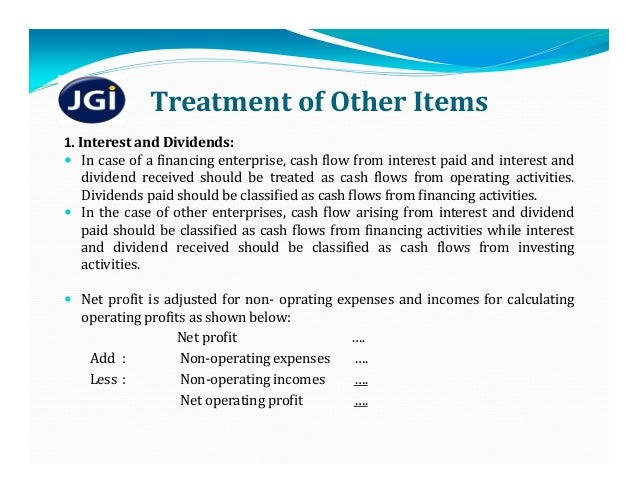
Treatment	of	Other	Items
1. Interest and Dividends:
 In case of a financing enterprise, cash flow from interest paid and interest and
dividend received should be treated as cash flows from operating activities.
Dividends paid should be classified as cash flows from financing activities.
 In the case of other enterprises, cash flow arising from interest and dividend
paid should be classified as cash flows from financing activities while interest
and dividend received should be classified as cash flows from investing
activities.
 Net profit is adjusted for non‐ oprating expenses and incomes for calculating
operating profits as shown below:
Net	profit ….
Add : Non‐operating	expenses ….
Less : Non‐operating	incomes ….
Net	operating	profit ….
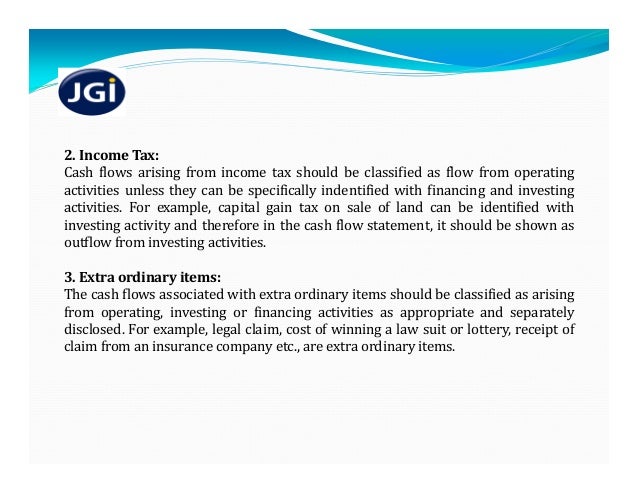
2. Income Tax:
Cash flows arising from income tax should be classified as flow from operating
activities unless they can be specifically indentified with financing and investing
activities. For example, capital gain tax on sale of land can be identified with
investing activity and therefore in the cash flow statement, it should be shown as
outflow from investing activities.
3. Extra ordinary items:
The cash flows associated with extra ordinary items should be classified as arising
from operating, investing or financing activities as appropriate and separately
disclosed. For example, legal claim, cost of winning a law suit or lottery, receipt of
claim from an insurance company etc., are extra ordinary items.
Non‐Cash	Transactions
 Many investing and financing activities do not have a direct impact on current
cash flows although they do affect the capital and asset structure of an
enterprise.
 Examples of non‐cash transactions are:
 The acquisition of assets by assuming directly related activities;
 The acquisition of an enterprise by means of issue of shares; and
 The conversion of debt to equity
 Investing and financing transactions that do not require the use of cash or cash
equivalents should be excluded from a cash flow statement. Such transactions
should be disclosed elsewhere in the financial statements in way that provides
all the relevant information about these investing and financing activities.
Thank	you

VI-Sem-Management-Accounting-Cash-flow.pdf

  • 1.
  • 2.
    Introduction & Meaning of Cash flow statement Cash flow statement helps the Management to understand the past behavior of the cash cycle, and to control the uses of cash in future.  Cash flow statement is a statement which describes the inflows (sources) and outflows (uses) of cash and cash equivalents in an enterprise during a specified period of time.  According to AS‐3 (revised), an enterprise should prepare a cash flow Statement and should present it for each period for which financial statements are prepared.  Some of the terminologies used in Cash flow statement  Cash comprises cash on hand and demand deposits with banks.  Cash equivalents are short term, highly liquid investments that are readily convertible into known amounts of cash.  Cash flows are inflows and outflows of cash and cash equivalents.
  • 3.
    Classification of Cash Flows  Cash Flowsfrom Operating Activities: Operating activities are the principal revenue‐producing activities of the enterprise.  Cash Flows from Investing Activities: Investing activities are the acquisition and disposal of long‐term assets and other investments not included in cash equivalents.  Cash Flows from Financing Activities: Financing activities are activities that result in changes in the size and composition of the owners’ capital and borrowings of the enterprise.
  • 4.
    Uses and Significance of Cash Flow Statement  Cash flowstatement is useful in the evaluation of cash position of a firm.  A projected cash flow statement can be prepared in order to know the future cash position of a concern so as to enable a firm to plan and co‐ordinate its financial operations properly.  It better explains the causes for poor cash position in spite of substantial profits in a firm.  Cash flow analysis is more useful and appropriate than funds flow analysis for short‐term financial analysis  Cash flow statement provides information of all activities classified under operating, investing and financing activities.  Cash flow statement helps in planning the repayment of loans, replacement of fixed assets and other similar long‐term planning of cash.
  • 5.
    Limitations of Cash Statement  As cashflow statement is based on cash basis of accounting, it ignores the basic accounting concept of accrual basis.  Some people feel that as working capital is a wider concept of funds, a funds flow statement provides a more complete picture than cash flow statement.  Cash flow statement is not suitable for judging the profitability of a firm as non‐ cash charges are ignored while calculating cash flows from operating activities.
  • 6.
    Treatment of Other Items 1. Interest andDividends:  In case of a financing enterprise, cash flow from interest paid and interest and dividend received should be treated as cash flows from operating activities. Dividends paid should be classified as cash flows from financing activities.  In the case of other enterprises, cash flow arising from interest and dividend paid should be classified as cash flows from financing activities while interest and dividend received should be classified as cash flows from investing activities.  Net profit is adjusted for non‐ oprating expenses and incomes for calculating operating profits as shown below: Net profit …. Add : Non‐operating expenses …. Less : Non‐operating incomes …. Net operating profit ….
  • 7.
    2. Income Tax: Cashflows arising from income tax should be classified as flow from operating activities unless they can be specifically indentified with financing and investing activities. For example, capital gain tax on sale of land can be identified with investing activity and therefore in the cash flow statement, it should be shown as outflow from investing activities. 3. Extra ordinary items: The cash flows associated with extra ordinary items should be classified as arising from operating, investing or financing activities as appropriate and separately disclosed. For example, legal claim, cost of winning a law suit or lottery, receipt of claim from an insurance company etc., are extra ordinary items.
  • 8.
    Non‐Cash Transactions  Many investingand financing activities do not have a direct impact on current cash flows although they do affect the capital and asset structure of an enterprise.  Examples of non‐cash transactions are:  The acquisition of assets by assuming directly related activities;  The acquisition of an enterprise by means of issue of shares; and  The conversion of debt to equity  Investing and financing transactions that do not require the use of cash or cash equivalents should be excluded from a cash flow statement. Such transactions should be disclosed elsewhere in the financial statements in way that provides all the relevant information about these investing and financing activities.
  • 9.