CASE STUDY OF DIGITAL
CAMERA
HARDWARE AND SOFWARE
ARCHITECTURE
1. Specifications
CCD Array
Camera records the pictures using a chargecoupled
devices (CCD) array.
The array consisting of large number of horizontal
rows and vertical columns of CCD cells for the picture
In each row of cells, a number of CCD cell
unexposed to the picture but used for off-set
corrections in the each-row output from the
picture cells.
Camera Picture resolution
2592 Ă— 1944 pixels, there are 2592 Ă— 1944 = 5038848
set of cells.
Each set of pixel has three cells, for the red, green
and blue components in a pixel.
Each cell gets exposed to a picture when shutter of
camera opens on a user command.
Controllers, LCD display, Switches and
buttons
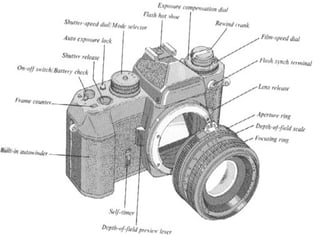
A set of controllers to control shutter, flash, auto─
focus and eye-ball image control.
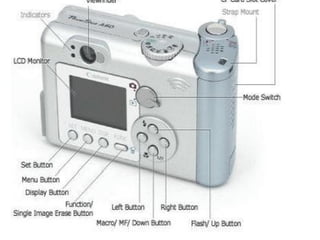
LCD display for graphics and GUI Switches and
buttons for inputs at camera.
User gives commands for switching on the camera,
flash, shutter, adjust brightness, contrast, color, save
and transfer.
When a button for opening the shutter is pressed, a
flash lamp glows and a self-timer circuit switches off
the lamp automatically
Memory stick Micro (M2) size
15Ă—12.5Ă—1.2 mm, flash memory of 2 GB
and 160 Mbps data transfer rate
Purpose
Digital recording and display of pictures Processing
to get the pictures of required brightness, contrast
and color.
Permanent saving of picture in file in a standard
format at a flash-memory stick or card
Transfer files to a computer and printer through a
USB port
Inputs
Intensity and color values for each picture
horizontal and vertical rows and columns
of pixels in a picture frame.
Intensity and color values for unexposed
(dark) area in each horizontal rows and
columns of pixels.
User control inputs
Outputs
Encoded file for a picture
Permanent store of the picture at a file on
flash memory stick
Screen display of picture from the file
after decoding
File output to an interfaced computer
and printer.
Functions of the system
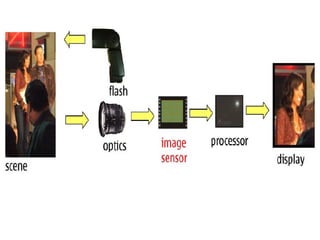
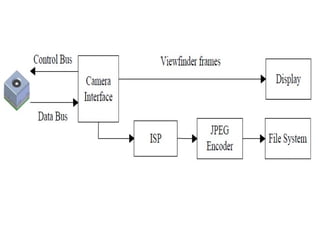
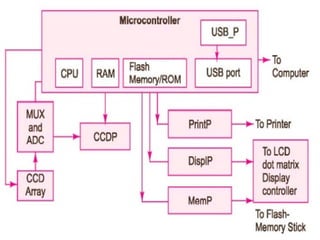
A color LCD dot matrix displays the picture
before shooting enables manual─
adjustment of view of the picture.
For shooting a shutter button pressed a─
charge-coupled device (CCD) array placed
at the focus generates a byte stream in
output after operations by ADC on analog
output of each CCD cell.
A file creates after encoding (compression) and pixel
co-processing.
The byte stream is preprocessed and then encoded in
a standard format using a CODEC
The encoded picture file saved for permanent record.
A memory stick saves the file.
The file is used for display of recorded picture using a
display processor and can be copied or transferred to
a memory stick and to computer or printer connected
through USB port
The LCD displays picture file after it is
decoded (decompressed) using the
CODEC. Text such as picture-title,
shooting date and time and serial
number are also displayed.
USB port is used for transferring and
storing pictures on a computer.
Alternatively, Bluetooth or IR port can
be used for interfacing the computer
Design metrics
1. Power Dissipation: Battery operation.
Battery recharging after 400 pictures (assumed)
2. Resolution: High-resolution pictures with options
2592 Ă— 1944 pixels = 5038848 pixels,
2592 Ă— 1728 = 3.2 M,
2048 Ă— 1536 = 3 M and
1280 x 960 = 1M.
3. Performance: Shooting a 4M pixels
still picture in 0.5 s. 25 pictures per m
3. Process Deadlines: Exposing camera process
maximum 0.1 s. Flash synchronous with shutter
opening and closing. Picture display latency
maximum 0.5 s.
4. User Interfaces: Graphic at LCD or touch screen
display on LCD and commands by camera user
through fingers on touch screen and switches and
buttons
5. Engineering Cost: US$ 50000 (assumed)
6. Manufacturing Cost: US$ 50
Camera tasks
Camera tasks are modeled by four
class diagrams are divided
•Picture_FileCreation,
•Picture_FileDisplay,
•Picture_FileTransfer and
•Controller_tasks
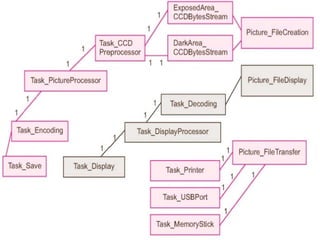
Class Diagrams for file creation, display
and transfer
• Digital camera file creation, display
• and transferring to printer, memory
• stick and USB port can be modeled by
• the class diagrams of abstract class
• Picture_FileCreation,
• Picture_FileDisplay, and
• Picture_FileTransfer
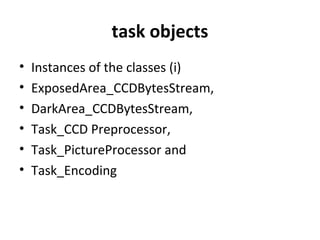
task objects
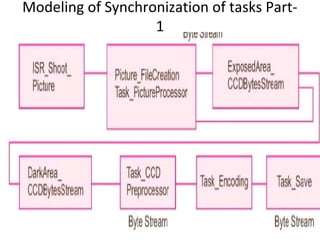
• Instances of the classes (i)
• ExposedArea_CCDBytesStream,
• DarkArea_CCDBytesStream,
• Task_CCD Preprocessor,
• Task_PictureProcessor and
• Task_Encoding
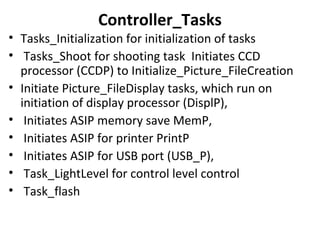
Controller_Tasks
• Tasks_Initialization for initialization of tasks
• Tasks_Shoot for shooting task Initiates CCD
processor (CCDP) to Initialize_Picture_FileCreation
• Initiate Picture_FileDisplay tasks, which run on
initiation of display processor (DisplP),
• Initiates ASIP memory save MemP,
• Initiates ASIP for printer PrintP
• Initiates ASIP for USB port (USB_P),
• Task_LightLevel for control level control
• Task_flash
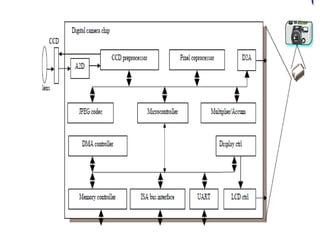
Hardware architecture
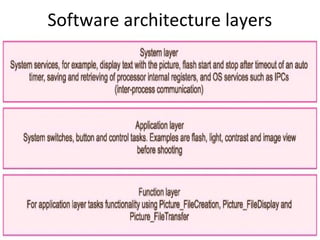
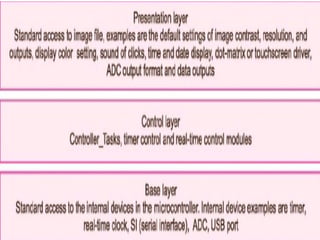
Software architecture layers
Modeling of Synchronization of tasks Part-
1
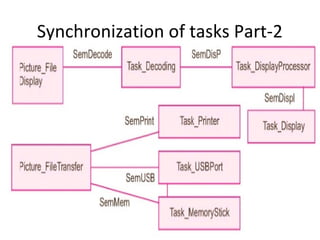
Synchronization of tasks Part-2

Case study of digital camera

  • 1.
    CASE STUDY OFDIGITAL CAMERA HARDWARE AND SOFWARE ARCHITECTURE 1. Specifications
  • 2.
    CCD Array Camera recordsthe pictures using a chargecoupled devices (CCD) array. The array consisting of large number of horizontal rows and vertical columns of CCD cells for the picture In each row of cells, a number of CCD cell unexposed to the picture but used for off-set corrections in the each-row output from the picture cells.
  • 8.
    Camera Picture resolution 2592Ă— 1944 pixels, there are 2592 Ă— 1944 = 5038848 set of cells. Each set of pixel has three cells, for the red, green and blue components in a pixel. Each cell gets exposed to a picture when shutter of camera opens on a user command.
  • 9.
    Controllers, LCD display,Switches and buttons A set of controllers to control shutter, flash, auto─ focus and eye-ball image control. LCD display for graphics and GUI Switches and buttons for inputs at camera. User gives commands for switching on the camera, flash, shutter, adjust brightness, contrast, color, save and transfer. When a button for opening the shutter is pressed, a flash lamp glows and a self-timer circuit switches off the lamp automatically
  • 10.
    Memory stick Micro(M2) size 15Ă—12.5Ă—1.2 mm, flash memory of 2 GB and 160 Mbps data transfer rate Purpose Digital recording and display of pictures Processing to get the pictures of required brightness, contrast and color. Permanent saving of picture in file in a standard format at a flash-memory stick or card Transfer files to a computer and printer through a USB port
  • 11.
    Inputs Intensity and colorvalues for each picture horizontal and vertical rows and columns of pixels in a picture frame. Intensity and color values for unexposed (dark) area in each horizontal rows and columns of pixels. User control inputs
  • 12.
    Outputs Encoded file fora picture Permanent store of the picture at a file on flash memory stick Screen display of picture from the file after decoding File output to an interfaced computer and printer.
  • 13.
    Functions of thesystem A color LCD dot matrix displays the picture before shooting enables manual─ adjustment of view of the picture. For shooting a shutter button pressed a─ charge-coupled device (CCD) array placed at the focus generates a byte stream in output after operations by ADC on analog output of each CCD cell.
  • 14.
    A file createsafter encoding (compression) and pixel co-processing. The byte stream is preprocessed and then encoded in a standard format using a CODEC The encoded picture file saved for permanent record. A memory stick saves the file. The file is used for display of recorded picture using a display processor and can be copied or transferred to a memory stick and to computer or printer connected through USB port
  • 15.
    The LCD displayspicture file after it is decoded (decompressed) using the CODEC. Text such as picture-title, shooting date and time and serial number are also displayed. USB port is used for transferring and storing pictures on a computer. Alternatively, Bluetooth or IR port can be used for interfacing the computer
  • 16.
    Design metrics 1. PowerDissipation: Battery operation. Battery recharging after 400 pictures (assumed) 2. Resolution: High-resolution pictures with options 2592 Ă— 1944 pixels = 5038848 pixels, 2592 Ă— 1728 = 3.2 M, 2048 Ă— 1536 = 3 M and 1280 x 960 = 1M. 3. Performance: Shooting a 4M pixels still picture in 0.5 s. 25 pictures per m
  • 17.
    3. Process Deadlines:Exposing camera process maximum 0.1 s. Flash synchronous with shutter opening and closing. Picture display latency maximum 0.5 s. 4. User Interfaces: Graphic at LCD or touch screen display on LCD and commands by camera user through fingers on touch screen and switches and buttons 5. Engineering Cost: US$ 50000 (assumed) 6. Manufacturing Cost: US$ 50
  • 18.
    Camera tasks Camera tasksare modeled by four class diagrams are divided •Picture_FileCreation, •Picture_FileDisplay, •Picture_FileTransfer and •Controller_tasks
  • 19.
    Class Diagrams forfile creation, display and transfer • Digital camera file creation, display • and transferring to printer, memory • stick and USB port can be modeled by • the class diagrams of abstract class • Picture_FileCreation, • Picture_FileDisplay, and • Picture_FileTransfer
  • 21.
    task objects • Instancesof the classes (i) • ExposedArea_CCDBytesStream, • DarkArea_CCDBytesStream, • Task_CCD Preprocessor, • Task_PictureProcessor and • Task_Encoding
  • 22.
    Controller_Tasks • Tasks_Initialization forinitialization of tasks • Tasks_Shoot for shooting task Initiates CCD processor (CCDP) to Initialize_Picture_FileCreation • Initiate Picture_FileDisplay tasks, which run on initiation of display processor (DisplP), • Initiates ASIP memory save MemP, • Initiates ASIP for printer PrintP • Initiates ASIP for USB port (USB_P), • Task_LightLevel for control level control • Task_flash
  • 23.
  • 25.
  • 27.
  • 28.