Computer Architecture
06:- MIPS ISA
Outline - Instruction Sets
• Instruction Set Overview
• MIPS Instruction Set
• Overview 
• Registers and Memory
• MIPS Instructions
MIPS
• MIPS:
Microprocessor without Interlocked Pipeline Stages
• We’ll be working with the MIPS instruction set architecture
• similar to other architectures developed since the 1980's
• Almost 100 million MIPS processors manufactured in 2002
• used by NEC, Nintendo, Cisco, Silicon Graphics, Sony, …
Outline - Instruction Sets
• Instruction Set Overview
• MIPS Instruction Set
• Overview
• Registers and Memory 
• MIPS Instructions
MIPS Registers and Memory
Memory
4GB Max
(Typically 64MB-1GB)
0x00000000
0x00000004
0x00000008
0x0000000C
0x00000010
0x00000014
0x00000018
0x0000001C
0xfffffff4
0xfffffffc
0xfffffffc
PC = 0x0000001C
Registers
32 General Purpose Registers
R0
R1
R2
R30
R31
32 bits
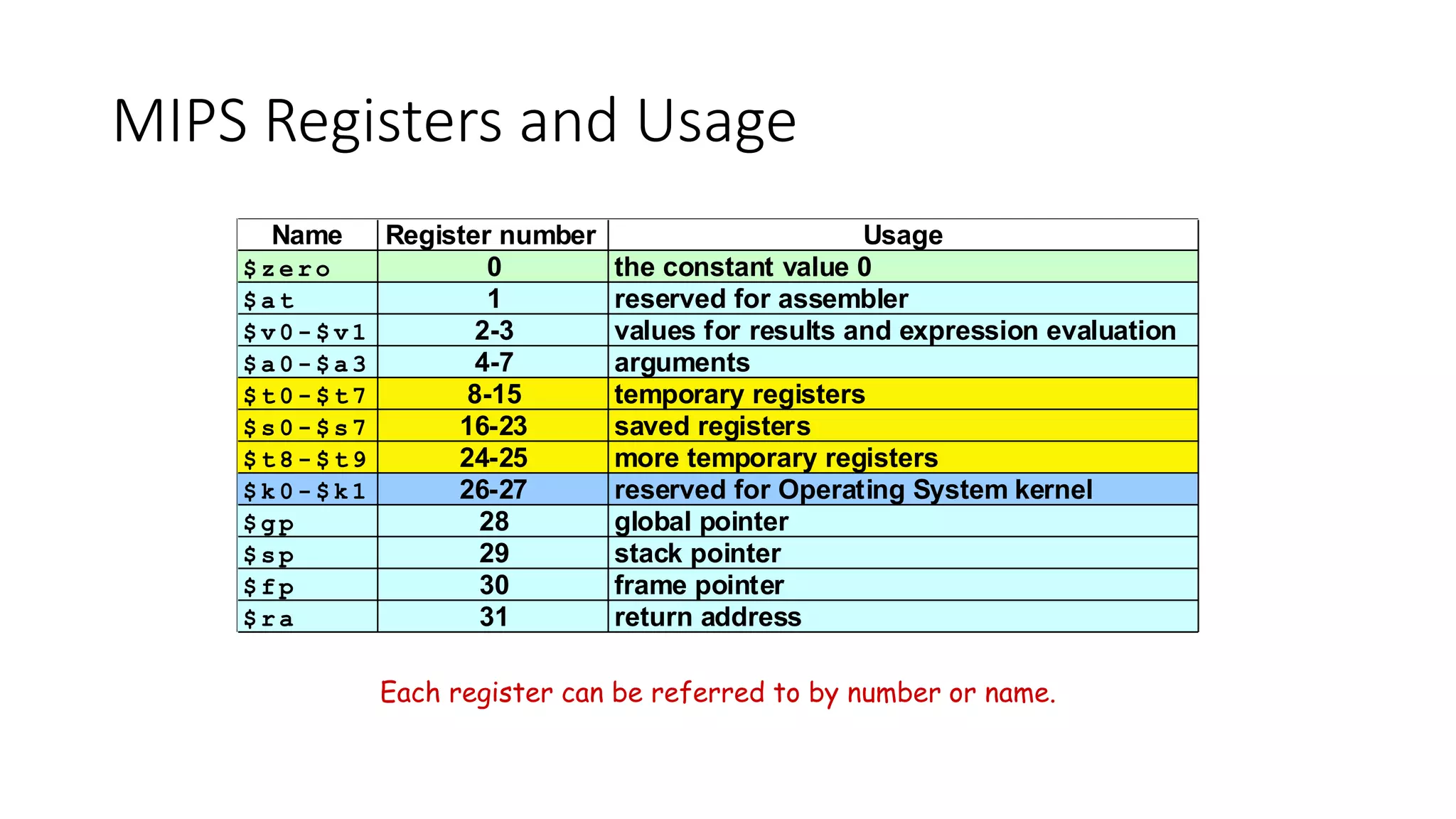
MIPS Registers and Usage
Name Register number Usage
$ z e r o 0 the constant value 0
$ a t 1 reserved for assembler
$ v 0 - $ v 1 2-3 values for results and expression evaluation
$ a 0 - $ a 3 4-7 arguments
$ t 0 - $ t 7 8-15 temporary registers
$ s 0 - $ s 7 16-23 saved registers
$ t 8 - $ t 9 24-25 more temporary registers
$ k 0 - $ k 1 26-27 reserved for Operating System kernel
$ g p 28 global pointer
$ s p 29 stack pointer
$ f p 30 frame pointer
$ r a 31 return address
Each register can be referred to by number or name.
More about MIPS Memory Organization
• Two views of memory:
• 232 bytes with addresses 0, 1, 2, …, 232-1
• 230 4-byte words* with addresses 0, 4, 8, …, 232-4
• Both views use byte addresses
• Word address must be multiple of 4 (aligned)
8 bits
0x00000000
0x00000001
0x00000002
0x00000003
0x00000000
0x00000004
0x00000008
0x0000000C
32 bits
0 1 2 3
*Word sizes vary in
other architectures
MIPS Instructions
• All instructions exactly 32 bits wide
• Different formats for different purposes
• Similarities in formats ease implementation
op rs rt offset
6 bits 5 bits 5 bits 16 bits
op rs rt rd functshamt
6 bits 5 bits 5 bits 5 bits 5 bits 6 bits
R-Format
I-Format
op address
6 bits 26 bits
J-Format
31 0
31 0
31 0
MIPS Instruction Types
• Arithmetic & Logical - manipulate data in registers
add $s1, $s2, $s3 $s1 = $s2 + $s3
or $s3, $s4, $s5 $s3 = $s4 OR $s5
• Data Transfer - move register data to/from memory
lw $s1, 100($s2) $s1 = Memory[$s2 + 100]
sw $s1, 100($s2) Memory[$s2 + 100] = $s1
• Branch - alter program flow
beq $s1, $s2, 25 if ($s1==$s1) PC = PC + 4 + 4*25
MIPS Arithmetic & Logical Instructions
• Instruction usage (assembly)
add dest, src1, src2 dest=src1 + src2
sub dest, src1, src2 dest=src1 - src2
and dest, src1, src2 dest=src1 AND src2
• Instruction characteristics
• Always 3 operands: destination + 2 sources
• Operand order is fixed
• Operands are always general purpose registers
• Design Principles:
• Design Principle 1: Simplicity favors regularity
• Design Principle 2: Smaller is faster
Arithmetic & Logical Instructions - Binary
Representation
• Used for arithmetic, logical, shift instructions
• op: Basic operation of the instruction (opcode)
• rs: first register source operand
• rt: second register source operand
• rd: register destination operand
• shamt: shift amount (more about this later)
• funct: function - specific type of operation
• Also called “R-Format” or “R-Type” Instructions
op rs rt rd functshamt
6 bits 5 bits 5 bits 5 bits 5 bits 6 bits
031
op rs rt rd functshamt
6 bits 5 bits 5 bits 5 bits 5 bits 6 bits
Decimal
Binary
Arithmetic & Logical Instructions -
Binary Representation Example
• Machine language for
add $8, $17, $18
• See reference card for op, funct values
000000
0
10001
17
10010
18
01000
8
00000
0
100000
32
031
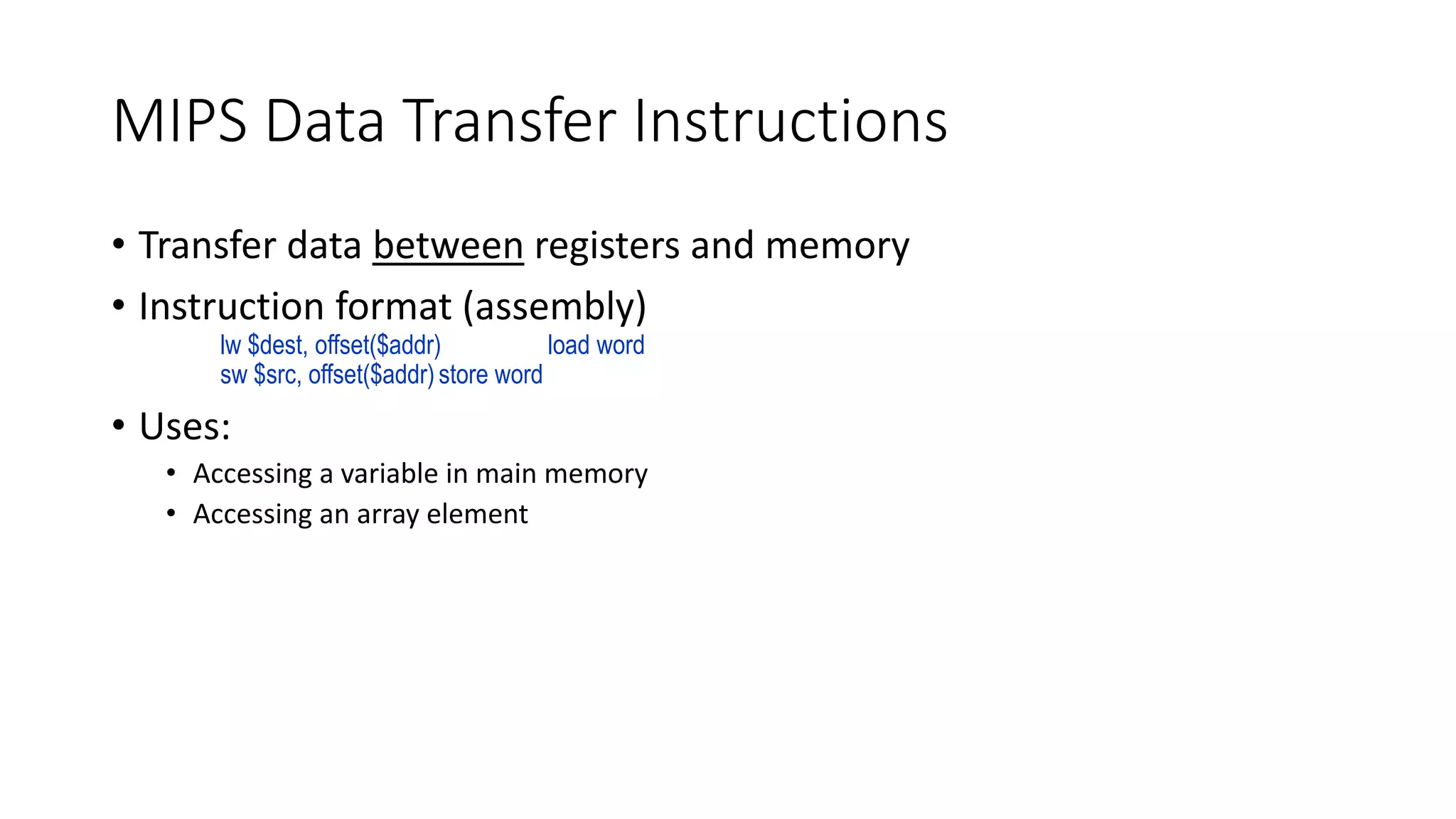
MIPS Data Transfer Instructions
• Transfer data between registers and memory
• Instruction format (assembly)
lw $dest, offset($addr) load word
sw $src, offset($addr)store word
• Uses:
• Accessing a variable in main memory
• Accessing an array element
Example - Loading a Simple Variable
lw R5,8(R2) Memory
0x00
Variable Z = 692310
Variable X
Variable Y
0x04
0x08
0x0c
0x10
0x14
0x18
0x1c
8
+
Registers
R0=0 (constant)
R1
R2=0x10
R30
R31
R3
R4
R5R5
R2=0x10
R5 = 629310
Variable Z = 692310
Data Transfer Example - Array Variable
Registers
R0=0 (constant)
R1
R2=0x08
R30
R31
R3
R4
R5=105
C Program: int a[5];
a[3] = z;
Assembly: sw $5,12($2)
12=0xc
+
Memory
0x00
a[0]
a[4]
a[2]
a[1]
a[3]
0x04
0x08
0x0c
0x10
0x14
0x18
0x1c
Base Address
R5=105
R2=0x08
a[3]=105
scaled offset
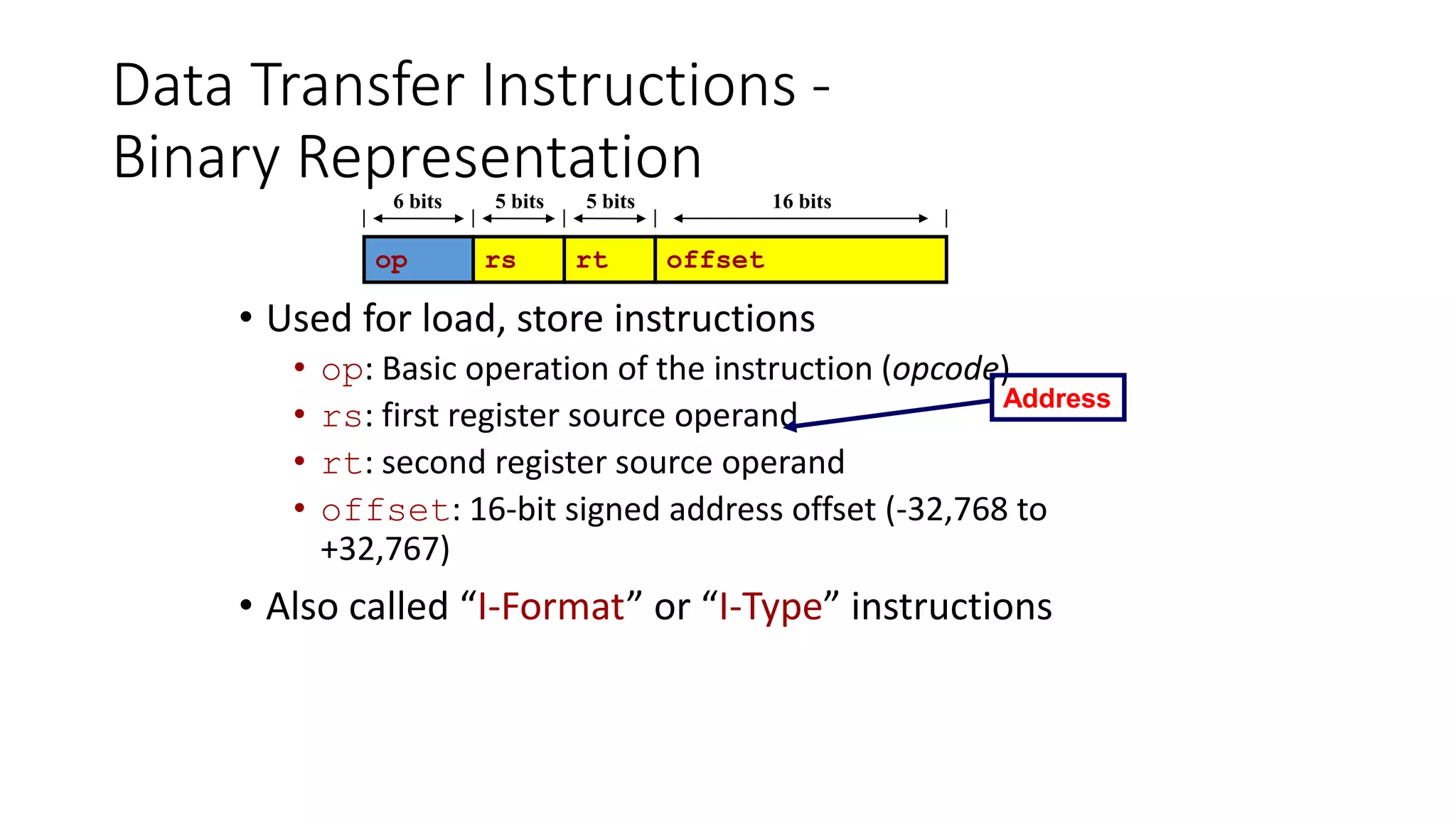
Data Transfer Instructions -
Binary Representation
• Used for load, store instructions
• op: Basic operation of the instruction (opcode)
• rs: first register source operand
• rt: second register source operand
• offset: 16-bit signed address offset (-32,768 to
+32,767)
• Also called “I-Format” or “I-Type” instructions
op rs rt offset
6 bits 5 bits 5 bits 16 bits
Address
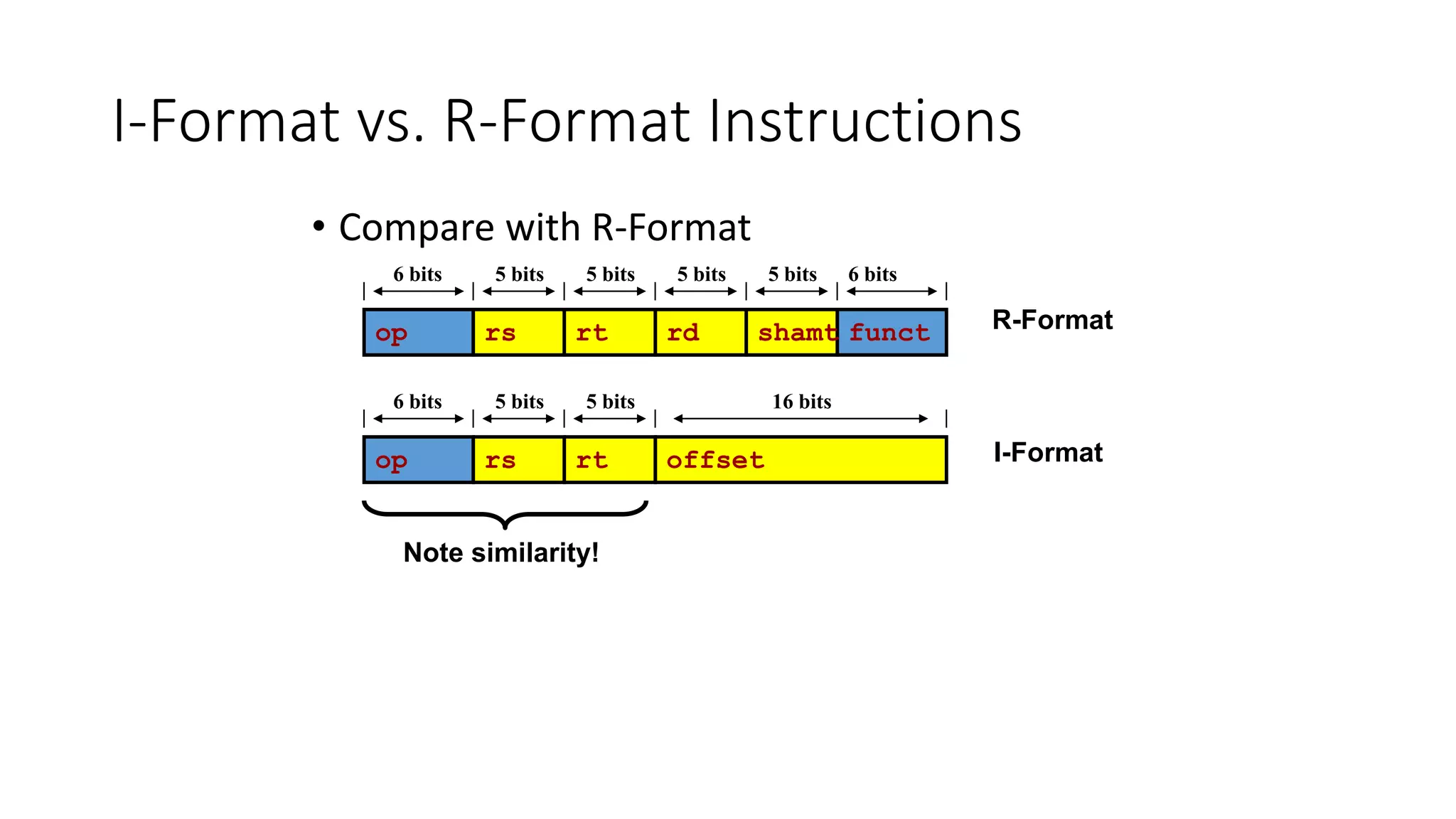
I-Format vs. R-Format Instructions
• Compare with R-Format
offset
6 bits 5 bits 5 bits 16 bits
I-Formatop rs rt
rd functshamt
6 bits 5 bits 5 bits 5 bits 5 bits 6 bits
R-Formatop rs rt
Note similarity!
I-Format Example
• Machine language for
lw $9, 1200($8) == lw $t1, 1200($t0)
op rs rt offset
6 bits 5 bits 5 bits 16 bits
Binary
Decimal35 8 9 1200
100011 01000 01001 0000010010110000
031
Binary Representation - Jump
• Jump Instruction uses J-Format (op=2)
• What happens during execution?
PC = PC[31:28] : (IR[25:0] << 2)
op address
6 bits 26 bits
Conversion to
word offset
Concatenate
upper 4 bits
of PC to form
complete
32-bit address
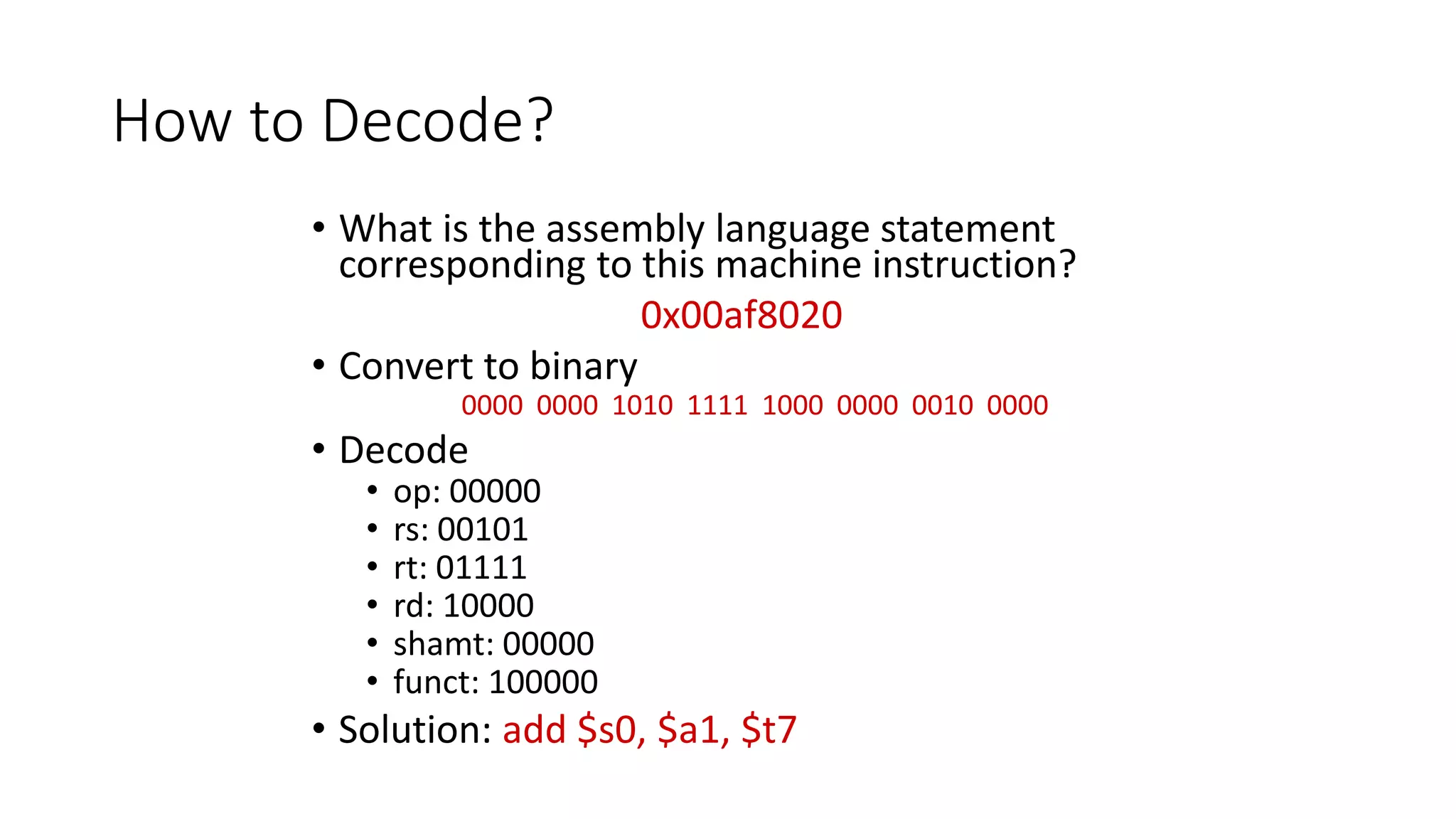
How to Decode?
• What is the assembly language statement
corresponding to this machine instruction?
0x00af8020
• Convert to binary
0000 0000 1010 1111 1000 0000 0010 0000
• Decode
• op: 00000
• rs: 00101
• rt: 01111
• rd: 10000
• shamt: 00000
• funct: 100000
• Solution: add $s0, $a1, $t7
Summary - MIPS Instruction Set
• simple instructions all 32 bits wide
• very structured, no unnecessary baggage
• only three instruction formats
op rs rt offset
6 bits 5 bits 5 bits 16 bits
op rs rt rd functshamt
6 bits 5 bits 5 bits 5 bits 5 bits 6 bits
R-Format
I-Format
op address
6 bits 26 bits
J-Format
Coming up Next
MIPS Assembly Language.
C u ……. Take Care,,,

06 mips-isa

  • 1.
  • 2.
    Outline - InstructionSets • Instruction Set Overview • MIPS Instruction Set • Overview • Registers and Memory • MIPS Instructions
  • 3.
    MIPS • MIPS: Microprocessor withoutInterlocked Pipeline Stages • We’ll be working with the MIPS instruction set architecture • similar to other architectures developed since the 1980's • Almost 100 million MIPS processors manufactured in 2002 • used by NEC, Nintendo, Cisco, Silicon Graphics, Sony, …
  • 4.
    Outline - InstructionSets • Instruction Set Overview • MIPS Instruction Set • Overview • Registers and Memory • MIPS Instructions
  • 5.
    MIPS Registers andMemory Memory 4GB Max (Typically 64MB-1GB) 0x00000000 0x00000004 0x00000008 0x0000000C 0x00000010 0x00000014 0x00000018 0x0000001C 0xfffffff4 0xfffffffc 0xfffffffc PC = 0x0000001C Registers 32 General Purpose Registers R0 R1 R2 R30 R31 32 bits
  • 6.
    MIPS Registers andUsage Name Register number Usage $ z e r o 0 the constant value 0 $ a t 1 reserved for assembler $ v 0 - $ v 1 2-3 values for results and expression evaluation $ a 0 - $ a 3 4-7 arguments $ t 0 - $ t 7 8-15 temporary registers $ s 0 - $ s 7 16-23 saved registers $ t 8 - $ t 9 24-25 more temporary registers $ k 0 - $ k 1 26-27 reserved for Operating System kernel $ g p 28 global pointer $ s p 29 stack pointer $ f p 30 frame pointer $ r a 31 return address Each register can be referred to by number or name.
  • 7.
    More about MIPSMemory Organization • Two views of memory: • 232 bytes with addresses 0, 1, 2, …, 232-1 • 230 4-byte words* with addresses 0, 4, 8, …, 232-4 • Both views use byte addresses • Word address must be multiple of 4 (aligned) 8 bits 0x00000000 0x00000001 0x00000002 0x00000003 0x00000000 0x00000004 0x00000008 0x0000000C 32 bits 0 1 2 3 *Word sizes vary in other architectures
  • 8.
    MIPS Instructions • Allinstructions exactly 32 bits wide • Different formats for different purposes • Similarities in formats ease implementation op rs rt offset 6 bits 5 bits 5 bits 16 bits op rs rt rd functshamt 6 bits 5 bits 5 bits 5 bits 5 bits 6 bits R-Format I-Format op address 6 bits 26 bits J-Format 31 0 31 0 31 0
  • 9.
    MIPS Instruction Types •Arithmetic & Logical - manipulate data in registers add $s1, $s2, $s3 $s1 = $s2 + $s3 or $s3, $s4, $s5 $s3 = $s4 OR $s5 • Data Transfer - move register data to/from memory lw $s1, 100($s2) $s1 = Memory[$s2 + 100] sw $s1, 100($s2) Memory[$s2 + 100] = $s1 • Branch - alter program flow beq $s1, $s2, 25 if ($s1==$s1) PC = PC + 4 + 4*25
  • 10.
    MIPS Arithmetic &Logical Instructions • Instruction usage (assembly) add dest, src1, src2 dest=src1 + src2 sub dest, src1, src2 dest=src1 - src2 and dest, src1, src2 dest=src1 AND src2 • Instruction characteristics • Always 3 operands: destination + 2 sources • Operand order is fixed • Operands are always general purpose registers • Design Principles: • Design Principle 1: Simplicity favors regularity • Design Principle 2: Smaller is faster
  • 11.
    Arithmetic & LogicalInstructions - Binary Representation • Used for arithmetic, logical, shift instructions • op: Basic operation of the instruction (opcode) • rs: first register source operand • rt: second register source operand • rd: register destination operand • shamt: shift amount (more about this later) • funct: function - specific type of operation • Also called “R-Format” or “R-Type” Instructions op rs rt rd functshamt 6 bits 5 bits 5 bits 5 bits 5 bits 6 bits 031
  • 12.
    op rs rtrd functshamt 6 bits 5 bits 5 bits 5 bits 5 bits 6 bits Decimal Binary Arithmetic & Logical Instructions - Binary Representation Example • Machine language for add $8, $17, $18 • See reference card for op, funct values 000000 0 10001 17 10010 18 01000 8 00000 0 100000 32 031
  • 13.
    MIPS Data TransferInstructions • Transfer data between registers and memory • Instruction format (assembly) lw $dest, offset($addr) load word sw $src, offset($addr)store word • Uses: • Accessing a variable in main memory • Accessing an array element
  • 14.
    Example - Loadinga Simple Variable lw R5,8(R2) Memory 0x00 Variable Z = 692310 Variable X Variable Y 0x04 0x08 0x0c 0x10 0x14 0x18 0x1c 8 + Registers R0=0 (constant) R1 R2=0x10 R30 R31 R3 R4 R5R5 R2=0x10 R5 = 629310 Variable Z = 692310
  • 15.
    Data Transfer Example- Array Variable Registers R0=0 (constant) R1 R2=0x08 R30 R31 R3 R4 R5=105 C Program: int a[5]; a[3] = z; Assembly: sw $5,12($2) 12=0xc + Memory 0x00 a[0] a[4] a[2] a[1] a[3] 0x04 0x08 0x0c 0x10 0x14 0x18 0x1c Base Address R5=105 R2=0x08 a[3]=105 scaled offset
  • 16.
    Data Transfer Instructions- Binary Representation • Used for load, store instructions • op: Basic operation of the instruction (opcode) • rs: first register source operand • rt: second register source operand • offset: 16-bit signed address offset (-32,768 to +32,767) • Also called “I-Format” or “I-Type” instructions op rs rt offset 6 bits 5 bits 5 bits 16 bits Address
  • 17.
    I-Format vs. R-FormatInstructions • Compare with R-Format offset 6 bits 5 bits 5 bits 16 bits I-Formatop rs rt rd functshamt 6 bits 5 bits 5 bits 5 bits 5 bits 6 bits R-Formatop rs rt Note similarity!
  • 18.
    I-Format Example • Machinelanguage for lw $9, 1200($8) == lw $t1, 1200($t0) op rs rt offset 6 bits 5 bits 5 bits 16 bits Binary Decimal35 8 9 1200 100011 01000 01001 0000010010110000 031
  • 19.
    Binary Representation -Jump • Jump Instruction uses J-Format (op=2) • What happens during execution? PC = PC[31:28] : (IR[25:0] << 2) op address 6 bits 26 bits Conversion to word offset Concatenate upper 4 bits of PC to form complete 32-bit address
  • 20.
    How to Decode? •What is the assembly language statement corresponding to this machine instruction? 0x00af8020 • Convert to binary 0000 0000 1010 1111 1000 0000 0010 0000 • Decode • op: 00000 • rs: 00101 • rt: 01111 • rd: 10000 • shamt: 00000 • funct: 100000 • Solution: add $s0, $a1, $t7
  • 21.
    Summary - MIPSInstruction Set • simple instructions all 32 bits wide • very structured, no unnecessary baggage • only three instruction formats op rs rt offset 6 bits 5 bits 5 bits 16 bits op rs rt rd functshamt 6 bits 5 bits 5 bits 5 bits 5 bits 6 bits R-Format I-Format op address 6 bits 26 bits J-Format
  • 22.
    Coming up Next MIPSAssembly Language. C u ……. Take Care,,,