Topics today:
Chapter 9. CVI Skills
Inventory & Strategies
Worksheet
Presented by
Optom Anis Suzanna Mohamad, Penang Hospital
CVI LEARNING SERIES 3.0
(SESI 2025)
24th June 2025
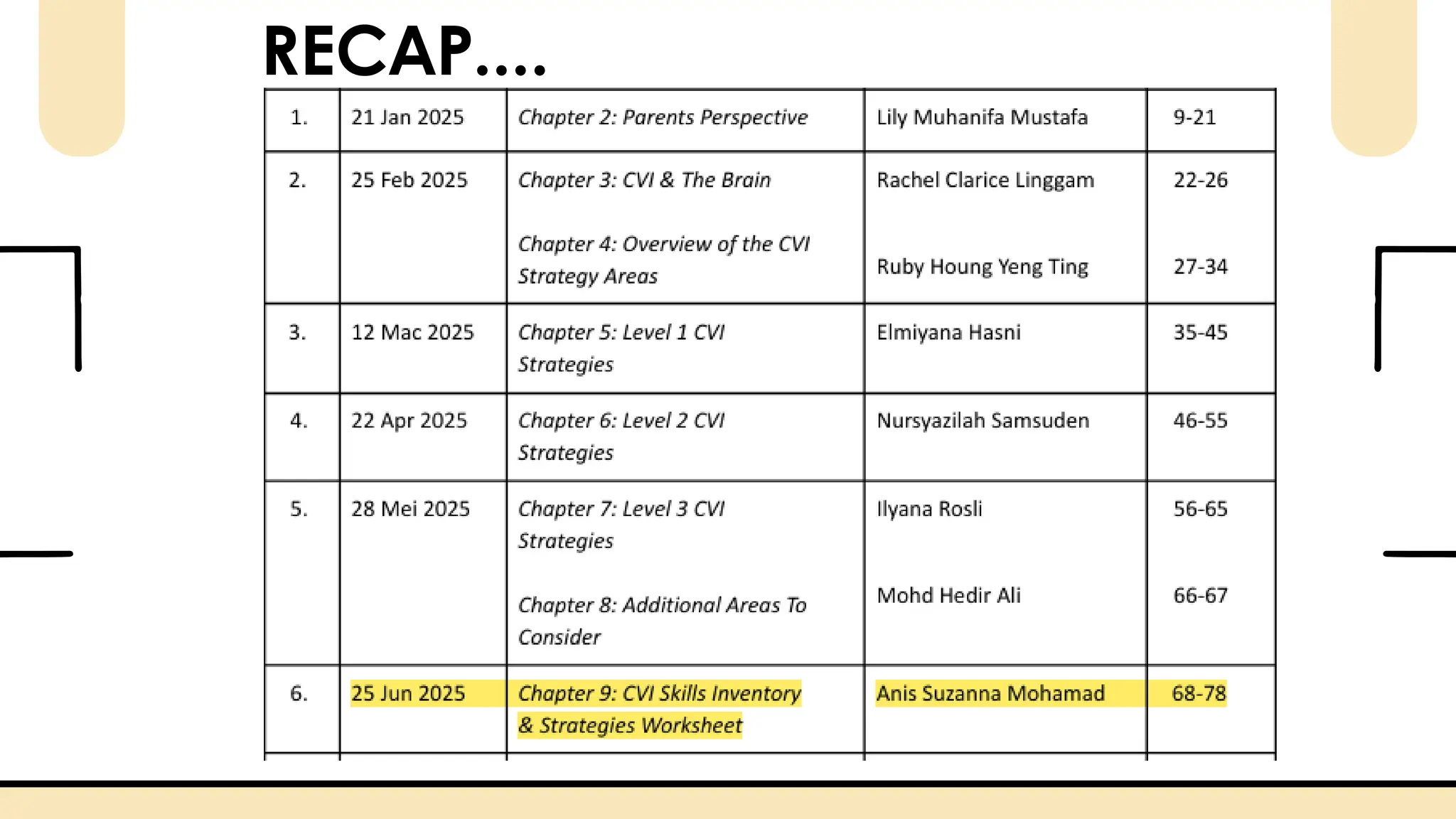
RECAP....
PURPOSE OF THE CVI SKILLS INVENTORY & STRATEGIES
WORKSHEET
•Capture patient’s/student’s
current status across 10 CVI
characteristics
•Plan personalized, evidence-
based strategies
•Inform Individualized
Education Programs (IEPs)
and team collaboration
about the strategies
•Encourage patient/student
with CVI to more consistently
and efficiently use their vision.
TOPIC OUTLINES
1.Background Information
2. Completion of the CVI Skills
Inventory & strategies
Worksheet
BACKGROUND
INFORMATION
Before completing the CVI Skills Inventory &
Strategies Worksheet, patient/student have to
undergo:-
Functional Vision Evaluation (FVE)
Learning Media Assessment (LMA)
FUNCTIONAL VISION EVALUATION (FVE)
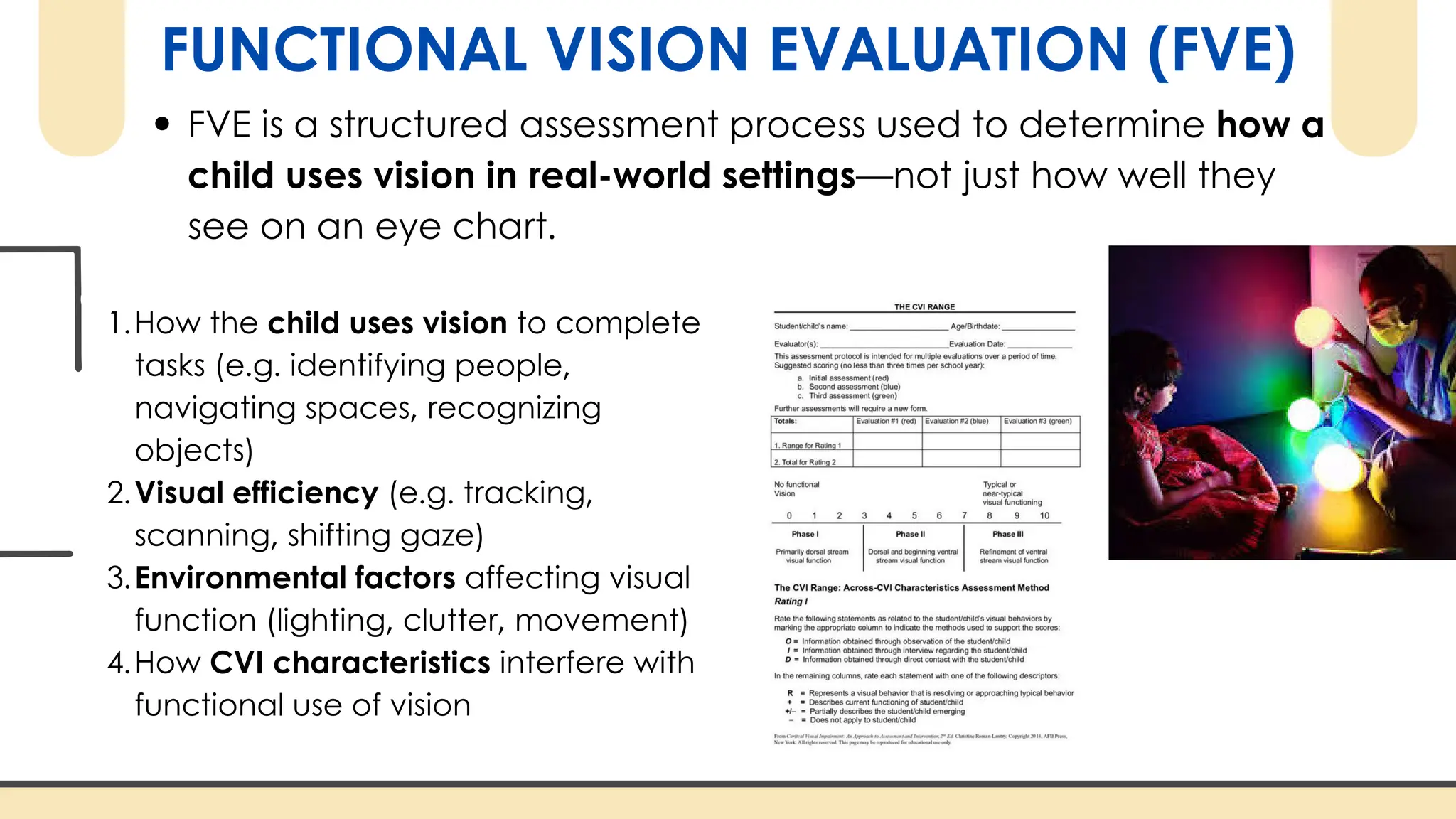
FVE is a structured assessment process used to determine how a
child uses vision in real-world settings—not just how well they
see on an eye chart.
1.How the child uses vision to complete
tasks (e.g. identifying people,
navigating spaces, recognizing
objects)
2.Visual efficiency (e.g. tracking,
scanning, shifting gaze)
3.Environmental factors affecting visual
function (lighting, clutter, movement)
4.How CVI characteristics interfere with
functional use of vision
LEARNING MEDIA ASSESSMENT (LMA)
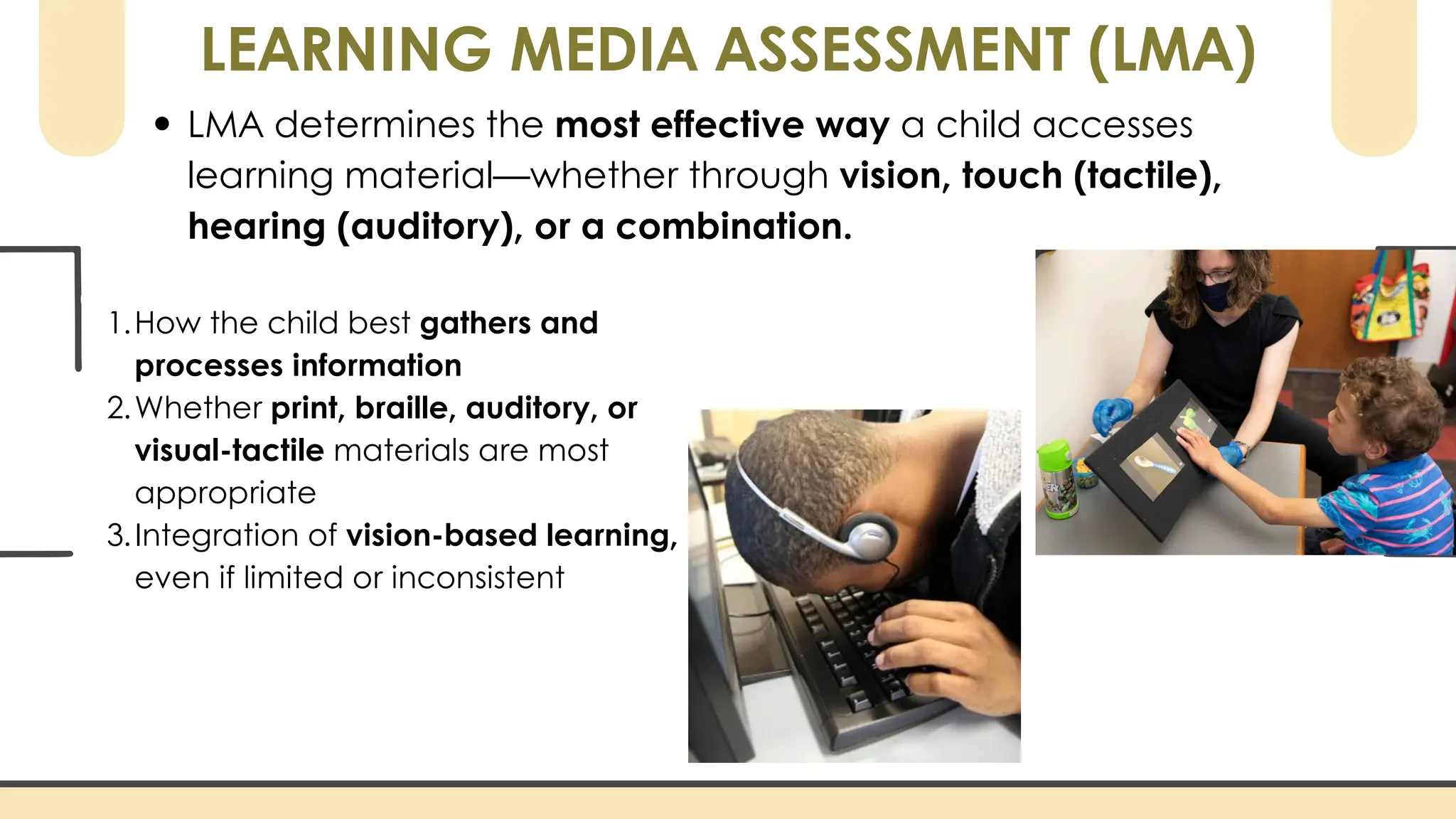
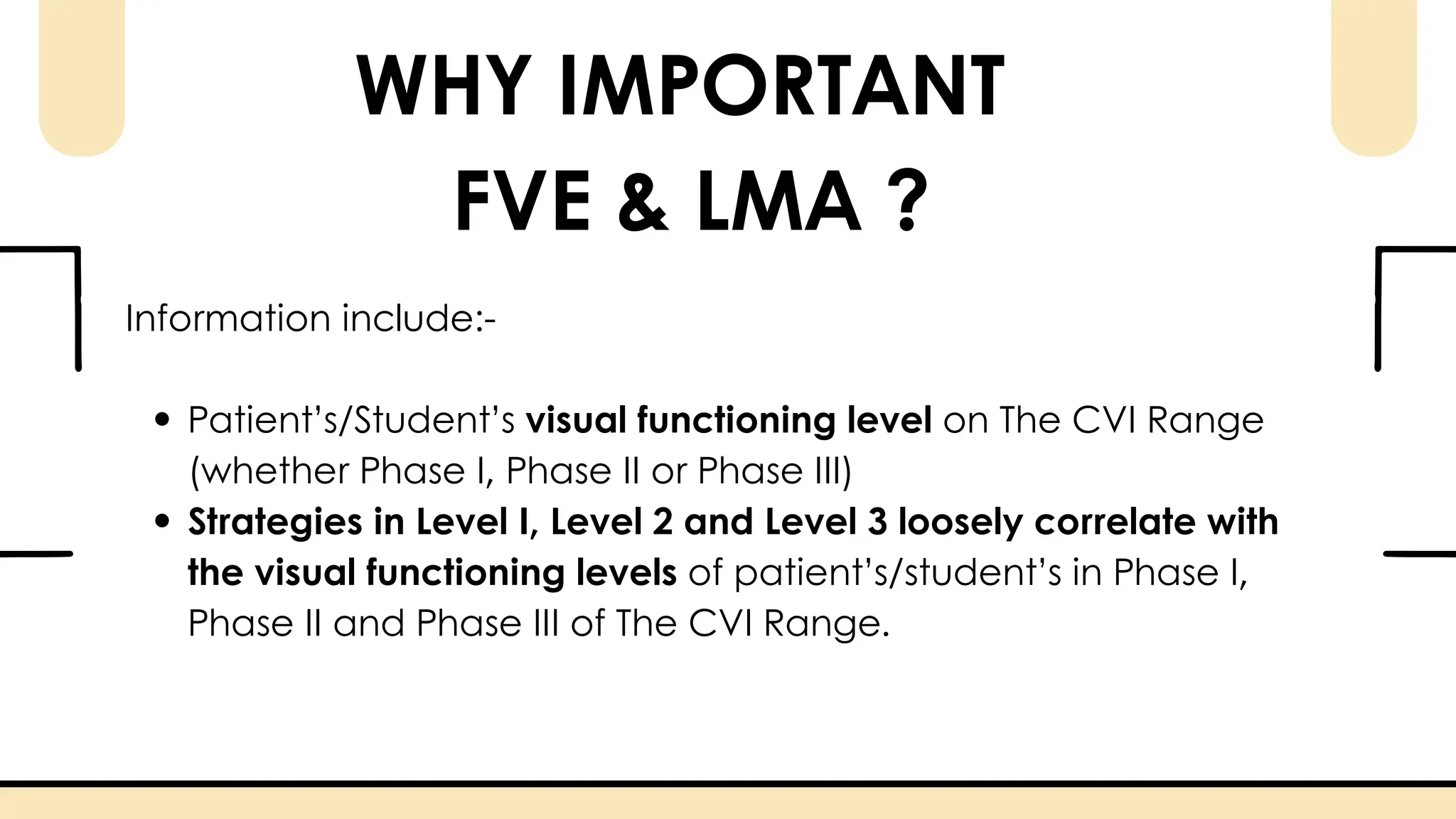
LMA determines the most effective way a child accesses
learning material—whether through vision, touch (tactile),
hearing (auditory), or a combination.
1.How the child best gathers and
processes information
2.Whether print, braille, auditory, or
visual-tactile materials are most
appropriate
3.Integration of vision-based learning,
even if limited or inconsistent
WHY IMPORTANT
FVE & LMA ?
Information include:-
Patient’s/Student’s visual functioning level on The CVI Range
(whether Phase I, Phase II or Phase III)
Strategies in Level I, Level 2 and Level 3 loosely correlate with
the visual functioning levels of patient’s/student’s in Phase I,
Phase II and Phase III of The CVI Range.
BACKGROUND
INFORMATION
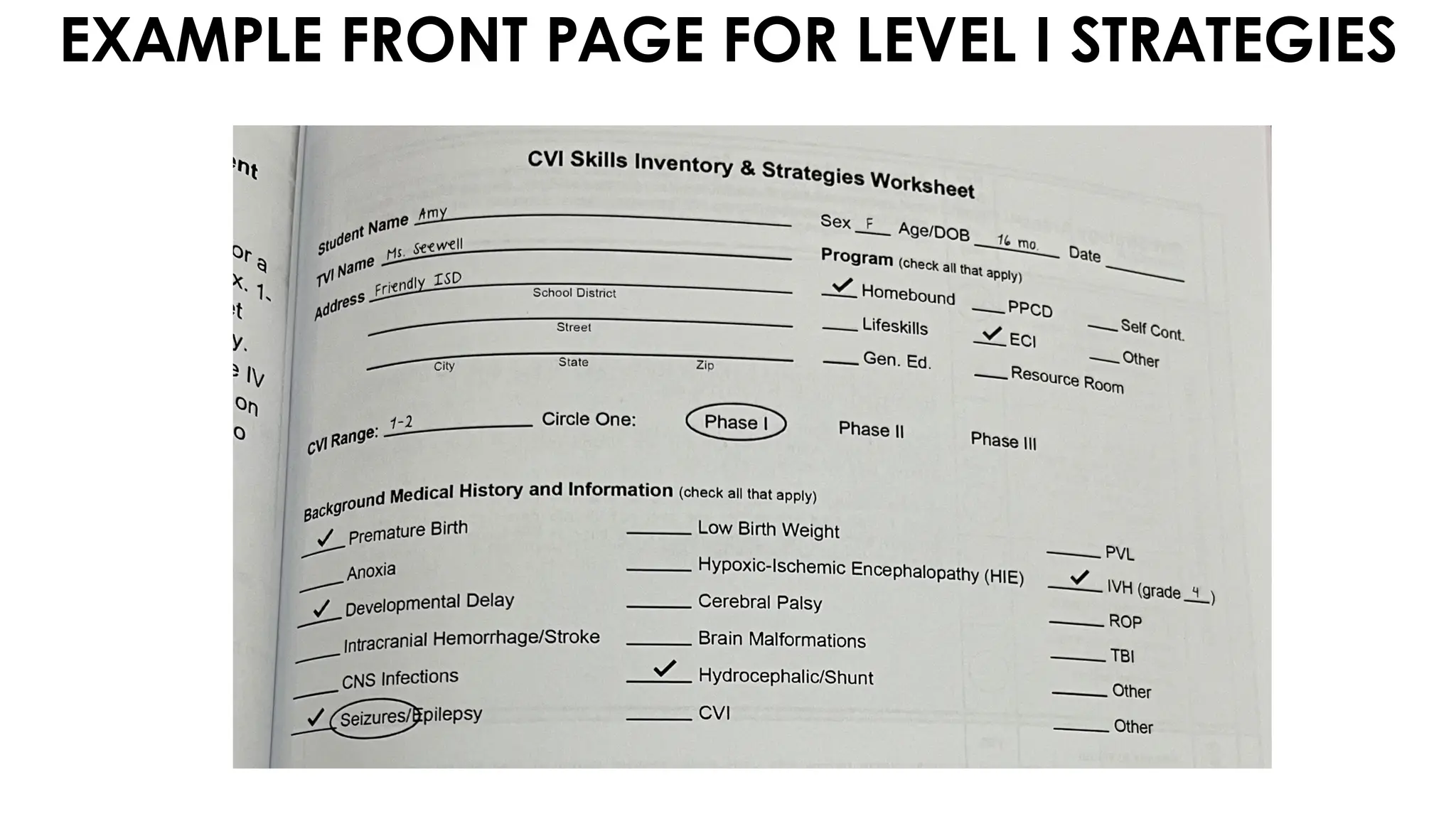
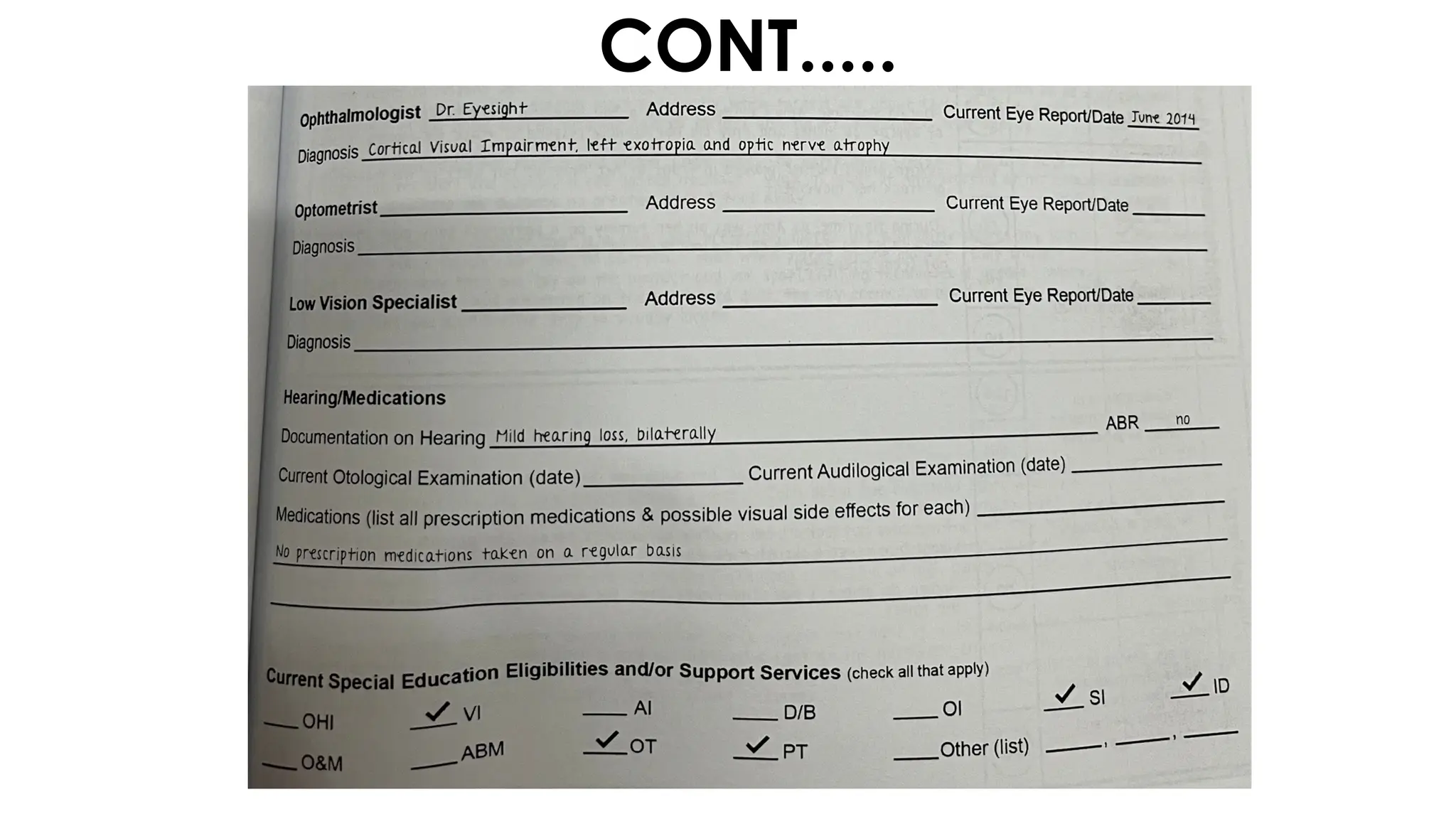
The front page of the CVI Skills Inventory &
Strategies Worksheet should be completed as
thoroughly as possible, especially:-
On medications (any possible side effects of
those medications, any hearing loss??
Seizures/shunt (blinking lights and close
proximity to a tablet are sometimes
contraindicated)
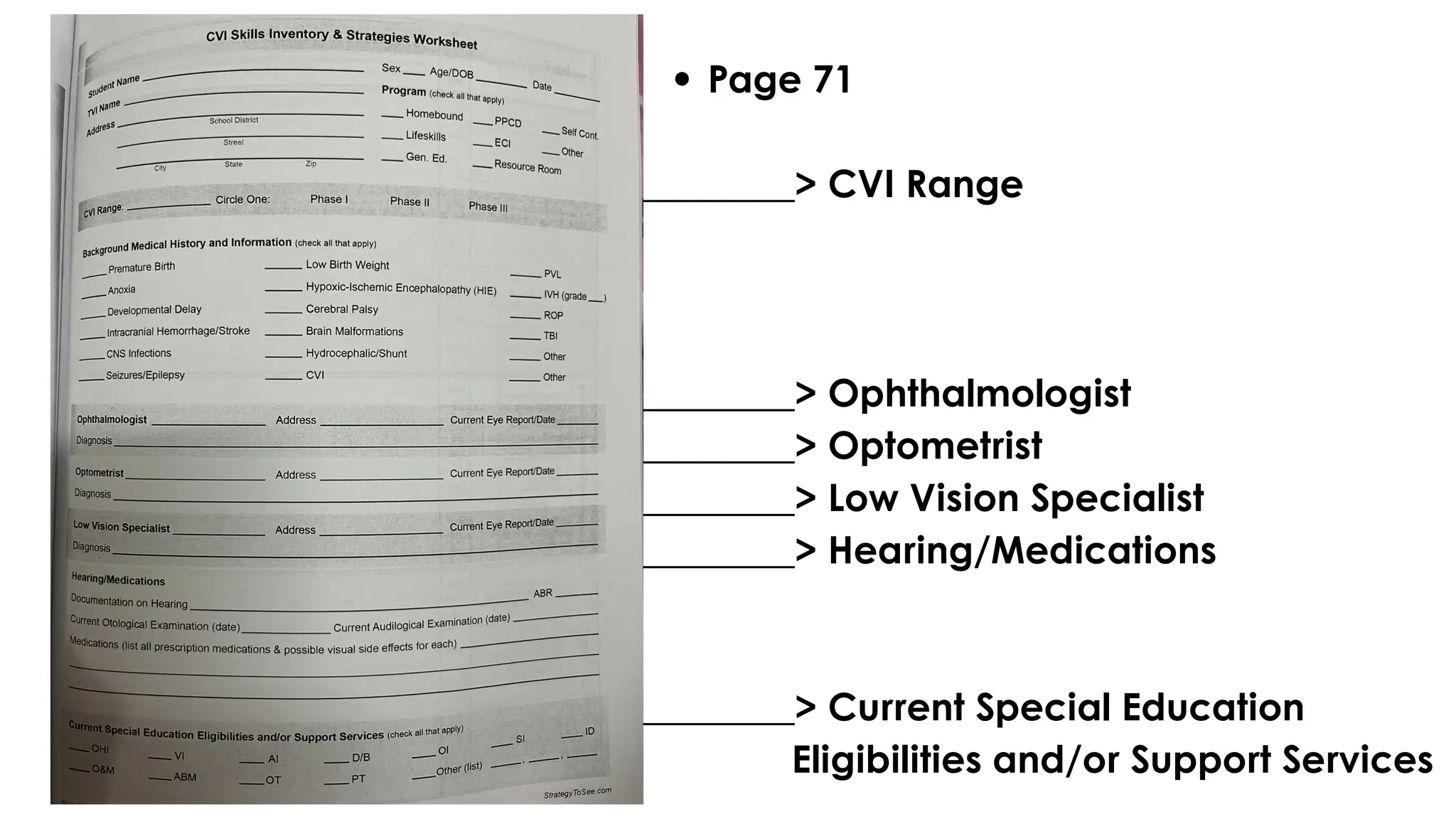
Page 71
________> CVI Range
________> Ophthalmologist
________> Optometrist
________> Low Vision Specialist
________> Hearing/Medications
________> Current Special Education
Eligibilities and/or Support Services
EXAMPLE FRONT PAGE FOR LEVEL I STRATEGIES
CONT.....
COMPLETION OF
THE CVI SKILLS
INVENTORY &
STRATEGIES
WORKSHEET
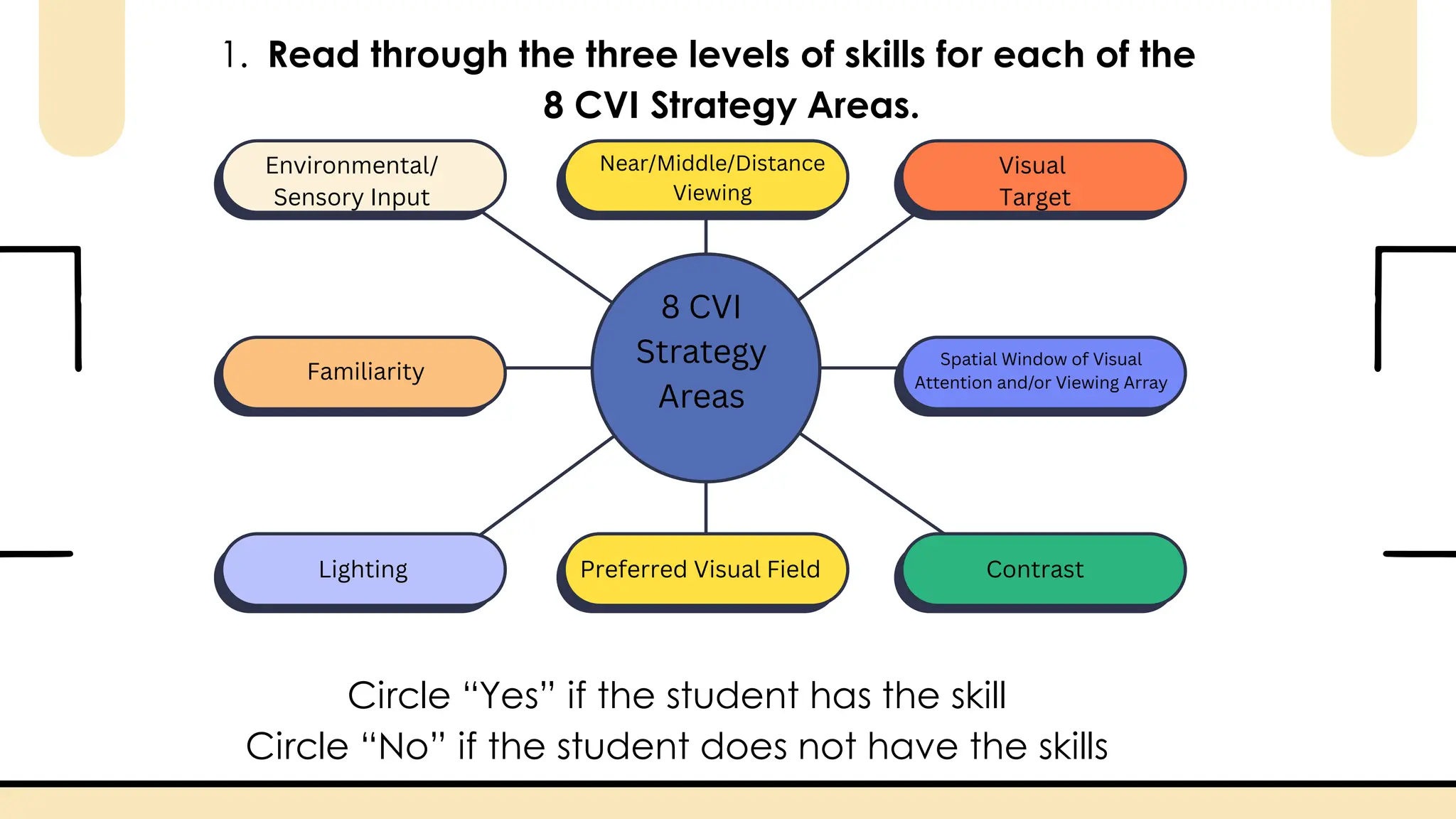
1. Read through the three levels of skills for each of the
8 CVI Strategy Areas.
Environmental/
Sensory Input
Near/Middle/Distance
Viewing
Visual
Target
Spatial Window of Visual
Attention and/or Viewing Array
Contrast
Preferred Visual Field
Lighting
Familiarity
8 CVI
Strategy
Areas
Circle “Yes” if the student has the skill
Circle “No” if the student does not have the skills
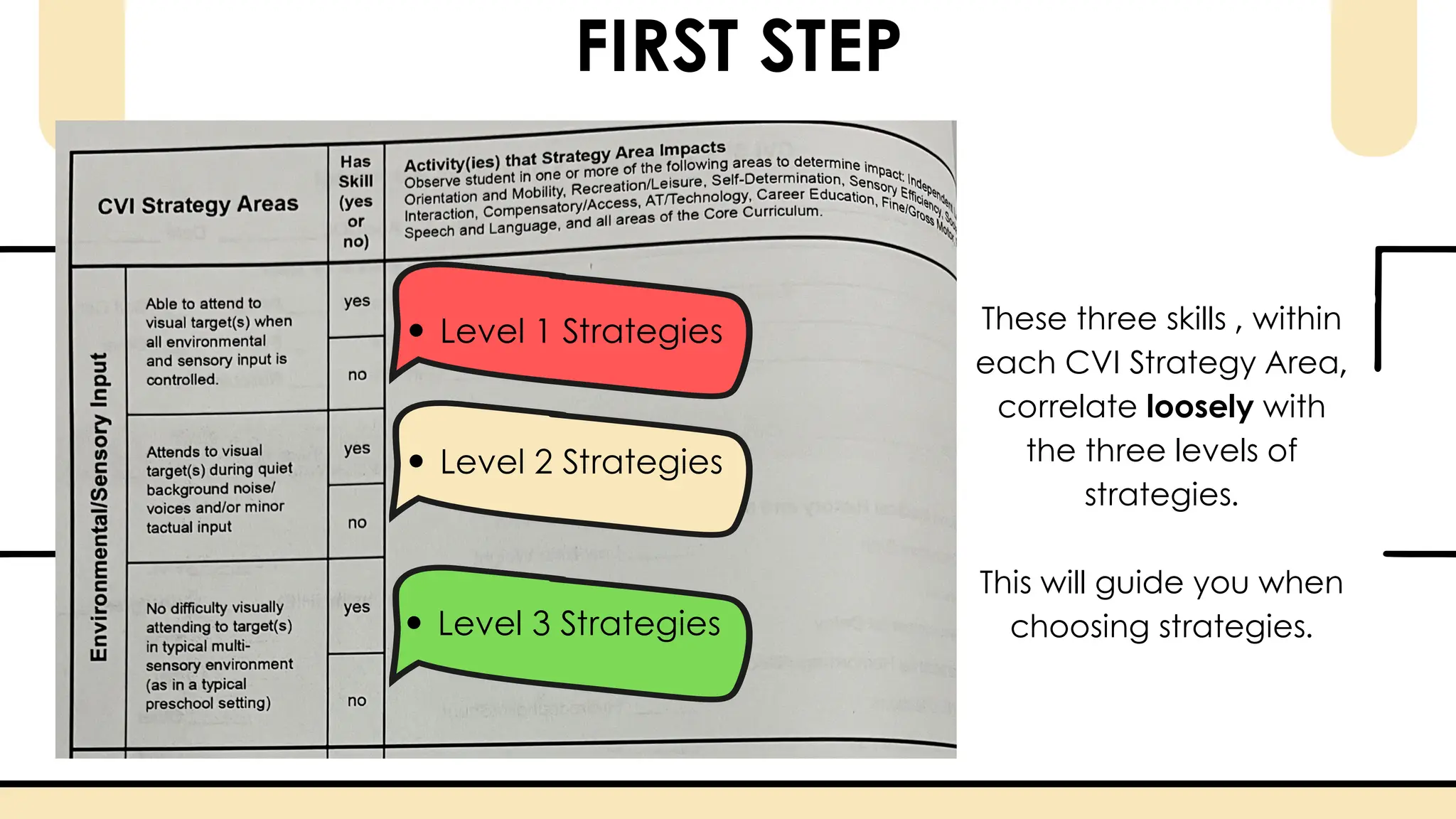
FIRST STEP
Level 2 Strategies
Level 3 Strategies
Level 1 Strategies These three skills , within
each CVI Strategy Area,
correlate loosely with
the three levels of
strategies.
This will guide you when
choosing strategies.
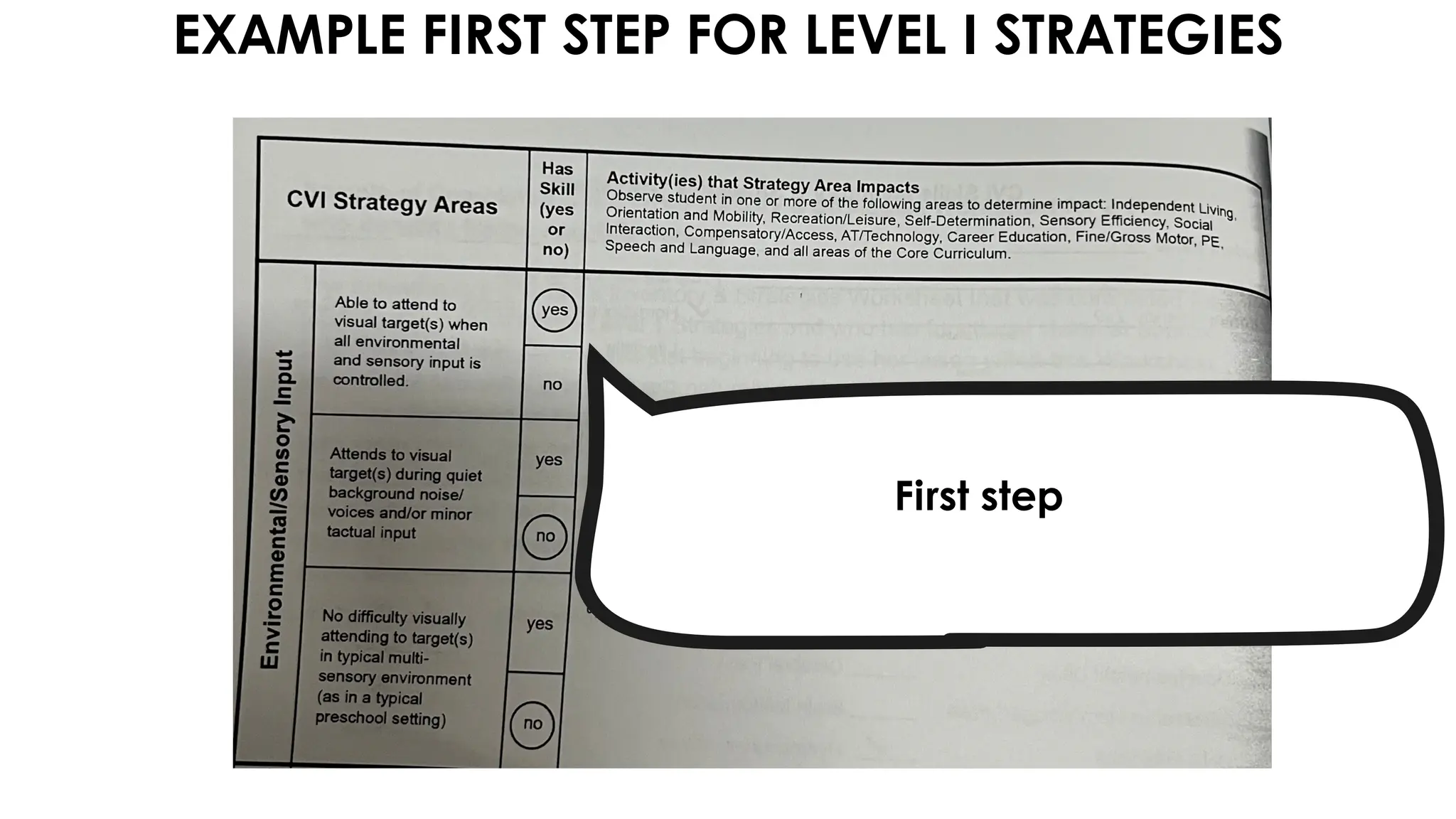
First step
EXAMPLE FIRST STEP FOR LEVEL I STRATEGIES
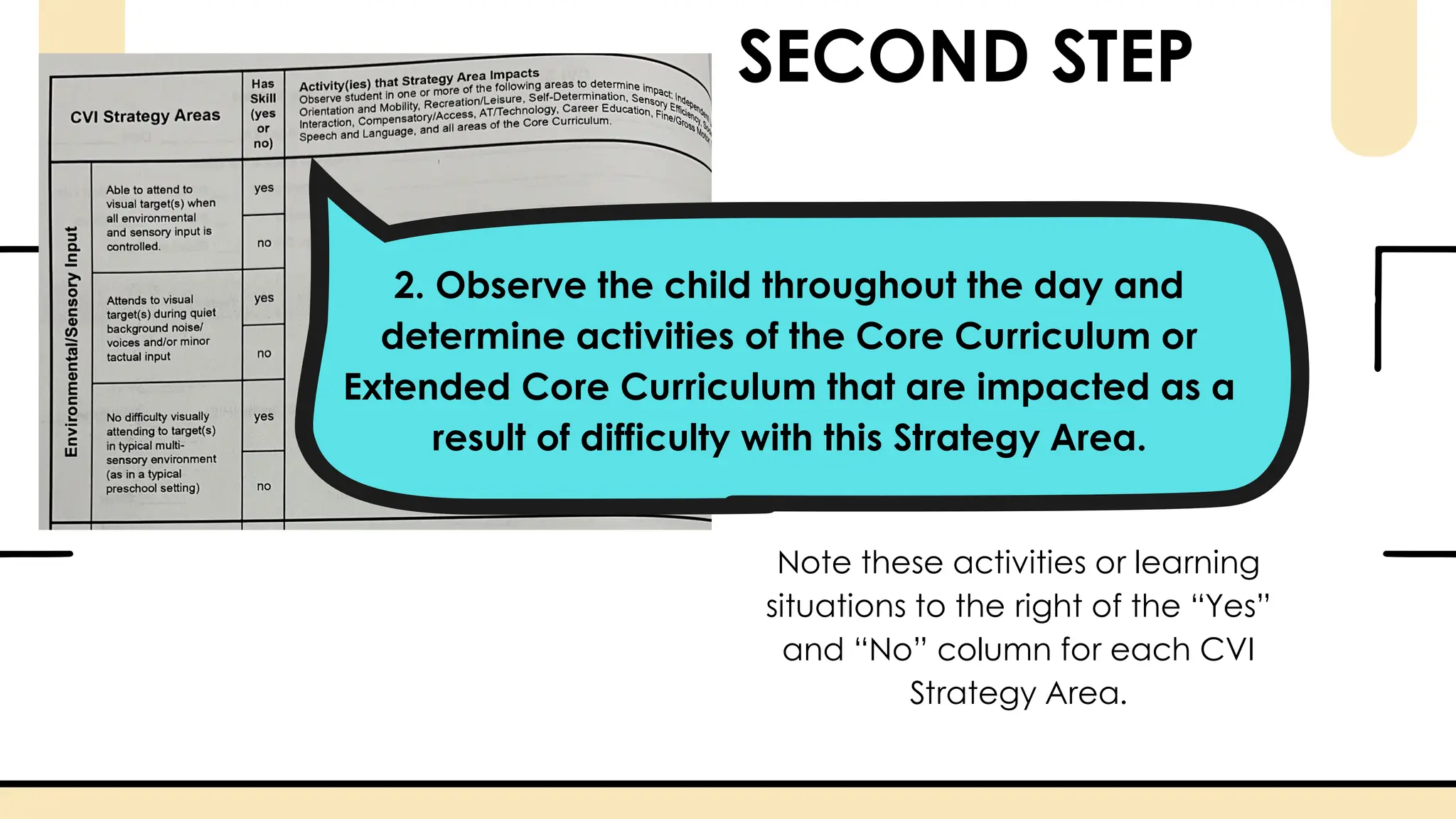
Note these activities or learning
situations to the right of the “Yes”
and “No” column for each CVI
Strategy Area.
2. Observe the child throughout the day and
determine activities of the Core Curriculum or
Extended Core Curriculum that are impacted as a
result of difficulty with this Strategy Area.
SECOND STEP
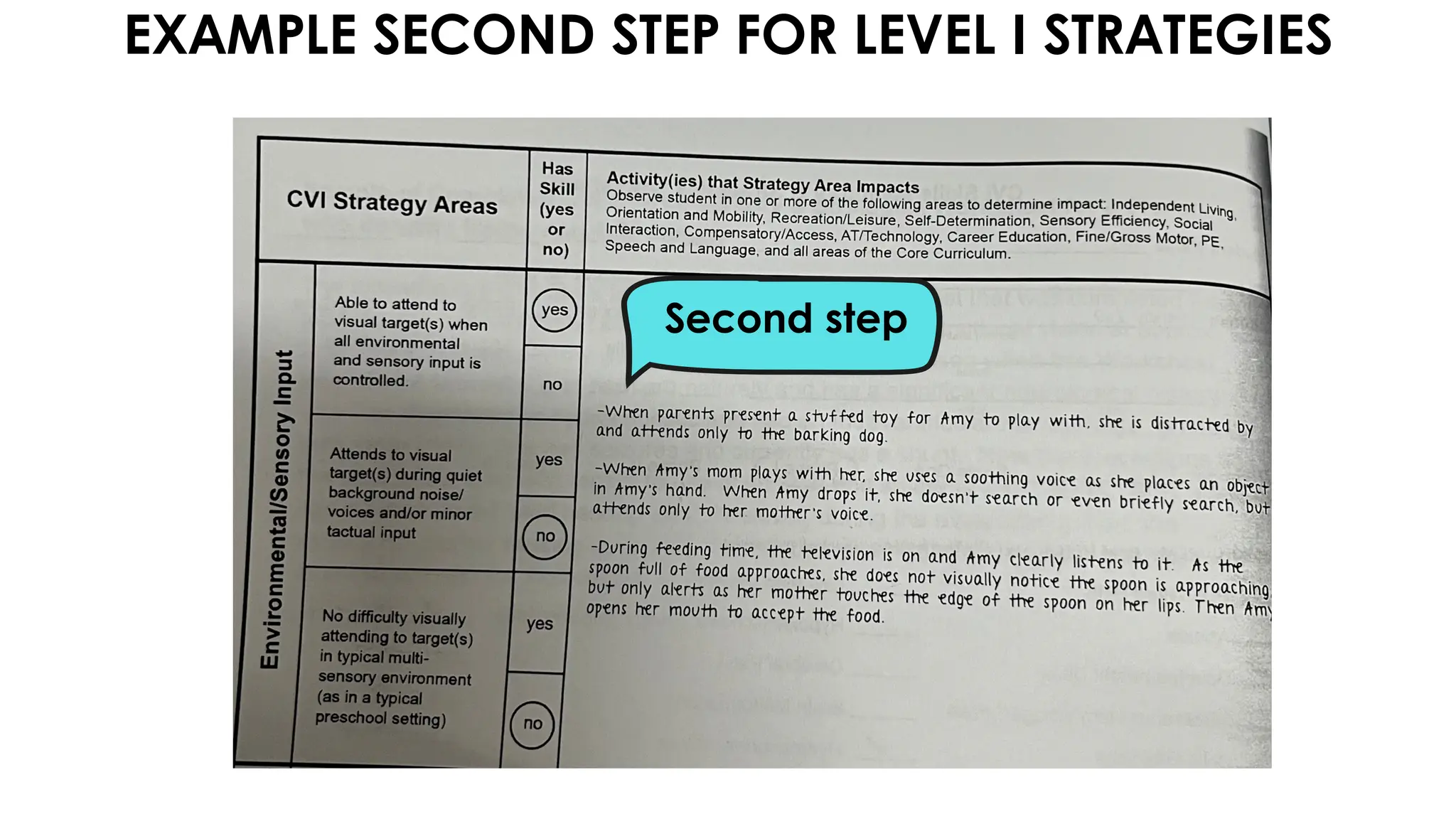
EXAMPLE SECOND STEP FOR LEVEL I STRATEGIES
Second step
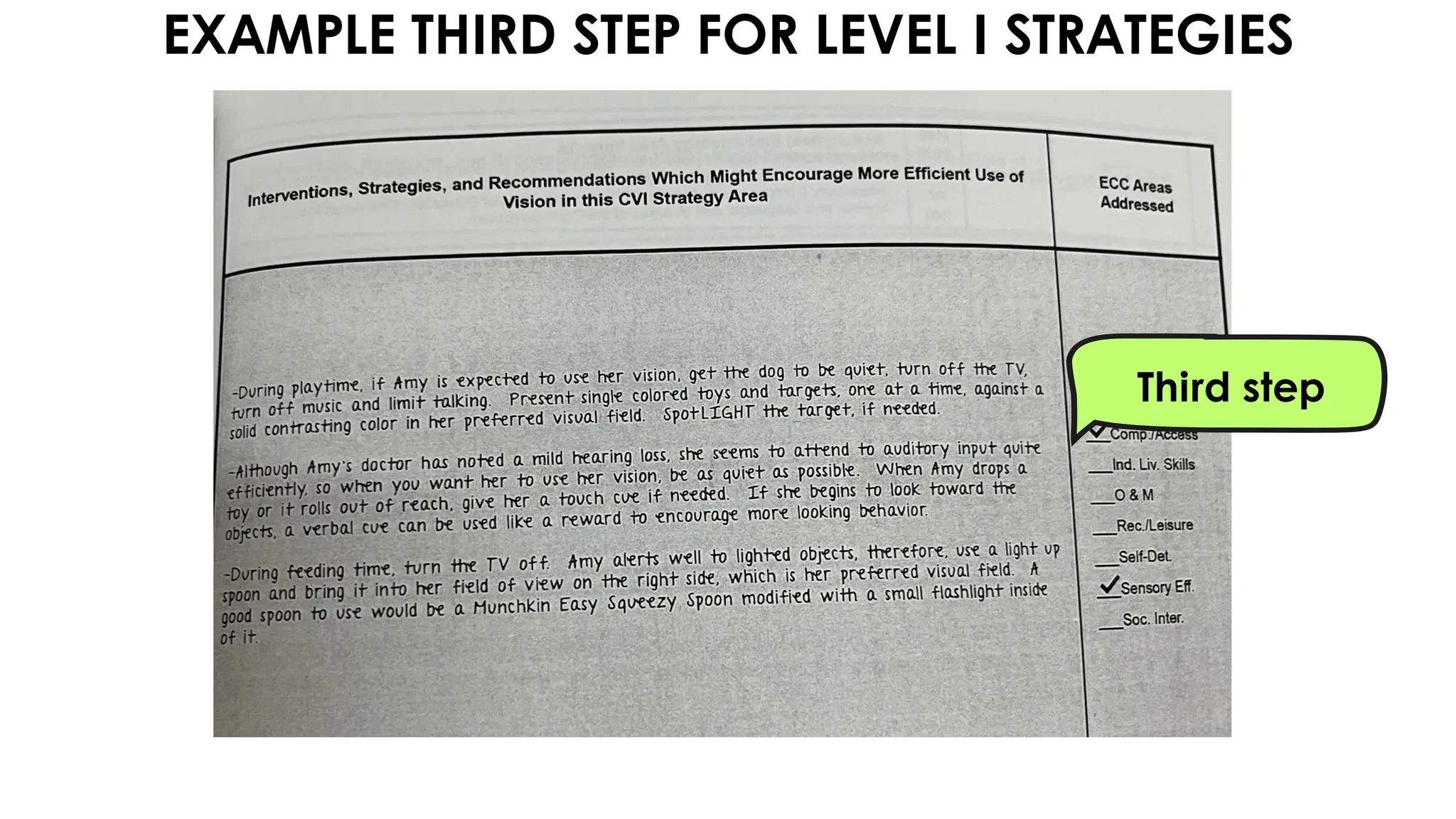
As noted in First Step, the circled
“Yes” or “No” will guide you in
selecting and developing
strategies.
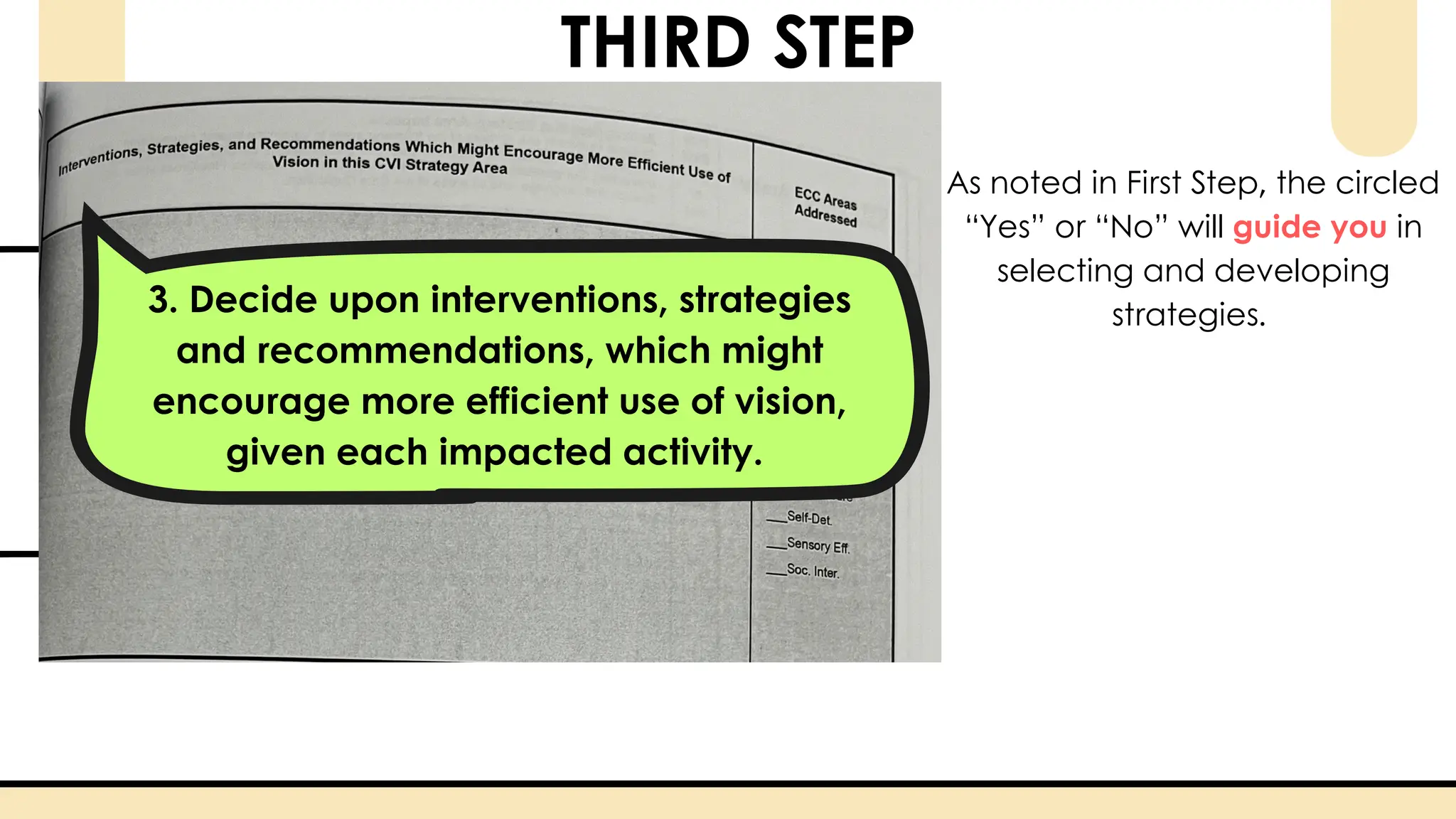
3. Decide upon interventions, strategies
and recommendations, which might
encourage more efficient use of vision,
given each impacted activity.
THIRD STEP
GUIDELINES FOR DETERMINING THE LEVEL OF
STRATEGIES TO USE
If the first “No” is circled within a CVI Strategy Area (followed by
“No” in the second and third box), look at Level 1 Strategies
If the first “Yes” is circled within a CVI Strategy Area (followed by
“No” in the second and third box), look at Level 2 Strategies
If the first “Yes” and the second “Yes” are circled within a CVI
Strategy Area (followed by “No” for the third box), look at Level 3
Strategies
If all three of the “Yes” boxes are circled, there may be very little
use of strategies needed or possibly, none.
EXAMPLE THIRD STEP FOR LEVEL I STRATEGIES
Third step
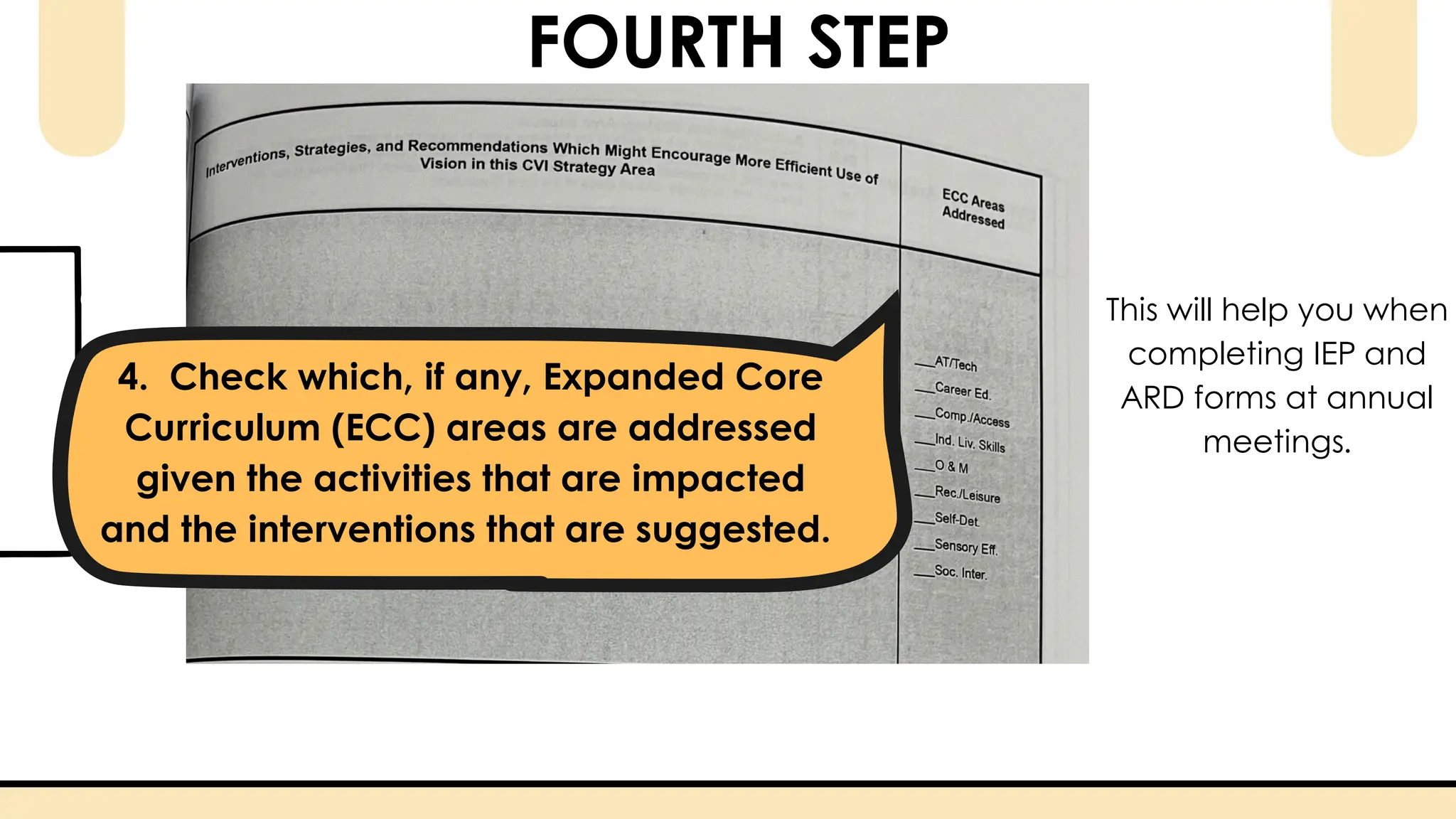
This will help you when
completing IEP and
ARD forms at annual
meetings.
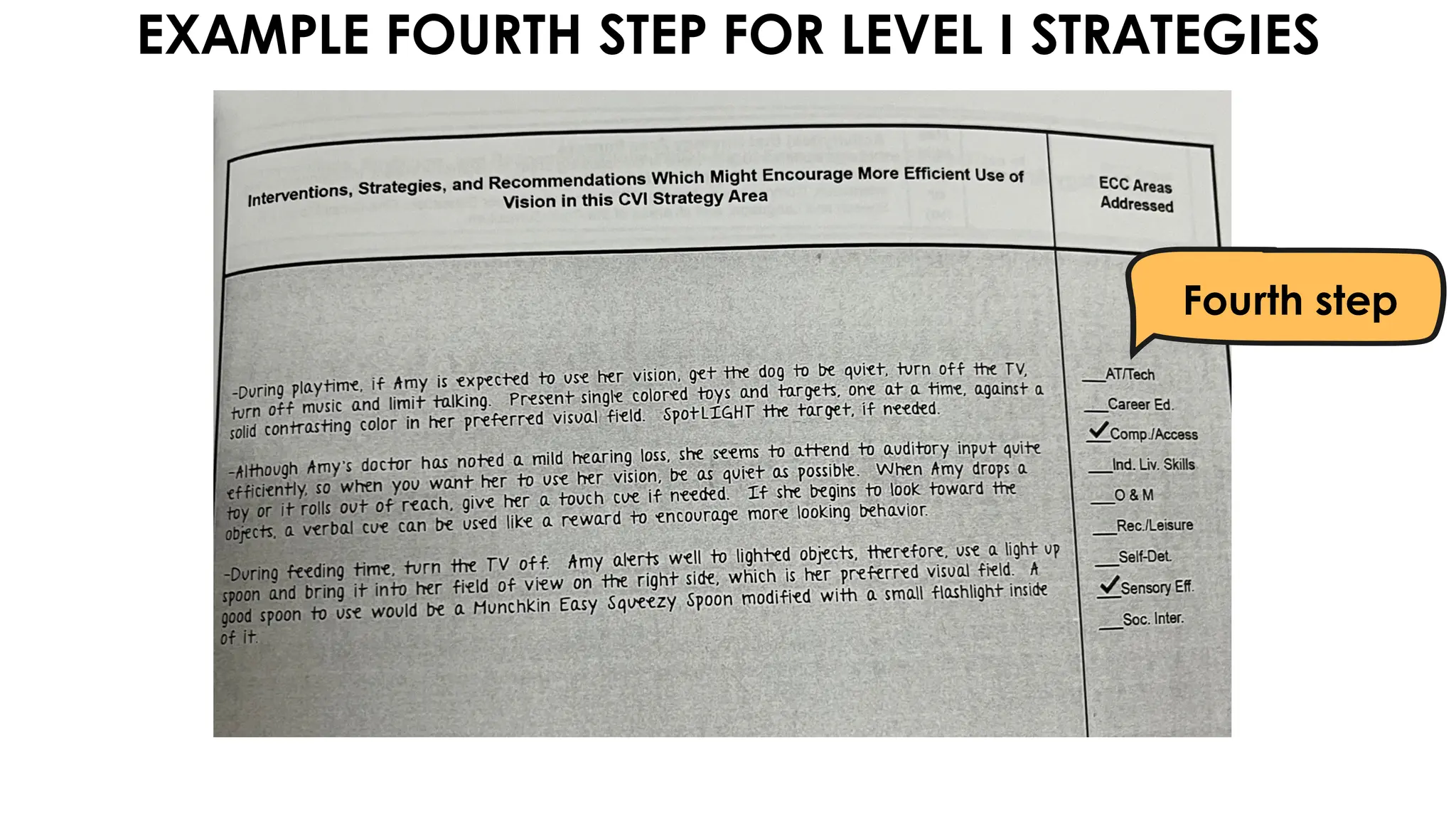
4. Check which, if any, Expanded Core
Curriculum (ECC) areas are addressed
given the activities that are impacted
and the interventions that are suggested.
FOURTH STEP
EXAMPLE FOURTH STEP FOR LEVEL I STRATEGIES
Fourth step
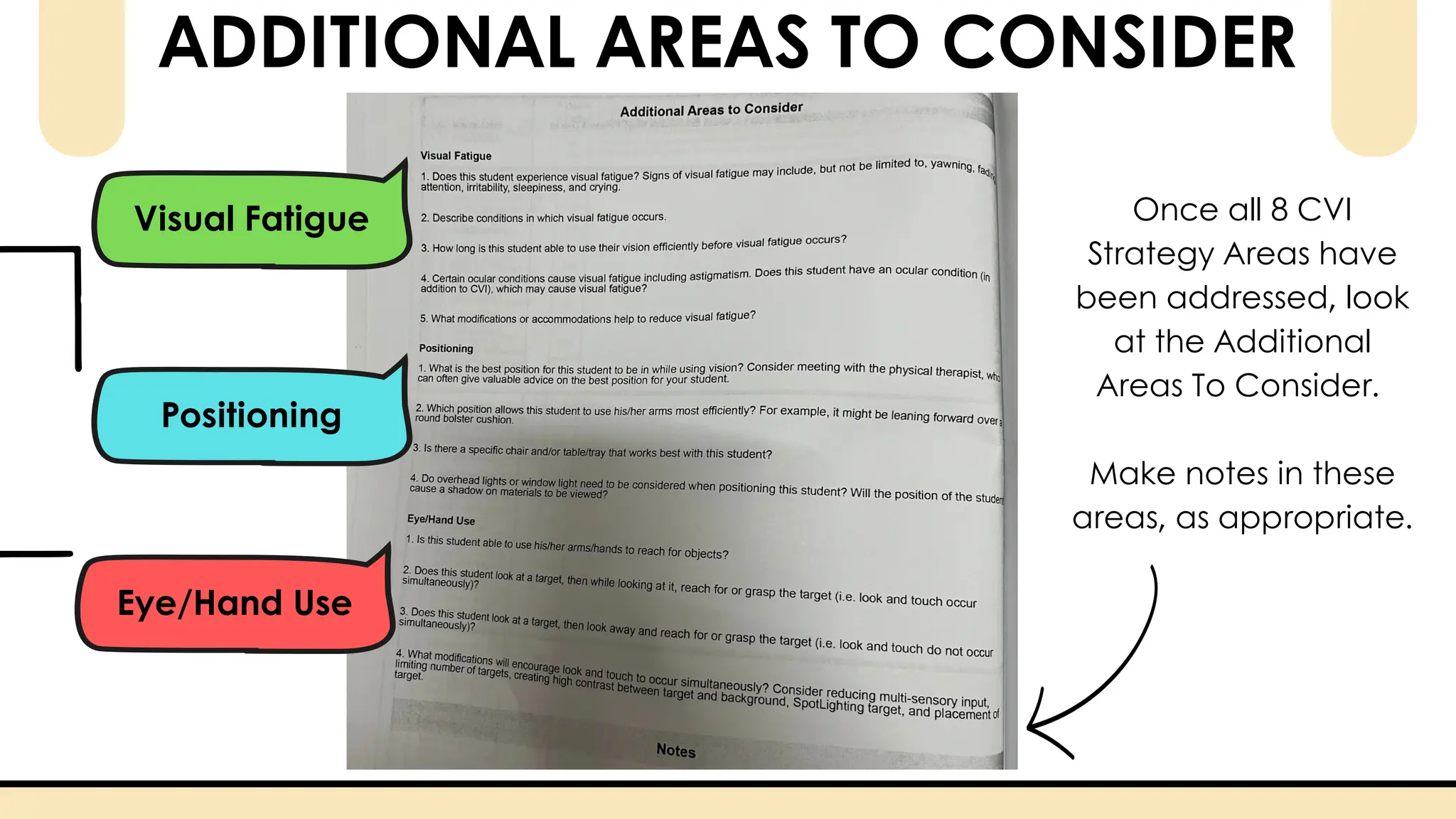
Once all 8 CVI
Strategy Areas have
been addressed, look
at the Additional
Areas To Consider.
Make notes in these
areas, as appropriate.
ADDITIONAL AREAS TO CONSIDER
Visual Fatigue
Positioning
Eye/Hand Use
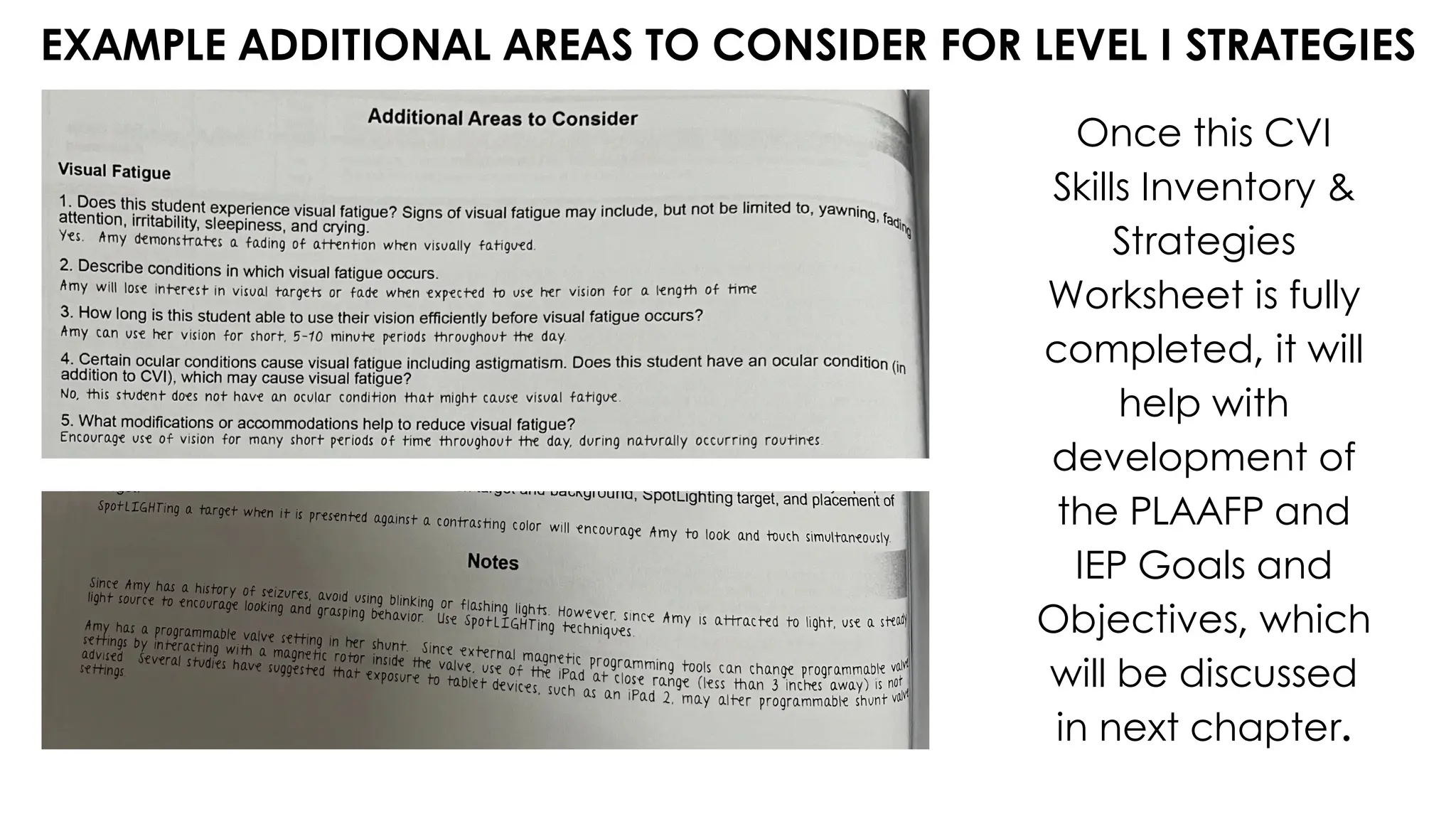
EXAMPLE ADDITIONAL AREAS TO CONSIDER FOR LEVEL I STRATEGIES
Once this CVI
Skills Inventory &
Strategies
Worksheet is fully
completed, it will
help with
development of
the PLAAFP and
IEP Goals and
Objectives, which
will be discussed
in next chapter.
THANK YOU

Chapter 9. CVI Skills Inventory & Strategies Worksheet.pdf

  • 1.
    Topics today: Chapter 9.CVI Skills Inventory & Strategies Worksheet Presented by Optom Anis Suzanna Mohamad, Penang Hospital CVI LEARNING SERIES 3.0 (SESI 2025) 24th June 2025
  • 2.
  • 3.
    PURPOSE OF THECVI SKILLS INVENTORY & STRATEGIES WORKSHEET •Capture patient’s/student’s current status across 10 CVI characteristics •Plan personalized, evidence- based strategies •Inform Individualized Education Programs (IEPs) and team collaboration about the strategies •Encourage patient/student with CVI to more consistently and efficiently use their vision.
  • 4.
    TOPIC OUTLINES 1.Background Information 2.Completion of the CVI Skills Inventory & strategies Worksheet
  • 5.
    BACKGROUND INFORMATION Before completing theCVI Skills Inventory & Strategies Worksheet, patient/student have to undergo:- Functional Vision Evaluation (FVE) Learning Media Assessment (LMA)
  • 6.
    FUNCTIONAL VISION EVALUATION(FVE) FVE is a structured assessment process used to determine how a child uses vision in real-world settings—not just how well they see on an eye chart. 1.How the child uses vision to complete tasks (e.g. identifying people, navigating spaces, recognizing objects) 2.Visual efficiency (e.g. tracking, scanning, shifting gaze) 3.Environmental factors affecting visual function (lighting, clutter, movement) 4.How CVI characteristics interfere with functional use of vision
  • 7.
    LEARNING MEDIA ASSESSMENT(LMA) LMA determines the most effective way a child accesses learning material—whether through vision, touch (tactile), hearing (auditory), or a combination. 1.How the child best gathers and processes information 2.Whether print, braille, auditory, or visual-tactile materials are most appropriate 3.Integration of vision-based learning, even if limited or inconsistent
  • 8.
    WHY IMPORTANT FVE &LMA ? Information include:- Patient’s/Student’s visual functioning level on The CVI Range (whether Phase I, Phase II or Phase III) Strategies in Level I, Level 2 and Level 3 loosely correlate with the visual functioning levels of patient’s/student’s in Phase I, Phase II and Phase III of The CVI Range.
  • 9.
    BACKGROUND INFORMATION The front pageof the CVI Skills Inventory & Strategies Worksheet should be completed as thoroughly as possible, especially:- On medications (any possible side effects of those medications, any hearing loss?? Seizures/shunt (blinking lights and close proximity to a tablet are sometimes contraindicated)
  • 10.
    Page 71 ________> CVIRange ________> Ophthalmologist ________> Optometrist ________> Low Vision Specialist ________> Hearing/Medications ________> Current Special Education Eligibilities and/or Support Services
  • 11.
    EXAMPLE FRONT PAGEFOR LEVEL I STRATEGIES
  • 12.
  • 13.
    COMPLETION OF THE CVISKILLS INVENTORY & STRATEGIES WORKSHEET
  • 14.
    1. Read throughthe three levels of skills for each of the 8 CVI Strategy Areas. Environmental/ Sensory Input Near/Middle/Distance Viewing Visual Target Spatial Window of Visual Attention and/or Viewing Array Contrast Preferred Visual Field Lighting Familiarity 8 CVI Strategy Areas Circle “Yes” if the student has the skill Circle “No” if the student does not have the skills
  • 15.
    FIRST STEP Level 2Strategies Level 3 Strategies Level 1 Strategies These three skills , within each CVI Strategy Area, correlate loosely with the three levels of strategies. This will guide you when choosing strategies.
  • 16.
    First step EXAMPLE FIRSTSTEP FOR LEVEL I STRATEGIES
  • 17.
    Note these activitiesor learning situations to the right of the “Yes” and “No” column for each CVI Strategy Area. 2. Observe the child throughout the day and determine activities of the Core Curriculum or Extended Core Curriculum that are impacted as a result of difficulty with this Strategy Area. SECOND STEP
  • 18.
    EXAMPLE SECOND STEPFOR LEVEL I STRATEGIES Second step
  • 19.
    As noted inFirst Step, the circled “Yes” or “No” will guide you in selecting and developing strategies. 3. Decide upon interventions, strategies and recommendations, which might encourage more efficient use of vision, given each impacted activity. THIRD STEP
  • 20.
    GUIDELINES FOR DETERMININGTHE LEVEL OF STRATEGIES TO USE If the first “No” is circled within a CVI Strategy Area (followed by “No” in the second and third box), look at Level 1 Strategies If the first “Yes” is circled within a CVI Strategy Area (followed by “No” in the second and third box), look at Level 2 Strategies If the first “Yes” and the second “Yes” are circled within a CVI Strategy Area (followed by “No” for the third box), look at Level 3 Strategies If all three of the “Yes” boxes are circled, there may be very little use of strategies needed or possibly, none.
  • 21.
    EXAMPLE THIRD STEPFOR LEVEL I STRATEGIES Third step
  • 22.
    This will helpyou when completing IEP and ARD forms at annual meetings. 4. Check which, if any, Expanded Core Curriculum (ECC) areas are addressed given the activities that are impacted and the interventions that are suggested. FOURTH STEP
  • 23.
    EXAMPLE FOURTH STEPFOR LEVEL I STRATEGIES Fourth step
  • 24.
    Once all 8CVI Strategy Areas have been addressed, look at the Additional Areas To Consider. Make notes in these areas, as appropriate. ADDITIONAL AREAS TO CONSIDER Visual Fatigue Positioning Eye/Hand Use
  • 25.
    EXAMPLE ADDITIONAL AREASTO CONSIDER FOR LEVEL I STRATEGIES Once this CVI Skills Inventory & Strategies Worksheet is fully completed, it will help with development of the PLAAFP and IEP Goals and Objectives, which will be discussed in next chapter.
  • 26.