National Ocular Biometry
Course 2015
An echoing presentation
Prepared by:
Anis Suzanna Binti Mohamad
Rohaila Binti Ariffin
Pegawai Optometri U41
Hospital Sultanah Bahiyah, Alor Setar
COURSE OBJECTIVES:
 Understand the basic principal of biometry
 Perform, define the discuss the pathology that would require the
biometry test
 Interpret the result of biometry test
 Measure axial length
 Name four ocular structures that reflect ultrasound echoes
 Able to perform biometry test
 Able to perform topography, discuss corneal contours of normal,
pathological and post-surgical cornea
 Take pre-operative testing and intraocular lens power calculation
method to the next level of accuracy and efficiency
 Utilize standardize diagnostic ultrasonography as a valuable
adjuvant to current clinical evaluation.
Cataract surgery
• What is cataract surgery?
– Precise biometry is essential for accurate outcomes in cataract and
refractive surgeries.
– The measurement of axial length by ultrasound was the gold
standard for many years.
– With the introduction of optical biometry in the US in the year
2000, this technology has become more & more popular & is now
the most common method for the measurement of axial length.
– Optical biometry uses a partially coherent wave that has approx. 9x
the resolution of a 10 MHz sound wave, making the measurement
of axial length very precise.
– It helps to avoid operator variations in measurement.
– Also, to increase the accuracy as contact with cornea is not needed
(eliminates compression to cornea).
– Since Optical biometry measures to the centre of macula, it gives
the refractive AXL vs the anatomical AXL achieved with ulrasound.
Pre-op assessment
1. Keratometry
2. A-Scan Biometry
3. IOL Formula
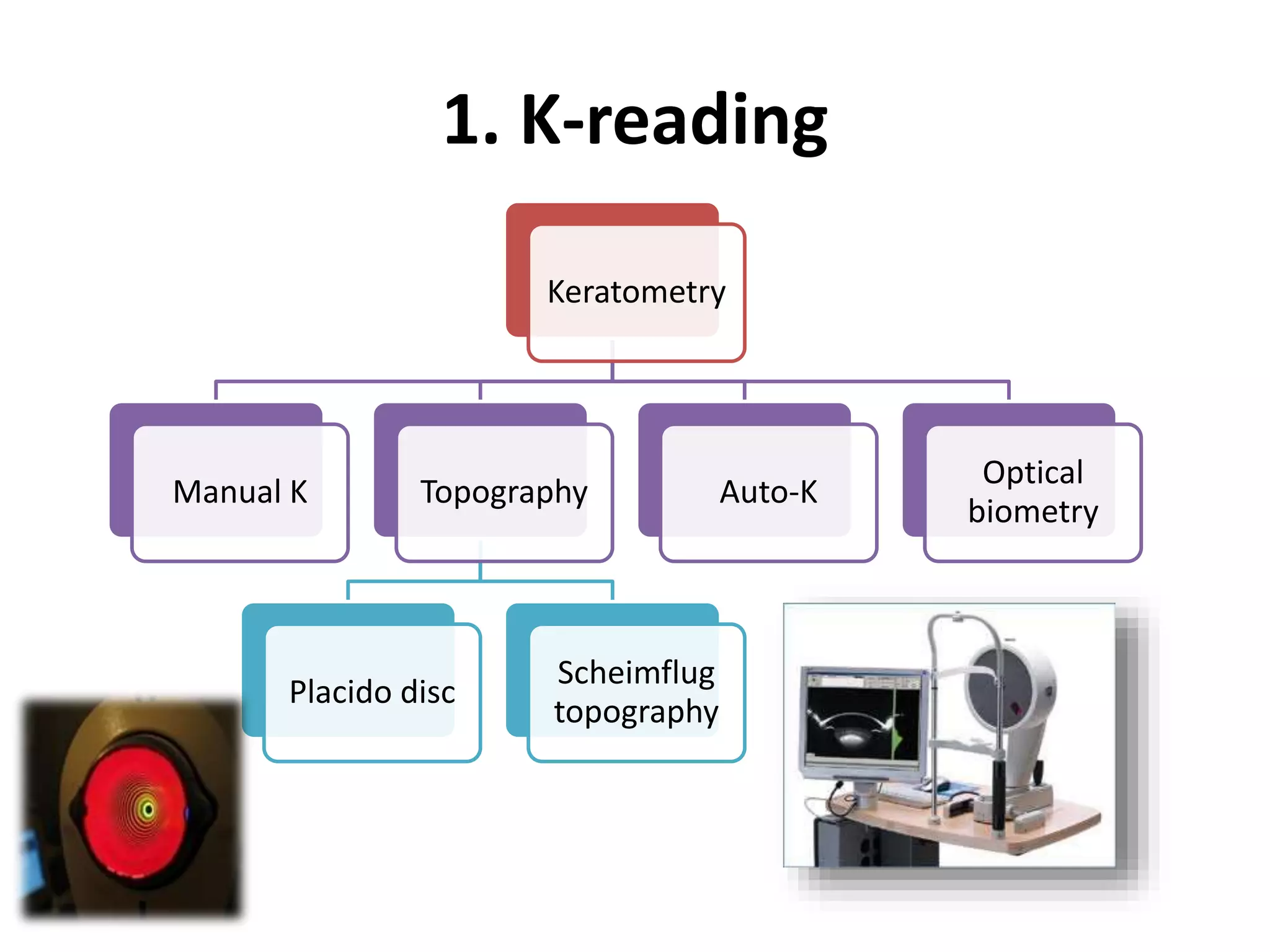
1. K-reading
Keratometry
Manual K Topography
Placido disc
Scheimflug
topography
Auto-K
Optical
biometry
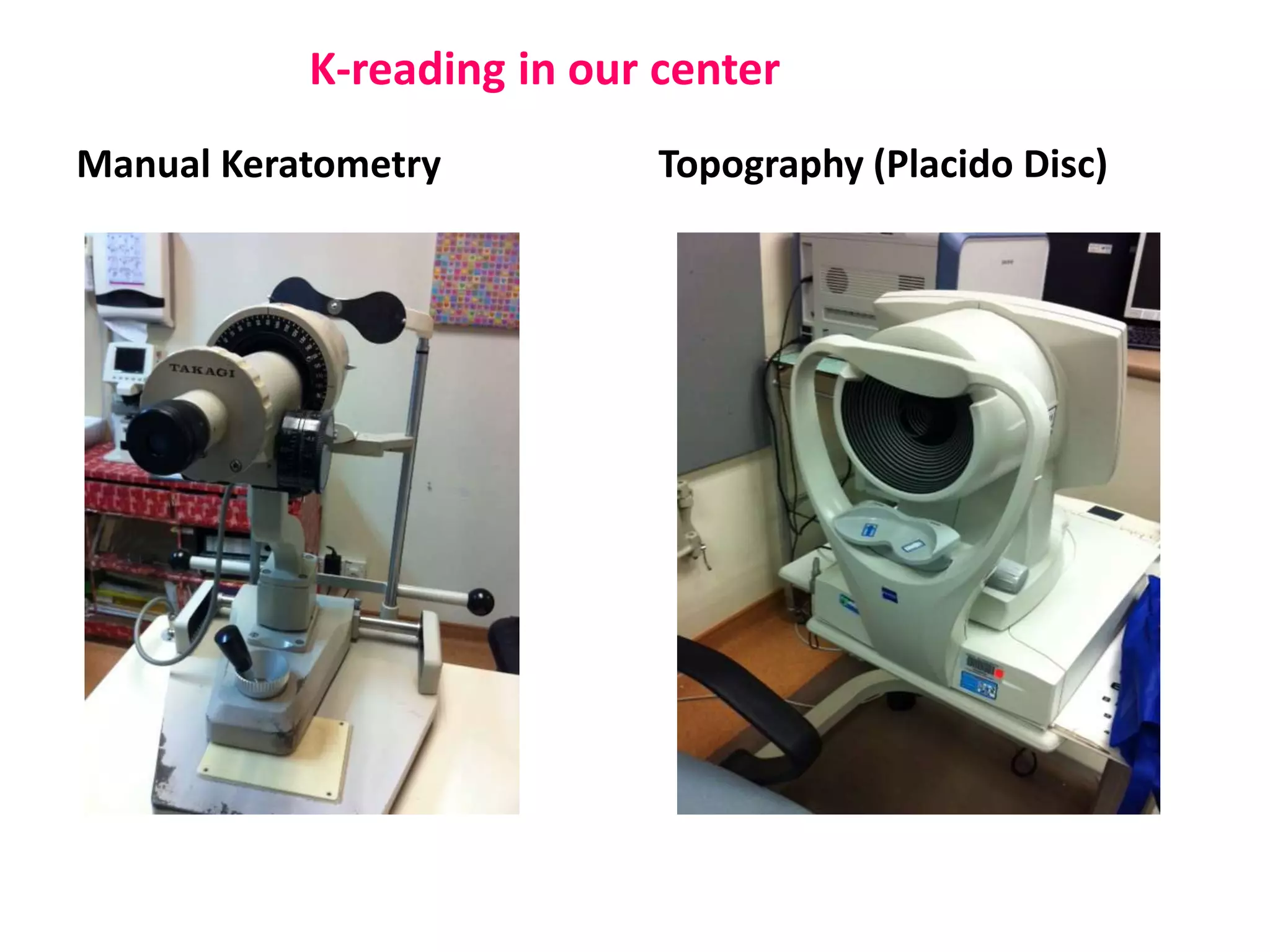
Manual Keratometry Topography (Placido Disc)
K-reading in our center
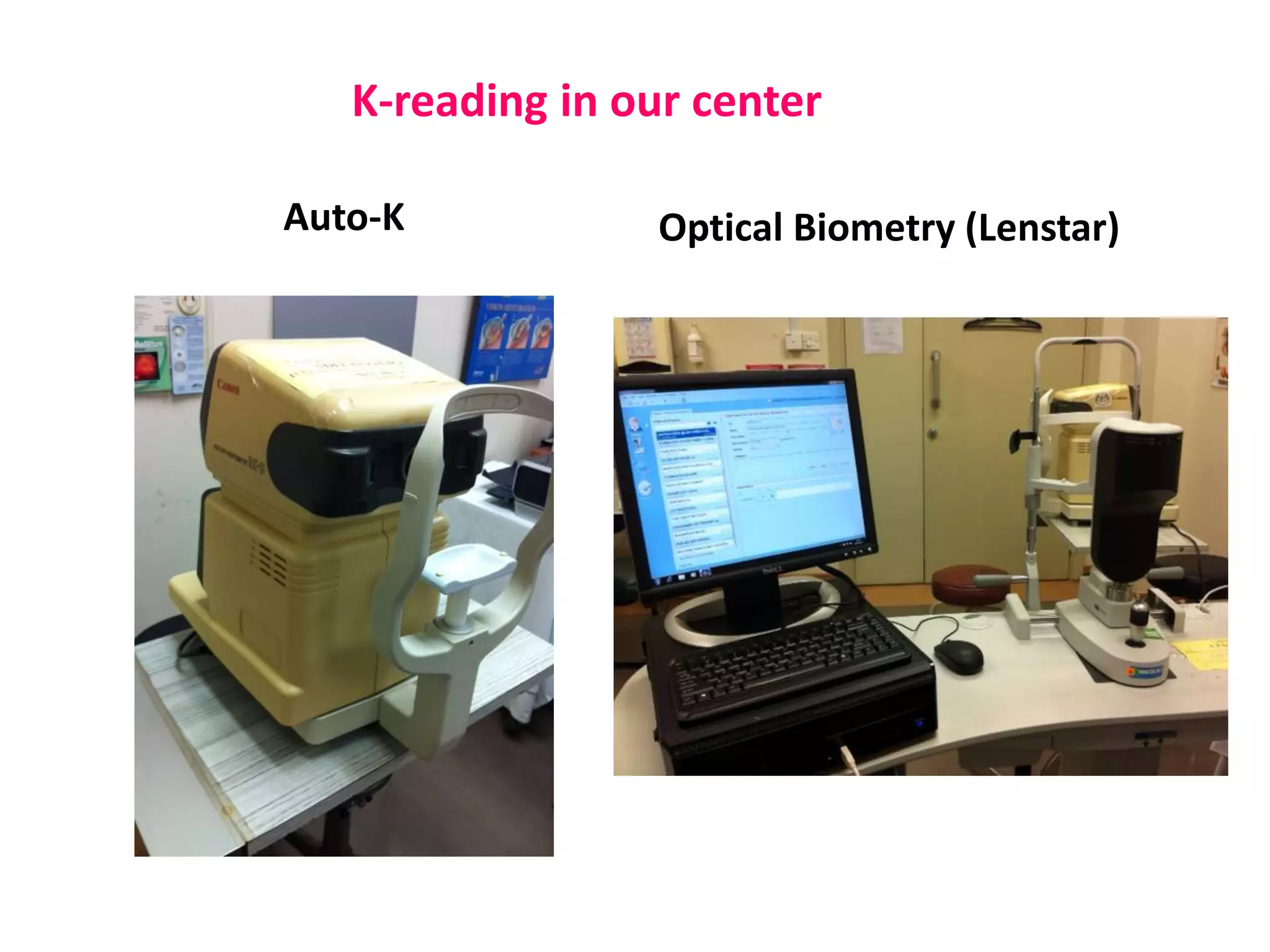
Auto-K Optical Biometry (Lenstar)
K-reading in our center
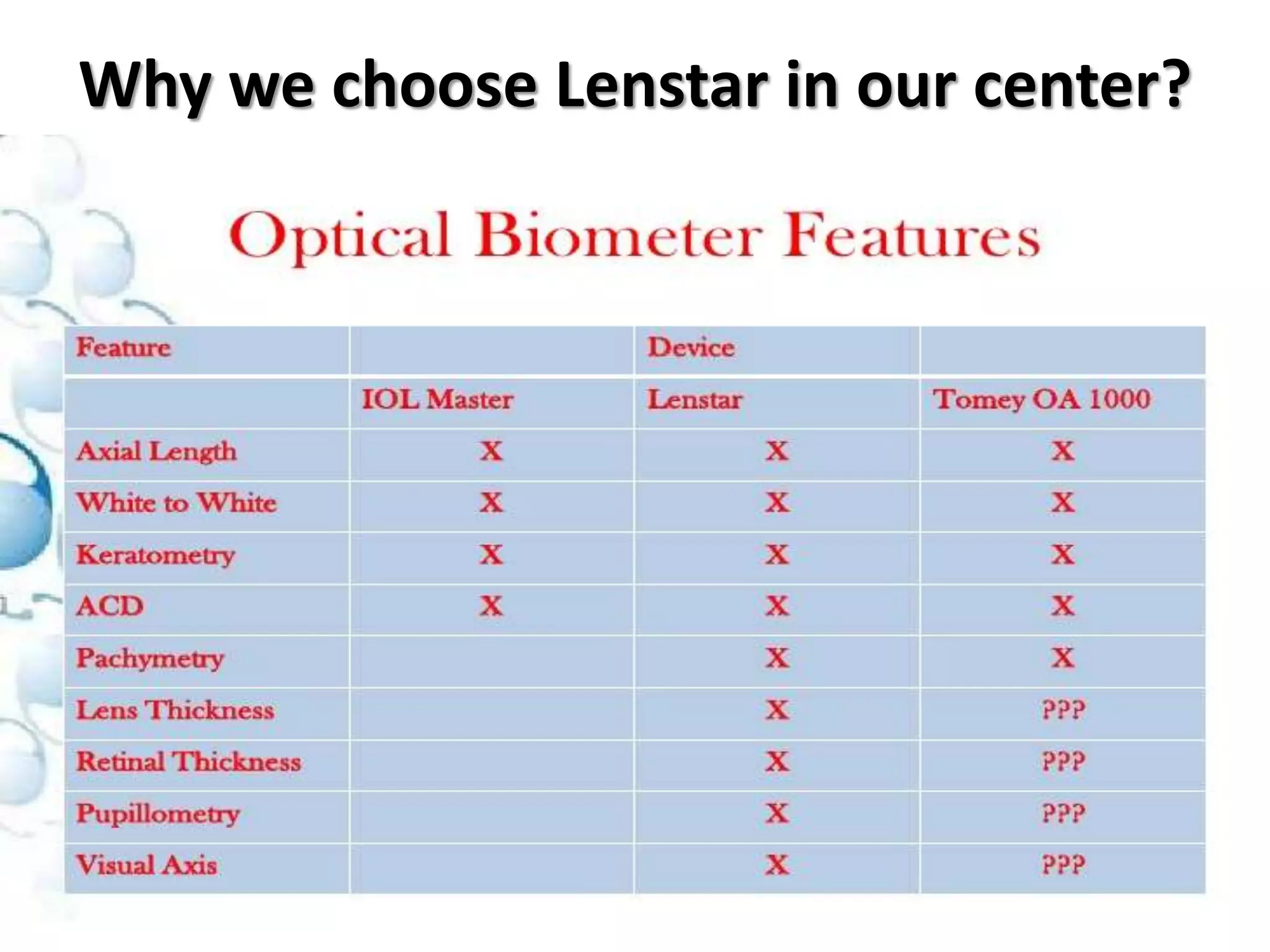
Why we choose Lenstar in our center?
2. A-Scan Biometry
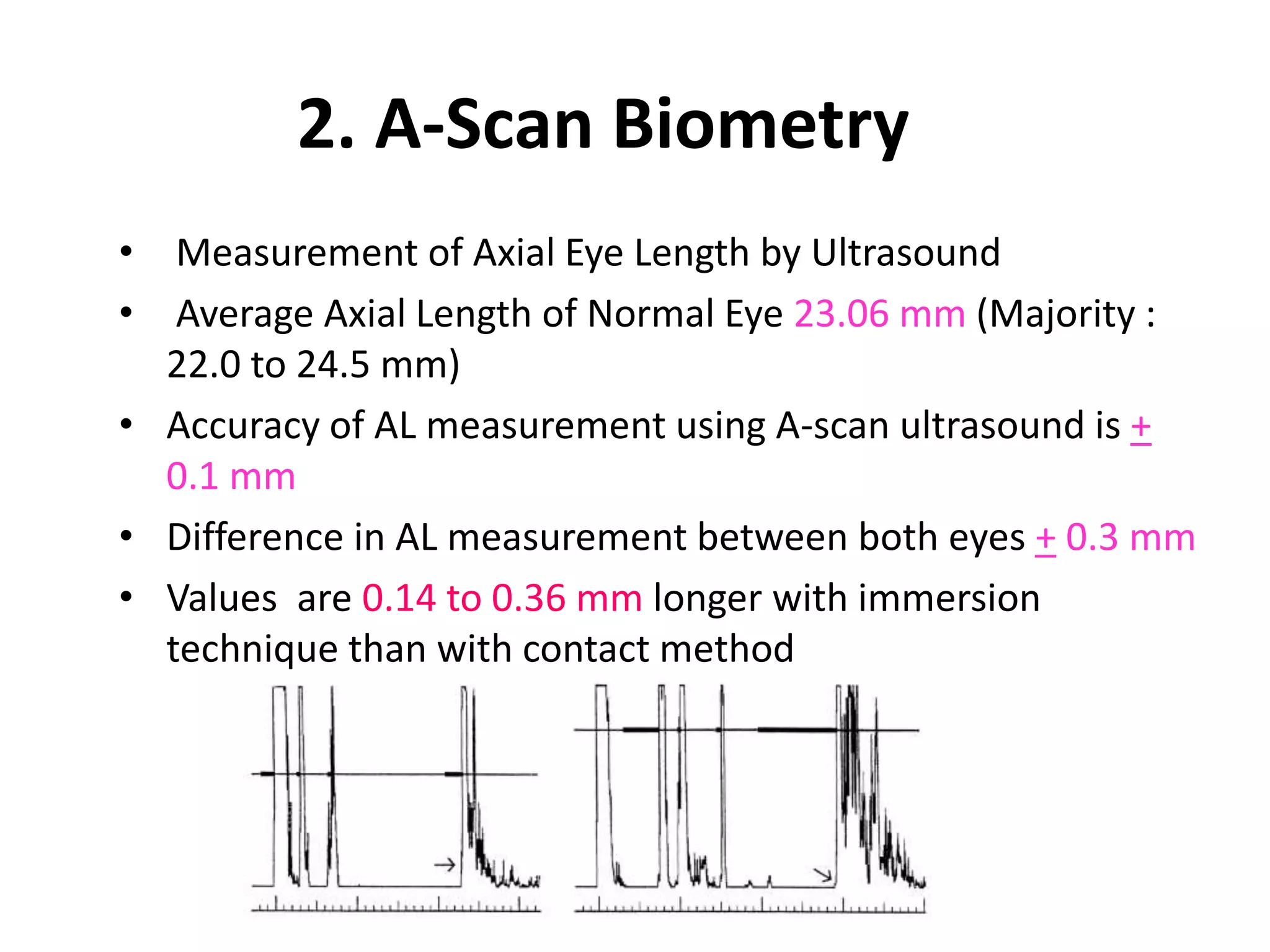
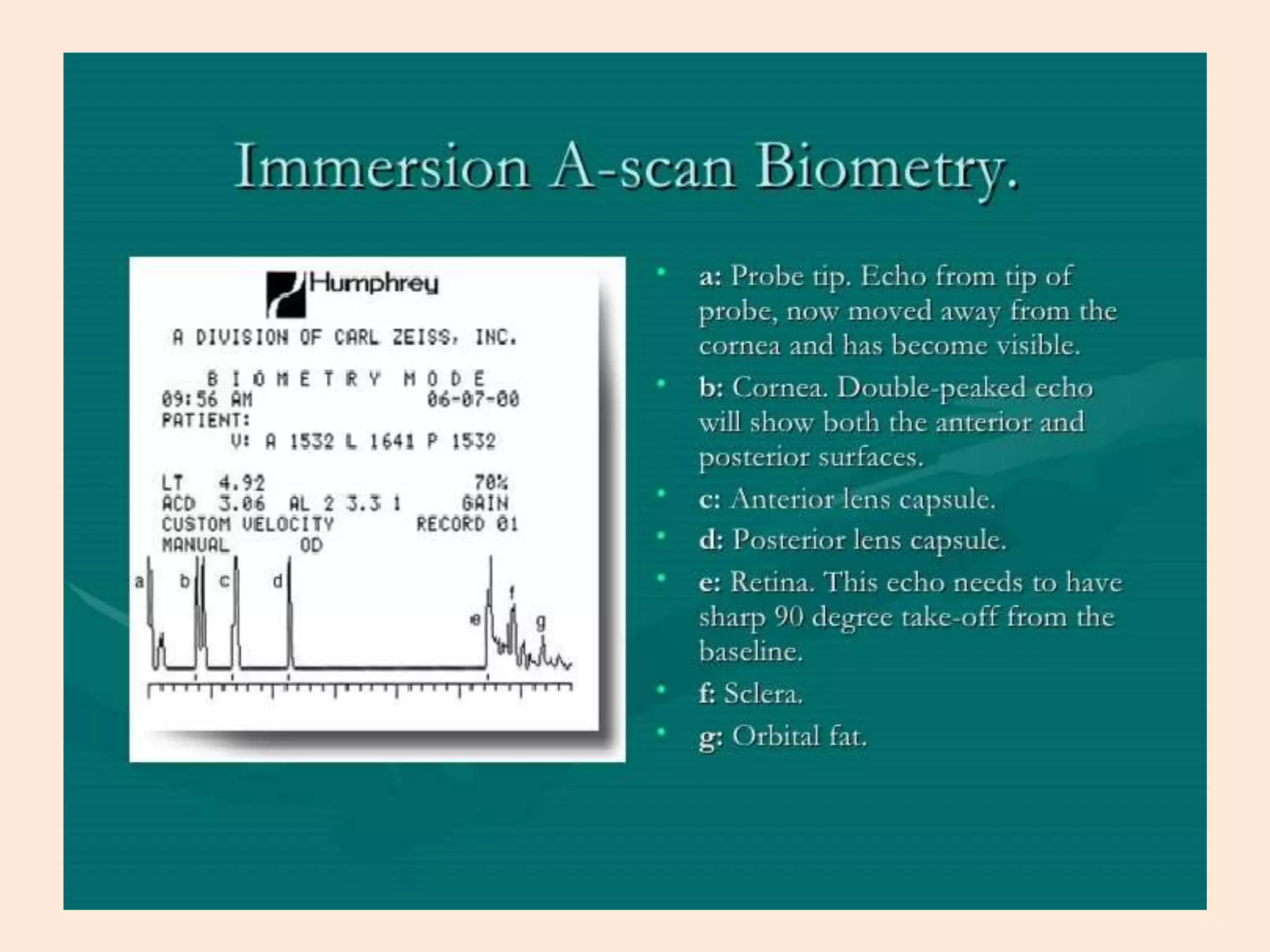
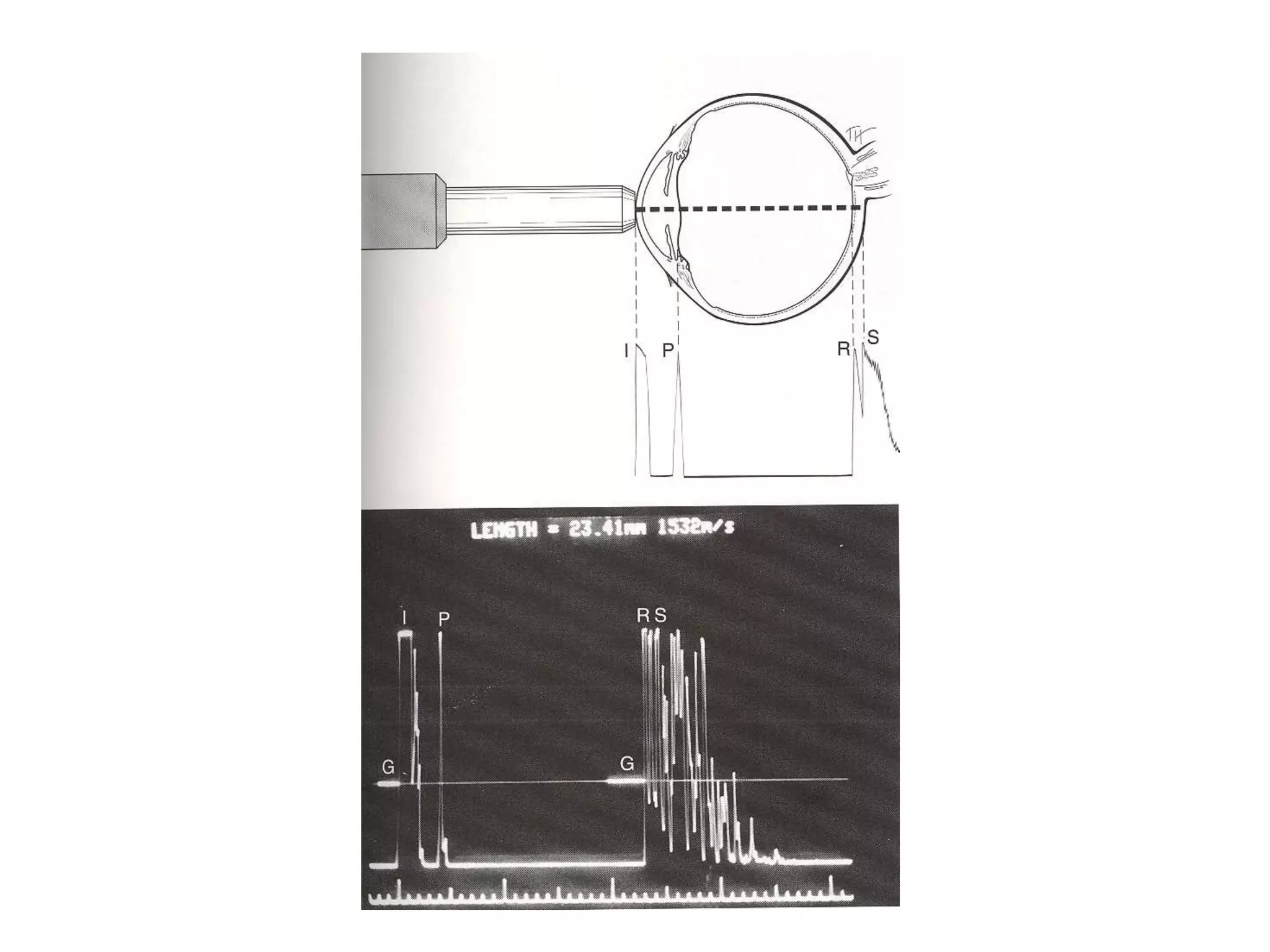
• Measurement of Axial Eye Length by Ultrasound
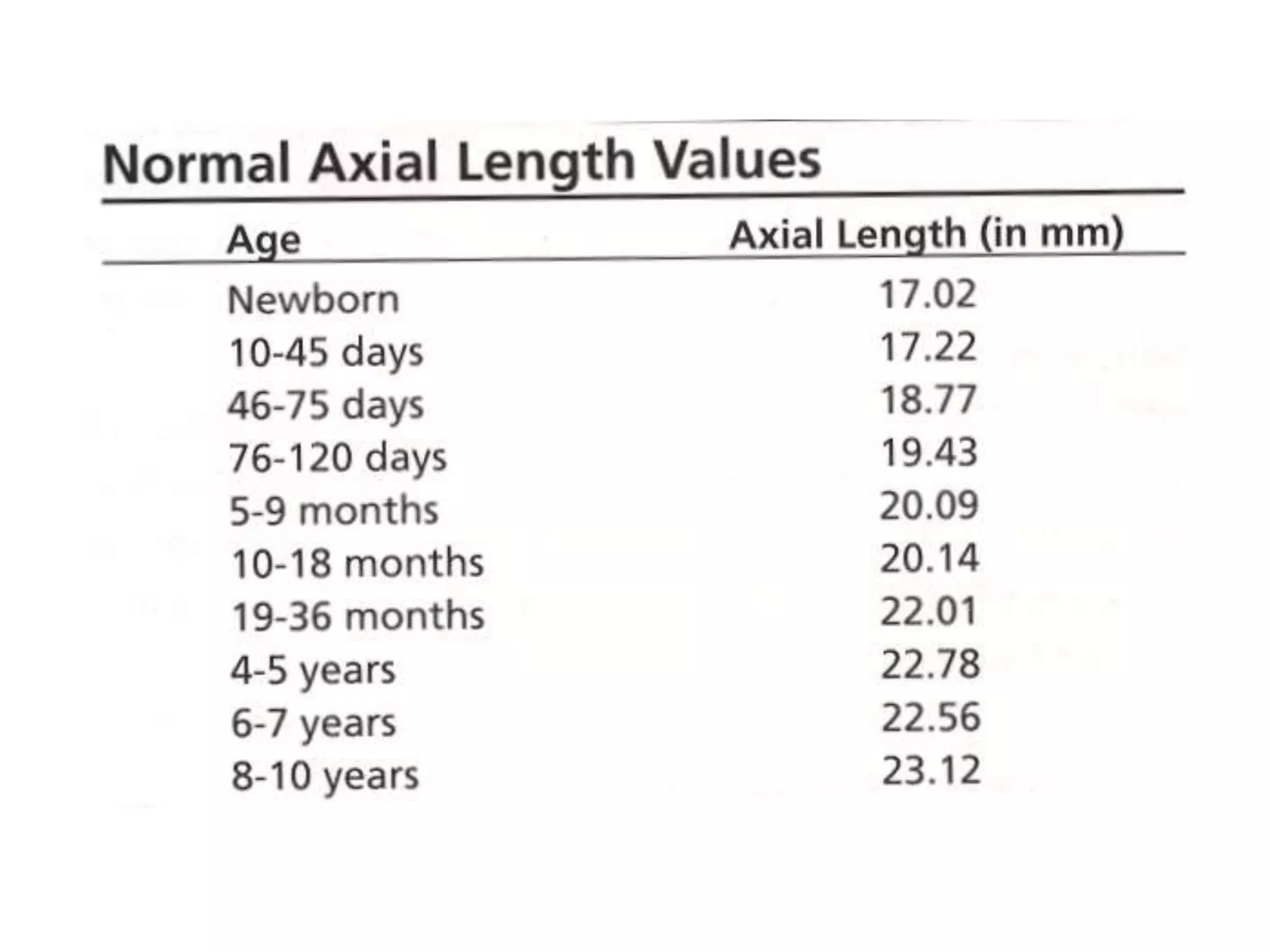
• Average Axial Length of Normal Eye 23.06 mm (Majority :
22.0 to 24.5 mm)
• Accuracy of AL measurement using A-scan ultrasound is +
0.1 mm
• Difference in AL measurement between both eyes + 0.3 mm
• Values are 0.14 to 0.36 mm longer with immersion
technique than with contact method
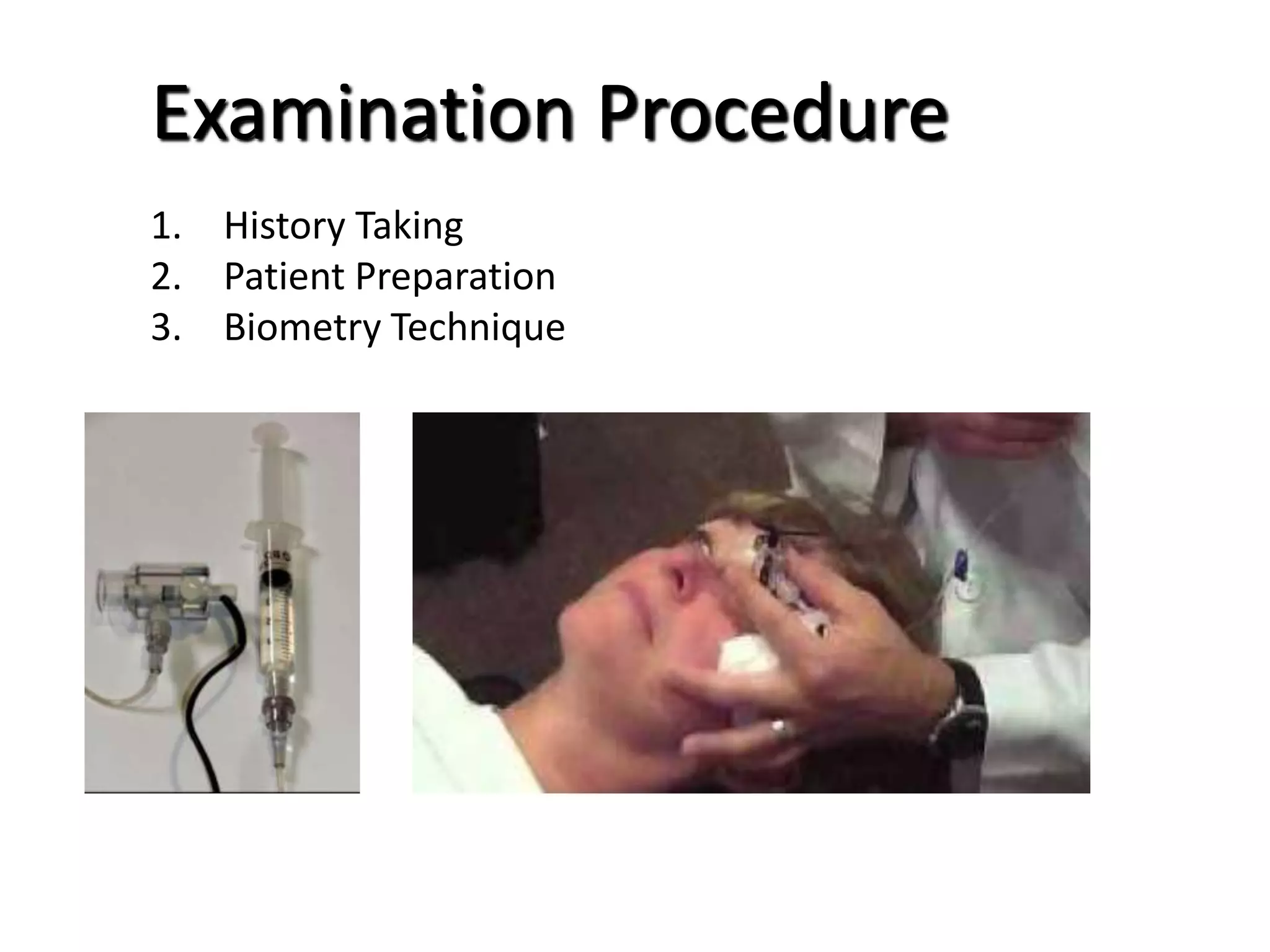
Examination Procedure
1. History Taking
2. Patient Preparation
3. Biometry Technique
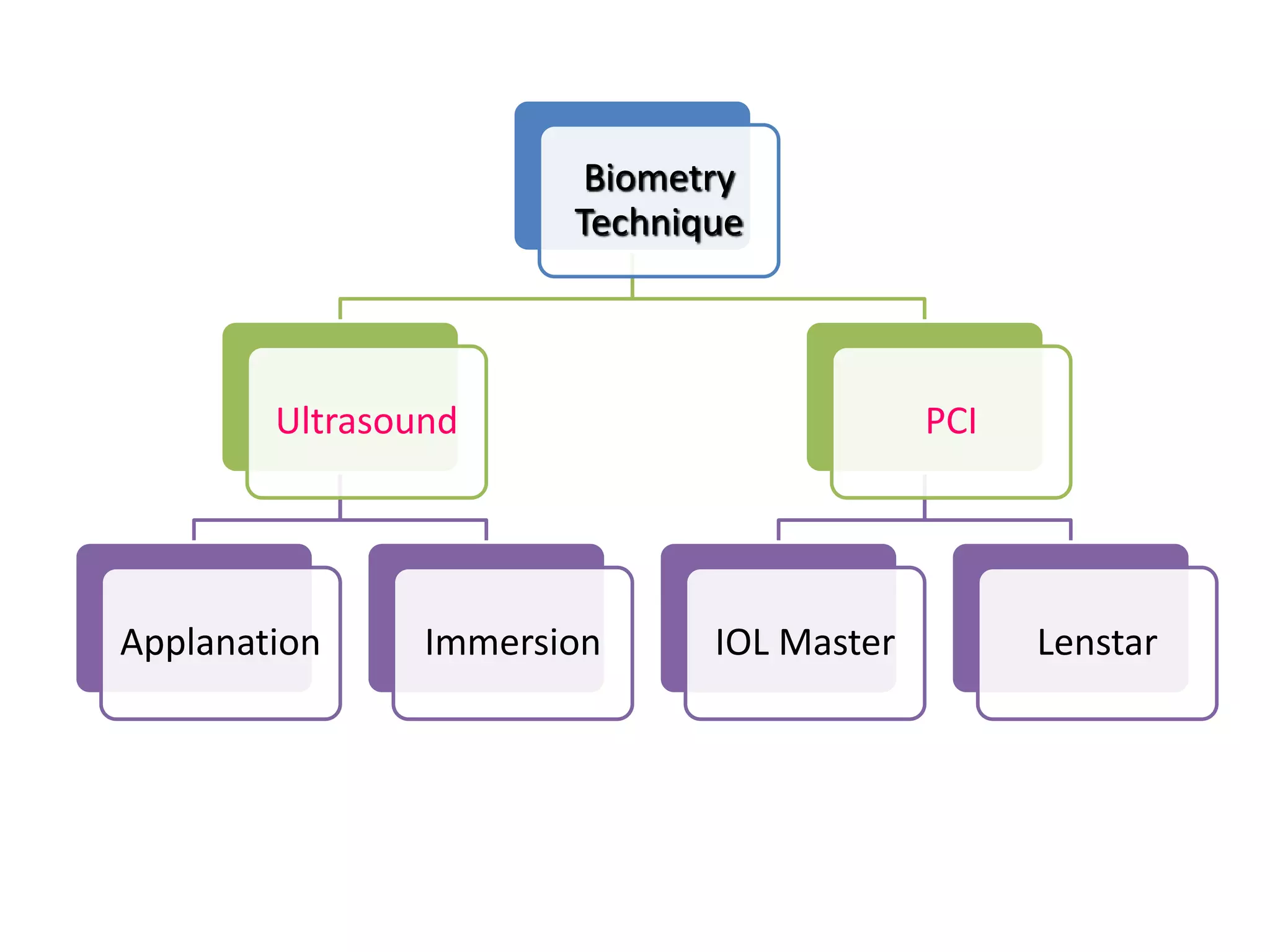
Biometry
Technique
Ultrasound
Applanation Immersion
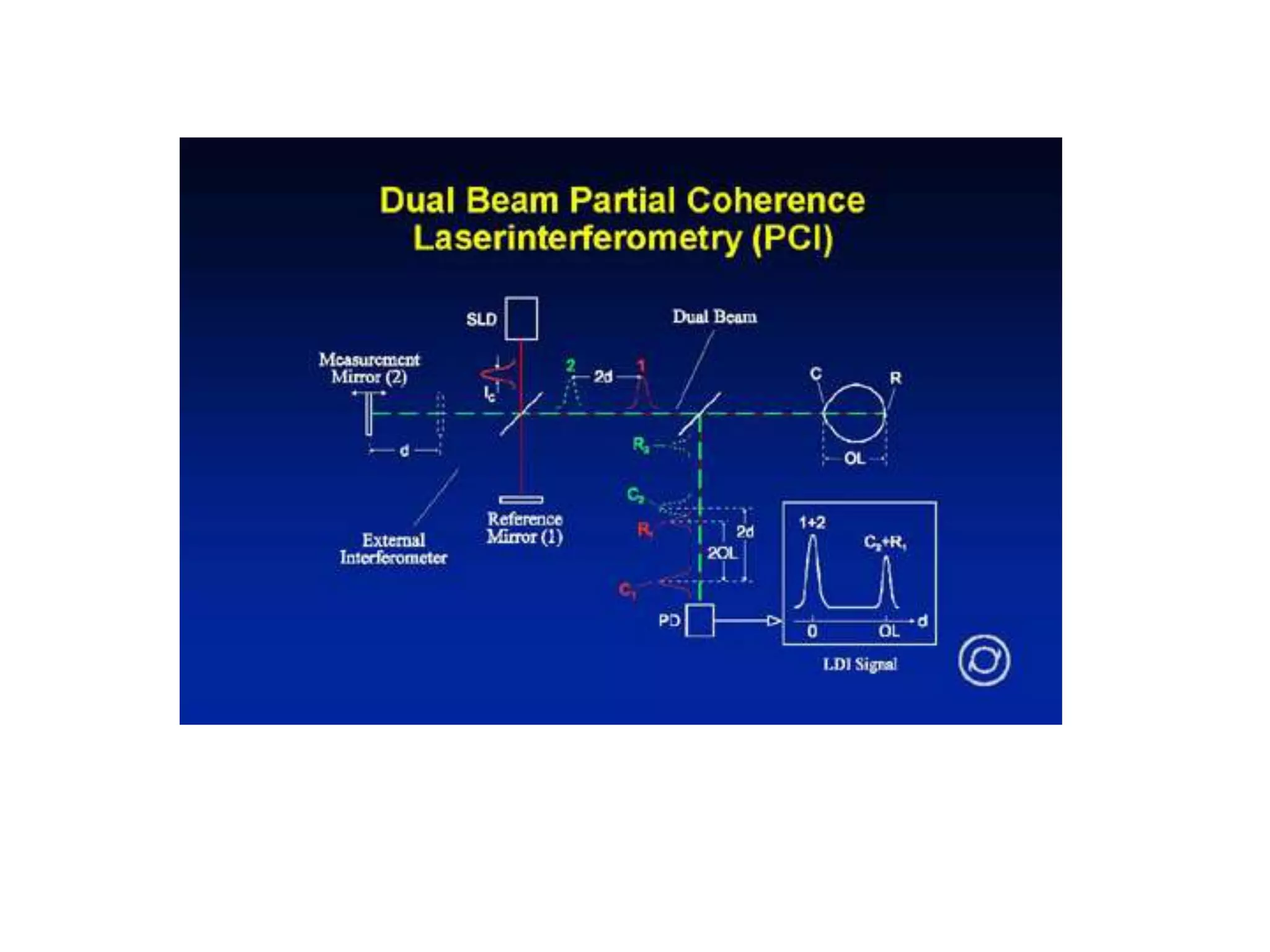
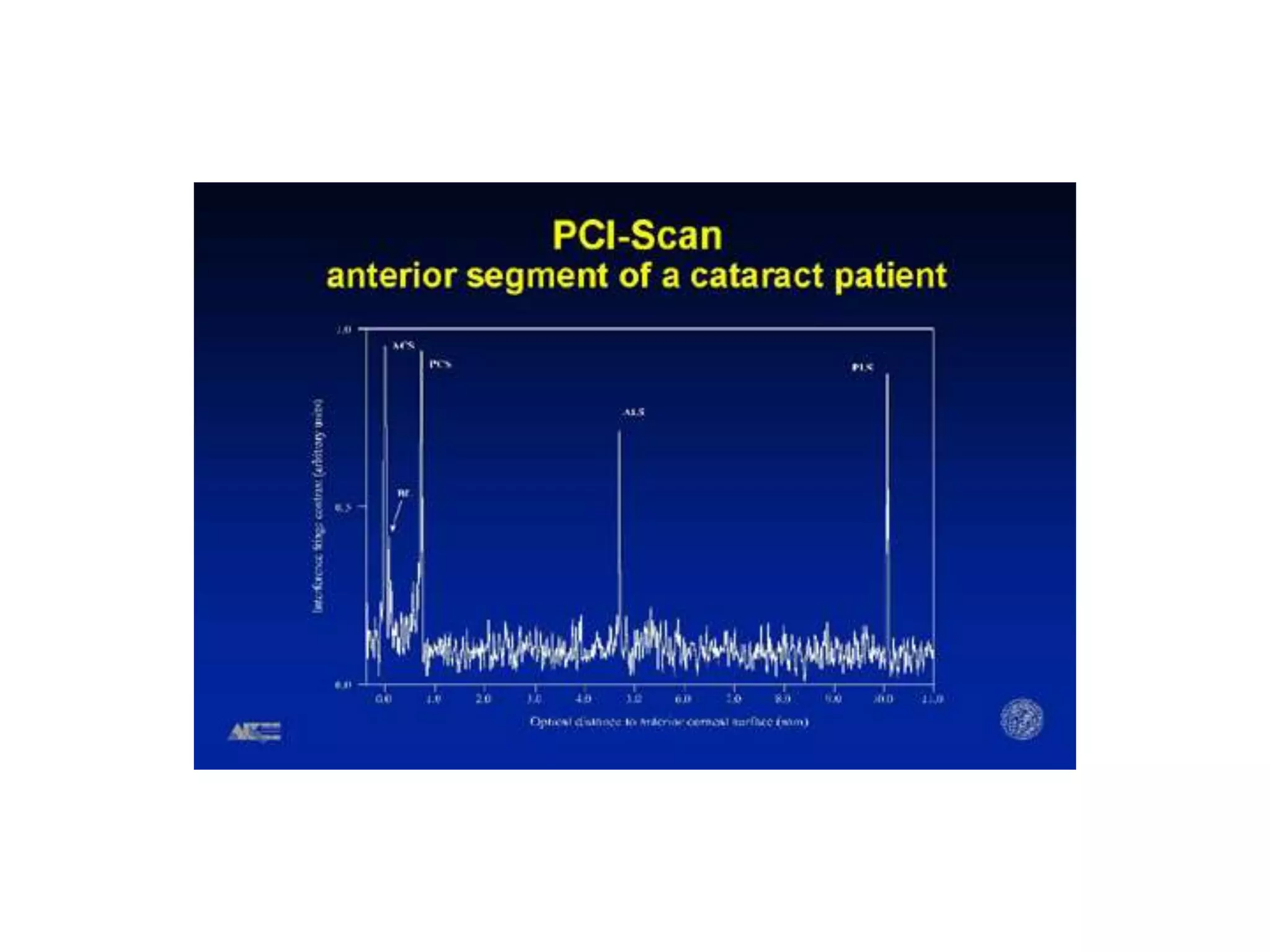
PCI
IOL Master Lenstar
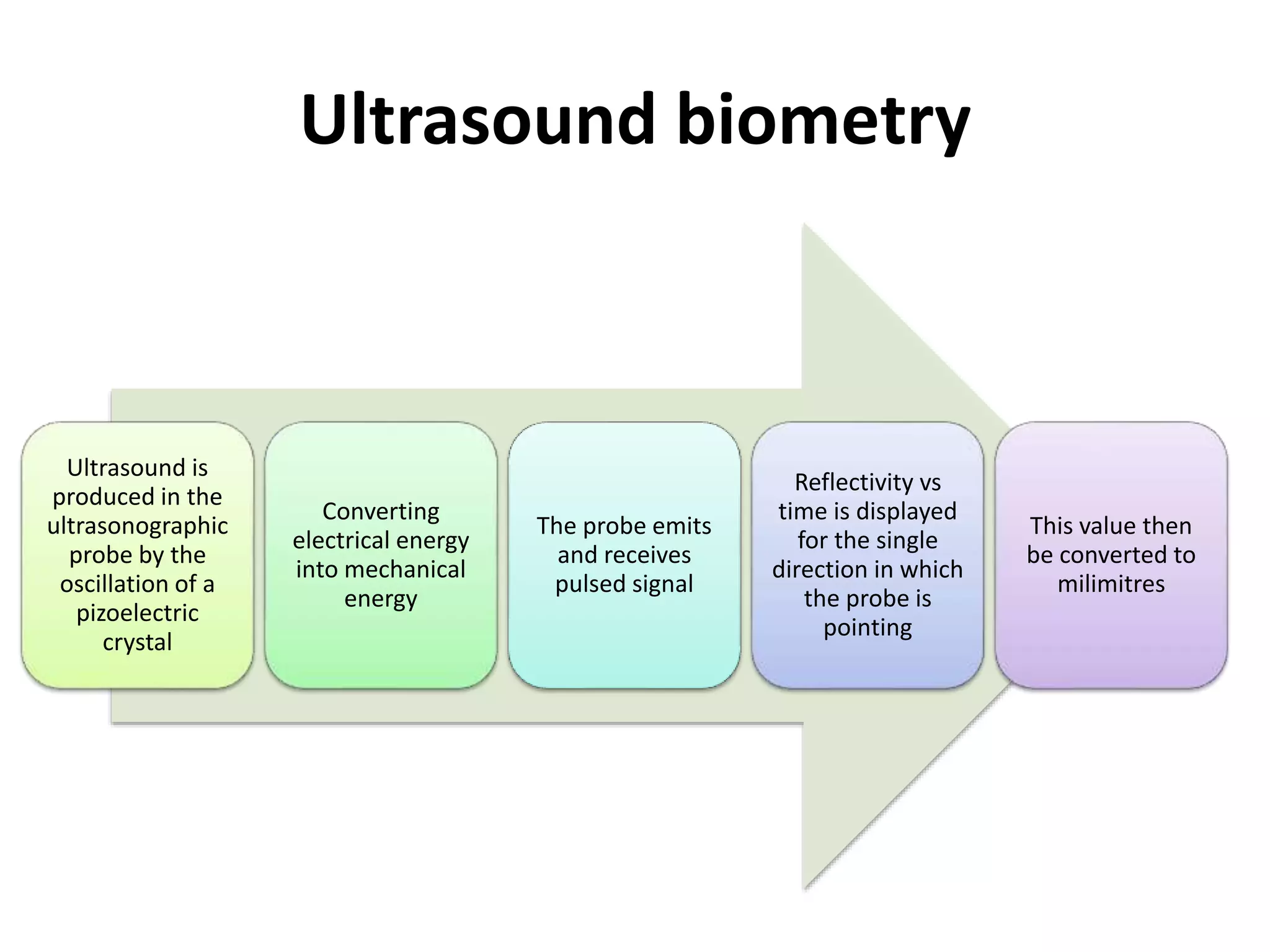
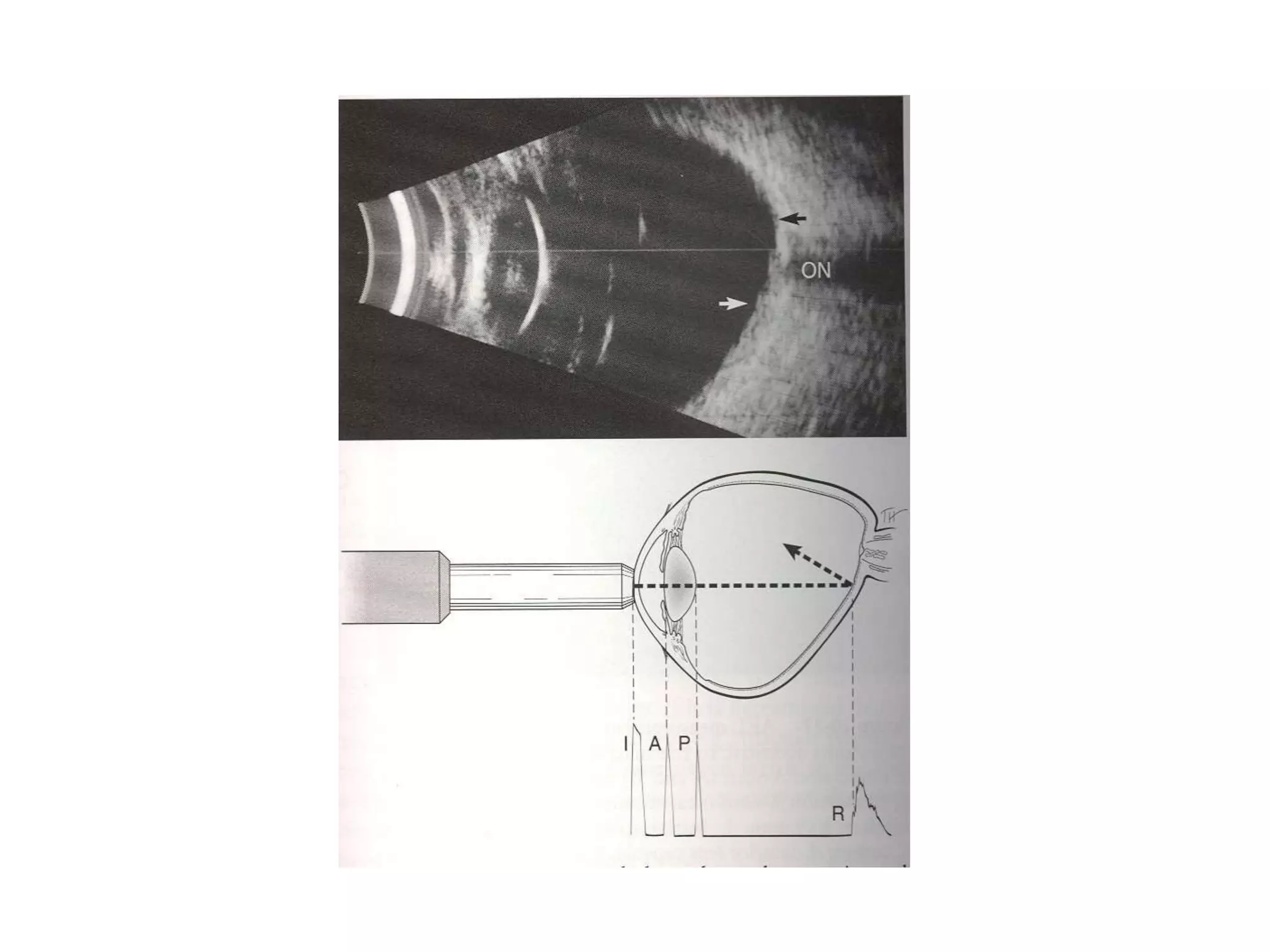
Ultrasound biometry
Ultrasound is
produced in the
ultrasonographic
probe by the
oscillation of a
pizoelectric
crystal
Converting
electrical energy
into mechanical
energy
The probe emits
and receives
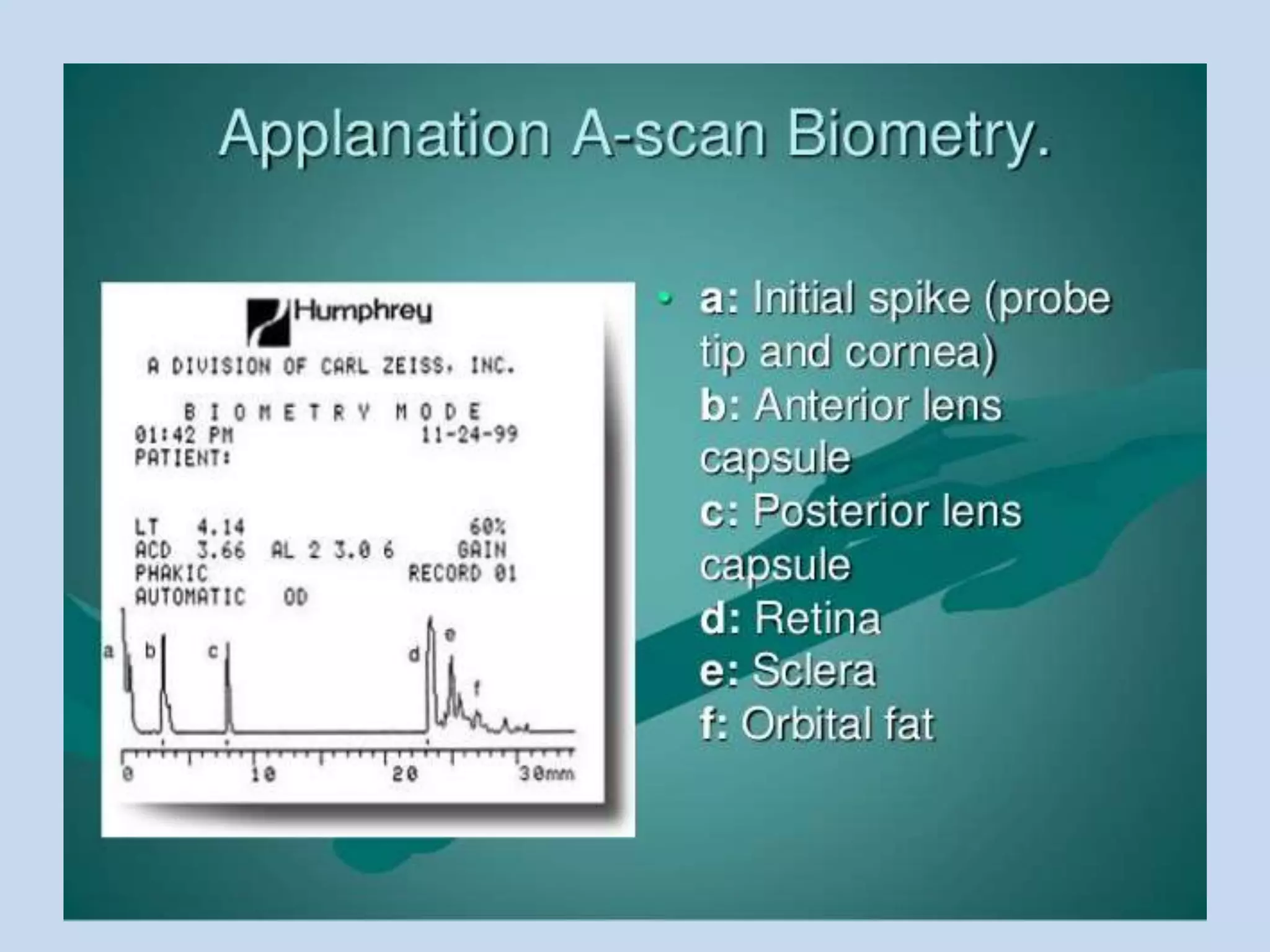
pulsed signal
Reflectivity vs
time is displayed
for the single
direction in which
the probe is
pointing
This value then
be converted to
milimitres
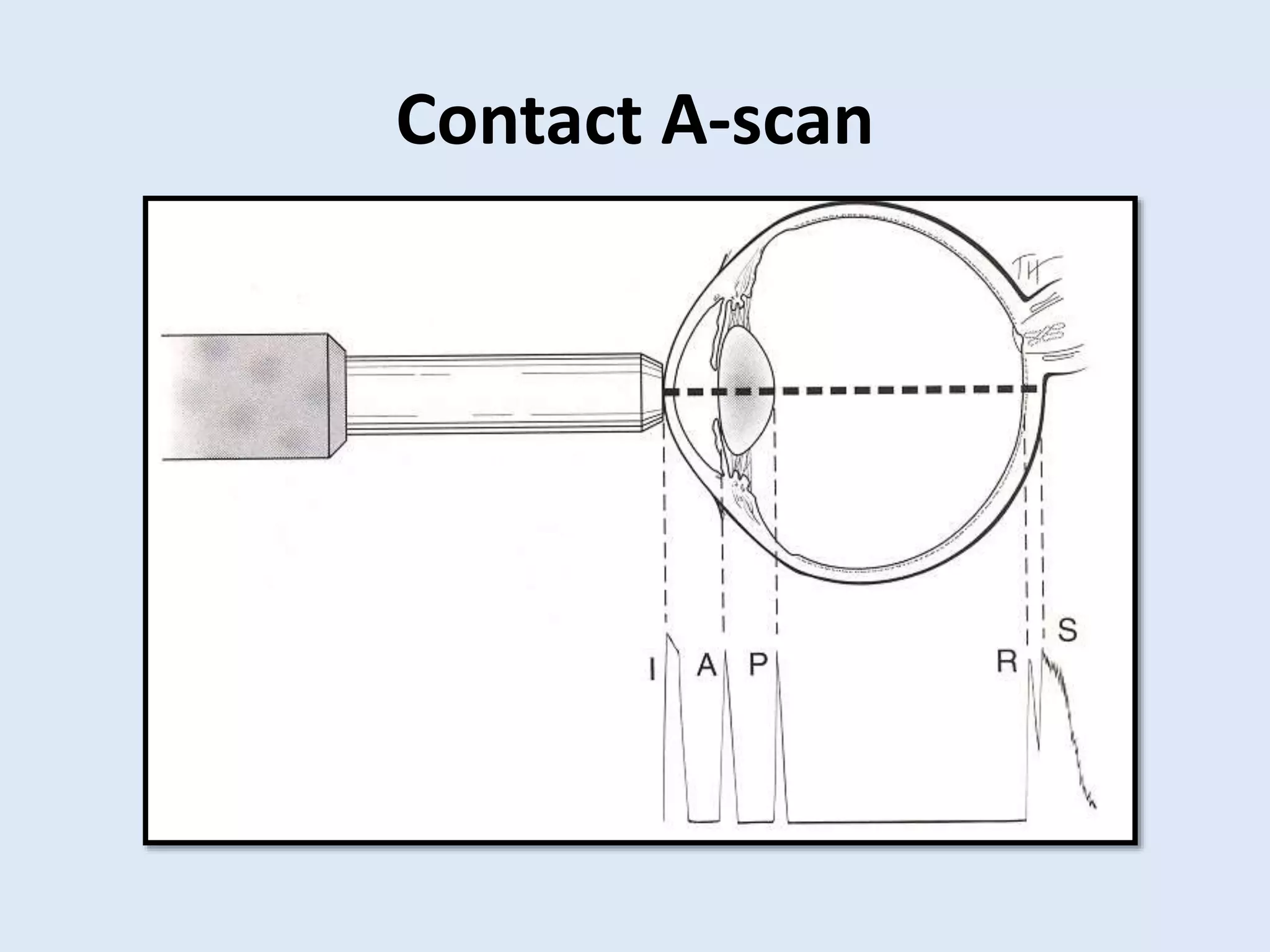
Contact A-scan
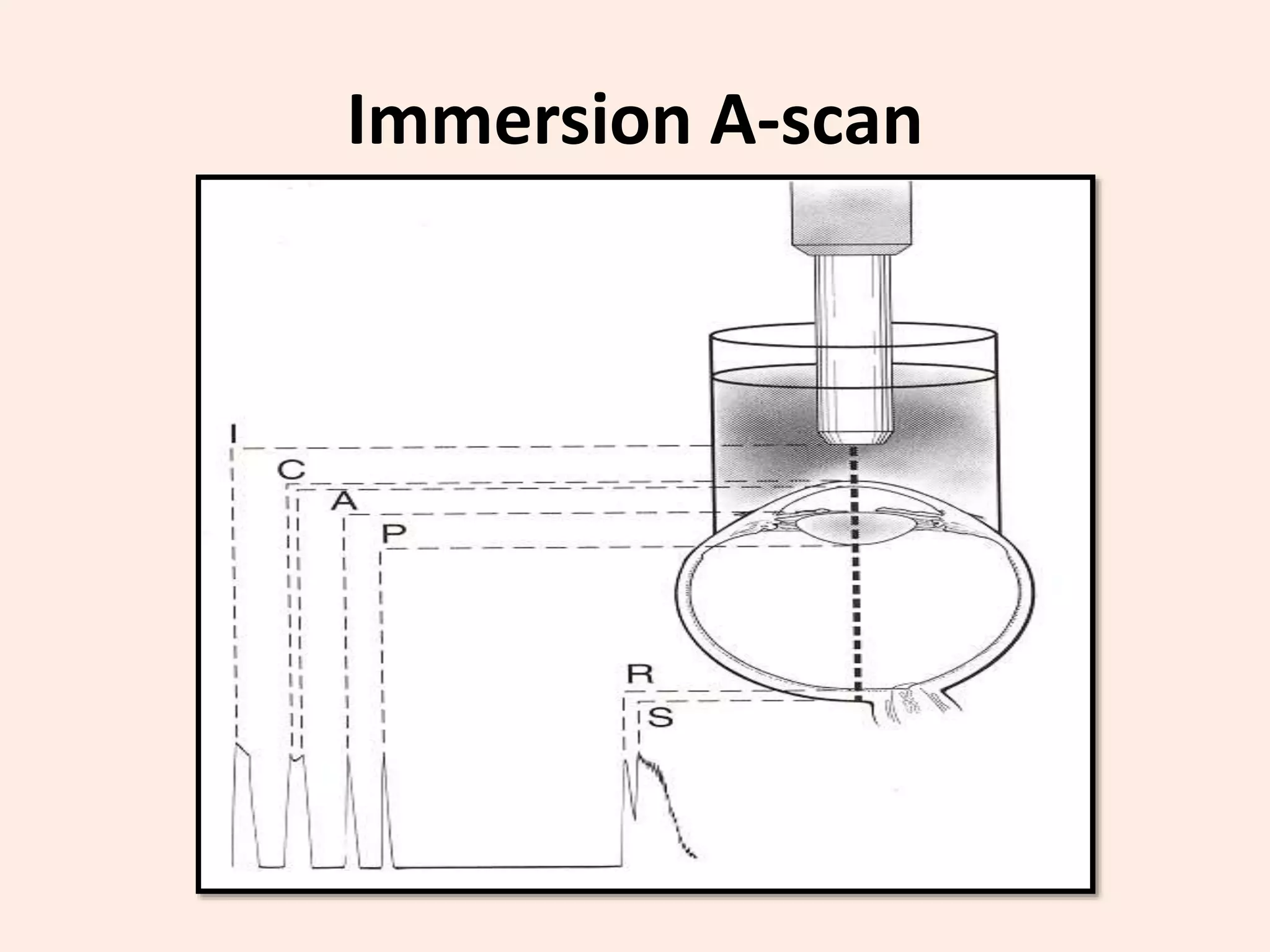
Immersion A-scan
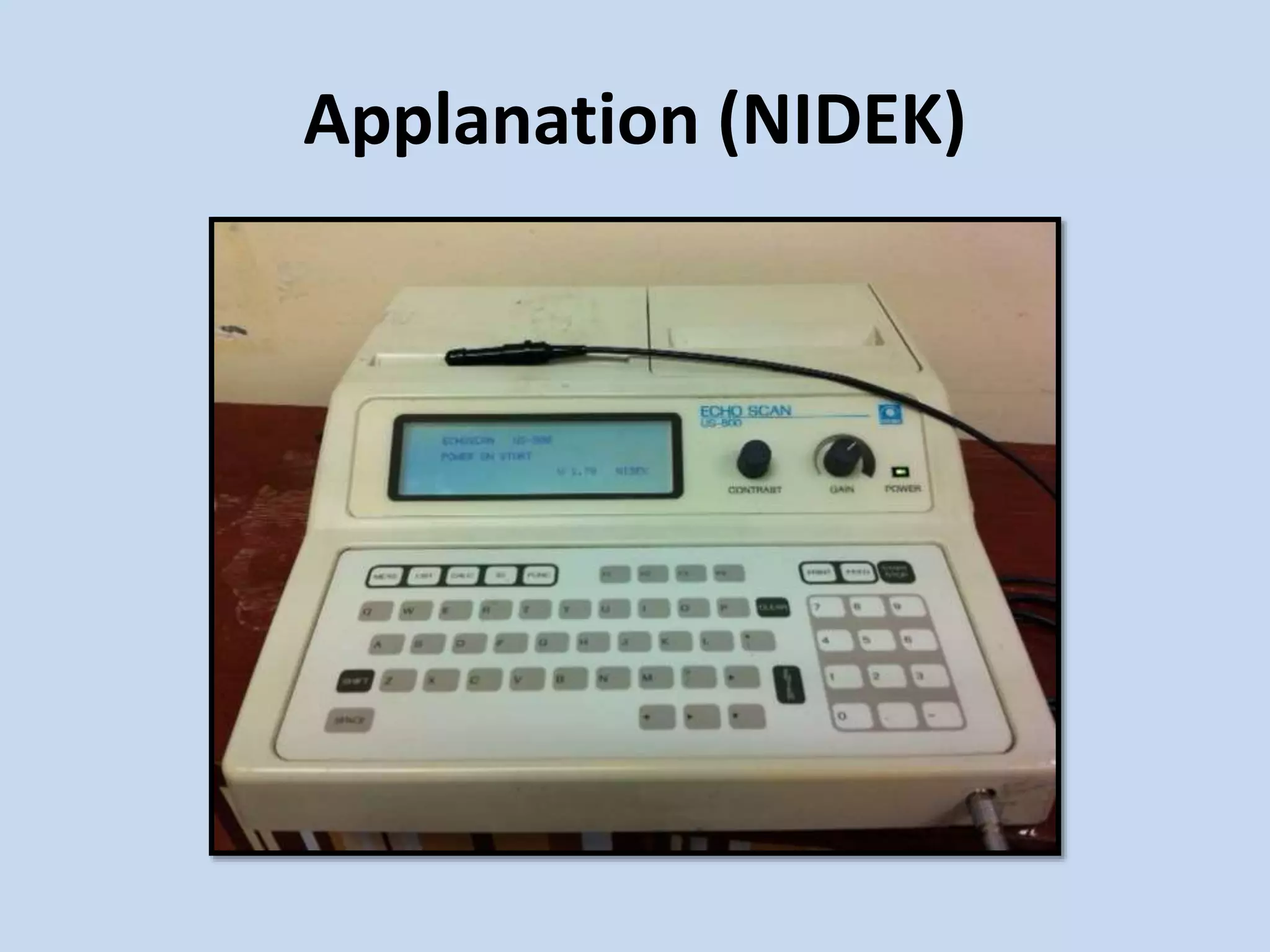
Applanation (NIDEK)
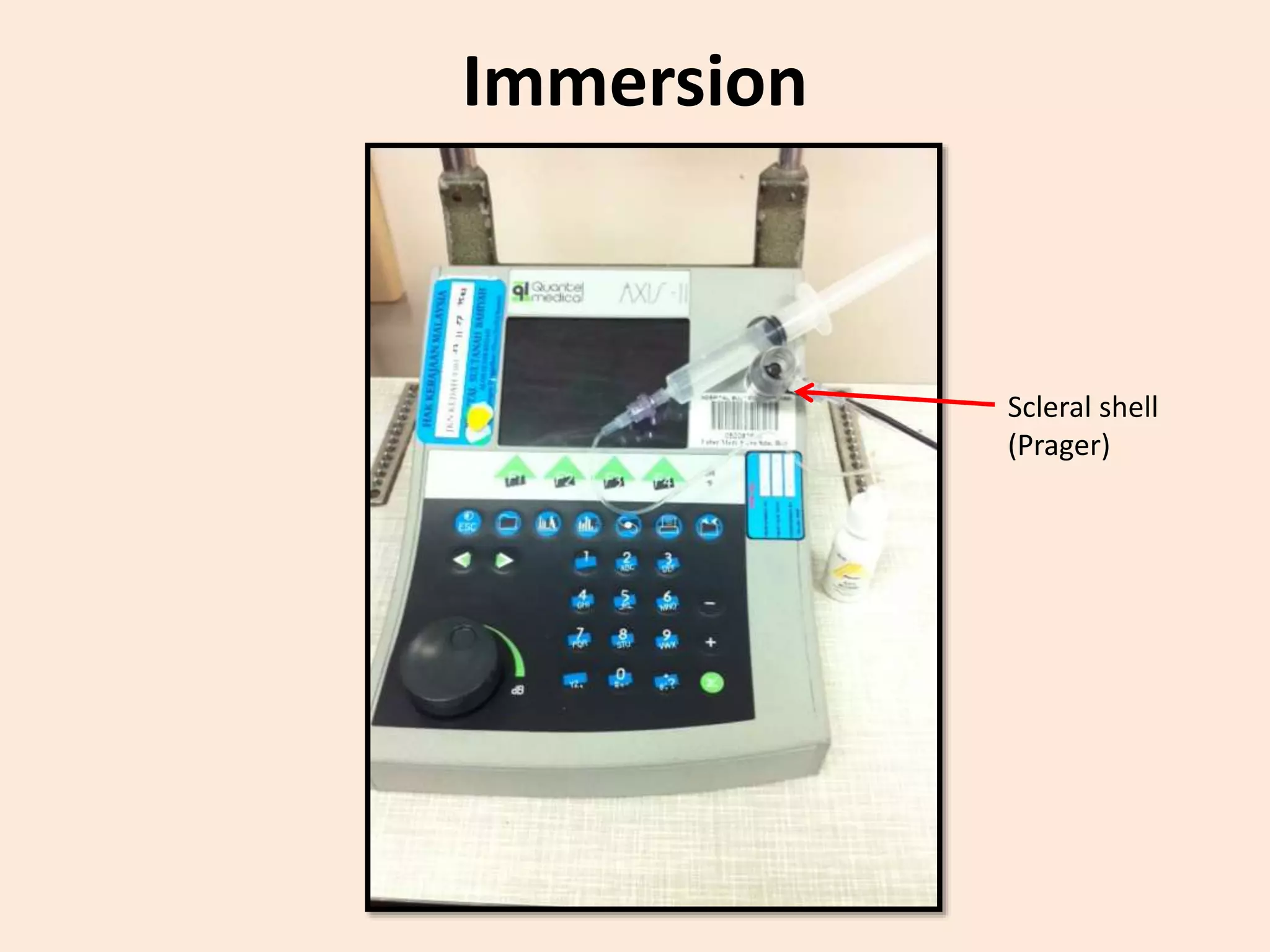
Immersion
Scleral shell
(Prager)
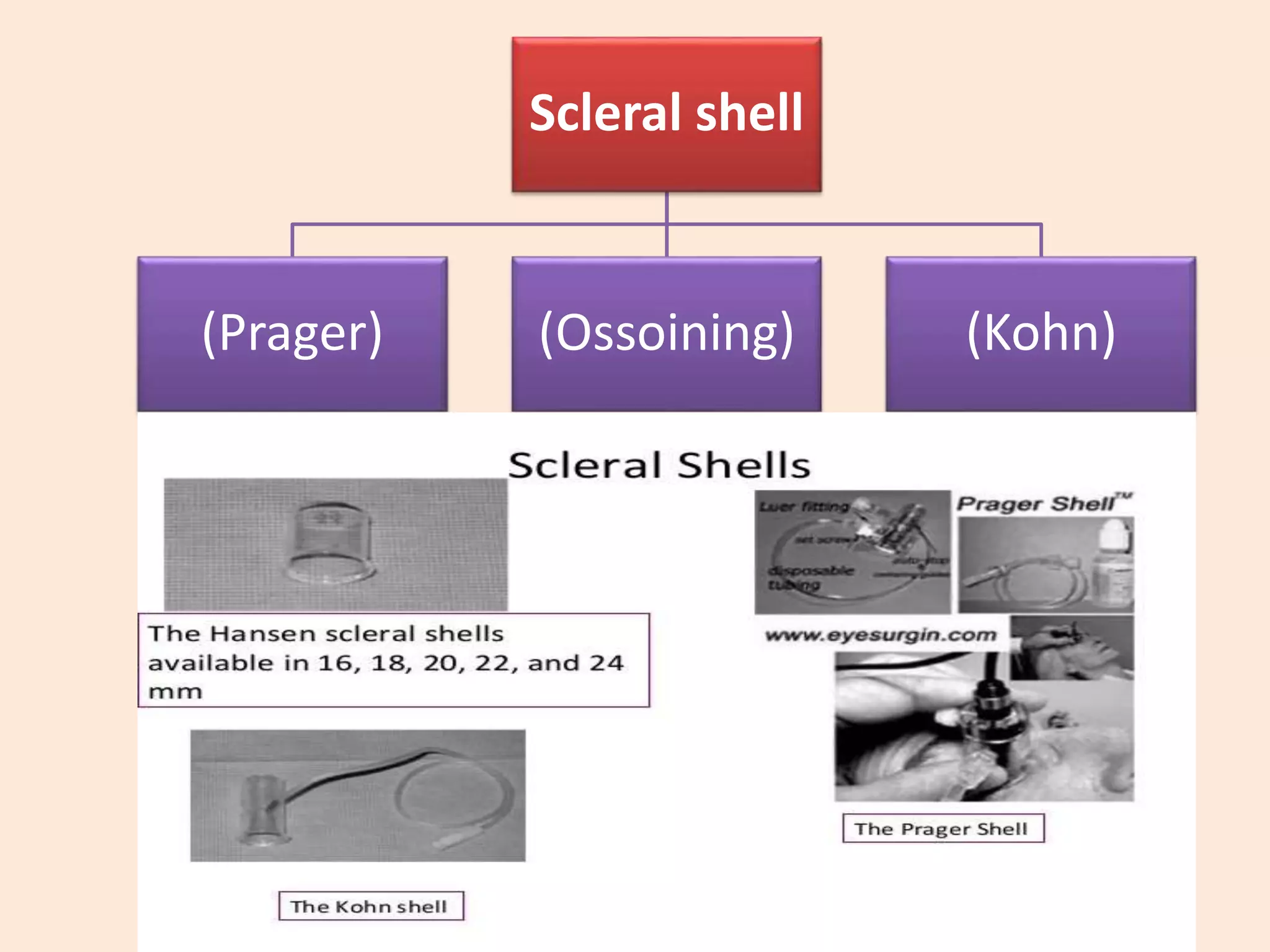
Scleral shell
(Prager) (Ossoining) (Kohn)
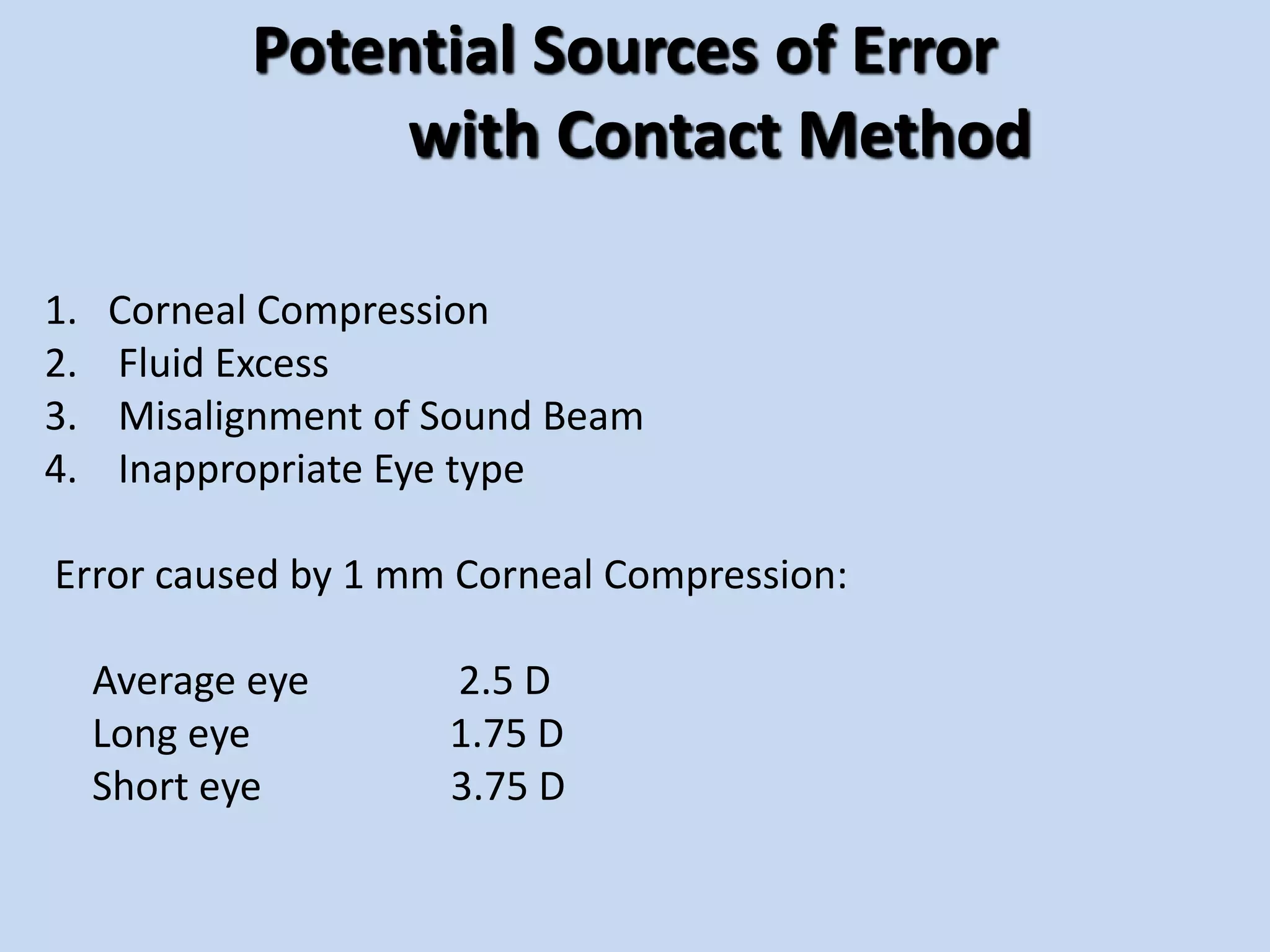
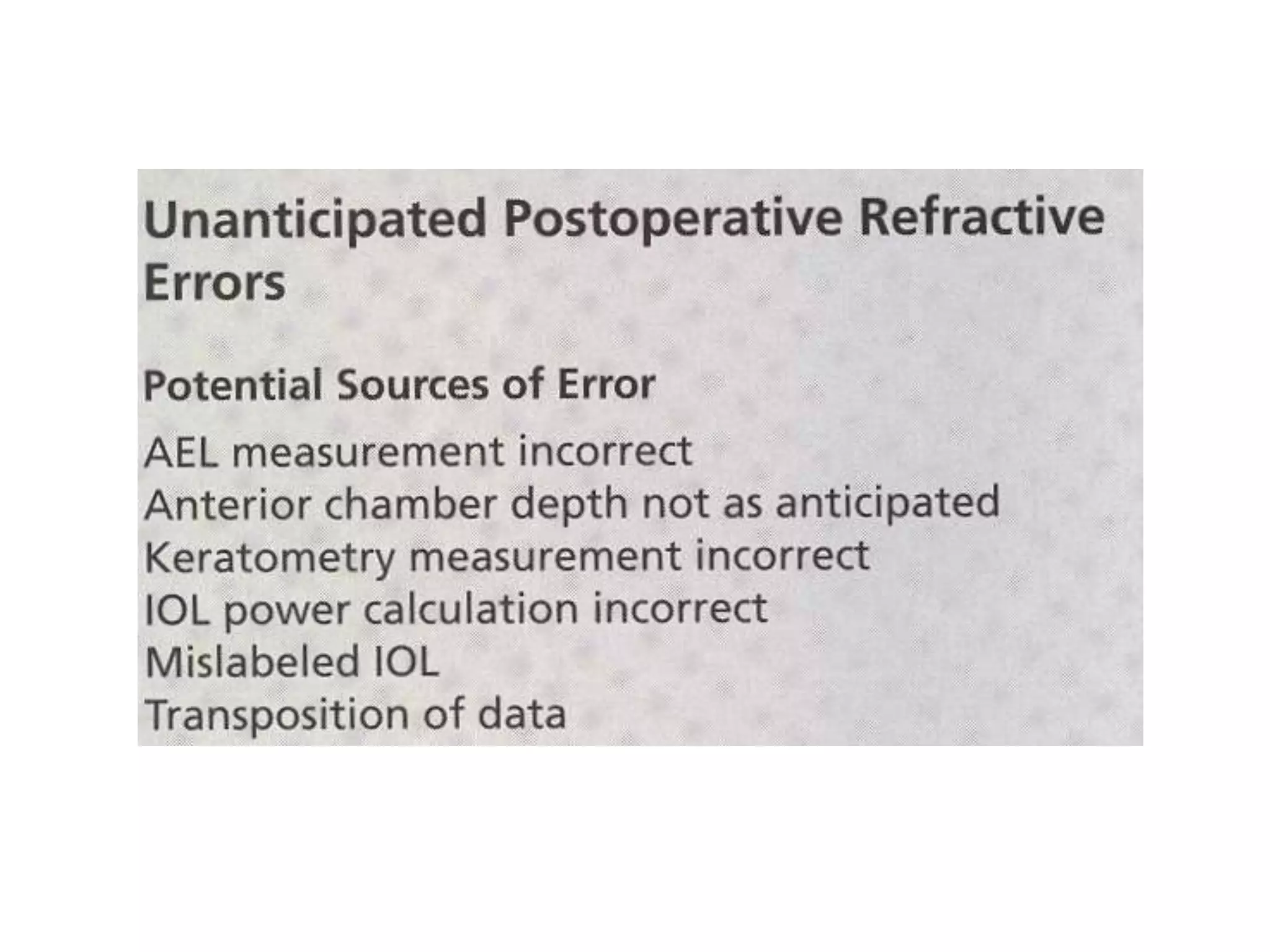
Potential Sources of Error
with Contact Method
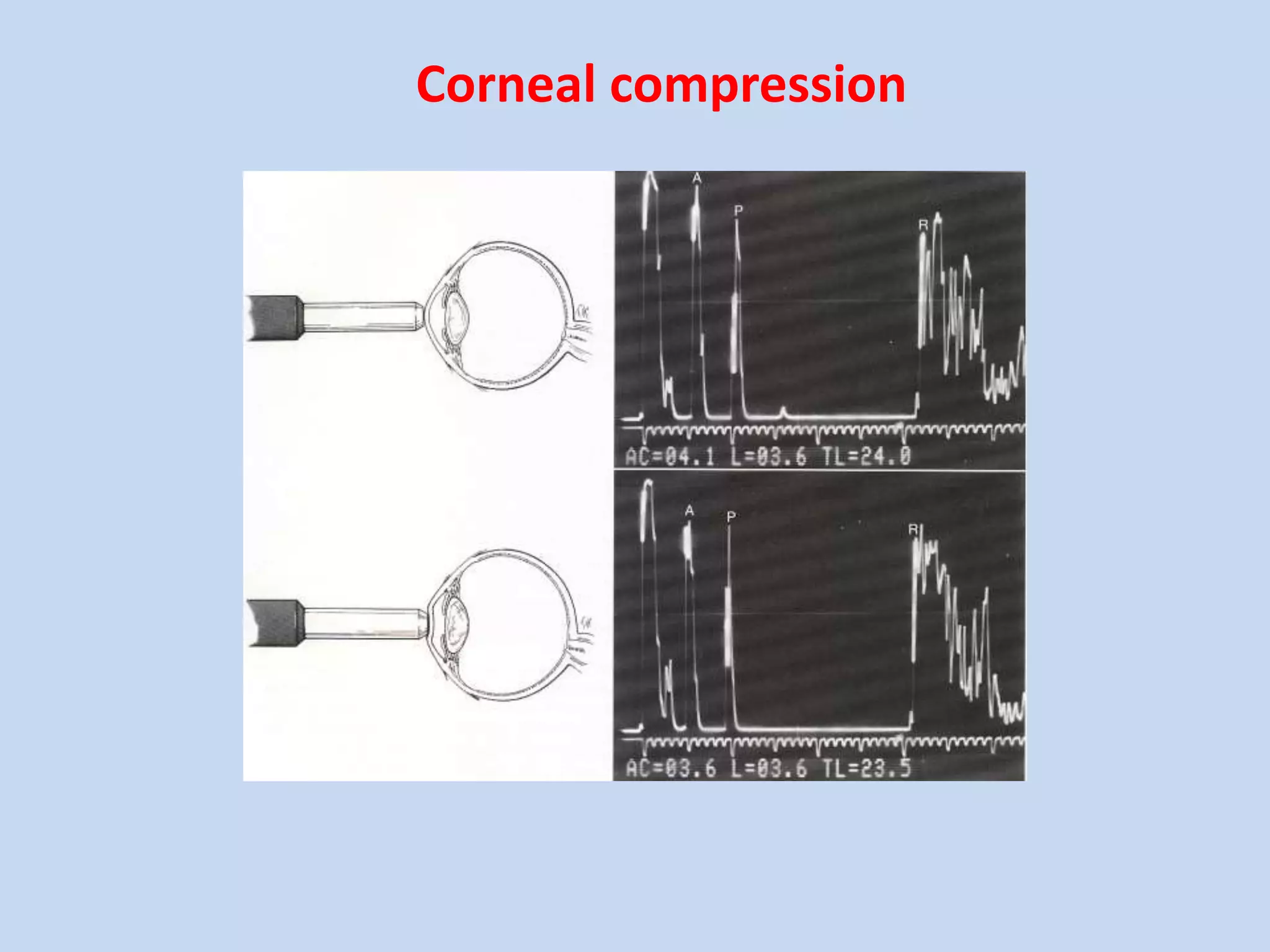
1. Corneal Compression
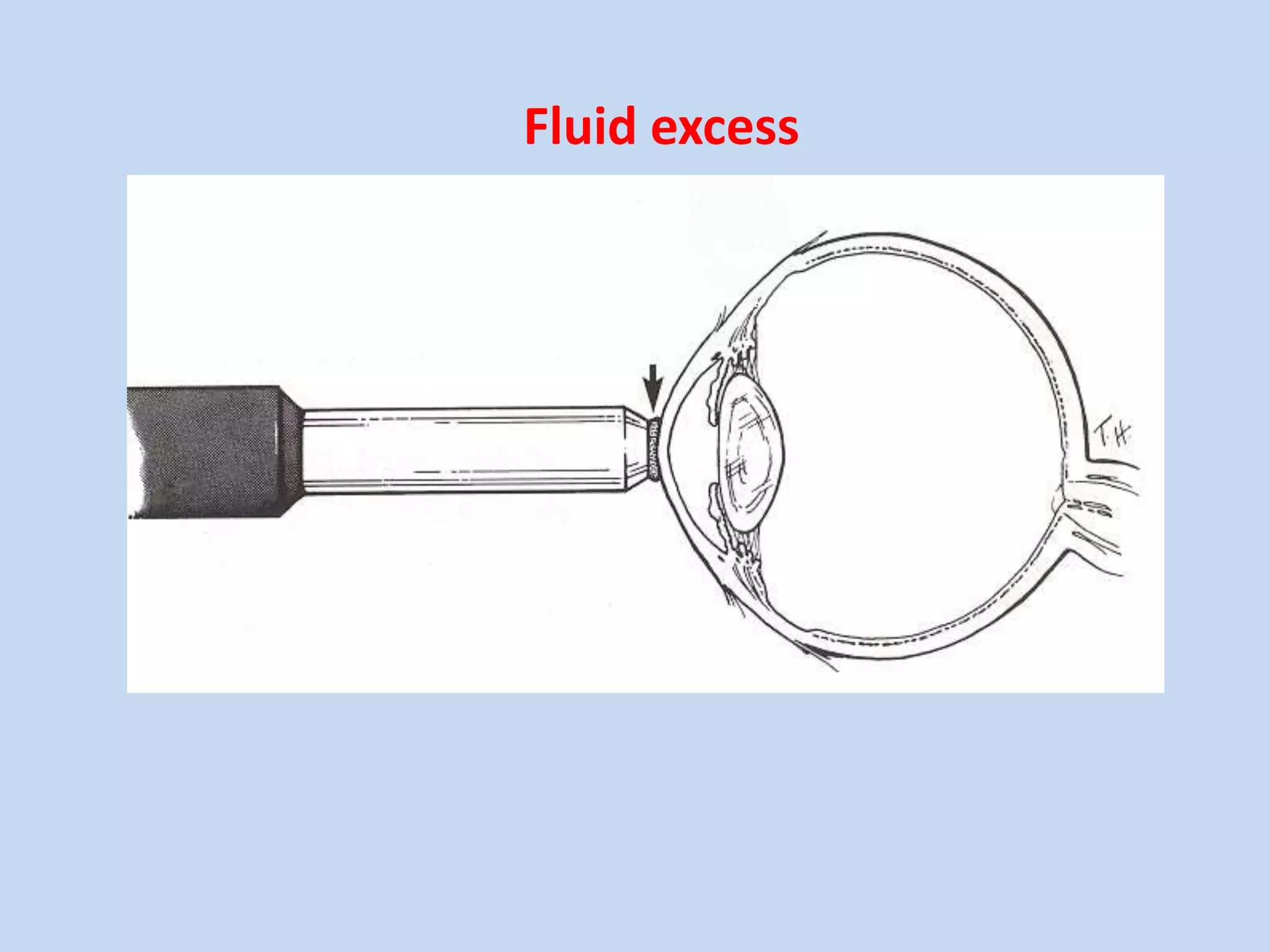
2. Fluid Excess
3. Misalignment of Sound Beam
4. Inappropriate Eye type
Error caused by 1 mm Corneal Compression:
Average eye 2.5 D
Long eye 1.75 D
Short eye 3.75 D
Corneal compression
Fluid excess
Potential Sources of Error
with Immersion Method
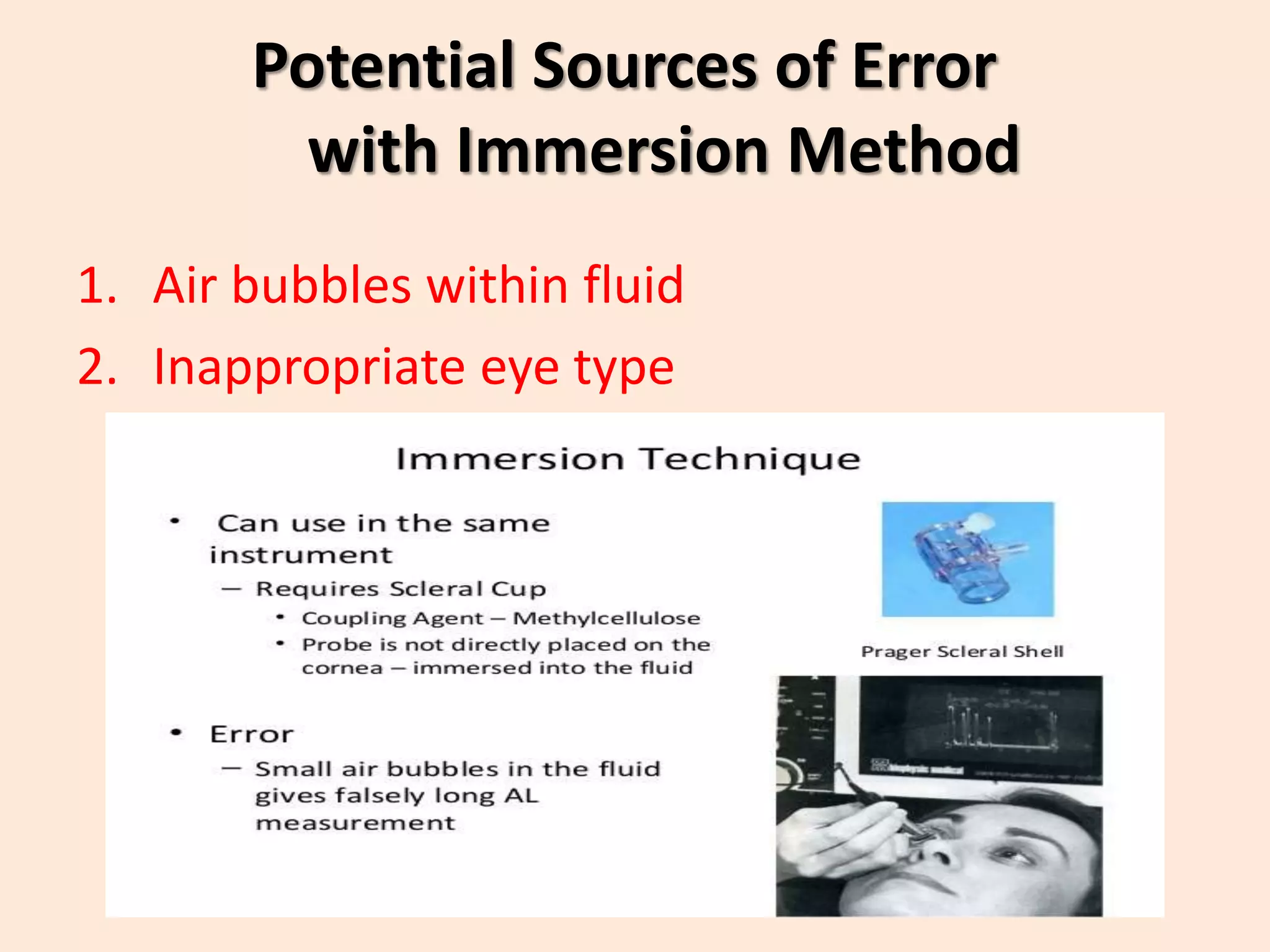
1. Air bubbles within fluid
2. Inappropriate eye type
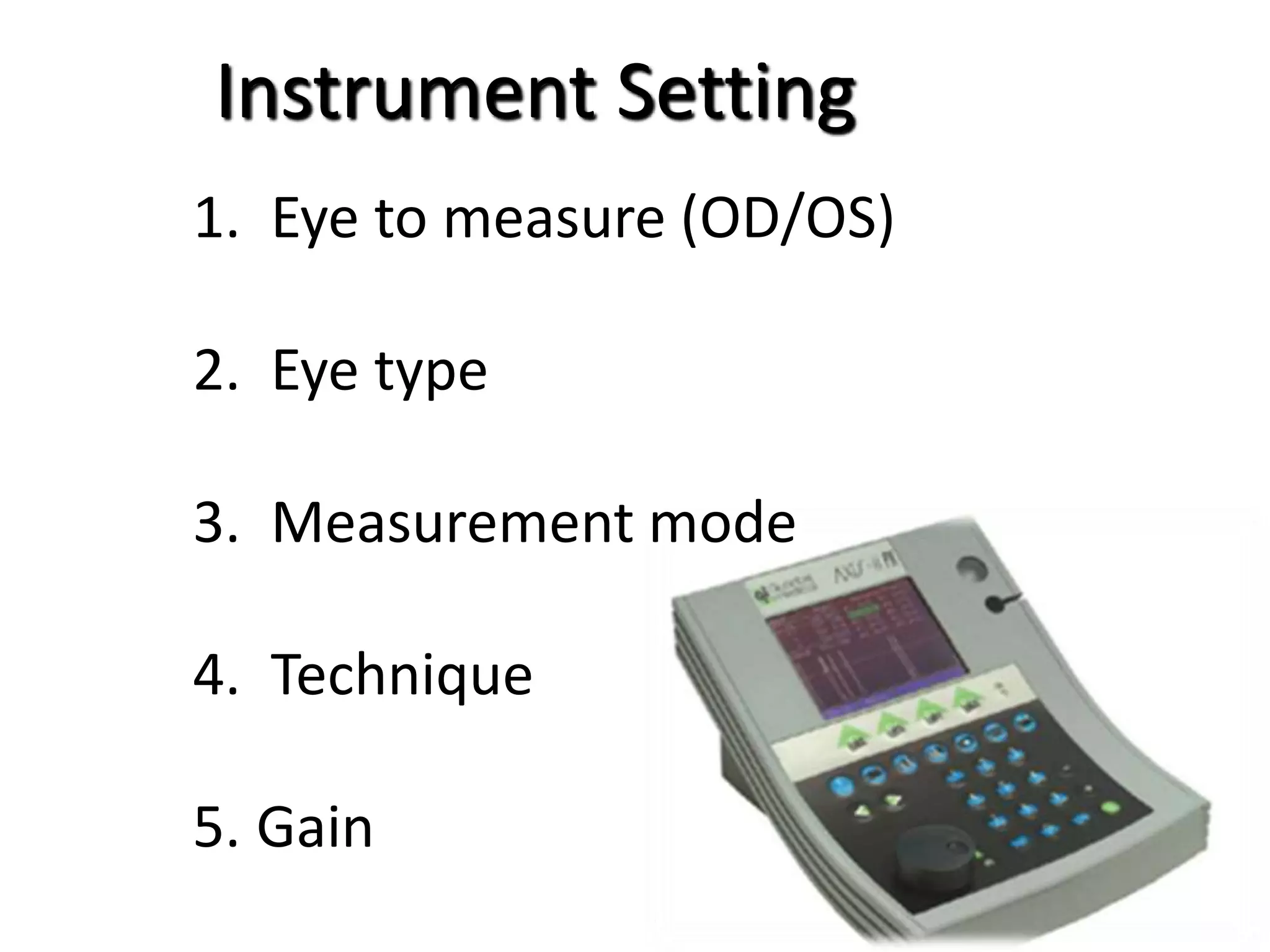
Instrument Setting
1. Eye to measure (OD/OS)
2. Eye type
3. Measurement mode
4. Technique
5. Gain
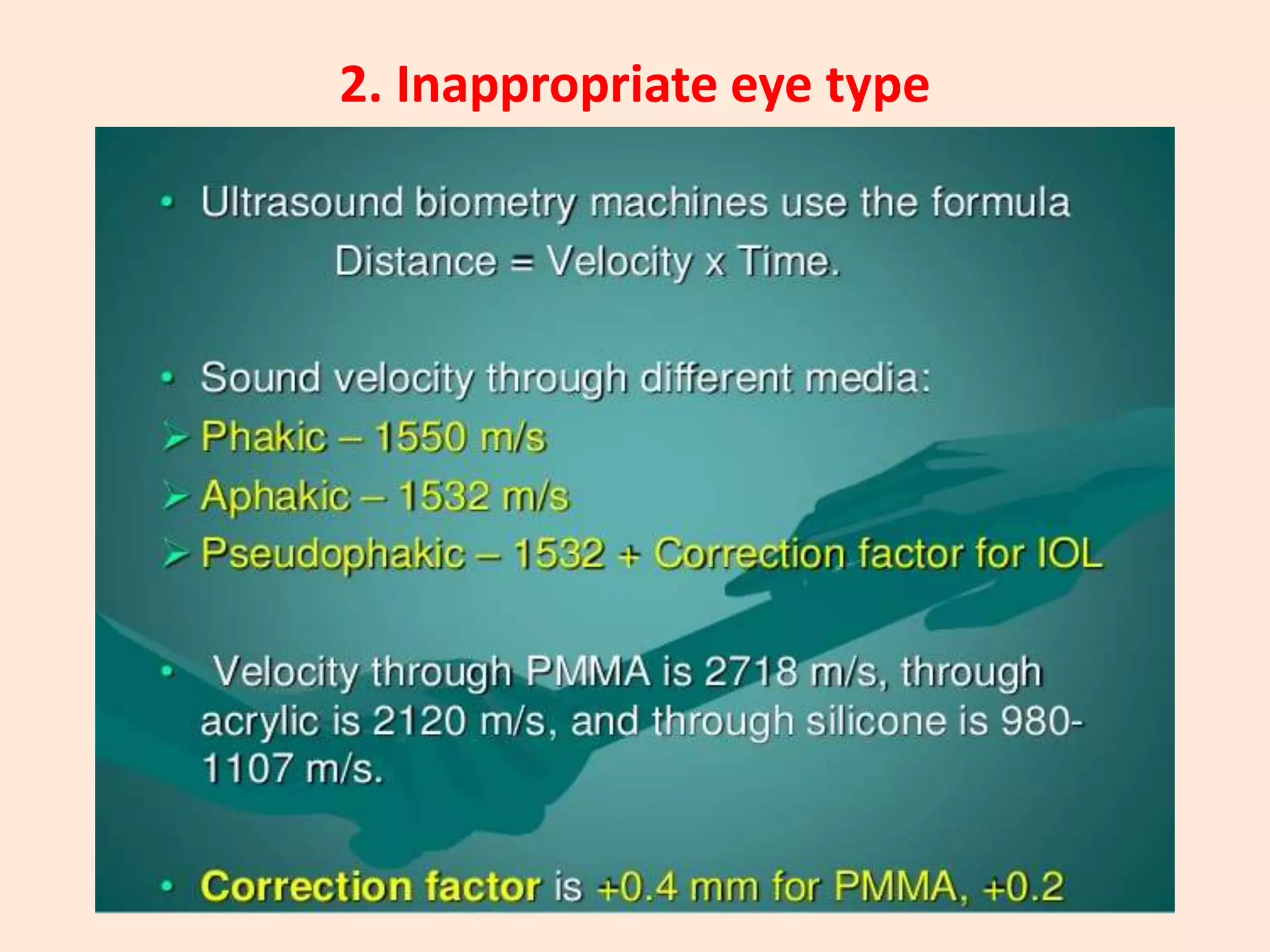
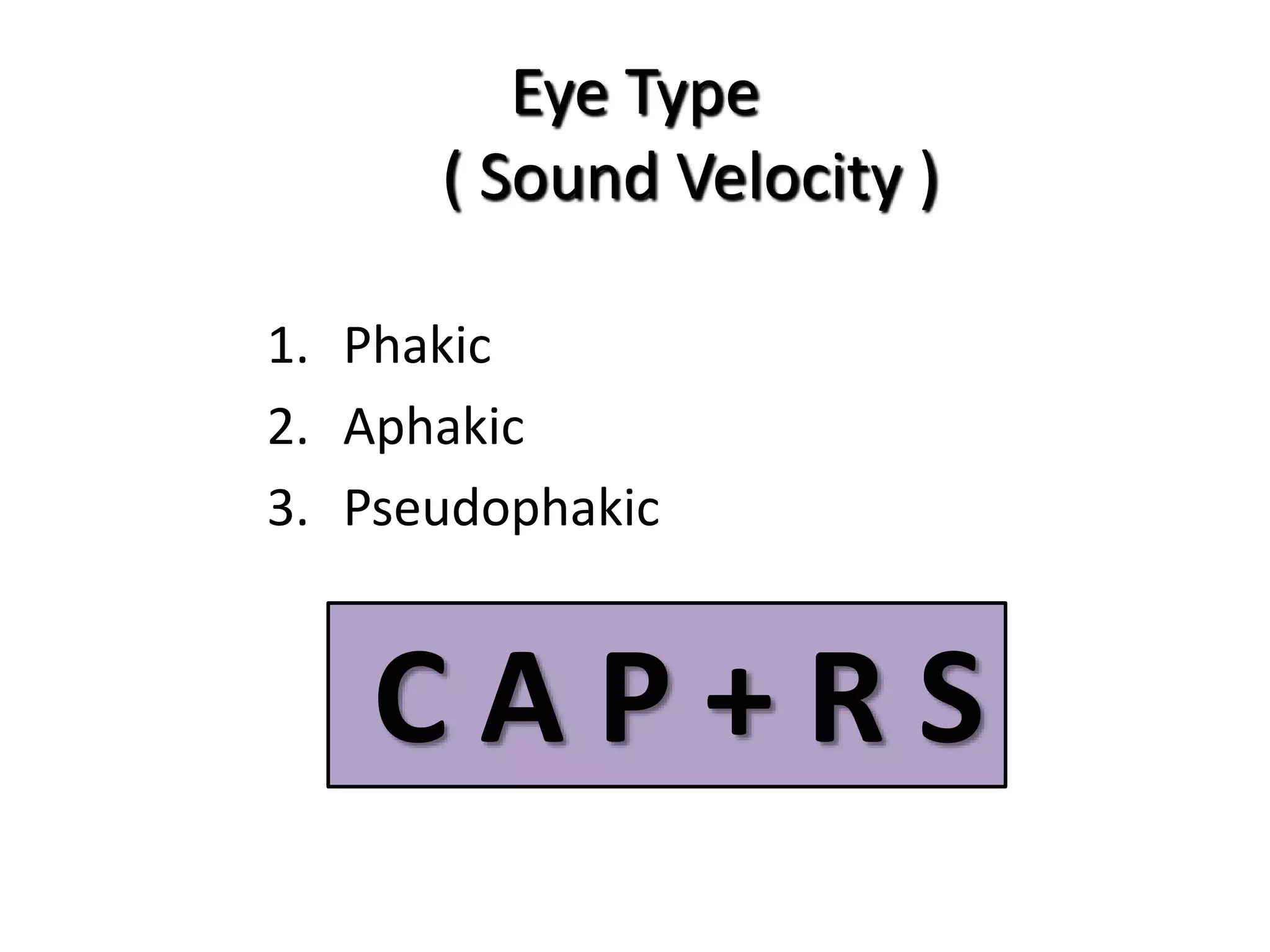
Eye Type
( Sound Velocity )
1. Phakic
2. Aphakic
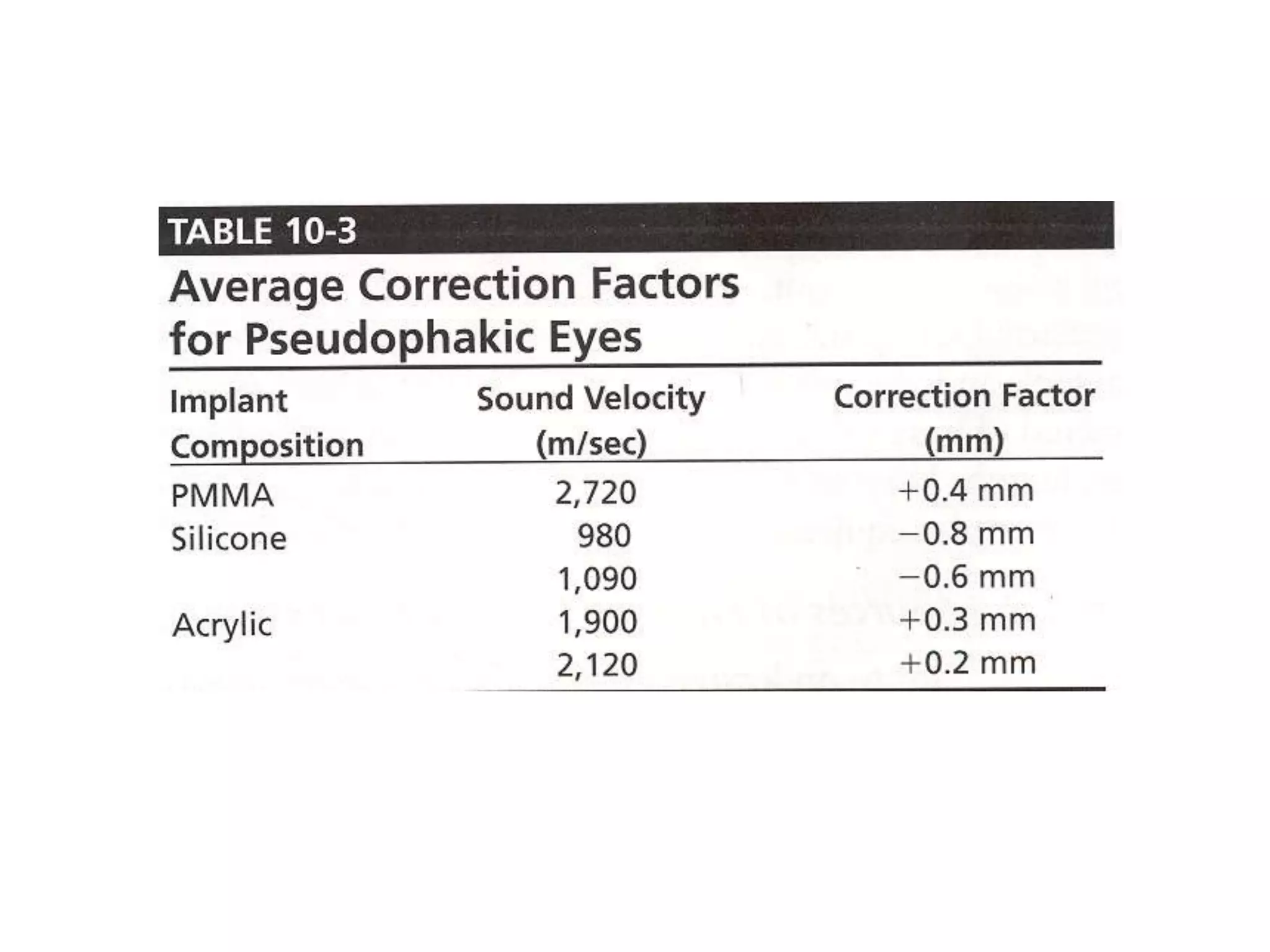
3. Pseudophakic
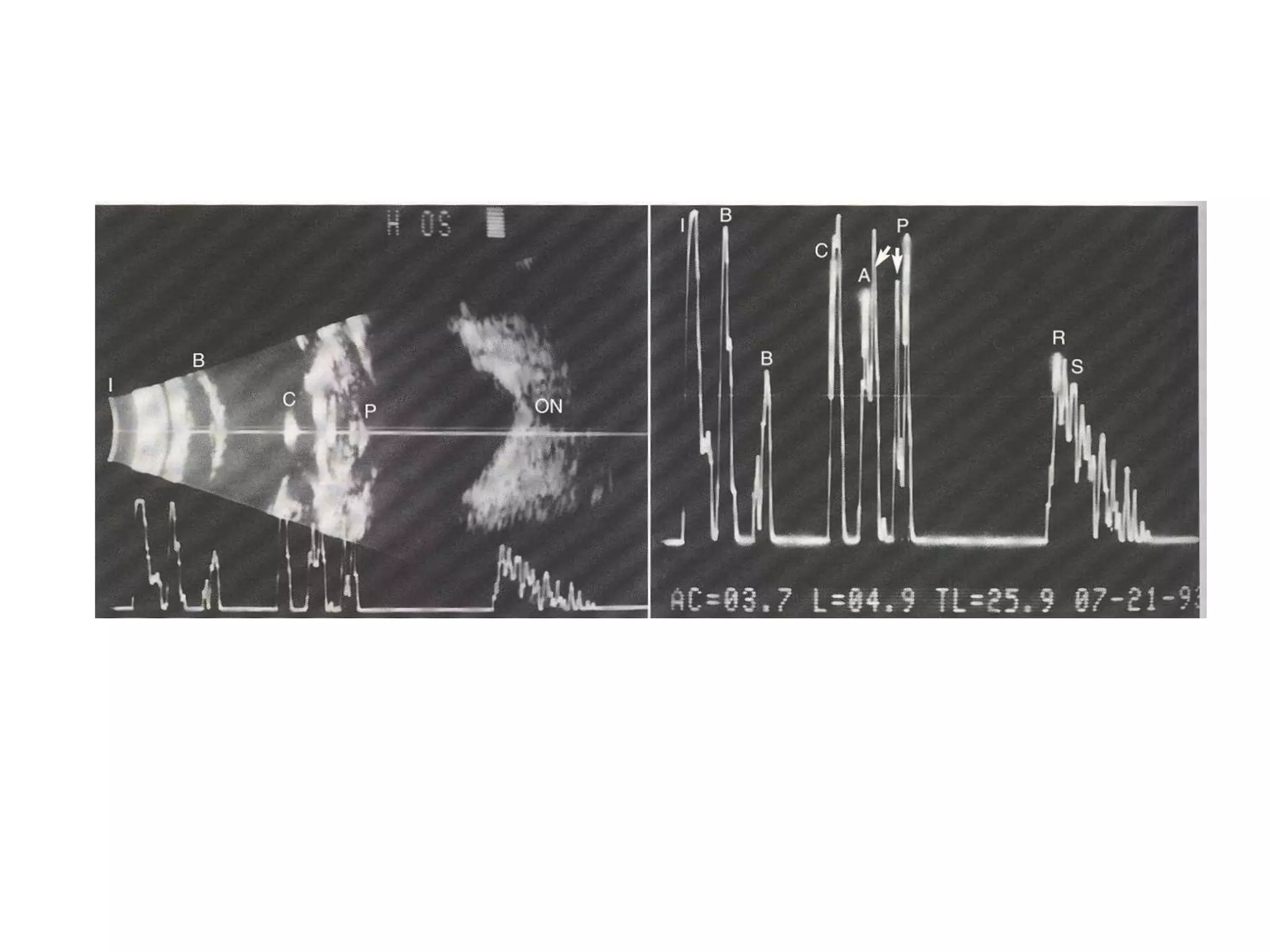
C A P + R S
Measurement Mode
 Automatic
 Semiautomatic
 Manual
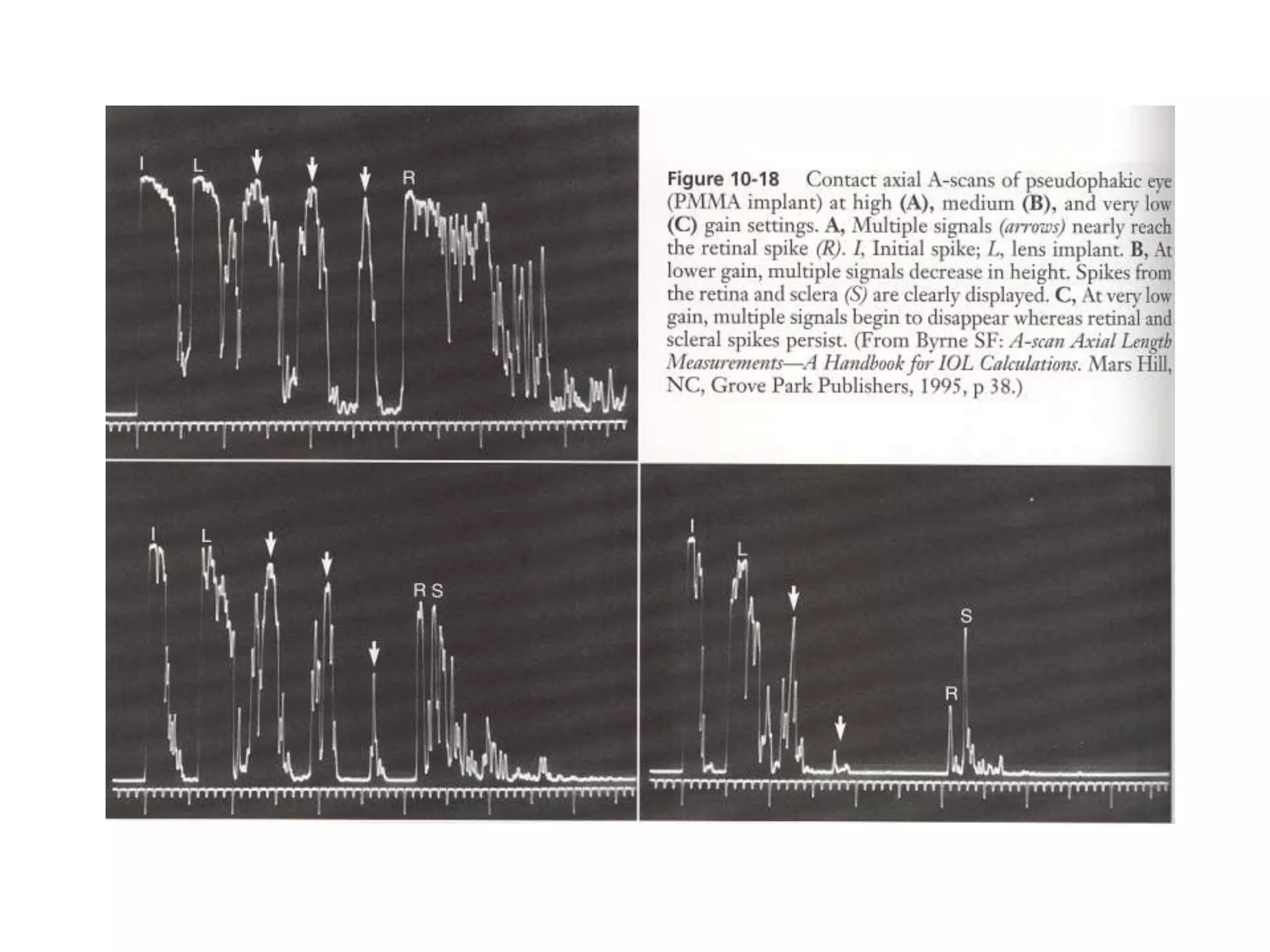
Gain Setting
• Initially high gain setting should be used to assess the overall
appearance of the echogram , then gain should be reduced to a
medium level to improve resolution of spikes .
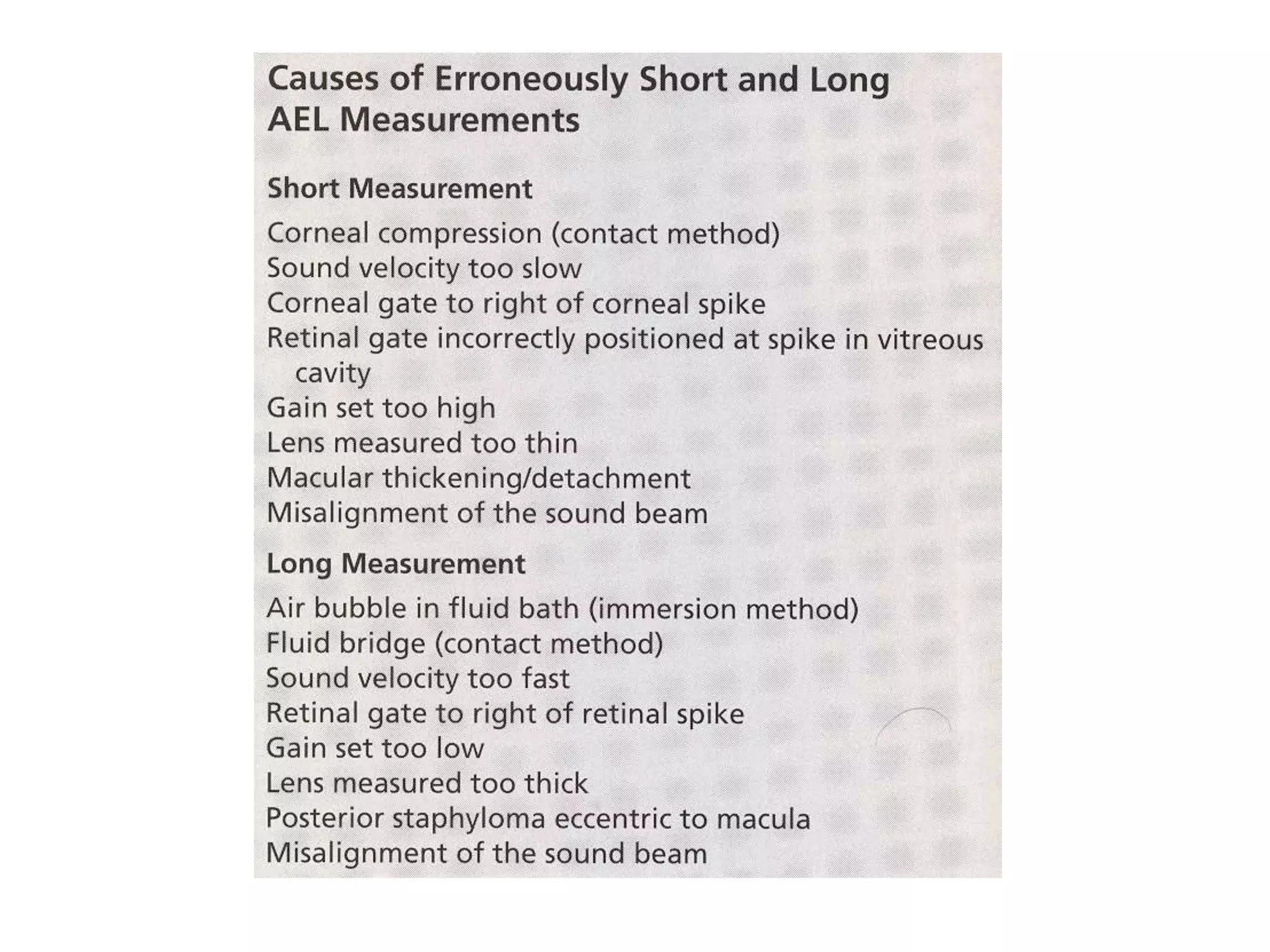
• Error can occur when the gain is set too high or too low .
Very high gain : short reading
Very low gain : long reading
Use of average sound velocity ,although
sufficient in normal phakic eye , may
result in slight error when the lens is
inordinately thin or thick or when the
eye is very short or very long .
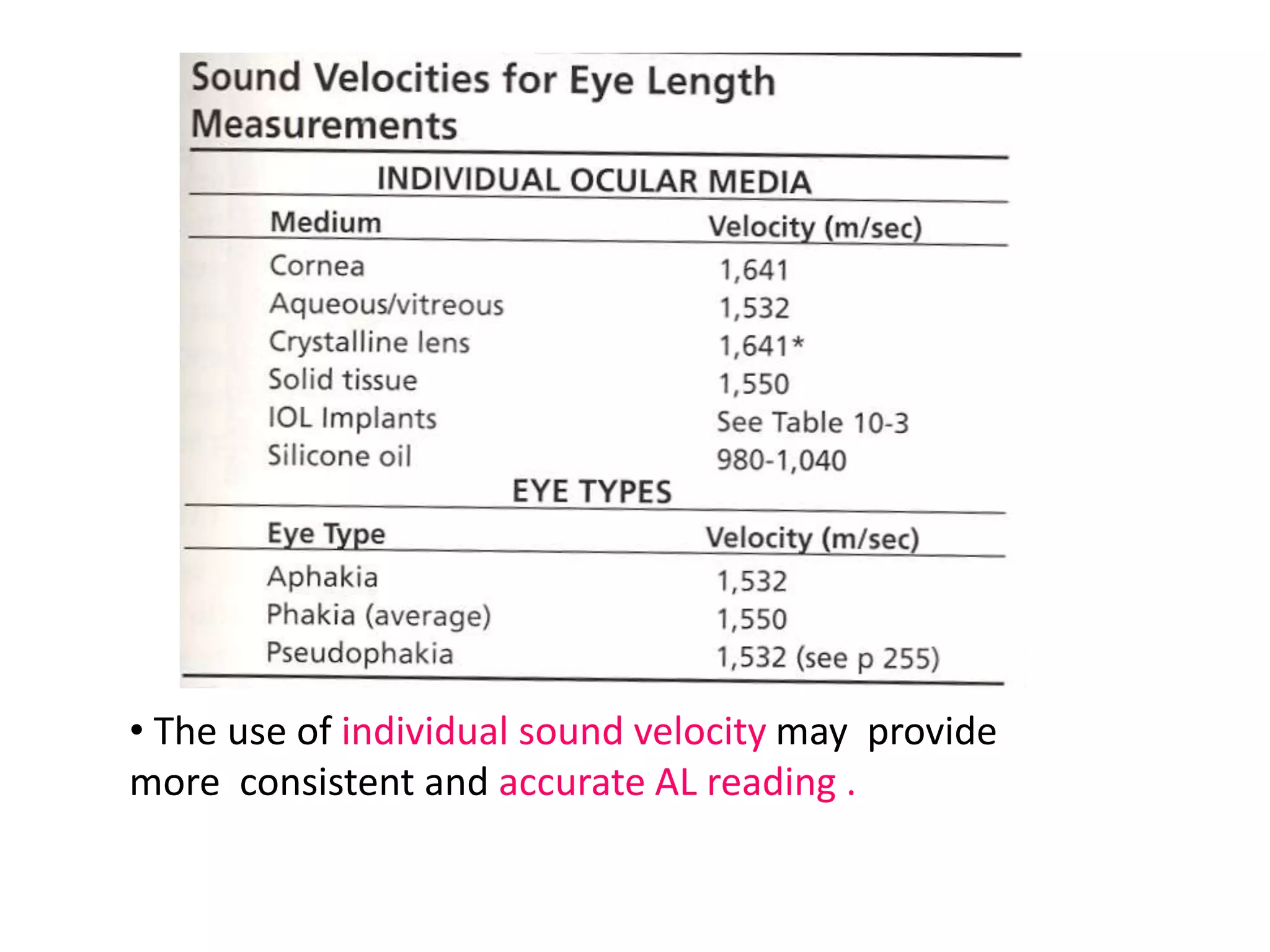
• The use of individual sound velocity may provide
more consistent and accurate AL reading .
• Manual measurement mode is better to help
ensure alignment of sound beam .
Aphakia & Pseudophakia
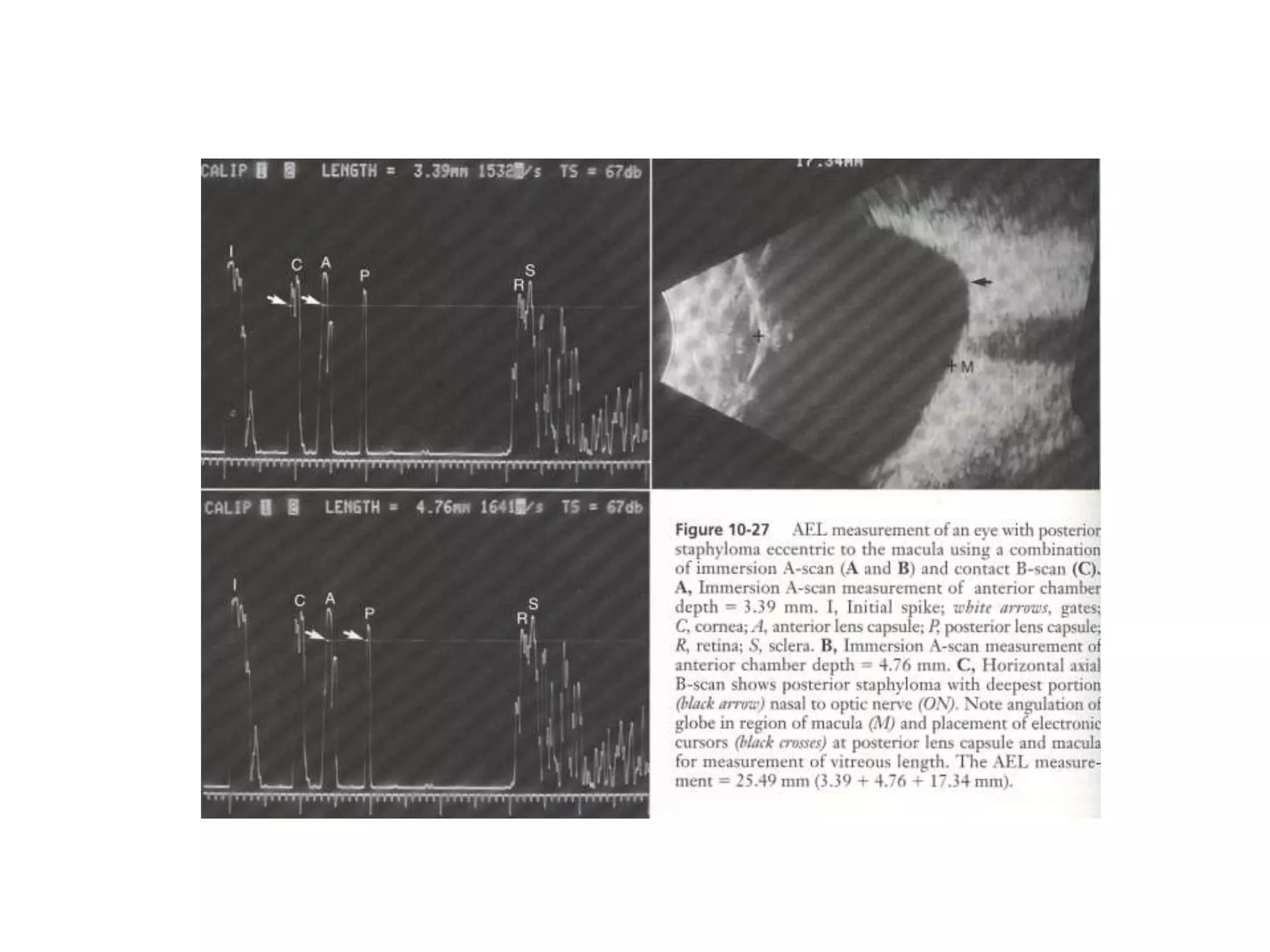
Posterior Staphyloma
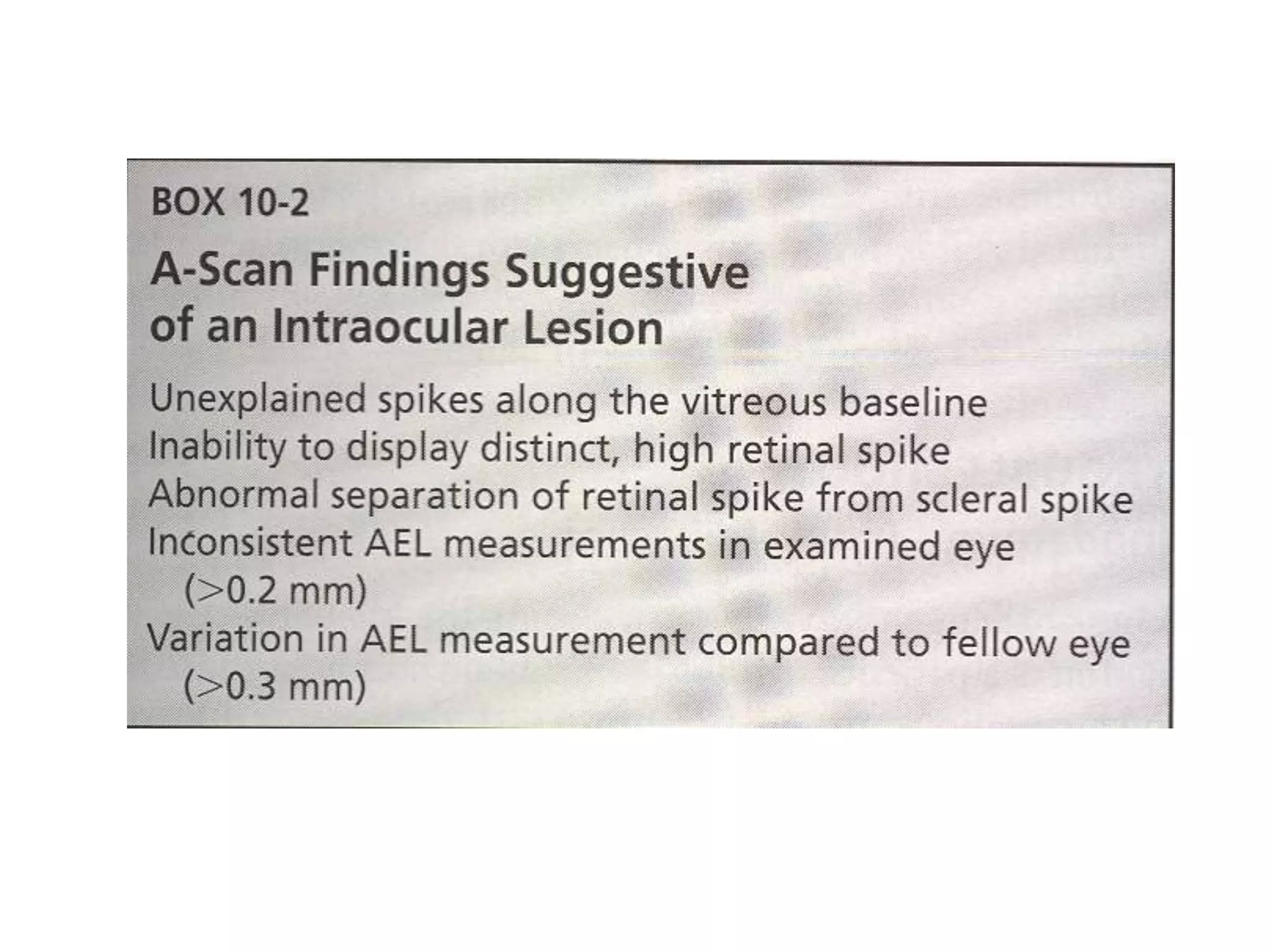
• Posterior staphylomas often causes an irregular shape of the ocular wall
resulting in an inability to display a distinct , high retinal spike , leading to a
significant error in A-scan measurement .
• Deepest portion of the staphyloma may be located eccentric to macula thus the
measurement may be longer than true AL along the visual axis .
• B-scan can be used to demonstrate the shape of posterior ocular wall and the
relationship of macula to the staphyloma .
• Probes with fixation light are preferable
High Hyperopia
• Immersion technique is preferable .
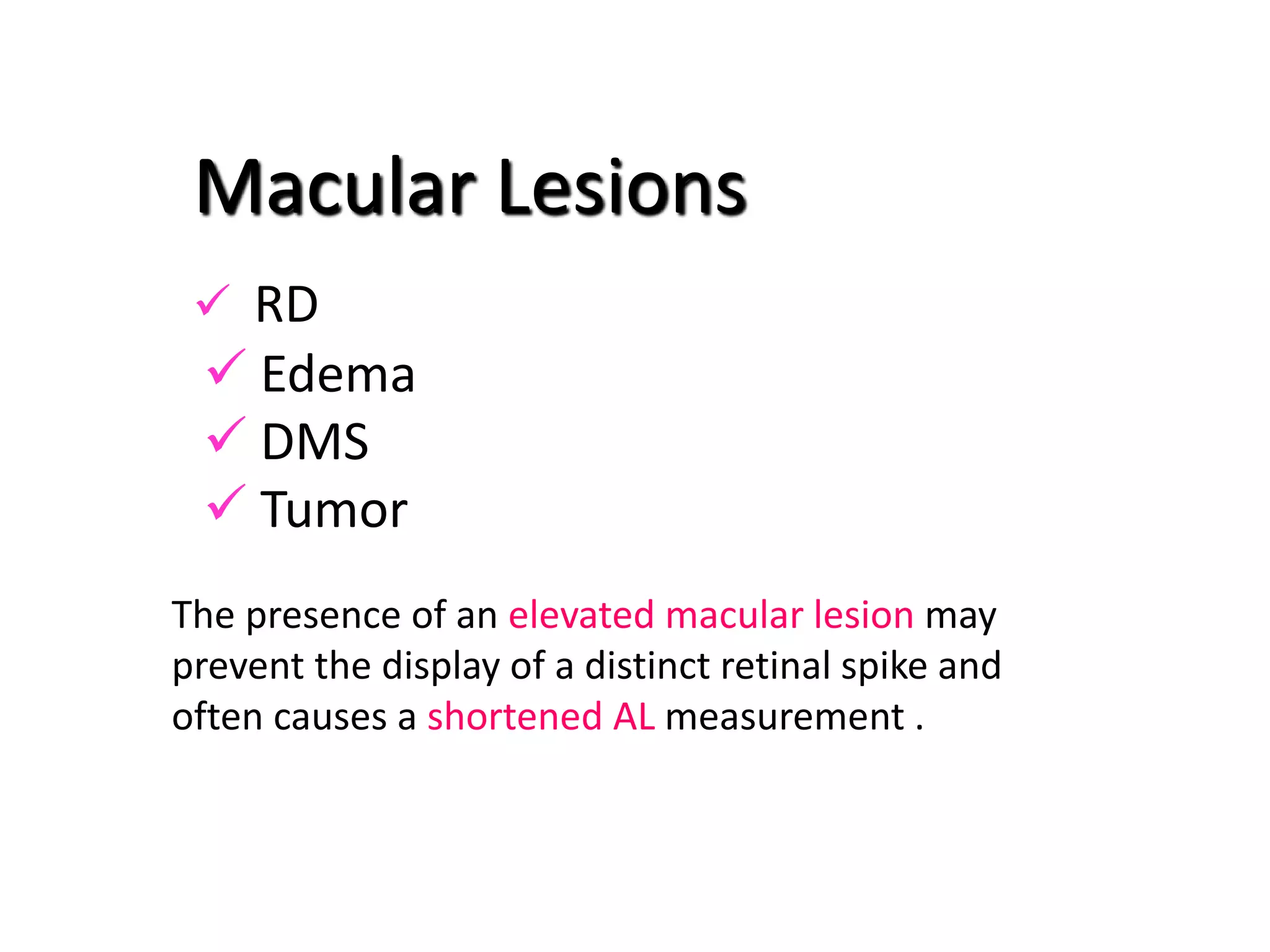
 Edema
 DMS
 Tumor
Macular Lesions
 RD
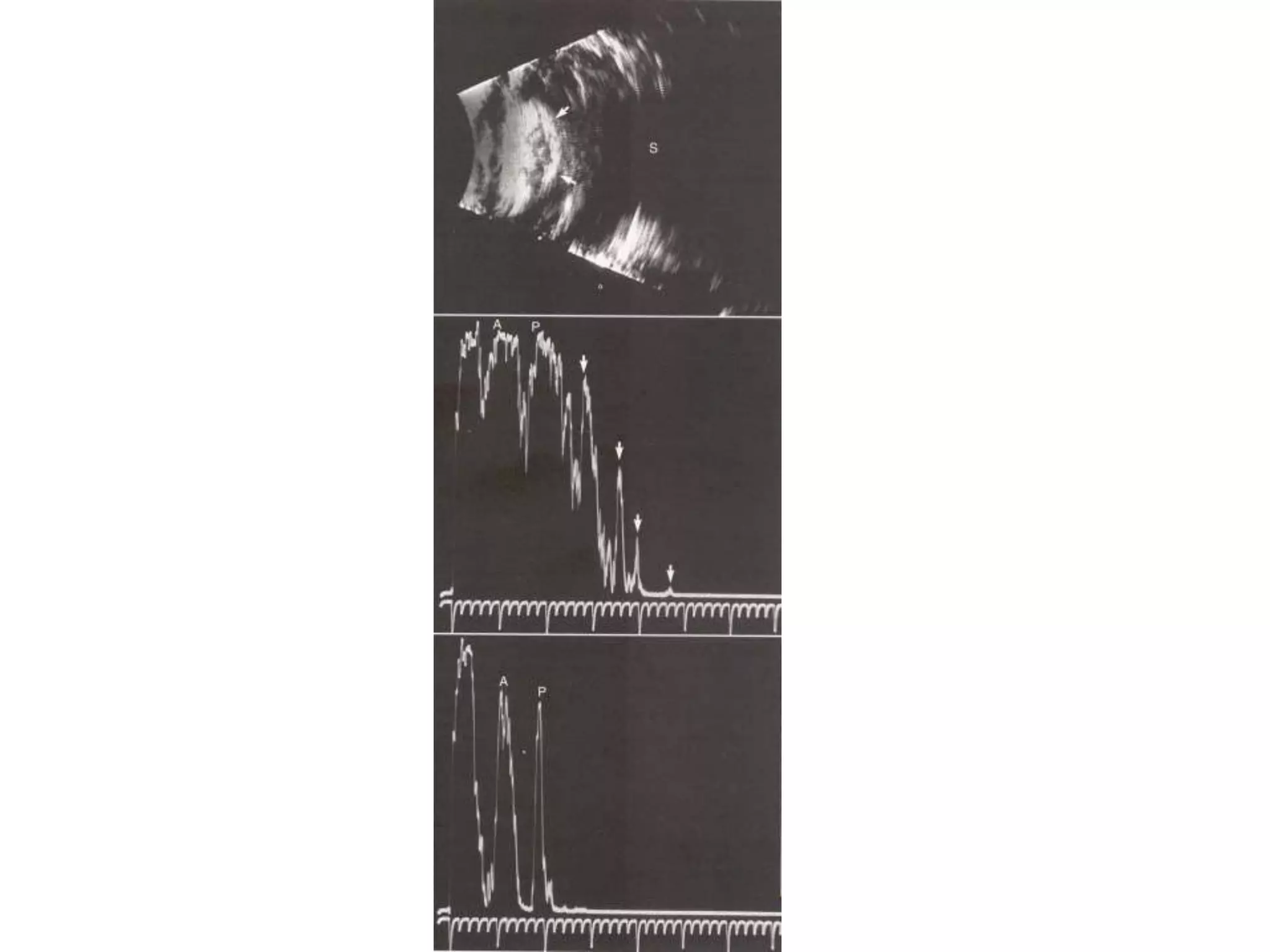
The presence of an elevated macular lesion may
prevent the display of a distinct retinal spike and
often causes a shortened AL measurement .
Vitreous Lesions
 Asteroid Hyalosis
 Vitreous Hemorrhage
 Gas Bubble
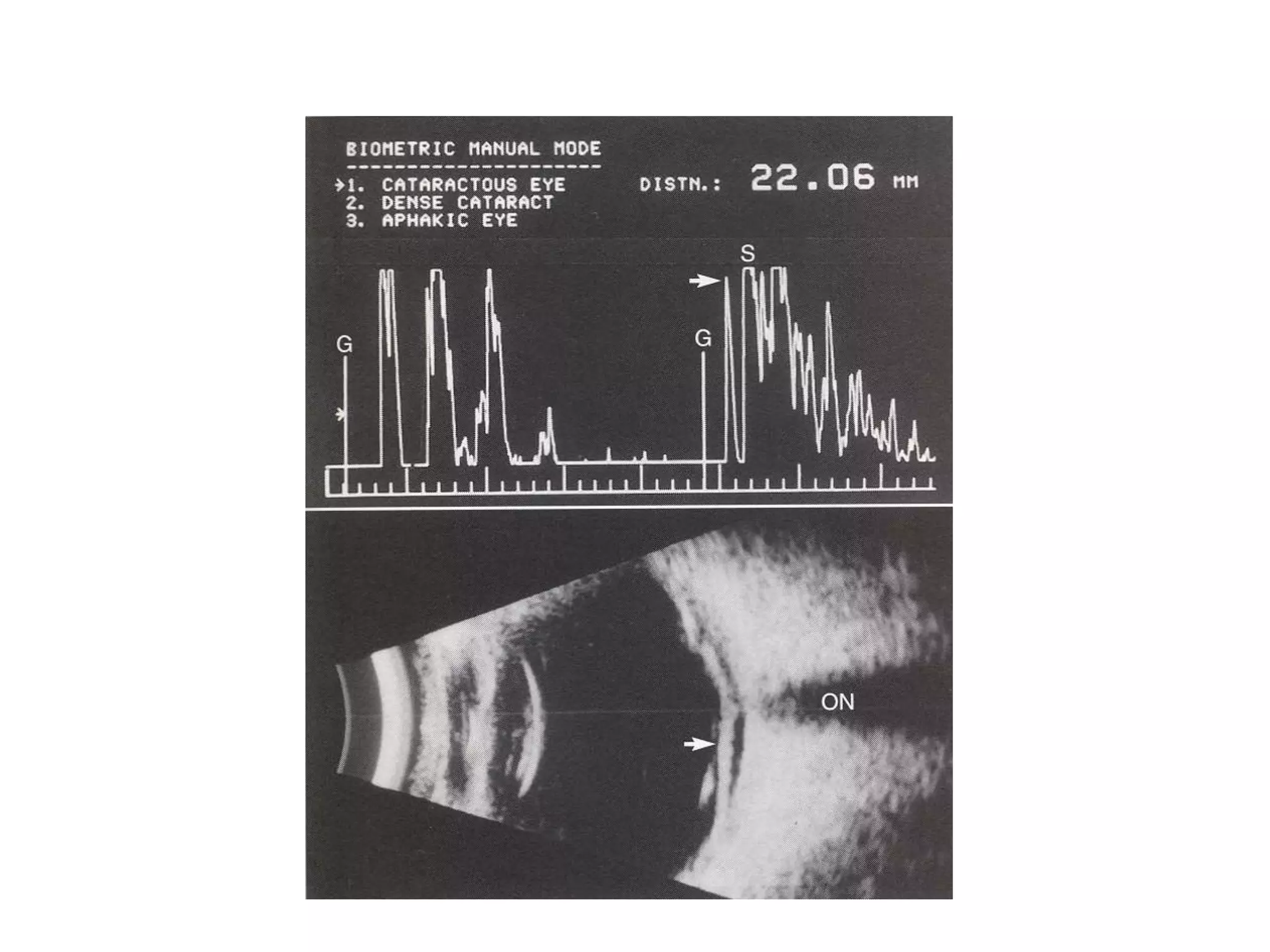
Dense Cataract
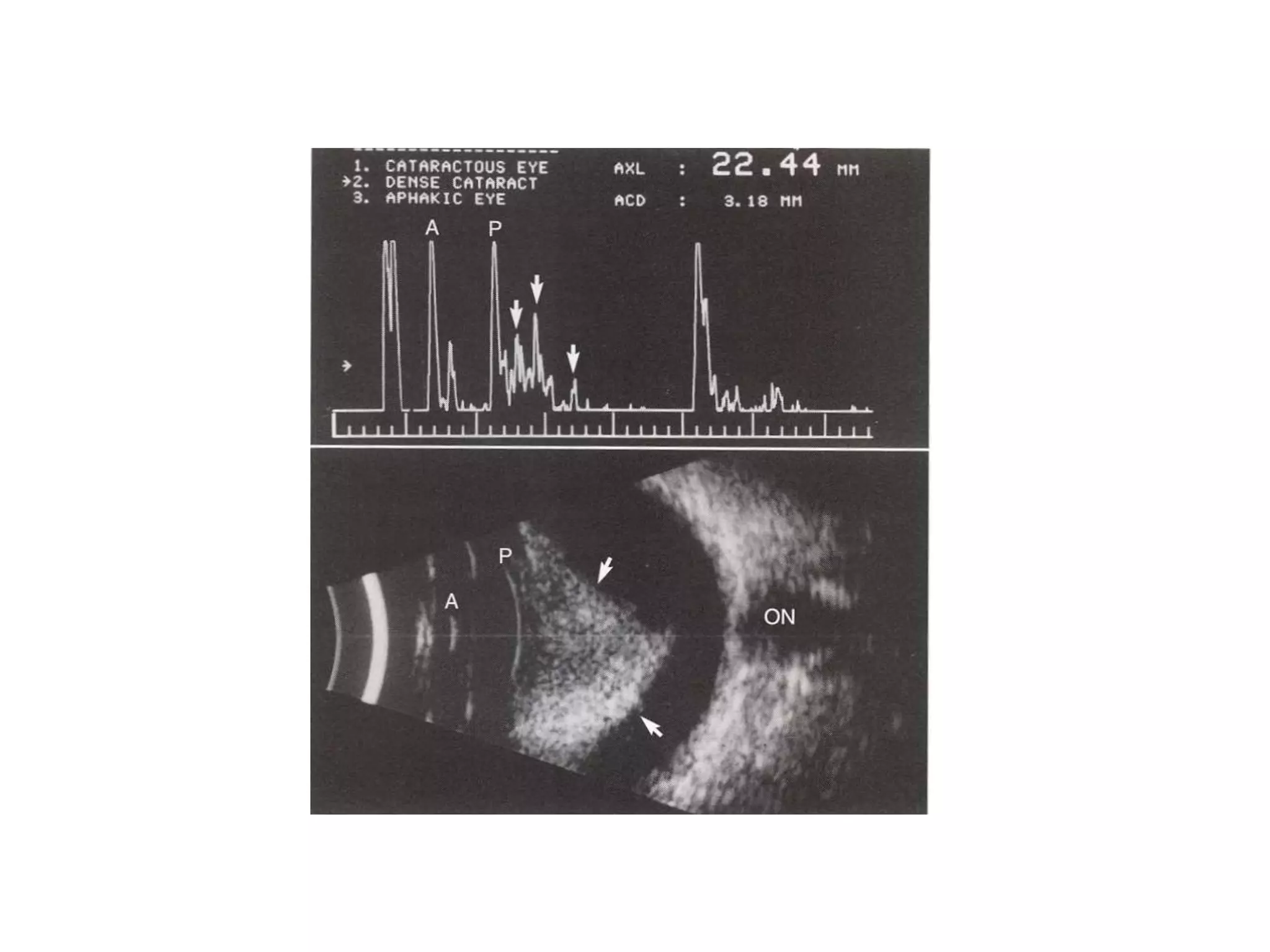
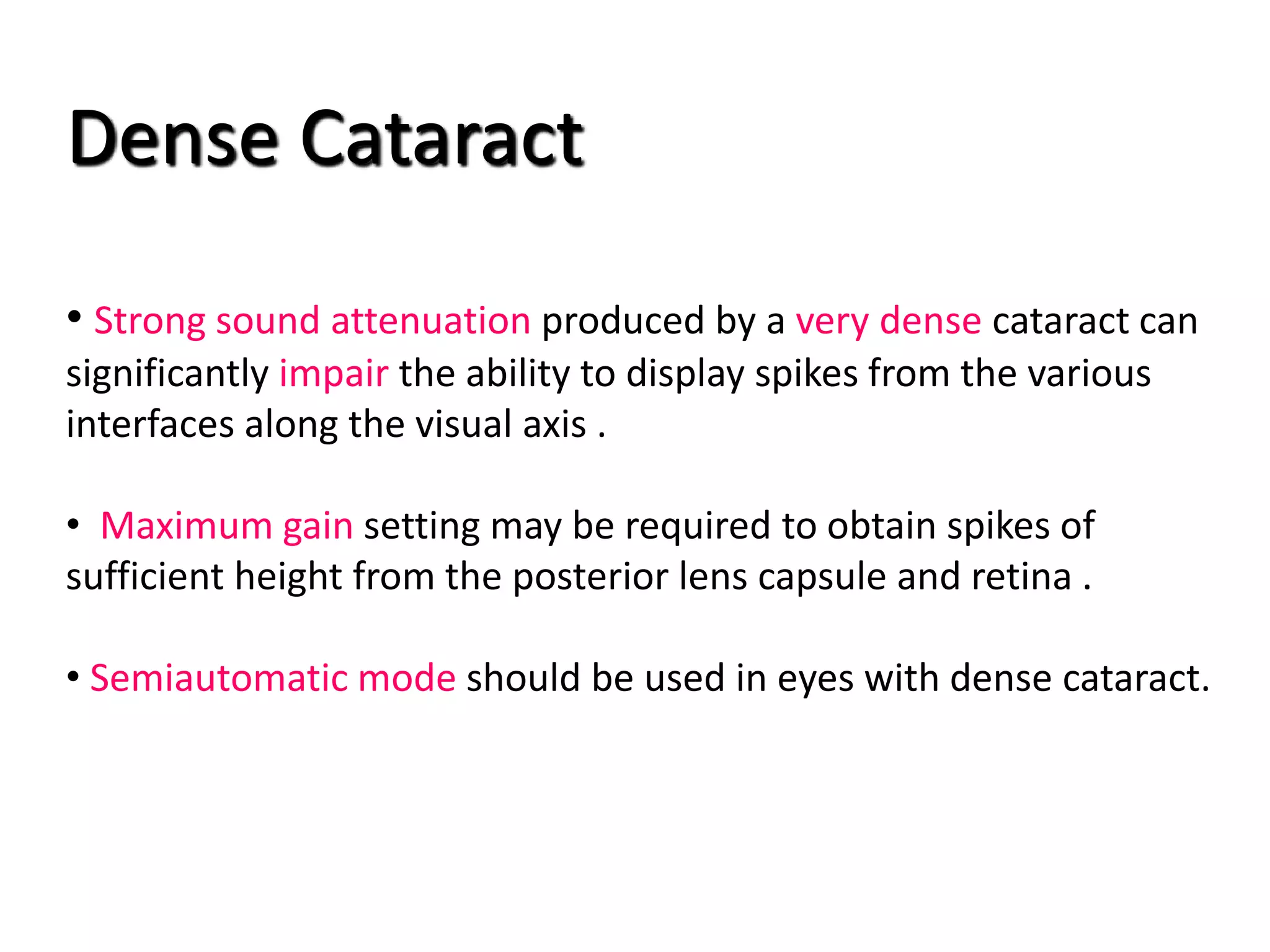
• Strong sound attenuation produced by a very dense cataract can
significantly impair the ability to display spikes from the various
interfaces along the visual axis .
• Maximum gain setting may be required to obtain spikes of
sufficient height from the posterior lens capsule and retina .
• Semiautomatic mode should be used in eyes with dense cataract.
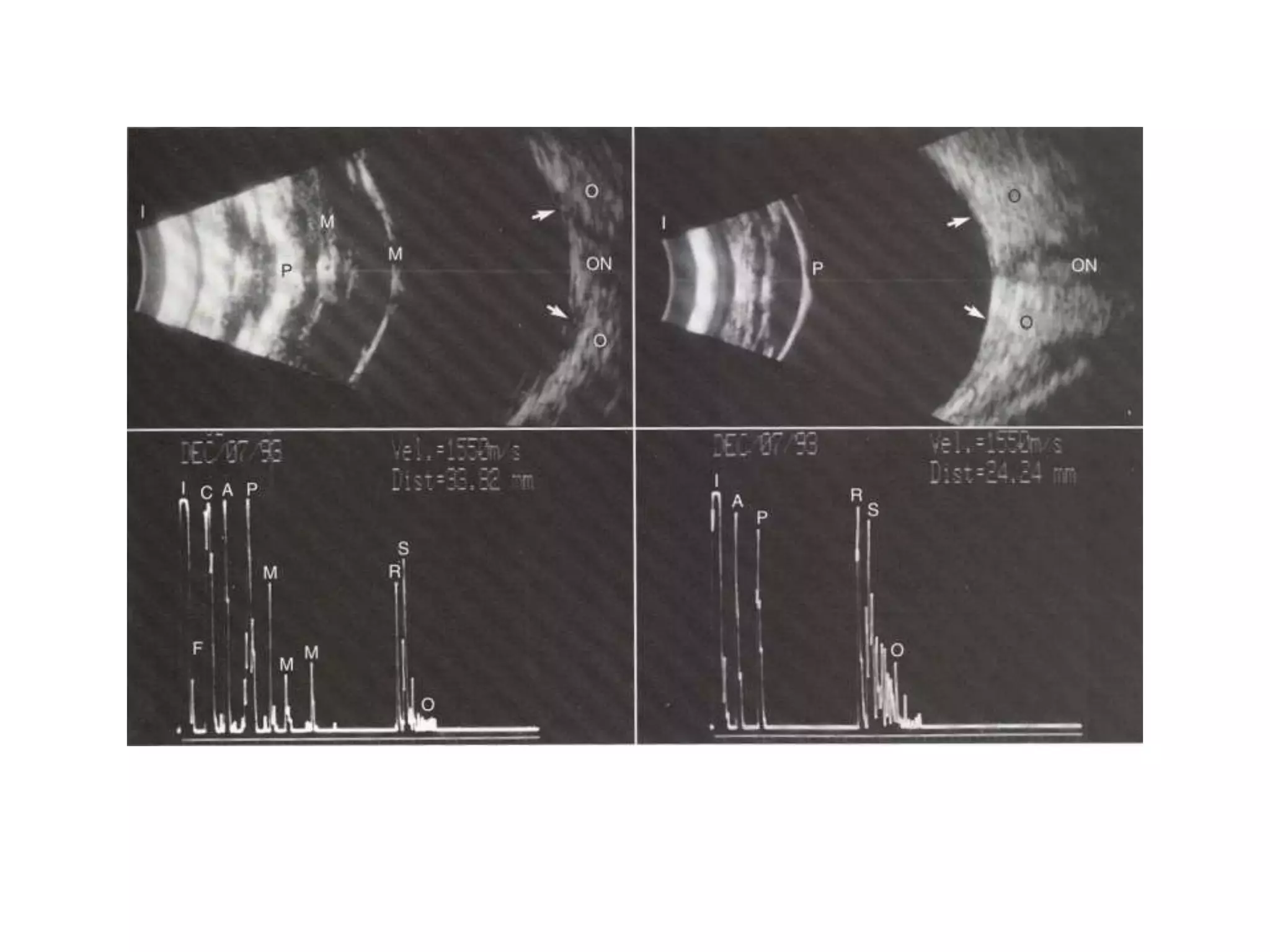
Silicone Oil
• Sound velocity in silicone oil
1040 m/s 5000 cs
980 m/s 1000cs
• This low sound velocity can result in
pronounced sound attenuation and difficulty
in identifying the retinal spikes .
• If proper sound velocity are not used , erroneously long AL
measurement will be obtained .
• For accurate AL measurement ,various ocular components
should be measured separately with appropriate sound
velocity .
• The least preferred method is use of average sound velocity.
Average sound velocity in eyes with average length (23.5 mm):
1,139 m/s phakic eye
1,052 m/s aphakic eye
• Due to strong sound attenuation AL measurement often can
not be obtained from an eye containing emulsified silicone oil .
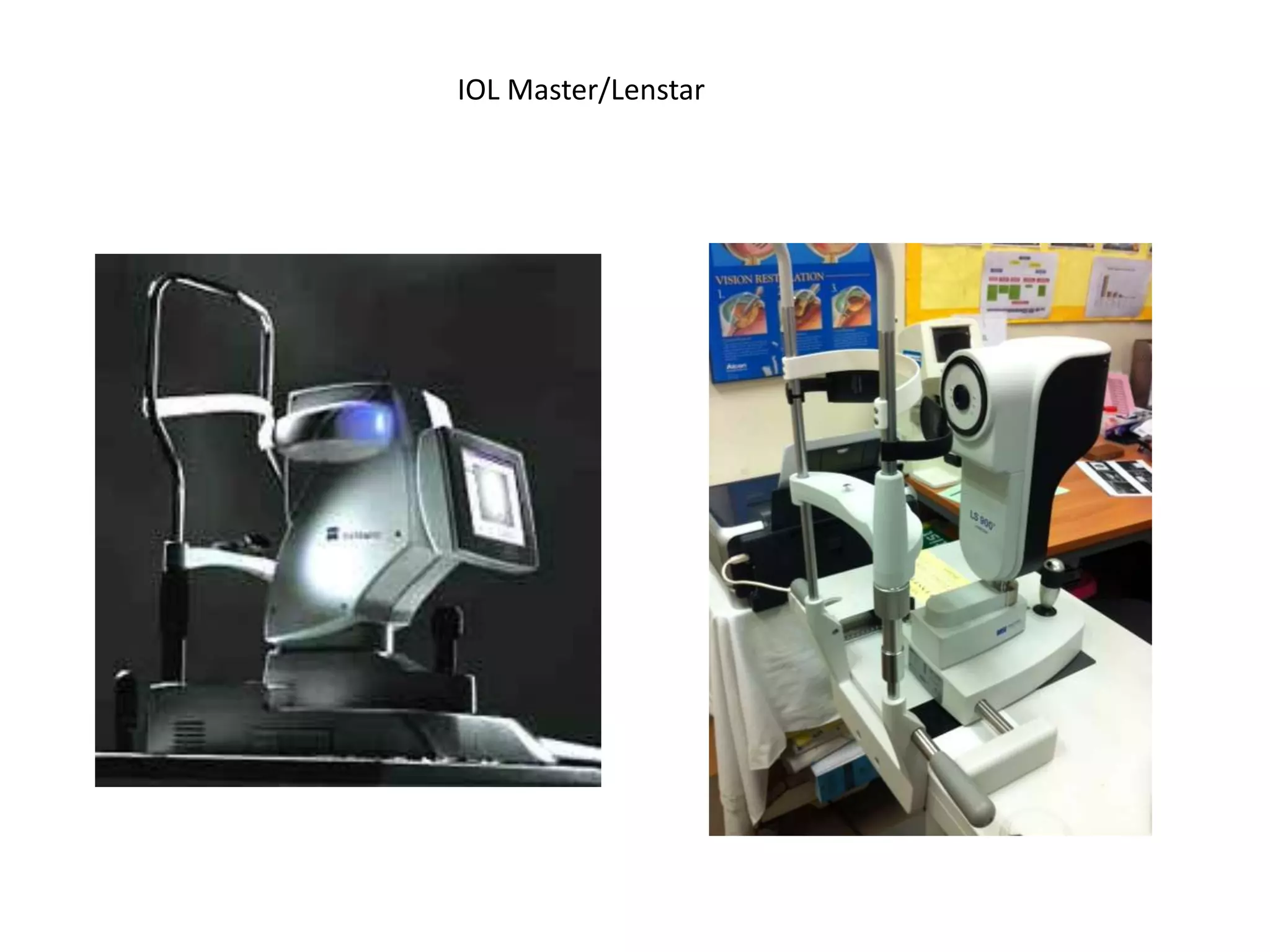
IOL Master/Lenstar
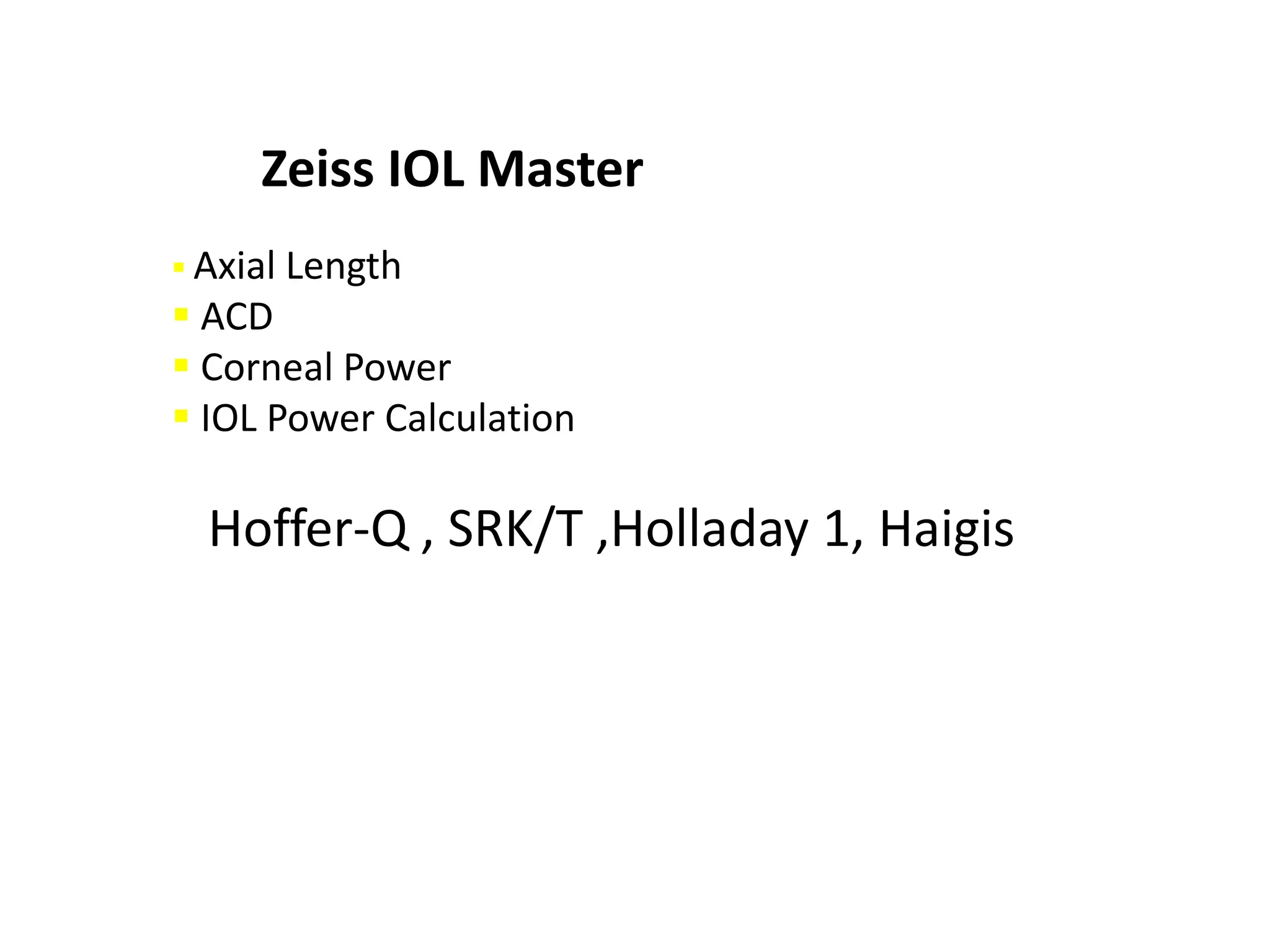
Zeiss IOL Master
 Axial Length
 ACD
 Corneal Power
 IOL Power Calculation
Hoffer-Q , SRK/T ,Holladay 1, Haigis
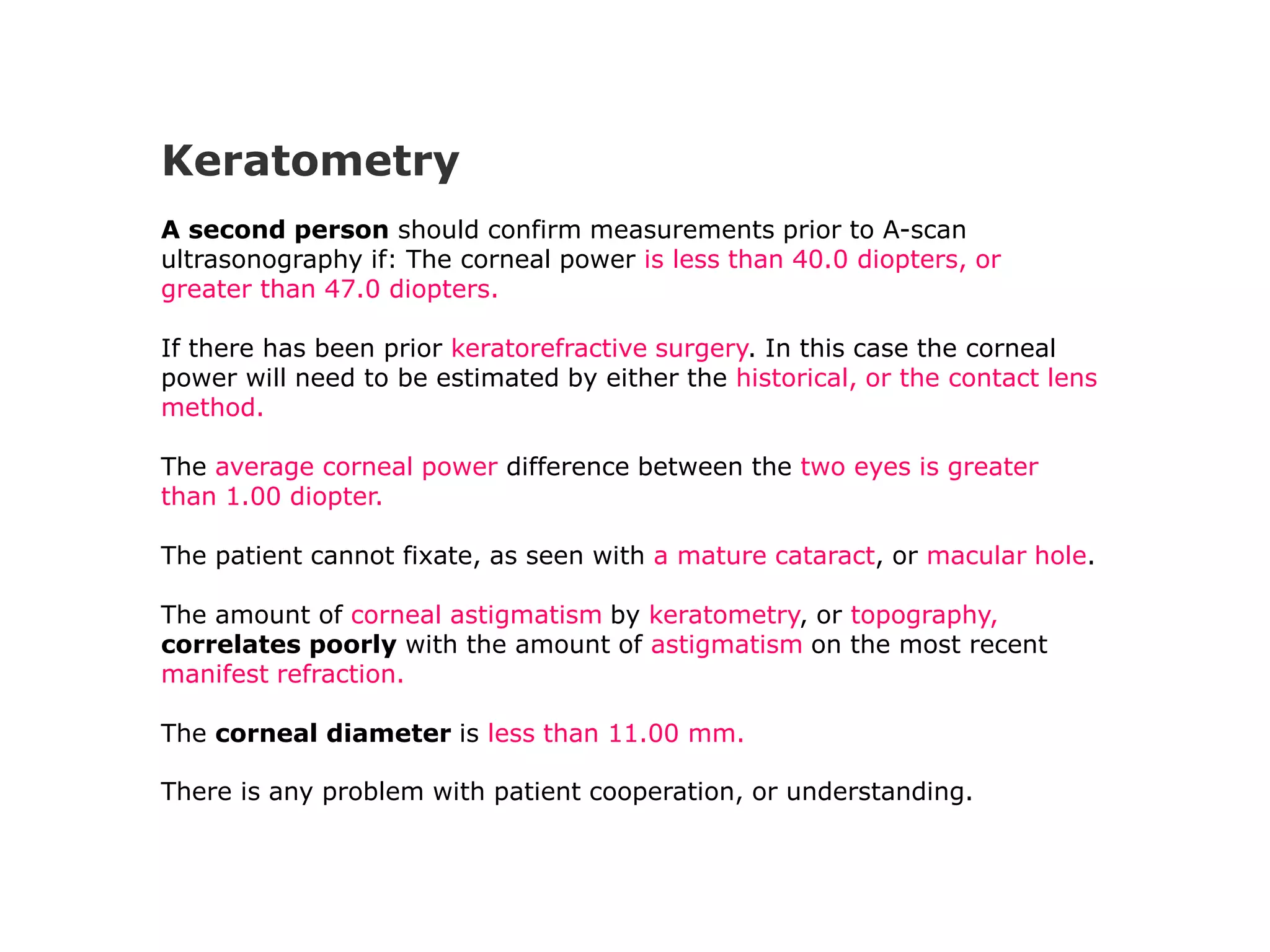
Keratometry
A second person should confirm measurements prior to A-scan
ultrasonography if: The corneal power is less than 40.0 diopters, or
greater than 47.0 diopters.
If there has been prior keratorefractive surgery. In this case the corneal
power will need to be estimated by either the historical, or the contact lens
method.
The average corneal power difference between the two eyes is greater
than 1.00 diopter.
The patient cannot fixate, as seen with a mature cataract, or macular hole.
The amount of corneal astigmatism by keratometry, or topography,
correlates poorly with the amount of astigmatism on the most recent
manifest refraction.
The corneal diameter is less than 11.00 mm.
There is any problem with patient cooperation, or understanding.
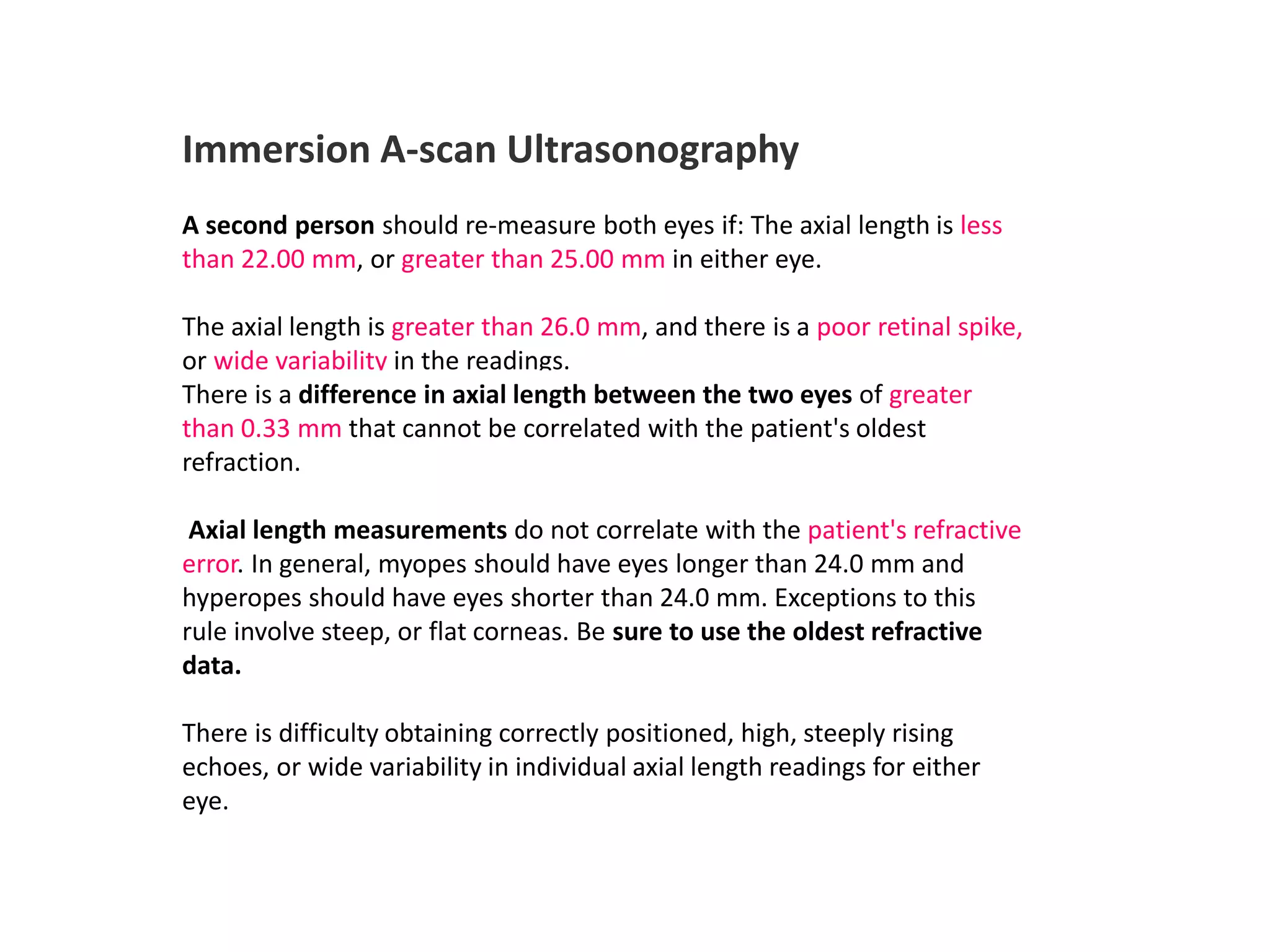
Immersion A-scan Ultrasonography
A second person should re-measure both eyes if: The axial length is less
than 22.00 mm, or greater than 25.00 mm in either eye.
The axial length is greater than 26.0 mm, and there is a poor retinal spike,
or wide variability in the readings.
There is a difference in axial length between the two eyes of greater
than 0.33 mm that cannot be correlated with the patient's oldest
refraction.
Axial length measurements do not correlate with the patient's refractive
error. In general, myopes should have eyes longer than 24.0 mm and
hyperopes should have eyes shorter than 24.0 mm. Exceptions to this
rule involve steep, or flat corneas. Be sure to use the oldest refractive
data.
There is difficulty obtaining correctly positioned, high, steeply rising
echoes, or wide variability in individual axial length readings for either
eye.
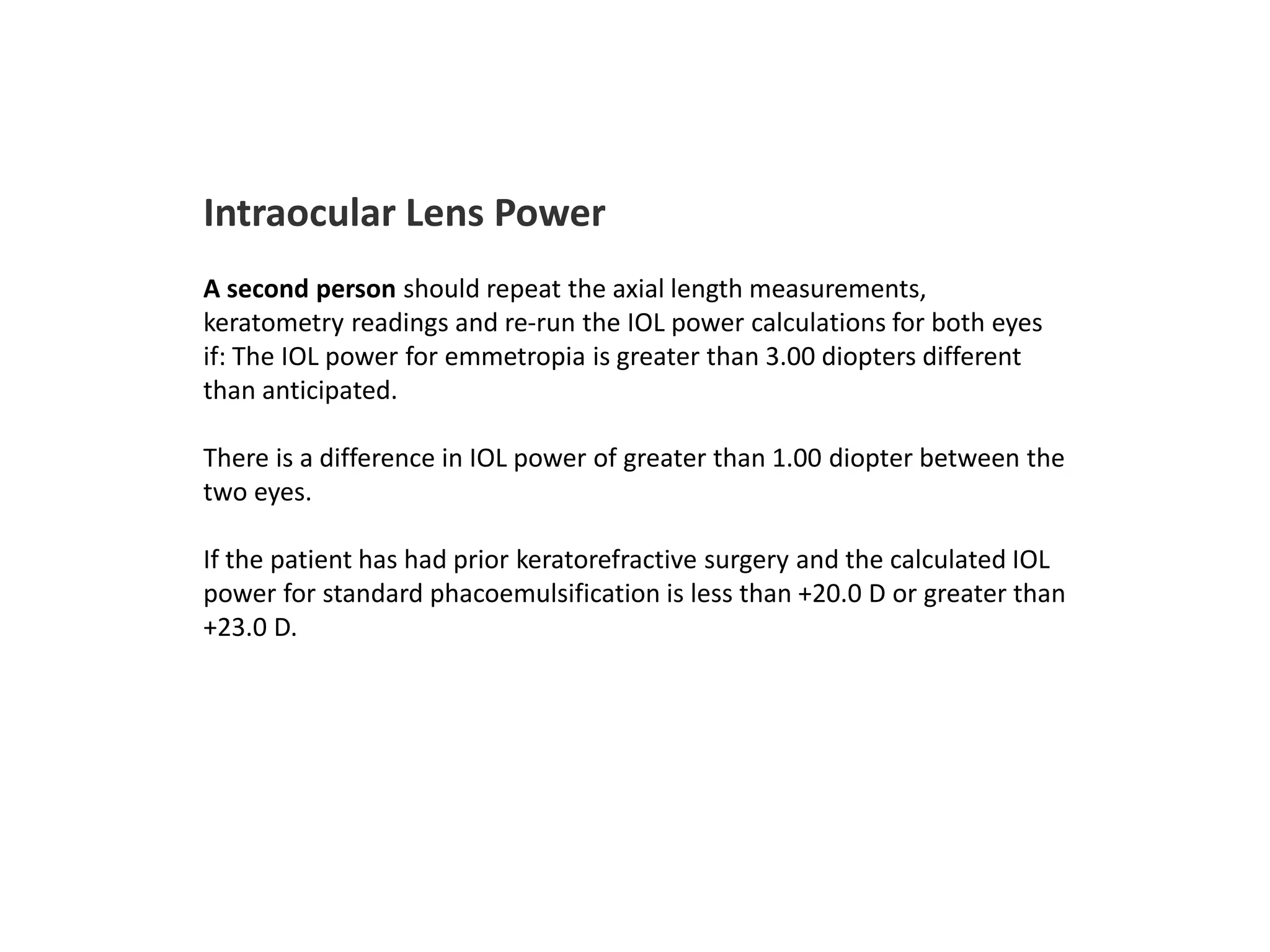
Intraocular Lens Power
A second person should repeat the axial length measurements,
keratometry readings and re-run the IOL power calculations for both eyes
if: The IOL power for emmetropia is greater than 3.00 diopters different
than anticipated.
There is a difference in IOL power of greater than 1.00 diopter between the
two eyes.
If the patient has had prior keratorefractive surgery and the calculated IOL
power for standard phacoemulsification is less than +20.0 D or greater than
+23.0 D.
Formula
for
IOL Power Calculation
IOL Power Formula
 Theoretical
 Regression
 Refractive
Theoretical Formulas
These are derived from
geometrical optics
Regression Formulas
Actual postop refractive results
of many lens implantations are
used to predict IOL power
Theoretical Formula
These formulas contain many
assumptions including values of
postop ACD , refractive index of
cornea and ocular humors , retinal
thickness
Theoretical Formula
These formulas are reliable for
average AL , but overestimates
in short eyes and underestimates
in long eyes
Refractive Formulas
IOL power calculation without
determination of axial length
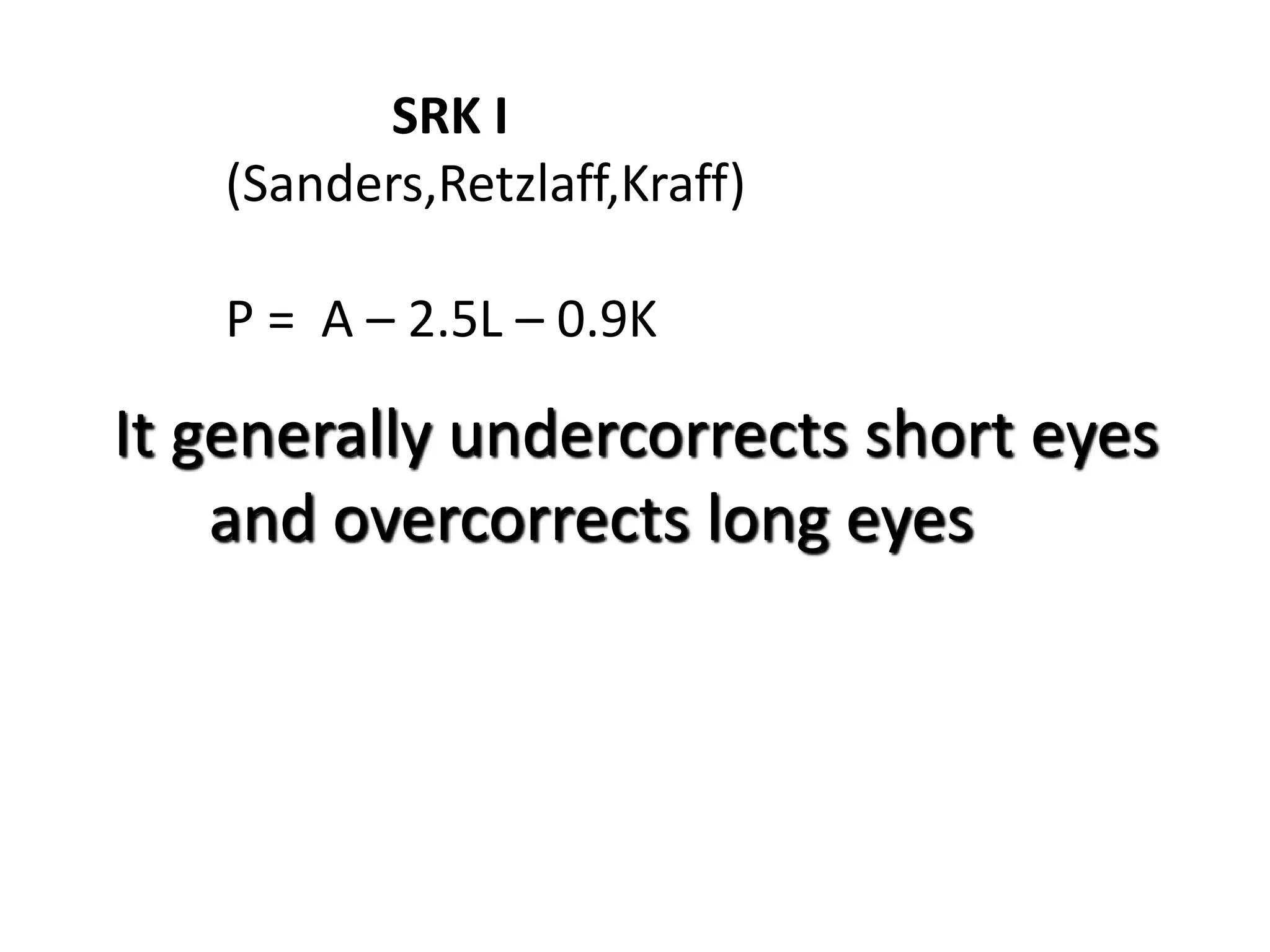
SRK I
(Sanders,Retzlaff,Kraff)
P = A – 2.5L – 0.9K
It generally undercorrects short eyes
and overcorrects long eyes
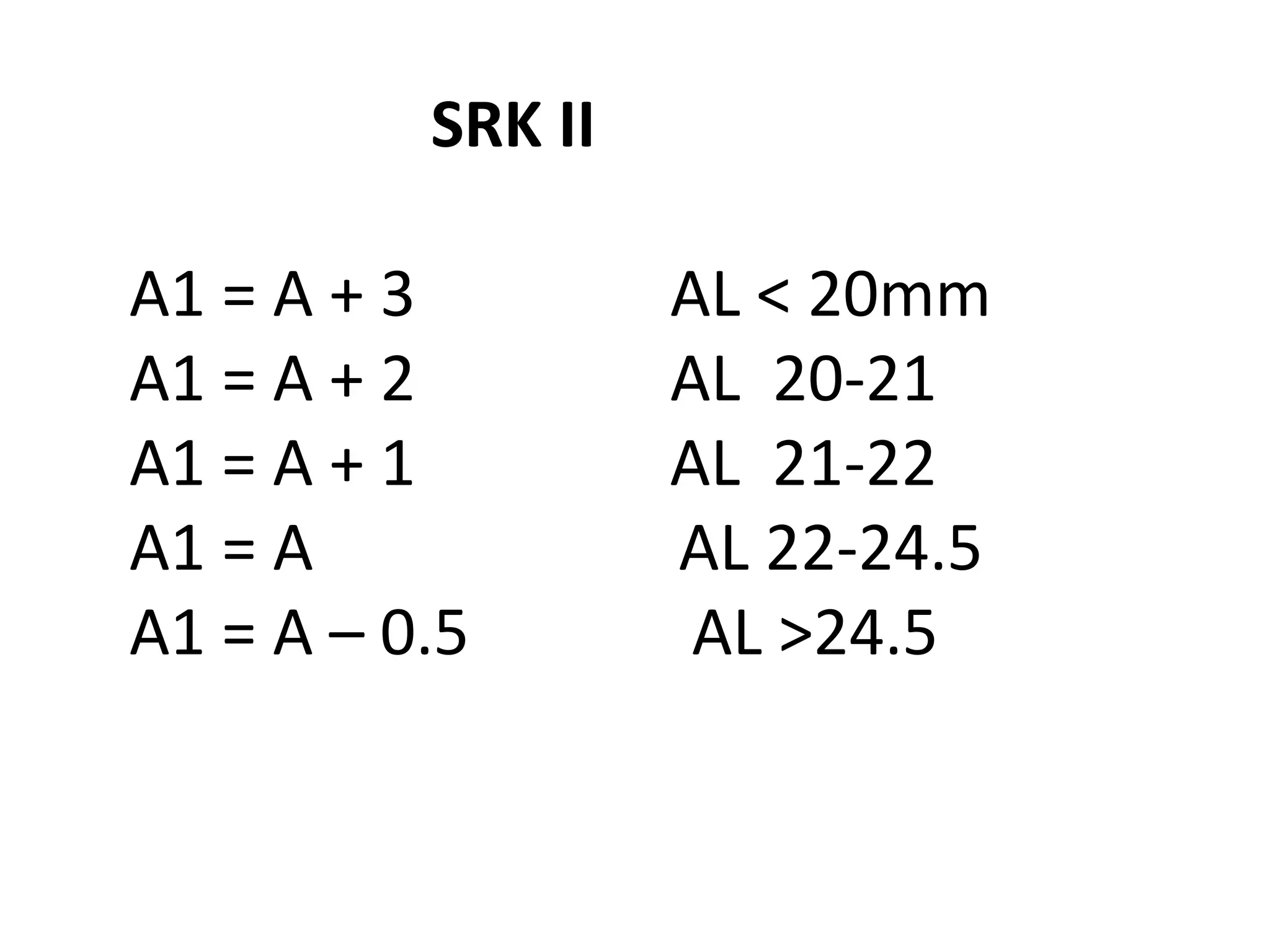
SRK II
A1 = A + 3 AL < 20mm
A1 = A + 2 AL 20-21
A1 = A + 1 AL 21-22
A1 = A AL 22-24.5
A1 = A – 0.5 AL >24.5
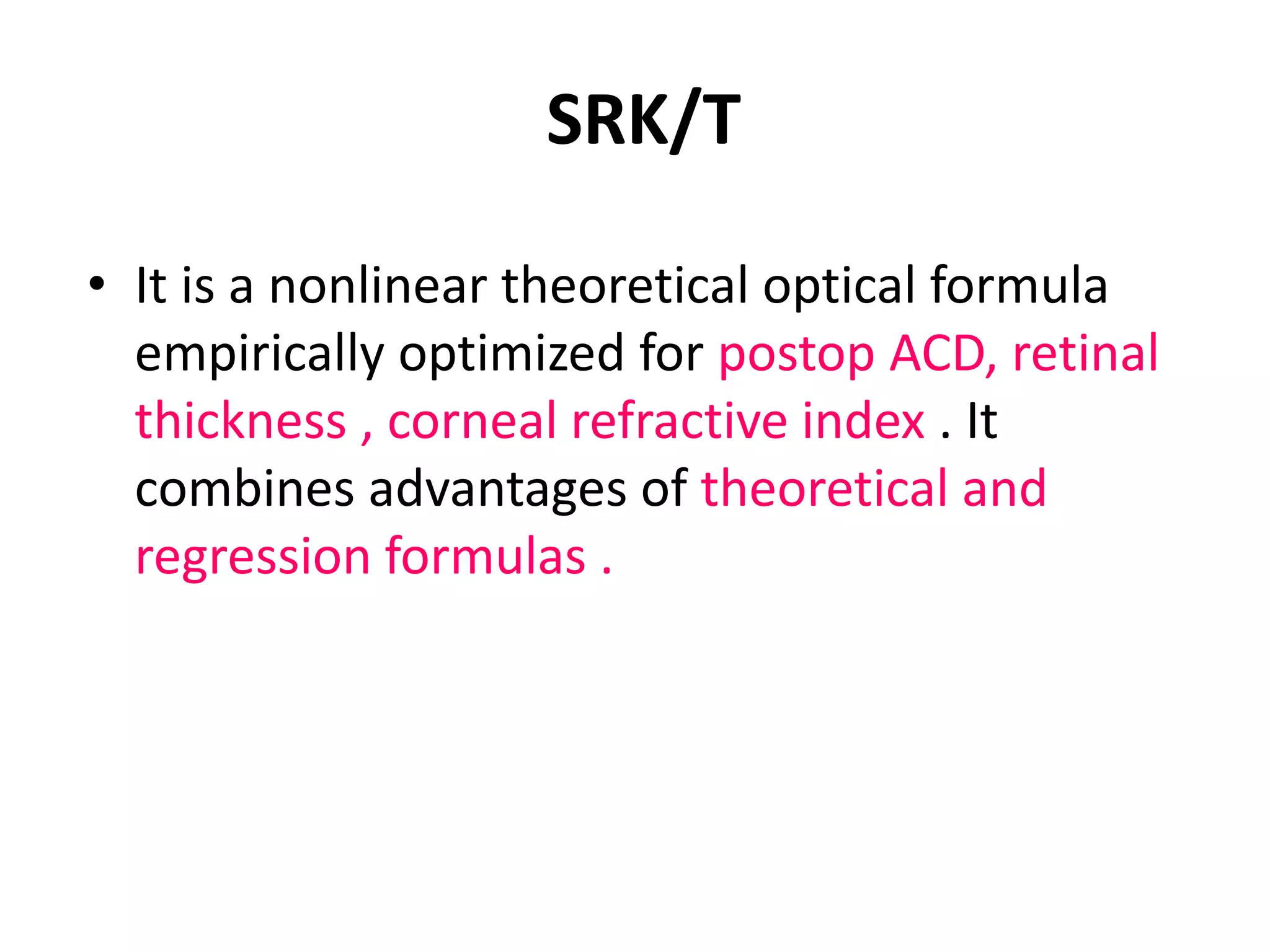
SRK/T
• It is a nonlinear theoretical optical formula
empirically optimized for postop ACD, retinal
thickness , corneal refractive index . It
combines advantages of theoretical and
regression formulas .
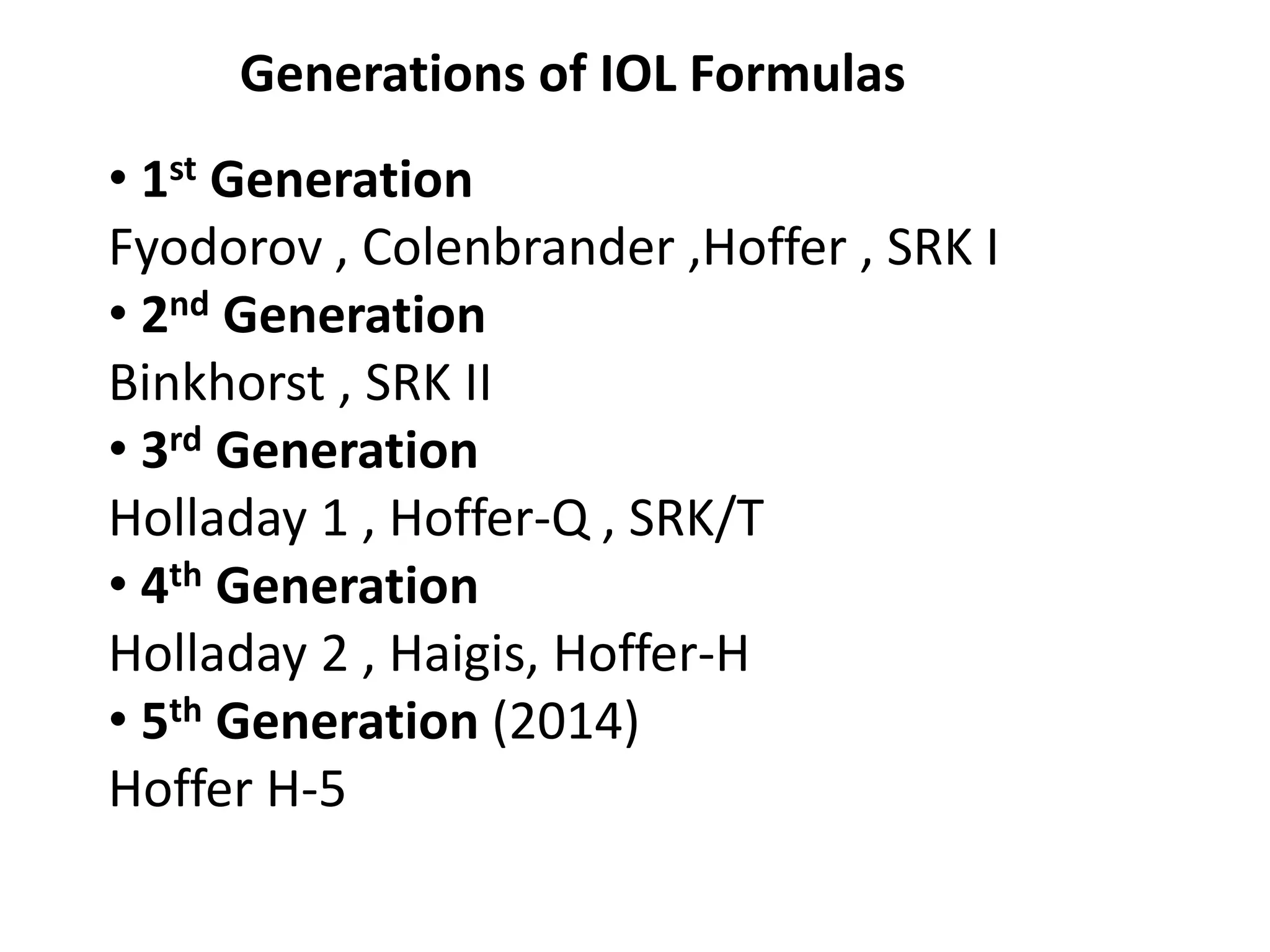
Generations of IOL Formulas
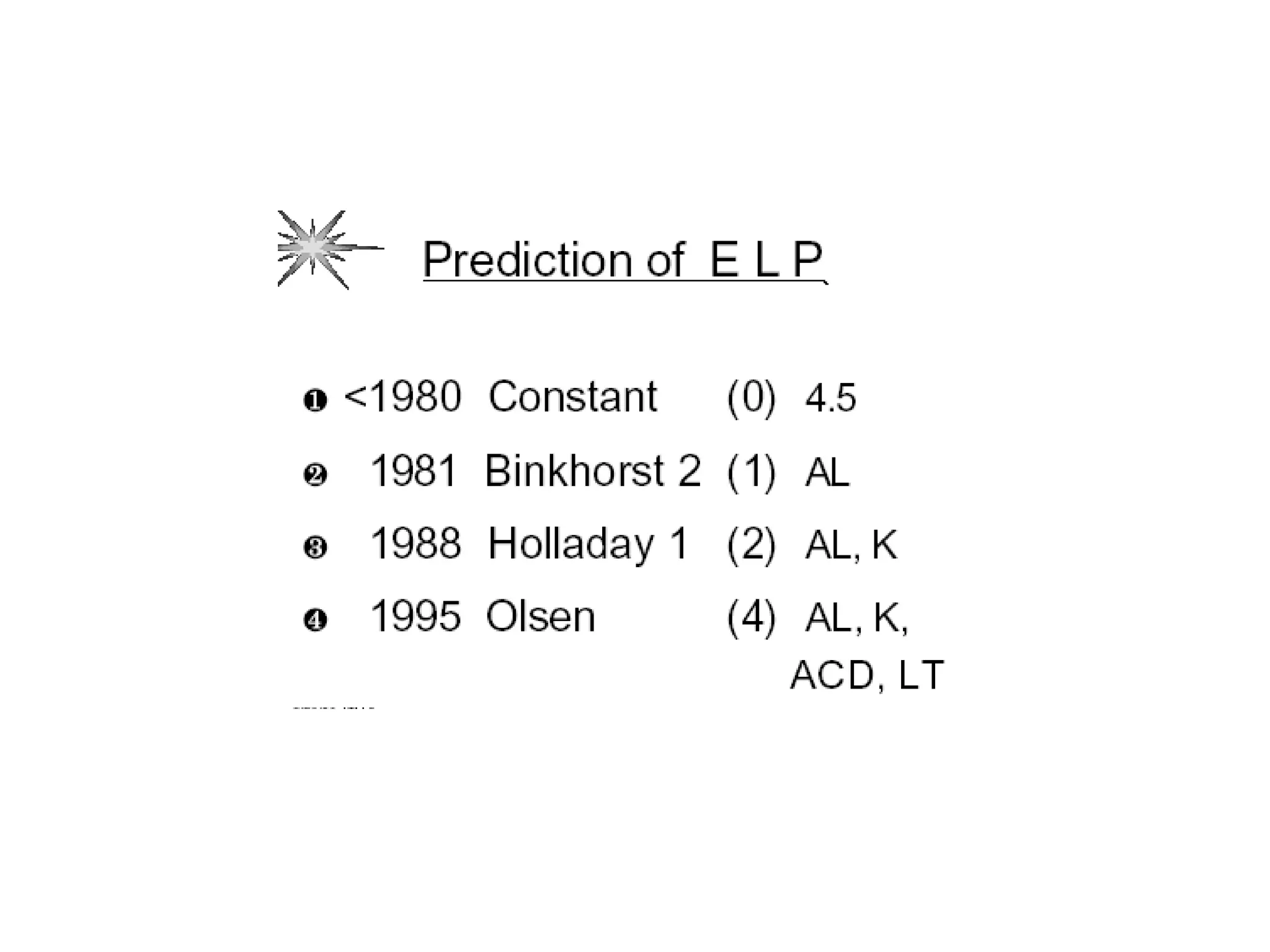
• 1st Generation
Fyodorov , Colenbrander ,Hoffer , SRK I
• 2nd Generation
Binkhorst , SRK II
• 3rd Generation
Holladay 1 , Hoffer-Q , SRK/T
• 4th Generation
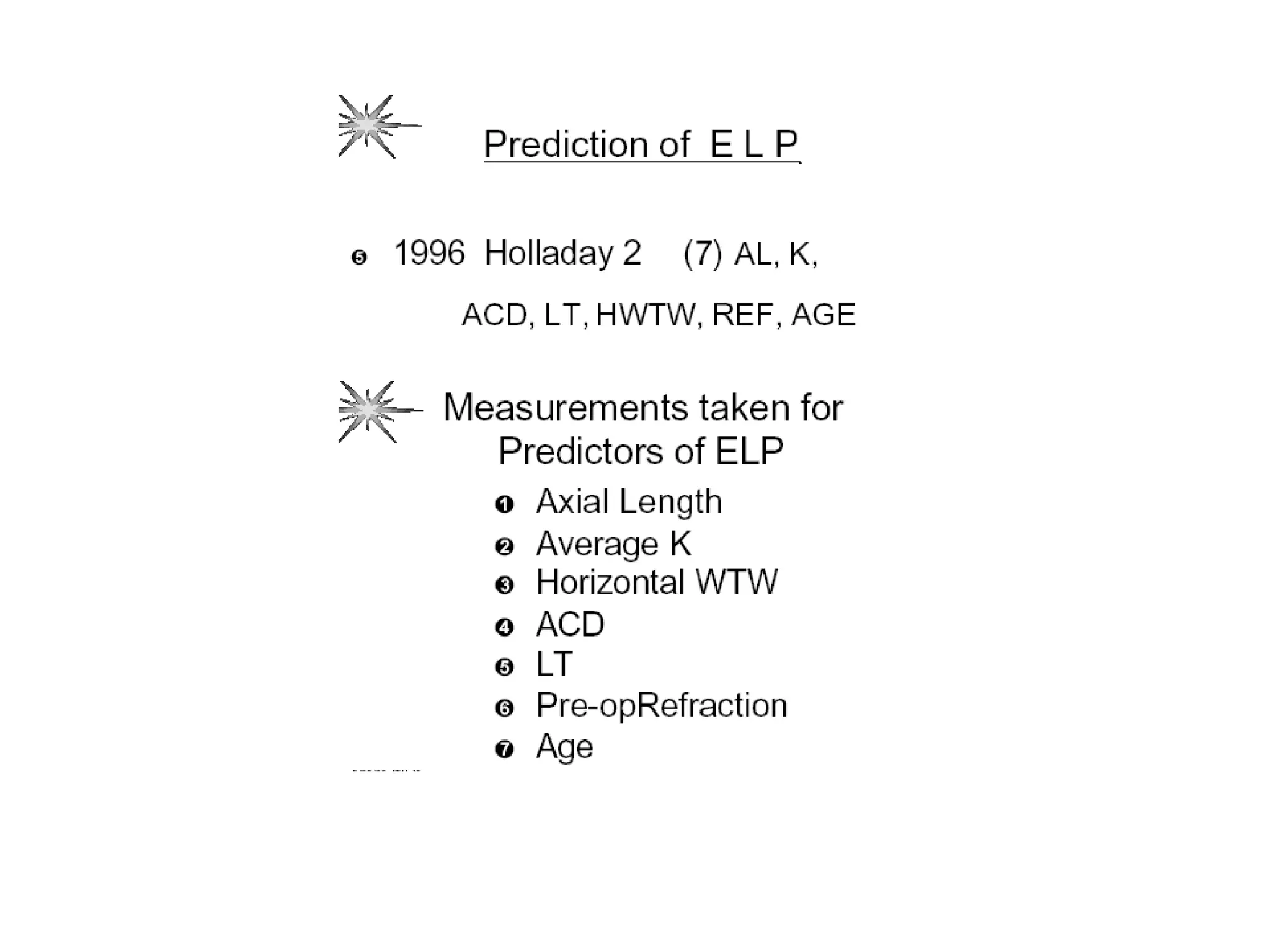
Holladay 2 , Haigis, Hoffer-H
• 5th Generation (2014)
Hoffer H-5
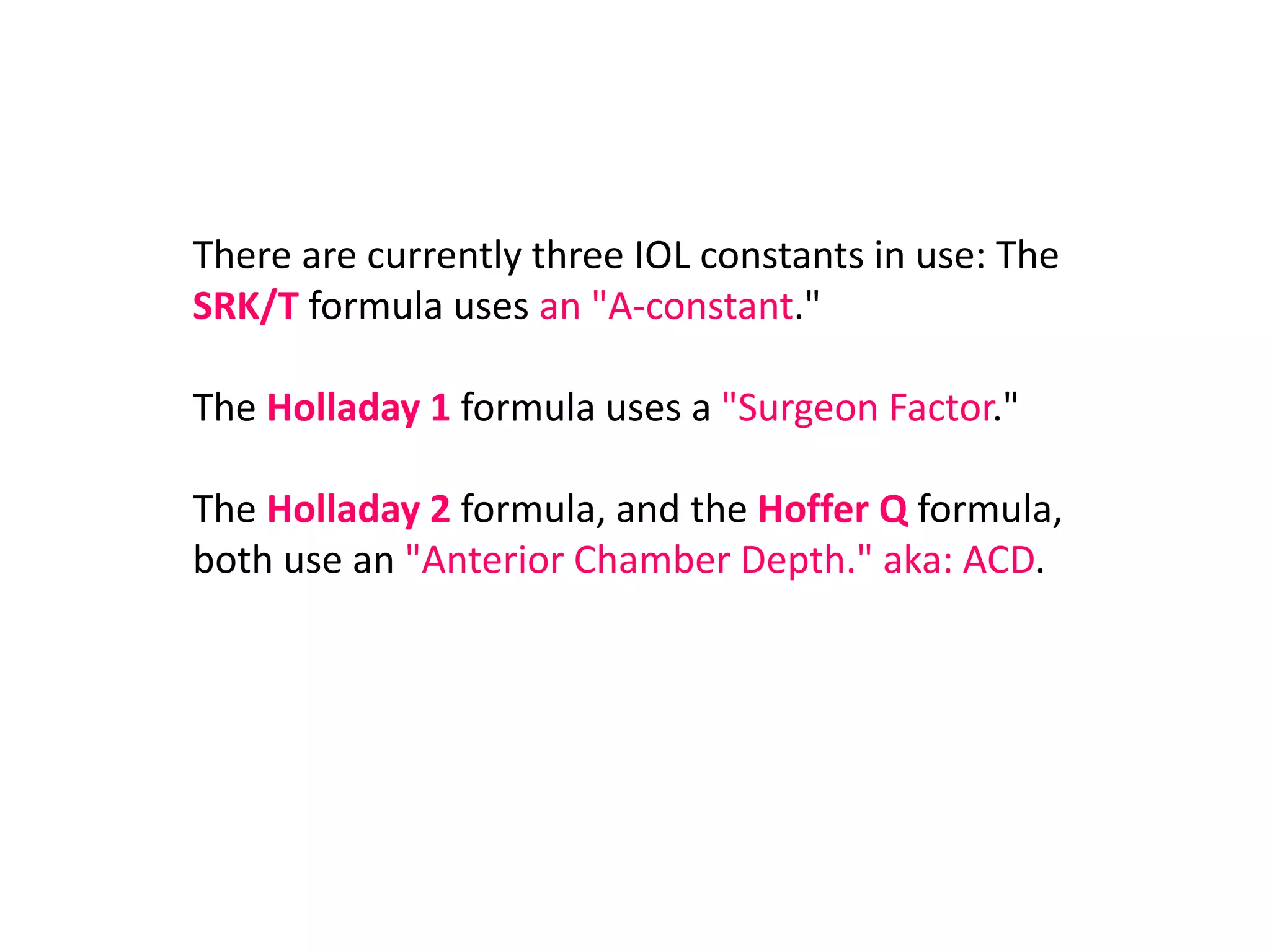
There are currently three IOL constants in use: The
SRK/T formula uses an "A-constant."
The Holladay 1 formula uses a "Surgeon Factor."
The Holladay 2 formula, and the Hoffer Q formula,
both use an "Anterior Chamber Depth." aka: ACD.
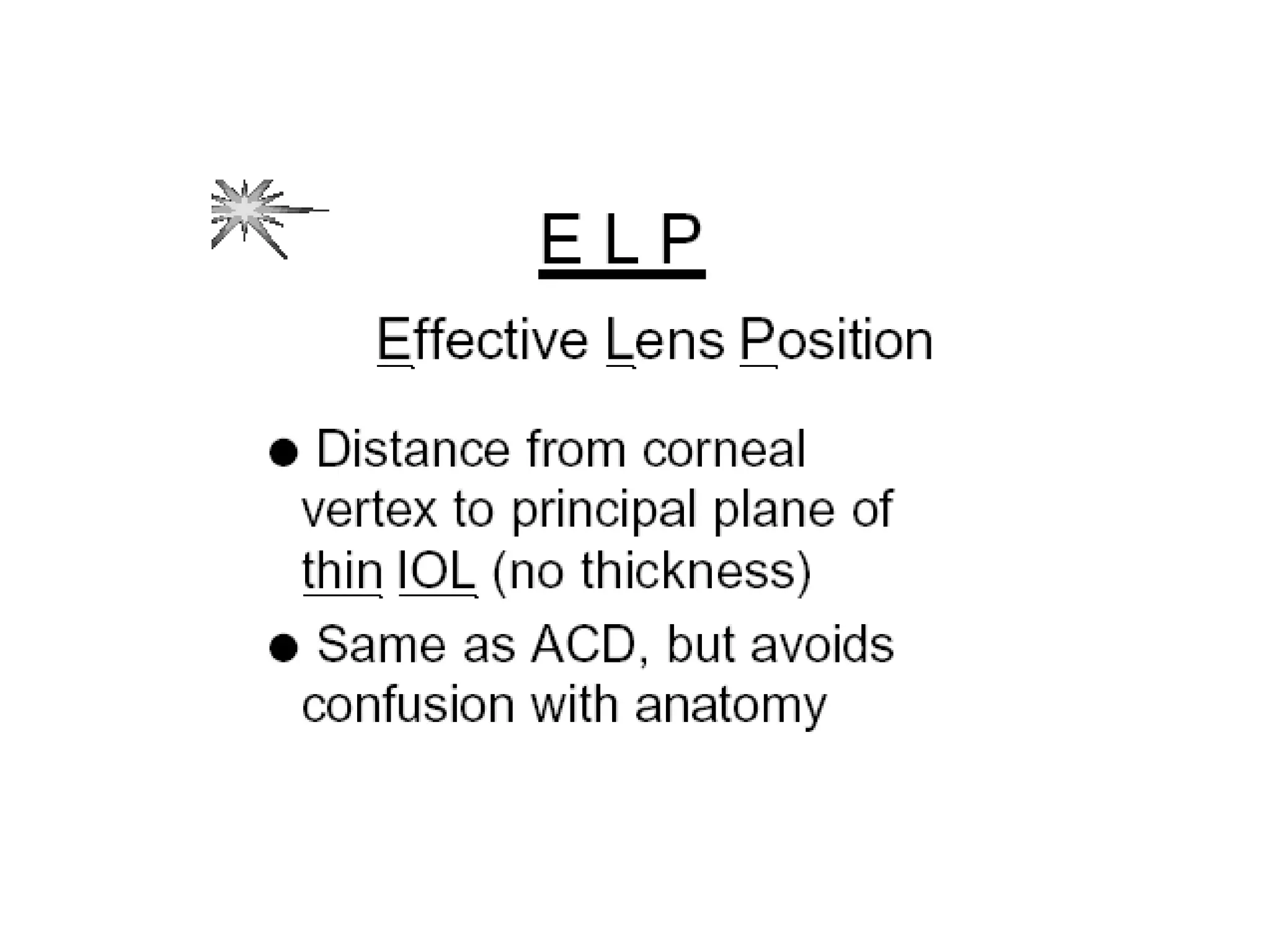
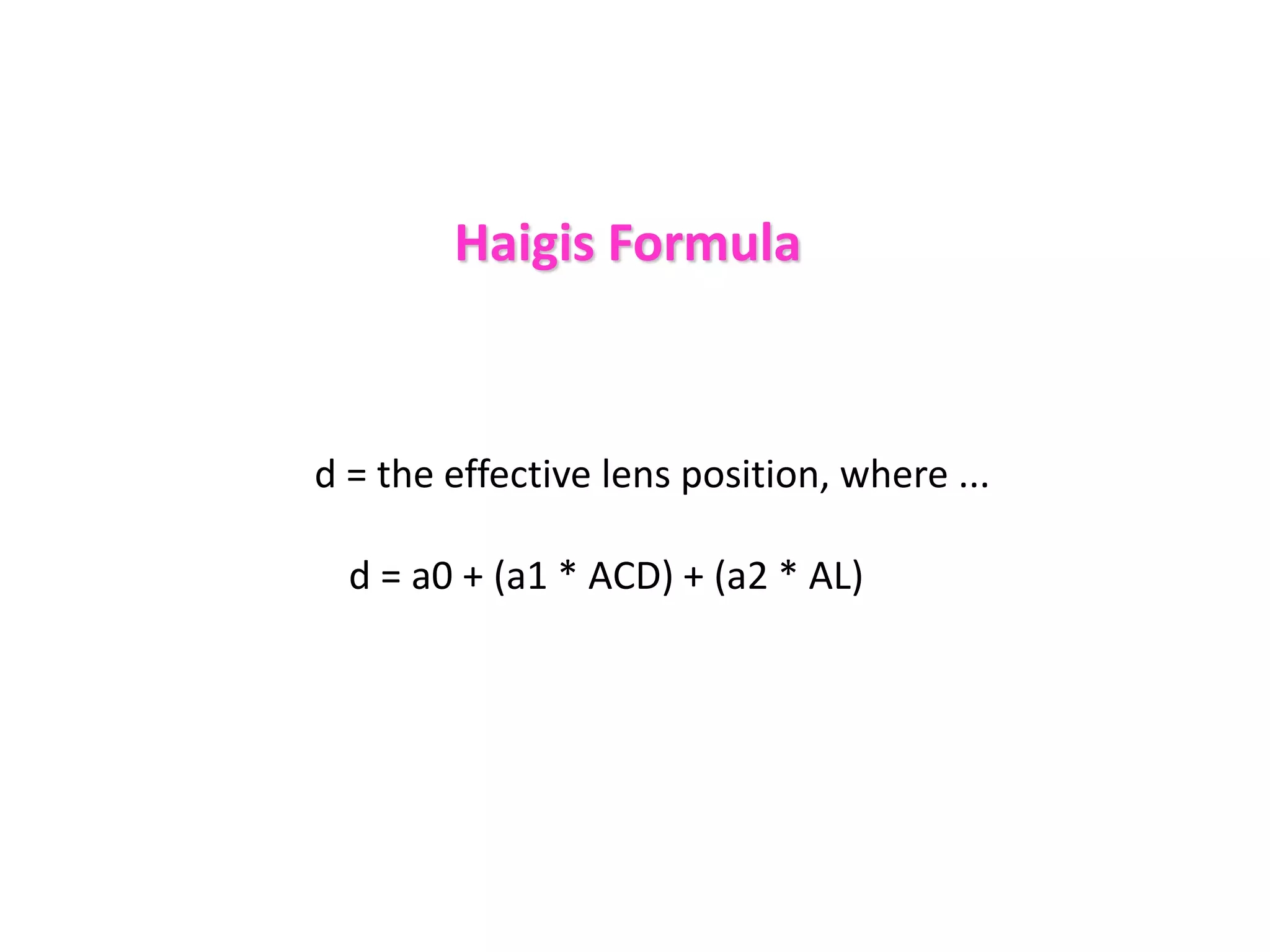
d = the effective lens position, where ...
d = a0 + (a1 * ACD) + (a2 * AL)
Haigis Formula
* The a0 constant basically moves the curve up,
or down, in much the same way that the A-
constant, Surgeon Factor, or ACD does for the
Holladay 1, Holladay 2, Hoffer Q and SRK/T
formulas.
* The a1 constant is tied to the measured
anterior chamber depth.
* The a2 constant is tied to the measured axial
length. The way the a0, a1 and a2 constants are
derived is by generating a set of surgeon, and
IOL-specific
AL < 19 mm (<0.1%)
Holladay 2
AL 19-22 mm (8%)
Holladay 2 , Hoffer-Q
AL 22-24.5 mm (72%)
SRK II , Hoffer-Q ,Holladay 1
AL 24.5-26 mm (15%)
Holladay 1 , Hoffer-Q
AL > 26 mm ( 15%)
SRK/T
Formula Choice
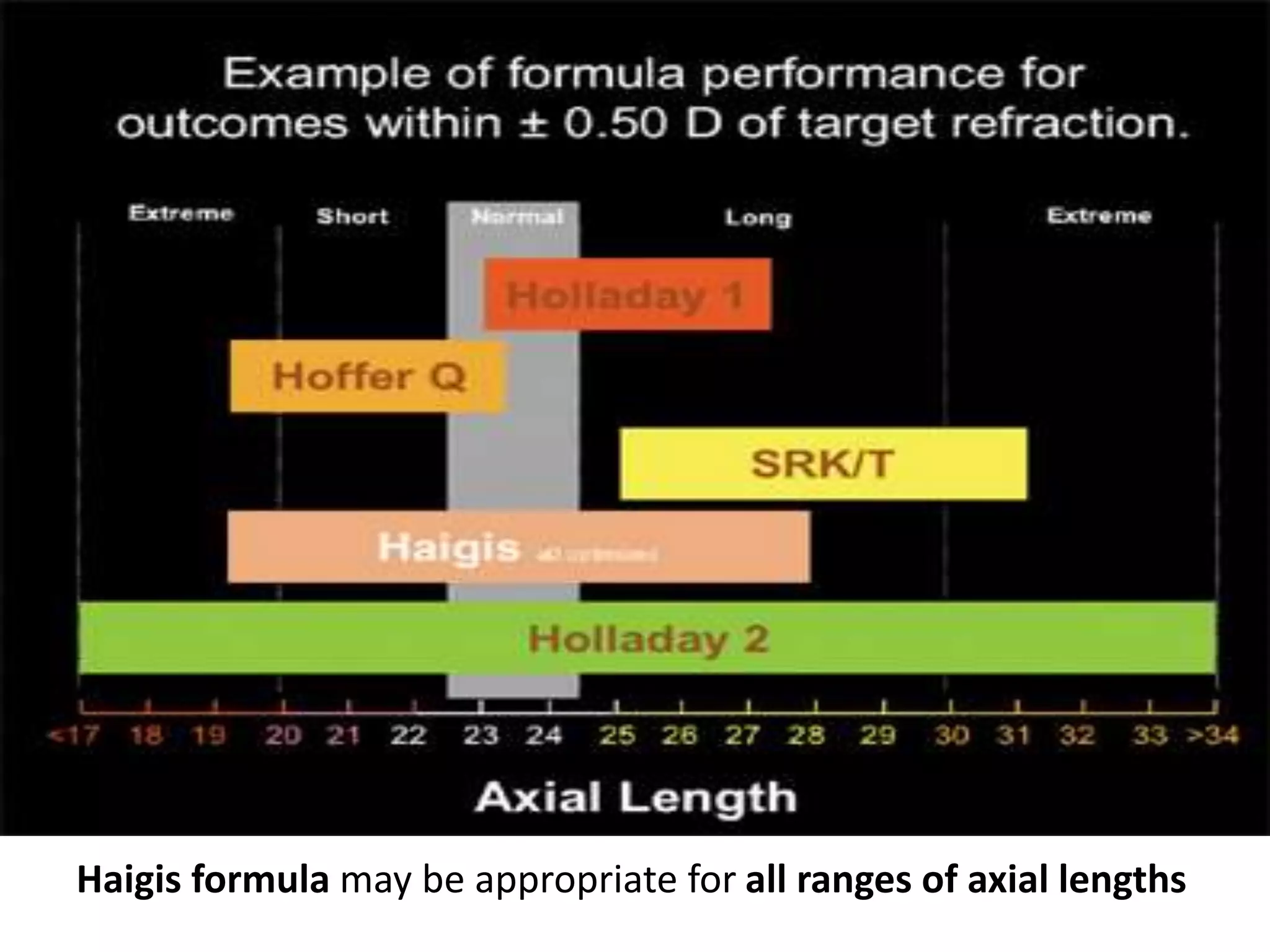
Haigis formula may be appropriate for all ranges of axial lengths
National Ocular Biometry Course (NOBC) 2015 An echoslide presentation

National Ocular Biometry Course (NOBC) 2015 An echoslide presentation

  • 1.
    National Ocular Biometry Course2015 An echoing presentation Prepared by: Anis Suzanna Binti Mohamad Rohaila Binti Ariffin Pegawai Optometri U41 Hospital Sultanah Bahiyah, Alor Setar
  • 2.
    COURSE OBJECTIVES:  Understandthe basic principal of biometry  Perform, define the discuss the pathology that would require the biometry test  Interpret the result of biometry test  Measure axial length  Name four ocular structures that reflect ultrasound echoes  Able to perform biometry test  Able to perform topography, discuss corneal contours of normal, pathological and post-surgical cornea  Take pre-operative testing and intraocular lens power calculation method to the next level of accuracy and efficiency  Utilize standardize diagnostic ultrasonography as a valuable adjuvant to current clinical evaluation.
  • 3.
    Cataract surgery • Whatis cataract surgery? – Precise biometry is essential for accurate outcomes in cataract and refractive surgeries. – The measurement of axial length by ultrasound was the gold standard for many years. – With the introduction of optical biometry in the US in the year 2000, this technology has become more & more popular & is now the most common method for the measurement of axial length. – Optical biometry uses a partially coherent wave that has approx. 9x the resolution of a 10 MHz sound wave, making the measurement of axial length very precise. – It helps to avoid operator variations in measurement. – Also, to increase the accuracy as contact with cornea is not needed (eliminates compression to cornea). – Since Optical biometry measures to the centre of macula, it gives the refractive AXL vs the anatomical AXL achieved with ulrasound.
  • 4.
    Pre-op assessment 1. Keratometry 2.A-Scan Biometry 3. IOL Formula
  • 5.
    1. K-reading Keratometry Manual KTopography Placido disc Scheimflug topography Auto-K Optical biometry
  • 6.
    Manual Keratometry Topography(Placido Disc) K-reading in our center
  • 7.
    Auto-K Optical Biometry(Lenstar) K-reading in our center
  • 8.
    Why we chooseLenstar in our center?
  • 9.
    2. A-Scan Biometry •Measurement of Axial Eye Length by Ultrasound • Average Axial Length of Normal Eye 23.06 mm (Majority : 22.0 to 24.5 mm) • Accuracy of AL measurement using A-scan ultrasound is + 0.1 mm • Difference in AL measurement between both eyes + 0.3 mm • Values are 0.14 to 0.36 mm longer with immersion technique than with contact method
  • 12.
    Examination Procedure 1. HistoryTaking 2. Patient Preparation 3. Biometry Technique
  • 13.
  • 14.
    Ultrasound biometry Ultrasound is producedin the ultrasonographic probe by the oscillation of a pizoelectric crystal Converting electrical energy into mechanical energy The probe emits and receives pulsed signal Reflectivity vs time is displayed for the single direction in which the probe is pointing This value then be converted to milimitres
  • 15.
  • 16.
  • 17.
  • 19.
  • 20.
  • 22.
    Potential Sources ofError with Contact Method 1. Corneal Compression 2. Fluid Excess 3. Misalignment of Sound Beam 4. Inappropriate Eye type Error caused by 1 mm Corneal Compression: Average eye 2.5 D Long eye 1.75 D Short eye 3.75 D
  • 23.
  • 24.
  • 25.
    Potential Sources ofError with Immersion Method 1. Air bubbles within fluid 2. Inappropriate eye type
  • 26.
  • 27.
    Instrument Setting 1. Eyeto measure (OD/OS) 2. Eye type 3. Measurement mode 4. Technique 5. Gain
  • 28.
    Eye Type ( SoundVelocity ) 1. Phakic 2. Aphakic 3. Pseudophakic C A P + R S
  • 30.
    Measurement Mode  Automatic Semiautomatic  Manual
  • 31.
    Gain Setting • Initiallyhigh gain setting should be used to assess the overall appearance of the echogram , then gain should be reduced to a medium level to improve resolution of spikes . • Error can occur when the gain is set too high or too low . Very high gain : short reading Very low gain : long reading
  • 33.
    Use of averagesound velocity ,although sufficient in normal phakic eye , may result in slight error when the lens is inordinately thin or thick or when the eye is very short or very long .
  • 34.
    • The useof individual sound velocity may provide more consistent and accurate AL reading .
  • 36.
    • Manual measurementmode is better to help ensure alignment of sound beam . Aphakia & Pseudophakia
  • 37.
    Posterior Staphyloma • Posteriorstaphylomas often causes an irregular shape of the ocular wall resulting in an inability to display a distinct , high retinal spike , leading to a significant error in A-scan measurement . • Deepest portion of the staphyloma may be located eccentric to macula thus the measurement may be longer than true AL along the visual axis . • B-scan can be used to demonstrate the shape of posterior ocular wall and the relationship of macula to the staphyloma . • Probes with fixation light are preferable
  • 41.
    High Hyperopia • Immersiontechnique is preferable .
  • 42.
     Edema  DMS Tumor Macular Lesions  RD The presence of an elevated macular lesion may prevent the display of a distinct retinal spike and often causes a shortened AL measurement .
  • 45.
    Vitreous Lesions  AsteroidHyalosis  Vitreous Hemorrhage  Gas Bubble
  • 47.
    Dense Cataract • Strongsound attenuation produced by a very dense cataract can significantly impair the ability to display spikes from the various interfaces along the visual axis . • Maximum gain setting may be required to obtain spikes of sufficient height from the posterior lens capsule and retina . • Semiautomatic mode should be used in eyes with dense cataract.
  • 49.
    Silicone Oil • Soundvelocity in silicone oil 1040 m/s 5000 cs 980 m/s 1000cs • This low sound velocity can result in pronounced sound attenuation and difficulty in identifying the retinal spikes .
  • 51.
    • If propersound velocity are not used , erroneously long AL measurement will be obtained . • For accurate AL measurement ,various ocular components should be measured separately with appropriate sound velocity . • The least preferred method is use of average sound velocity. Average sound velocity in eyes with average length (23.5 mm): 1,139 m/s phakic eye 1,052 m/s aphakic eye • Due to strong sound attenuation AL measurement often can not be obtained from an eye containing emulsified silicone oil .
  • 52.
  • 55.
    Zeiss IOL Master Axial Length  ACD  Corneal Power  IOL Power Calculation Hoffer-Q , SRK/T ,Holladay 1, Haigis
  • 58.
    Keratometry A second personshould confirm measurements prior to A-scan ultrasonography if: The corneal power is less than 40.0 diopters, or greater than 47.0 diopters. If there has been prior keratorefractive surgery. In this case the corneal power will need to be estimated by either the historical, or the contact lens method. The average corneal power difference between the two eyes is greater than 1.00 diopter. The patient cannot fixate, as seen with a mature cataract, or macular hole. The amount of corneal astigmatism by keratometry, or topography, correlates poorly with the amount of astigmatism on the most recent manifest refraction. The corneal diameter is less than 11.00 mm. There is any problem with patient cooperation, or understanding.
  • 59.
    Immersion A-scan Ultrasonography Asecond person should re-measure both eyes if: The axial length is less than 22.00 mm, or greater than 25.00 mm in either eye. The axial length is greater than 26.0 mm, and there is a poor retinal spike, or wide variability in the readings. There is a difference in axial length between the two eyes of greater than 0.33 mm that cannot be correlated with the patient's oldest refraction. Axial length measurements do not correlate with the patient's refractive error. In general, myopes should have eyes longer than 24.0 mm and hyperopes should have eyes shorter than 24.0 mm. Exceptions to this rule involve steep, or flat corneas. Be sure to use the oldest refractive data. There is difficulty obtaining correctly positioned, high, steeply rising echoes, or wide variability in individual axial length readings for either eye.
  • 60.
    Intraocular Lens Power Asecond person should repeat the axial length measurements, keratometry readings and re-run the IOL power calculations for both eyes if: The IOL power for emmetropia is greater than 3.00 diopters different than anticipated. There is a difference in IOL power of greater than 1.00 diopter between the two eyes. If the patient has had prior keratorefractive surgery and the calculated IOL power for standard phacoemulsification is less than +20.0 D or greater than +23.0 D.
  • 61.
  • 62.
    IOL Power Formula Theoretical  Regression  Refractive
  • 63.
    Theoretical Formulas These arederived from geometrical optics
  • 64.
    Regression Formulas Actual postoprefractive results of many lens implantations are used to predict IOL power
  • 65.
    Theoretical Formula These formulascontain many assumptions including values of postop ACD , refractive index of cornea and ocular humors , retinal thickness
  • 66.
    Theoretical Formula These formulasare reliable for average AL , but overestimates in short eyes and underestimates in long eyes
  • 67.
    Refractive Formulas IOL powercalculation without determination of axial length
  • 72.
    SRK I (Sanders,Retzlaff,Kraff) P =A – 2.5L – 0.9K It generally undercorrects short eyes and overcorrects long eyes
  • 73.
    SRK II A1 =A + 3 AL < 20mm A1 = A + 2 AL 20-21 A1 = A + 1 AL 21-22 A1 = A AL 22-24.5 A1 = A – 0.5 AL >24.5
  • 74.
    SRK/T • It isa nonlinear theoretical optical formula empirically optimized for postop ACD, retinal thickness , corneal refractive index . It combines advantages of theoretical and regression formulas .
  • 75.
    Generations of IOLFormulas • 1st Generation Fyodorov , Colenbrander ,Hoffer , SRK I • 2nd Generation Binkhorst , SRK II • 3rd Generation Holladay 1 , Hoffer-Q , SRK/T • 4th Generation Holladay 2 , Haigis, Hoffer-H • 5th Generation (2014) Hoffer H-5
  • 79.
    There are currentlythree IOL constants in use: The SRK/T formula uses an "A-constant." The Holladay 1 formula uses a "Surgeon Factor." The Holladay 2 formula, and the Hoffer Q formula, both use an "Anterior Chamber Depth." aka: ACD.
  • 80.
    d = theeffective lens position, where ... d = a0 + (a1 * ACD) + (a2 * AL) Haigis Formula
  • 81.
    * The a0constant basically moves the curve up, or down, in much the same way that the A- constant, Surgeon Factor, or ACD does for the Holladay 1, Holladay 2, Hoffer Q and SRK/T formulas. * The a1 constant is tied to the measured anterior chamber depth. * The a2 constant is tied to the measured axial length. The way the a0, a1 and a2 constants are derived is by generating a set of surgeon, and IOL-specific
  • 82.
    AL < 19mm (<0.1%) Holladay 2 AL 19-22 mm (8%) Holladay 2 , Hoffer-Q AL 22-24.5 mm (72%) SRK II , Hoffer-Q ,Holladay 1 AL 24.5-26 mm (15%) Holladay 1 , Hoffer-Q AL > 26 mm ( 15%) SRK/T Formula Choice
  • 83.
    Haigis formula maybe appropriate for all ranges of axial lengths

Editor's Notes

  • #10 A-scan ultrasound biometry, commonly referred to as an A-scan, is routine type of diagnostic test used in ophthalmology. The A-scan provides data on the length of the eye, which is a major determinant in common sight disorders.
  • #21 Scleral shell (Prager) Scleral Shell (Ossoining) Scleral Shell (Kohn)