DEFINITION
• An exodeviation is a manifest (exotropia) or latent (exophoria) divergent strabismus.
• Simple words : Eye deviating outwards (away from nose).
• Could be :
a. constant (one eye)
b. Alternating (preference / no preference)
c. Mixed with vertical deviation
d. Associated with A orV pattern
RISK FACTORS
Maternal substance abuse , smoking during pregnancy
Premature birth
Perinatal morbidity
Genetic anomalies
Family history of strabismus
Uncorrected refractive errors.
MUST KNOW
TERMINOLOGIES!
((Exodeviations based on fusion ability)
PSEUDO-EXOTROPIA
• Appearance of exodeviation when the eyes are actually aligned.
• May occur when there is a wide interpupillary distance or a positive
angle kappa with or without other ocular abnormalities.
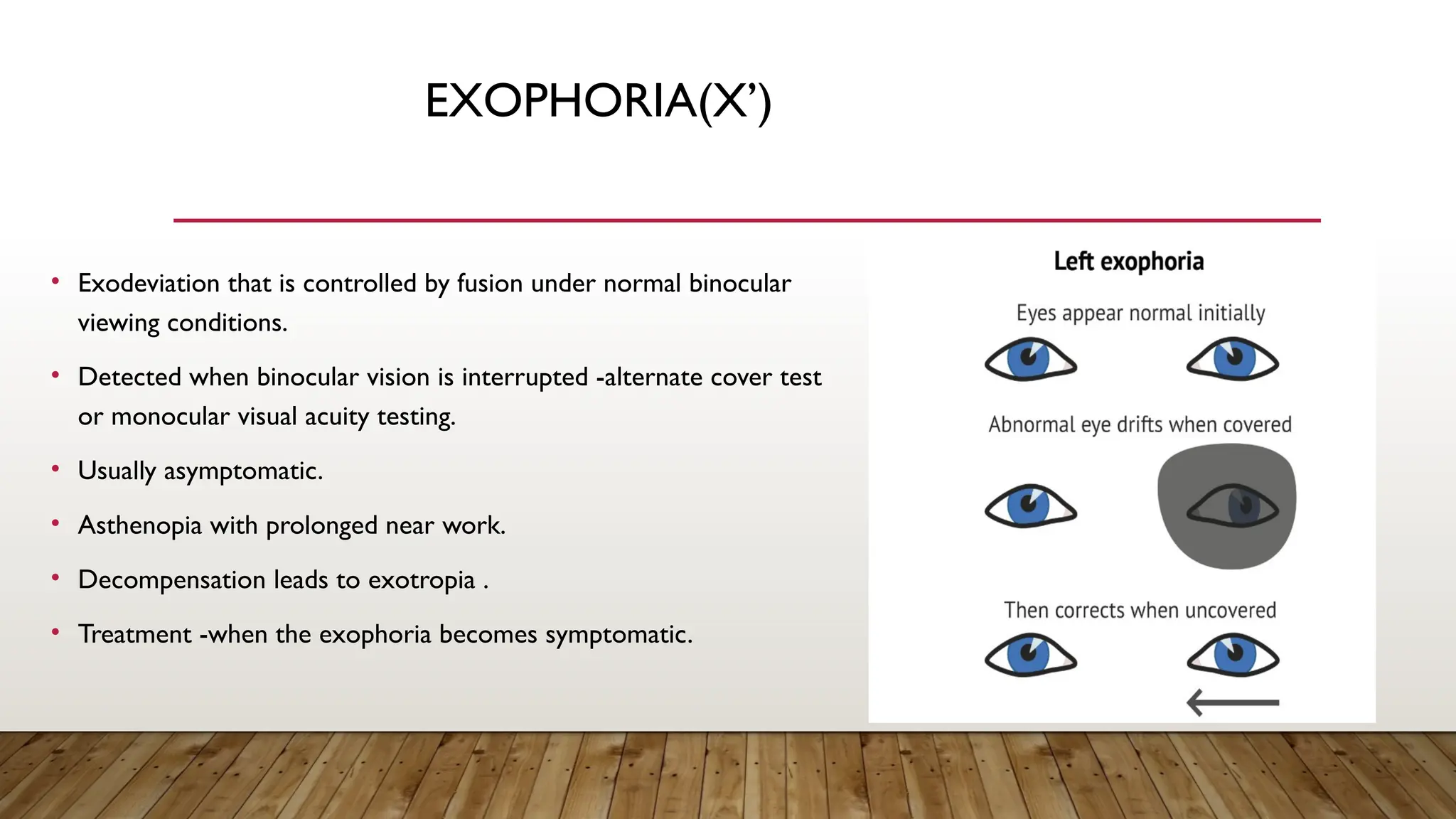
EXOPHORIA(X’)
• Exodeviation that is controlled by fusion under normal binocular
viewing conditions.
• Detected when binocular vision is interrupted -alternate cover test
or monocular visual acuity testing.
• Usually asymptomatic.
• Asthenopia with prolonged near work.
• Decompensation leads to exotropia .
• Treatment -when the exophoria becomes symptomatic.
INTERMITTENT EXOTROPIA - X(T)
• Eye deviated outward but controlled by fusion/accommodation.
• Onset usually before 5 years.
• Manifest during times of visual inattention, fatigue, stress, or illness.
• Parents say that the exotropia occurs late in the day or when the child is daydreaming or tired.
• Usually larger when the patient views distant targets, and difficult to elicit at near fixation.
• May be associated with small hypertropias,A andV patterns, and overelevation and underelevation
in adduction
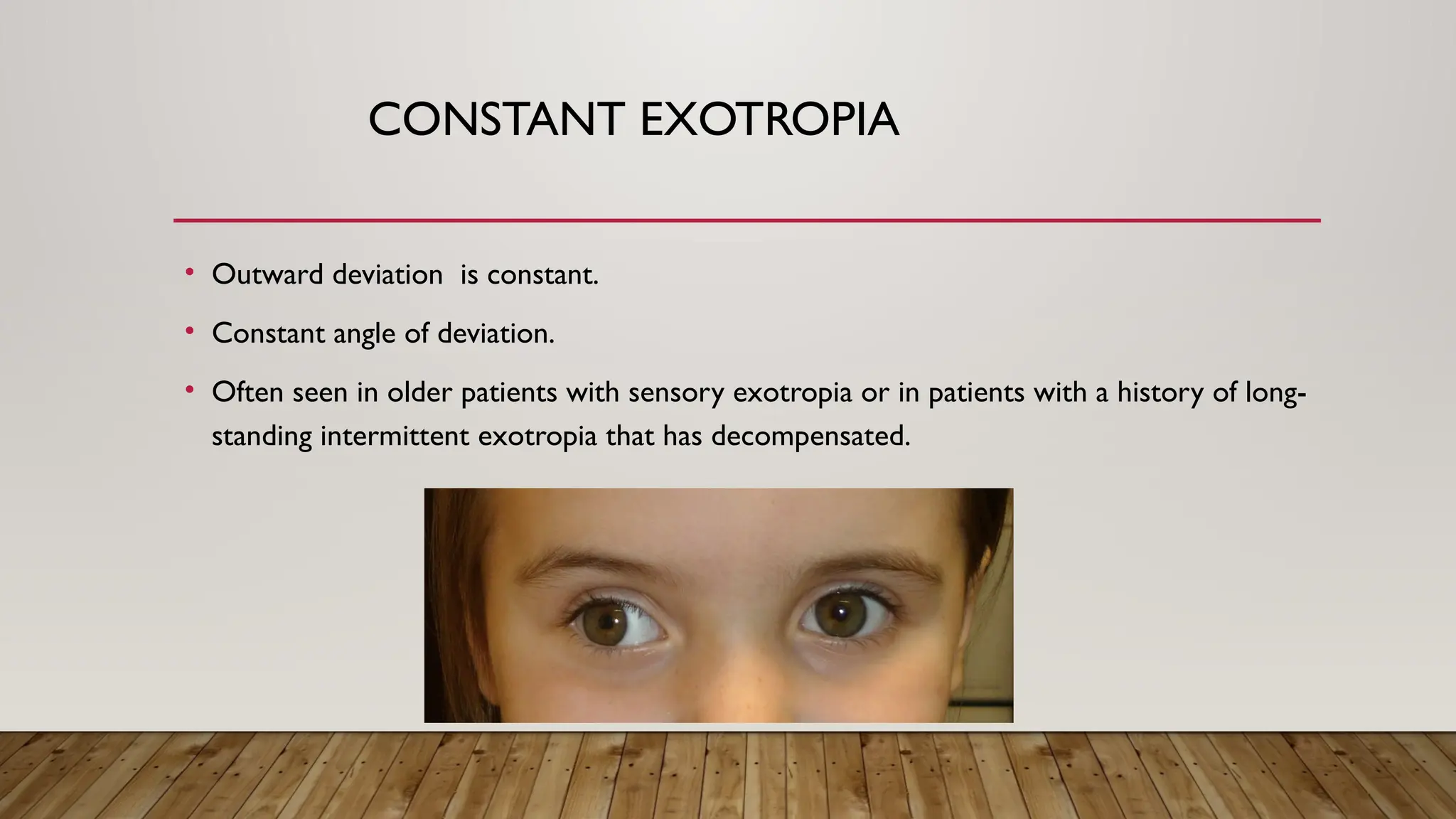
CONSTANT EXOTROPIA
• Outward deviation is constant.
• Constant angle of deviation.
• Often seen in older patients with sensory exotropia or in patients with a history of long-
standing intermittent exotropia that has decompensated.
TYPES
a.Concomitant
1. Primary
• Infantile exotropia
Intermittent exotropia
2. Secondary
• Sensory exotropia –d/t cataract / RD/opacity/optic atrophy
Consecutive exotropia –overcorrection of esotropia
b.Incomitant
1. Paralytic (III n., medial rectus palsy)
2. Restrictive
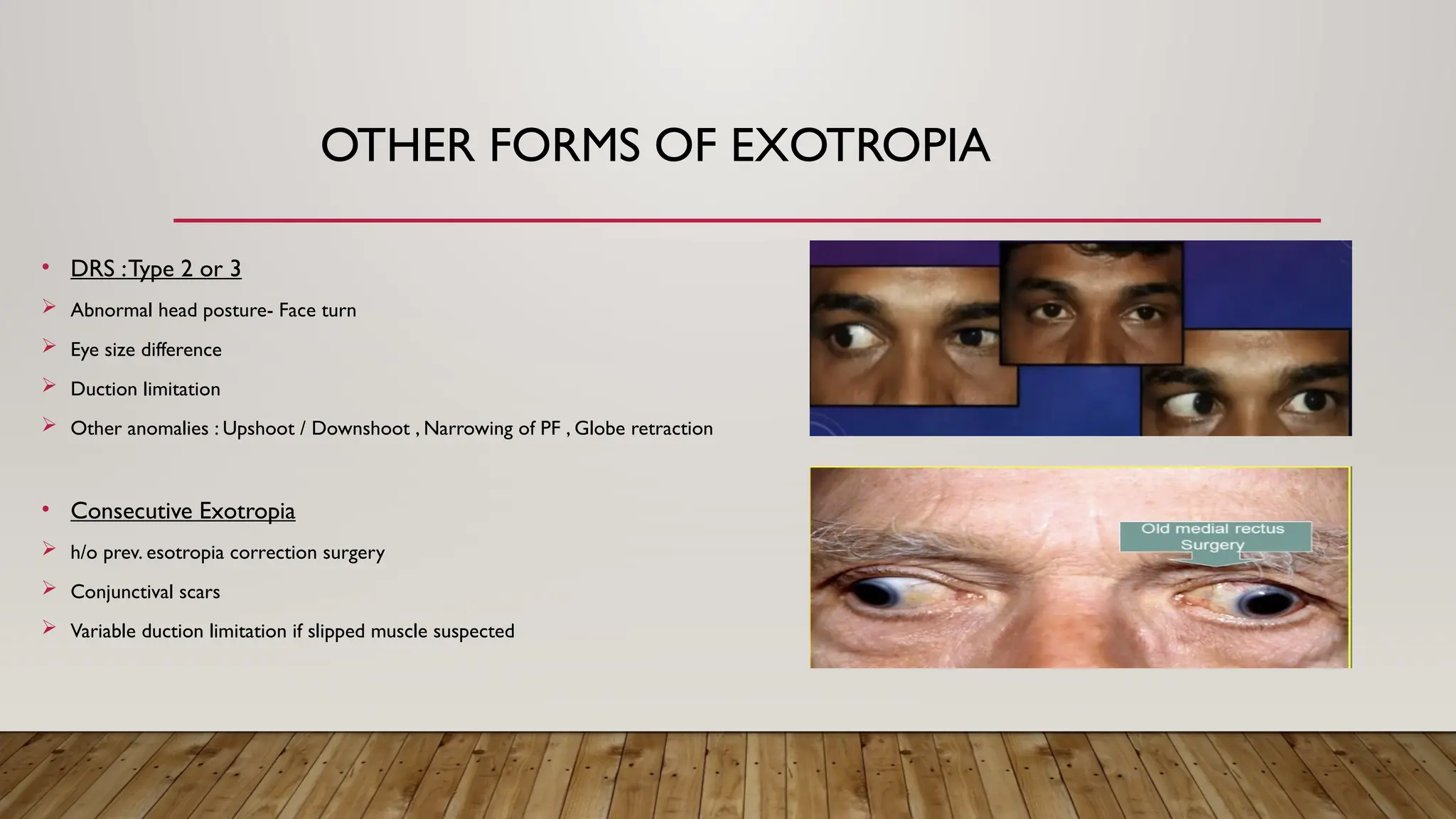
3. Musculofascial anomalies (Duane's retraction syndrome type 2 and 3)
4. Dissociated horizontal deviation.
INFANTILE EXOTROPIA
• Infantile exotropia is much less common than
infantile esotropia.
• Onset before age 6 months as a large-angle
deviation .
• The risk of amblyopia is higher in constant
exotropia than in intermittent exotropia.
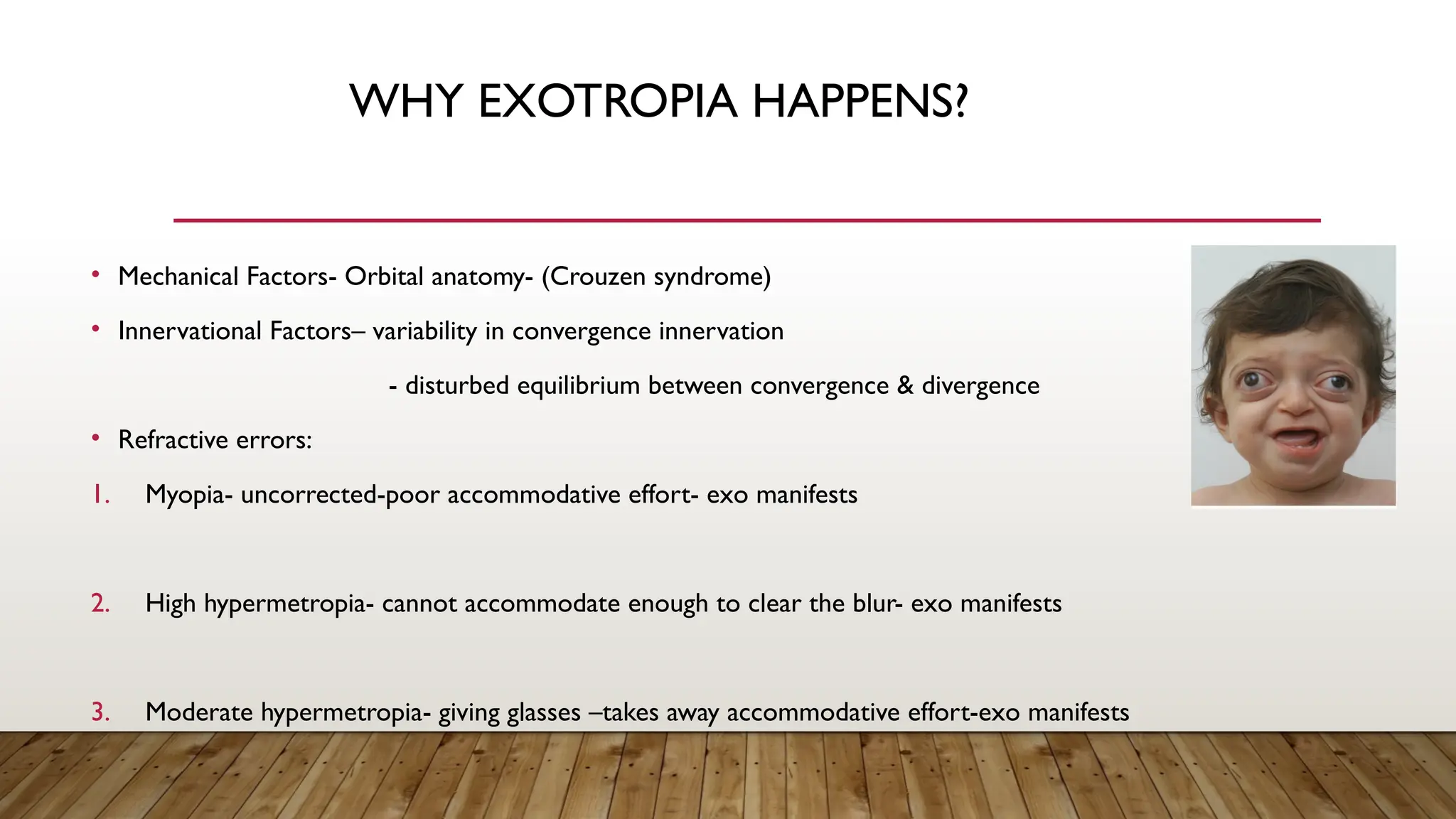
WHY EXOTROPIA HAPPENS?
• Mechanical Factors- Orbital anatomy- (Crouzen syndrome)
• Innervational Factors– variability in convergence innervation
- disturbed equilibrium between convergence & divergence
• Refractive errors:
1. Myopia- uncorrected-poor accommodative effort- exo manifests
2. High hypermetropia- cannot accommodate enough to clear the blur- exo manifests
3. Moderate hypermetropia- giving glasses –takes away accommodative effort-exo manifests
HISTORY
age at onset / present
since birth? (less
stereopsis)
h/o prematurity—ROP?
Developmental delay?
Viral illness?
h/o vaccination , h/o
trauma , family history
frequency and duration of
misalignment
circumstances under which
the deviation is manifest
whether the exotropia is
becoming more frequent
with time.
symptoms such as
diplopia, asthenopia, or
difficulty with interpersonal
interactions secondary to
ocular misalignment are
present.
EXAMINATION
• A typical examination order is:
1. Stereopsis (distance and near) - eg:Titmus fly test..
2. Duction andVersion
3. Exodeviation control
• Good: Exotropia manifests only after cover testing; the patient resumes fusion rapidly without blinking or refixating.
• Fair: Exotropia manifests after fusion is disrupted by cover testing; the patient resumes fusion only after blinking or refixating.
• Poor:Exotropia manifests spontaneously ,may remain manifest for an extended time.
4.Exodeviation angle
5.Visual acuity (monocular & binocular)
MOTOR CONTROL SCORES
• Helps for comparison with previous
visits
PEDIG OFFICE CONTROL SCALE
Dissociation- covering the eye
EXODEVIATION ANGLE
• Prism and alternate cover testing is used to evaluate the exodeviation at
fixation distances of 6 m and 33 cm.
• A far-distance measurement at 30 m or greater (eg, at the end of a long
hallway or out a window) may uncover a latent deviation or elicit an even
larger one.
OTHER THINGSTO KEEP IN MIND DURING
EXAMINATION
Amblyopia
Distance near disparity
Co-existing A/V pattern
Refractive correction
Media and Fundus
DUANE’S CLASSIFICATION
1. Divergence excess pattern : Distance deviation 15 Prism dioptres (PD) larger than near deviation.
2. Convergence insufficiency pattern : Near deviation 15 PD larger than distance deviation.
3. Basic exodeviation : Exodeviation equal for near and far distance ( usually within 10 PD).
4. Simulated divergence excess/ Pseudo divergence excess : type of basic deviation presenting as divergence
excess due to part compensation of near deviation by fusional or accommodative convergence.
BURIAN’S CLASSIFICATION
• Divergence excess
• Simulated divergence excess with tenacious proximal proximal fusion (patch test)
• Simulated divergence excess with +3DS lens
• Basic
• Convergence insufficiency
IMPLEMENTATION
1) Near=30XT , Distance=30XT
Dx-Basic XT
2) Near=20XT , Distance=40XT
?Divergence excess
Do a patch test (45min occlusion)
3) Near=35XT , Distance=40XT
Dx=Divergence excess with Tenacious proximal fusion
Fusion used to keep near deviation in check
4) Near=20XT , Distance=40XT
Patch test
Near=20XT , Distance=40XT
AC/A ratio (Hold up +3.00DS lens)
Near=35XT , Distance=40XT
Dx-Simulated Divergence excess with high AC/A ratio
5) Near=10XT , Distance=35XT
After patch test and AC/A ratio with +3.00DS lens
Same measurements
Dx- True divergence excess
6) Near=45XT , Distance=20XT
Dx- Convergence insufficiency
SYMPTOMS
• Exophoria– Diplopia ,Visual disturbances , Eyestrain , Headache (d/t constantly trying to fuse)
• Intermittent exotropia : precipitates on exposure to strong light
may lead to decreased vision when both eyes open
sometimes micropsia
• Constant exotropia : lack binocular vision
have wide peripheral vision
OTHER FORMS OF EXOTROPIA
• DRS :Type 2 or 3
 Abnormal head posture- Face turn
 Eye size difference
 Duction limitation
 Other anomalies : Upshoot / Downshoot , Narrowing of PF , Globe retraction
• Consecutive Exotropia
 h/o prev. esotropia correction surgery
 Conjunctival scars
 Variable duction limitation if slipped muscle suspected
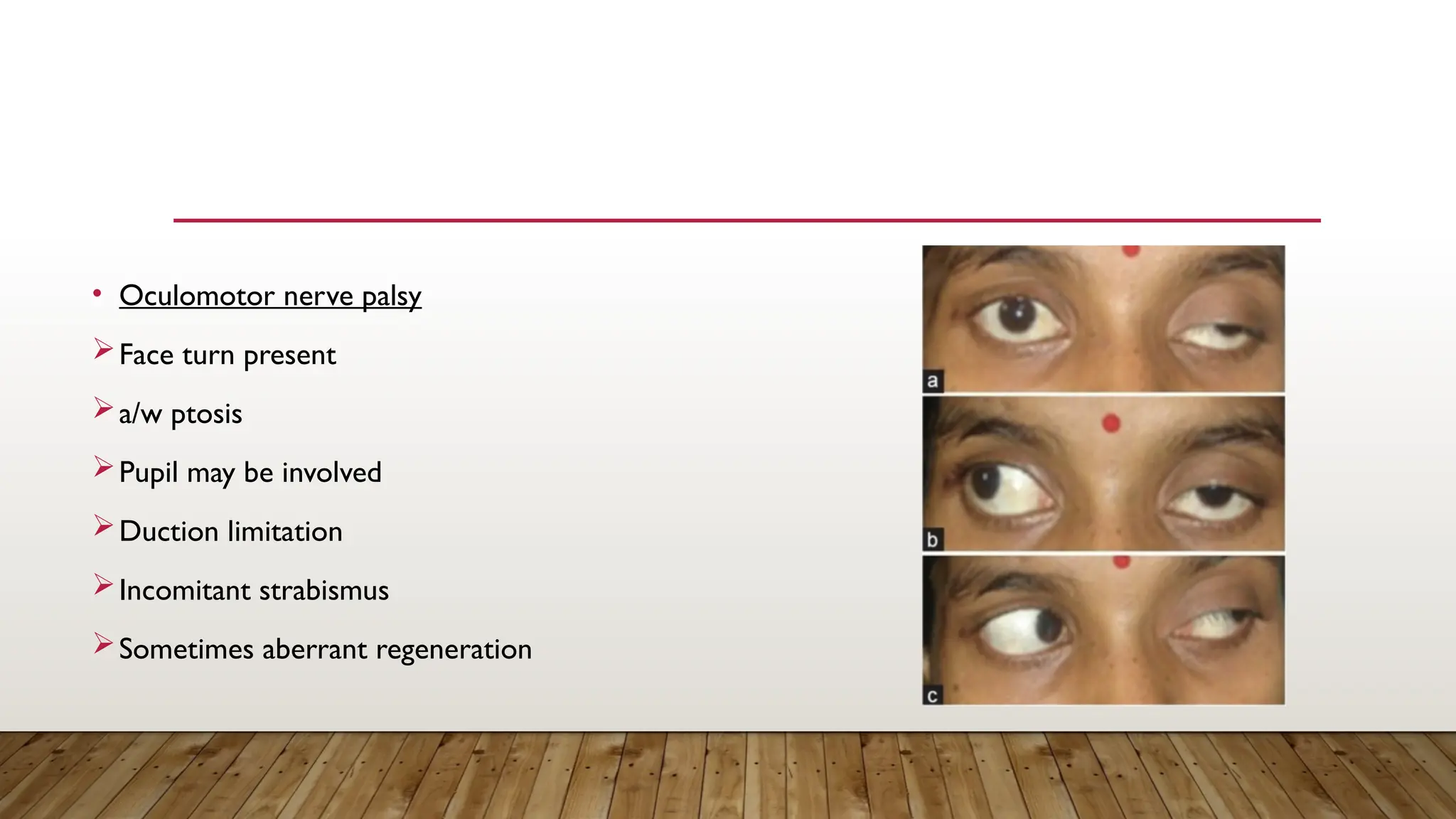
• Oculomotor nerve palsy
Face turn present
a/w ptosis
Pupil may be involved
Duction limitation
Incomitant strabismus
Sometimes aberrant regeneration
• Congenital exotropia
Present since birth
Large angles of deviation
a/w co-existing delayed visual maturation
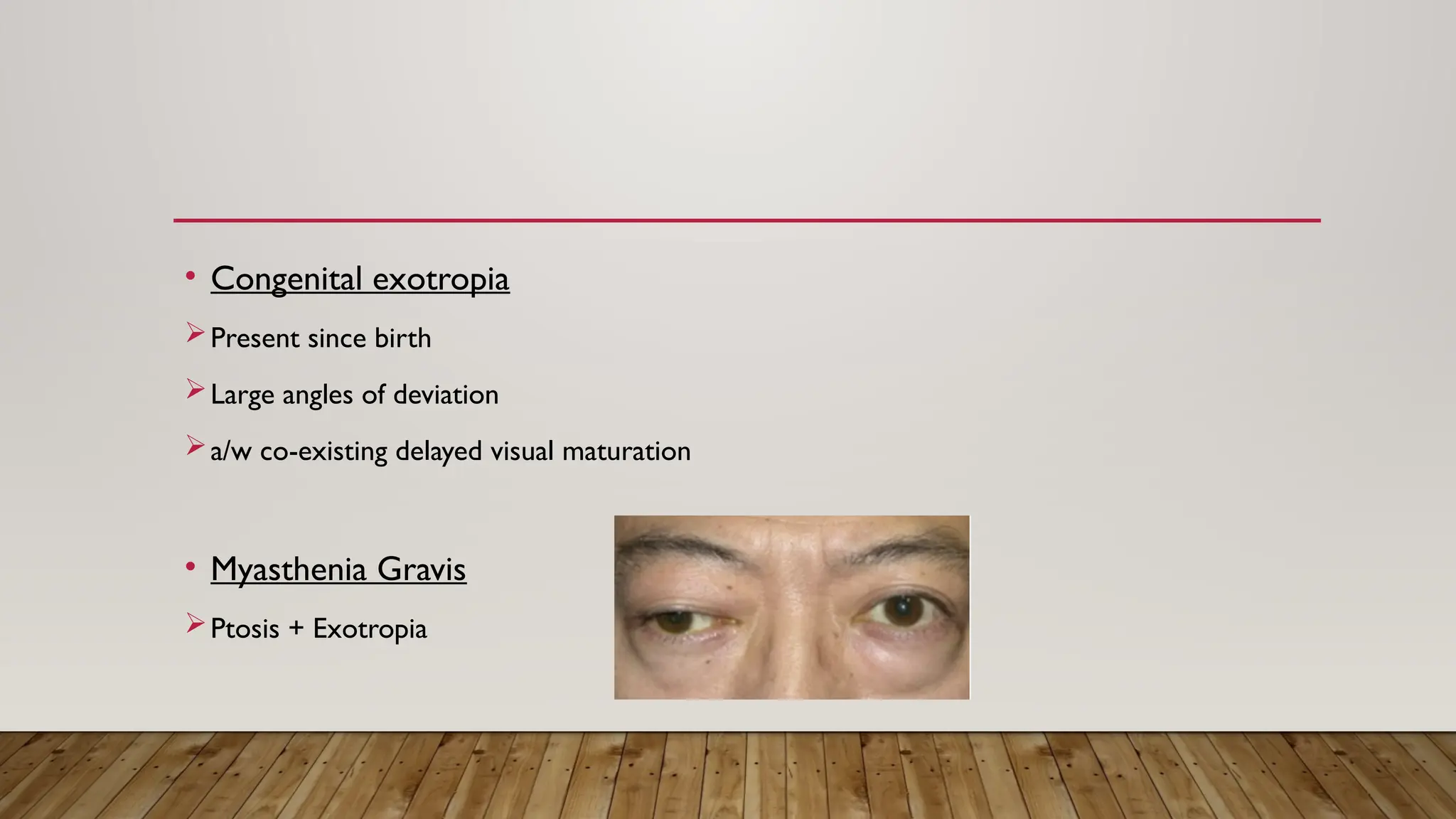
• Myasthenia Gravis
Ptosis + Exotropia
MANAGEMENT
NON-SURGICAL
• Glass correction:
1. Uncorrected myopia- give full myopic correction
2. Astigmatism – full astigmatic correction in children
maximum tolerated correction in older children & adults
3. Hypermetropia – appropriate under-correction may improve control because of clear retinal
image
OCCLUSIONTHERAPY
• Occlusion therapy (patching) for amblyopia may improve exotropic deviations.
• For patients without amblyopia, part-time patching of the dominant (nondeviating) eye or alternate
patching (alternating which eye is patched each day) in the absence of a strong ocular preference
can improve control of small- to moderate-sized deviations
• The improvement is often temporary, however, and many patients eventually require surgery.
• Base In prisms can be used, but not longterm – as causes reduced fusional vergence
• Orthoptic exercises : Treatment of symptomatic CI involves orthoptic exercises such as
stereograms,“pencil push-ups,” and computer-based or office-based convergence training
programs.
SURGICALTREATMENT
• Factors influencing to proceed with surgery :
a. strabismus that is frequently manifest
b. poorly controlled
c. worsening (especially at near)
d. Symptomatic-decreased stereoacuity in the distance before near
e. poor self-image and difficulty with personal or professional relationships.
• Surgical treatment consists of bilateral lateral rectus muscle recession or unilateral lateral rectus muscle
recession combined with medial rectus muscle resection.
• Large (>50 )
Δ deviations may require surgery on 3 or 4 muscles .
• Caution is advised when surgery is considered for a patient with true divergence excess exotropia, especially
with a high AC/A ratio, because of the associated risk of postoperative diplopia and esotropia at near.
POST-OPERATIVE ALIGNMENT
• small-angle esotropia in the immediate postoperative period tends to resolve and is desirable because of its
association with a reduced risk of recurrent exotropia and higher success rates.
• Patients may experience diplopia.
• Postsurgical esotropia (unresolved) may require further treatment, such as hyperopic correction, base-out prisms,
patching to prevent amblyopia, or additional surgery.
• Bifocal glasses can be used in patients with a high AC/A ratio and should be discussed preoperatively with these
patients.
THANKYOU !

exodeviations.presention................

  • 1.
    DEFINITION • An exodeviationis a manifest (exotropia) or latent (exophoria) divergent strabismus. • Simple words : Eye deviating outwards (away from nose). • Could be : a. constant (one eye) b. Alternating (preference / no preference) c. Mixed with vertical deviation d. Associated with A orV pattern
  • 2.
    RISK FACTORS Maternal substanceabuse , smoking during pregnancy Premature birth Perinatal morbidity Genetic anomalies Family history of strabismus Uncorrected refractive errors.
  • 3.
  • 4.
    PSEUDO-EXOTROPIA • Appearance ofexodeviation when the eyes are actually aligned. • May occur when there is a wide interpupillary distance or a positive angle kappa with or without other ocular abnormalities.
  • 5.
    EXOPHORIA(X’) • Exodeviation thatis controlled by fusion under normal binocular viewing conditions. • Detected when binocular vision is interrupted -alternate cover test or monocular visual acuity testing. • Usually asymptomatic. • Asthenopia with prolonged near work. • Decompensation leads to exotropia . • Treatment -when the exophoria becomes symptomatic.
  • 6.
    INTERMITTENT EXOTROPIA -X(T) • Eye deviated outward but controlled by fusion/accommodation. • Onset usually before 5 years. • Manifest during times of visual inattention, fatigue, stress, or illness. • Parents say that the exotropia occurs late in the day or when the child is daydreaming or tired. • Usually larger when the patient views distant targets, and difficult to elicit at near fixation. • May be associated with small hypertropias,A andV patterns, and overelevation and underelevation in adduction
  • 7.
    CONSTANT EXOTROPIA • Outwarddeviation is constant. • Constant angle of deviation. • Often seen in older patients with sensory exotropia or in patients with a history of long- standing intermittent exotropia that has decompensated.
  • 8.
    TYPES a.Concomitant 1. Primary • Infantileexotropia Intermittent exotropia 2. Secondary • Sensory exotropia –d/t cataract / RD/opacity/optic atrophy Consecutive exotropia –overcorrection of esotropia b.Incomitant 1. Paralytic (III n., medial rectus palsy) 2. Restrictive 3. Musculofascial anomalies (Duane's retraction syndrome type 2 and 3) 4. Dissociated horizontal deviation.
  • 9.
    INFANTILE EXOTROPIA • Infantileexotropia is much less common than infantile esotropia. • Onset before age 6 months as a large-angle deviation . • The risk of amblyopia is higher in constant exotropia than in intermittent exotropia.
  • 10.
    WHY EXOTROPIA HAPPENS? •Mechanical Factors- Orbital anatomy- (Crouzen syndrome) • Innervational Factors– variability in convergence innervation - disturbed equilibrium between convergence & divergence • Refractive errors: 1. Myopia- uncorrected-poor accommodative effort- exo manifests 2. High hypermetropia- cannot accommodate enough to clear the blur- exo manifests 3. Moderate hypermetropia- giving glasses –takes away accommodative effort-exo manifests
  • 11.
    HISTORY age at onset/ present since birth? (less stereopsis) h/o prematurity—ROP? Developmental delay? Viral illness? h/o vaccination , h/o trauma , family history frequency and duration of misalignment circumstances under which the deviation is manifest whether the exotropia is becoming more frequent with time. symptoms such as diplopia, asthenopia, or difficulty with interpersonal interactions secondary to ocular misalignment are present.
  • 12.
    EXAMINATION • A typicalexamination order is: 1. Stereopsis (distance and near) - eg:Titmus fly test.. 2. Duction andVersion 3. Exodeviation control • Good: Exotropia manifests only after cover testing; the patient resumes fusion rapidly without blinking or refixating. • Fair: Exotropia manifests after fusion is disrupted by cover testing; the patient resumes fusion only after blinking or refixating. • Poor:Exotropia manifests spontaneously ,may remain manifest for an extended time. 4.Exodeviation angle 5.Visual acuity (monocular & binocular)
  • 13.
    MOTOR CONTROL SCORES •Helps for comparison with previous visits
  • 14.
    PEDIG OFFICE CONTROLSCALE Dissociation- covering the eye
  • 15.
    EXODEVIATION ANGLE • Prismand alternate cover testing is used to evaluate the exodeviation at fixation distances of 6 m and 33 cm. • A far-distance measurement at 30 m or greater (eg, at the end of a long hallway or out a window) may uncover a latent deviation or elicit an even larger one.
  • 16.
    OTHER THINGSTO KEEPIN MIND DURING EXAMINATION Amblyopia Distance near disparity Co-existing A/V pattern Refractive correction Media and Fundus
  • 17.
    DUANE’S CLASSIFICATION 1. Divergenceexcess pattern : Distance deviation 15 Prism dioptres (PD) larger than near deviation. 2. Convergence insufficiency pattern : Near deviation 15 PD larger than distance deviation. 3. Basic exodeviation : Exodeviation equal for near and far distance ( usually within 10 PD). 4. Simulated divergence excess/ Pseudo divergence excess : type of basic deviation presenting as divergence excess due to part compensation of near deviation by fusional or accommodative convergence.
  • 18.
    BURIAN’S CLASSIFICATION • Divergenceexcess • Simulated divergence excess with tenacious proximal proximal fusion (patch test) • Simulated divergence excess with +3DS lens • Basic • Convergence insufficiency
  • 19.
    IMPLEMENTATION 1) Near=30XT ,Distance=30XT Dx-Basic XT 2) Near=20XT , Distance=40XT ?Divergence excess Do a patch test (45min occlusion) 3) Near=35XT , Distance=40XT Dx=Divergence excess with Tenacious proximal fusion Fusion used to keep near deviation in check
  • 20.
    4) Near=20XT ,Distance=40XT Patch test Near=20XT , Distance=40XT AC/A ratio (Hold up +3.00DS lens) Near=35XT , Distance=40XT Dx-Simulated Divergence excess with high AC/A ratio 5) Near=10XT , Distance=35XT After patch test and AC/A ratio with +3.00DS lens Same measurements Dx- True divergence excess 6) Near=45XT , Distance=20XT Dx- Convergence insufficiency
  • 21.
    SYMPTOMS • Exophoria– Diplopia,Visual disturbances , Eyestrain , Headache (d/t constantly trying to fuse) • Intermittent exotropia : precipitates on exposure to strong light may lead to decreased vision when both eyes open sometimes micropsia • Constant exotropia : lack binocular vision have wide peripheral vision
  • 22.
    OTHER FORMS OFEXOTROPIA • DRS :Type 2 or 3  Abnormal head posture- Face turn  Eye size difference  Duction limitation  Other anomalies : Upshoot / Downshoot , Narrowing of PF , Globe retraction • Consecutive Exotropia  h/o prev. esotropia correction surgery  Conjunctival scars  Variable duction limitation if slipped muscle suspected
  • 23.
    • Oculomotor nervepalsy Face turn present a/w ptosis Pupil may be involved Duction limitation Incomitant strabismus Sometimes aberrant regeneration
  • 24.
    • Congenital exotropia Presentsince birth Large angles of deviation a/w co-existing delayed visual maturation • Myasthenia Gravis Ptosis + Exotropia
  • 25.
  • 26.
    NON-SURGICAL • Glass correction: 1.Uncorrected myopia- give full myopic correction 2. Astigmatism – full astigmatic correction in children maximum tolerated correction in older children & adults 3. Hypermetropia – appropriate under-correction may improve control because of clear retinal image
  • 27.
    OCCLUSIONTHERAPY • Occlusion therapy(patching) for amblyopia may improve exotropic deviations. • For patients without amblyopia, part-time patching of the dominant (nondeviating) eye or alternate patching (alternating which eye is patched each day) in the absence of a strong ocular preference can improve control of small- to moderate-sized deviations • The improvement is often temporary, however, and many patients eventually require surgery.
  • 28.
    • Base Inprisms can be used, but not longterm – as causes reduced fusional vergence • Orthoptic exercises : Treatment of symptomatic CI involves orthoptic exercises such as stereograms,“pencil push-ups,” and computer-based or office-based convergence training programs.
  • 29.
    SURGICALTREATMENT • Factors influencingto proceed with surgery : a. strabismus that is frequently manifest b. poorly controlled c. worsening (especially at near) d. Symptomatic-decreased stereoacuity in the distance before near e. poor self-image and difficulty with personal or professional relationships.
  • 30.
    • Surgical treatmentconsists of bilateral lateral rectus muscle recession or unilateral lateral rectus muscle recession combined with medial rectus muscle resection. • Large (>50 ) Δ deviations may require surgery on 3 or 4 muscles . • Caution is advised when surgery is considered for a patient with true divergence excess exotropia, especially with a high AC/A ratio, because of the associated risk of postoperative diplopia and esotropia at near.
  • 31.
    POST-OPERATIVE ALIGNMENT • small-angleesotropia in the immediate postoperative period tends to resolve and is desirable because of its association with a reduced risk of recurrent exotropia and higher success rates. • Patients may experience diplopia. • Postsurgical esotropia (unresolved) may require further treatment, such as hyperopic correction, base-out prisms, patching to prevent amblyopia, or additional surgery. • Bifocal glasses can be used in patients with a high AC/A ratio and should be discussed preoperatively with these patients.
  • 32.