B.Sc.-I (Physics)
Paper-I, Unit 01
Dr. Krishna Jibon Mondal
Assistant Professor and Head
Department of Physisc and Electronics
Shri Shankaracharya Mahavidyalaya, Bhilai
Part 01
Velocity and Acceleration in Different Co-ordinates system
Outlines
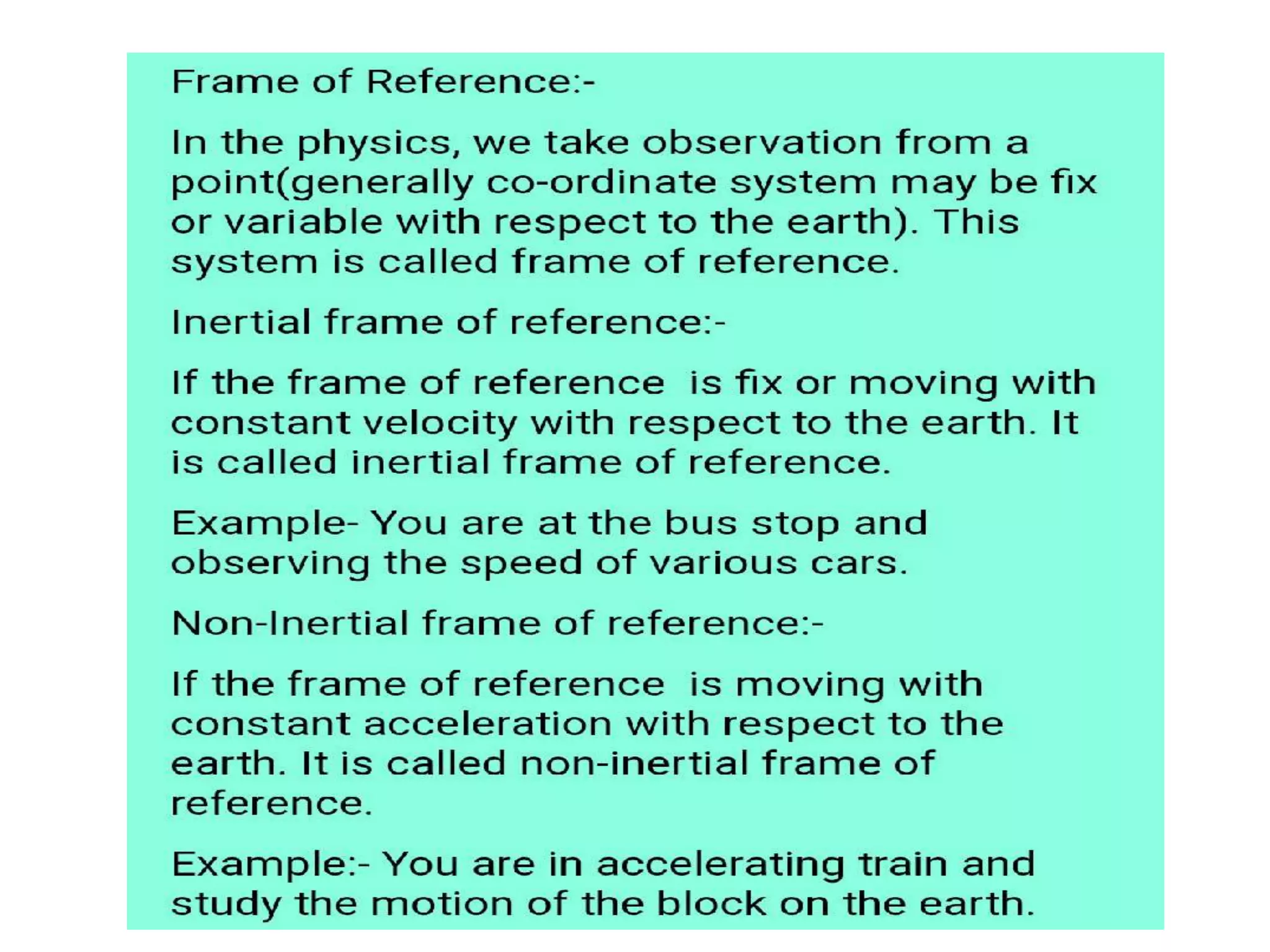
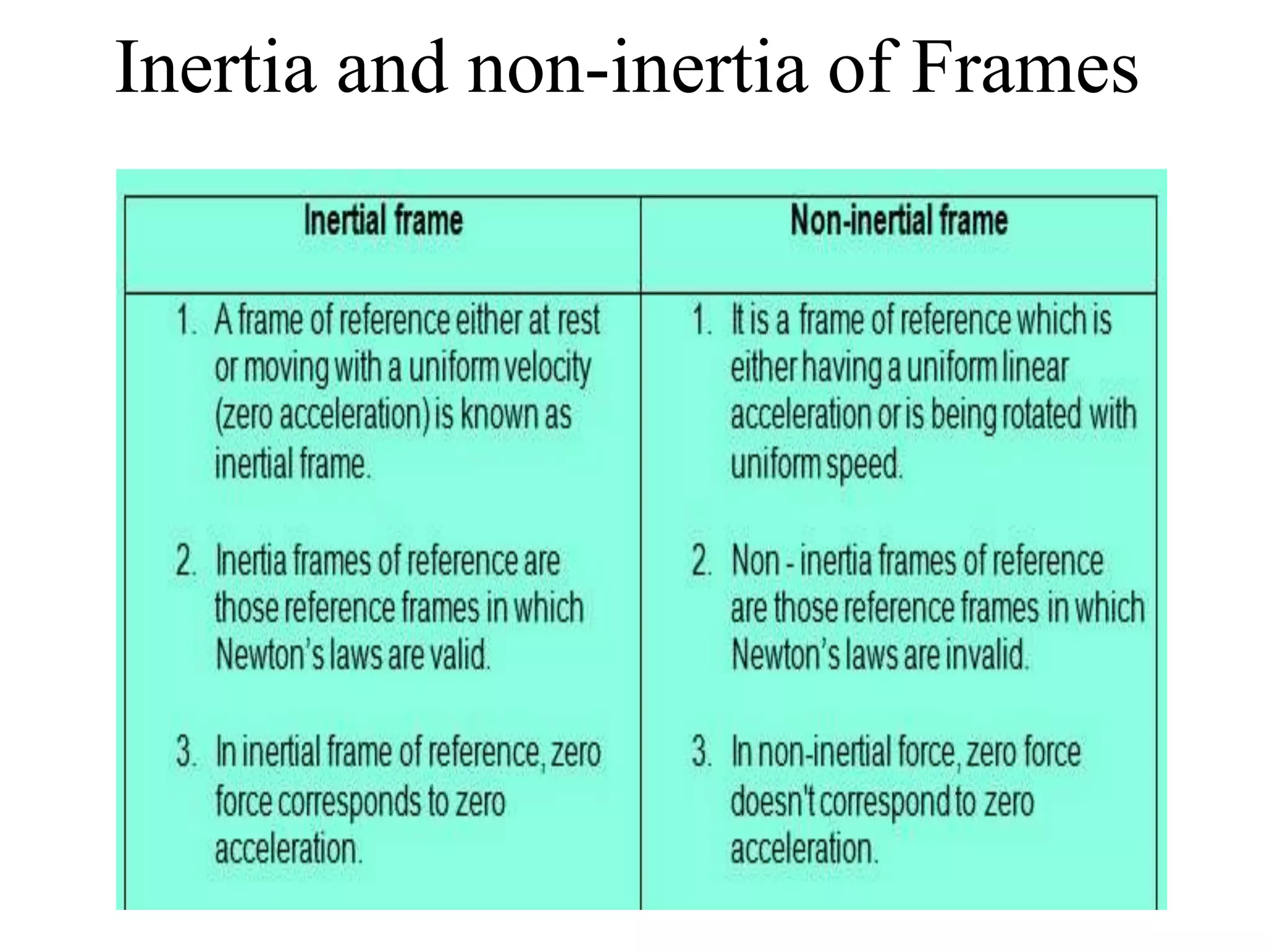
1. Inertial and Non Inertial frame
2. The Cartesian (rectangular)
coordinate system
3. The spherical coordinate system
4. The cylindrical coordinate system
Inertia and non-inertia of Frames
Cartesian coordinate system
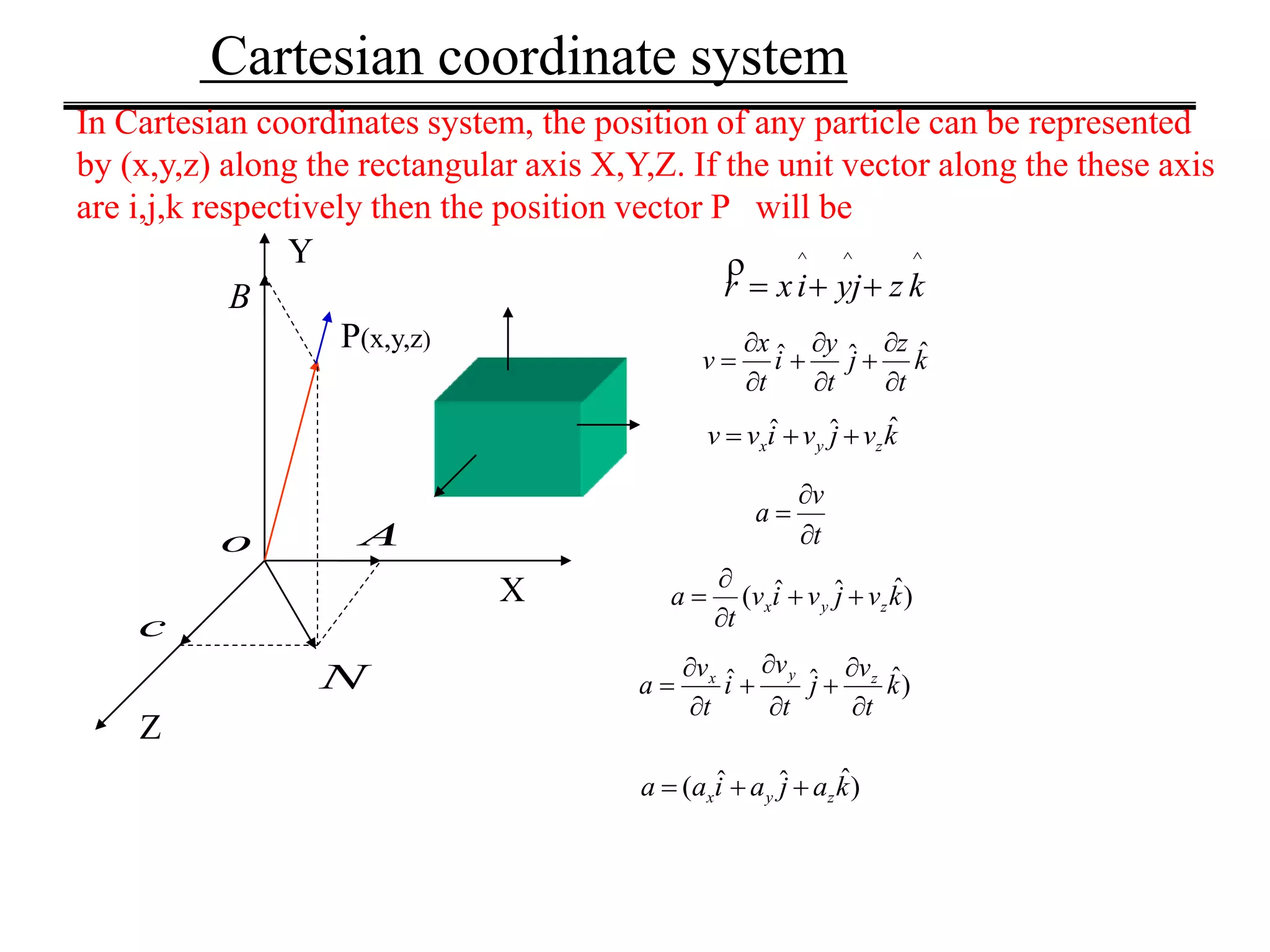
In Cartesian coordinates system, the position of any particle can be represented
by (x,y,z) along the rectangular axis X,Y,Z. If the unit vector along the these axis
are i,j,k respectively then the position vector P will be
Z
X
Y
P(x,y,z)
B
^^^
kzyjixr 

o
c
N
A
k
t
z
j
t
y
i
t
x
v ˆˆˆ









kvjvivv zyx
ˆˆˆ 
t
v
a



)ˆˆˆ( kvjviv
t
a zyx 



)ˆˆˆ k
t
v
j
t
v
i
t
v
a zyx









)ˆˆˆ( kajaiaa zyx 
Spherical coordinate system
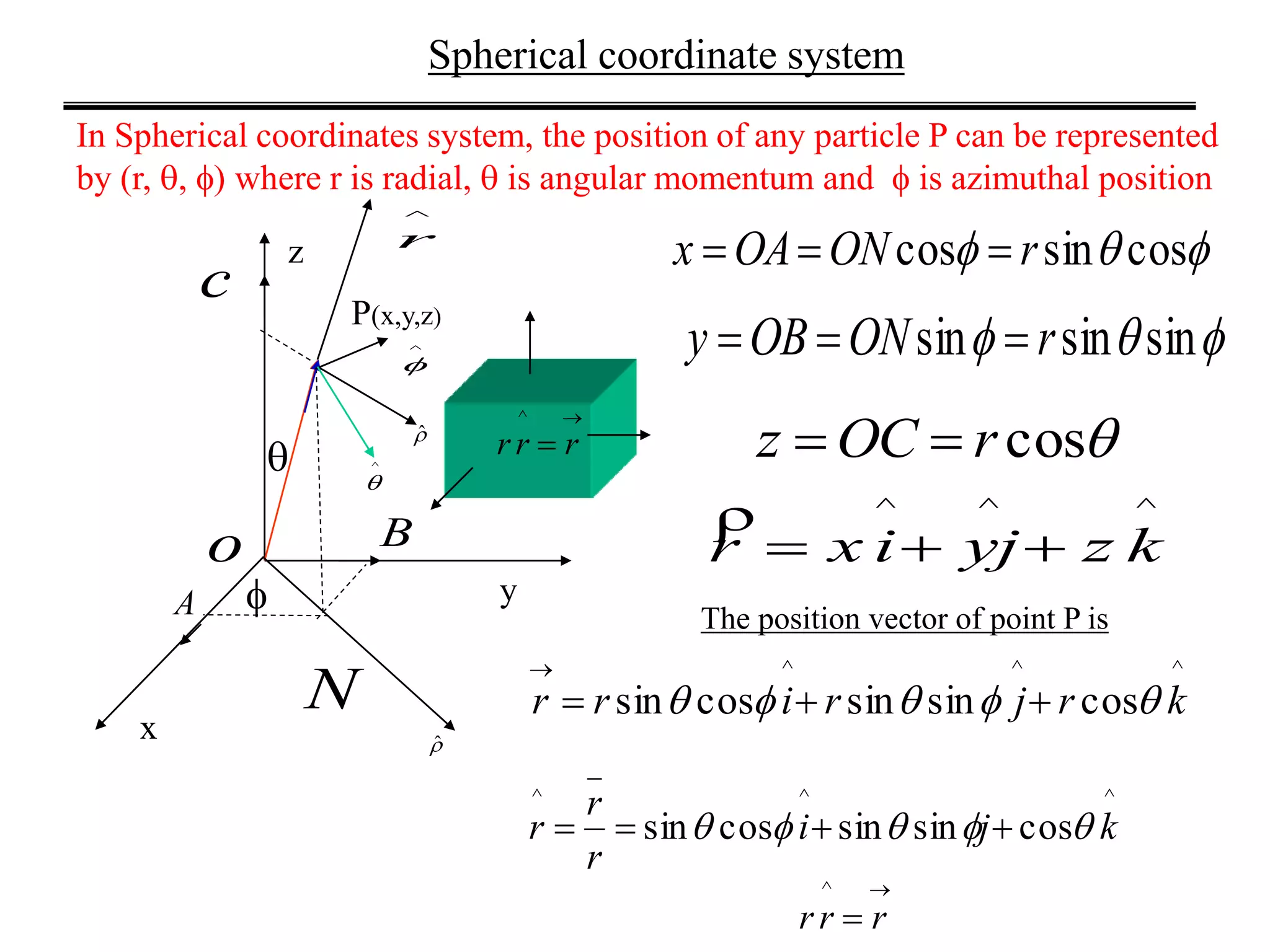
In Spherical coordinates system, the position of any particle P can be represented
by (r, , ) where r is radial,  is angular momentum and  is azimuthal position
x
y
z
P(x,y,z)
A


^
r
^

^^^
kzyjixr 

 cossincos rONOAx 
 sinsinsin rONOBy 
cosrOCz 
The position vector of point P is
^^^
cossinsincossin krjrirr  

^^^
cossinsincossin kji
r
r
r  
o
N
B
c

 rrr
^

 rrr
^
ˆ
^

ˆ
Spherical coordinate system
ˆ
^


kˆ
P
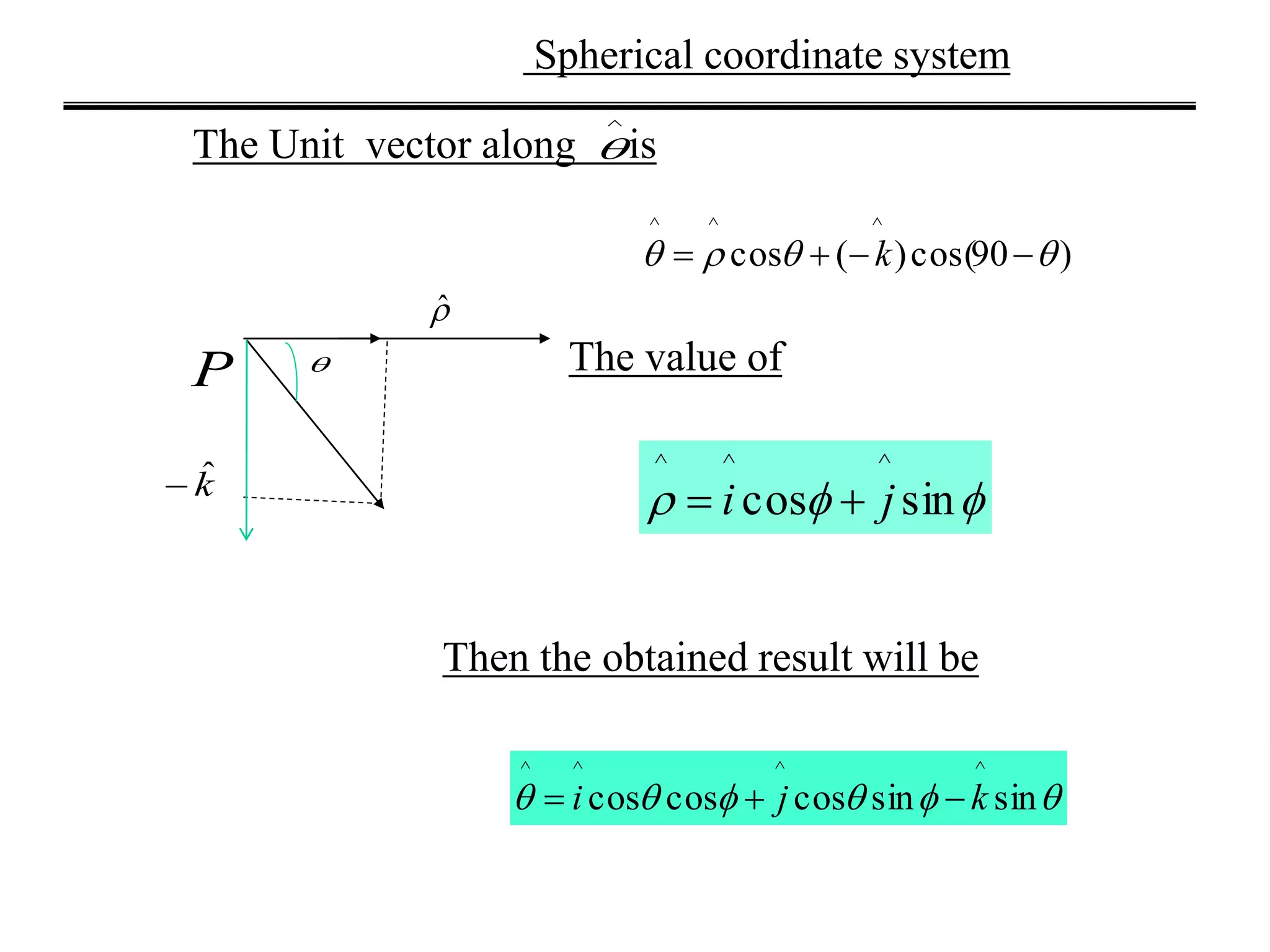
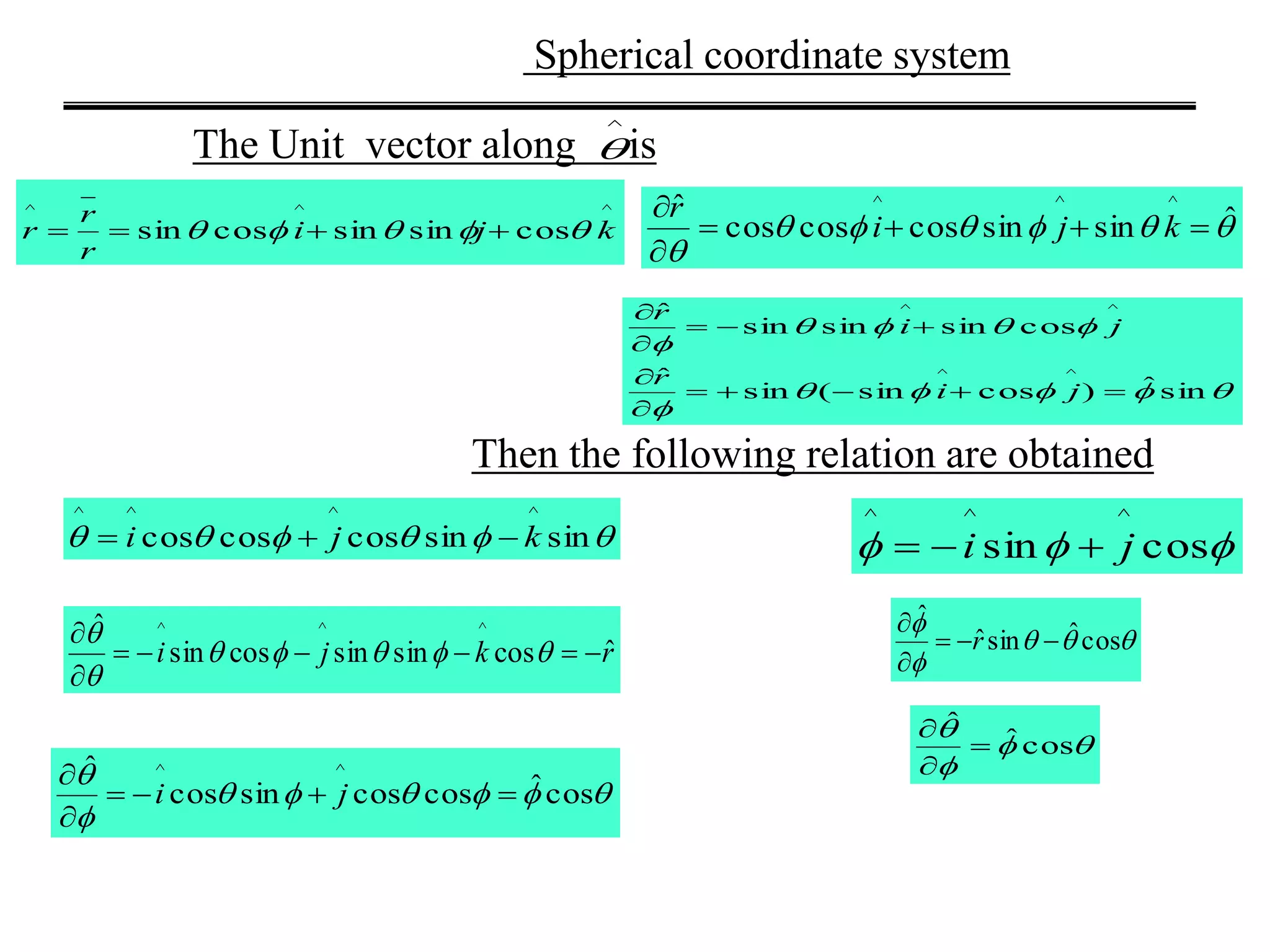
The Unit vector along is
)90cos()(cos
^^^
  k
 sinsincoscoscos
^^^^
kji 
 sincos
^^^
ji 
The value of
Then the obtained result will be
• Spherical coordinate system
x
y
jˆ

•Spherical coordinate system
^

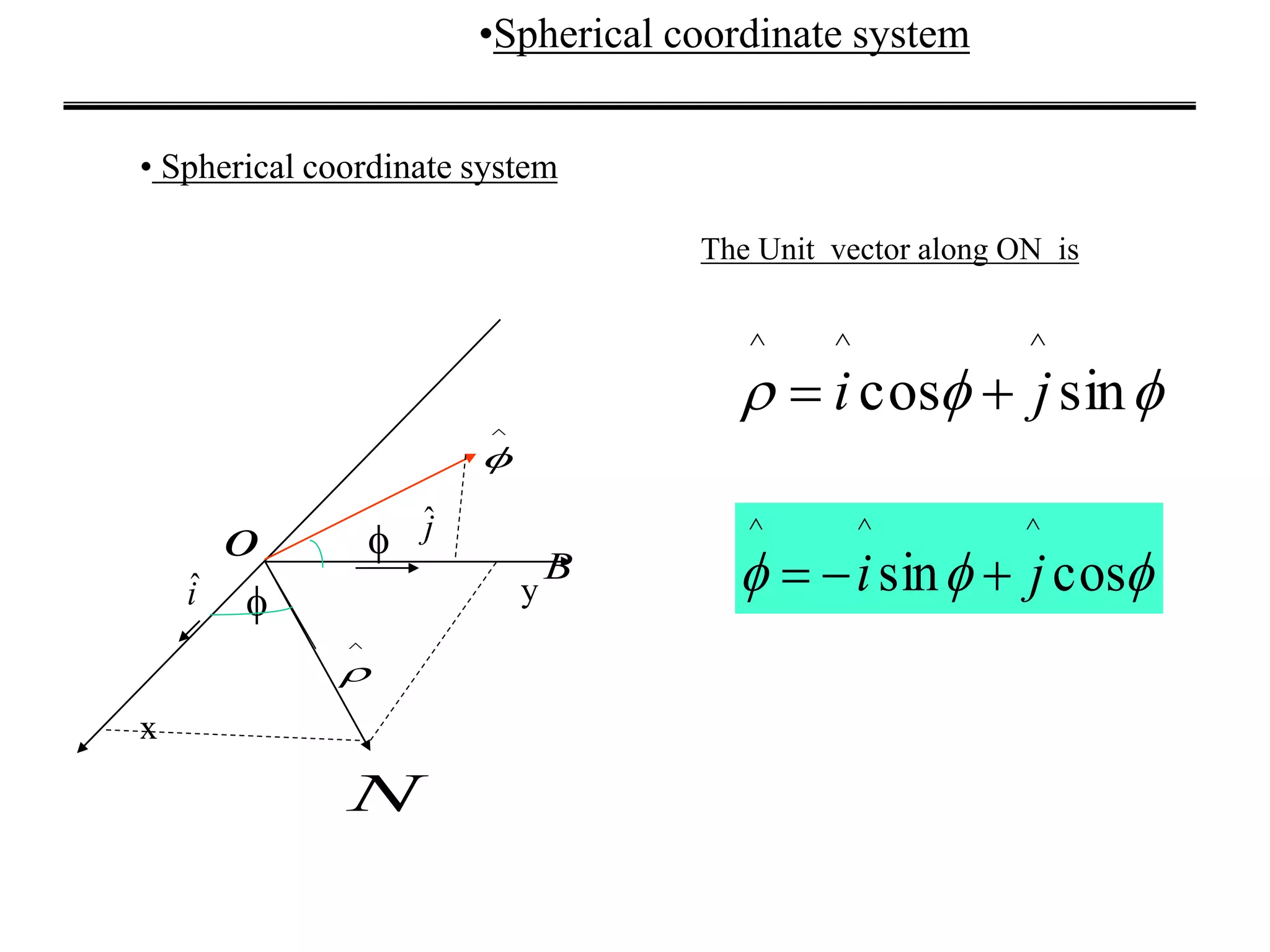
The Unit vector along ON is
 sincos
^^^
ji 
iˆ
o
N
B  cossin
^^^
ji 
^


Spherical coordinate system
^
The Unit vector along is
 sinsincoscoscos
^^^^
kji 



cosˆ
ˆ






cosˆsinˆ
ˆ



r
Then the following relation are obtained
^^^
cossinsincossin kji
r
r
r   

ˆsinsincoscoscos
ˆ ^^^



kji
r




sinˆ)cossin(sin
ˆ
cossinsinsin
ˆ
^^
^^






ji
r
ji
r
 cossin
^^^
ji 
rkji ˆcossinsincossin
ˆ ^^^









cosˆcoscossincos
ˆ ^^



ji
Spherical coordinate system
rˆ
ˆ







ˆˆ


r
0
ˆ







sinˆˆ


r



cosˆ
ˆ






cosˆsinˆ
ˆ



r
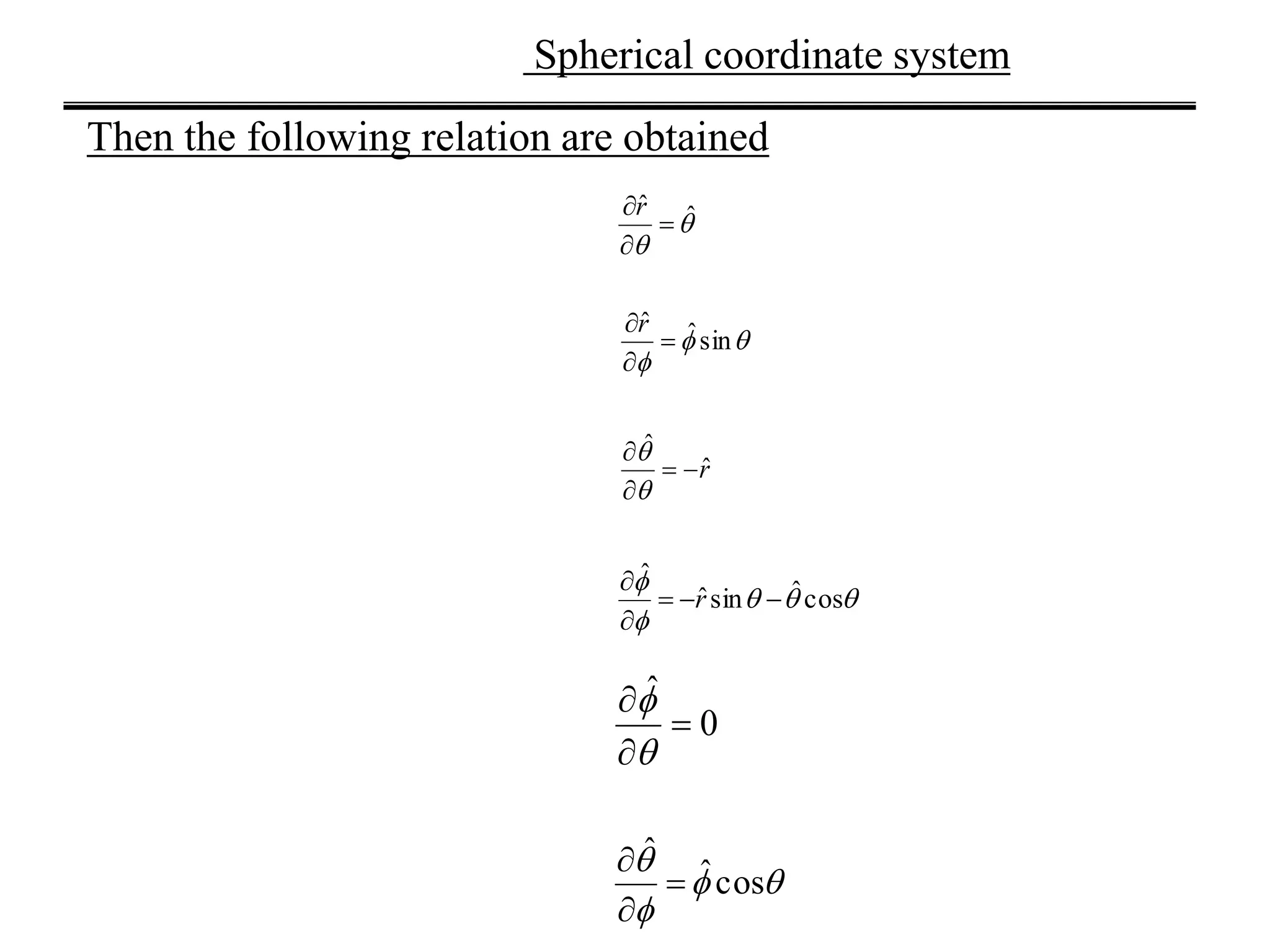
Then the following relation are obtained
Spherical coordinate system
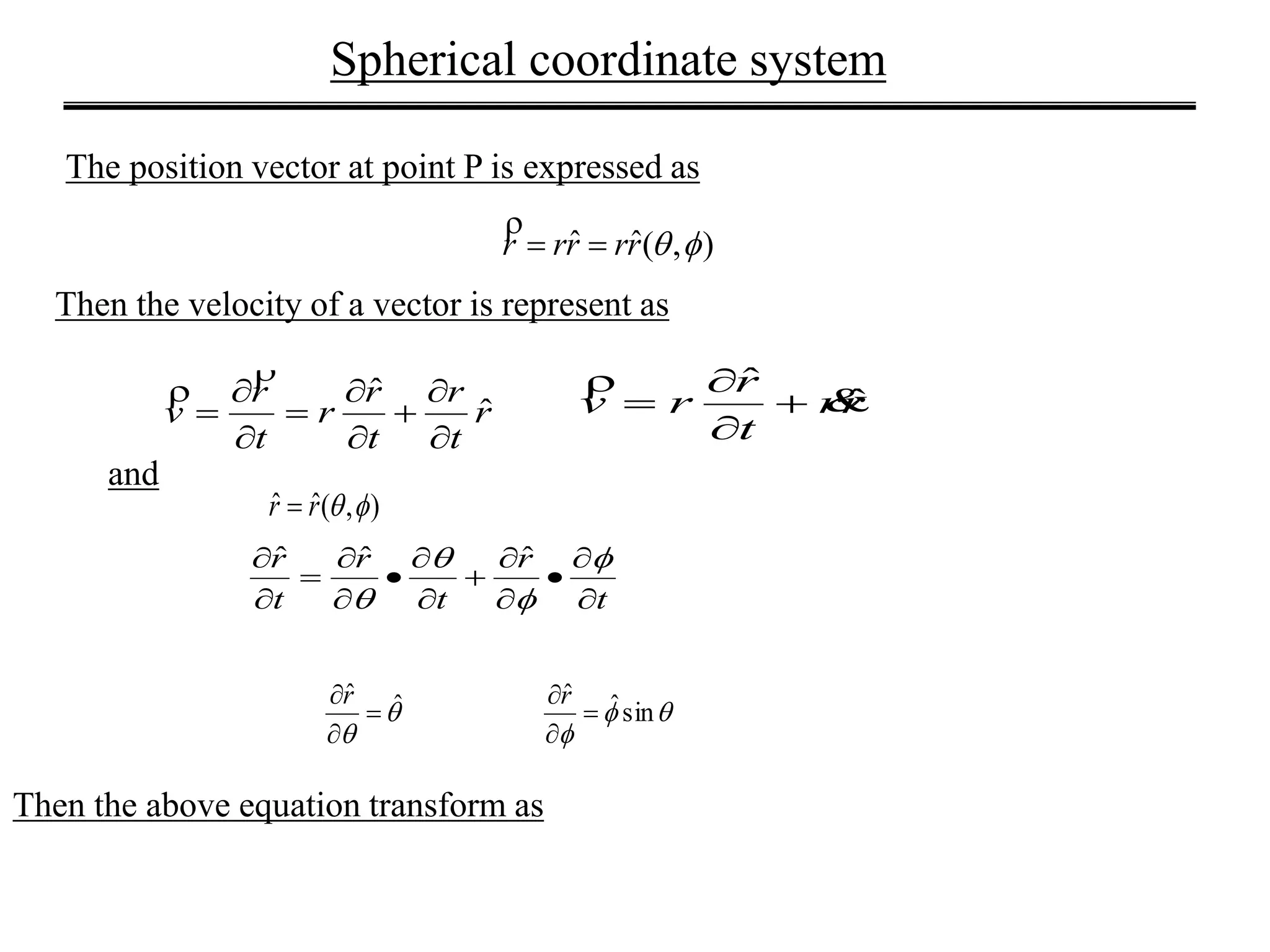
The position vector at point P is expressed as
),(ˆˆ rrrrr 

Then the velocity of a vector is represent as
r
t
r
t
r
r
t
r
v ˆ
ˆ










 rr
t
r
rv ˆ
ˆ






and
),(ˆˆ rr 
t
r
t
r
t
r













 



ˆˆˆ
Then the above equation transform as


ˆˆ


r


sinˆˆ


r
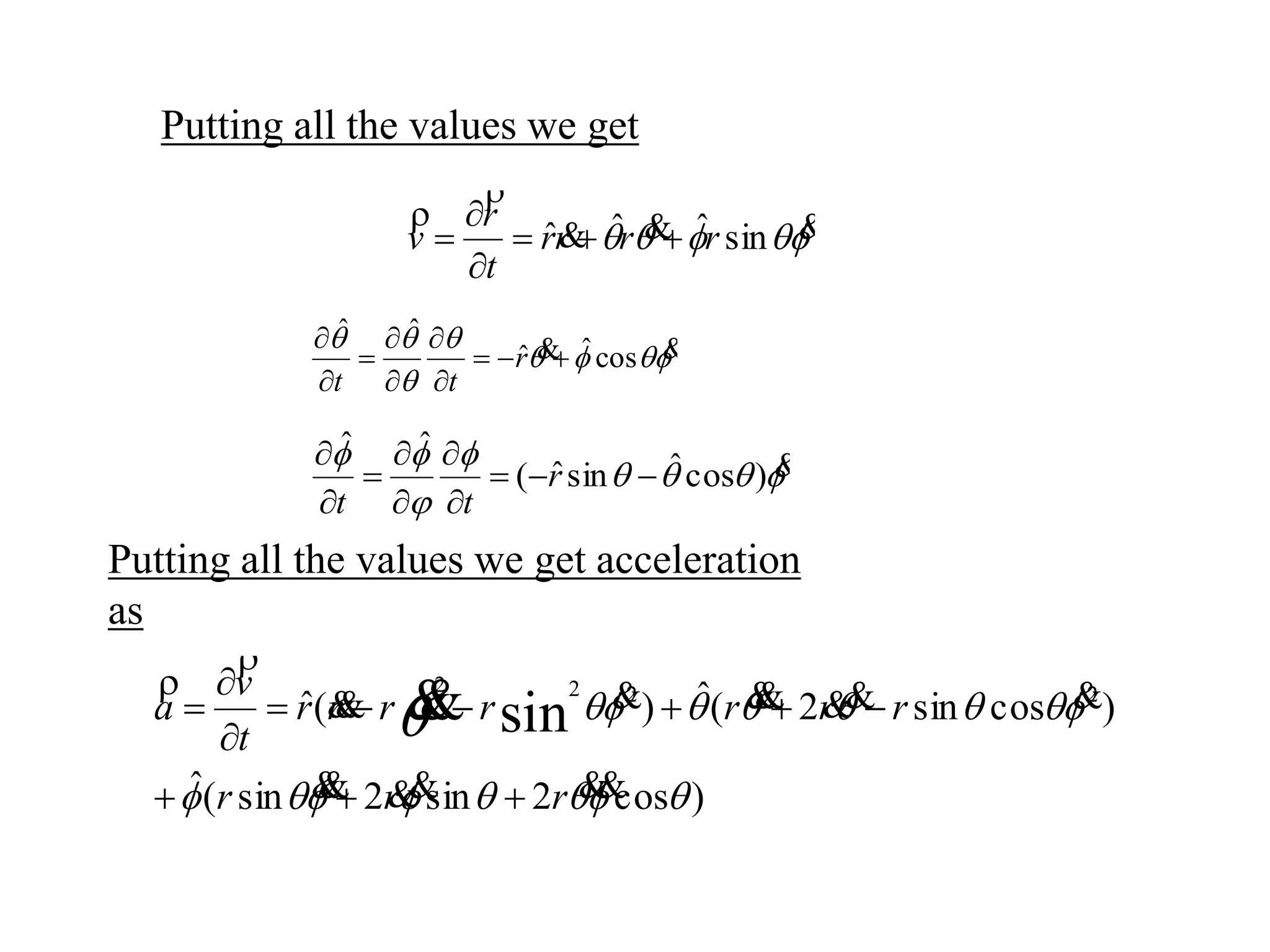
Putting all the values we get
 


sinˆˆˆ rrrr
t
r
v 



)cos2sin2sin(ˆ
)cossin2(ˆ)(ˆ 2222
sin







rrr
rrrrrrr
t
v
a








 )cosˆsinˆ(
ˆˆ








r
tt



  cosˆˆ
ˆˆ








r
tt
Putting all the values we get acceleration
as
Cylindrical coordinate system
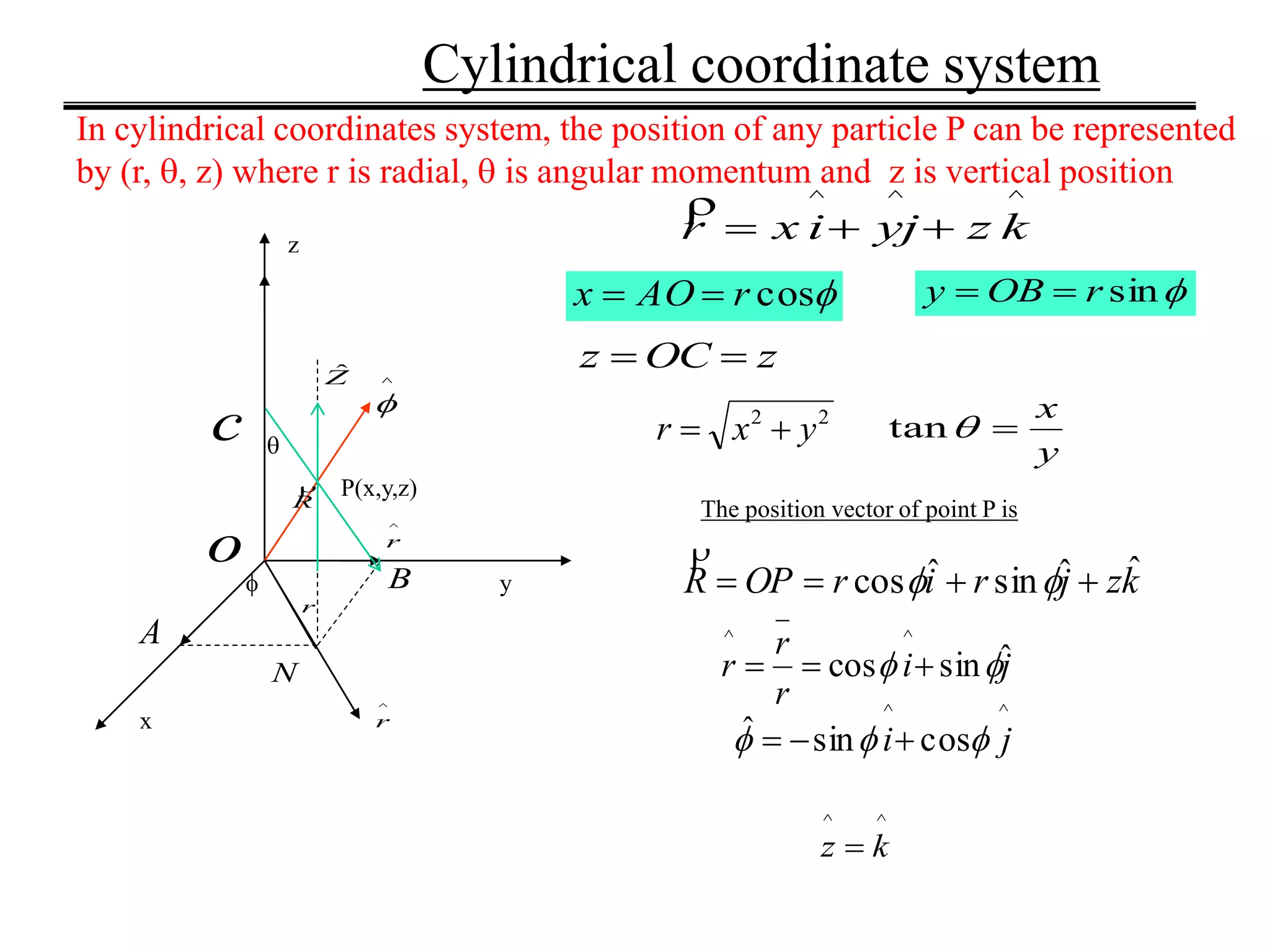
In cylindrical coordinates system, the position of any particle P can be represented
by (r, , z) where r is radial,  is angular momentum and z is vertical position
x
y
z
P(x,y,z)
A


Zˆ
^
r
^

^^^
kzyjixr 

cosrAOx  sinrOBy 
zOCz 
The position vector of point P is
kzjrirOPR ˆˆsinˆcos  

^^
cossinˆ ji  
o
N
B
c
R

r
^
r
22
yxr 
y
x
tan
ji
r
r
r ˆsincos
^^
 
^^
kz 
Cylindrical coordinate system
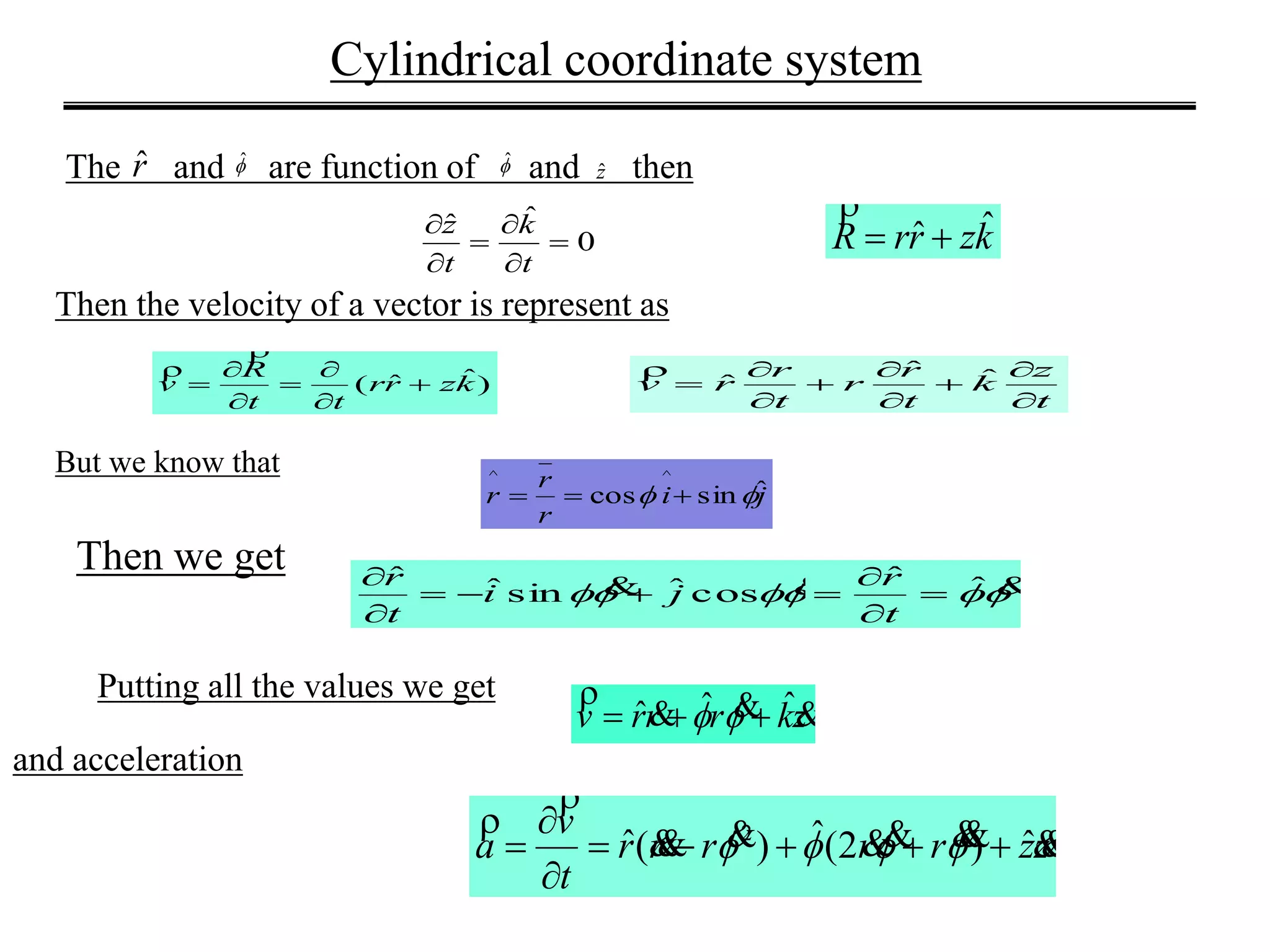
The and are function of and then
Then the velocity of a vector is represent as
)ˆˆ( kzrr
tt
R
v 








t
z
k
t
r
r
t
r
rv








 ˆˆ
ˆ

Putting all the values we get
zkrrrv 
 ˆˆˆ  
and acceleration
zzrrrrr
t
v
a 


ˆ)2(ˆ)(ˆ 2



 
rˆ ˆ ˆ
zˆ
0
ˆˆ






t
k
t
z
kzrrR ˆˆ 

  cosˆsinˆˆ
ji
t
r



 ˆˆ




t
r
ji
r
r
r ˆsincos
^^
 
But we know that
Then we get
Thank You

Cartesian coordinates

  • 2.
    B.Sc.-I (Physics) Paper-I, Unit01 Dr. Krishna Jibon Mondal Assistant Professor and Head Department of Physisc and Electronics Shri Shankaracharya Mahavidyalaya, Bhilai Part 01 Velocity and Acceleration in Different Co-ordinates system
  • 3.
    Outlines 1. Inertial andNon Inertial frame 2. The Cartesian (rectangular) coordinate system 3. The spherical coordinate system 4. The cylindrical coordinate system
  • 5.
  • 6.
    Cartesian coordinate system InCartesian coordinates system, the position of any particle can be represented by (x,y,z) along the rectangular axis X,Y,Z. If the unit vector along the these axis are i,j,k respectively then the position vector P will be Z X Y P(x,y,z) B ^^^ kzyjixr   o c N A k t z j t y i t x v ˆˆˆ          kvjvivv zyx ˆˆˆ  t v a    )ˆˆˆ( kvjviv t a zyx     )ˆˆˆ k t v j t v i t v a zyx          )ˆˆˆ( kajaiaa zyx 
  • 7.
    Spherical coordinate system InSpherical coordinates system, the position of any particle P can be represented by (r, , ) where r is radial,  is angular momentum and  is azimuthal position x y z P(x,y,z) A   ^ r ^  ^^^ kzyjixr    cossincos rONOAx   sinsinsin rONOBy  cosrOCz  The position vector of point P is ^^^ cossinsincossin krjrirr    ^^^ cossinsincossin kji r r r   o N B c   rrr ^   rrr ^ ˆ ^  ˆ
  • 8.
    Spherical coordinate system ˆ ^   kˆ P TheUnit vector along is )90cos()(cos ^^^   k  sinsincoscoscos ^^^^ kji   sincos ^^^ ji  The value of Then the obtained result will be
  • 9.
    • Spherical coordinatesystem x y jˆ  •Spherical coordinate system ^  The Unit vector along ON is  sincos ^^^ ji  iˆ o N B  cossin ^^^ ji  ^  
  • 10.
    Spherical coordinate system ^ TheUnit vector along is  sinsincoscoscos ^^^^ kji     cosˆ ˆ       cosˆsinˆ ˆ    r Then the following relation are obtained ^^^ cossinsincossin kji r r r     ˆsinsincoscoscos ˆ ^^^    kji r     sinˆ)cossin(sin ˆ cossinsinsin ˆ ^^ ^^       ji r ji r  cossin ^^^ ji  rkji ˆcossinsincossin ˆ ^^^          cosˆcoscossincos ˆ ^^    ji
  • 11.
  • 12.
    Spherical coordinate system Theposition vector at point P is expressed as ),(ˆˆ rrrrr   Then the velocity of a vector is represent as r t r t r r t r v ˆ ˆ            rr t r rv ˆ ˆ       and ),(ˆˆ rr  t r t r t r                   ˆˆˆ Then the above equation transform as   ˆˆ   r   sinˆˆ   r
  • 13.
    Putting all thevalues we get     sinˆˆˆ rrrr t r v     )cos2sin2sin(ˆ )cossin2(ˆ)(ˆ 2222 sin        rrr rrrrrrr t v a          )cosˆsinˆ( ˆˆ         r tt      cosˆˆ ˆˆ         r tt Putting all the values we get acceleration as
  • 14.
    Cylindrical coordinate system Incylindrical coordinates system, the position of any particle P can be represented by (r, , z) where r is radial,  is angular momentum and z is vertical position x y z P(x,y,z) A   Zˆ ^ r ^  ^^^ kzyjixr   cosrAOx  sinrOBy  zOCz  The position vector of point P is kzjrirOPR ˆˆsinˆcos    ^^ cossinˆ ji   o N B c R  r ^ r 22 yxr  y x tan ji r r r ˆsincos ^^   ^^ kz 
  • 15.
    Cylindrical coordinate system Theand are function of and then Then the velocity of a vector is represent as )ˆˆ( kzrr tt R v          t z k t r r t r rv          ˆˆ ˆ  Putting all the values we get zkrrrv   ˆˆˆ   and acceleration zzrrrrr t v a    ˆ)2(ˆ)(ˆ 2      rˆ ˆ ˆ zˆ 0 ˆˆ       t k t z kzrrR ˆˆ     cosˆsinˆˆ ji t r     ˆˆ     t r ji r r r ˆsincos ^^   But we know that Then we get
  • 16.