Subject:- Field Theory
Topic:-Current And Current density
Prepared By :
Dhruv Aradeshana (150110109004)
Tejas Dobariya (150110109010)
Dhruval Gondaliya (150110109011)
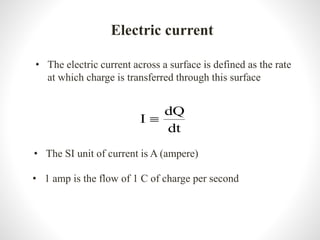
Electric current
• The electric current across a surface is defined as the rate
at which charge is transferred through this surface
I
dQ
dt

• The SI unit of current is A (ampere)
• 1 amp is the flow of 1 C of charge per second
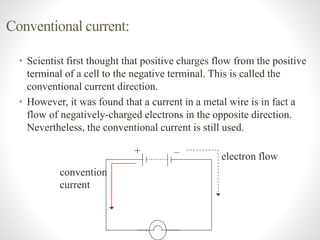
Conventional current:
• Scientist first thought that positive charges flow from the positive
terminal of a cell to the negative terminal. This is called the
conventional current direction.
• However, it was found that a current in a metal wire is in fact a
flow of negatively-charged electrons in the opposite direction.
Nevertheless, the conventional current is still used.
+ – electron flow
convention
current
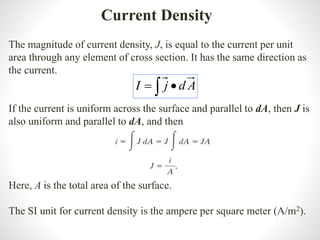
Current Density
The magnitude of current density, J, is equal to the current per unit
area through any element of cross section. It has the same direction as
the current.
If the current is uniform across the surface and parallel to dA, then J is
also uniform and parallel to dA, and then
Here, A is the total area of the surface.
The SI unit for current density is the ampere per square meter (A/m2).
  AdjI
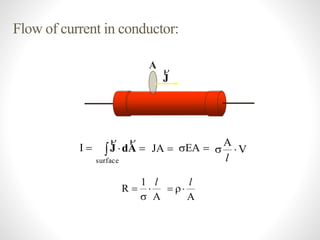
Flow of current in conductor:
I
J
A
A
1
R
l




surface
AdJ

EAJA V
A

l
A
l

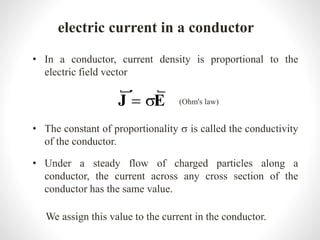
• In a conductor, current density is proportional to the
electric field vector
• The constant of proportionality  is called the conductivity
of the conductor.
• Under a steady flow of charged particles along a
conductor, the current across any cross section of the
conductor has the same value.
We assign this value to the current in the conductor.
 
J E  (Ohm's law)
electric current in a conductor
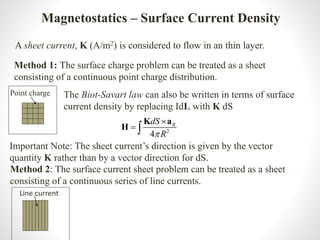
Magnetostatics – Surface Current Density
A sheet current, K (A/m2) is considered to flow in an thin layer.
The Biot-Savart law can also be written in terms of surface
current density by replacing IdL with K dS
2
4
RdS
R

 
K a
H
Important Note: The sheet current’s direction is given by the vector
quantity K rather than by a vector direction for dS.
Method 2: The surface current sheet problem can be treated as a sheet
consisting of a continuous series of line currents.
Line current
Method 1: The surface charge problem can be treated as a sheet
consisting of a continuous point charge distribution.
Point charge
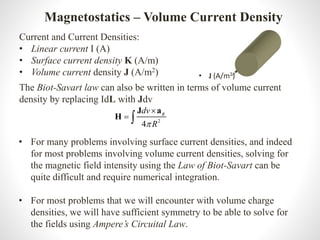
Magnetostatics – Volume Current Density
Current and Current Densities:
• Linear current I (A)
• Surface current density K (A/m)
• Volume current density J (A/m2)
• For many problems involving surface current densities, and indeed
for most problems involving volume current densities, solving for
the magnetic field intensity using the Law of Biot-Savart can be
quite difficult and require numerical integration.
• For most problems that we will encounter with volume charge
densities, we will have sufficient symmetry to be able to solve for
the fields using Ampere’s Circuital Law.
The Biot-Savart law can also be written in terms of volume current
density by replacing IdL with Jdv
2
4
R
dv
R

 
J a
H
• J (A/m2)
Thank You…..

current&current density

  • 1.
    Subject:- Field Theory Topic:-CurrentAnd Current density Prepared By : Dhruv Aradeshana (150110109004) Tejas Dobariya (150110109010) Dhruval Gondaliya (150110109011)
  • 2.
    Electric current • Theelectric current across a surface is defined as the rate at which charge is transferred through this surface I dQ dt  • The SI unit of current is A (ampere) • 1 amp is the flow of 1 C of charge per second
  • 4.
    Conventional current: • Scientistfirst thought that positive charges flow from the positive terminal of a cell to the negative terminal. This is called the conventional current direction. • However, it was found that a current in a metal wire is in fact a flow of negatively-charged electrons in the opposite direction. Nevertheless, the conventional current is still used. + – electron flow convention current
  • 5.
    Current Density The magnitudeof current density, J, is equal to the current per unit area through any element of cross section. It has the same direction as the current. If the current is uniform across the surface and parallel to dA, then J is also uniform and parallel to dA, and then Here, A is the total area of the surface. The SI unit for current density is the ampere per square meter (A/m2).   AdjI
  • 6.
    Flow of currentin conductor: I J A A 1 R l     surface AdJ  EAJA V A  l A l 
  • 7.
    • In aconductor, current density is proportional to the electric field vector • The constant of proportionality  is called the conductivity of the conductor. • Under a steady flow of charged particles along a conductor, the current across any cross section of the conductor has the same value. We assign this value to the current in the conductor.   J E  (Ohm's law) electric current in a conductor
  • 8.
    Magnetostatics – SurfaceCurrent Density A sheet current, K (A/m2) is considered to flow in an thin layer. The Biot-Savart law can also be written in terms of surface current density by replacing IdL with K dS 2 4 RdS R    K a H Important Note: The sheet current’s direction is given by the vector quantity K rather than by a vector direction for dS. Method 2: The surface current sheet problem can be treated as a sheet consisting of a continuous series of line currents. Line current Method 1: The surface charge problem can be treated as a sheet consisting of a continuous point charge distribution. Point charge
  • 9.
    Magnetostatics – VolumeCurrent Density Current and Current Densities: • Linear current I (A) • Surface current density K (A/m) • Volume current density J (A/m2) • For many problems involving surface current densities, and indeed for most problems involving volume current densities, solving for the magnetic field intensity using the Law of Biot-Savart can be quite difficult and require numerical integration. • For most problems that we will encounter with volume charge densities, we will have sufficient symmetry to be able to solve for the fields using Ampere’s Circuital Law. The Biot-Savart law can also be written in terms of volume current density by replacing IdL with Jdv 2 4 R dv R    J a H • J (A/m2)
  • 10.