Unit-2
Poission’s equations
JETGI
Mr. Himanshu Diwakar
Assistant Professor
JETGI
1
Poisson’s and Laplace Equations
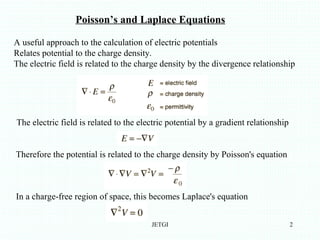
A useful approach to the calculation of electric potentials
Relates potential to the charge density.
The electric field is related to the charge density by the divergence relationship
The electric field is related to the electric potential by a gradient relationship
Therefore the potential is related to the charge density by Poisson's equation
In a charge-free region of space, this becomes Laplace's equation
JETGI 2
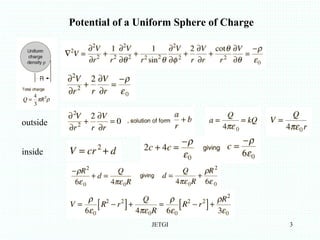
Potential of a Uniform Sphere of Charge
outside
inside
JETGI 3
Poisson’s and Laplace Equations
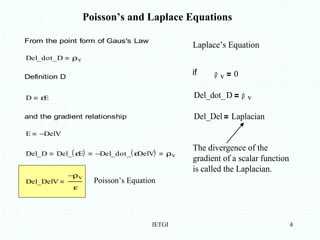
Poisson’s Equation
From the point form of Gaus's Law
Del_dot_D ρv
Definition D
D εE
and the gradient relationship
E DelV−
Del_D Del_ εE( ) Del_dot_ εDelV( )− ρv
Del_DelV
ρv−
ε
Laplace’s Equation
if ρ v 0
Del_dot_D ρ v
Del_Del Laplacian
The divergence of the
gradient of a scalar function
is called the Laplacian.
JETGI 4
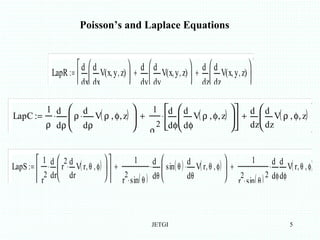
LapR
x x
V x y, z,( )
d
d






d
d y y
V x y, z,( )
d
d






d
d
+
z z
V x y, z,( )
d
d






d
d
+






:=
LapC
1
ρ ρ
ρ
ρ
V ρ φ, z,( )d
d
⋅






d
d
⋅
1
ρ
2 φ φ
V ρ φ, z,( )d
d






d
d






⋅+
z z
V ρ φ, z,( )d
d






d
d
+:=
LapS
1
r
2 r
r
2
r
V r θ, φ,( )d
d
⋅






d
d
⋅






1
r
2
sin θ( )⋅ θ
sin θ( )
θ
V r θ, φ,( )d
d
⋅






d
d
⋅+
1
r
2
sin θ( )2
⋅
φ φ
V r θ, φ,( )d
d
d
d
⋅+:=
Poisson’s and Laplace Equations
JETGI 5
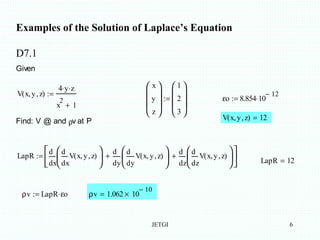
Given
V x y, z,( )
4 y⋅ z⋅
x
2
1+
:=
x
y
z








1
2
3








:= εo 8.854 10
12−
⋅:=
V x y, z,( ) 12=Find: V @ and ρv at P
LapR
x x
V x y, z,( )
d
d






d
d y y
V x y, z,( )
d
d






d
d
+
z z
V x y, z,( )
d
d






d
d
+






:=
LapR 12=
ρv LapR εo⋅:= ρv 1.062 10
10−
×=
Examples of the Solution of Laplace’s Equation
D7.1
JETGI 6
Examples of the Solution of Laplace’s Equation
Example 7.1
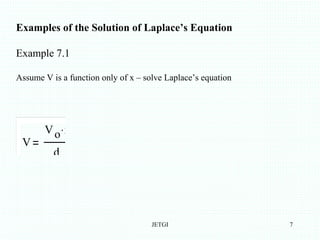
Assume V is a function only of x – solve Laplace’s equation
V
Vo x⋅
d
JETGI 7
Examples of the Solution of Laplace’s Equation
Finding the capacitance of a parallel-plate capacitor
Steps
1 – Given V, use E = - DelV to find E
2 – Use D = εE to find D
3 - Evaluate D at either capacitor plate, D = Ds = Dn an
4 – Recognize that ρs = Dn
5 – Find Q by a surface integration over the capacitor plate
C
Q
Vo
ε S⋅
d
JETGI 8
CAPACITANCE
• The ratio of electric charge to electric
potential of a conductor or a device is
called capacitance
• Capacitance C = Q/V
• Unit is farad (F)
• 1 farad = 1 coulomb / 1 volt
JETGI 9
PRINCIPLE OF A CAPACITOR
• Capacitor is based on the principle that the
capacitance of an isolated charged conductor
increases when an uncharged earthed conductor is
kept near it and the capacitance is further
increased by keeping a dielectric medium between
the conductors.
JETGI 10
CAPACITANCE OF A PARALLEL PLATE
CAPACITOR
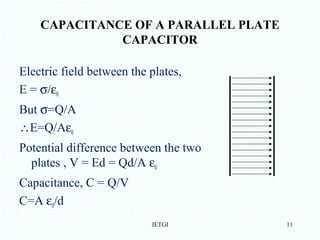
Electric field between the plates,
E = σ/ε0
But σ=Q/A
∴E=Q/Aε0
Potential difference between the two
plates , V = Ed = Qd/A ε0
Capacitance, C = Q/V
C=A ε0/d
JETGI 11
CAPACITANCE OF A PARALLEL PLATE CAPACITOR WITH A
DIELECTRIC SLAB
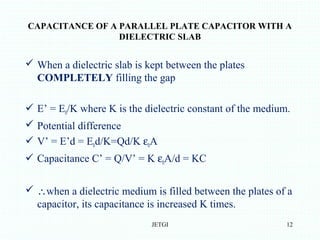
 When a dielectric slab is kept between the plates
COMPLETELY filling the gap
 E’ = E0/K where K is the dielectric constant of the medium.
 Potential difference
 V’ = E’d = E0d/K=Qd/K ε0A
 Capacitance C’ = Q/V’ = K ε0A/d = KC
 ∴when a dielectric medium is filled between the plates of a
capacitor, its capacitance is increased K times.
JETGI 12
DIELECTRIC STRENGTH
• Dielectric strength of a dielectric is the
maximum electric field that can be applied
to it beyond which it breaks down.
JETGI 13
PRACTICE PROBLEMS
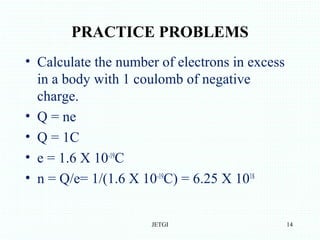
• Calculate the number of electrons in excess
in a body with 1 coulomb of negative
charge.
• Q = ne
• Q = 1C
• e = 1.6 X 10⁻¹⁹
C
• n = Q/e= 1/(1.6 X 10-19
C) = 6.25 X 10¹⁸
JETGI 14
Resistance
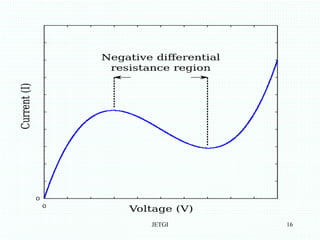
• The electrical resistance of an electrical conductor is a
measure of the difficulty to pass an electric current through
that conductor.
• The inverse quantity is electrical conductance, and is the
ease with which an electric current passes.
JETGI 15
JETGI 16
RESISTORS IN SERIES AND PARALLEL
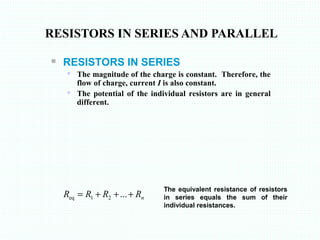
nRRRR +++= ...21eq
 RESISTORS IN SERIES
 The magnitude of the charge is constant. Therefore, the
flow of charge, current I is also constant.
 The potential of the individual resistors are in general
different.
The equivalent resistance of resistors
in series equals the sum of their
individual resistances.
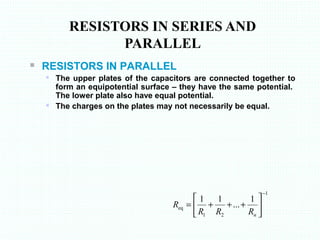
 RESISTORS IN PARALLEL
 The upper plates of the capacitors are connected together to
form an equipotential surface – they have the same potential.
The lower plate also have equal potential.
 The charges on the plates may not necessarily be equal.
RESISTORS IN SERIES AND
PARALLEL
1
21
eq
1
...
11
−






+++=
nRRR
R
RESISTORS IN
SERIES AND PARALLEL
JETGI 19

Poisson's equation 2nd 4

  • 1.
    Unit-2 Poission’s equations JETGI Mr. HimanshuDiwakar Assistant Professor JETGI 1
  • 2.
    Poisson’s and LaplaceEquations A useful approach to the calculation of electric potentials Relates potential to the charge density. The electric field is related to the charge density by the divergence relationship The electric field is related to the electric potential by a gradient relationship Therefore the potential is related to the charge density by Poisson's equation In a charge-free region of space, this becomes Laplace's equation JETGI 2
  • 3.
    Potential of aUniform Sphere of Charge outside inside JETGI 3
  • 4.
    Poisson’s and LaplaceEquations Poisson’s Equation From the point form of Gaus's Law Del_dot_D ρv Definition D D εE and the gradient relationship E DelV− Del_D Del_ εE( ) Del_dot_ εDelV( )− ρv Del_DelV ρv− ε Laplace’s Equation if ρ v 0 Del_dot_D ρ v Del_Del Laplacian The divergence of the gradient of a scalar function is called the Laplacian. JETGI 4
  • 5.
    LapR x x V xy, z,( ) d d       d d y y V x y, z,( ) d d       d d + z z V x y, z,( ) d d       d d +       := LapC 1 ρ ρ ρ ρ V ρ φ, z,( )d d ⋅       d d ⋅ 1 ρ 2 φ φ V ρ φ, z,( )d d       d d       ⋅+ z z V ρ φ, z,( )d d       d d +:= LapS 1 r 2 r r 2 r V r θ, φ,( )d d ⋅       d d ⋅       1 r 2 sin θ( )⋅ θ sin θ( ) θ V r θ, φ,( )d d ⋅       d d ⋅+ 1 r 2 sin θ( )2 ⋅ φ φ V r θ, φ,( )d d d d ⋅+:= Poisson’s and Laplace Equations JETGI 5
  • 6.
    Given V x y,z,( ) 4 y⋅ z⋅ x 2 1+ := x y z         1 2 3         := εo 8.854 10 12− ⋅:= V x y, z,( ) 12=Find: V @ and ρv at P LapR x x V x y, z,( ) d d       d d y y V x y, z,( ) d d       d d + z z V x y, z,( ) d d       d d +       := LapR 12= ρv LapR εo⋅:= ρv 1.062 10 10− ×= Examples of the Solution of Laplace’s Equation D7.1 JETGI 6
  • 7.
    Examples of theSolution of Laplace’s Equation Example 7.1 Assume V is a function only of x – solve Laplace’s equation V Vo x⋅ d JETGI 7
  • 8.
    Examples of theSolution of Laplace’s Equation Finding the capacitance of a parallel-plate capacitor Steps 1 – Given V, use E = - DelV to find E 2 – Use D = εE to find D 3 - Evaluate D at either capacitor plate, D = Ds = Dn an 4 – Recognize that ρs = Dn 5 – Find Q by a surface integration over the capacitor plate C Q Vo ε S⋅ d JETGI 8
  • 9.
    CAPACITANCE • The ratioof electric charge to electric potential of a conductor or a device is called capacitance • Capacitance C = Q/V • Unit is farad (F) • 1 farad = 1 coulomb / 1 volt JETGI 9
  • 10.
    PRINCIPLE OF ACAPACITOR • Capacitor is based on the principle that the capacitance of an isolated charged conductor increases when an uncharged earthed conductor is kept near it and the capacitance is further increased by keeping a dielectric medium between the conductors. JETGI 10
  • 11.
    CAPACITANCE OF APARALLEL PLATE CAPACITOR Electric field between the plates, E = σ/ε0 But σ=Q/A ∴E=Q/Aε0 Potential difference between the two plates , V = Ed = Qd/A ε0 Capacitance, C = Q/V C=A ε0/d JETGI 11
  • 12.
    CAPACITANCE OF APARALLEL PLATE CAPACITOR WITH A DIELECTRIC SLAB  When a dielectric slab is kept between the plates COMPLETELY filling the gap  E’ = E0/K where K is the dielectric constant of the medium.  Potential difference  V’ = E’d = E0d/K=Qd/K ε0A  Capacitance C’ = Q/V’ = K ε0A/d = KC  ∴when a dielectric medium is filled between the plates of a capacitor, its capacitance is increased K times. JETGI 12
  • 13.
    DIELECTRIC STRENGTH • Dielectricstrength of a dielectric is the maximum electric field that can be applied to it beyond which it breaks down. JETGI 13
  • 14.
    PRACTICE PROBLEMS • Calculatethe number of electrons in excess in a body with 1 coulomb of negative charge. • Q = ne • Q = 1C • e = 1.6 X 10⁻¹⁹ C • n = Q/e= 1/(1.6 X 10-19 C) = 6.25 X 10¹⁸ JETGI 14
  • 15.
    Resistance • The electricalresistance of an electrical conductor is a measure of the difficulty to pass an electric current through that conductor. • The inverse quantity is electrical conductance, and is the ease with which an electric current passes. JETGI 15
  • 16.
  • 17.
    RESISTORS IN SERIESAND PARALLEL nRRRR +++= ...21eq  RESISTORS IN SERIES  The magnitude of the charge is constant. Therefore, the flow of charge, current I is also constant.  The potential of the individual resistors are in general different. The equivalent resistance of resistors in series equals the sum of their individual resistances.
  • 18.
     RESISTORS INPARALLEL  The upper plates of the capacitors are connected together to form an equipotential surface – they have the same potential. The lower plate also have equal potential.  The charges on the plates may not necessarily be equal. RESISTORS IN SERIES AND PARALLEL 1 21 eq 1 ... 11 −       +++= nRRR R
  • 19.
    RESISTORS IN SERIES ANDPARALLEL JETGI 19