Content to be covered
 Constancy of the Speed of Light
 Lorentz Transformation
 Consequence of Relativity
 Length Contraction
 Time Dilation
 Muon decay problem
 Twin Paradox
Lecture #17,18
Resources to be consulted
Concepts of Modern Physics by Arthur Beiser
15B11PH111 ODD2021 1
Physics-1
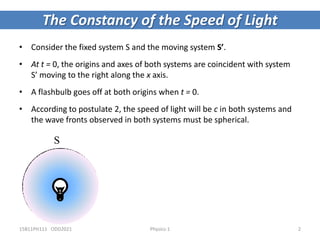
• Consider the fixed system S and the moving system S’.
• At t = 0, the origins and axes of both systems are coincident with system
S’ moving to the right along the x axis.
• A flashbulb goes off at both origins when t = 0.
• According to postulate 2, the speed of light will be c in both systems and
the wave fronts observed in both systems must be spherical.
S
The Constancy of the Speed of Light
15B11PH111 ODD2021 Physics-1 2
Spherical wavefronts in S:
Spherical wavefronts in S’:
S S’
2 2 2 2 2 2 2 2 2 2
( 2 v v )
x y z x x t t y z c t
   
       
There are a couple of extra terms
(-2xvt +v2t2) in the primed frame.
Note that this cannot occur in Galilean transformations.
x’ = x – vt
y‘ = y
z‘ = z
t’ = t
15B11PH111 ODD2021 Physics-1 3
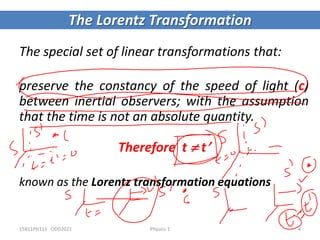
The special set of linear transformations that:
preserve the constancy of the speed of light (c)
between inertial observers; with the assumption
that the time is not an absolute quantity.
Therefore t  t
known as the Lorentz transformation equations
The Lorentz Transformation
15B11PH111 ODD2021 Physics-1 4
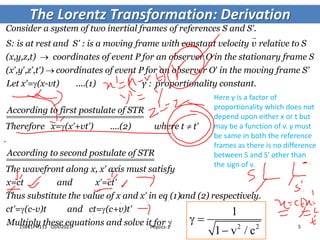
Consider a system of two inertial frames of references S and S .
S: is at rest and S : is a moving frame with constant velocity v relative to S
(x,y,z,t) coordinates of event P for an observer O in




the stationary frame S
(x ,y ,z ,t ) coordinates of event P for an observer O in the moving frame S
Let x = (x-vt) ....(1) γ : proportionality constant.
According to first
     

 
postulate of STR
Therefore x= (x +vt ) ....(2) where t t
According to second postulate of STR
The wavefront along x, x axis must satisfy
x=ct and x =ct
Thus
  
 

 
substitute the value of x and x in eq (1)and (2) respectively.
ct = (c-v)t and ct= (c+v)t
Multiply these equations and solve it for

 
 
 2 2
1
1 v / c
 

The Lorentz Transformation: Derivation
Here γ is a factor of
proportionality which does not
depend upon either x or t but
may be a function of v. γ must
be same in both the reference
frames as there is no difference
between S and S’ other than
the sign of v.
15B11PH111 ODD2021 Physics-1 5
2
x
x [ (x - vt) vt ] (x - vt) vt
x x x 1
t t (1 )
v v v
x = (x-vt) ....(1) x= (x +vt ) ....(2)
From eq(1) and eq(2)
or
t = or t =
similarly t
  
 
 
      

 
 
      
 
2
x 1
t (1 )
v
=



  

2
2 2
2
xv
t
vx c
t t
c v
1
c

 
    
 
 

2
2 2
2
x v
t
x v c
t t
c v
1
c

 

 

   
 
 

2 2 2 2 2 2 2 2 2 2
y z c t x y z c t
Imp:Prove that
x
under Lorentz Transformation
   
      
The Lorentz Transformation: Derivation
15B11PH111 ODD2021 Physics-1 6
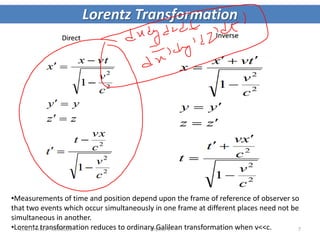
Lorentz Transformation
•Measurements of time and position depend upon the frame of reference of observer so
that two events which occur simultaneously in one frame at different places need not be
simultaneous in another.
•Lorentz transformation reduces to ordinary Galilean transformation when v<<c.
15B11PH111 ODD2021 Physics-1 7
2 2
v
1 v /
x t
x
c

 

2
2 2
v /
1 v /
t x c
t
c

 

y y
 
z z
 
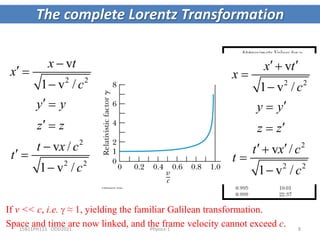
If v << c, i.e.  ≈ 1, yielding the familiar Galilean transformation.
Space and time are now linked, and the frame velocity cannot exceed c.
2 2
v
1 v /
x t
x
c
 



2
2 2
v /
1 v /
t x c
t
c
 



y y

z z

The complete Lorentz Transformation
15B11PH111 ODD2021 Physics-1 8
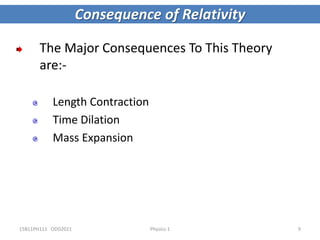
The Major Consequences To This Theory
are:-
Length Contraction
Time Dilation
Mass Expansion
Consequence of Relativity
15B11PH111 ODD2021 Physics-1 9
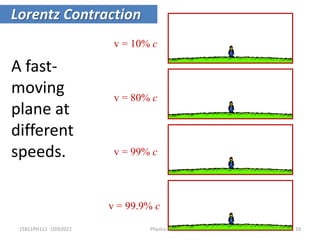
A fast-
moving
plane at
different
speeds.
v = 10% c
v = 80% c
v = 99.9% c
v = 99% c
Lorentz Contraction
15B11PH111 ODD2021 Physics-1 10
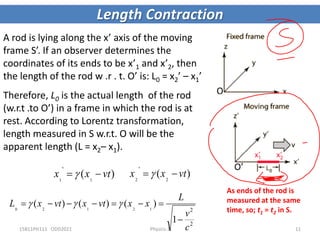
A rod is lying along the x’ axis of the moving
frame S’. If an observer determines the
coordinates of its ends to be x’1 and x’2, then
the length of the rod w .r . t. O’ is: L0 = x2’ – x1’
Therefore, L0 is the actual length of the rod
(w.r.t .to O’) in a frame in which the rod is at
rest. According to Lorentz transformation,
length measured in S w.r.t. O will be the
apparent length (L = x2– x1).
)
( 1
1
'
vt
x
x 
  )
( 2
2
'
vt
x
x 
 
2
2
1
)
(
)
(
)
( 1
2
1
2
0
c
v
L
x
x
vt
x
vt
x
L







 


Length Contraction
As ends of the rod is
measured at the same
time, so; t1 = t2 in S.
15B11PH111 ODD2021 Physics-1 11
2 2 o
o 1 v / c
 

L
Therefore L=L
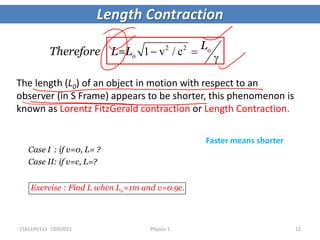
The length (L0) of an object in motion with respect to an
observer (​in S Frame) ​appears to be shorter, this phenomenon is
known as Lorentz FitzGerald contraction or Length Contraction.
Length Contraction
o
Case I : if v=0, L= ?
Case II: if v=c, L=?
Exercise : Find L when L =1m and v=0.9c.
Faster means shorter
15B11PH111 ODD2021 Physics-1 12
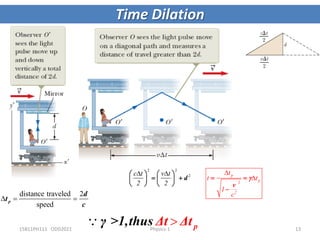
distance traveled 2
speed
  
p
d
t
c
2
2 2
2 p
p
2
t
t t
1
c t v t
2
c
2


 
v
d 
   
 
   
  
 



 p
γ >1,thu Δt Δt
s
Time Dilation
15B11PH111 ODD2021 Physics-1 13
Time Dilation
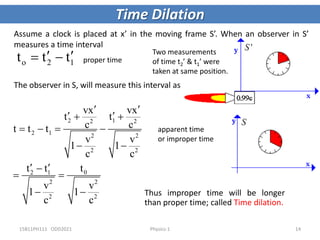
Assume a clock is placed at x’ in the moving frame S’. When an observer in S’
measures a time interval
The observer in S, will measure this interval as
2 1
2 2
2 1 2 2
2 2
0
2 1
2 2
2 2
vx vx
t t
c c
t t t
v v
1 1
c c
t
t t
v v
1 1
c c
 
 
 
   
 
 

 
  Thus improper time will be longer
than proper time; called Time dilation.
o 2 1
t t t
 
  Two measurements
of time t2’ & t1’ were
taken at same position.
proper time
apparent time
or improper time
15B11PH111 ODD2021 Physics-1 14
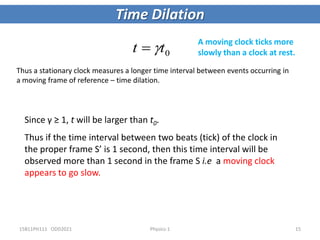
0
t
t 

Thus a stationary clock measures a longer time interval between events occurring in
a moving frame of reference – time dilation.
Since γ ≥ 1, t will be larger than t0.
Thus if the time interval between two beats (tick) of the clock in
the proper frame S’ is 1 second, then this time interval will be
observed more than 1 second in the frame S i.e a moving clock
appears to go slow.
Time Dilation
A moving clock ticks more
slowly than a clock at rest.
15B11PH111 ODD2021 Physics-1 15
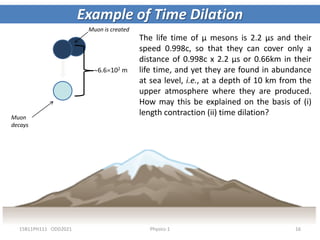
6.6102 m
Muon is created
Muon
decays
The life time of μ mesons is 2.2 μs and their
speed 0.998c, so that they can cover only a
distance of 0.998c x 2.2 μs or 0.66km in their
life time, and yet they are found in abundance
at sea level, i.e., at a depth of 10 km from the
upper atmosphere where they are produced.
How may this be explained on the basis of (i)
length contraction (ii) time dilation?
Example of Time Dilation
15B11PH111 ODD2021 Physics-1 16
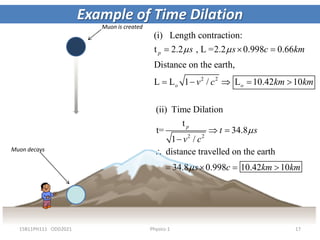
Muon is created
Muon decays
2 2
(i) Length contraction:
t 2.2 , L =2.2 0.998 0.66
Distance on the earth,
L L 1 / L 10.42 10
p
o o
s s c km
v c km km
 
  
    
2 2
(ii) Time Dilation
t
t= 34.8
1 /
distance travelled on the earth
34.8 0.998 10.42 10
p
t s
v c
s c km km


 


   
Example of Time Dilation
15B11PH111 ODD2021 Physics-1 17
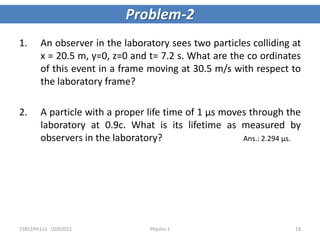
1. An observer in the laboratory sees two particles colliding at
x = 20.5 m, y=0, z=0 and t= 7.2 s. What are the co ordinates
of this event in a frame moving at 30.5 m/s with respect to
the laboratory frame?
2. A particle with a proper life time of 1 µs moves through the
laboratory at 0.9c. What is its lifetime as measured by
observers in the laboratory? Ans.: 2.294 μs.
Problem-2
15B11PH111 ODD2021 Physics-1 18
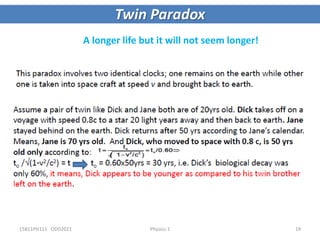
Twin Paradox
A longer life but it will not seem longer!
15B11PH111 ODD2021 Physics-1 19

L17,18_Lorentz transformation,Length contraction & Time dilation.pdf

  • 1.
    Content to becovered  Constancy of the Speed of Light  Lorentz Transformation  Consequence of Relativity  Length Contraction  Time Dilation  Muon decay problem  Twin Paradox Lecture #17,18 Resources to be consulted Concepts of Modern Physics by Arthur Beiser 15B11PH111 ODD2021 1 Physics-1
  • 2.
    • Consider thefixed system S and the moving system S’. • At t = 0, the origins and axes of both systems are coincident with system S’ moving to the right along the x axis. • A flashbulb goes off at both origins when t = 0. • According to postulate 2, the speed of light will be c in both systems and the wave fronts observed in both systems must be spherical. S The Constancy of the Speed of Light 15B11PH111 ODD2021 Physics-1 2
  • 3.
    Spherical wavefronts inS: Spherical wavefronts in S’: S S’ 2 2 2 2 2 2 2 2 2 2 ( 2 v v ) x y z x x t t y z c t             There are a couple of extra terms (-2xvt +v2t2) in the primed frame. Note that this cannot occur in Galilean transformations. x’ = x – vt y‘ = y z‘ = z t’ = t 15B11PH111 ODD2021 Physics-1 3
  • 4.
    The special setof linear transformations that: preserve the constancy of the speed of light (c) between inertial observers; with the assumption that the time is not an absolute quantity. Therefore t  t known as the Lorentz transformation equations The Lorentz Transformation 15B11PH111 ODD2021 Physics-1 4
  • 5.
    Consider a systemof two inertial frames of references S and S . S: is at rest and S : is a moving frame with constant velocity v relative to S (x,y,z,t) coordinates of event P for an observer O in     the stationary frame S (x ,y ,z ,t ) coordinates of event P for an observer O in the moving frame S Let x = (x-vt) ....(1) γ : proportionality constant. According to first          postulate of STR Therefore x= (x +vt ) ....(2) where t t According to second postulate of STR The wavefront along x, x axis must satisfy x=ct and x =ct Thus         substitute the value of x and x in eq (1)and (2) respectively. ct = (c-v)t and ct= (c+v)t Multiply these equations and solve it for       2 2 1 1 v / c    The Lorentz Transformation: Derivation Here γ is a factor of proportionality which does not depend upon either x or t but may be a function of v. γ must be same in both the reference frames as there is no difference between S and S’ other than the sign of v. 15B11PH111 ODD2021 Physics-1 5
  • 6.
    2 x x [ (x- vt) vt ] (x - vt) vt x x x 1 t t (1 ) v v v x = (x-vt) ....(1) x= (x +vt ) ....(2) From eq(1) and eq(2) or t = or t = similarly t                             2 x 1 t (1 ) v =        2 2 2 2 xv t vx c t t c v 1 c              2 2 2 2 x v t x v c t t c v 1 c                 2 2 2 2 2 2 2 2 2 2 y z c t x y z c t Imp:Prove that x under Lorentz Transformation            The Lorentz Transformation: Derivation 15B11PH111 ODD2021 Physics-1 6
  • 7.
    Lorentz Transformation •Measurements oftime and position depend upon the frame of reference of observer so that two events which occur simultaneously in one frame at different places need not be simultaneous in another. •Lorentz transformation reduces to ordinary Galilean transformation when v<<c. 15B11PH111 ODD2021 Physics-1 7
  • 8.
    2 2 v 1 v/ x t x c     2 2 2 v / 1 v / t x c t c     y y   z z   If v << c, i.e.  ≈ 1, yielding the familiar Galilean transformation. Space and time are now linked, and the frame velocity cannot exceed c. 2 2 v 1 v / x t x c      2 2 2 v / 1 v / t x c t c      y y  z z  The complete Lorentz Transformation 15B11PH111 ODD2021 Physics-1 8
  • 9.
    The Major ConsequencesTo This Theory are:- Length Contraction Time Dilation Mass Expansion Consequence of Relativity 15B11PH111 ODD2021 Physics-1 9
  • 10.
    A fast- moving plane at different speeds. v= 10% c v = 80% c v = 99.9% c v = 99% c Lorentz Contraction 15B11PH111 ODD2021 Physics-1 10
  • 11.
    A rod islying along the x’ axis of the moving frame S’. If an observer determines the coordinates of its ends to be x’1 and x’2, then the length of the rod w .r . t. O’ is: L0 = x2’ – x1’ Therefore, L0 is the actual length of the rod (w.r.t .to O’) in a frame in which the rod is at rest. According to Lorentz transformation, length measured in S w.r.t. O will be the apparent length (L = x2– x1). ) ( 1 1 ' vt x x    ) ( 2 2 ' vt x x    2 2 1 ) ( ) ( ) ( 1 2 1 2 0 c v L x x vt x vt x L            Length Contraction As ends of the rod is measured at the same time, so; t1 = t2 in S. 15B11PH111 ODD2021 Physics-1 11
  • 12.
    2 2 o o1 v / c    L Therefore L=L The length (L0) of an object in motion with respect to an observer (​in S Frame) ​appears to be shorter, this phenomenon is known as Lorentz FitzGerald contraction or Length Contraction. Length Contraction o Case I : if v=0, L= ? Case II: if v=c, L=? Exercise : Find L when L =1m and v=0.9c. Faster means shorter 15B11PH111 ODD2021 Physics-1 12
  • 13.
    distance traveled 2 speed   p d t c 2 2 2 2 p p 2 t t t 1 c t v t 2 c 2     v d                     p γ >1,thu Δt Δt s Time Dilation 15B11PH111 ODD2021 Physics-1 13
  • 14.
    Time Dilation Assume aclock is placed at x’ in the moving frame S’. When an observer in S’ measures a time interval The observer in S, will measure this interval as 2 1 2 2 2 1 2 2 2 2 0 2 1 2 2 2 2 vx vx t t c c t t t v v 1 1 c c t t t v v 1 1 c c                    Thus improper time will be longer than proper time; called Time dilation. o 2 1 t t t     Two measurements of time t2’ & t1’ were taken at same position. proper time apparent time or improper time 15B11PH111 ODD2021 Physics-1 14
  • 15.
    0 t t   Thus astationary clock measures a longer time interval between events occurring in a moving frame of reference – time dilation. Since γ ≥ 1, t will be larger than t0. Thus if the time interval between two beats (tick) of the clock in the proper frame S’ is 1 second, then this time interval will be observed more than 1 second in the frame S i.e a moving clock appears to go slow. Time Dilation A moving clock ticks more slowly than a clock at rest. 15B11PH111 ODD2021 Physics-1 15
  • 16.
    6.6102 m Muon iscreated Muon decays The life time of μ mesons is 2.2 μs and their speed 0.998c, so that they can cover only a distance of 0.998c x 2.2 μs or 0.66km in their life time, and yet they are found in abundance at sea level, i.e., at a depth of 10 km from the upper atmosphere where they are produced. How may this be explained on the basis of (i) length contraction (ii) time dilation? Example of Time Dilation 15B11PH111 ODD2021 Physics-1 16
  • 17.
    Muon is created Muondecays 2 2 (i) Length contraction: t 2.2 , L =2.2 0.998 0.66 Distance on the earth, L L 1 / L 10.42 10 p o o s s c km v c km km           2 2 (ii) Time Dilation t t= 34.8 1 / distance travelled on the earth 34.8 0.998 10.42 10 p t s v c s c km km           Example of Time Dilation 15B11PH111 ODD2021 Physics-1 17
  • 18.
    1. An observerin the laboratory sees two particles colliding at x = 20.5 m, y=0, z=0 and t= 7.2 s. What are the co ordinates of this event in a frame moving at 30.5 m/s with respect to the laboratory frame? 2. A particle with a proper life time of 1 µs moves through the laboratory at 0.9c. What is its lifetime as measured by observers in the laboratory? Ans.: 2.294 μs. Problem-2 15B11PH111 ODD2021 Physics-1 18
  • 19.
    Twin Paradox A longerlife but it will not seem longer! 15B11PH111 ODD2021 Physics-1 19