SYSTEM OF PARTICLES AND
ROTATIONAL MOTION
SECTION 1
OVERVIEW
• System of particles and centre of mass
• Centre of mass of a system of particles
- Centre of gravity and centre of mass
• Newton’s Law for a system of particles
• Motion of centre of mass
• Reduced Mass of a two particle system
SYSTEM OF PARTICLES
• Well-defined collection of a large number of
particles that may or may not interact with
each other or are connected to each other.
SYSTEM OF PARTICLES (Contd.)
• May be actual particles of rigid bodies in
translational motion.
• The particle which interacts with each other
apply force on each other
• These forces of mutual interaction between
the particle of the system are called the
internal force of the system.
SYSTEM OF PARTICLES (Contd.)
• Term External force means a force that is
acting on any one particle, which is included in
the system by some other body outside the
system.
Centre of Mass
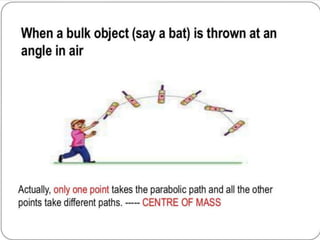
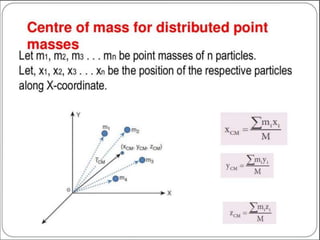
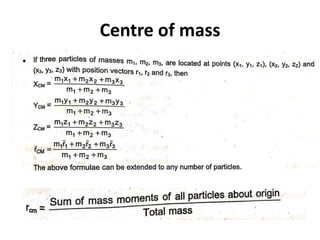
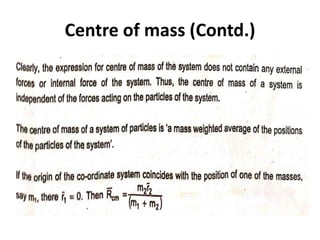
• The Centre of mass of a system of particles or
a body is the point inside or outside the body
where the entire mass of the body is assumed
to be concentrated.
• Point at which algebraic sum of the mass
moments of the particles reduces to zero.
Centre of mass
• The centre of mass may lie within, outside,
on the surface of the body.
Centre of mass at a point
Centre of Mass for different shapes
Centre of mass
Centre of mass (Contd.)
• Centre of mass of system of particles is
independent of origin
• Centre of Mass lies in the straight line joining
two particles at location between the two
particles
• Centre of mass of a two particle system, is
located near the heavier particle
Centre of mass (Contd.)
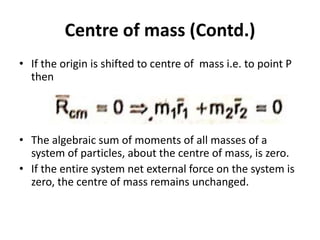
• If the origin is shifted to centre of mass i.e. to point P
then
• The algebraic sum of moments of all masses of a
system of particles, about the centre of mass, is zero.
• If the entire system net external force on the system is
zero, the centre of mass remains unchanged.
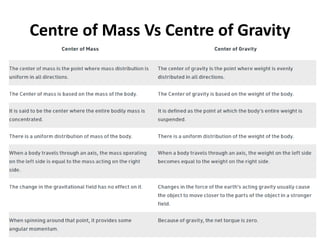
Centre of Mass Vs Centre of Gravity
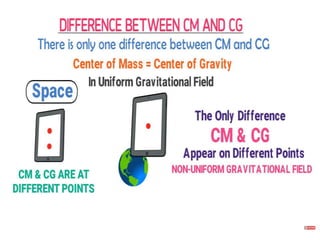
Centre of Gravity and Centre of Mass
• If the gravitational field is uniform then the centre of
mass and centre of gravity will coincide
• The term of Centre of gravity is meaningless where
there is no gravity, while centre of mass is always
valid
• The centre of gravity of a rigid body may change
from place to place, while the centre of mass
remains the same.
Newton’s Law for a System of
Particles
• Newton's second law states that, when a
force acts on a particle, this force is equal to
mass times acceleration.
Newton’s Law for a System of
Particles
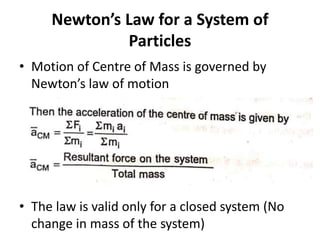
• Motion of Centre of Mass is governed by
Newton’s law of motion
• The law is valid only for a closed system (No
change in mass of the system)
Motion of centre of mass
• If a system experiences no external force, the
center-of-mass of the system will remain at
rest, or will move at constant velocity if it is
already moving.
• The state of rest or uniform motion of the
centre of mass of a body in a direction will not
change unless it is acted upon by an external
unbalanced force in that direction
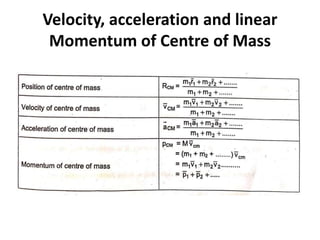
Velocity, acceleration and linear
Momentum of Centre of Mass
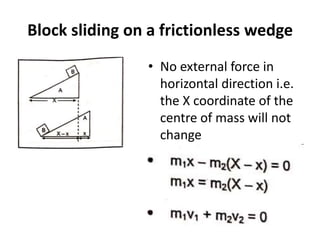
Block sliding on a frictionless wedge
• No external force in
horizontal direction i.e.
the X coordinate of the
centre of mass will not
change
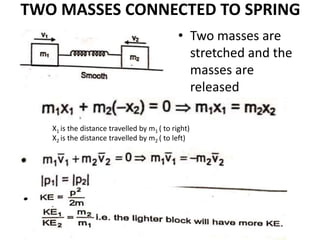
TWO MASSES CONNECTED TO SPRING
• Two masses are
stretched and the
masses are
released
X1 is the distance travelled by m1 ( to right)
X2 is the distance travelled by m2 ( to left)
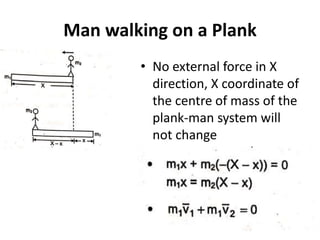
Man walking on a Plank
• No external force in X
direction, X coordinate of
the centre of mass of the
plank-man system will
not change
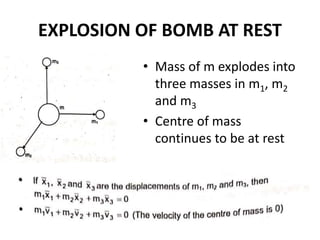
EXPLOSION OF BOMB AT REST
• Mass of m explodes into
three masses in m1, m2
and m3
• Centre of mass
continues to be at rest
Reduced Mass of a Two Particle
System
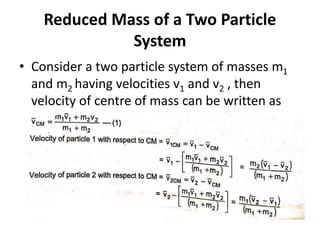
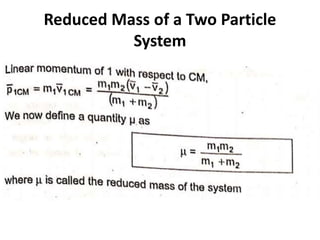
• Consider a two particle system of masses m1
and m2 having velocities v1 and v2 , then
velocity of centre of mass can be written as
Reduced Mass of a Two Particle
System
SECTION 2
Overview
• Rigid body
• Centre of mass of rigid bodies
• Motion of a rigid body
• Rotation of a rigid body
• Axis rotation
• Moment of Inertia of a rigid body
• Parallel axes theorem
• Perpendicular axes theorem
• Moment of Inertia of some regular bodies
Rigid body
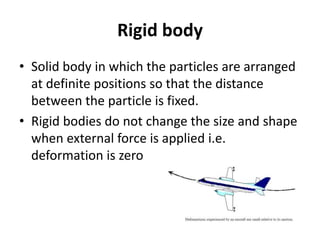
• Solid body in which the particles are arranged
at definite positions so that the distance
between the particle is fixed.
• Rigid bodies do not change the size and shape
when external force is applied i.e.
deformation is zero
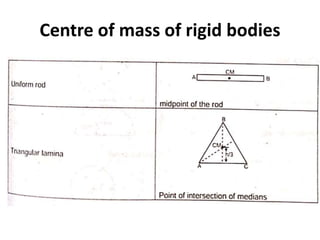
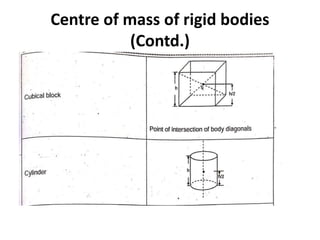
Centre of mass of rigid bodies
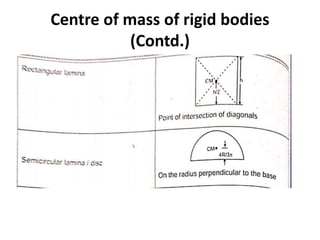
(Contd.)
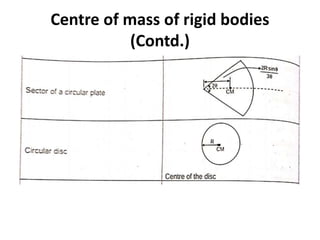
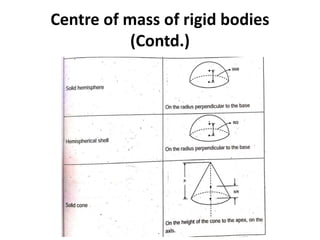
Centre of mass of rigid bodies
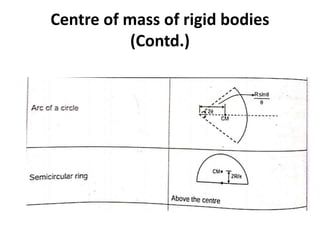
(Contd.)
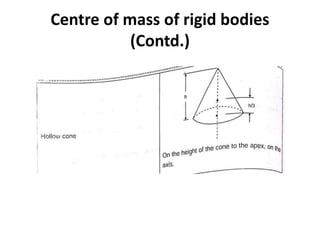
Centre of mass of rigid bodies
(Contd.)
Centre of mass of rigid bodies
(Contd.)
Centre of mass of rigid bodies
(Contd.)
Centre of mass of rigid bodies
(Contd.)
Centre of mass – Continuous mass
distribution
• Position vector of centre of mass
• Centre of mass (X direction)
• Centre of mass (Y direction)
• Centre of Mass (Z direction)
Motion of Rigid body
Three types of Motion
- Translatory motion
- Combination of Translatory and Rotational
motion
- Pure Rotational motion
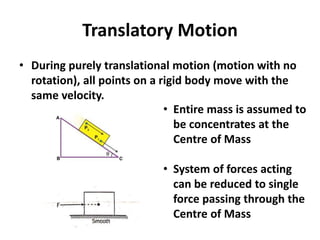
Translatory Motion
• During purely translational motion (motion with no
rotation), all points on a rigid body move with the
same velocity.
• Entire mass is assumed to
be concentrates at the
Centre of Mass
• System of forces acting
can be reduced to single
force passing through the
Centre of Mass
Combination of Translation and
Rotation
• System of forces acting on a body can be reduced to
a single force not passing the centre of mass or two
unequal parallel forces.
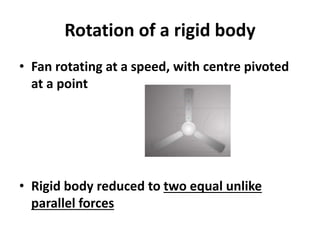
Rotation of a rigid body
• Fan rotating at a speed, with centre pivoted
at a point
• Rigid body reduced to two equal unlike
parallel forces
Rotation of a rigid body
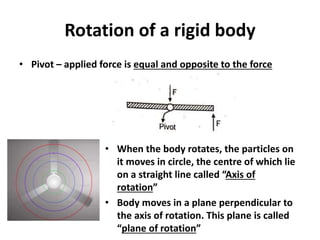
• Pivot – applied force is equal and opposite to the force
• When the body rotates, the particles on
it moves in circle, the centre of which lie
on a straight line called “Axis of
rotation”
• Body moves in a plane perpendicular to
the axis of rotation. This plane is called
“plane of rotation”
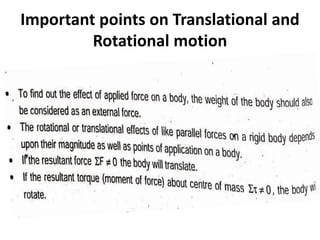
Important points on Translational and
Rotational motion
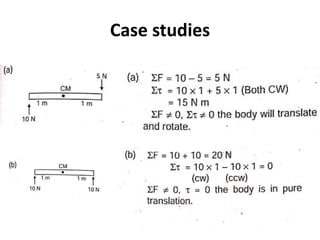
Case studies
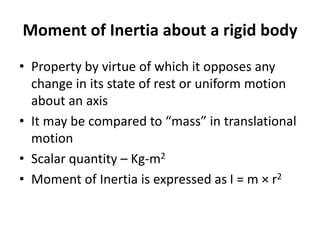
Moment of Inertia about a rigid body
• Property by virtue of which it opposes any
change in its state of rest or uniform motion
about an axis
• It may be compared to “mass” in translational
motion
• Scalar quantity – Kg-m2
• Moment of Inertia is expressed as I = m × r2
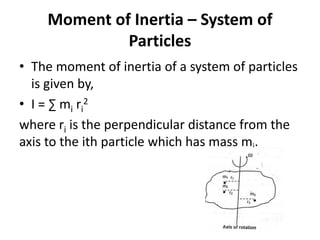
Moment of Inertia – System of
Particles
• The moment of inertia of a system of particles
is given by,
• I = ∑ mi ri
2
where ri is the perpendicular distance from the
axis to the ith particle which has mass mi.
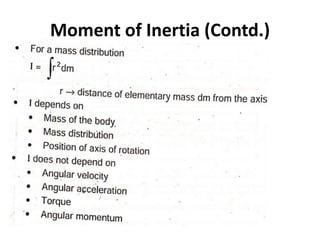
Moment of Inertia (Contd.)
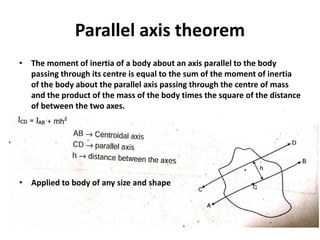
Parallel axis theorem
• The moment of inertia of a body about an axis parallel to the body
passing through its centre is equal to the sum of the moment of inertia
of the body about the parallel axis passing through the centre of mass
and the product of the mass of the body times the square of the distance
of between the two axes.
• Applied to body of any size and shape
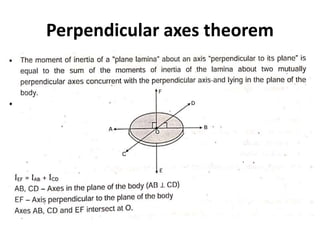
Perpendicular axes theorem
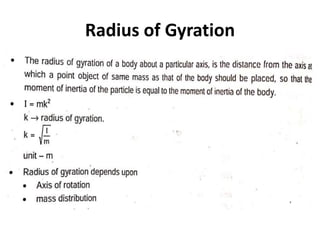
Radius of Gyration
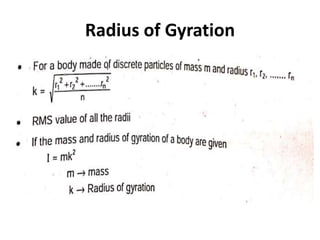
Radius of Gyration
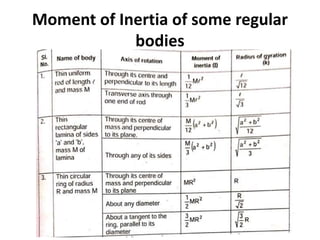
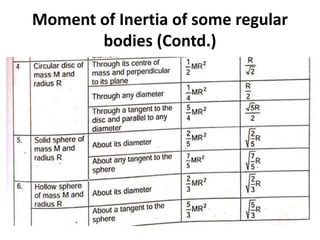
Moment of Inertia of some regular
bodies
Moment of Inertia of some regular
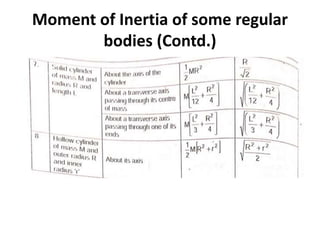
bodies (Contd.)
Moment of Inertia of some regular
bodies (Contd.)
SECTION 3
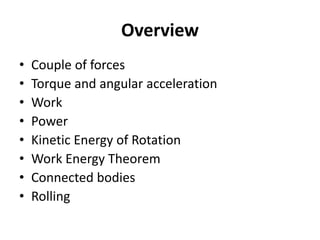
Overview
• Couple of forces
• Torque and angular acceleration
• Work
• Power
• Kinetic Energy of Rotation
• Work Energy Theorem
• Connected bodies
• Rolling
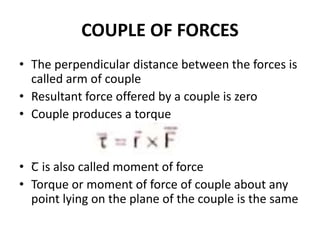
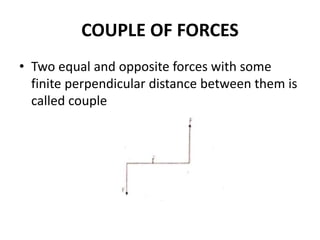
COUPLE OF FORCES
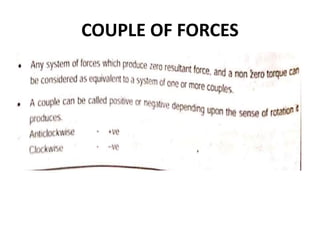
• Two equal and opposite forces with some
finite perpendicular distance between them is
called couple
COUPLE OF FORCES
• The perpendicular distance between the forces is
called arm of couple
• Resultant force offered by a couple is zero
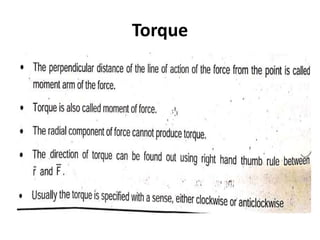
• Couple produces a torque
• Ꞇ is also called moment of force
• Torque or moment of force of couple about any
point lying on the plane of the couple is the same
COUPLE OF FORCES
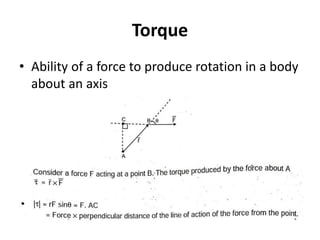
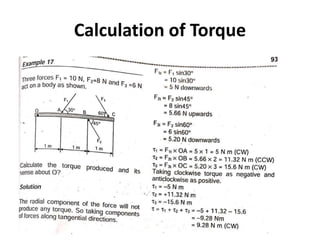
Torque
• Ability of a force to produce rotation in a body
about an axis
Torque
Calculation of Torque
ANGULAR ACCELERATION -
NEWTON’S LAW OF ROTATIONAL
MOTION
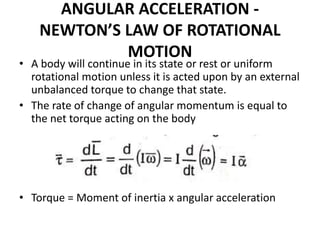
• A body will continue in its state or rest or uniform
rotational motion unless it is acted upon by an external
unbalanced torque to change that state.
• The rate of change of angular momentum is equal to
the net torque acting on the body
• Torque = Moment of inertia x angular acceleration
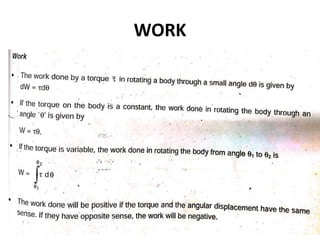
WORK
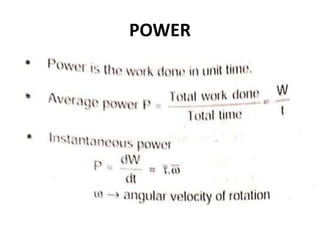
POWER
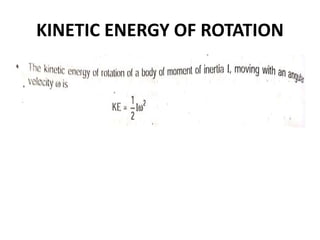
KINETIC ENERGY OF ROTATION
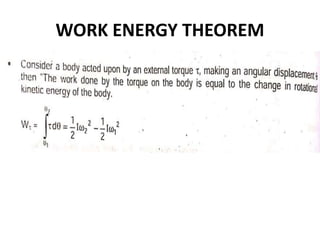
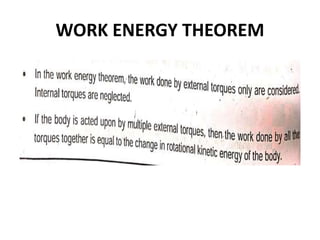
WORK ENERGY THEOREM
WORK ENERGY THEOREM
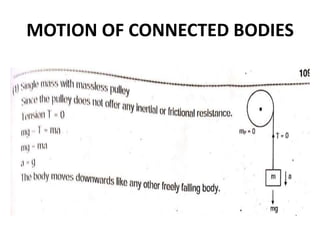
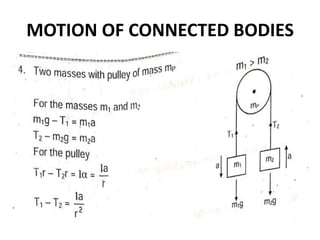
MOTION OF CONNECTED BODIES
ROLLING
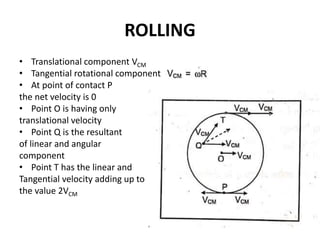
• Translational component VCM
• Tangential rotational component
• At point of contact P
the net velocity is 0
• Point O is having only
translational velocity
• Point Q is the resultant
of linear and angular
component
• Point T has the linear and
Tangential velocity adding up to
the value 2VCM
KINETIC ENERGY IN ROLLING
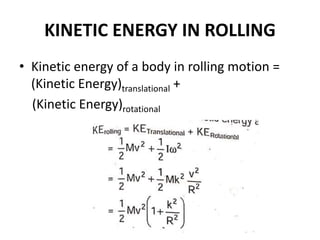
• Kinetic energy of a body in rolling motion =
(Kinetic Energy)translational +
(Kinetic Energy)rotational
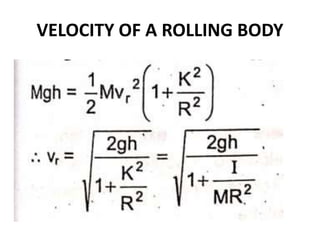
VELOCITY OF A ROLLING BODY
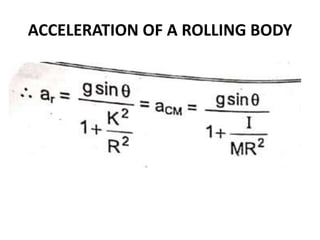
ACCELERATION OF A ROLLING BODY
SECTION 4
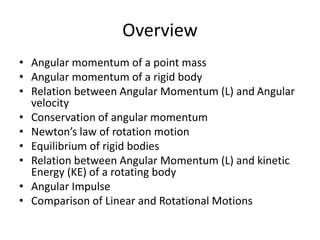
Overview
• Angular momentum of a point mass
• Angular momentum of a rigid body
• Relation between Angular Momentum (L) and Angular
velocity
• Conservation of angular momentum
• Newton’s law of rotation motion
• Equilibrium of rigid bodies
• Relation between Angular Momentum (L) and kinetic
Energy (KE) of a rotating body
• Angular Impulse
• Comparison of Linear and Rotational Motions
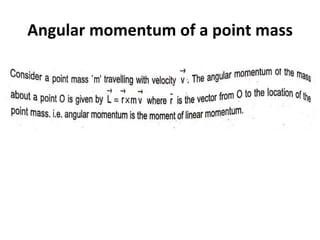
Angular momentum of a point mass
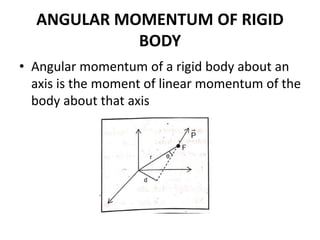
ANGULAR MOMENTUM OF RIGID
BODY
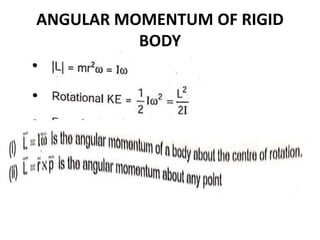
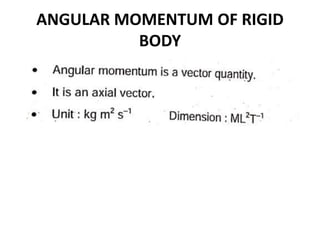
• Angular momentum of a rigid body about an
axis is the moment of linear momentum of the
body about that axis
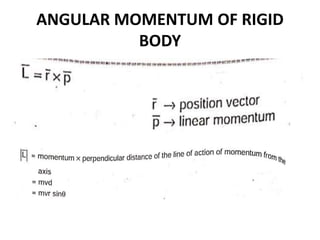
ANGULAR MOMENTUM OF RIGID
BODY
ANGULAR MOMENTUM OF RIGID
BODY
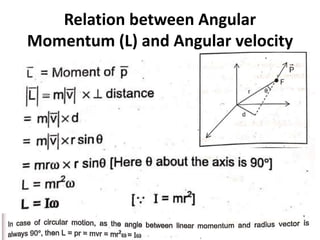
Relation between Angular
Momentum (L) and Angular velocity
ANGULAR MOMENTUM OF RIGID
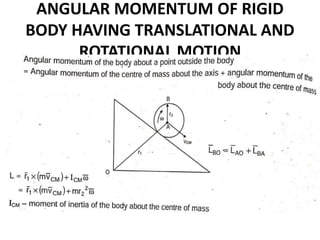
BODY HAVING TRANSLATIONAL AND
ROTATIONAL MOTION
ANGULAR MOMENTUM OF RIGID
BODY
Conservation of Angular momentum
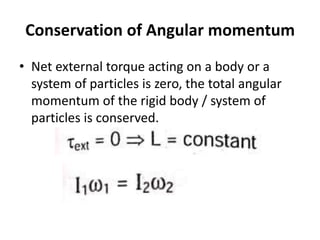
• Net external torque acting on a body or a
system of particles is zero, the total angular
momentum of the rigid body / system of
particles is conserved.
Conservation of Angular momentum
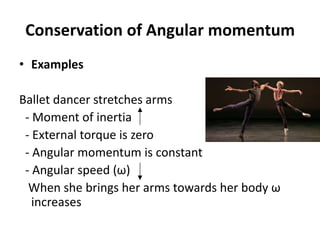
• Examples
Ballet dancer stretches arms
- Moment of inertia
- External torque is zero
- Angular momentum is constant
- Angular speed (ω)
When she brings her arms towards her body ω
increases
Conservation of Angular momentum
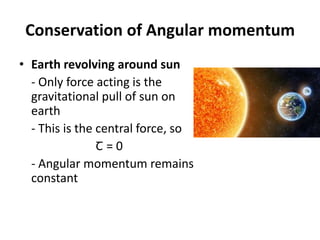
• Earth revolving around sun
- Only force acting is the
gravitational pull of sun on
earth
- This is the central force, so
Ꞇ = 0
- Angular momentum remains
constant
Conservation of Angular momentum
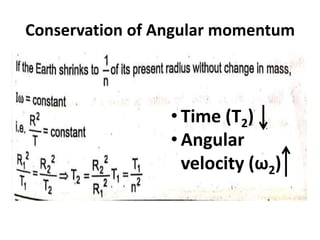
• Time (T2)
• Angular
velocity (ω2)
NEWTON’S LAW OF ROTATIONAL
MOTION
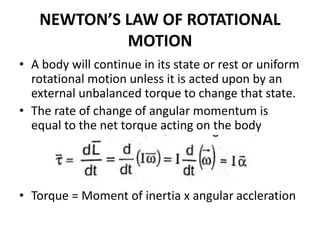
• A body will continue in its state or rest or uniform
rotational motion unless it is acted upon by an
external unbalanced torque to change that state.
• The rate of change of angular momentum is
equal to the net torque acting on the body
• Torque = Moment of inertia x angular accleration
NEWTON’S LAW OF ROTATIONAL
MOTION
• Resultant torque acting on a body about a
point =
moment of inertia of the body about that
point x angular acceleration
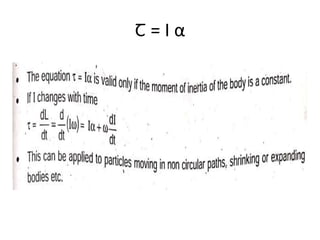
Ꞇ = I α
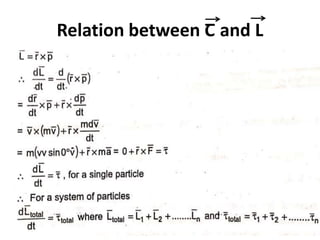
Relation between Ꞇ and L
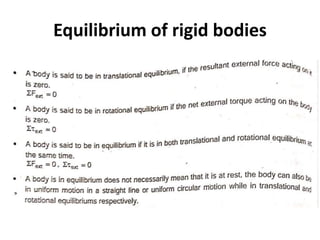
Equilibrium of rigid bodies
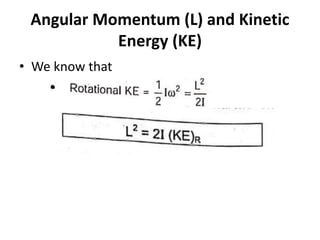
Angular Momentum (L) and Kinetic
Energy (KE)
• We know that
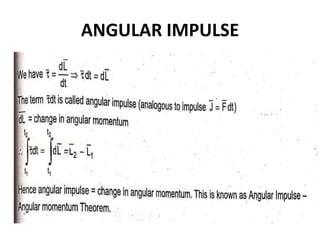
ANGULAR IMPULSE
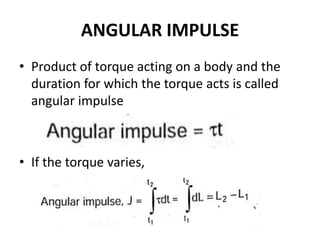
ANGULAR IMPULSE
• Product of torque acting on a body and the
duration for which the torque acts is called
angular impulse
• If the torque varies,