LOW LATENCY
MICROWAVE
Fact, Fiction & Future
AVIAT NETWORKS
MICROWAVE IS FASTER THAN FIBER AND IS QUICKLY BECOMING
DEFACTO STANDARD FOR ULTRA LOW LATENCY TRANSPORT
AVIAT NETWORKS
Air Latency is the dominant
Factor
Angular deviation comes at a high
cost
Regulatory
Availability of licensed spectrum
Infrastructure
Equipment Operating Modes
Repeaters and Regenerators
Number of Hops
Modem and RF Performance
Equipment Latency
LOW LATENCY MICROWAVE FACTS
AVIAT NETWORKS
Air Latency is the dominant
Factor
Angular deviation comes at a high
cost
Regulatory
Availability of licensed spectrum
Infrastructure
Equipment Operating Modes
Repeaters and Regenerators
Number of Hops
Modem and RF Performance
Equipment Latency
Angular
Deviation
Increased
Distance
Increased
Latency
Percentage
5 Degrees 2.8 Miles 15.0 µs 0.38%
10 Degrees 11.3 Miles 60.5 µs 1.54%
15 Degrees 25.9 Miles 138.4 µs 3.53%
20 Degrees 47.2 Miles 251.8µs 6.42%
Even with microwave working at the speed of light a less than ideal path
will cause a significant latency penalty
735 Miles
AIR LATENCY
AVIAT NETWORKS
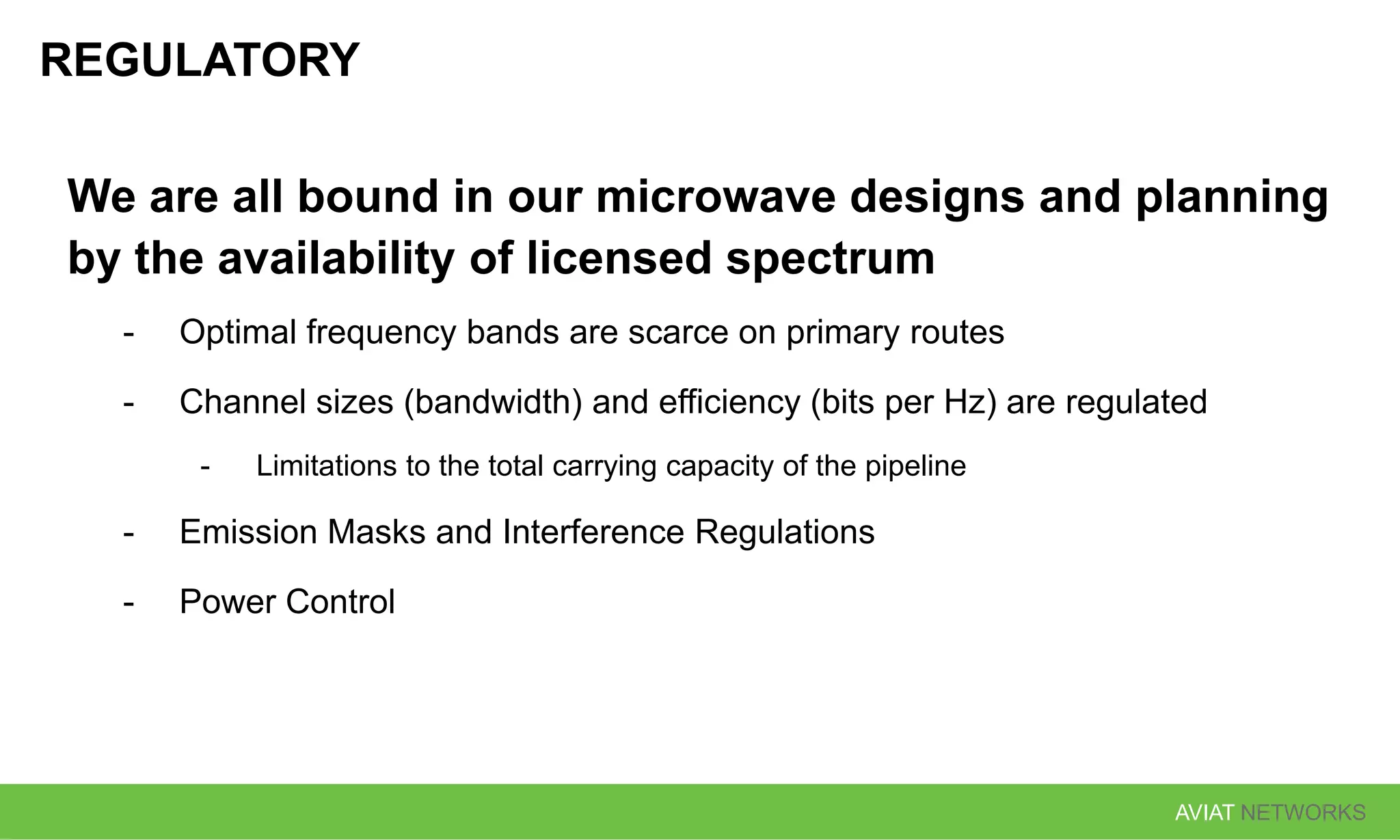
REGULATORY
We are all bound in our microwave designs and planning
by the availability of licensed spectrum
- Optimal frequency bands are scarce on primary routes
- Channel sizes (bandwidth) and efficiency (bits per Hz) are regulated
- Limitations to the total carrying capacity of the pipeline
- Emission Masks and Interference Regulations
- Power Control
AVIAT NETWORKS
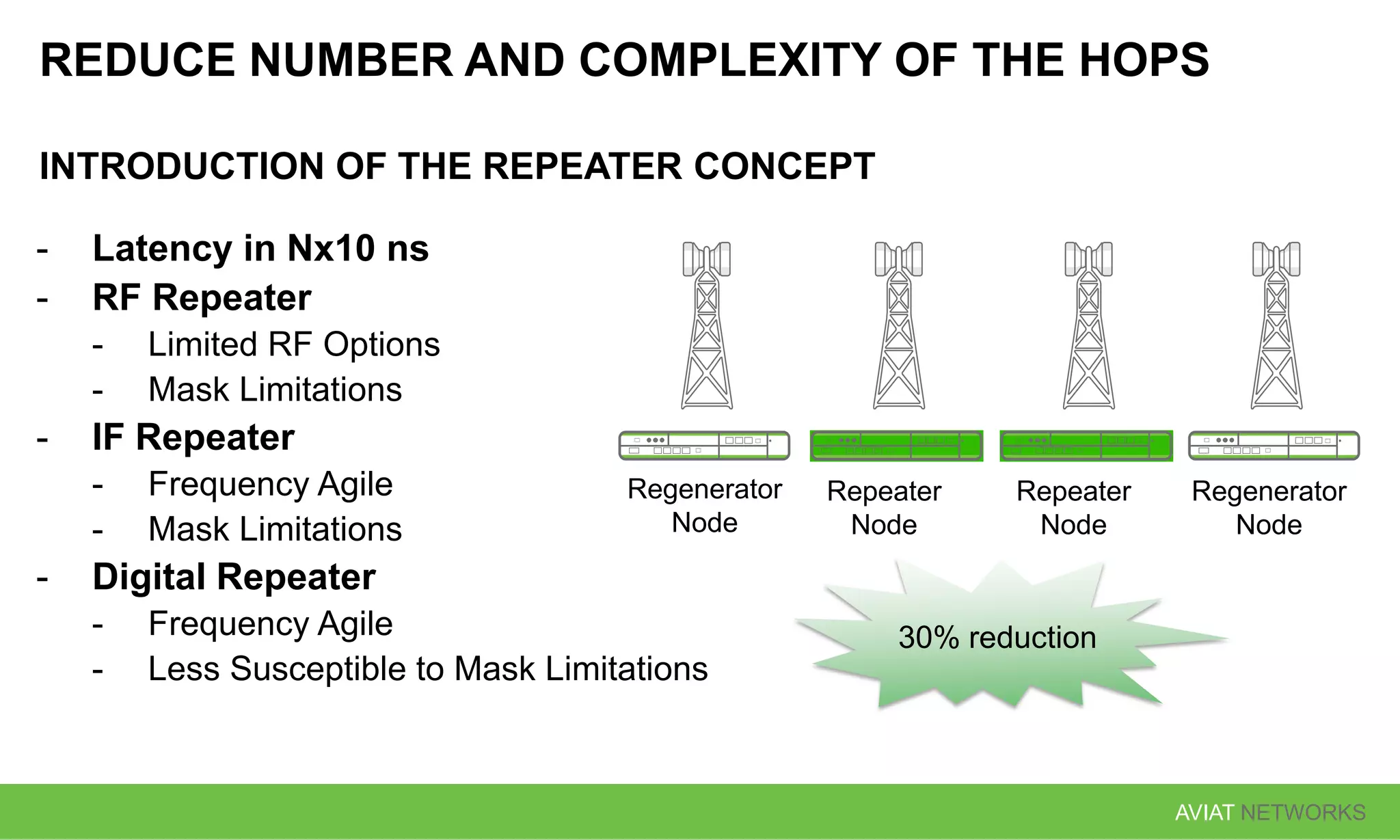
REDUCE NUMBER AND COMPLEXITY OF THE HOPS
INTRODUCTION OF THE REPEATER CONCEPT
- Latency in Nx10 ns
- RF Repeater
- Limited RF Options
- Mask Limitations
- IF Repeater
- Frequency Agile
- Mask Limitations
- Digital Repeater
- Frequency Agile
- Less Susceptible to Mask Limitations
Regenerator
Node
Regenerator
Node
Repeater
Node
Repeater
Node
30% reduction
AVIAT NETWORKS
Regenerator
Node
Repeater
Node
Repeater
Node
Regenerator
Node
Repeater
Node
Repeater
Node
Regenerator
Node
Repeater
Node
Repeater
Node
Regenerator
Node
Repeater
Node
Regenerator
Node
ADAPTIVE REPEATER TECHNOLOGY
Ultra Low
End-End
Latency
Low End-End
Latency
(still better
than fiber)
99% of time
1% of time
Continuous monitoring of the received signal quality
AVIAT NETWORKS
RF AND MODEM PERFORMANCE
WHERE DOES IT HELP?
• Antenna Size
• Number of Repeaters
- FEC Coding
- Rx Threshold
- Higher Quality Oscillators
Ultimately all revolves around having better System Gain !!!
• Link Distance
• Number of Hops
• Link Availability
TECHNIQUES INCLUDE:
- Tx Power
- Rx Sensitivity
- Diversity
AVIAT NETWORKS
MODEM TECHNOLOGY
Forward Error Correction
Modulations and Bandwidths
Diversity Protection
Improves link availability and hence low latency availability
Adaptive Modulation and Adaptive Coding  Latency Increase
Phase noise reduction
FEC Method
Linear and Iterative
Convolutional Codes
Algorithm
LPDC, Turbo Codes
Viterbi
Latency
High
Medium
Block Codes
No FEC
Reed Solomon
- - -
Low*
Lowest
SG Imp.
High
Good*
None
Good
BW
30 MHz
40 MHz
Mod
16QAM
32QAM
50 MHz
128QAM
64QAM
256QAM
QPSK
     
     
     
AVIAT NETWORKS
RF TECHNOLOGY
IF Preprocessing
Adaptive Predistortion
Higher Output Power
Clean LOs
AVIAT NETWORKS
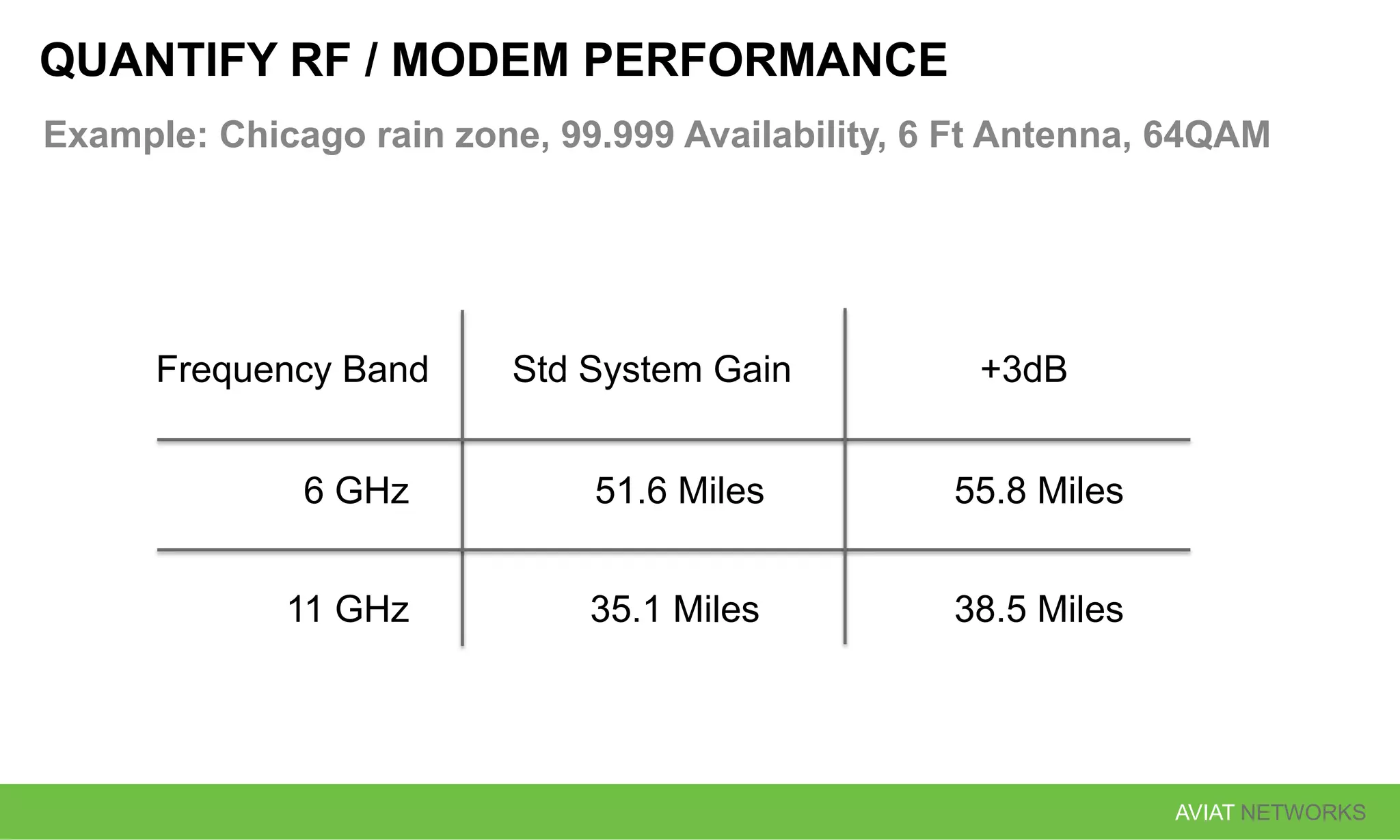
QUANTIFY RF / MODEM PERFORMANCE
Example: Chicago rain zone, 99.999 Availability, 6 Ft Antenna, 64QAM
Frequency Band
6 GHz
11 GHz
Std System Gain
51.6 Miles
35.1 Miles
+3dB
55.8 Miles
38.5 Miles
AVIAT NETWORKS
EQUIPMENT LATENCY
Payload Interface
Interface Alternatives (Ethernet, L1 Interfaces, Proprietary)
Switch Forwarding (Store and Forward, Early Packet Forwarding)
Switch Buffering
Serialization Delay
Interface speed differentials force store and forward stages and buffering
Modem Technology (Traditional)
Scrambling / Descrambling
Encoding / Decoding
Interleaving / Deinterleaving
Modulation / Demodulation
Analog Front End
Reduce or Eliminate
AVIAT NETWORKS
FICTION, MISCONCEPTIONS AND MYTHS
Equipment latency is most
important
Focus in In and Out of the box
latency
Reduced Latency = Reduced
Reliability
Link Reliability
Equipment Reliability
High site count is OK if path is
AVIAT NETWORKS
EQUIPMENT LATENCY-THE MOST IMPORTANT FACTOR
Equipment latency is important but not the most important factor
Route design
Path and Frequency planning
Maximizing the number of repeaters
RF / Modem performance
Reduce the number of hops
Improve link availability
Equipment Latency
End to end latency is the goal
Optimal blend of above features  Lowest end to end latency + Highest availability
~3-20 µs
Regenerator
Node
Repeater
Node
~100-500 ns
AVIAT NETWORKS
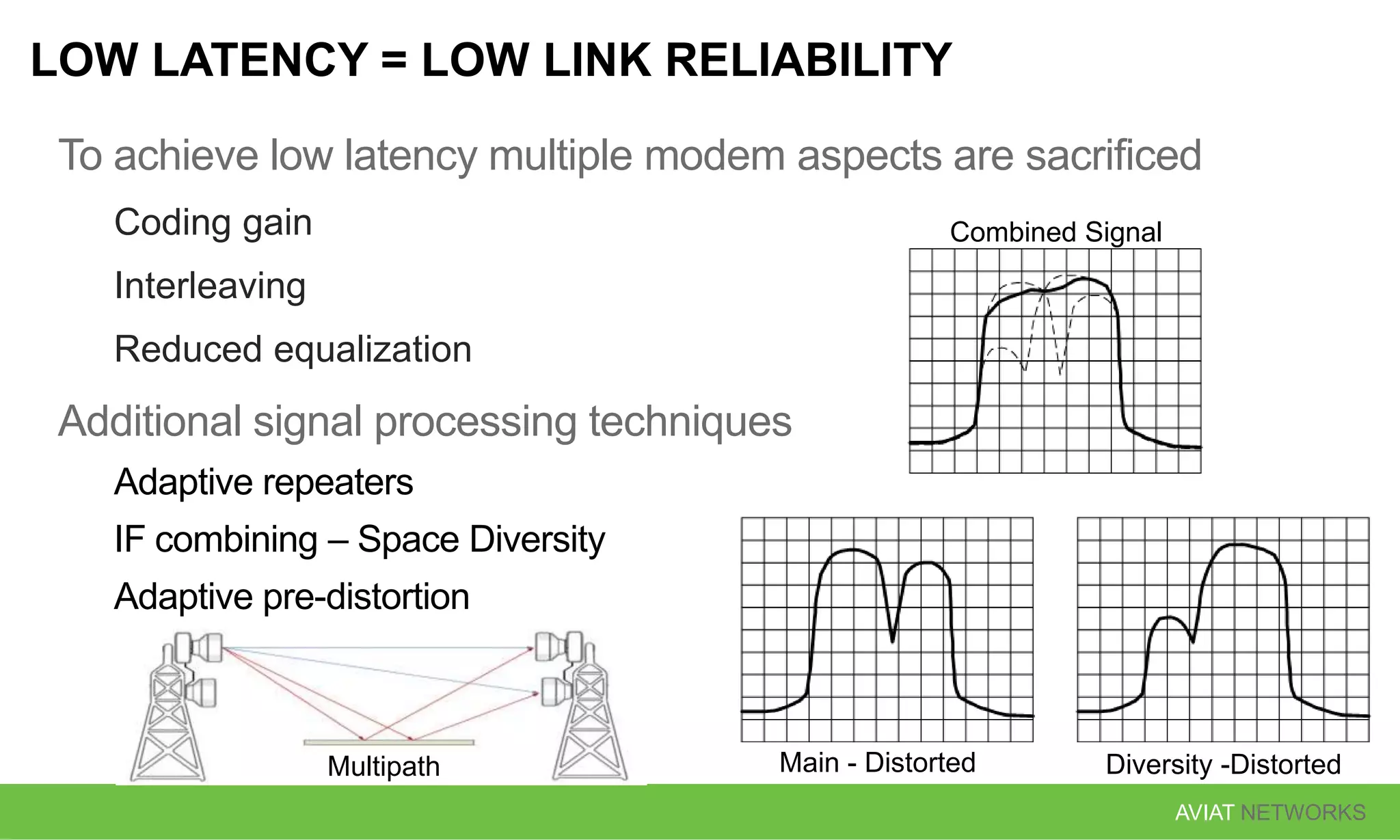
LOW LATENCY = LOW LINK RELIABILITY
To achieve low latency multiple modem aspects are sacrificed
Coding gain
Interleaving
Reduced equalization
Additional signal processing techniques
Adaptive repeaters
IF combining – Space Diversity
Adaptive pre-distortion
Combined Signal
Main - Distorted Diversity -DistortedMultipath
AVIAT NETWORKS
LOW LATENCY = LOW EQUIPMENT RELIABILITY
Low latency can be built on a field proven platform with very high MTBF
AVIAT NETWORKS
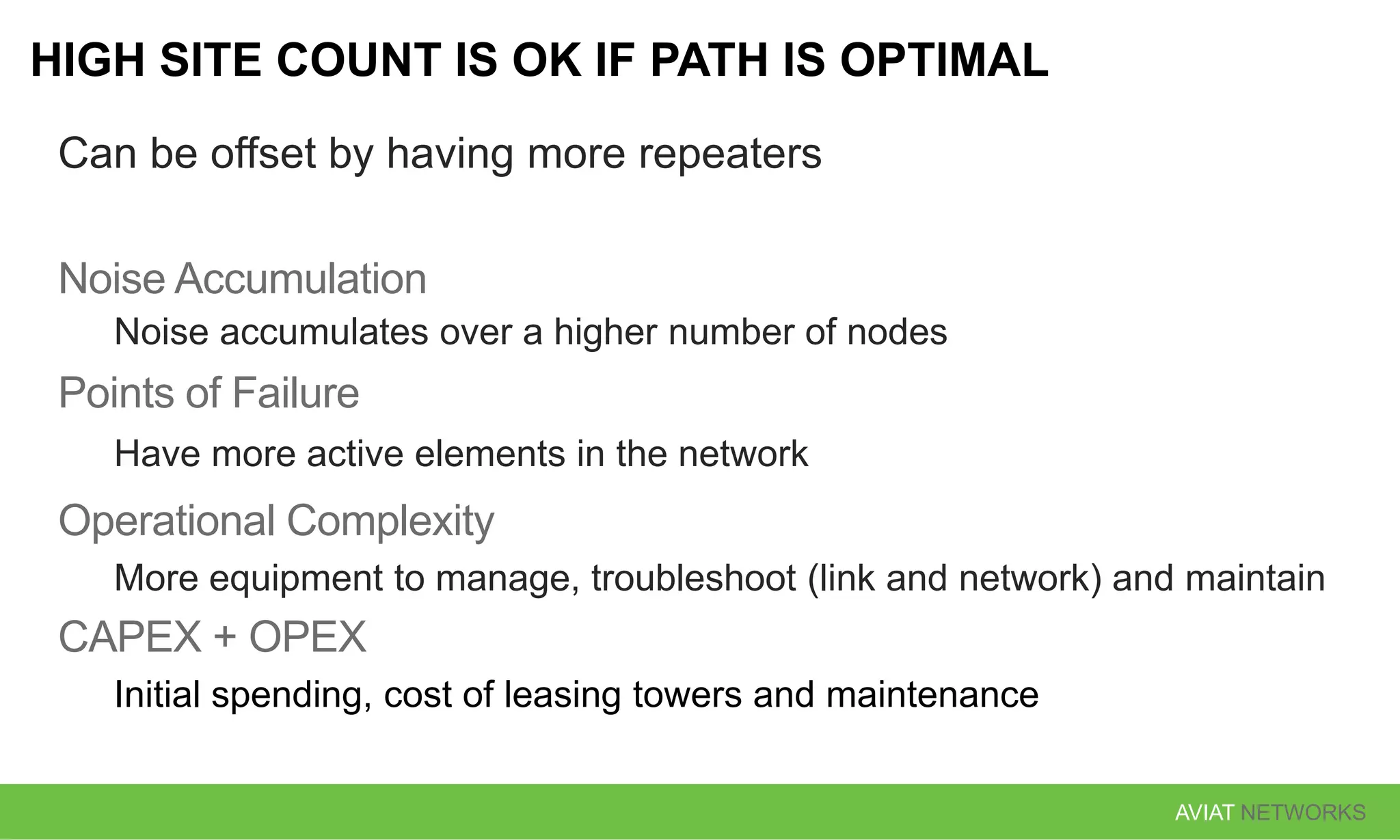
HIGH SITE COUNT IS OK IF PATH IS OPTIMAL
Can be offset by having more repeaters
Noise Accumulation
Noise accumulates over a higher number of nodes
Points of Failure
Have more active elements in the network
Operational Complexity
More equipment to manage, troubleshoot (link and network) and maintain
CAPEX + OPEX
Initial spending, cost of leasing towers and maintenance
AVIAT NETWORKS
LOW LATENCY MICROWAVE FUTURE
Lower Latency
Increase number of repeaters
Specialized Modems
All outdoor radio repeaters
Increased Capacity
Multi-Carrier
XPIC
Channel Bonding
Higher Modulations
Beyond Microwave
AVIAT NETWORKS
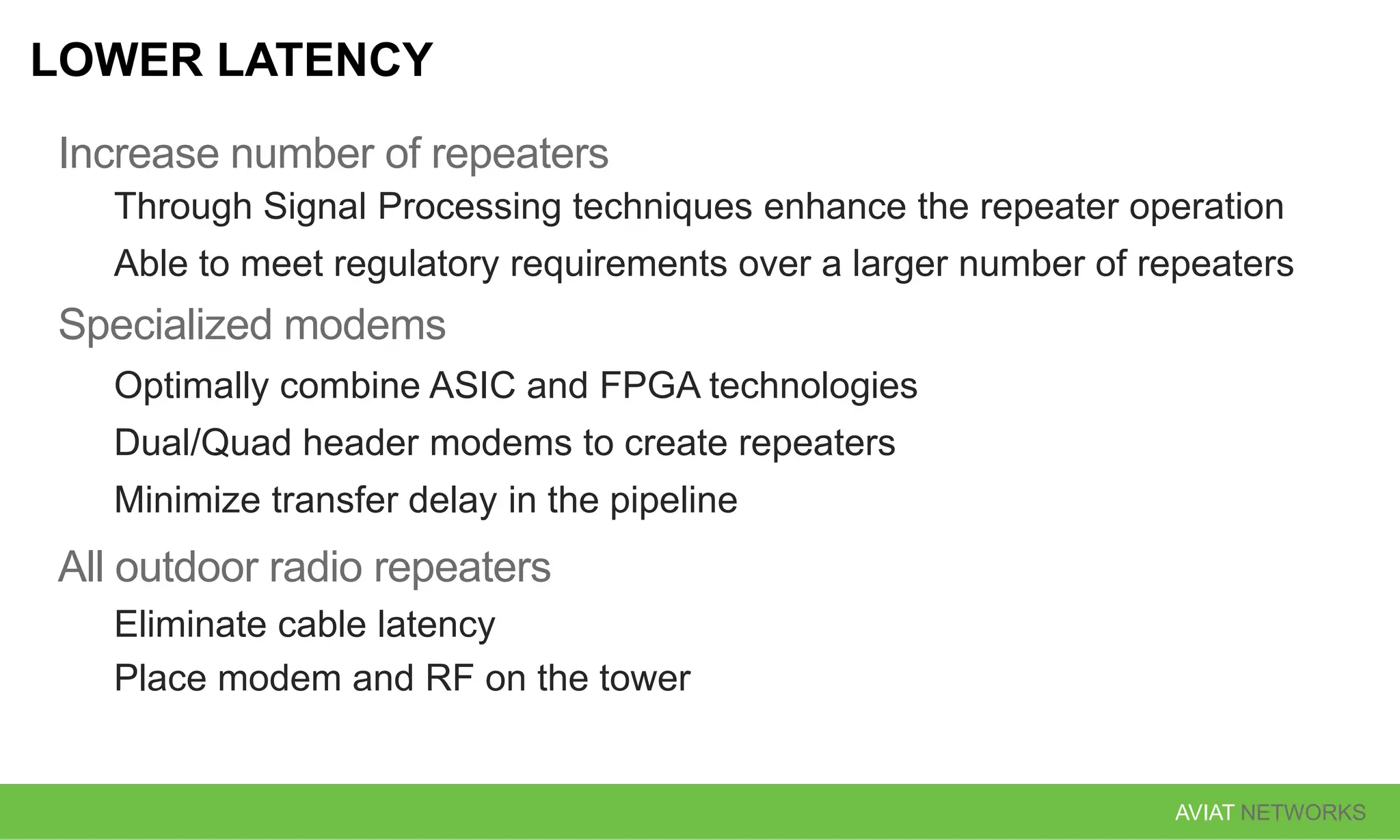
LOWER LATENCY
Increase number of repeaters
Through Signal Processing techniques enhance the repeater operation
Able to meet regulatory requirements over a larger number of repeaters
Specialized modems
Optimally combine ASIC and FPGA technologies
Dual/Quad header modems to create repeaters
Minimize transfer delay in the pipeline
All outdoor radio repeaters
Eliminate cable latency
Place modem and RF on the tower
AVIAT NETWORKS
INCREASED CAPACITY
Multi-carrier
Outdoor branching for up to 8 channels in a single antenna
Use dual or quad header modems
XPIC + Diversity
Cross polar cancelling for lowest possible latency
Regulatory requirements internationally – Efficient channel utilization (H & V)
Channel bonding
Create wider carriers by bonding 2 to 4 channels together
Single RF for concatenated wide channel
Higher Modulations
Higher bits per Hz efficiencies using up to 1024 QAM
Better signal processing in the modem and cleaner RF
AVIAT NETWORKS
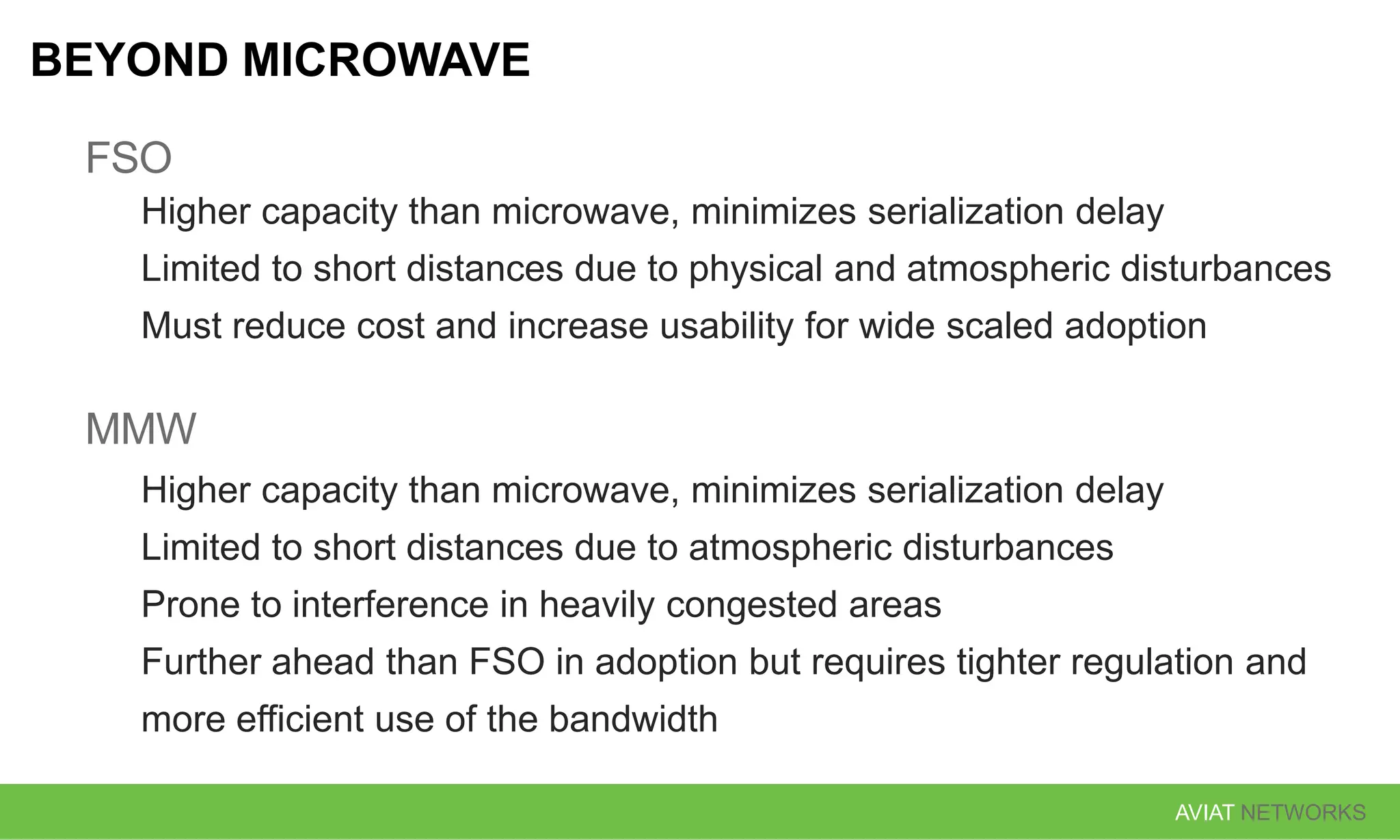
BEYOND MICROWAVE
FSO
Higher capacity than microwave, minimizes serialization delay
Limited to short distances due to physical and atmospheric disturbances
Must reduce cost and increase usability for wide scaled adoption
MMW
Higher capacity than microwave, minimizes serialization delay
Limited to short distances due to atmospheric disturbances
Prone to interference in heavily congested areas
Further ahead than FSO in adoption but requires tighter regulation and
more efficient use of the bandwidth
W W W . AV I AT N E T W O R K S . C O M

Low latency Microwave: Fact, Fiction & Future

  • 1.
  • 2.
    AVIAT NETWORKS MICROWAVE ISFASTER THAN FIBER AND IS QUICKLY BECOMING DEFACTO STANDARD FOR ULTRA LOW LATENCY TRANSPORT
  • 3.
    AVIAT NETWORKS Air Latencyis the dominant Factor Angular deviation comes at a high cost Regulatory Availability of licensed spectrum Infrastructure Equipment Operating Modes Repeaters and Regenerators Number of Hops Modem and RF Performance Equipment Latency LOW LATENCY MICROWAVE FACTS
  • 4.
    AVIAT NETWORKS Air Latencyis the dominant Factor Angular deviation comes at a high cost Regulatory Availability of licensed spectrum Infrastructure Equipment Operating Modes Repeaters and Regenerators Number of Hops Modem and RF Performance Equipment Latency Angular Deviation Increased Distance Increased Latency Percentage 5 Degrees 2.8 Miles 15.0 µs 0.38% 10 Degrees 11.3 Miles 60.5 µs 1.54% 15 Degrees 25.9 Miles 138.4 µs 3.53% 20 Degrees 47.2 Miles 251.8µs 6.42% Even with microwave working at the speed of light a less than ideal path will cause a significant latency penalty 735 Miles AIR LATENCY
  • 5.
    AVIAT NETWORKS REGULATORY We areall bound in our microwave designs and planning by the availability of licensed spectrum - Optimal frequency bands are scarce on primary routes - Channel sizes (bandwidth) and efficiency (bits per Hz) are regulated - Limitations to the total carrying capacity of the pipeline - Emission Masks and Interference Regulations - Power Control
  • 6.
    AVIAT NETWORKS REDUCE NUMBERAND COMPLEXITY OF THE HOPS INTRODUCTION OF THE REPEATER CONCEPT - Latency in Nx10 ns - RF Repeater - Limited RF Options - Mask Limitations - IF Repeater - Frequency Agile - Mask Limitations - Digital Repeater - Frequency Agile - Less Susceptible to Mask Limitations Regenerator Node Regenerator Node Repeater Node Repeater Node 30% reduction
  • 7.
    AVIAT NETWORKS Regenerator Node Repeater Node Repeater Node Regenerator Node Repeater Node Repeater Node Regenerator Node Repeater Node Repeater Node Regenerator Node Repeater Node Regenerator Node ADAPTIVE REPEATERTECHNOLOGY Ultra Low End-End Latency Low End-End Latency (still better than fiber) 99% of time 1% of time Continuous monitoring of the received signal quality
  • 8.
    AVIAT NETWORKS RF ANDMODEM PERFORMANCE WHERE DOES IT HELP? • Antenna Size • Number of Repeaters - FEC Coding - Rx Threshold - Higher Quality Oscillators Ultimately all revolves around having better System Gain !!! • Link Distance • Number of Hops • Link Availability TECHNIQUES INCLUDE: - Tx Power - Rx Sensitivity - Diversity
  • 9.
    AVIAT NETWORKS MODEM TECHNOLOGY ForwardError Correction Modulations and Bandwidths Diversity Protection Improves link availability and hence low latency availability Adaptive Modulation and Adaptive Coding  Latency Increase Phase noise reduction FEC Method Linear and Iterative Convolutional Codes Algorithm LPDC, Turbo Codes Viterbi Latency High Medium Block Codes No FEC Reed Solomon - - - Low* Lowest SG Imp. High Good* None Good BW 30 MHz 40 MHz Mod 16QAM 32QAM 50 MHz 128QAM 64QAM 256QAM QPSK                  
  • 10.
    AVIAT NETWORKS RF TECHNOLOGY IFPreprocessing Adaptive Predistortion Higher Output Power Clean LOs
  • 11.
    AVIAT NETWORKS QUANTIFY RF/ MODEM PERFORMANCE Example: Chicago rain zone, 99.999 Availability, 6 Ft Antenna, 64QAM Frequency Band 6 GHz 11 GHz Std System Gain 51.6 Miles 35.1 Miles +3dB 55.8 Miles 38.5 Miles
  • 12.
    AVIAT NETWORKS EQUIPMENT LATENCY PayloadInterface Interface Alternatives (Ethernet, L1 Interfaces, Proprietary) Switch Forwarding (Store and Forward, Early Packet Forwarding) Switch Buffering Serialization Delay Interface speed differentials force store and forward stages and buffering Modem Technology (Traditional) Scrambling / Descrambling Encoding / Decoding Interleaving / Deinterleaving Modulation / Demodulation Analog Front End Reduce or Eliminate
  • 13.
    AVIAT NETWORKS FICTION, MISCONCEPTIONSAND MYTHS Equipment latency is most important Focus in In and Out of the box latency Reduced Latency = Reduced Reliability Link Reliability Equipment Reliability High site count is OK if path is
  • 14.
    AVIAT NETWORKS EQUIPMENT LATENCY-THEMOST IMPORTANT FACTOR Equipment latency is important but not the most important factor Route design Path and Frequency planning Maximizing the number of repeaters RF / Modem performance Reduce the number of hops Improve link availability Equipment Latency End to end latency is the goal Optimal blend of above features  Lowest end to end latency + Highest availability ~3-20 µs Regenerator Node Repeater Node ~100-500 ns
  • 15.
    AVIAT NETWORKS LOW LATENCY= LOW LINK RELIABILITY To achieve low latency multiple modem aspects are sacrificed Coding gain Interleaving Reduced equalization Additional signal processing techniques Adaptive repeaters IF combining – Space Diversity Adaptive pre-distortion Combined Signal Main - Distorted Diversity -DistortedMultipath
  • 16.
    AVIAT NETWORKS LOW LATENCY= LOW EQUIPMENT RELIABILITY Low latency can be built on a field proven platform with very high MTBF
  • 17.
    AVIAT NETWORKS HIGH SITECOUNT IS OK IF PATH IS OPTIMAL Can be offset by having more repeaters Noise Accumulation Noise accumulates over a higher number of nodes Points of Failure Have more active elements in the network Operational Complexity More equipment to manage, troubleshoot (link and network) and maintain CAPEX + OPEX Initial spending, cost of leasing towers and maintenance
  • 18.
    AVIAT NETWORKS LOW LATENCYMICROWAVE FUTURE Lower Latency Increase number of repeaters Specialized Modems All outdoor radio repeaters Increased Capacity Multi-Carrier XPIC Channel Bonding Higher Modulations Beyond Microwave
  • 19.
    AVIAT NETWORKS LOWER LATENCY Increasenumber of repeaters Through Signal Processing techniques enhance the repeater operation Able to meet regulatory requirements over a larger number of repeaters Specialized modems Optimally combine ASIC and FPGA technologies Dual/Quad header modems to create repeaters Minimize transfer delay in the pipeline All outdoor radio repeaters Eliminate cable latency Place modem and RF on the tower
  • 20.
    AVIAT NETWORKS INCREASED CAPACITY Multi-carrier Outdoorbranching for up to 8 channels in a single antenna Use dual or quad header modems XPIC + Diversity Cross polar cancelling for lowest possible latency Regulatory requirements internationally – Efficient channel utilization (H & V) Channel bonding Create wider carriers by bonding 2 to 4 channels together Single RF for concatenated wide channel Higher Modulations Higher bits per Hz efficiencies using up to 1024 QAM Better signal processing in the modem and cleaner RF
  • 21.
    AVIAT NETWORKS BEYOND MICROWAVE FSO Highercapacity than microwave, minimizes serialization delay Limited to short distances due to physical and atmospheric disturbances Must reduce cost and increase usability for wide scaled adoption MMW Higher capacity than microwave, minimizes serialization delay Limited to short distances due to atmospheric disturbances Prone to interference in heavily congested areas Further ahead than FSO in adoption but requires tighter regulation and more efficient use of the bandwidth
  • 22.
    W W W. AV I AT N E T W O R K S . C O M