Outline
   Multiple access mechanisms
   Random access
   Controlled access
   Channelization


                                 1
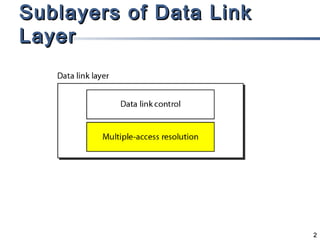
Sublayers of Data Link
Layer


                         2
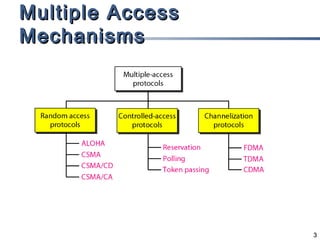
Multiple Access
Mechanisms


                  3
Random Access
Random Access
   Also called contention-based access
   No station is assigned to control another


                                                5
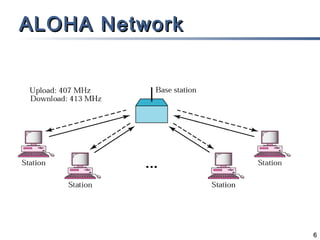
ALOHA Network


                6
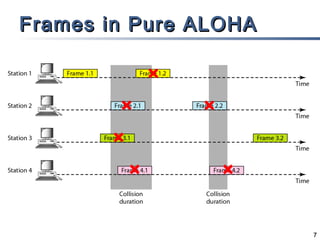
Frames in Pure ALOHA


                       7
ALOHA Protocol


                 8
Example
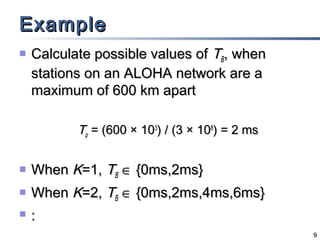
   Calculate possible values of TB, when
    stations on an ALOHA network are a
    maximum of 600 km apart

           Tp = (600 × 103) / (3 × 10⁸) = 2 ms

   When K=1, TB ∈ {0ms,2ms}
   When K=2, TB ∈ {0ms,2ms,4ms,6ms}
   :
                                                 9
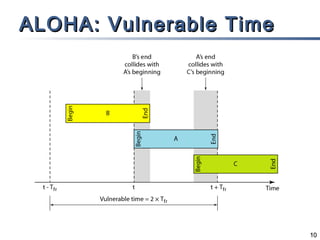
ALOHA: Vulnerable Time


                         10
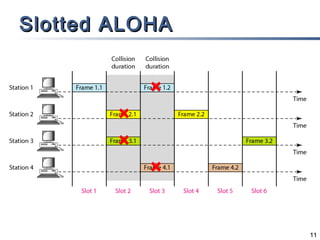
Slotted ALOHA


                11
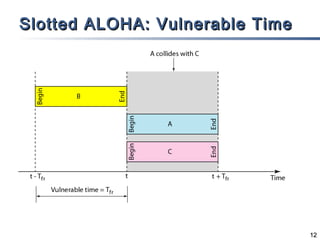
Slotted ALOHA: Vulnerable Time


                                 12
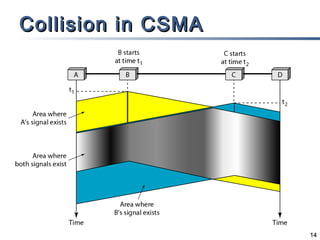
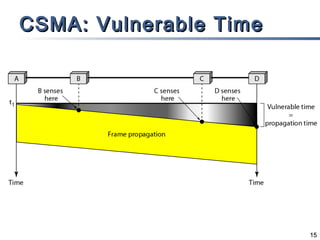
CSMA
   C arrier S ense M ultiple A ccess
       “Sense Before Transmit"
   Reduce the possibility of collision
       But cannot completely eliminate it


                                             13
Collision in CSMA


                    14
CSMA: Vulnerable Time


                        15
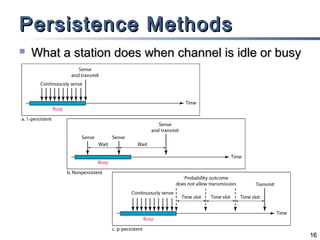
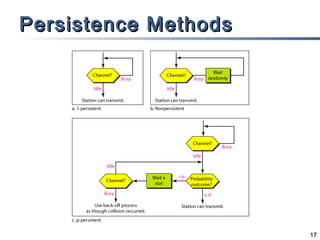
Persistence Methods
   What a station does when channel is idle or busy


                                                       16
Persistence Methods


                      17
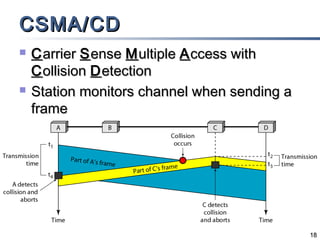
CSMA/CD
   C arrier S ense M ultiple A ccess with
    C ollision D etection
   Station monitors channel when sending a
    frame


                                              18
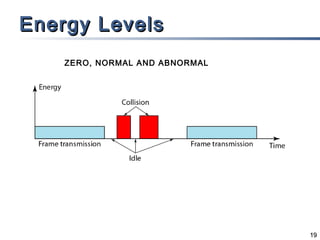
Energy Levels
    ZERO, NORMAL AND ABNORMAL


                                19
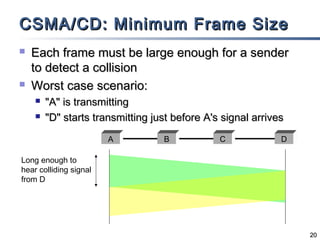
CSMA/CD: Minimum Frame Size
   Each frame must be large enough for a sender
    to detect a collision
   Worst case scenario:
       "A" is transmitting
       "D" starts transmitting just before A's signal arrives
                        A         B            C             D

Long enough to
hear colliding signal
from D


                                                                 20
Example
   A CSMA/CD network has a bandwidth of
    10 Mbps. If the maximum propagation
    time is 25.6 μs, what is the minimum size
    of the frame?


                                                21
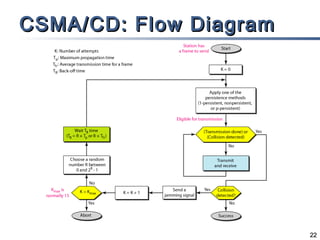
CSMA/CD: Flow Diagram


                        22
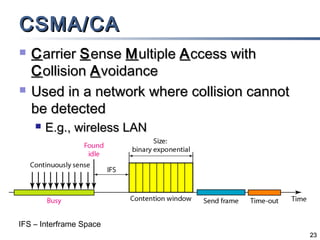
CSMA/CA
   C arrier S ense M ultiple A ccess with
    C ollision A voidance
   Used in a network where collision cannot
    be detected
       E.g., wireless LAN


IFS – Interframe Space
                                               23
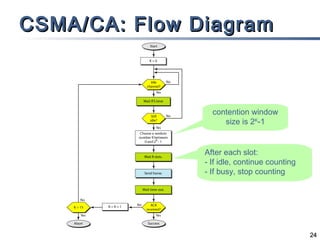
CSMA/CA: Flow Diagram


                 contention window
                    size is 2K-1


               After each slot:
               - If idle, continue counting
               - If busy, stop counting


                                              24

12 multiple access