COMPOSITE RESIN
DR. AGHOLOR CN
OUTLINE
• INTRODUCTION
• COMPONENTS
• CLASSIFICATION
• PROPERTIES
• GENERAL INDICATION AND CONTRAINDICATION
• CLINICAL TECHNIQUE
• ADVANTAGES/DISADVANTAGES
• RECENT ADVANCES
INTRODUCTION
A composite material is a product which consists
of at least two distinct phases normally formed
by blending together components having
different structures and properties to produce a
material having properties superior to those of
the individual constituents.
Resin composites are used to replace missing
tooth structure and modify tooth colour, thus
enhancing facial aesthetics and restoring
function.
COMPONENTS
Major components include;
•Resin matrix
• it is the chemically active component of the
composite.
• Initially a fluid monomer but is converted to a rigid
polymer by a radical addition polymerisation
reaction.
• Bis phenol-A-glycidyl methacrylate (BISGMA),
urethane dimethacrylate (UDMA) and tri-ethylene
glycol dimethacrylate (TEGDMA) are most
commonly used.
Filler particles
• The type, concentration, particle size and distribution
used in a composite material are major factors
controlling properties of the matrix material.
• Commonly used include quartz, silica,
aluminosilicates
Major benefits include
1. Reduction of polymerisation shrinkage.
2. Reduction of co-efficient of thermal expansion
3.Improves mechanical properties
4.Provides radio-opacity
5.Controls various aesthetics features
Coupling agents
• Bonds fillers to resin matrix.
• Organo-silanes are mostly used.
Other components include;
Initiator and activator:
Light cure: Initiator-camphoroquinone
Activator-blue light (460-480nm)
Chemical cure:Initiator-benzoyl peroxide
Activator –tertiary amine
Inhibitors;
Minimize or prevent spontaneous polymerisation. E.g.
Hydroquinone
•Pigments; added in small amounts to provide
shades that match the majority of tooth shades.
•Fuorides have also been added to composite
resins to prevent recurrent caries
Advocated because they are:
• Mercury-free
• Thermally nonconductive
• Match the shade of natural teeth
• Bond to tooth structure readily with use of
adhesive systems
CLASSIFICATION
Based on size amount and composition of
inorganic fillers
• Conventional composites(Macrofilled)
• Microfill composites
• Hybrid composites
Based according to the method of curing the organic
matrix
• Chemical cure
• Light cure
• Dual cure
Based on fabrication
• Direct composite
Packable composite
Flowable composite
Smart composite
• Indirect composite
• Fibre reinforced composite
• Sculpture/Fibrekor
• Art glass
• Cristobal
• belleglass
Conventional composites
Generally contain about 75-80% inorganic filler by
weight.
They typically exhibit a rough surface texture because
of their relatively large size and extreme hardness of
the fillers.
This causes the restoration to be more susceptible to
extrinsic staining.
.
Microfill composites
Introduced in the late 70s,they were designed to
replace the rough surface characteristics of
conventional composites with a smooth lustrous
surface similar to enamel thereby less receptive to
plaque and extrinsic staining.
Hybrid composites;
These materials generally have an inorganic filler
content of approximately 75-85% by weight.
The filler is a blend of microfiller and small filler
particle size that results in a considerably smaller
average size than conventional composites.
The physical and mechanical properties are
superior to conventional composites.
Recent Terminology
• Light-body composite resins: Flowable materials
that have low viscosity
• Medium-body composites: Comprised of the
microfill, hybrid and microhybrid universal
resins. Have a medium viscosity which allows
them to be placed and contoured with different
degrees of ease or difficulty depending on cavity
configuration
• Heavy-body: Packable posterior composite resin
PROPERTIES
• They have a thermal expansion similar to enamel this
reduces the less chances of voids or openings at the
junction of material and the tooth when temperature
changes occur.
• Materials with high filler content exhibit lower water
absorption values.
• Although quite good, their wear resistance is not as
good as amalgam.
• Surface texture; filler contents primarily determine
the smoothness of a restoration microfill give the
smoothest restorative surface
• Radio-opacity; most composite contain radioopaque
fillers such as barium glass. this helps to reveal the
radiolucent recurrent caries around or under a
restoration on radiograph.
• Modulus of elasticity; refers to stiffness of a material
the higher the modulus the more rigid and vice versa
microfilled composite restoration are more flexible
than the macrofill composites, better protecting the
interface.
Based on curingof organic matrix
chemical cured; supplied in two paste system-(base
and catalyst).
spatulation of both usually result incorporation of
air bubbles which weakens the composite resin
restoration rendering it more liable to staining
Light cured; supplied in one paste system.
it is placed directly into the prepared cavity.
The chances of air bubbles are minimised as it uses
visible light to enhance polymerisation
Dual cure & paste liquid system
• Paste contains the initiator while the liquid
contains the chemical activator and visible light
energy absorber.
• The dual cure system is useful for cementation of
composite resin inlays, ceramic labial veneers as
well as bridges.
Based on Fabrication
• Indirect composite:
• This type of composite is cured outside the mouth in
a processing unit that is capable of delivering higher
intensities and level of energy than handheld lights
can.
• They can have higher fillers levels and are cured for
longer times.
• They typically have better mechanical properties
Fibre reinforced composites (FRC)
These new emerging materials have highly favorable
mechanical properties, and their strength to weight
ratios are superior to those of most alloys.
They are non corrosive, translucent and have good
bonding properties ,ease of repair.
They are used for inlays/onlays, veneers, anterior and
posterior crowns,bridges.
E.g. Targis Vectris.
Fibrekor
• It is used in place of metal to reinforce single unit
and 3-unit bridge.
• Used for anterior and posterior crowns, full
coverage bridges, inlays and onlays.
•Art glass
• A completely new type of material.
• The parameters exceed those of conventional
composites and with its elastic properties, it
outperforms porcelain as well.
• It has hardness similar to enamel, flexible strength
and can be easily adjusted and repaired intra-orally.
Direct composite
• They are placed by dentist in a clinic setting and
polymerisation is accomplished typically with handheld
curing light that emits specific wavelengths.
• Packable Composites:
• Designed to be similar to amalgam.
• They were introduced in an attempt to address certain
issues such as shrinkage, wear and handling.
• They also offer the potential to obtain a better
proximal contact when packing them against a matrix
band.
• Flowable Composite:
• They have lower filler content and consequently
inferior physical properties.
• They exhibit much higher polymerization shrinkage
and should always be placed in thin layers.
• They are appropriate in small class I restorations, as
pit and fissure sealants, as marginal repair materials
or more frequently, as the first increment placed as a
liner under hybrid or packable composite.
Smart composite
• This class is regarded as an ion-releasing
composite material. It releases fluoride, hydroxyl
and calciumions as the pH drops in the area
immediately adjacent to the restorative material.
The fluoride release is less than that released in
GIC
GENERALINDICATIONS/CONTRA-
INDICATIONS
Indications
• Class I-VI restorations
• Fractured anterior teeth
• Foundations or core build-ups
• Sealants and preventive resin restorations
• Aesthetics enhancement procedures
• Temporary restorations
• Periodontal splinting
• Cervical lesion abrasion cavities
• Bonding of orthododontic brackets
Contraindications
• Bruxism/clenching
• Opposing porcelain
• Long span fixed partial dentures
• High caries rate
• Difficult moisture control
CLINICALTECHNIQUE
• Local anaesthesia
• Prophylaxis
• Shade selection
• Isolation of the operating site- use of rubber
dam
• Tooth preparation
• Pulpal protection
• Etching and bonding
• Dispensing
• Insertion- use of incremental techniques
• Polymerisation
• Contouring
• Finishing and polishing
• Etched enamel has an increased surface area over
non-etched enamel and a high surface energy, which
allows the resin to wet the surface and penetrate
into the micro-porosity of the tooth, where it
hardens.
 Interlocking is achieved by the penetration of these
resin “tags” into the substrate. The resin tags may
penetrate 10 to 20 micrometers into the enamel
porosity.
 Ideal acid-etching results are achieved with 37
percent phosphoric acid applied for a period of 15-
30seconds.
•
• Incremental technique:
• Horizontal technique: occlusogingival layering, for
small cavities, increases the C-factor.
PLACEMENT TECHNIQUES
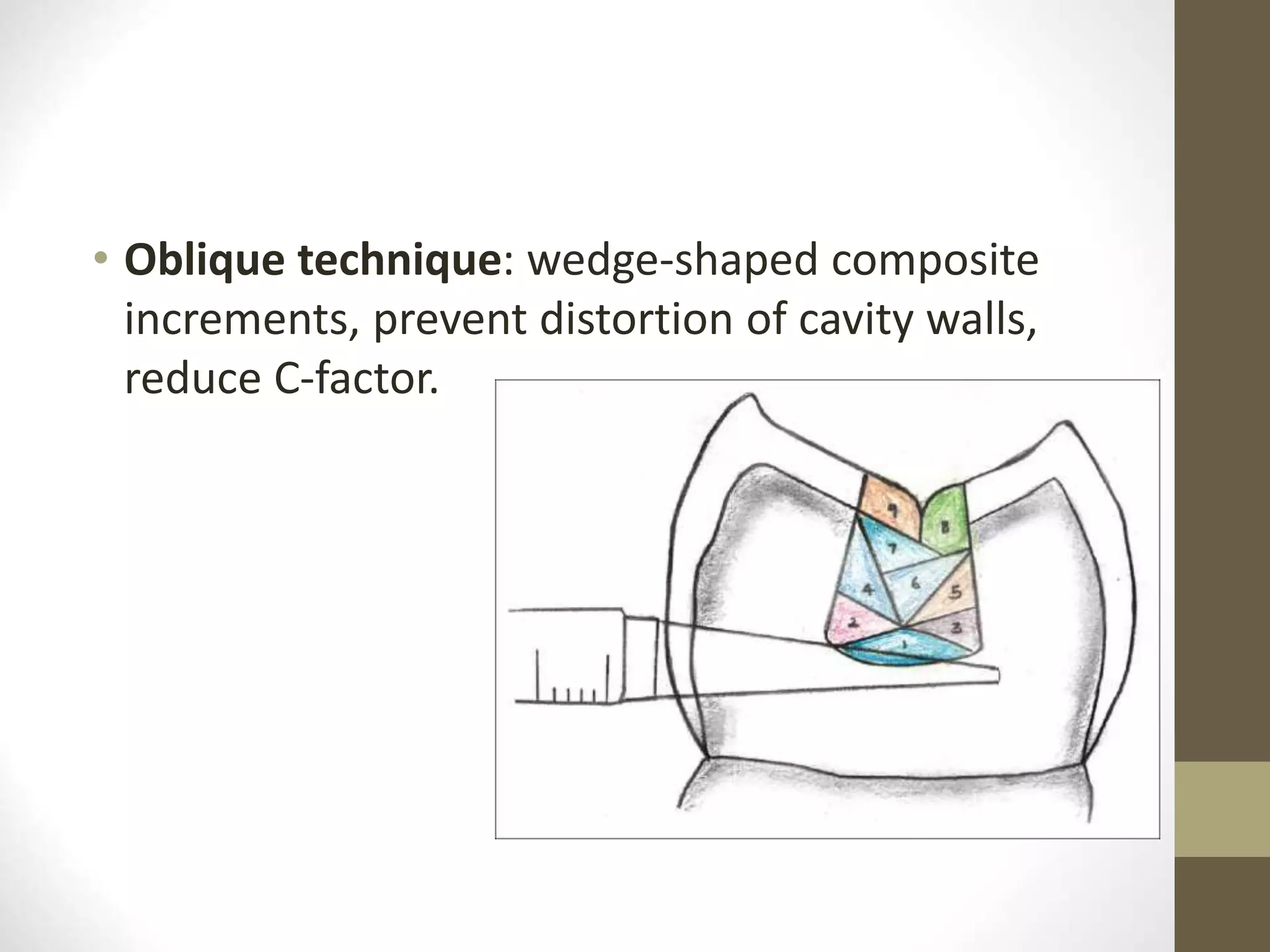
• Oblique technique: wedge-shaped composite
increments, prevent distortion of cavity walls,
reduce C-factor.
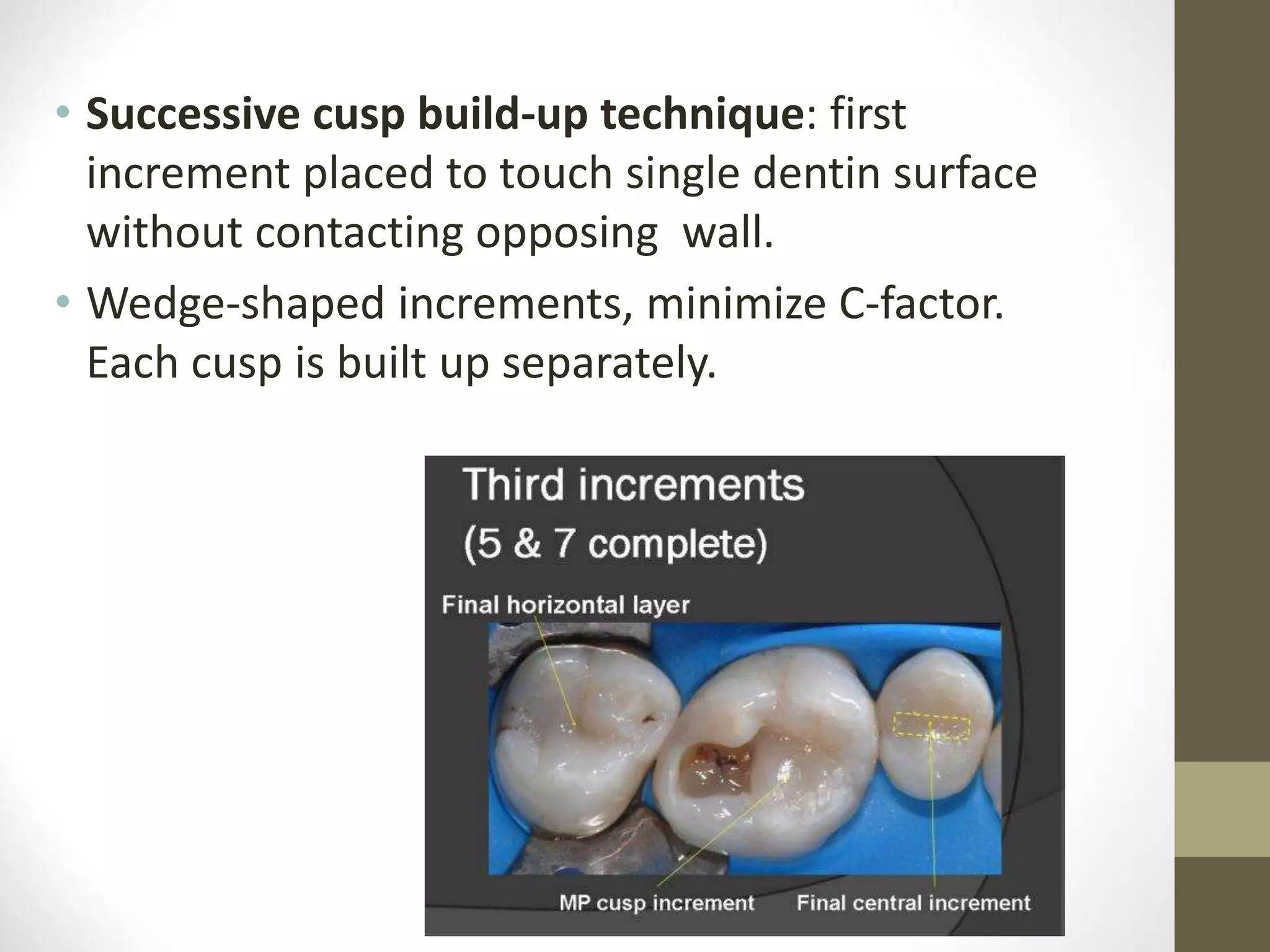
• Successive cusp build-up technique: first
increment placed to touch single dentin surface
without contacting opposing wall.
• Wedge-shaped increments, minimize C-factor.
Each cusp is built up separately.
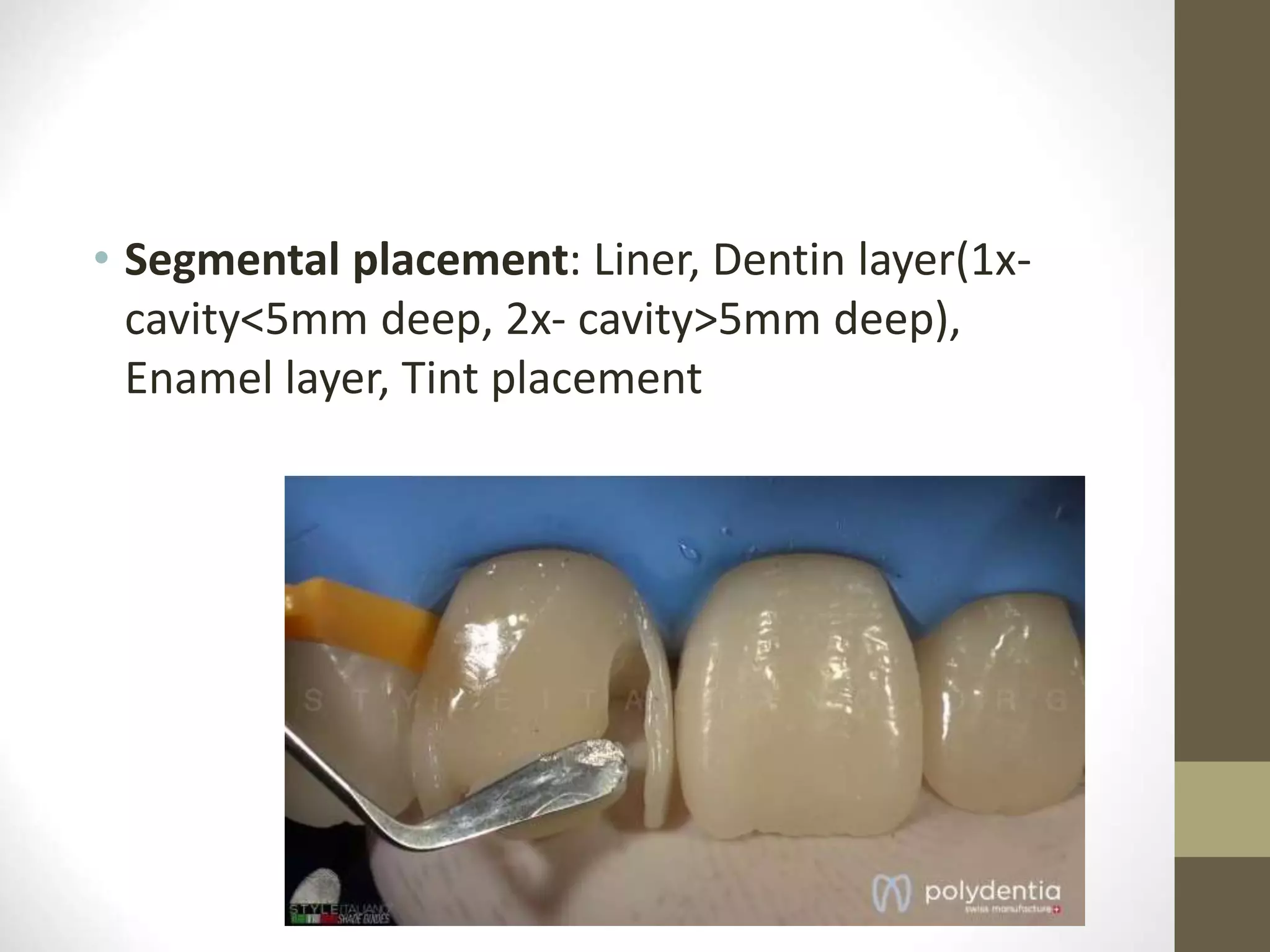
• Segmental placement: Liner, Dentin layer(1x-
cavity<5mm deep, 2x- cavity>5mm deep),
Enamel layer, Tint placement
? C-factor
• The C-factor depends on the cavity shape and plays an
essential role in determining the polymerization
shrinkage stresses in the setting composite resin.
• The C-factor is defined as the ratio of cavity bonded
surfaces to non-bonded surfaces
• The greater the number of bonded surfaces in contact
with the setting composite resin, the greater the C-
factor and consequently the greater the stresses at
these surfaces.
• Non-bonded surfaces allow the composite to
fow and reduce the stresses in the composite.
• The highest C-factor is obtained for Class I
composite restoration, while the lowest factor is
for “non-carious” Class V
• The materials are more technique sensitive than
amalgam
• Require more time for placement because
rubber dam isolation is needed for field control.
• A potential drawback to stiffer materials is their
limited ability to adapt to internal cavity wall
surfaces and to cavity margins.
Issues with Composite Restorations
• The presence of postoperative sensitivity may
indicate poor ability of the dentin adhesive combined
with the restorative material to adapt to internal
walls and seal the dentinal tubules.
• Fracture is a common reason for failure of posterior
composite restorations.
• The packing technique can introduce air bubbles into
a composite restoration made of packable composite
and may thus have a greater potential to fracture
than a restoration made of hybrid resin composite.
• Postoperative Pain
• Margin adaptation defects
• Secondary Caries
• Marginal discolouration
Reasons for Failure of Composite
Restorations
ADVANTAGES
• Aesthetically pleasing
• Conservative of tooth structure removal.
• Insulative ,having low thermal conductivity
• Used almost universally
• Bonded to tooth structure, resulting in good
retention, low micro leakage, minimal interfacial
staining, and increased strength of remaining
tooth structure.
• Repairable
DISADVANTAGES
• Are more difficult, time-consuming, and costly
• Are more technique sensitive because the
procedure demands proper technique
• May exhibit greater occlusal wear in areas of high
occlusal stress or when all tooth’s occlusal contacts
are on the composite material
• Micro leakages may occur if inadequate bonding
technique is used.
ADVANCEMENTS
• a) Ceromers
• b) Smart composites
• c) Ormocers
• d) Giomers
• e) Single crystal modified composites
• f) Nanocomposites
Conclusion
• To satisfy the growing aesthetic demands of today’s
dental patients, improvements in materials and
procedures have been made to make it possible to
reproduce the natural appearance of teeth
• Even though the resin-based restorative materials of
today are a vast improvement over what was
previously offered the placement of composite-based
resin restorations remain technique sensitive and
complex
• However, these materials provide patients with the
aesthetically acceptable restorations they seek.

COMPOSITE.ppt

  • 1.
  • 2.
    OUTLINE • INTRODUCTION • COMPONENTS •CLASSIFICATION • PROPERTIES • GENERAL INDICATION AND CONTRAINDICATION • CLINICAL TECHNIQUE • ADVANTAGES/DISADVANTAGES • RECENT ADVANCES
  • 3.
    INTRODUCTION A composite materialis a product which consists of at least two distinct phases normally formed by blending together components having different structures and properties to produce a material having properties superior to those of the individual constituents.
  • 4.
    Resin composites areused to replace missing tooth structure and modify tooth colour, thus enhancing facial aesthetics and restoring function.
  • 5.
    COMPONENTS Major components include; •Resinmatrix • it is the chemically active component of the composite. • Initially a fluid monomer but is converted to a rigid polymer by a radical addition polymerisation reaction. • Bis phenol-A-glycidyl methacrylate (BISGMA), urethane dimethacrylate (UDMA) and tri-ethylene glycol dimethacrylate (TEGDMA) are most commonly used.
  • 6.
    Filler particles • Thetype, concentration, particle size and distribution used in a composite material are major factors controlling properties of the matrix material. • Commonly used include quartz, silica, aluminosilicates Major benefits include 1. Reduction of polymerisation shrinkage. 2. Reduction of co-efficient of thermal expansion 3.Improves mechanical properties 4.Provides radio-opacity 5.Controls various aesthetics features
  • 7.
    Coupling agents • Bondsfillers to resin matrix. • Organo-silanes are mostly used.
  • 8.
    Other components include; Initiatorand activator: Light cure: Initiator-camphoroquinone Activator-blue light (460-480nm) Chemical cure:Initiator-benzoyl peroxide Activator –tertiary amine Inhibitors; Minimize or prevent spontaneous polymerisation. E.g. Hydroquinone
  • 9.
    •Pigments; added insmall amounts to provide shades that match the majority of tooth shades. •Fuorides have also been added to composite resins to prevent recurrent caries
  • 10.
    Advocated because theyare: • Mercury-free • Thermally nonconductive • Match the shade of natural teeth • Bond to tooth structure readily with use of adhesive systems
  • 11.
    CLASSIFICATION Based on sizeamount and composition of inorganic fillers • Conventional composites(Macrofilled) • Microfill composites • Hybrid composites
  • 12.
    Based according tothe method of curing the organic matrix • Chemical cure • Light cure • Dual cure
  • 13.
    Based on fabrication •Direct composite Packable composite Flowable composite Smart composite
  • 14.
    • Indirect composite •Fibre reinforced composite • Sculpture/Fibrekor • Art glass • Cristobal • belleglass
  • 15.
    Conventional composites Generally containabout 75-80% inorganic filler by weight. They typically exhibit a rough surface texture because of their relatively large size and extreme hardness of the fillers. This causes the restoration to be more susceptible to extrinsic staining. .
  • 16.
    Microfill composites Introduced inthe late 70s,they were designed to replace the rough surface characteristics of conventional composites with a smooth lustrous surface similar to enamel thereby less receptive to plaque and extrinsic staining.
  • 17.
    Hybrid composites; These materialsgenerally have an inorganic filler content of approximately 75-85% by weight. The filler is a blend of microfiller and small filler particle size that results in a considerably smaller average size than conventional composites. The physical and mechanical properties are superior to conventional composites.
  • 18.
    Recent Terminology • Light-bodycomposite resins: Flowable materials that have low viscosity • Medium-body composites: Comprised of the microfill, hybrid and microhybrid universal resins. Have a medium viscosity which allows them to be placed and contoured with different degrees of ease or difficulty depending on cavity configuration • Heavy-body: Packable posterior composite resin
  • 19.
    PROPERTIES • They havea thermal expansion similar to enamel this reduces the less chances of voids or openings at the junction of material and the tooth when temperature changes occur. • Materials with high filler content exhibit lower water absorption values. • Although quite good, their wear resistance is not as good as amalgam. • Surface texture; filler contents primarily determine the smoothness of a restoration microfill give the smoothest restorative surface
  • 20.
    • Radio-opacity; mostcomposite contain radioopaque fillers such as barium glass. this helps to reveal the radiolucent recurrent caries around or under a restoration on radiograph. • Modulus of elasticity; refers to stiffness of a material the higher the modulus the more rigid and vice versa microfilled composite restoration are more flexible than the macrofill composites, better protecting the interface.
  • 21.
    Based on curingoforganic matrix chemical cured; supplied in two paste system-(base and catalyst). spatulation of both usually result incorporation of air bubbles which weakens the composite resin restoration rendering it more liable to staining Light cured; supplied in one paste system. it is placed directly into the prepared cavity. The chances of air bubbles are minimised as it uses visible light to enhance polymerisation
  • 22.
    Dual cure &paste liquid system • Paste contains the initiator while the liquid contains the chemical activator and visible light energy absorber. • The dual cure system is useful for cementation of composite resin inlays, ceramic labial veneers as well as bridges.
  • 23.
    Based on Fabrication •Indirect composite: • This type of composite is cured outside the mouth in a processing unit that is capable of delivering higher intensities and level of energy than handheld lights can. • They can have higher fillers levels and are cured for longer times. • They typically have better mechanical properties
  • 24.
    Fibre reinforced composites(FRC) These new emerging materials have highly favorable mechanical properties, and their strength to weight ratios are superior to those of most alloys. They are non corrosive, translucent and have good bonding properties ,ease of repair. They are used for inlays/onlays, veneers, anterior and posterior crowns,bridges. E.g. Targis Vectris.
  • 25.
    Fibrekor • It isused in place of metal to reinforce single unit and 3-unit bridge. • Used for anterior and posterior crowns, full coverage bridges, inlays and onlays. •Art glass • A completely new type of material. • The parameters exceed those of conventional composites and with its elastic properties, it outperforms porcelain as well. • It has hardness similar to enamel, flexible strength and can be easily adjusted and repaired intra-orally.
  • 26.
    Direct composite • Theyare placed by dentist in a clinic setting and polymerisation is accomplished typically with handheld curing light that emits specific wavelengths. • Packable Composites: • Designed to be similar to amalgam. • They were introduced in an attempt to address certain issues such as shrinkage, wear and handling. • They also offer the potential to obtain a better proximal contact when packing them against a matrix band.
  • 27.
    • Flowable Composite: •They have lower filler content and consequently inferior physical properties. • They exhibit much higher polymerization shrinkage and should always be placed in thin layers. • They are appropriate in small class I restorations, as pit and fissure sealants, as marginal repair materials or more frequently, as the first increment placed as a liner under hybrid or packable composite.
  • 28.
    Smart composite • Thisclass is regarded as an ion-releasing composite material. It releases fluoride, hydroxyl and calciumions as the pH drops in the area immediately adjacent to the restorative material. The fluoride release is less than that released in GIC
  • 29.
    GENERALINDICATIONS/CONTRA- INDICATIONS Indications • Class I-VIrestorations • Fractured anterior teeth • Foundations or core build-ups • Sealants and preventive resin restorations • Aesthetics enhancement procedures • Temporary restorations • Periodontal splinting • Cervical lesion abrasion cavities • Bonding of orthododontic brackets
  • 30.
    Contraindications • Bruxism/clenching • Opposingporcelain • Long span fixed partial dentures • High caries rate • Difficult moisture control
  • 31.
    CLINICALTECHNIQUE • Local anaesthesia •Prophylaxis • Shade selection • Isolation of the operating site- use of rubber dam • Tooth preparation • Pulpal protection • Etching and bonding
  • 32.
    • Dispensing • Insertion-use of incremental techniques • Polymerisation • Contouring • Finishing and polishing
  • 33.
    • Etched enamelhas an increased surface area over non-etched enamel and a high surface energy, which allows the resin to wet the surface and penetrate into the micro-porosity of the tooth, where it hardens.  Interlocking is achieved by the penetration of these resin “tags” into the substrate. The resin tags may penetrate 10 to 20 micrometers into the enamel porosity.  Ideal acid-etching results are achieved with 37 percent phosphoric acid applied for a period of 15- 30seconds. •
  • 35.
    • Incremental technique: •Horizontal technique: occlusogingival layering, for small cavities, increases the C-factor. PLACEMENT TECHNIQUES
  • 36.
    • Oblique technique:wedge-shaped composite increments, prevent distortion of cavity walls, reduce C-factor.
  • 37.
    • Successive cuspbuild-up technique: first increment placed to touch single dentin surface without contacting opposing wall. • Wedge-shaped increments, minimize C-factor. Each cusp is built up separately.
  • 38.
    • Segmental placement:Liner, Dentin layer(1x- cavity<5mm deep, 2x- cavity>5mm deep), Enamel layer, Tint placement
  • 39.
    ? C-factor • TheC-factor depends on the cavity shape and plays an essential role in determining the polymerization shrinkage stresses in the setting composite resin. • The C-factor is defined as the ratio of cavity bonded surfaces to non-bonded surfaces • The greater the number of bonded surfaces in contact with the setting composite resin, the greater the C- factor and consequently the greater the stresses at these surfaces.
  • 40.
    • Non-bonded surfacesallow the composite to fow and reduce the stresses in the composite. • The highest C-factor is obtained for Class I composite restoration, while the lowest factor is for “non-carious” Class V
  • 41.
    • The materialsare more technique sensitive than amalgam • Require more time for placement because rubber dam isolation is needed for field control. • A potential drawback to stiffer materials is their limited ability to adapt to internal cavity wall surfaces and to cavity margins. Issues with Composite Restorations
  • 42.
    • The presenceof postoperative sensitivity may indicate poor ability of the dentin adhesive combined with the restorative material to adapt to internal walls and seal the dentinal tubules. • Fracture is a common reason for failure of posterior composite restorations. • The packing technique can introduce air bubbles into a composite restoration made of packable composite and may thus have a greater potential to fracture than a restoration made of hybrid resin composite.
  • 43.
    • Postoperative Pain •Margin adaptation defects • Secondary Caries • Marginal discolouration Reasons for Failure of Composite Restorations
  • 44.
    ADVANTAGES • Aesthetically pleasing •Conservative of tooth structure removal. • Insulative ,having low thermal conductivity • Used almost universally • Bonded to tooth structure, resulting in good retention, low micro leakage, minimal interfacial staining, and increased strength of remaining tooth structure. • Repairable
  • 45.
    DISADVANTAGES • Are moredifficult, time-consuming, and costly • Are more technique sensitive because the procedure demands proper technique • May exhibit greater occlusal wear in areas of high occlusal stress or when all tooth’s occlusal contacts are on the composite material • Micro leakages may occur if inadequate bonding technique is used.
  • 46.
    ADVANCEMENTS • a) Ceromers •b) Smart composites • c) Ormocers • d) Giomers • e) Single crystal modified composites • f) Nanocomposites
  • 47.
    Conclusion • To satisfythe growing aesthetic demands of today’s dental patients, improvements in materials and procedures have been made to make it possible to reproduce the natural appearance of teeth • Even though the resin-based restorative materials of today are a vast improvement over what was previously offered the placement of composite-based resin restorations remain technique sensitive and complex • However, these materials provide patients with the aesthetically acceptable restorations they seek.