20/04/2020 1
Dental Amalgam
Properties
Professor
Dr Tahir Ali Khan
Objective
 At the end the student will be able to
know
 The properties of amalgam
20/04/2020 2
20/04/2020 3
20/04/2020 4
Material-Related Variables
 Leakage
 Dimensional change
 Strength
 Corrosion
 Creep
 Thermal Properties
 Biological Properties
MICRO or Nano LEAKAGE
OCCURS DUE TO PENETRATION OF FLUIDS OR
DEBRIS AROUND THE MARGINS THAT CAN
LEAD TO RECUURENT/SECONDARY CARIES
AMALGAM HAS GOT A SELF SEALING
PROPERTY – CORROSION PRODUCT WILL FILL
THE TOOTH RESTORATION INTERFACE &
PREVENT LEAKAGE
20/04/2020 5
20/04/2020 6
MODERN AMALGAM ALWAYS SHOWS CONTRACTION
OLDER AMALGAM SHOWS EXPANSION
DIMENSIONAL CHANGES
CONTRACTION EXPANSION
20/04/2020 7
Dimensional Changes
Contraction or expansion depends on
Its manipulation
Ideally it should be small
Severe contraction can lead to
Micro leakage, plaque accumulation and recurrent/secondary caries
Dimensional Changes
Excessive expansion
Pressure on the pulp and post-operative
sensitivity, and protrusion of a restoration
ADA/ANSI Specification No.1 requires ± 20µm/cm measured
at 37Cº b/w 5 min and 24 hr after beginning of Trituration
with a device that is accurate to at least 0.5µm
20/04/2020 8
20/04/2020 9
Mixing of Alloy and Mercury Results in Contraction
The dissolution of particles begins and the Gamma 1 grows
Contraction continues as long as the growth of Gamma 1 phase
continues
As gamma 1 crystal grow, they impinge against one another
If condition appropriate, this impingement of Gamma 1 can
produce an outward pressure, tending to oppose the contraction
20/04/2020 10
Plastic matrix in case of sufficient mercury
Gamma 1 crystals impingement causes expansion
Once the matrix rigid matrix, growth of gamma 1 crystals cannot
force the matrix to expand
If sufficient mercury is present, net expansion will occur
20/04/2020 11
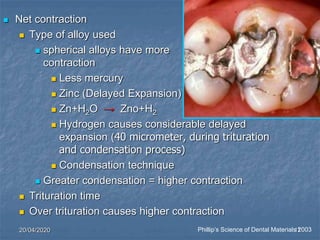
 Net contraction
 Type of alloy used
 spherical alloys have more
contraction
 Less mercury
 Zinc (Delayed Expansion)
 Zn+H2O → Zno+H2
 Hydrogen causes considerable delayed
expansion (40 micrometer, during trituration
and condensation process)
 Condensation technique
 Greater condensation = higher contraction
 Trituration time
 Over trituration causes higher contraction
Phillip’s Science of Dental Materials 2003
20/04/2020 12
Strength
Develops slowly
• 1 hr: 40 to 60% of maximum (50MPa)
• 24 hrs: 90% of maximum (300MPa)
Spherical alloys and Cu enriched alloy develop strength
more rapidly than conventional lathe cut alloy
Fine grain lathe cute alloys develop more rapidly than
coarse grain prodcts
• Require less mercury (Optimum Properties = 44 – 48% Hg)
Phillip’s Science of Dental Materials 2003
20/04/2020 13
Greater the condensation pressure the higher the strength (lathe
cut)
Condensation with lighter pressure produces adequate strength
(spherical alloy)
Higher compressive vs. tensile strength
20/04/2020 14
AMALGAM IS SRONGEST IN COMPRESSION &
MUCH WEAKER IN TENSION & SHEAR
THE PREPARD CAVITY DESIGN SHOULD MAXIMIZE THE
COMPRESSION FORCES IN SERVICE & MINIMIZE TENSION 
SHEAR FORCES
20/04/2020 15
Weak in thin sections
• Unsupported edges fracture
• Voids and porosity are possible factors influencing the
compressive strength
• In case of delayed condensation and under tritutation
The porosity will more and strength will be reduced
20/04/2020 16
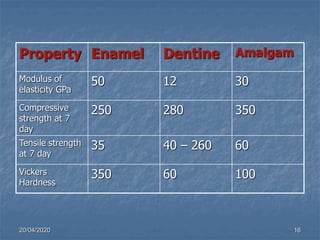
Property Enamel Dentine Amalgam
Modulus of
elasticity GPa
50 12 30
Compressive
strength at 7
day
250 280 350
Tensile strength
at 7 day
35 40 – 260 60
Vickers
Hardness
350 60 100
20/04/2020 17
Hardness of amalgam is lower than enamel
Surface hardness is 3 times lower than enamel
Appears to have adequate resistance to intra-oral abrasion
and rarely fails by this mechanism
20/04/2020 18
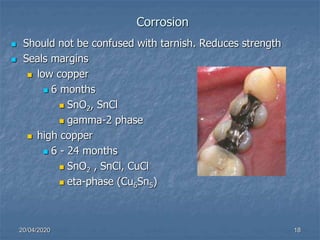
Corrosion
 Should not be confused with tarnish. Reduces strength
 Seals margins
 low copper
 6 months
 SnO2, SnCl
 gamma-2 phase
 high copper
 6 - 24 months
 SnO2 , SnCl, CuCl
 eta-phase (Cu6Sn5)
20/04/2020 19
 Why Dental amalgam behaves as a self sealing
restoration because
 SnO helps to seal the space against
microleakage (Along the margins)
 Electrochemical corrosion of high-copper
amalgams produce both Cu & Sn oxides &
oxychloride
20/04/2020 20
 The most electrochemically reactive is 2
phase, readily forms the anode in an
electrolytic cell
 The 2 phase breaks down
 Hg which may be able to combine with
unreacted alloy ( phase).
 Small quantity is inevitably ingested which
is of concern
20/04/2020 21
Creep or plastic deformation
DEFINED AS A TIME DEPENDENT PLASTIC DEFORMATION
UNDER CONSTANT STRESS.
ACCORDING TO ADA SPECIFICATION NO 1 CREEP SHOULD
BE BELOW 3%.
CREEP OF LOW Cu AMALGAM IS 0.8-8% & HIGH Cu IS 0.4-
1%.
20/04/2020 22
Amalgam undergoes a certain amount of creep when
subjected to dynamic intra-oral stresses
Creep causes the amalgam to flow, such that unsupported
amalgam protrudes from the margin of the cavity
These unsupported edges are weak and may be further
weakened by corrosion
20/04/2020 23
Fracture cause the formation of ditch around the margin of
amalgam restorations
Gamma 2 phase in case of low copper alloys is responsible for
the relatively high values of creep
High copper alloys got low creep values
20/04/2020 24
 Material type Creep %
 Convention amalgam alloy 2.5
 Admixed 0.2
 Copper enriched 0.6
containing 0.5 %
palladium
20/04/2020 25
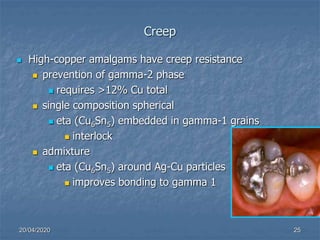
Creep
 High-copper amalgams have creep resistance
 prevention of gamma-2 phase
 requires >12% Cu total
 single composition spherical
 eta (Cu6Sn5) embedded in gamma-1 grains
 interlock
 admixture
 eta (Cu6Sn5) around Ag-Cu particles
 improves bonding to gamma 1
20/04/2020 26
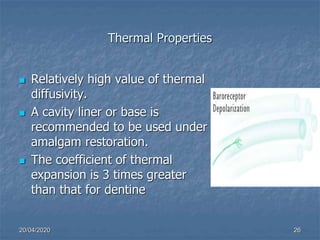
Thermal Properties
 Relatively high value of thermal
diffusivity.
 A cavity liner or base is
recommended to be used under
amalgam restoration.
 The coefficient of thermal
expansion is 3 times greater
than that for dentine
20/04/2020 27
Biological Properties
 2 aspects: on Patient and on Dentist & Auxiliary staff.
 Neurotoxicity
 Renal dysfunction
 Birth defects
 Reduce immunocompitence
 Compromised general health.
20/04/2020 28
20/04/2020 29
Thanks
20/04/2020 30
20/04/2020 31
20/04/2020 32

Dental amalgam properties

  • 1.
  • 2.
    Objective  At theend the student will be able to know  The properties of amalgam 20/04/2020 2
  • 3.
  • 4.
    20/04/2020 4 Material-Related Variables Leakage  Dimensional change  Strength  Corrosion  Creep  Thermal Properties  Biological Properties
  • 5.
    MICRO or NanoLEAKAGE OCCURS DUE TO PENETRATION OF FLUIDS OR DEBRIS AROUND THE MARGINS THAT CAN LEAD TO RECUURENT/SECONDARY CARIES AMALGAM HAS GOT A SELF SEALING PROPERTY – CORROSION PRODUCT WILL FILL THE TOOTH RESTORATION INTERFACE & PREVENT LEAKAGE 20/04/2020 5
  • 6.
    20/04/2020 6 MODERN AMALGAMALWAYS SHOWS CONTRACTION OLDER AMALGAM SHOWS EXPANSION DIMENSIONAL CHANGES CONTRACTION EXPANSION
  • 7.
    20/04/2020 7 Dimensional Changes Contractionor expansion depends on Its manipulation Ideally it should be small Severe contraction can lead to Micro leakage, plaque accumulation and recurrent/secondary caries
  • 8.
    Dimensional Changes Excessive expansion Pressureon the pulp and post-operative sensitivity, and protrusion of a restoration ADA/ANSI Specification No.1 requires ± 20µm/cm measured at 37Cº b/w 5 min and 24 hr after beginning of Trituration with a device that is accurate to at least 0.5µm 20/04/2020 8
  • 9.
    20/04/2020 9 Mixing ofAlloy and Mercury Results in Contraction The dissolution of particles begins and the Gamma 1 grows Contraction continues as long as the growth of Gamma 1 phase continues As gamma 1 crystal grow, they impinge against one another If condition appropriate, this impingement of Gamma 1 can produce an outward pressure, tending to oppose the contraction
  • 10.
    20/04/2020 10 Plastic matrixin case of sufficient mercury Gamma 1 crystals impingement causes expansion Once the matrix rigid matrix, growth of gamma 1 crystals cannot force the matrix to expand If sufficient mercury is present, net expansion will occur
  • 11.
    20/04/2020 11  Netcontraction  Type of alloy used  spherical alloys have more contraction  Less mercury  Zinc (Delayed Expansion)  Zn+H2O → Zno+H2  Hydrogen causes considerable delayed expansion (40 micrometer, during trituration and condensation process)  Condensation technique  Greater condensation = higher contraction  Trituration time  Over trituration causes higher contraction Phillip’s Science of Dental Materials 2003
  • 12.
    20/04/2020 12 Strength Develops slowly •1 hr: 40 to 60% of maximum (50MPa) • 24 hrs: 90% of maximum (300MPa) Spherical alloys and Cu enriched alloy develop strength more rapidly than conventional lathe cut alloy Fine grain lathe cute alloys develop more rapidly than coarse grain prodcts • Require less mercury (Optimum Properties = 44 – 48% Hg) Phillip’s Science of Dental Materials 2003
  • 13.
    20/04/2020 13 Greater thecondensation pressure the higher the strength (lathe cut) Condensation with lighter pressure produces adequate strength (spherical alloy) Higher compressive vs. tensile strength
  • 14.
    20/04/2020 14 AMALGAM ISSRONGEST IN COMPRESSION & MUCH WEAKER IN TENSION & SHEAR THE PREPARD CAVITY DESIGN SHOULD MAXIMIZE THE COMPRESSION FORCES IN SERVICE & MINIMIZE TENSION SHEAR FORCES
  • 15.
    20/04/2020 15 Weak inthin sections • Unsupported edges fracture • Voids and porosity are possible factors influencing the compressive strength • In case of delayed condensation and under tritutation The porosity will more and strength will be reduced
  • 16.
    20/04/2020 16 Property EnamelDentine Amalgam Modulus of elasticity GPa 50 12 30 Compressive strength at 7 day 250 280 350 Tensile strength at 7 day 35 40 – 260 60 Vickers Hardness 350 60 100
  • 17.
    20/04/2020 17 Hardness ofamalgam is lower than enamel Surface hardness is 3 times lower than enamel Appears to have adequate resistance to intra-oral abrasion and rarely fails by this mechanism
  • 18.
    20/04/2020 18 Corrosion  Shouldnot be confused with tarnish. Reduces strength  Seals margins  low copper  6 months  SnO2, SnCl  gamma-2 phase  high copper  6 - 24 months  SnO2 , SnCl, CuCl  eta-phase (Cu6Sn5)
  • 19.
    20/04/2020 19  WhyDental amalgam behaves as a self sealing restoration because  SnO helps to seal the space against microleakage (Along the margins)  Electrochemical corrosion of high-copper amalgams produce both Cu & Sn oxides & oxychloride
  • 20.
    20/04/2020 20  Themost electrochemically reactive is 2 phase, readily forms the anode in an electrolytic cell  The 2 phase breaks down  Hg which may be able to combine with unreacted alloy ( phase).  Small quantity is inevitably ingested which is of concern
  • 21.
    20/04/2020 21 Creep orplastic deformation DEFINED AS A TIME DEPENDENT PLASTIC DEFORMATION UNDER CONSTANT STRESS. ACCORDING TO ADA SPECIFICATION NO 1 CREEP SHOULD BE BELOW 3%. CREEP OF LOW Cu AMALGAM IS 0.8-8% & HIGH Cu IS 0.4- 1%.
  • 22.
    20/04/2020 22 Amalgam undergoesa certain amount of creep when subjected to dynamic intra-oral stresses Creep causes the amalgam to flow, such that unsupported amalgam protrudes from the margin of the cavity These unsupported edges are weak and may be further weakened by corrosion
  • 23.
    20/04/2020 23 Fracture causethe formation of ditch around the margin of amalgam restorations Gamma 2 phase in case of low copper alloys is responsible for the relatively high values of creep High copper alloys got low creep values
  • 24.
    20/04/2020 24  Materialtype Creep %  Convention amalgam alloy 2.5  Admixed 0.2  Copper enriched 0.6 containing 0.5 % palladium
  • 25.
    20/04/2020 25 Creep  High-copperamalgams have creep resistance  prevention of gamma-2 phase  requires >12% Cu total  single composition spherical  eta (Cu6Sn5) embedded in gamma-1 grains  interlock  admixture  eta (Cu6Sn5) around Ag-Cu particles  improves bonding to gamma 1
  • 26.
    20/04/2020 26 Thermal Properties Relatively high value of thermal diffusivity.  A cavity liner or base is recommended to be used under amalgam restoration.  The coefficient of thermal expansion is 3 times greater than that for dentine
  • 27.
    20/04/2020 27 Biological Properties 2 aspects: on Patient and on Dentist & Auxiliary staff.  Neurotoxicity  Renal dysfunction  Birth defects  Reduce immunocompitence  Compromised general health.
  • 28.
  • 29.
  • 30.
  • 31.
  • 32.

Editor's Notes

  • #9 Excessive expansion can produce
  • #10 Mixing of Alloy and Mercury Results in Contraction
  • #11 If sufficient mercury present to provide a plastic matrix, Expansion will occur when gamma 1 crystals impinge upon one another After a rigid matrix formation, growth of gamma 1 crystals cannot force the matrix to expand If sufficient mercury is present, expansion will occur otherwise contraction will occur
  • #12 3-5 days then for maximum upto 6 months, 40micrometer delayed expansion. This is due to moisture contamination during trituration and condensation process.
  • #19 (Amalgam readily tarnish due to the formation of sulphide layer on surface) TARNISH & CORROSION Undergoes Chemical & Electrochemical corrosion Chemical corrosion results in formation of surface Silver sulfide layer Electrochemical corrosion – Galvanic, Crevice & Stress Corrosion The most common corrosion products of traditional amalgam alloys are oxides & oxychlorides of tin
  • #21 The 2 phase of conventional amalgam is the most electrochemically reactive and readily forms the anode in an electrolytic cell. The 2 phase breaks down to give tin containing corrosion products and Hg which may be able to combine with unreacted alloy ( phase). Not all Hg is formed during corrosion is able to combine rapidly with unreacted alloy and small quantity is inevitably ingested which is of concern.