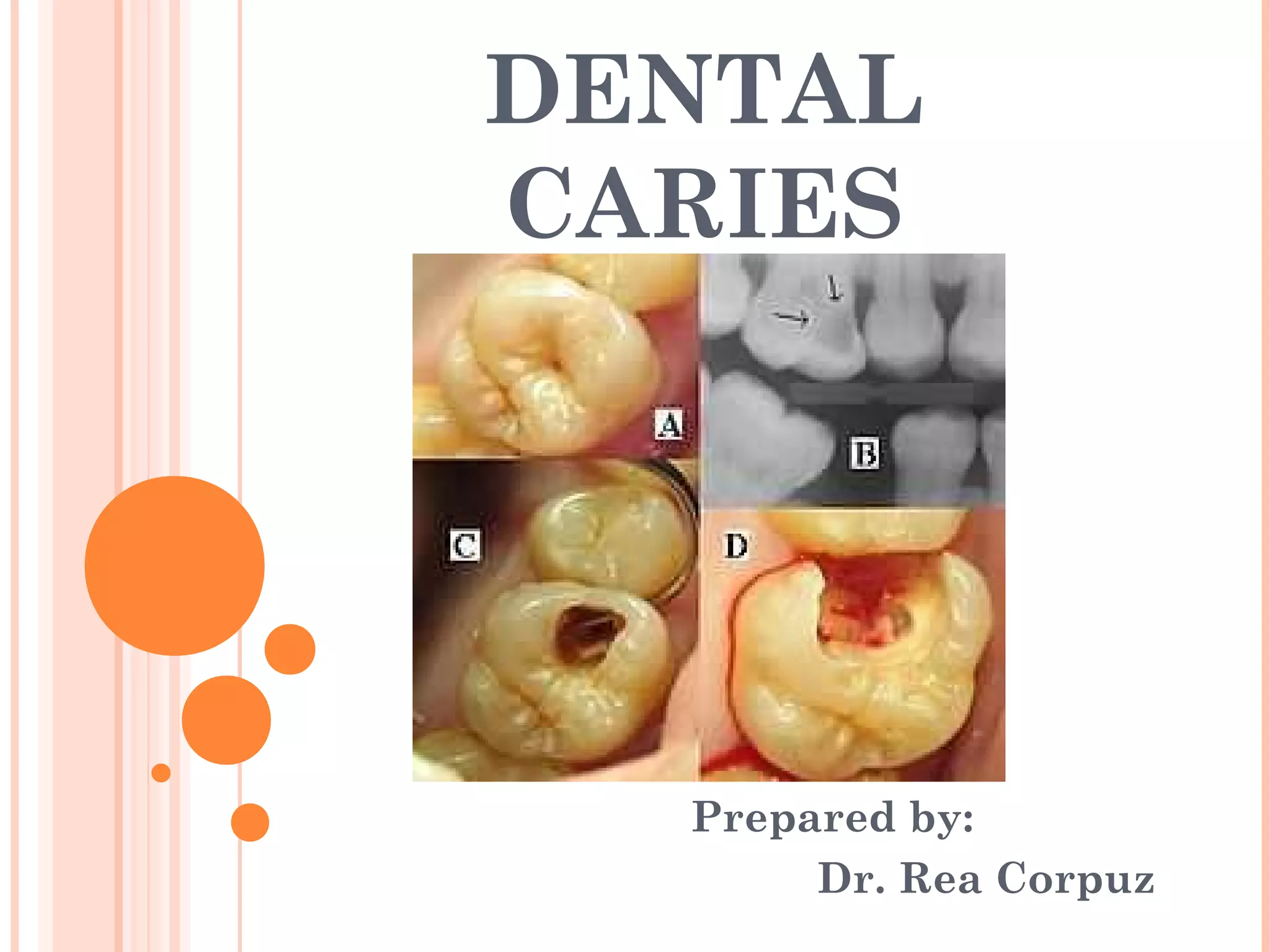
DENTAL
CARIES


  Prepared by:
       Dr. Rea Corpuz
Dental Caries

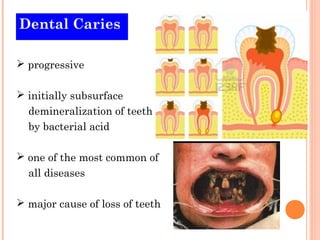
 progressive

 initially subsurface
  demineralization of teeth
  by bacterial acid

 one of the most common of
  all diseases

 major cause of loss of teeth
Dental Caries

 may be considered a
  disease of modern
  civilization

 since prehistoric man
  rarely suffered from
  this form of tooth
Dental Caries

 biological process of tooth
  decay with mutifactorial
  etiology

 microbial disease of calcified
  tissues of teeth

 characterized by demineralization
  of inorganic portion

 destruction of organic substance
  of tooth
Etiology of Dental Caries

 generally agreed to be
  complex problem

 complicated by many
  indirect factors

 obscure the direct cause
  or causes
Etiology of Dental Caries
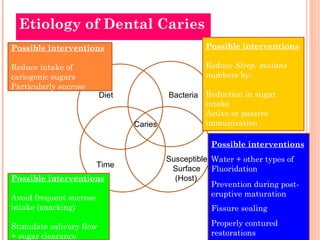
Possible interventions                              Possible interventions

Reduce intake of                                    Reduce Strep. mutans
cariogenic sugars                                   numbers by:
Particularly sucrose
                          Diet            Bacteria Reduction in sugar
                                                   intake
                                                   Active or passive
                                 Caries            immunization

                                                     Possible interventions
                                          Susceptible Water + other types of
                         Time              Surface Fluoridation
Possible interventions                      (Host)
                                                      Prevention during post-
Avoid frequent sucrose                                eruptive maturation
intake (snacking)                                    Fissure sealing

Stimulate salivary flow                              Properly contured
+ sugar clearance                                    restorations
Etiology of Dental Caries


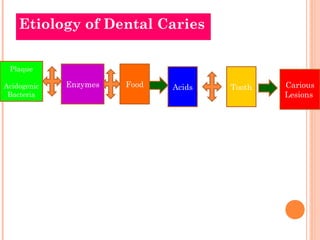
 Plaque

Acidogenic   Enzymes   Food   Acids   Tooth   Carious
 Bacteria                                     Lesions
Etiology of Dental Caries

 Old Theories

   Exogenous Theories

     • (1) Legend of worm
     • (2) Chemical Theory
     • (3) Parasitic or Septic Theory
Etiology of Dental Caries

 Old Theories

   Endogenous Theories

     • (1) Humoral Theory
     • (2) Vital Theory
Etiology of Dental Caries

 New Theories

   (1) Acidogenic Theory
   (2) Proteolytic Theory
   (3) Proteolysis-chelation Theory
Old Theories
(Exogenous Theory)
 (1) Legend of Worm

   5000 BC

   ancient Sumerian text

   obtained from Mesopotamian
    area
   caused by worm that drank
    blood of teeth

   fed on roots of jaws
Old Theories
(Exogenous Theory)
 (2) Chemical Theory

    1819

    proposed by Parmly

    unidentified chemical
     agent

    responsible for caries
Old Theories
(Exogenous Theory)
 (2) Chemical Theory

    stated that caries began
     on enamel surface where
     food putrefied

    acquired sufficient dissolving
     power to produce disease
     chemically
Old Theories
(Exogenous Theory)
 (3) Parasitic or Septic
      Theory

    1843

    proposed by Erdl

    filamentous parasite in
     plaque

      • he termed as “Denticolae”
      • responsible for dental caries
Old Theories
(Endogenous Theory)
 (1) Humoral Theory

   4 humors of body
     • blood
     • phelgm
     • black bile
     • yellow bile

   any change in relative
     proportion of these elements
     causes disease
Old Theories
(Endogenous Theory)
 (2) Vital Theory

    18 century

    tooth decay originated
     like bone gangrene, from
     within the tooth itself
New Theories
Old Theories
(Exogenous Theory)
 (1) Acidogenic/Chemoparasitic
     Theory

    1890

    WD Miller

    dental decay is a chemoparasitic
     process consisting of 2 stages

      • decalcification of enamel
           results in total
            destruction
New Theories
Old Theories
(Exogenous Theory)
 (1) Acidogenic/Chemoparasitic
     Theory

      • decalcification of dentin
       as a preliminary stage

          followed by dissolution
           of softened residue
New Theories
Old Theories
(Exogenous Theory)
 (1) Acidogenic/Chemoparasitic
     Theory

       following factors cause
        decay:

         • (1) Role of carbohydrates
         • (2) Role of microorganisms
         • (3) Role of acids
         • (4) Role of dental plaque
(1)Acidogenic/
Old Theories
Chemoparasitic Theory
 (1) Role of carbohydrates

    food substances act as
     substrate for microorganisms
     of dental plaque

    various carbohydrates have
     been examined for cariogenic
     potential
(1)Acidogenic/
Old Theories
Chemoparasitic Theory
 (1) Role of carbohydrates

    cariogenicity of carbohydrate
     varies with:

      • (1) frequency of ingestion
      • (2) physical form
      • (3) chemical composition
      • (4) route of administration
      • (5) presence of other food
           constituents
(1)Acidogenic/
Old Theories
Chemoparasitic Theory
 (1) Role of carbohydrates

      • (1) frequency of ingestion

          taken repeatedly in
           between two major
           meals

          provides constant supply
           of carbohydrate to plaque
           bacteria for fermentation +
           production of acids
(1)Acidogenic/
Old Theories
Chemoparasitic Theory
 (1) Role of carbohydrates

      • (2) physical form

          sticky

          solid carbohydrates
(1)Acidogenic/
Old Theories
Chemoparasitic Theory
 (1) Role of carbohydrates

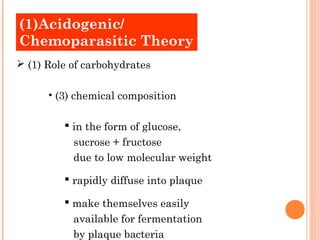
      • (3) chemical composition

          in the form of glucose,
           sucrose + fructose
           due to low molecular weight

          rapidly diffuse into plaque

          make themselves easily
           available for fermentation
           by plaque bacteria
(1)Acidogenic/
Chemoparasitic Theory
 (1) Role of carbohydrates

      • (4) Route of administration

          oral intake of sticky
           food
(1)Acidogenic/
Chemoparasitic Theory
 (1) Role of carbohydrates

      • (5) Presence of other food
           constituents

          refined pure carbohydrates
           more caries producing
(1)Acidogenic/
Chemoparasitic Theory
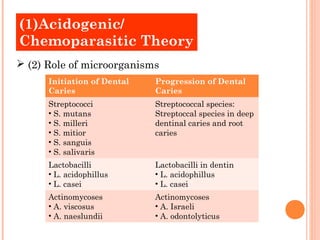
 (2) Role of microorganisms

    caused by acid resulting from
     action of microorganisms
     on carbohydrates
(1)Acidogenic/
Chemoparasitic Theory
 (2) Role of microorganisms
      Initiation of Dental   Progression of Dental
      Caries                 Caries
      Streptococci           Streptococcal species:
      • S. mutans            Streptoccal species in deep
      • S. milleri           dentinal caries and root
      • S. mitior            caries
      • S. sanguis
      • S. salivaris
      Lactobacilli           Lactobacilli in dentin
      • L. acidophillus      • L. acidophillus
      • L. casei             • L. casei
      Actinomycoses          Actinomycoses
      • A. viscosus          • A. Israeli
      • A. naeslundii        • A. odontolyticus
(1)Acidogenic/
Chemoparasitic Theory
 (2) Role of microorganisms

    S. mutans has been proved
     for the initiation of caries
(1)Acidogenic/
Chemoparasitic Theory
 (3) Role of acids

    play most important role
     in pathogenesis of dental
     caries

    pH 5.5 is called critical pH

    below this pH demineralization
     of tooth substance begins
(1)Acidogenic/
Chemoparasitic Theory
 (4) Role of Dental Plaque

    found on uncleaned tooth
     surfaces

    appear as tenacious, thin
     film

    may accumulate within 24-48
     hours
New Theories
Old Theories
(Exogenous Theory)
 (2) Proteolytic Theory

    proteolysis of the organic
     components of tooth
     as an initial process

    than actual demineralization
     + dissolution of inorganic
     substances
New Theories
Old Theories
(Exogenous Theory)
 (2) Proteolytic Theory

    proposed that enamel
     lamellae or rod sheath
     (proteins) may be lysed

    which means proteolysis
     as first event in further
     progression of bacterial
     invasion + demineralization
     carious lesions
New Theories
Old Theories
(Exogenous Theory)
 (3) Proteolysis Chelation Theory

    suggests that caries is
     caused by simultaneous
     events of proteolysis +
     chelation

    proteolysis
      • destruction of organic
        portion of tooth by
        proteolytic microorganisms
New Theories
Old Theories
(Exogenous Theory)
 (3) Proteolysis Chelation Theory

    chelation

      •removal of calcium by
        forming soluble chelates

    oral bacteria attack organic
     component of enamel (proteolysis)

    breakdown products have chelating
     ability and this dissolves tooth minerals
Classification
Old Theories

 (1) Depending on nature of attack

 (2) Depending on progression of
      caries

 (3) Depending on surfaces involved

 (4) Based on direction of attack

 (5) Based on number of surfaces involved
Classification
Old Theories

 (6) GV Black Classification
      based on treatment and
      restoration design

 (7) Based on location of lesion

 (8) Based on tissue involved
(1) Nature of
Old Theories Attack

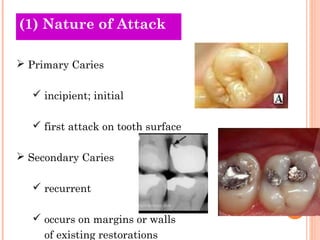
 Primary Caries

   incipient; initial

   first attack on tooth surface

 Secondary Caries

   recurrent

   occurs on margins or walls
     of existing restorations
(2) Progression of Caries
Old Theories

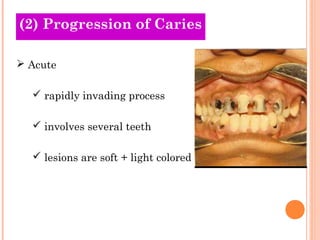
 Acute

   rapidly invading process

   involves several teeth

   lesions are soft + light colored
(2) Progression of Caries
Old Theories

 Acute

   usually pulp is involved
    at early stage

     • Rampant caries
     • Nursing bottle caries
     • Radiation caries
(2) Progression of Caries
Old Theories

 Chronic

   lesions are long standing

   fewer in number
(3) Surfaces involved
Old Theories

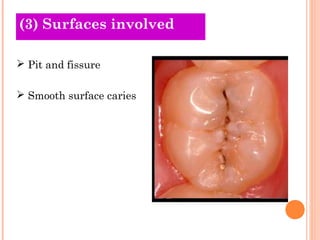
 Pit and fissure

 Smooth surface caries
(4) Direction
Old Theories of caries
   attack
 Forward Caries

   proceeds from enamel
     to dentin

   lesion is triangle in shaped
     with base of triangle at enamel
     surface + apex towards
     dentin

   in pits + fissures base is at DEJ
     + apex is in the pit
(4) Direction
Old Theories of caries
   attack
 Backward Caries

   proceeds from DEJ towards
    enamel surface

   also triangle shaped with
    base at DEJ + apex towards
    enamel surface
(5) Number of
Old Theories Surfaces
    involved
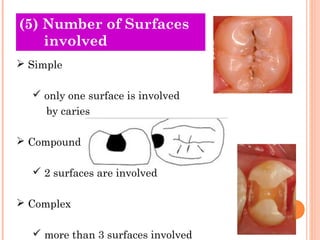
 Simple

   only one surface is involved
     by caries

 Compound

   2 surfaces are involved

 Complex

   more than 3 surfaces involved
(6) GV Black
Old Theories Classification

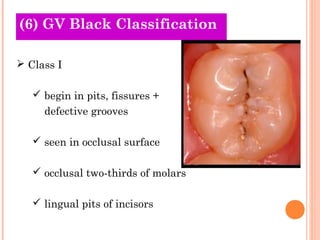
 Class I

    begin in pits, fissures +
     defective grooves

    seen in occlusal surface

    occlusal two-thirds of molars

    lingual pits of incisors
(6) GV Black
Old Theories Classification

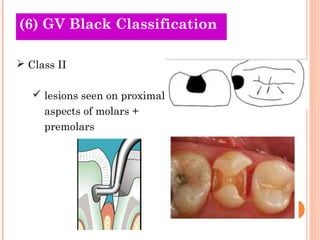
 Class II

    lesions seen on proximal
     aspects of molars +
     premolars
(6) GV Black
Old Theories Classification

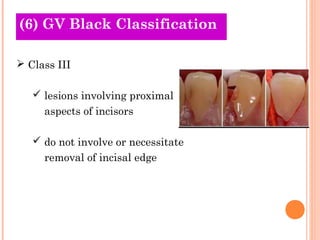
 Class III

    lesions involving proximal
     aspects of incisors

    do not involve or necessitate
     removal of incisal edge
(6) GV Black
Old Theories Classification

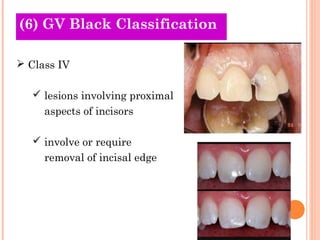
 Class IV

    lesions involving proximal
     aspects of incisors

    involve or require
     removal of incisal edge
(6) GV Black
Old Theories Classification

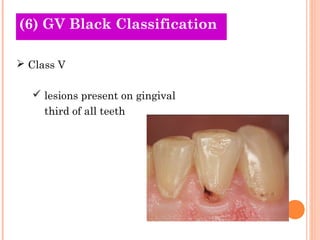
 Class V

   lesions present on gingival
     third of all teeth
(6) GV Black
Old Theories Classification

 Class VI

    lesions found on incisal
     edges + cusp tips
(7) Location
Old Theoriesof the lesion

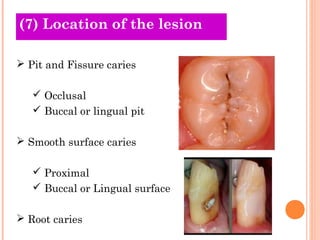
 Pit and Fissure caries

    Occlusal
    Buccal or lingual pit

 Smooth surface caries

    Proximal
    Buccal or Lingual surface

 Root caries
(8) Tissue involved
Old Theories

 Enamel Caries

 Dentinal Caries

 Cemental Caries
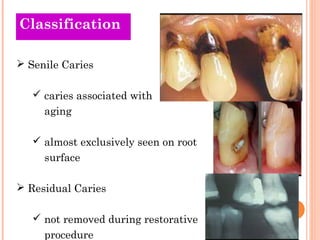
Classification

 Senile Caries

    caries associated with
     aging

    almost exclusively seen on root
     surface

 Residual Caries

    not removed during restorative
     procedure
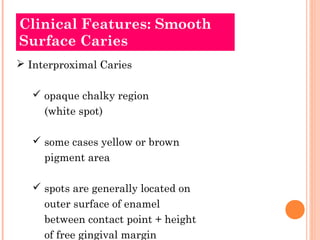
Clinical Features: Smooth
Surface Caries
 Interproximal Caries

    opaque chalky region
     (white spot)

    some cases yellow or brown
     pigment area

    spots are generally located on
     outer surface of enamel
     between contact point + height
     of free gingival margin
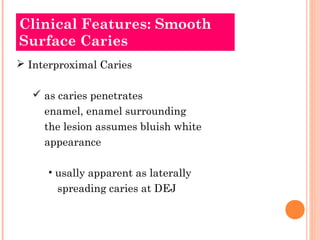
Clinical Features: Smooth
Surface Caries
 Interproximal Caries

    as caries penetrates
     enamel, enamel surrounding
     the lesion assumes bluish white
     appearance

      • usally apparent as laterally
       spreading caries at DEJ
Clinical Features: Smooth
Surface Caries
 Interproximal Caries

    common for proximal
     caries to extend both
     bucally + lingually
Cervical, Buccal, Lingual or
Palatal Caries
 Clinical Features:

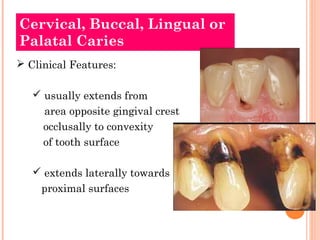
    usually extends from
     area opposite gingival crest
     occlusally to convexity
     of tooth surface

    extends laterally towards
     proximal surfaces
Cervical, Buccal, Lingual or
Palatal Caries
 Clinical Features:

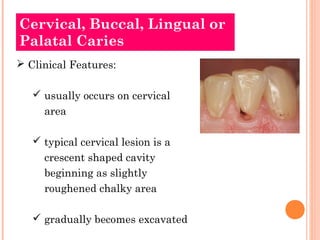
    usually occurs on cervical
     area

    typical cervical lesion is a
     crescent shaped cavity
     beginning as slightly
     roughened chalky area

    gradually becomes excavated
Pit and Fissure Caries

 Clinical Features:

    appears brown or black

    feel slightly soft

    catch a fine explorer point
Pit and Fissure Caries

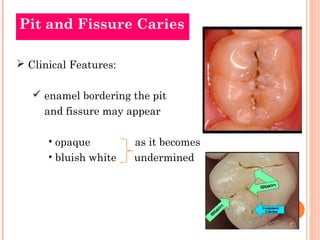
 Clinical Features:

    enamel bordering the pit
     and fissure may appear

      • opaque         as it becomes
      • bluish white   undermined
Pit and Fissure Caries

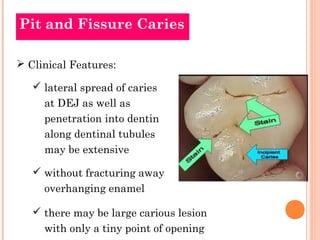
 Clinical Features:

    lateral spread of caries
     at DEJ as well as
     penetration into dentin
     along dentinal tubules
     may be extensive

    without fracturing away
     overhanging enamel

    there may be large carious lesion
     with only a tiny point of opening
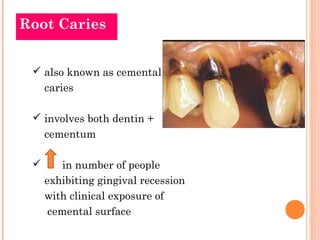
Root Caries


  also known as cemental
     caries

  involves both dentin +
     cementum

        in number of people
     exhibiting gingival recession
     with clinical exposure of
      cemental surface
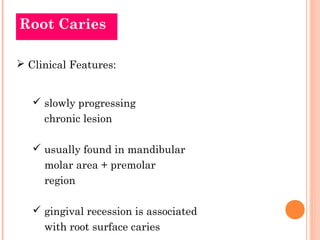
Root Caries

 Clinical Features:


    slowly progressing
     chronic lesion

    usually found in mandibular
     molar area + premolar
     region

    gingival recession is associated
     with root surface caries
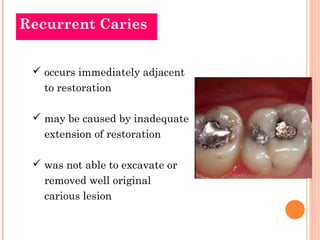
Recurrent Caries


  occurs immediately adjacent
   to restoration

  may be caused by inadequate
   extension of restoration

  was not able to excavate or
   removed well original
   carious lesion
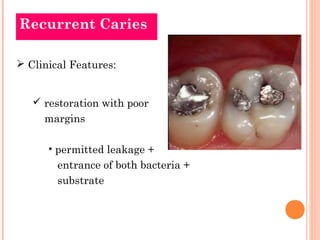
Recurrent Caries

 Clinical Features:


    restoration with poor
     margins

      • permitted leakage +
        entrance of both bacteria +
        substrate
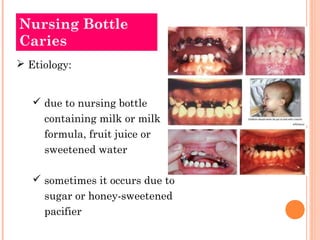
Nursing Bottle
Caries
 Etiology:


    due to nursing bottle
     containing milk or milk
     formula, fruit juice or
     sweetened water

    sometimes it occurs due to
     sugar or honey-sweetened
     pacifier
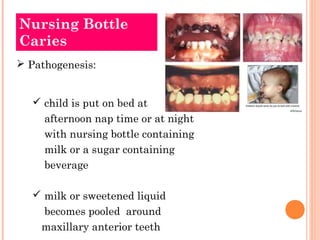
Nursing Bottle
Caries
 Pathogenesis:


    child is put on bed at
     afternoon nap time or at night
     with nursing bottle containing
     milk or a sugar containing
     beverage

    milk or sweetened liquid
    becomes pooled around
    maxillary anterior teeth
Nursing Bottle
Caries
 Pathogenesis:


    carbohydrate containing
     liquid provide an excellent
     culture medium for
     acidogenic microorganisms
Nursing Bottle
Caries
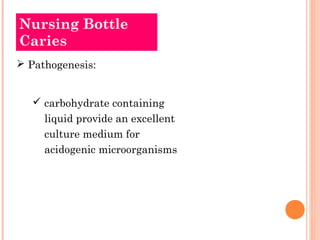
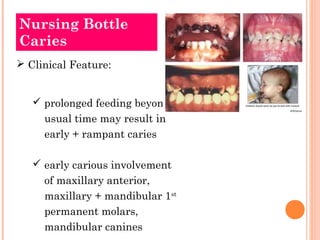
 Clinical Feature:


    prolonged feeding beyond
     usual time may result in
     early + rampant caries

    early carious involvement
     of maxillary anterior,
     maxillary + mandibular 1st
     permanent molars,
     mandibular canines
Nursing Bottle
Caries
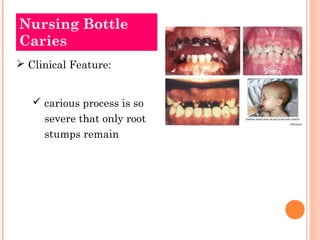
 Clinical Feature:


    carious process is so
     severe that only root
     stumps remain
Nursing Bottle
Caries
 Prevention:


    parent should start brushing
     the child teeth as soon
     as they erupt in oral
     cavity

    discontinue bottle feeding as
     soon as child can drink from
     a cup, at approximately
     12-15 months of age
Rampant Caries

 suddenly appearing

 widespread

 resulting in early involvement
  of pulp
Rampant Caries

 Etiology:

    may be due to nutritional
     deficiency

    malnutrition

    emotional disturbances
Rampant Caries

 Clinical Features:

    occurs in children with
     poor dietary habits

    extensive inter-proximal
     + smooth surface caries
Rampant Caries

 Management:

   extensive dental care

   parent education
Arrested Caries

 Clinical Features:

    both deciduous + permanent
     are affected

    large open cavities

    brown-stained polished
     appearance + hard
Prevention/Management
of Dental Caries

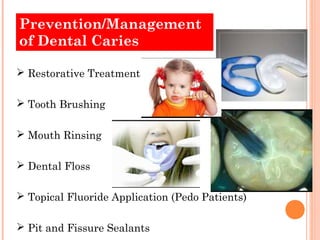
 Restorative Treatment

 Tooth Brushing

 Mouth Rinsing

 Dental Floss

 Topical Fluoride Application (Pedo Patients)

 Pit and Fissure Sealants
References:
 Books
   Cawson, R.A: Cawson’s Essentials of Oral
       Oral Pathology and Oral Medicine,
       8th Edition
        • (page 40)
   Ghom, Ali & Mhaske, Shubhangi: Textbook of
       Oral Pathology
        • (pages 401-419)
  Shafer, et al: A textbook of Oral Pathology,
        3rd Edition
        • (pages 369,394, 407)

Dental caries

  • 1.
    DENTAL CARIES Preparedby: Dr. Rea Corpuz
  • 2.
    Dental Caries  progressive initially subsurface demineralization of teeth by bacterial acid  one of the most common of all diseases  major cause of loss of teeth
  • 3.
    Dental Caries  maybe considered a disease of modern civilization  since prehistoric man rarely suffered from this form of tooth
  • 4.
    Dental Caries  biologicalprocess of tooth decay with mutifactorial etiology  microbial disease of calcified tissues of teeth  characterized by demineralization of inorganic portion  destruction of organic substance of tooth
  • 5.
    Etiology of DentalCaries  generally agreed to be complex problem  complicated by many indirect factors  obscure the direct cause or causes
  • 6.
    Etiology of DentalCaries Possible interventions Possible interventions Reduce intake of Reduce Strep. mutans cariogenic sugars numbers by: Particularly sucrose Diet Bacteria Reduction in sugar intake Active or passive Caries immunization Possible interventions Susceptible Water + other types of Time Surface Fluoridation Possible interventions (Host) Prevention during post- Avoid frequent sucrose eruptive maturation intake (snacking) Fissure sealing Stimulate salivary flow Properly contured + sugar clearance restorations
  • 7.
    Etiology of DentalCaries Plaque Acidogenic Enzymes Food Acids Tooth Carious Bacteria Lesions
  • 8.
    Etiology of DentalCaries  Old Theories  Exogenous Theories • (1) Legend of worm • (2) Chemical Theory • (3) Parasitic or Septic Theory
  • 9.
    Etiology of DentalCaries  Old Theories  Endogenous Theories • (1) Humoral Theory • (2) Vital Theory
  • 10.
    Etiology of DentalCaries  New Theories  (1) Acidogenic Theory  (2) Proteolytic Theory  (3) Proteolysis-chelation Theory
  • 11.
    Old Theories (Exogenous Theory) (1) Legend of Worm  5000 BC  ancient Sumerian text  obtained from Mesopotamian area  caused by worm that drank blood of teeth  fed on roots of jaws
  • 12.
    Old Theories (Exogenous Theory) (2) Chemical Theory  1819  proposed by Parmly  unidentified chemical agent  responsible for caries
  • 13.
    Old Theories (Exogenous Theory) (2) Chemical Theory  stated that caries began on enamel surface where food putrefied  acquired sufficient dissolving power to produce disease chemically
  • 14.
    Old Theories (Exogenous Theory) (3) Parasitic or Septic Theory  1843  proposed by Erdl  filamentous parasite in plaque • he termed as “Denticolae” • responsible for dental caries
  • 15.
    Old Theories (Endogenous Theory) (1) Humoral Theory  4 humors of body • blood • phelgm • black bile • yellow bile  any change in relative proportion of these elements causes disease
  • 16.
    Old Theories (Endogenous Theory) (2) Vital Theory  18 century  tooth decay originated like bone gangrene, from within the tooth itself
  • 17.
    New Theories Old Theories (ExogenousTheory)  (1) Acidogenic/Chemoparasitic Theory  1890  WD Miller  dental decay is a chemoparasitic process consisting of 2 stages • decalcification of enamel  results in total destruction
  • 18.
    New Theories Old Theories (ExogenousTheory)  (1) Acidogenic/Chemoparasitic Theory • decalcification of dentin as a preliminary stage  followed by dissolution of softened residue
  • 19.
    New Theories Old Theories (ExogenousTheory)  (1) Acidogenic/Chemoparasitic Theory  following factors cause decay: • (1) Role of carbohydrates • (2) Role of microorganisms • (3) Role of acids • (4) Role of dental plaque
  • 20.
    (1)Acidogenic/ Old Theories Chemoparasitic Theory (1) Role of carbohydrates  food substances act as substrate for microorganisms of dental plaque  various carbohydrates have been examined for cariogenic potential
  • 21.
    (1)Acidogenic/ Old Theories Chemoparasitic Theory (1) Role of carbohydrates  cariogenicity of carbohydrate varies with: • (1) frequency of ingestion • (2) physical form • (3) chemical composition • (4) route of administration • (5) presence of other food constituents
  • 22.
    (1)Acidogenic/ Old Theories Chemoparasitic Theory (1) Role of carbohydrates • (1) frequency of ingestion  taken repeatedly in between two major meals  provides constant supply of carbohydrate to plaque bacteria for fermentation + production of acids
  • 23.
    (1)Acidogenic/ Old Theories Chemoparasitic Theory (1) Role of carbohydrates • (2) physical form  sticky  solid carbohydrates
  • 24.
    (1)Acidogenic/ Old Theories Chemoparasitic Theory (1) Role of carbohydrates • (3) chemical composition  in the form of glucose, sucrose + fructose due to low molecular weight  rapidly diffuse into plaque  make themselves easily available for fermentation by plaque bacteria
  • 25.
    (1)Acidogenic/ Chemoparasitic Theory  (1)Role of carbohydrates • (4) Route of administration  oral intake of sticky food
  • 26.
    (1)Acidogenic/ Chemoparasitic Theory  (1)Role of carbohydrates • (5) Presence of other food constituents  refined pure carbohydrates more caries producing
  • 27.
    (1)Acidogenic/ Chemoparasitic Theory  (2)Role of microorganisms  caused by acid resulting from action of microorganisms on carbohydrates
  • 28.
    (1)Acidogenic/ Chemoparasitic Theory  (2)Role of microorganisms Initiation of Dental Progression of Dental Caries Caries Streptococci Streptococcal species: • S. mutans Streptoccal species in deep • S. milleri dentinal caries and root • S. mitior caries • S. sanguis • S. salivaris Lactobacilli Lactobacilli in dentin • L. acidophillus • L. acidophillus • L. casei • L. casei Actinomycoses Actinomycoses • A. viscosus • A. Israeli • A. naeslundii • A. odontolyticus
  • 29.
    (1)Acidogenic/ Chemoparasitic Theory  (2)Role of microorganisms  S. mutans has been proved for the initiation of caries
  • 30.
    (1)Acidogenic/ Chemoparasitic Theory  (3)Role of acids  play most important role in pathogenesis of dental caries  pH 5.5 is called critical pH  below this pH demineralization of tooth substance begins
  • 31.
    (1)Acidogenic/ Chemoparasitic Theory  (4)Role of Dental Plaque  found on uncleaned tooth surfaces  appear as tenacious, thin film  may accumulate within 24-48 hours
  • 32.
    New Theories Old Theories (ExogenousTheory)  (2) Proteolytic Theory  proteolysis of the organic components of tooth as an initial process  than actual demineralization + dissolution of inorganic substances
  • 33.
    New Theories Old Theories (ExogenousTheory)  (2) Proteolytic Theory  proposed that enamel lamellae or rod sheath (proteins) may be lysed  which means proteolysis as first event in further progression of bacterial invasion + demineralization carious lesions
  • 34.
    New Theories Old Theories (ExogenousTheory)  (3) Proteolysis Chelation Theory  suggests that caries is caused by simultaneous events of proteolysis + chelation  proteolysis • destruction of organic portion of tooth by proteolytic microorganisms
  • 35.
    New Theories Old Theories (ExogenousTheory)  (3) Proteolysis Chelation Theory  chelation •removal of calcium by forming soluble chelates  oral bacteria attack organic component of enamel (proteolysis)  breakdown products have chelating ability and this dissolves tooth minerals
  • 36.
    Classification Old Theories  (1)Depending on nature of attack  (2) Depending on progression of caries  (3) Depending on surfaces involved  (4) Based on direction of attack  (5) Based on number of surfaces involved
  • 37.
    Classification Old Theories  (6)GV Black Classification based on treatment and restoration design  (7) Based on location of lesion  (8) Based on tissue involved
  • 38.
    (1) Nature of OldTheories Attack  Primary Caries  incipient; initial  first attack on tooth surface  Secondary Caries  recurrent  occurs on margins or walls of existing restorations
  • 39.
    (2) Progression ofCaries Old Theories  Acute  rapidly invading process  involves several teeth  lesions are soft + light colored
  • 40.
    (2) Progression ofCaries Old Theories  Acute  usually pulp is involved at early stage • Rampant caries • Nursing bottle caries • Radiation caries
  • 41.
    (2) Progression ofCaries Old Theories  Chronic  lesions are long standing  fewer in number
  • 42.
    (3) Surfaces involved OldTheories  Pit and fissure  Smooth surface caries
  • 43.
    (4) Direction Old Theoriesof caries attack  Forward Caries  proceeds from enamel to dentin  lesion is triangle in shaped with base of triangle at enamel surface + apex towards dentin  in pits + fissures base is at DEJ + apex is in the pit
  • 44.
    (4) Direction Old Theoriesof caries attack  Backward Caries  proceeds from DEJ towards enamel surface  also triangle shaped with base at DEJ + apex towards enamel surface
  • 45.
    (5) Number of OldTheories Surfaces involved  Simple  only one surface is involved by caries  Compound  2 surfaces are involved  Complex  more than 3 surfaces involved
  • 46.
    (6) GV Black OldTheories Classification  Class I  begin in pits, fissures + defective grooves  seen in occlusal surface  occlusal two-thirds of molars  lingual pits of incisors
  • 47.
    (6) GV Black OldTheories Classification  Class II  lesions seen on proximal aspects of molars + premolars
  • 48.
    (6) GV Black OldTheories Classification  Class III  lesions involving proximal aspects of incisors  do not involve or necessitate removal of incisal edge
  • 49.
    (6) GV Black OldTheories Classification  Class IV  lesions involving proximal aspects of incisors  involve or require removal of incisal edge
  • 50.
    (6) GV Black OldTheories Classification  Class V  lesions present on gingival third of all teeth
  • 51.
    (6) GV Black OldTheories Classification  Class VI  lesions found on incisal edges + cusp tips
  • 52.
    (7) Location Old Theoriesofthe lesion  Pit and Fissure caries  Occlusal  Buccal or lingual pit  Smooth surface caries  Proximal  Buccal or Lingual surface  Root caries
  • 53.
    (8) Tissue involved OldTheories  Enamel Caries  Dentinal Caries  Cemental Caries
  • 54.
    Classification  Senile Caries  caries associated with aging  almost exclusively seen on root surface  Residual Caries  not removed during restorative procedure
  • 55.
    Clinical Features: Smooth SurfaceCaries  Interproximal Caries  opaque chalky region (white spot)  some cases yellow or brown pigment area  spots are generally located on outer surface of enamel between contact point + height of free gingival margin
  • 56.
    Clinical Features: Smooth SurfaceCaries  Interproximal Caries  as caries penetrates enamel, enamel surrounding the lesion assumes bluish white appearance • usally apparent as laterally spreading caries at DEJ
  • 57.
    Clinical Features: Smooth SurfaceCaries  Interproximal Caries  common for proximal caries to extend both bucally + lingually
  • 58.
    Cervical, Buccal, Lingualor Palatal Caries  Clinical Features:  usually extends from area opposite gingival crest occlusally to convexity of tooth surface  extends laterally towards proximal surfaces
  • 59.
    Cervical, Buccal, Lingualor Palatal Caries  Clinical Features:  usually occurs on cervical area  typical cervical lesion is a crescent shaped cavity beginning as slightly roughened chalky area  gradually becomes excavated
  • 60.
    Pit and FissureCaries  Clinical Features:  appears brown or black  feel slightly soft  catch a fine explorer point
  • 61.
    Pit and FissureCaries  Clinical Features:  enamel bordering the pit and fissure may appear • opaque as it becomes • bluish white undermined
  • 62.
    Pit and FissureCaries  Clinical Features:  lateral spread of caries at DEJ as well as penetration into dentin along dentinal tubules may be extensive  without fracturing away overhanging enamel  there may be large carious lesion with only a tiny point of opening
  • 63.
    Root Caries also known as cemental caries  involves both dentin + cementum  in number of people exhibiting gingival recession with clinical exposure of cemental surface
  • 64.
    Root Caries  ClinicalFeatures:  slowly progressing chronic lesion  usually found in mandibular molar area + premolar region  gingival recession is associated with root surface caries
  • 65.
    Recurrent Caries occurs immediately adjacent to restoration  may be caused by inadequate extension of restoration  was not able to excavate or removed well original carious lesion
  • 66.
    Recurrent Caries  ClinicalFeatures:  restoration with poor margins • permitted leakage + entrance of both bacteria + substrate
  • 67.
    Nursing Bottle Caries  Etiology:  due to nursing bottle containing milk or milk formula, fruit juice or sweetened water  sometimes it occurs due to sugar or honey-sweetened pacifier
  • 68.
    Nursing Bottle Caries  Pathogenesis:  child is put on bed at afternoon nap time or at night with nursing bottle containing milk or a sugar containing beverage  milk or sweetened liquid becomes pooled around maxillary anterior teeth
  • 69.
    Nursing Bottle Caries  Pathogenesis:  carbohydrate containing liquid provide an excellent culture medium for acidogenic microorganisms
  • 70.
    Nursing Bottle Caries  ClinicalFeature:  prolonged feeding beyond usual time may result in early + rampant caries  early carious involvement of maxillary anterior, maxillary + mandibular 1st permanent molars, mandibular canines
  • 71.
    Nursing Bottle Caries  ClinicalFeature:  carious process is so severe that only root stumps remain
  • 72.
    Nursing Bottle Caries  Prevention:  parent should start brushing the child teeth as soon as they erupt in oral cavity  discontinue bottle feeding as soon as child can drink from a cup, at approximately 12-15 months of age
  • 73.
    Rampant Caries  suddenlyappearing  widespread  resulting in early involvement of pulp
  • 74.
    Rampant Caries  Etiology:  may be due to nutritional deficiency  malnutrition  emotional disturbances
  • 75.
    Rampant Caries  ClinicalFeatures:  occurs in children with poor dietary habits  extensive inter-proximal + smooth surface caries
  • 76.
    Rampant Caries  Management:  extensive dental care  parent education
  • 77.
    Arrested Caries  ClinicalFeatures:  both deciduous + permanent are affected  large open cavities  brown-stained polished appearance + hard
  • 78.
    Prevention/Management of Dental Caries Restorative Treatment  Tooth Brushing  Mouth Rinsing  Dental Floss  Topical Fluoride Application (Pedo Patients)  Pit and Fissure Sealants
  • 79.
    References:  Books  Cawson, R.A: Cawson’s Essentials of Oral Oral Pathology and Oral Medicine, 8th Edition • (page 40)  Ghom, Ali & Mhaske, Shubhangi: Textbook of Oral Pathology • (pages 401-419) Shafer, et al: A textbook of Oral Pathology, 3rd Edition • (pages 369,394, 407)