BASICS OF
DENTAL CARIES
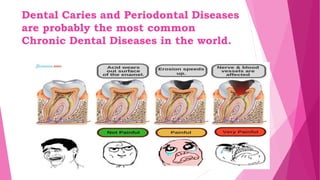
Dental Caries and Periodontal Diseases
are probably the most common
Chronic Dental Diseases in the world.
DEFINITION OF DENTAL CARIES
Dental caries is a multifactorial
microbial infectious disease
characterized by demineralization of
the inorganic and destruction of the
organic substance of the tooth.
ETIOLOGY OF CARIES
 No universally accepted opinion of etiology of
dental caries.
 3 theories have involved:
1. ACIDOGENIC THEORY (MILLER'S CHEMO-
PARASITIC THEORY)
2. PROTEOLYTIC THEORY
3. PROTEOLYSIS-CHELATION THEORY.
1. ACIDOGENIC THEORY (MILLER'S
CHEMO-PARASITIC THEORY)
 W.D. MILLER, stated that, "dental decay is a
chemo-parasitic process consisting of two
stages, the decalcification of enamel, which
results in its total destruction and
decalcification of dentin, as a preliminary stage
followed by dissolution of the softened residue.
 The acid which affects the primary
decalcification is derived from
the fermentation of starches and sugar lodged
in the retaining centers of the teeth."
ROLE OF CARBOHYDRATES
 Monosaccharides and disaccharides play
prime role in dental caries.
 Sucrose (disaccharide) is composed of
glucose and fructose have an evident role
in carious process.
 Serves as a unique substrate for a
cariogenic flora.
 The cariogenicity of dietary carbohydrate varies with:
 Frequency of ingestion:
 Greater the frequency of intake, higher the chances of
caries progression.
 Physical form:
 Raw carbohydrates are less caries causing, than the
refined form.
 Chemical composition:
 Disaccharides and monosaccharides are the readily
fermentable so forms an ideal substrate for causing
caries as compared to polysaccharides.
 Presence of Food Constituents:
 Ratio of other food ingredients also influence the caries
incidence.
 Foreg: Proteins, Fats, Vitamins in higher ratio
nullifies the effect of carbohydrates.
 Root of Administration
 Carbohydrates in detergent food are less damaging as
compared to soft, retentive foods.
 Sugar substitutes like sorbitol, manitol and sugar
alcohol are less caries causing because , they
produce very little acid.
ROLE OF MICROORGANISMS:
 Most potential microorganisms responsible for
dental caries is STREPTOCOCCUS MUTANS.
 Most important organisms responsible for
1. Smooth surface caries and Pits and Fissure caries : S.
mutans, S. sanguis, S. salwarius
2. Root surface caries: A. vircoses, A. naeslundii
3. Deep surface caries: Lactobacillus species , A.
naeslundii
ROLE OF STREPTOCOCCUS MUTANS
 The main substrate is sucrose.
 STREPTOCOCCUS MUTANS act through 2 pathways:
1. INTRACELLULAR PATHWAY:
a.Leads to formation of lactic acid by direct phosphorylation
through glycolytic pathway.
2. EXTRACELLULAR PATHWAY:
a. Conversion of sucrose to extracellular polymers (glucans and
fructans) cell bound and extracellular enzymes.
b. Glucans promotes accumulation of plaque whereas fructans
becomes the reservoir for fermentable sugars for oral bacteria.
ROLE OF ACIDS IN
DEMINERALISATION
 The enzymatic breakdown of carbohydrates by bacterial
action is the prime step for acid formation.
 One molecule of glucose breaks into 2 molecules of lactic
acid.
 Lactic acid is the main organic acid produced by the
fermentation of carbohydrates followed by propionic,
butyric, succinic and glutamic acid.
 It is not just the acids that causes demineralization of
enamel and dentin but it is the localisation of the acids on
the tooth structure for longer periods which is done by
DENTAL PLAQUE.
ROLE OF DENTAL PLAQUE
 It is a thin biofilm, soft, non-mineralised, which is found on
tooth, restorations and dental prosthesis that are not
adequately cleared.
 Composed of :
1. Salivary mucin.
2. Desquamated epithelial cells.
3. Microorganisms and leukocytes.
 It is of 2 types:
1. SUPRAGINGIVAL
2. SUBGINGIVAL
 Role of plaque depends on 3 factors:
1. Harbouring the cariogenic bacteria on the tooth
surface
2. Holding the acids on the tooth surface for long
duration.
3. Protecting the acids from getting neutralized by the
buffering action of the saliva.
 Pathogenicity of plaque depends upon ratio of the
presence of acidogenic bacteria like Streptococcus
species decides the caries formation.
STEPHEN'S CURVE
 Stephen in 1940 suggested a hypothesis which
stated that: "Caries occurrence in an individual is
largely dependent on the average pH value of the
saliva.
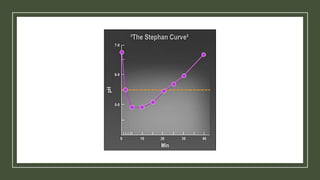
 According to him, pH value of 6.8 - 7.1 is
the normal pH of caries free individuals.
 The critical pH value of saliva is = 5.5
 Individuals lower than pH 5.5 are the maximum
risk of caries occurrence due to acid production
leading to demineralization of enamel surface.
 He used microelectrodes which were capable of
measuring the pH in dental plaque
 He selected various individuals and calculated
the pH of the subjects after rinsing their mouth
with 10% glucose/sucrose solution.
 He noted down that the pH after every 10
minutes and observed that there was an initial
fall in the pH of all subjects and pH gradually
return to their initial value in 1-2 hours.
 However, reduction in pH of caries free group
and caries active group were different.
 In caries free individuals, the pH drop was not
less than 5 after the rinse while in caries active
individuals, the pH drop was less than 5
after rinsing.
 Maxillary anterior teeth exhibited a greater pH
drop in plaque than the mandibular anterior
teeth indicating the influence of saliva in acid
production.
PROTEOLYTIC THEORY
 The theory was given by GOTTLEIB AND GOTTLEIB in
1944
 This theory states that- " Caries is essentially a
proteolytic process where the proteolytic microorganisms
invade the organic pathways (Enamel lamellae, Enamel
Cracks, Enamel pits, rod sheets) which are hypocalcified
structures.
 These structures are destroyed first, followed by
inorganic destruction of enamel by acid
formation subsequently.
 This theory suggests the importance of proteolytic
bacteria rather than acidogenic bacteria in caries
production.
 However, the presence of acidogenic bacteria was not
ruled out but the initial attack was by the proteolytic
enzymes liberated from the proteolytic microorganisms
through the organic pathway and later on
the inorganic destruction was done by the acidogenic bacteria.
 DRAWBACKS:
1. There is no evidence to support that initial attack is proteolytic.
2. Studies suggests that, the occurrence of caries even in the
absence of proteolytic organisms
 CONCLUSION:
 Proteolysis in the initiation of dental caries is likely to be of
no significance but its role in the progression of more
advanced lesions cannot be ruled out.
PROTEOLYTIC-CHELATION THEORY
 This theory was given by SCHATZ IN 1955.
 It implies that : " Degradation of organic components
and destruction of inorganic components occur
simultaneously and not one after the other.
 According to this theory - there is a simultaneous
breakdown of organic matrix (by proteolysis) and
dissolution of inorganic matrix (by chelation)
 CHELATION is a process involving the complexing of a
metallic ions to a complex substance through a
covalent bond which results in the formation of highly
stable, poorly dissociated or weakly ionized
compound.
 This theory considers dental caries – a process where the initial
attack is proteolytic breakdown of organic component of enamel.
 The organic breakdown products have chelating properties and
thereby dissolve the minerals in the enamel and cause decalcification.
 Chelation of calcium and phosphate ions (from enamel) occurs even at
neutral pH or alkaline pH, terefore, according to this theory -
 "DENTAL CARIES IS INDEPENDENT OF THE pH OF SALIVA"
 DRAWBACKS:
1. Insufficient data and research presented in order to prove the
hypothesis.
2. Studies done regarding this theory stated that - " Insufficient
concentrations of chelating agent is present in saliva and plaque, in
order to chelate calcium from the calcium – phosphorus system."
3. Studies suggest a minor role of chelation in the carious process.
CURRENT CONCEPTS IN CARIES
ETOLOGY
 Dental caries is multifactorial disease and
involves an interplay of 3 main factor:
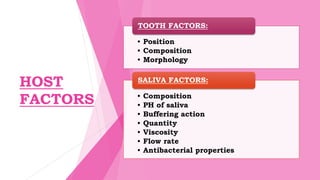
1. HOST FACTORS
2. MICROFLORA
3. SUBSTRATE
HOST
FACTORS
• Position
• Composition
• Morphology
TOOTH FACTORS:
• Composition
• PH of saliva
• Buffering action
• Quantity
• Viscosity
• Flow rate
• Antibacterial properties
SALIVA FACTORS:
 SYSTEMIC FACTORS AND
CONDITIONS:
a. Hereditary
b. Pregnancy
c. Lactation
d. Metabolic disorders
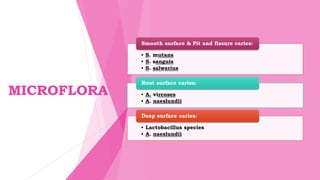
MICROFLORA
• S. mutans
• S. sanguis
• S. salwarius
Smooth surface & Pit and fissure caries:
• A. vircoses
• A. naeslundii
Root surface caries:
• Lactobacillus species
• A. naeslundii
Deep surface caries:
SUBSTRATE
 PHYSICAL FACTORS:
 Frequency, quantity of diet,
ratio of carbohydrates to
protein and lipid fats,
physical firm, presence of
vitamins, minerals and
fluorine in diet.
CLASSIFICATION OF DENTAL CARIES
 ACCORDING TO G.V. BLACK:
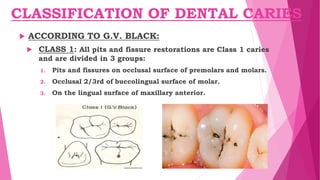
 CLASS 1: All pits and fissure restorations are Class 1 caries
and are divided in 3 groups:
1. Pits and fissures on occlusal surface of premolars and molars.
2. Occlusal 2/3rd of buccolingual surface of molar.
3. On the lingual surface of maxillary anterior.
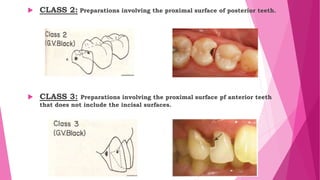
 CLASS 2: Preparations involving the proximal surface of posterior teeth.
 CLASS 3: Preparations involving the proximal surface pf anterior teeth
that does not include the incisal surfaces.
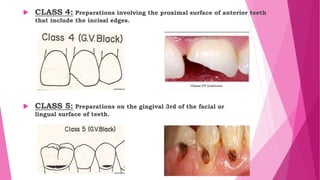
 CLASS 4: Preparations involving the proximal surface of anterior teeth
that include the incisal edges.
 CLASS 5: Preparations on the gingival 3rd of the facial or
lingual surface of teeth.
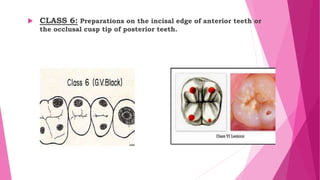
 CLASS 6: Preparations on the incisal edge of anterior teeth or
the occlusal cusp tip of posterior teeth.
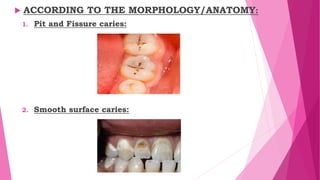
 ACCORDING TO THE MORPHOLOGY/ANATOMY:
1. Pit and Fissure caries:
2. Smooth surface caries:
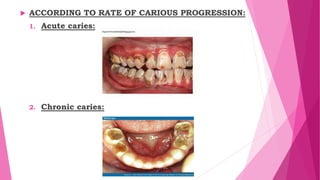
 ACCORDING TO RATE OF CARIOUS PROGRESSION:
1. Acute caries:
2. Chronic caries:
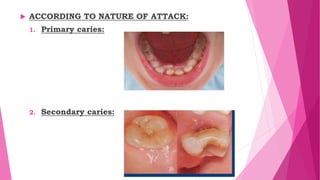
 ACCORDING TO NATURE OF ATTACK:
1. Primary caries:
2. Secondary caries:
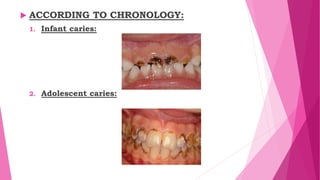
 ACCORDING TO CHRONOLOGY:
1. Infant caries:
2. Adolescent caries:
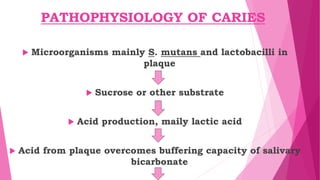
PATHOPHYSIOLOGY OF CARIES
 Microorganisms mainly S. mutans and lactobacilli in
plaque
 Sucrose or other substrate
 Acid production, maily lactic acid
 Acid from plaque overcomes buffering capacity of salivary
bicarbonate
 pH is lowered
 When pH<5.5, critical pH and remains at tooth
surface for 23-50 minutes
 This buffering capacity maintains local pH 5.0
 At pH 5.0, surface remains intact, subsruface
mineral is lost – initial carious lesion (incipient
caries)
 Incipient lesion may be reversed by remineralization
 When subsurface demineralization becomes extensive
 Tooth surface collapses
 Cavities (Caries)
DIAGNOSIS OF CARIES:
 Patient's History
 Visual Examination
 Explorers
 Radiographs
 Dental Floss/Tape
 Separation of Teeth
 Ammoniated Silver Nitrate
 Caries detecting solutions/dyes
 Digital fiber-optic Transillumination
 White light endoscopy
 Endoscopically filtered fluorescence
 Electroconductivity mearuements
 Quantitative laser fluorescence
 Direct digital radiology – digital
radiographs, xeroradiography
 Caries detection using laser fluorescence (diagnodent)
 Optical cohrence tomography
 CO2 laser
 Magnetic resonance microimaging (MRM).
PREVENTION OF DENTAL CARIES:
 Increasing the resistace of tooth structure to
demineralization:
 Flouride exposures:
 Systemic fluorides
 Topical fluorides
 Use of pit and fissure sealants
 remineralization
 Modification of diet:
 Limitation of sucrose consumption to mealtimes
 Replacement of sucrose by other sweeteners in
foods (sweeteners like sorbitol, lycasin, xylitol)
 Addition of caries – inhibiting agents to foods
(Fluoride, CAlcium, Phosphate, Vitamin K, Fatty
acids, etc.)
 Plaque control:
 Mechanical method (toothbrushing, flossing)
 Chemical methods (antibiotics, chlorhexidine etc.)
 Immunological method (oral, systemic, active
gingivosalivary etc.)
TREATMENT
 Normal lesions:
 No treatment required
 1 year clinical examination
 Hypocalcified enamel (developmental
white spots):
 Treatment is elective, for esthetics, restore
defects
 1 year clinical examination
 Incipient enamel leasions:
 Bitewing radiographs indicated (demineralixed
white spots)
 Seal defective pits and fissures as indicated
 3 months evaluation – oral flora, MS count,
progression of white spots, presence of cavitations.
 Possible cavitated lesions (active caries):
 Bitewing radiographs indicated
 Restorative treatment indicated
 3 months evaluation as incipient lesions and pulpal
response.
 Arrested caries:
 No active new cavitations
 Treatment is elective, for esthetics, restore
defects.
 1 year clinical examination.
Dental caries

Dental caries

  • 1.
  • 2.
    Dental Caries andPeriodontal Diseases are probably the most common Chronic Dental Diseases in the world.
  • 3.
    DEFINITION OF DENTALCARIES Dental caries is a multifactorial microbial infectious disease characterized by demineralization of the inorganic and destruction of the organic substance of the tooth.
  • 4.
    ETIOLOGY OF CARIES No universally accepted opinion of etiology of dental caries.  3 theories have involved: 1. ACIDOGENIC THEORY (MILLER'S CHEMO- PARASITIC THEORY) 2. PROTEOLYTIC THEORY 3. PROTEOLYSIS-CHELATION THEORY.
  • 5.
    1. ACIDOGENIC THEORY(MILLER'S CHEMO-PARASITIC THEORY)  W.D. MILLER, stated that, "dental decay is a chemo-parasitic process consisting of two stages, the decalcification of enamel, which results in its total destruction and decalcification of dentin, as a preliminary stage followed by dissolution of the softened residue.  The acid which affects the primary decalcification is derived from the fermentation of starches and sugar lodged in the retaining centers of the teeth."
  • 6.
    ROLE OF CARBOHYDRATES Monosaccharides and disaccharides play prime role in dental caries.  Sucrose (disaccharide) is composed of glucose and fructose have an evident role in carious process.  Serves as a unique substrate for a cariogenic flora.
  • 7.
     The cariogenicityof dietary carbohydrate varies with:  Frequency of ingestion:  Greater the frequency of intake, higher the chances of caries progression.  Physical form:  Raw carbohydrates are less caries causing, than the refined form.  Chemical composition:  Disaccharides and monosaccharides are the readily fermentable so forms an ideal substrate for causing caries as compared to polysaccharides.
  • 8.
     Presence ofFood Constituents:  Ratio of other food ingredients also influence the caries incidence.  Foreg: Proteins, Fats, Vitamins in higher ratio nullifies the effect of carbohydrates.  Root of Administration  Carbohydrates in detergent food are less damaging as compared to soft, retentive foods.  Sugar substitutes like sorbitol, manitol and sugar alcohol are less caries causing because , they produce very little acid.
  • 9.
    ROLE OF MICROORGANISMS: Most potential microorganisms responsible for dental caries is STREPTOCOCCUS MUTANS.  Most important organisms responsible for 1. Smooth surface caries and Pits and Fissure caries : S. mutans, S. sanguis, S. salwarius 2. Root surface caries: A. vircoses, A. naeslundii 3. Deep surface caries: Lactobacillus species , A. naeslundii
  • 10.
    ROLE OF STREPTOCOCCUSMUTANS  The main substrate is sucrose.  STREPTOCOCCUS MUTANS act through 2 pathways: 1. INTRACELLULAR PATHWAY: a.Leads to formation of lactic acid by direct phosphorylation through glycolytic pathway. 2. EXTRACELLULAR PATHWAY: a. Conversion of sucrose to extracellular polymers (glucans and fructans) cell bound and extracellular enzymes. b. Glucans promotes accumulation of plaque whereas fructans becomes the reservoir for fermentable sugars for oral bacteria.
  • 11.
    ROLE OF ACIDSIN DEMINERALISATION  The enzymatic breakdown of carbohydrates by bacterial action is the prime step for acid formation.  One molecule of glucose breaks into 2 molecules of lactic acid.  Lactic acid is the main organic acid produced by the fermentation of carbohydrates followed by propionic, butyric, succinic and glutamic acid.  It is not just the acids that causes demineralization of enamel and dentin but it is the localisation of the acids on the tooth structure for longer periods which is done by DENTAL PLAQUE.
  • 12.
    ROLE OF DENTALPLAQUE  It is a thin biofilm, soft, non-mineralised, which is found on tooth, restorations and dental prosthesis that are not adequately cleared.  Composed of : 1. Salivary mucin. 2. Desquamated epithelial cells. 3. Microorganisms and leukocytes.  It is of 2 types: 1. SUPRAGINGIVAL 2. SUBGINGIVAL
  • 13.
     Role ofplaque depends on 3 factors: 1. Harbouring the cariogenic bacteria on the tooth surface 2. Holding the acids on the tooth surface for long duration. 3. Protecting the acids from getting neutralized by the buffering action of the saliva.  Pathogenicity of plaque depends upon ratio of the presence of acidogenic bacteria like Streptococcus species decides the caries formation.
  • 14.
    STEPHEN'S CURVE  Stephenin 1940 suggested a hypothesis which stated that: "Caries occurrence in an individual is largely dependent on the average pH value of the saliva.  According to him, pH value of 6.8 - 7.1 is the normal pH of caries free individuals.  The critical pH value of saliva is = 5.5  Individuals lower than pH 5.5 are the maximum risk of caries occurrence due to acid production leading to demineralization of enamel surface.
  • 15.
     He usedmicroelectrodes which were capable of measuring the pH in dental plaque  He selected various individuals and calculated the pH of the subjects after rinsing their mouth with 10% glucose/sucrose solution.  He noted down that the pH after every 10 minutes and observed that there was an initial fall in the pH of all subjects and pH gradually return to their initial value in 1-2 hours.
  • 16.
     However, reductionin pH of caries free group and caries active group were different.  In caries free individuals, the pH drop was not less than 5 after the rinse while in caries active individuals, the pH drop was less than 5 after rinsing.  Maxillary anterior teeth exhibited a greater pH drop in plaque than the mandibular anterior teeth indicating the influence of saliva in acid production.
  • 18.
    PROTEOLYTIC THEORY  Thetheory was given by GOTTLEIB AND GOTTLEIB in 1944  This theory states that- " Caries is essentially a proteolytic process where the proteolytic microorganisms invade the organic pathways (Enamel lamellae, Enamel Cracks, Enamel pits, rod sheets) which are hypocalcified structures.  These structures are destroyed first, followed by inorganic destruction of enamel by acid formation subsequently.  This theory suggests the importance of proteolytic bacteria rather than acidogenic bacteria in caries production.
  • 19.
     However, thepresence of acidogenic bacteria was not ruled out but the initial attack was by the proteolytic enzymes liberated from the proteolytic microorganisms through the organic pathway and later on the inorganic destruction was done by the acidogenic bacteria.  DRAWBACKS: 1. There is no evidence to support that initial attack is proteolytic. 2. Studies suggests that, the occurrence of caries even in the absence of proteolytic organisms  CONCLUSION:  Proteolysis in the initiation of dental caries is likely to be of no significance but its role in the progression of more advanced lesions cannot be ruled out.
  • 20.
    PROTEOLYTIC-CHELATION THEORY  Thistheory was given by SCHATZ IN 1955.  It implies that : " Degradation of organic components and destruction of inorganic components occur simultaneously and not one after the other.  According to this theory - there is a simultaneous breakdown of organic matrix (by proteolysis) and dissolution of inorganic matrix (by chelation)  CHELATION is a process involving the complexing of a metallic ions to a complex substance through a covalent bond which results in the formation of highly stable, poorly dissociated or weakly ionized compound.
  • 21.
     This theoryconsiders dental caries – a process where the initial attack is proteolytic breakdown of organic component of enamel.  The organic breakdown products have chelating properties and thereby dissolve the minerals in the enamel and cause decalcification.  Chelation of calcium and phosphate ions (from enamel) occurs even at neutral pH or alkaline pH, terefore, according to this theory -  "DENTAL CARIES IS INDEPENDENT OF THE pH OF SALIVA"  DRAWBACKS: 1. Insufficient data and research presented in order to prove the hypothesis. 2. Studies done regarding this theory stated that - " Insufficient concentrations of chelating agent is present in saliva and plaque, in order to chelate calcium from the calcium – phosphorus system." 3. Studies suggest a minor role of chelation in the carious process.
  • 22.
    CURRENT CONCEPTS INCARIES ETOLOGY  Dental caries is multifactorial disease and involves an interplay of 3 main factor: 1. HOST FACTORS 2. MICROFLORA 3. SUBSTRATE
  • 24.
    HOST FACTORS • Position • Composition •Morphology TOOTH FACTORS: • Composition • PH of saliva • Buffering action • Quantity • Viscosity • Flow rate • Antibacterial properties SALIVA FACTORS:
  • 25.
     SYSTEMIC FACTORSAND CONDITIONS: a. Hereditary b. Pregnancy c. Lactation d. Metabolic disorders
  • 26.
    MICROFLORA • S. mutans •S. sanguis • S. salwarius Smooth surface & Pit and fissure caries: • A. vircoses • A. naeslundii Root surface caries: • Lactobacillus species • A. naeslundii Deep surface caries:
  • 27.
    SUBSTRATE  PHYSICAL FACTORS: Frequency, quantity of diet, ratio of carbohydrates to protein and lipid fats, physical firm, presence of vitamins, minerals and fluorine in diet.
  • 28.
    CLASSIFICATION OF DENTALCARIES  ACCORDING TO G.V. BLACK:  CLASS 1: All pits and fissure restorations are Class 1 caries and are divided in 3 groups: 1. Pits and fissures on occlusal surface of premolars and molars. 2. Occlusal 2/3rd of buccolingual surface of molar. 3. On the lingual surface of maxillary anterior.
  • 29.
     CLASS 2:Preparations involving the proximal surface of posterior teeth.  CLASS 3: Preparations involving the proximal surface pf anterior teeth that does not include the incisal surfaces.
  • 30.
     CLASS 4:Preparations involving the proximal surface of anterior teeth that include the incisal edges.  CLASS 5: Preparations on the gingival 3rd of the facial or lingual surface of teeth.
  • 31.
     CLASS 6:Preparations on the incisal edge of anterior teeth or the occlusal cusp tip of posterior teeth.
  • 32.
     ACCORDING TOTHE MORPHOLOGY/ANATOMY: 1. Pit and Fissure caries: 2. Smooth surface caries:
  • 33.
     ACCORDING TORATE OF CARIOUS PROGRESSION: 1. Acute caries: 2. Chronic caries:
  • 34.
     ACCORDING TONATURE OF ATTACK: 1. Primary caries: 2. Secondary caries:
  • 35.
     ACCORDING TOCHRONOLOGY: 1. Infant caries: 2. Adolescent caries:
  • 36.
    PATHOPHYSIOLOGY OF CARIES Microorganisms mainly S. mutans and lactobacilli in plaque  Sucrose or other substrate  Acid production, maily lactic acid  Acid from plaque overcomes buffering capacity of salivary bicarbonate
  • 37.
     pH islowered  When pH<5.5, critical pH and remains at tooth surface for 23-50 minutes  This buffering capacity maintains local pH 5.0  At pH 5.0, surface remains intact, subsruface mineral is lost – initial carious lesion (incipient caries)
  • 38.
     Incipient lesionmay be reversed by remineralization  When subsurface demineralization becomes extensive  Tooth surface collapses  Cavities (Caries)
  • 39.
    DIAGNOSIS OF CARIES: Patient's History  Visual Examination  Explorers  Radiographs  Dental Floss/Tape  Separation of Teeth  Ammoniated Silver Nitrate  Caries detecting solutions/dyes  Digital fiber-optic Transillumination
  • 40.
     White lightendoscopy  Endoscopically filtered fluorescence  Electroconductivity mearuements  Quantitative laser fluorescence  Direct digital radiology – digital radiographs, xeroradiography  Caries detection using laser fluorescence (diagnodent)  Optical cohrence tomography  CO2 laser  Magnetic resonance microimaging (MRM).
  • 41.
    PREVENTION OF DENTALCARIES:  Increasing the resistace of tooth structure to demineralization:  Flouride exposures:  Systemic fluorides  Topical fluorides  Use of pit and fissure sealants  remineralization
  • 42.
     Modification ofdiet:  Limitation of sucrose consumption to mealtimes  Replacement of sucrose by other sweeteners in foods (sweeteners like sorbitol, lycasin, xylitol)  Addition of caries – inhibiting agents to foods (Fluoride, CAlcium, Phosphate, Vitamin K, Fatty acids, etc.)  Plaque control:  Mechanical method (toothbrushing, flossing)  Chemical methods (antibiotics, chlorhexidine etc.)  Immunological method (oral, systemic, active gingivosalivary etc.)
  • 43.
    TREATMENT  Normal lesions: No treatment required  1 year clinical examination  Hypocalcified enamel (developmental white spots):  Treatment is elective, for esthetics, restore defects  1 year clinical examination
  • 44.
     Incipient enamelleasions:  Bitewing radiographs indicated (demineralixed white spots)  Seal defective pits and fissures as indicated  3 months evaluation – oral flora, MS count, progression of white spots, presence of cavitations.  Possible cavitated lesions (active caries):  Bitewing radiographs indicated  Restorative treatment indicated  3 months evaluation as incipient lesions and pulpal response.
  • 45.
     Arrested caries: No active new cavitations  Treatment is elective, for esthetics, restore defects.  1 year clinical examination.