

CARDIOGENIC SHOCK..
Mr. ANILKUMAR B R
Ms.c. Nursing
Medical-surgical nursing
Lecturer
Yenepoya Nursing College
 Cardiogenic shock is the failure of heart to pump
blood adequately to meet the oxygenation needs
of the body. It occurs when the heart muscle loses
its contractile power.
 It most commonly occurs in association with, and
as a direct result of , acute myocardial infarction
(AMI).
ETIOLOGICAL FACTORS OF
CARDIOGENIC SHOCK…
 The causes of cardiogenic shock are known
as either “ Coronary or Non coronary.”
 Coronary cardiogenic shock is more common
than non Coronary cardiogenic shock and it’s
seen most often in patients with MI.
Coronary cardiogenic shock occurs when the
significant amount of the left ventricular
myocardium has been damaged.
 Non coronary cardiogenic shock caused by
mainly following conditions.
• Conditions that stress the myocardium..
• E.g. severe hypoxemia
• Acidosis
• Hypoglycemia
Hypoglycemia and
Tension pneumothorax
Ineffective myocardial function..
E.g cardiomyopathies
Valvular damage
Cardiac temponode
Dysrhythmias
Clinical manifestations
 Confusion, restlessness, mental lethargy
( due to poor perfusion of brain)
 Low SBP
 Oliguria ( urine output less than
30ml/hr( due to decrease perfusion of
kidneys)

Clinical manifestations
Chest pain( due to lack of oxygen and blood to
heart muscle)
 Cold ,clammy skin
 Weak ,thready peripheral pulses
 Dispend , tachypnea, cyanosis
 Patients in cardiogenic shock may
experience the pain of angina and develop
Dysrhythmias and hemodynamic instability.
 The classic signs and symptoms of
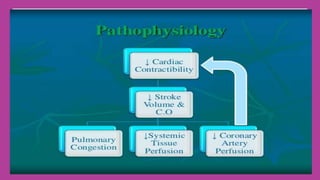
cardiogenic shock, the heart muscle loses,
it’s contractle power, resulting in a marked
reduction of SV and CO.
 Continue…
The decreased CO in turn reduce arterial
BP and tissue perfusion in the vital organs
(heart, brain, lung and kidneys)
Cerebral hypoxia due to decrease Cerebral
tissue perfusion (restlessness, confusion
and agitation)
 Continue… .
 Low BP, rapid or weak pulse, cold and clammy
skin, Tachypnea with respiratory crackles and
decrease urinary output and initial ABG shows
respiratory alkalosis.
 Dysrhythmias, SOB, weak thready pulse,
sweating, cold hand and feet and urine out put
less than 30 ml/hrs.
Complications of cardiogenic shock…
1. Severe brain damage (due to decrease Cerebral
tissue perfusion)
2. Kidneys damage (decrease renal tissue
perfusion)
3. Liver damage
4. MOF (Multiple organs failure)
5. Coma and death.
6. Acute respiratory distress syndrome
Diagnosis of cardiogenic shock
• Blood pressure
• ECG
• Echocardiogram
• Chest x-ray
• Cardiac enzyme test ( CPK-MB, cTn-I)
 Coronary angiography
 Pulmonary artery catheterization
 Lab- ABG, LFT & Renal function test
 The goal of medical management in
cardiogenic shock are..
 To limit further myocardial damage and
preserve the healthy myocardium.
 To improve the cardiac function by
increasing cardiac contractility, decreasing
ventricular after load or both.
 In general this goals are achieved by increasing
oxygen supply to the heart muscle while reducing
oxygen demands.
Initiation of First-line treatment.
First line treatment of cardiogenic shock
involves the following actions.
• Supplying supplemental oxygen
• Controlling chest pain
• Providing selected fluid support
• Administrating vasoactive medications
 Continue..
• Controlling heart rate with medications or
by implementation of a transthoracic or IV
pacemaker
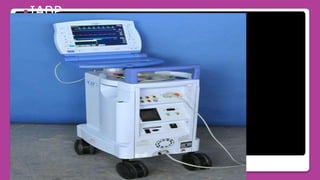
• Implementing mechanical Cardiac support
(intra -aortic balloon counter pulsation
therapy, or extracorporeal cardio
pulmonary bypass. (CPB)
IABP
Oxygenation
In the early stages of shock, supplemental
oxygen is administered by Nasal canula at rate
of 2 to 6 L/min to achieve an oxygen saturation
exceeding 90%.
* Monitoring of ABGs valves and pulse oximetry
valves helps determine whether the patient
requires a more aggressive method of oxygen
therapy.
Pain control:
* If a patient experience chest pain, IV
morphine sulfate is administered for pain
relief. Morphine also decreases the
patient’s anxiety.
Hemodynamic monitoring
Hemodynamic monitoring is initiated to
assess the patient’s response to
treatment.
Laboratory marker monitoring
Laboratory markers for ventricular
dysfunction (BNP) and cardiac enzyme
levels ( CPK-MB & cTn-I) are
measured, and serial 12 lead ECG are
obtained to assess the degree of
myocardial damage.
Pharmacologic therapy
Vasoactive medication therapy consists
of multiple pharmacologic strategies to
restore and maintain adequate cardiac
output.
Continue..
In Coronary cardiogenic shock, the aims
of vasoactive medications are improved
cardiac contractility, decreased
preloaded, afterload and stabilize heart
rate and rhythm.
 Positive inotropic drugs (epinephrine, dopamine,
dobutaminen, amrinone, milrinone)
 Others medications including
 Antiarrhythmic medications
 Fluid therapy
Mechanical assitve devices
If cardiac output does not improve
despite supplemental oxygen, vasoactive
medications and fluid therapy,
mechanical clinical assitve devices are
used temporarily to improve the heart
ability to pump.
 IABP (Intra – arotic balloon
counterpulsation) The goals of IABP
include the following..
 Increased SV
 Improved coronary artery perfusion
 Decreased preload
 Decreased cardiac work load
And decreased myocardial oxygen
demand..
Surgical management
• CABG (coronary artery bypass
graft)
• Replacement of faulty cardiac
value
Human heart transplantation may be
the only option remaining for a patient
who has cardiogenic shock and who can
not be weaned from mechanical assitve
devices..
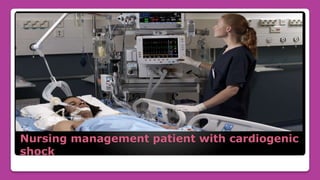
Nursing management patient with cardiogenic
shock
Nursing management patient with cardiogenic
shock.
* Clinical assessment begins with attention to the
airway/breathing/circulation and vital signs.
Nursing management patient with cardiogenic shock.
1. Identify patients at risk for development of
cardiogenic shock.
2. Assess for early signs and symptoms of indicative
of shock such as
• (Restlessness, confusion, or change in mental status)
• ( Increasing HR & decreasing pulse pressure)
• ( Degreasing urine output etc)
2. Administer safe and accurate IV
fluids and medications.
3. Documents and records medications
and treatment that are administered
as well as the patient response to
treatment.
Patients receiving thrombolytic therapy
must be monitored for bleeding.
Arterial and venous puncture sites must
be observed for bleeding, and pressure
must be applied at the sites if bleeding
occurs.
Neurologic assessment is essential after
the administration of thrombolytic
therapy to assess for the potential
complications of cerebral hemorrhage
associated with the therapy.
Urine output
BUN
Sr creatinine levels should be
monitored.
Maintain mechanical assistive devices
function
 Prevent complications associated with
cardiogenic shock.
Enhancing safety and comfort.
Nursing diagnosis
1. Decreased cardiac output related to
impaired contractility due to
extensive heart muscle damage.
2. Impaired gas exchange related to
pulmonary congestion due to elevated
leftvenricular pressure
Nursing diagnosis
3. Ineffective tissue perfusion ( renal,
cerebral, cardiopulmonary GI and
peripheral) related to decreased blood flow.
4. Anxiety related to intensive care
environment and invasive procedures.
Nursing interventions
1. Improving cardiac output
• Establish continuous ECG monitoring
• Hemodynamic monitoring
• Closely monitor adverse response to drug therapy
• Monitor BP & MAP with intra-arterial line
continuously.
• Measure and record intake and urine out put
•
 Nursing interventions
2. Improving oxygenation
* Monitor rate and rhythm of respiratory every hour.
* Auscultation lung fields for abnormal sounds
* ABG evaluation
* Administer oxygen
* Invasive oxygen therapies (ET & MV)
Nursing interventions
3. Marinating adequate Tissue perfusion
• Perform neurologic assessment every hour using
with “Glasgow coma scale” ( GCS)
• Report changes immediately
• Obtain BUN & creatinine blood levels & monitor
output to evaluate renal function
 Nursing interventions
4. Reliving anxiety

Cardiogenic shock

  • 1.
    CARDIOGENIC SHOCK.. Mr. ANILKUMARB R Ms.c. Nursing Medical-surgical nursing Lecturer Yenepoya Nursing College
  • 2.
     Cardiogenic shockis the failure of heart to pump blood adequately to meet the oxygenation needs of the body. It occurs when the heart muscle loses its contractile power.  It most commonly occurs in association with, and as a direct result of , acute myocardial infarction (AMI).
  • 3.
  • 4.
     The causesof cardiogenic shock are known as either “ Coronary or Non coronary.”  Coronary cardiogenic shock is more common than non Coronary cardiogenic shock and it’s seen most often in patients with MI.
  • 5.
    Coronary cardiogenic shockoccurs when the significant amount of the left ventricular myocardium has been damaged.
  • 6.
     Non coronarycardiogenic shock caused by mainly following conditions. • Conditions that stress the myocardium.. • E.g. severe hypoxemia • Acidosis • Hypoglycemia Hypoglycemia and Tension pneumothorax
  • 7.
    Ineffective myocardial function.. E.gcardiomyopathies Valvular damage Cardiac temponode Dysrhythmias
  • 9.
    Clinical manifestations  Confusion,restlessness, mental lethargy ( due to poor perfusion of brain)  Low SBP  Oliguria ( urine output less than 30ml/hr( due to decrease perfusion of kidneys) 
  • 10.
    Clinical manifestations Chest pain(due to lack of oxygen and blood to heart muscle)  Cold ,clammy skin  Weak ,thready peripheral pulses  Dispend , tachypnea, cyanosis
  • 11.
     Patients incardiogenic shock may experience the pain of angina and develop Dysrhythmias and hemodynamic instability.  The classic signs and symptoms of cardiogenic shock, the heart muscle loses, it’s contractle power, resulting in a marked reduction of SV and CO.
  • 12.
     Continue… The decreasedCO in turn reduce arterial BP and tissue perfusion in the vital organs (heart, brain, lung and kidneys) Cerebral hypoxia due to decrease Cerebral tissue perfusion (restlessness, confusion and agitation)
  • 13.
     Continue… . Low BP, rapid or weak pulse, cold and clammy skin, Tachypnea with respiratory crackles and decrease urinary output and initial ABG shows respiratory alkalosis.
  • 14.
     Dysrhythmias, SOB,weak thready pulse, sweating, cold hand and feet and urine out put less than 30 ml/hrs.
  • 15.
    Complications of cardiogenicshock… 1. Severe brain damage (due to decrease Cerebral tissue perfusion) 2. Kidneys damage (decrease renal tissue perfusion) 3. Liver damage 4. MOF (Multiple organs failure) 5. Coma and death. 6. Acute respiratory distress syndrome
  • 16.
    Diagnosis of cardiogenicshock • Blood pressure • ECG • Echocardiogram • Chest x-ray • Cardiac enzyme test ( CPK-MB, cTn-I)
  • 17.
     Coronary angiography Pulmonary artery catheterization  Lab- ABG, LFT & Renal function test
  • 19.
     The goalof medical management in cardiogenic shock are..  To limit further myocardial damage and preserve the healthy myocardium.  To improve the cardiac function by increasing cardiac contractility, decreasing ventricular after load or both.
  • 20.
     In generalthis goals are achieved by increasing oxygen supply to the heart muscle while reducing oxygen demands.
  • 22.
    Initiation of First-linetreatment. First line treatment of cardiogenic shock involves the following actions. • Supplying supplemental oxygen • Controlling chest pain • Providing selected fluid support • Administrating vasoactive medications
  • 23.
     Continue.. • Controllingheart rate with medications or by implementation of a transthoracic or IV pacemaker • Implementing mechanical Cardiac support (intra -aortic balloon counter pulsation therapy, or extracorporeal cardio pulmonary bypass. (CPB)
  • 24.
  • 25.
    Oxygenation In the earlystages of shock, supplemental oxygen is administered by Nasal canula at rate of 2 to 6 L/min to achieve an oxygen saturation exceeding 90%. * Monitoring of ABGs valves and pulse oximetry valves helps determine whether the patient requires a more aggressive method of oxygen therapy.
  • 26.
    Pain control: * Ifa patient experience chest pain, IV morphine sulfate is administered for pain relief. Morphine also decreases the patient’s anxiety.
  • 27.
    Hemodynamic monitoring Hemodynamic monitoringis initiated to assess the patient’s response to treatment.
  • 28.
    Laboratory marker monitoring Laboratorymarkers for ventricular dysfunction (BNP) and cardiac enzyme levels ( CPK-MB & cTn-I) are measured, and serial 12 lead ECG are obtained to assess the degree of myocardial damage.
  • 29.
    Pharmacologic therapy Vasoactive medicationtherapy consists of multiple pharmacologic strategies to restore and maintain adequate cardiac output.
  • 30.
    Continue.. In Coronary cardiogenicshock, the aims of vasoactive medications are improved cardiac contractility, decreased preloaded, afterload and stabilize heart rate and rhythm.
  • 31.
     Positive inotropicdrugs (epinephrine, dopamine, dobutaminen, amrinone, milrinone)  Others medications including  Antiarrhythmic medications  Fluid therapy
  • 32.
    Mechanical assitve devices Ifcardiac output does not improve despite supplemental oxygen, vasoactive medications and fluid therapy, mechanical clinical assitve devices are used temporarily to improve the heart ability to pump.
  • 33.
     IABP (Intra– arotic balloon counterpulsation) The goals of IABP include the following..  Increased SV  Improved coronary artery perfusion  Decreased preload  Decreased cardiac work load
  • 34.
    And decreased myocardialoxygen demand..
  • 35.
    Surgical management • CABG(coronary artery bypass graft) • Replacement of faulty cardiac value
  • 36.
    Human heart transplantationmay be the only option remaining for a patient who has cardiogenic shock and who can not be weaned from mechanical assitve devices..
  • 37.
    Nursing management patientwith cardiogenic shock
  • 38.
    Nursing management patientwith cardiogenic shock. * Clinical assessment begins with attention to the airway/breathing/circulation and vital signs.
  • 39.
    Nursing management patientwith cardiogenic shock. 1. Identify patients at risk for development of cardiogenic shock. 2. Assess for early signs and symptoms of indicative of shock such as • (Restlessness, confusion, or change in mental status) • ( Increasing HR & decreasing pulse pressure) • ( Degreasing urine output etc)
  • 40.
    2. Administer safeand accurate IV fluids and medications. 3. Documents and records medications and treatment that are administered as well as the patient response to treatment.
  • 41.
    Patients receiving thrombolytictherapy must be monitored for bleeding. Arterial and venous puncture sites must be observed for bleeding, and pressure must be applied at the sites if bleeding occurs.
  • 42.
    Neurologic assessment isessential after the administration of thrombolytic therapy to assess for the potential complications of cerebral hemorrhage associated with the therapy.
  • 43.
    Urine output BUN Sr creatininelevels should be monitored.
  • 44.
    Maintain mechanical assistivedevices function  Prevent complications associated with cardiogenic shock. Enhancing safety and comfort.
  • 45.
    Nursing diagnosis 1. Decreasedcardiac output related to impaired contractility due to extensive heart muscle damage. 2. Impaired gas exchange related to pulmonary congestion due to elevated leftvenricular pressure
  • 46.
    Nursing diagnosis 3. Ineffectivetissue perfusion ( renal, cerebral, cardiopulmonary GI and peripheral) related to decreased blood flow. 4. Anxiety related to intensive care environment and invasive procedures.
  • 47.
    Nursing interventions 1. Improvingcardiac output • Establish continuous ECG monitoring • Hemodynamic monitoring • Closely monitor adverse response to drug therapy • Monitor BP & MAP with intra-arterial line continuously. • Measure and record intake and urine out put •
  • 48.
     Nursing interventions 2.Improving oxygenation * Monitor rate and rhythm of respiratory every hour. * Auscultation lung fields for abnormal sounds * ABG evaluation * Administer oxygen * Invasive oxygen therapies (ET & MV)
  • 49.
    Nursing interventions 3. Marinatingadequate Tissue perfusion • Perform neurologic assessment every hour using with “Glasgow coma scale” ( GCS) • Report changes immediately • Obtain BUN & creatinine blood levels & monitor output to evaluate renal function
  • 50.