PROSTATE TUMOUR
OR CANCER
BY
Mr. ANILKUMAR B R . Assit Professor
Medical surgical nursing
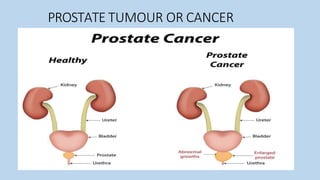
PROSTATE TUMOUR OR CANCER
Prostate cancer
Prostate cancer or tumor is the most common
cancer in men other than non-melanoma skin
cancer.
The majority (more than 75%) of cases occur in
men over age 65.
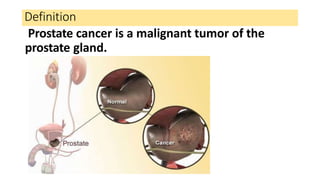
Definition
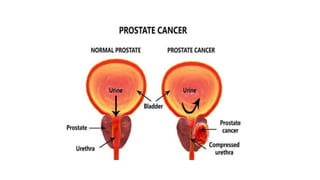
Prostate cancer is a malignant tumor of the
prostate gland.
EtioPathophysiology
1. Risk factors for prostate cancer including
increasing age, the incidence of prostate cancer
increase rapidly after the age of 50 years. And
more than 70% cases occur in men older than 65
year of age.
EtioPathophysiology
2. A Familial predisposition may occur in men
who have a father or brother previously
diagnosed with prostate cancer or tumor.
4. The risk of prostate cancer is also greater in
men who consume diet contain excessive
amounts of red meat, animal fat, dairy products
that are high in fat.
EtioPathophysiology
5.Obesity, smoking and excessive alcohol intake also
contribute factors of prostate cancer.
6.Age, Ethnicity, family history are three non –
modifiable risk factors. Although occupational
exposure to chemicals (e.g. cadmium), a history of
BPH is not a risk factor for prostate cancer.
7.The influence of dietary fat intake esp. animal fat
intake, serum testosterone levels, and industrial
exposure to carcinogens are investigation.
Continue
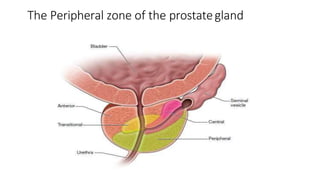
The majority of tumor occur in the outer aspect of
the prostate gland or peripheral zone of the
prostate gland
Prostate cancer is usually slow growing.
It can spread by mainly three routes:
1. Direct extension
2. Through the lymph system and
3. Through blood stream.
The Peripheral zone of the prostategland
Continue
•If prostate cancer spread through direct extension
involves the seminal vesicles , urethral mucosa,
bladder wall and external sphincter . The cancer
later spreads through the lymphatic system.
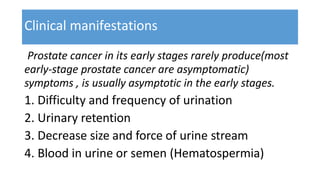
Clinical manifestations
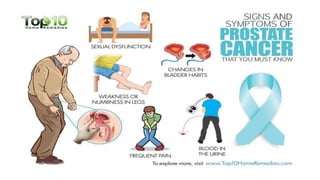
Prostate cancer in its early stages rarely produce(most
early-stage prostate cancer are asymptomatic)
symptoms , is usually asymptotic in the early stages.
1. Difficulty and frequency of urination
2. Urinary retention
3. Decrease size and force of urine stream
4. Blood in urine or semen (Hematospermia)
Clinical manifestations
4. Pain full sperm ejaculation
5. Hematuria
6. Dysuria and Nocturia
7. Dribbling of urine and Urgency
Clinical manifestations
6. Prostate cancer can metastasis or metastasize to
bone and lymph nodes, Symptoms related to
metastasis include:
Backache, hip pain, renal discomfort, anemia, weight
loss, weakness, Nausea and oliguria.
Assessment and diagnostic findings
• History collection
• Physical examination
The two primary diagnostic tool are:
1.DRE (Digital rectal examination) Prostate can felt
through the wall of the rectum, hard nodule may be
felt.
2.PSA (prostatic specific antigen)
•Biopsy of prostate tissue is necessary to confirm the
diagnosis of prostate cancer.
Assessment and diagnostic findings
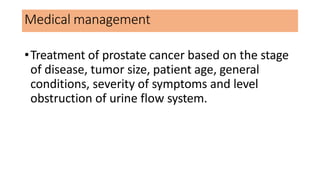
3.TRUS (Transrectal ultrasound) A transrectal ultrasound
(TRUS) may also be called prostate sonogram or
endorectal ultrasound. It is used to look at the prostate
and tissues around it.
4. CT and MRI
5. Bone scan
TRUS (Transrectal ultrasound)
Medical management
•Treatment of prostate cancer based on the stage
of disease, tumor size, patient age, general
conditions, severity of symptoms and level
obstruction of urine flow system.
Objective of the medical Management
•Reduce symptoms associated with prostate cancer
and cure if in early stage
• Improve quality of life
•Prevent complications associated with PCA and
it’s treatment
•Improve sexual function
Complications
• Hemorrhage and hypovolemic shock
• Infection
• DVT (Deep venous thrombosis)
• Pulmonary embolism
• Sexual dysfunction
Collaborative therapy patients with prostate
cancer
STAGE A
1.Watchful waiting with annual PSA & DRE
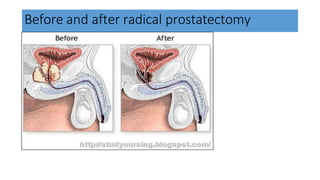
2.Radical prostatectomy ( in the radical
prostatectomy, the entire prostate gland, seminal
vesicles, and part of the bladder neck (ampulla) are
removed.
Conti
•A radical prostatectomy is the surgical procedure
considered the most effective treatment for long -
term survival.
•Thus it is the preferred treatment for men younger
than 70 years of age who are good health and
prostate cancer in first or second stage.
Continue
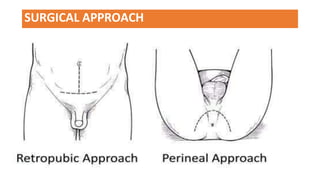
•The two most common approaches for radical
prostatectomy.
•Retro pubic radical prostatectomy (more
common)
•Perineal radical prostatectomy
SURGICAL APPROACH
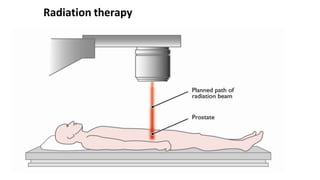
Radiation therapy
Possible side effects of Radiation therapy
1. Erectile Dysfunction : Radiotherapy can affect the nerves
surrounding the prostate that control a man’s erections.
2. Urinary problems : Radiotherapy does not usually cause
urinary incontinence but sometimes it may cause a narrowing
of the urethra which may then cause difficulties passing urine.
This tends to occur some years following treatment.
3.Bowel problems : Radiotherapy can cause inflammation to the
lining of the rectum in a small percentage of men. This may be
temporary or occasionally permanent. It may cause bleeding from
the back passage or the need to go to the toilet to pass stool more
frequently.
STAGE B
1. Radical prostatectomy
2. Radiation therapy
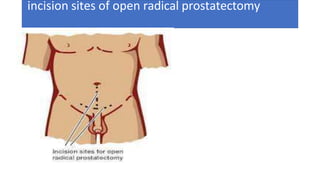
incision sites of open radical prostatectomy
Before and after radical prostatectomy
STAGE C
•Radical prostatectomy
•Radiation therapy
•Hormonal therapy ( Prostate cancer growth is
largely dependent on the presence of
androgens.
•Therfore androgen deprivation is a primary
therapeutic approach in some cases)
CONTINUE
• Orchiectomy ( is a surgical removal of the testis that
may be done alone or in combination with
prostatectomy).
•Side effects of orchiectomy include erectile
dysfunction, loss of sex drive and hot flashes.
STAGE D
• Hormone therapy
• orchiectomy
• Chemotherapy
• Radiation therapy to metastatic bone areas.
Nursing management patients with prostatecancer
A) Nursing assessment
1.History collection
2.Physical examination regarding presenting urinary
problems, voiding functions, UTI, urinary retention,
Dysuria
3. Obtain family history of PCA
4.Nutritional assessment and life style
Pre operative nursing diagnosis
1.Anxiety about surgery, medical therapies and it’s out
come related to diagnosed with prostate cancer.
2. Acute pain related to bladder distention.
3.Deficient knowledge about factors related to disorder
and treatment protocol.
Post operative nursing diagnosis
4.Acute pain related to surgical incision, catheter
placement and bladder spasms
5.Deficient knowledge about post operative care and
management
6.Risk for infection related to surgical site, urinary
catheter and drainage and secondary to imbalanced
nutritional status
7.Deficient knowledge related to medications,
infection preventive techniques and signs and
symptoms of complications.

Prostate cancer

  • 1.
    PROSTATE TUMOUR OR CANCER BY Mr.ANILKUMAR B R . Assit Professor Medical surgical nursing
  • 2.
  • 3.
    Prostate cancer Prostate canceror tumor is the most common cancer in men other than non-melanoma skin cancer. The majority (more than 75%) of cases occur in men over age 65.
  • 4.
    Definition Prostate cancer isa malignant tumor of the prostate gland.
  • 6.
    EtioPathophysiology 1. Risk factorsfor prostate cancer including increasing age, the incidence of prostate cancer increase rapidly after the age of 50 years. And more than 70% cases occur in men older than 65 year of age.
  • 7.
    EtioPathophysiology 2. A Familialpredisposition may occur in men who have a father or brother previously diagnosed with prostate cancer or tumor. 4. The risk of prostate cancer is also greater in men who consume diet contain excessive amounts of red meat, animal fat, dairy products that are high in fat.
  • 8.
    EtioPathophysiology 5.Obesity, smoking andexcessive alcohol intake also contribute factors of prostate cancer. 6.Age, Ethnicity, family history are three non – modifiable risk factors. Although occupational exposure to chemicals (e.g. cadmium), a history of BPH is not a risk factor for prostate cancer. 7.The influence of dietary fat intake esp. animal fat intake, serum testosterone levels, and industrial exposure to carcinogens are investigation.
  • 9.
    Continue The majority oftumor occur in the outer aspect of the prostate gland or peripheral zone of the prostate gland Prostate cancer is usually slow growing. It can spread by mainly three routes: 1. Direct extension 2. Through the lymph system and 3. Through blood stream.
  • 10.
    The Peripheral zoneof the prostategland
  • 11.
    Continue •If prostate cancerspread through direct extension involves the seminal vesicles , urethral mucosa, bladder wall and external sphincter . The cancer later spreads through the lymphatic system.
  • 12.
    Clinical manifestations Prostate cancerin its early stages rarely produce(most early-stage prostate cancer are asymptomatic) symptoms , is usually asymptotic in the early stages. 1. Difficulty and frequency of urination 2. Urinary retention 3. Decrease size and force of urine stream 4. Blood in urine or semen (Hematospermia)
  • 13.
    Clinical manifestations 4. Painfull sperm ejaculation 5. Hematuria 6. Dysuria and Nocturia 7. Dribbling of urine and Urgency
  • 14.
    Clinical manifestations 6. Prostatecancer can metastasis or metastasize to bone and lymph nodes, Symptoms related to metastasis include: Backache, hip pain, renal discomfort, anemia, weight loss, weakness, Nausea and oliguria.
  • 16.
    Assessment and diagnosticfindings • History collection • Physical examination The two primary diagnostic tool are: 1.DRE (Digital rectal examination) Prostate can felt through the wall of the rectum, hard nodule may be felt. 2.PSA (prostatic specific antigen) •Biopsy of prostate tissue is necessary to confirm the diagnosis of prostate cancer.
  • 17.
    Assessment and diagnosticfindings 3.TRUS (Transrectal ultrasound) A transrectal ultrasound (TRUS) may also be called prostate sonogram or endorectal ultrasound. It is used to look at the prostate and tissues around it. 4. CT and MRI 5. Bone scan
  • 18.
  • 19.
    Medical management •Treatment ofprostate cancer based on the stage of disease, tumor size, patient age, general conditions, severity of symptoms and level obstruction of urine flow system.
  • 20.
    Objective of themedical Management •Reduce symptoms associated with prostate cancer and cure if in early stage • Improve quality of life •Prevent complications associated with PCA and it’s treatment •Improve sexual function
  • 21.
    Complications • Hemorrhage andhypovolemic shock • Infection • DVT (Deep venous thrombosis) • Pulmonary embolism • Sexual dysfunction
  • 22.
    Collaborative therapy patientswith prostate cancer STAGE A 1.Watchful waiting with annual PSA & DRE 2.Radical prostatectomy ( in the radical prostatectomy, the entire prostate gland, seminal vesicles, and part of the bladder neck (ampulla) are removed.
  • 23.
    Conti •A radical prostatectomyis the surgical procedure considered the most effective treatment for long - term survival. •Thus it is the preferred treatment for men younger than 70 years of age who are good health and prostate cancer in first or second stage.
  • 24.
    Continue •The two mostcommon approaches for radical prostatectomy. •Retro pubic radical prostatectomy (more common) •Perineal radical prostatectomy
  • 25.
  • 26.
  • 27.
    Possible side effectsof Radiation therapy 1. Erectile Dysfunction : Radiotherapy can affect the nerves surrounding the prostate that control a man’s erections. 2. Urinary problems : Radiotherapy does not usually cause urinary incontinence but sometimes it may cause a narrowing of the urethra which may then cause difficulties passing urine. This tends to occur some years following treatment. 3.Bowel problems : Radiotherapy can cause inflammation to the lining of the rectum in a small percentage of men. This may be temporary or occasionally permanent. It may cause bleeding from the back passage or the need to go to the toilet to pass stool more frequently.
  • 28.
    STAGE B 1. Radicalprostatectomy 2. Radiation therapy
  • 29.
    incision sites ofopen radical prostatectomy
  • 30.
    Before and afterradical prostatectomy
  • 31.
    STAGE C •Radical prostatectomy •Radiationtherapy •Hormonal therapy ( Prostate cancer growth is largely dependent on the presence of androgens. •Therfore androgen deprivation is a primary therapeutic approach in some cases)
  • 32.
    CONTINUE • Orchiectomy (is a surgical removal of the testis that may be done alone or in combination with prostatectomy). •Side effects of orchiectomy include erectile dysfunction, loss of sex drive and hot flashes.
  • 33.
    STAGE D • Hormonetherapy • orchiectomy • Chemotherapy • Radiation therapy to metastatic bone areas.
  • 34.
    Nursing management patientswith prostatecancer A) Nursing assessment 1.History collection 2.Physical examination regarding presenting urinary problems, voiding functions, UTI, urinary retention, Dysuria 3. Obtain family history of PCA 4.Nutritional assessment and life style
  • 35.
    Pre operative nursingdiagnosis 1.Anxiety about surgery, medical therapies and it’s out come related to diagnosed with prostate cancer. 2. Acute pain related to bladder distention. 3.Deficient knowledge about factors related to disorder and treatment protocol.
  • 36.
    Post operative nursingdiagnosis 4.Acute pain related to surgical incision, catheter placement and bladder spasms 5.Deficient knowledge about post operative care and management 6.Risk for infection related to surgical site, urinary catheter and drainage and secondary to imbalanced nutritional status 7.Deficient knowledge related to medications, infection preventive techniques and signs and symptoms of complications.