SHOCK
Presenter: Dr.Vasireddy
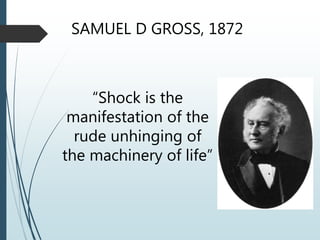
SAMUEL D GROSS, 1872
“Shock is the
manifestation of the
rude unhinging of
the machinery of life”
HISTORICAL PERSPECTIVE
 Ambroise Paré (1510) – Fluids to injured patients
 ‘Shock’ – 1743 – act of impact/ collision
 Guthrie (1815) – described physiological instability
 Crile (1899) – 1st successful direct Blood transfusion
 Claude Bernard – Milieu intérieur
 Walter B. Cannon – Homeostasis
 Alfred Blalock (1934) – 4 categories of shock
 Carl John Wiggers (1950) – Wiggers prep
Definition
 “a clinical syndrome that results from
inadequate tissue perfusion.”
 Failure of delivery or utilization of O2 causing loss
of cellular viability is central to the concept of
shock and its pathogenesis
4
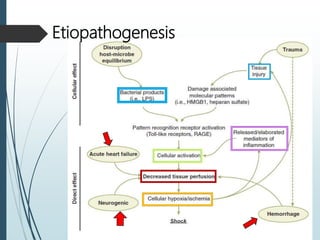
Etiopathogenesis
Classification
 Hypovolemic shock - Blood or fluid loss, both leading to a decreased
circulating blood volume, diastolic filling pressure, and volume.
 Cardiogenic shock - due to cardiac pump failure related to loss of
myocardial contractility/functional myocardium or structural/mechanical
failure of the cardiac anatomy and characterized by elevations of diastolic
filling pressures and volumes
 Extra-cardiac/obstructive shock - due to obstruction to flow in the
cardiovascular circuit and characterized by either impairment of diastolic
filling or excessive afterload
 Distributive shock - caused by loss of vasomotor control resulting in
arteriolar/venular dilatation leading to a decrease in preload, with
decreased, normal, or elevated cardiac output, depending on the presence
of myocardial depression.
Cardiogenic Shock
 Cardiogenic shock is defined by, a decrease in systemic oxygen
delivery caused by an acute or chronic deterioration of cardiac
function due to myocardial, valvular, structural, toxic, or
infectious causes.
 In-hospital mortality rates >50%
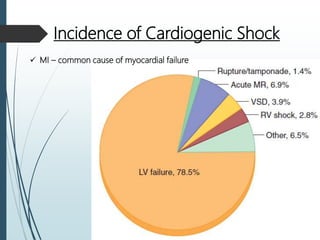
Incidence of Cardiogenic Shock
 MI – common cause of myocardial failure
Pathophysiology
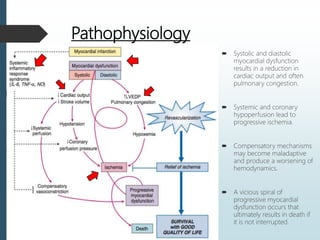
 Systolic and diastolic
myocardial dysfunction
results in a reduction in
cardiac output and often
pulmonary congestion.
 Systemic and coronary
hypoperfusion lead to
progressive ischemia.
 Compensatory mechanisms
may become maladaptive
and produce a worsening of
hemodynamics.
 A vicious spiral of
progressive myocardial
dysfunction occurs that
ultimately results in death if
it is not interrupted.
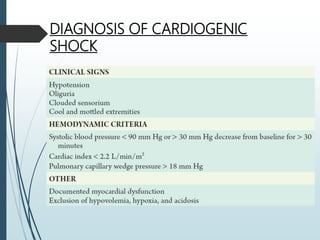
DIAGNOSIS OF CARDIOGENIC
SHOCK
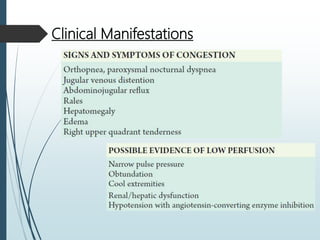
Clinical Manifestations
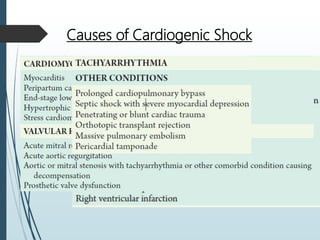
Causes of Cardiogenic Shock
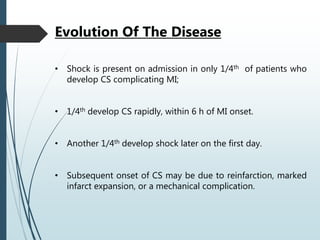
• Shock is present on admission in only 1/4th of patients who
develop CS complicating MI;
• 1/4th develop CS rapidly, within 6 h of MI onset.
• Another 1/4th develop shock later on the first day.
• Subsequent onset of CS may be due to reinfarction, marked
infarct expansion, or a mechanical complication.
Evolution Of The Disease
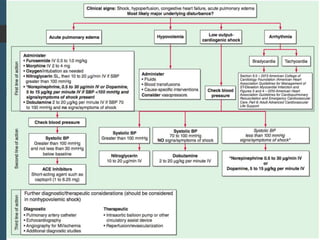
Initial Therapy
Goal:
 Maintain/Regain adequate systemic and
coronary perfusion by raising systemic BP with
vasopressors and adjusting volume status to a
level that ensures optimum LV filling pressure.
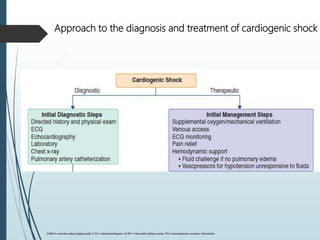
Approach to the diagnosis and treatment of cardiogenic shock
CABG = coronary artery bypass graft; E CG = electrocardiogram; IA BP = intra-aortic balloon pump; PCI = percutaneous coronary intervention.
Laboratory Findings
 white blood cell count is typically elevated
 Renal function is initially unchanged, but BUN & creatinine rise
progressively.
 Hepatic transaminases are elevated due to liver hypoperfusion.
 lactic acid level - elevated.
 ABG - hypoxemia and anion gap metabolic acidosis,
compensated by respiratory alkalosis.
 Cardiac markers, creatine phosphokinase and its MB fraction, and
troponins I and T are typically markedly elevated.
ELECTROCARDIOGRAM
 In CS due to acute MI with LV failure, Q waves
and/or >2-mm ST elevation in multiple leads
or LBBB are usually present.
 More than 60% of all infarcts associated with
shock are anterior.
 Global ischemia usually is accompanied by
severe (e.g., >3 mm) ST depressions in
multiple leads.
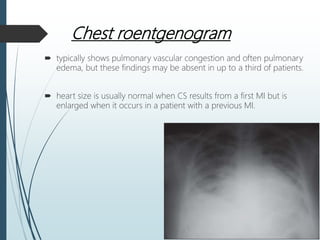
Chest roentgenogram
 typically shows pulmonary vascular congestion and often pulmonary
edema, but these findings may be absent in up to a third of patients.
 heart size is usually normal when CS results from a first MI but is
enlarged when it occurs in a patient with a previous MI.
Echocardiogram
 2D Echo with color-flow Doppler helps define the
etiology.
 Doppler mapping demonstrates
 left-to-right shunt in patients with VSR
 severity of MR
 Proximal aortic dissection with aortic regurgitation or
tamponade may be visualized,
 evidence for pulmonary embolism
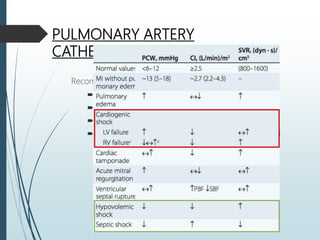
PULMONARY ARTERY
CATHETERIZATION
Recommended for
 measurement of filling pressures
 cardiac output
 to confirm the diagnosis
 and to optimize the use of IV fluids, inotropic agents, and
vasopressors in persistent shock.
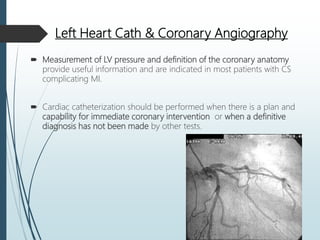
Left Heart Cath & Coronary Angiography
 Measurement of LV pressure and definition of the coronary anatomy
provide useful information and are indicated in most patients with CS
complicating MI.
 Cardiac catheterization should be performed when there is a plan and
capability for immediate coronary intervention or when a definitive
diagnosis has not been made by other tests.
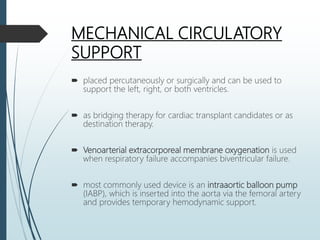
MECHANICAL CIRCULATORY
SUPPORT
 placed percutaneously or surgically and can be used to
support the left, right, or both ventricles.
 as bridging therapy for cardiac transplant candidates or as
destination therapy.
 Venoarterial extracorporeal membrane oxygenation is used
when respiratory failure accompanies biventricular failure.
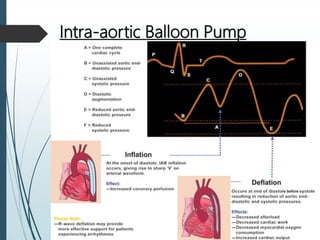
 most commonly used device is an intraaortic balloon pump
(IABP), which is inserted into the aorta via the femoral artery
and provides temporary hemodynamic support.
Intra-aortic Balloon Pump
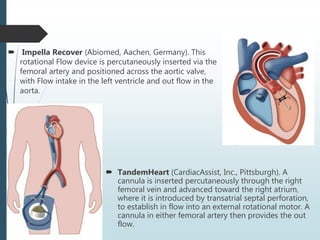
 Impella Recover (Abiomed, Aachen, Germany). This
rotational Flow device is percutaneously inserted via the
femoral artery and positioned across the aortic valve,
with Flow intake in the left ventricle and out flow in the
aorta.
 TandemHeart (CardiacAssist, Inc., Pittsburgh). A
cannula is inserted percutaneously through the right
femoral vein and advanced toward the right atrium,
where it is introduced by transatrial septal perforation,
to establish in flow into an external rotational motor. A
cannula in either femoral artery then provides the out
flow.
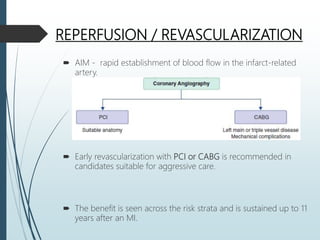
REPERFUSION / REVASCULARIZATION
 AIM - rapid establishment of blood flow in the infarct-related
artery.
 Early revascularization with PCI or CABG is recommended in
candidates suitable for aggressive care.
 The benefit is seen across the risk strata and is sustained up to 11
years after an MI.
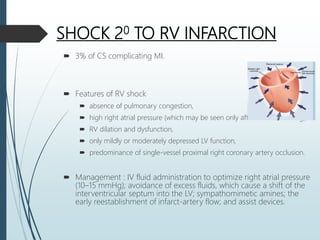
SHOCK 20 TO RV INFARCTION
 3% of CS complicating MI.
 Features of RV shock
 absence of pulmonary congestion,
 high right atrial pressure (which may be seen only after volume loading),
 RV dilation and dysfunction,
 only mildly or moderately depressed LV function,
 predominance of single-vessel proximal right coronary artery occlusion.
 Management : IV fluid administration to optimize right atrial pressure
(10–15 mmHg); avoidance of excess fluids, which cause a shift of the
interventricular septum into the LV; sympathomimetic amines; the
early reestablishment of infarct-artery flow; and assist devices.
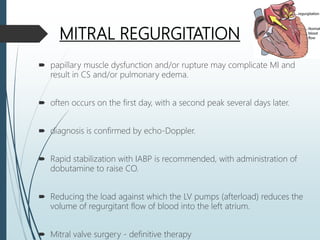
MITRAL REGURGITATION
 papillary muscle dysfunction and/or rupture may complicate MI and
result in CS and/or pulmonary edema.
 often occurs on the first day, with a second peak several days later.
 diagnosis is confirmed by echo-Doppler.
 Rapid stabilization with IABP is recommended, with administration of
dobutamine to raise CO.
 Reducing the load against which the LV pumps (afterload) reduces the
volume of regurgitant flow of blood into the left atrium.
 Mitral valve surgery - definitive therapy
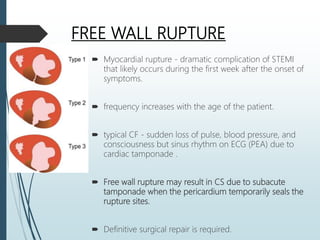
FREE WALL RUPTURE
 Myocardial rupture - dramatic complication of STEMI
that likely occurs during the first week after the onset of
symptoms.
 frequency increases with the age of the patient.
 typical CF - sudden loss of pulse, blood pressure, and
consciousness but sinus rhythm on ECG (PEA) due to
cardiac tamponade .
 Free wall rupture may result in CS due to subacute
tamponade when the pericardium temporarily seals the
rupture sites.
 Definitive surgical repair is required.
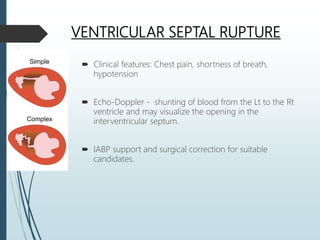
VENTRICULAR SEPTAL RUPTURE
 Clinical features: Chest pain, shortness of breath,
hypotension
 Echo-Doppler - shunting of blood from the Lt to the Rt
ventricle and may visualize the opening in the
interventricular septum.
 IABP support and surgical correction for suitable
candidates.
ACUTE FULMINANT
MYOCARDITIS Myocarditis can mimic acute MI with ST deviation or bundle branch block
, Elevated cardiac enzymes.
 causes CS in a small proportion of cases. Typically younger aged
 often do not have typical ischemic chest pain.
 2D Echo - global LV dysfunction.
 Initial management is the same as for CS complicating acute MI but does
not involve coronary revascularization.
 Endomyocardial biopsy recommended to determine the diagnosis and
need for immunosuppressives for entities such as giant cell myocarditis.
 Refractory CS can be managed with assist devices with or without ECMO.
Extra-cardiac / Obstructive Shock
CARDIAC TAMPONADE
• Ext compression of heart significantly restricts filling , limiting the
CO.
• CF – exaggerated pulsus parodoxus, distended Jugular veins,
muffled heart sounds.
• Common causes – pericardial effusion or a localised
compressing thrombus
• 2D Echo – classic effusion findings, diastolic compression of Rt
heart, variation in mitral inflow velocities.
• Management:
• IV fluid resuscitation to increase BP
• Percutaneous Pericardiocentesis/ Surgical Drianage.
Prognosis
 still the most common cause of death in acute MI.
 Survival rates are improving, however, coincident with the
increasing use of reperfusion therapy in appropriately
selected patients.
 Hemodynamics predict short-term but not long-term
mortality.
 survival benefit of early revascularization is maintained at 6-
year follow-up, with 5-year survival approaching 45%.
 Equality of life in survivors is usually excellent, with 83%
either asymptomatic or having only mildly symptomatic
heart failure.
References
 Harrison’s Principles of Internal Medicine 19th edition
 Goldman Cecil's Medicine, 25th Ed (2016)
 CURRENT Medical Diagnosis and Treatment 2016
 Washington Manual of Critical Care
 Braunwald’s Heart Disease 10th Ed (2015)

Introduction to Shock & Cardiogenic Shock

  • 1.
  • 2.
    SAMUEL D GROSS,1872 “Shock is the manifestation of the rude unhinging of the machinery of life”
  • 3.
    HISTORICAL PERSPECTIVE  AmbroiseParé (1510) – Fluids to injured patients  ‘Shock’ – 1743 – act of impact/ collision  Guthrie (1815) – described physiological instability  Crile (1899) – 1st successful direct Blood transfusion  Claude Bernard – Milieu intérieur  Walter B. Cannon – Homeostasis  Alfred Blalock (1934) – 4 categories of shock  Carl John Wiggers (1950) – Wiggers prep
  • 4.
    Definition  “a clinicalsyndrome that results from inadequate tissue perfusion.”  Failure of delivery or utilization of O2 causing loss of cellular viability is central to the concept of shock and its pathogenesis 4
  • 5.
  • 6.
    Classification  Hypovolemic shock- Blood or fluid loss, both leading to a decreased circulating blood volume, diastolic filling pressure, and volume.  Cardiogenic shock - due to cardiac pump failure related to loss of myocardial contractility/functional myocardium or structural/mechanical failure of the cardiac anatomy and characterized by elevations of diastolic filling pressures and volumes  Extra-cardiac/obstructive shock - due to obstruction to flow in the cardiovascular circuit and characterized by either impairment of diastolic filling or excessive afterload  Distributive shock - caused by loss of vasomotor control resulting in arteriolar/venular dilatation leading to a decrease in preload, with decreased, normal, or elevated cardiac output, depending on the presence of myocardial depression.
  • 7.
    Cardiogenic Shock  Cardiogenicshock is defined by, a decrease in systemic oxygen delivery caused by an acute or chronic deterioration of cardiac function due to myocardial, valvular, structural, toxic, or infectious causes.  In-hospital mortality rates >50%
  • 8.
    Incidence of CardiogenicShock  MI – common cause of myocardial failure
  • 9.
    Pathophysiology  Systolic anddiastolic myocardial dysfunction results in a reduction in cardiac output and often pulmonary congestion.  Systemic and coronary hypoperfusion lead to progressive ischemia.  Compensatory mechanisms may become maladaptive and produce a worsening of hemodynamics.  A vicious spiral of progressive myocardial dysfunction occurs that ultimately results in death if it is not interrupted.
  • 10.
  • 11.
  • 12.
  • 13.
    • Shock ispresent on admission in only 1/4th of patients who develop CS complicating MI; • 1/4th develop CS rapidly, within 6 h of MI onset. • Another 1/4th develop shock later on the first day. • Subsequent onset of CS may be due to reinfarction, marked infarct expansion, or a mechanical complication. Evolution Of The Disease
  • 14.
    Initial Therapy Goal:  Maintain/Regainadequate systemic and coronary perfusion by raising systemic BP with vasopressors and adjusting volume status to a level that ensures optimum LV filling pressure.
  • 15.
    Approach to thediagnosis and treatment of cardiogenic shock CABG = coronary artery bypass graft; E CG = electrocardiogram; IA BP = intra-aortic balloon pump; PCI = percutaneous coronary intervention.
  • 16.
    Laboratory Findings  whiteblood cell count is typically elevated  Renal function is initially unchanged, but BUN & creatinine rise progressively.  Hepatic transaminases are elevated due to liver hypoperfusion.  lactic acid level - elevated.  ABG - hypoxemia and anion gap metabolic acidosis, compensated by respiratory alkalosis.  Cardiac markers, creatine phosphokinase and its MB fraction, and troponins I and T are typically markedly elevated.
  • 17.
    ELECTROCARDIOGRAM  In CSdue to acute MI with LV failure, Q waves and/or >2-mm ST elevation in multiple leads or LBBB are usually present.  More than 60% of all infarcts associated with shock are anterior.  Global ischemia usually is accompanied by severe (e.g., >3 mm) ST depressions in multiple leads.
  • 18.
    Chest roentgenogram  typicallyshows pulmonary vascular congestion and often pulmonary edema, but these findings may be absent in up to a third of patients.  heart size is usually normal when CS results from a first MI but is enlarged when it occurs in a patient with a previous MI.
  • 19.
    Echocardiogram  2D Echowith color-flow Doppler helps define the etiology.  Doppler mapping demonstrates  left-to-right shunt in patients with VSR  severity of MR  Proximal aortic dissection with aortic regurgitation or tamponade may be visualized,  evidence for pulmonary embolism
  • 20.
    PULMONARY ARTERY CATHETERIZATION Recommended for measurement of filling pressures  cardiac output  to confirm the diagnosis  and to optimize the use of IV fluids, inotropic agents, and vasopressors in persistent shock.
  • 21.
    Left Heart Cath& Coronary Angiography  Measurement of LV pressure and definition of the coronary anatomy provide useful information and are indicated in most patients with CS complicating MI.  Cardiac catheterization should be performed when there is a plan and capability for immediate coronary intervention or when a definitive diagnosis has not been made by other tests.
  • 23.
    MECHANICAL CIRCULATORY SUPPORT  placedpercutaneously or surgically and can be used to support the left, right, or both ventricles.  as bridging therapy for cardiac transplant candidates or as destination therapy.  Venoarterial extracorporeal membrane oxygenation is used when respiratory failure accompanies biventricular failure.  most commonly used device is an intraaortic balloon pump (IABP), which is inserted into the aorta via the femoral artery and provides temporary hemodynamic support.
  • 24.
  • 25.
     Impella Recover(Abiomed, Aachen, Germany). This rotational Flow device is percutaneously inserted via the femoral artery and positioned across the aortic valve, with Flow intake in the left ventricle and out flow in the aorta.  TandemHeart (CardiacAssist, Inc., Pittsburgh). A cannula is inserted percutaneously through the right femoral vein and advanced toward the right atrium, where it is introduced by transatrial septal perforation, to establish in flow into an external rotational motor. A cannula in either femoral artery then provides the out flow.
  • 26.
    REPERFUSION / REVASCULARIZATION AIM - rapid establishment of blood flow in the infarct-related artery.  Early revascularization with PCI or CABG is recommended in candidates suitable for aggressive care.  The benefit is seen across the risk strata and is sustained up to 11 years after an MI.
  • 27.
    SHOCK 20 TORV INFARCTION  3% of CS complicating MI.  Features of RV shock  absence of pulmonary congestion,  high right atrial pressure (which may be seen only after volume loading),  RV dilation and dysfunction,  only mildly or moderately depressed LV function,  predominance of single-vessel proximal right coronary artery occlusion.  Management : IV fluid administration to optimize right atrial pressure (10–15 mmHg); avoidance of excess fluids, which cause a shift of the interventricular septum into the LV; sympathomimetic amines; the early reestablishment of infarct-artery flow; and assist devices.
  • 28.
    MITRAL REGURGITATION  papillarymuscle dysfunction and/or rupture may complicate MI and result in CS and/or pulmonary edema.  often occurs on the first day, with a second peak several days later.  diagnosis is confirmed by echo-Doppler.  Rapid stabilization with IABP is recommended, with administration of dobutamine to raise CO.  Reducing the load against which the LV pumps (afterload) reduces the volume of regurgitant flow of blood into the left atrium.  Mitral valve surgery - definitive therapy
  • 29.
    FREE WALL RUPTURE Myocardial rupture - dramatic complication of STEMI that likely occurs during the first week after the onset of symptoms.  frequency increases with the age of the patient.  typical CF - sudden loss of pulse, blood pressure, and consciousness but sinus rhythm on ECG (PEA) due to cardiac tamponade .  Free wall rupture may result in CS due to subacute tamponade when the pericardium temporarily seals the rupture sites.  Definitive surgical repair is required.
  • 30.
    VENTRICULAR SEPTAL RUPTURE Clinical features: Chest pain, shortness of breath, hypotension  Echo-Doppler - shunting of blood from the Lt to the Rt ventricle and may visualize the opening in the interventricular septum.  IABP support and surgical correction for suitable candidates.
  • 31.
    ACUTE FULMINANT MYOCARDITIS Myocarditiscan mimic acute MI with ST deviation or bundle branch block , Elevated cardiac enzymes.  causes CS in a small proportion of cases. Typically younger aged  often do not have typical ischemic chest pain.  2D Echo - global LV dysfunction.  Initial management is the same as for CS complicating acute MI but does not involve coronary revascularization.  Endomyocardial biopsy recommended to determine the diagnosis and need for immunosuppressives for entities such as giant cell myocarditis.  Refractory CS can be managed with assist devices with or without ECMO.
  • 32.
    Extra-cardiac / ObstructiveShock CARDIAC TAMPONADE • Ext compression of heart significantly restricts filling , limiting the CO. • CF – exaggerated pulsus parodoxus, distended Jugular veins, muffled heart sounds. • Common causes – pericardial effusion or a localised compressing thrombus • 2D Echo – classic effusion findings, diastolic compression of Rt heart, variation in mitral inflow velocities. • Management: • IV fluid resuscitation to increase BP • Percutaneous Pericardiocentesis/ Surgical Drianage.
  • 33.
    Prognosis  still themost common cause of death in acute MI.  Survival rates are improving, however, coincident with the increasing use of reperfusion therapy in appropriately selected patients.  Hemodynamics predict short-term but not long-term mortality.  survival benefit of early revascularization is maintained at 6- year follow-up, with 5-year survival approaching 45%.  Equality of life in survivors is usually excellent, with 83% either asymptomatic or having only mildly symptomatic heart failure.
  • 34.
    References  Harrison’s Principlesof Internal Medicine 19th edition  Goldman Cecil's Medicine, 25th Ed (2016)  CURRENT Medical Diagnosis and Treatment 2016  Washington Manual of Critical Care  Braunwald’s Heart Disease 10th Ed (2015)