
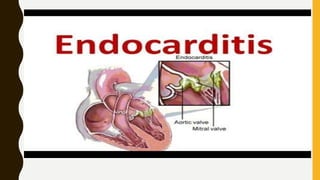
ENDOCARDITIS
A N I L K U M A R B R
L E C T U R E R ( M S N )
INTRODUCTION
•The heart is a major vital organ that pumps
blood and it’s has three layers which are
•ENDOCARIDIUM
•MYOCARDIUM
•PERICARDIUM
DEFINITION
Endocarditis is characterized by
inflammation of the endocardium it
usually involves the valves of the heart.
ETIOLOGY
Common infecting organisms include
“ Staphylococci (s.aureus, s. faecalis and
s.epidermidis.)
“ Fungus, e.g. candida, aspagellus
“gram negative orginsms e.g Pseudomonas
“Bactrias (e.g Staphylococci)
CONTINUE
This orginsms enter the body through the
oral cavity after dental procedures, mouth or
tooth abscess, oral irrigations, or irritations
from dental floss or bridge work.
CONTINUE
The upper respiratory tract is another port of entry
following conditions.
• Intubations or infectious
• Direct exposure of the blood stream orginsms can occur
with prolonged central line cathter or indwelling urinary
catheter
• Hemodynamic monitoring catheter and IV drug users
CONTINUE
Procedure including the gastrointestinal
and genitourinary tracts (e.g barium
enema, sigmoidoscopy, clonoscopy,
Percutaneous liver biopsy have been
associated with endocarditis.
RISK FACTORS
• Previous heart damage
• Dental procedures which lead into the introduction
of bactrias
• Heart surgery
• Endotracheal intubation
• Procedure involving the gastrointestinal and
genitourinary tracts
PATHOPHYSILOGY
• In this cause of the bactrias or any other
causing agents enter the blood stream through
Invasive procedure like dental procedures,
surgery, Endotracheal intubation and urinary
catheter.
• Then they accumulate on the valves of the
heart or endocardium
CONTINUE
• Finally they form vegetations and clusters
• These vegetations they lead into damage heart
valves by perforating and deforming the valves
leaflets
• This at the end leads to tearing which means there
is poor flow of blood and accumulation of blood in
chambers of the heart hence endocarditis
CLINICAL MANIFESTATIONS
• Fever, chils alternating with sweats
• Malaise and weakness
• Anorexia and weight loss
• Pallor
• Backache and splenomegally
• Shortness of breath and chest and abdominal pain
OTHER SYMPTOMS
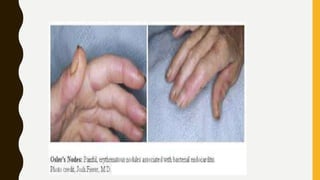
•Slernodes (a small, painful nodules on pads
of finger)
NAIL HEMORRHAGE (SPLINTER
HEMORRHAGE)
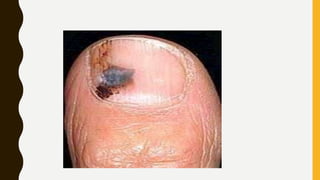
• Small inner hemorrhages under the
nails that are usually asymptotic and
found in some patients.
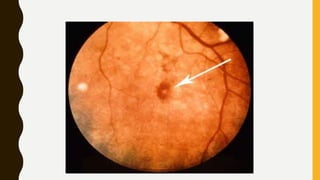
ROTHS SPOTS
• Oval shaped white centerd
hemorrhages present in the retina.
ASSASSESSMENT AND DIAGNOSTIC
FINDINGS
• History collection
• Physical examination
• Blood culture
• Urinalysis
• Doppler Echocardiography
• CT scan
• BUN and creatine
• WBC
CONTINUE
• ESR
• CRP
•Imagining studies include
• chest x-ray
• ECG and Echocardiography
MEDICAL MANAGEMENT
• The main goal of management are to
eradicate the infecting organism in the
vegetation and to treat the
complications.
• Antibiotics are the first line treatment of
infective endocarditis.
• Penicillin plus, ceftriaxone and getamycin or
vancomycin is commonly used.
• Antibiotics therapy is usually administered by
the IV route and continued for 4 to 6 weeks.

Endocarditis

  • 1.
    ENDOCARDITIS A N IL K U M A R B R L E C T U R E R ( M S N )
  • 3.
    INTRODUCTION •The heart isa major vital organ that pumps blood and it’s has three layers which are •ENDOCARIDIUM •MYOCARDIUM •PERICARDIUM
  • 4.
    DEFINITION Endocarditis is characterizedby inflammation of the endocardium it usually involves the valves of the heart.
  • 5.
    ETIOLOGY Common infecting organismsinclude “ Staphylococci (s.aureus, s. faecalis and s.epidermidis.) “ Fungus, e.g. candida, aspagellus “gram negative orginsms e.g Pseudomonas “Bactrias (e.g Staphylococci)
  • 6.
    CONTINUE This orginsms enterthe body through the oral cavity after dental procedures, mouth or tooth abscess, oral irrigations, or irritations from dental floss or bridge work.
  • 7.
    CONTINUE The upper respiratorytract is another port of entry following conditions. • Intubations or infectious • Direct exposure of the blood stream orginsms can occur with prolonged central line cathter or indwelling urinary catheter • Hemodynamic monitoring catheter and IV drug users
  • 8.
    CONTINUE Procedure including thegastrointestinal and genitourinary tracts (e.g barium enema, sigmoidoscopy, clonoscopy, Percutaneous liver biopsy have been associated with endocarditis.
  • 9.
    RISK FACTORS • Previousheart damage • Dental procedures which lead into the introduction of bactrias • Heart surgery • Endotracheal intubation • Procedure involving the gastrointestinal and genitourinary tracts
  • 10.
    PATHOPHYSILOGY • In thiscause of the bactrias or any other causing agents enter the blood stream through Invasive procedure like dental procedures, surgery, Endotracheal intubation and urinary catheter. • Then they accumulate on the valves of the heart or endocardium
  • 11.
    CONTINUE • Finally theyform vegetations and clusters • These vegetations they lead into damage heart valves by perforating and deforming the valves leaflets • This at the end leads to tearing which means there is poor flow of blood and accumulation of blood in chambers of the heart hence endocarditis
  • 12.
    CLINICAL MANIFESTATIONS • Fever,chils alternating with sweats • Malaise and weakness • Anorexia and weight loss • Pallor • Backache and splenomegally • Shortness of breath and chest and abdominal pain
  • 13.
    OTHER SYMPTOMS •Slernodes (asmall, painful nodules on pads of finger)
  • 15.
    NAIL HEMORRHAGE (SPLINTER HEMORRHAGE) •Small inner hemorrhages under the nails that are usually asymptotic and found in some patients.
  • 17.
    ROTHS SPOTS • Ovalshaped white centerd hemorrhages present in the retina.
  • 19.
    ASSASSESSMENT AND DIAGNOSTIC FINDINGS •History collection • Physical examination • Blood culture • Urinalysis • Doppler Echocardiography • CT scan • BUN and creatine • WBC
  • 20.
    CONTINUE • ESR • CRP •Imaginingstudies include • chest x-ray • ECG and Echocardiography
  • 21.
    MEDICAL MANAGEMENT • Themain goal of management are to eradicate the infecting organism in the vegetation and to treat the complications.
  • 22.
    • Antibiotics arethe first line treatment of infective endocarditis. • Penicillin plus, ceftriaxone and getamycin or vancomycin is commonly used. • Antibiotics therapy is usually administered by the IV route and continued for 4 to 6 weeks.