

DEFORMITIES OF EAR
Mr. ANILKUMAR B R M.sc Nursing
Assistant Professor
Medical- surgical Nursing
OVERVEIW
• Abnormal development or deformities of the
ear anatomy can cause a range of complications,
from cosmetic issues to hearing and
development problems.
• An estimated 6 to 45 percent of children are
born with some sort of congenital ear deformity.
• Some ear deformities are temporary. If the
deformity was caused by abnormal positioning
in the uterus or during birth, it may resolve as
the child grows,.
•Other ear deformities will need medical
intervention – either nonsurgical or surgical – to
correct the ear anomaly.
ETIOLOGY OF EAR DEFORMITIES
•The causes of ear deformities are varied.
Most ear deformities are congenital,
meaning they are present from birth. In rare
cases, children develop ear deformities
from trauma or disease.
ETIOLOGY OF EAR DEFORMITIES
•In some children, an ear deformity is a
symptom of a genetic disorder that can
affect multiple body systems, such as
Goldenhar syndrome and CHARGE
syndrome.
•Ear deformities can be inherited or caused
by genetic mutations.
TYPES OF EAR DEFORMITIES
There are several varieties of congenital ear
deformities, including:
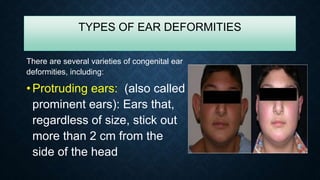
• Protruding ears: (also called
prominent ears): Ears that,
regardless of size, stick out
more than 2 cm from the
side of the head
TYPES OF EAR DEFORMITIES
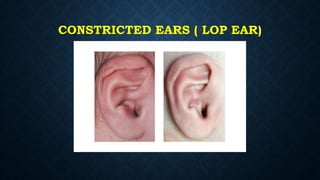
• Constricted ears ( Lop ear) : A variety of ear
deformities where the helical rim is either folded over
(also called lop ear), wrinkled, or tight.
• A constricted ear is present when the ear does not
have normal size and is missing some of the normal
features of the ear.
• The ear appears smaller than normal and often there is
a folding forward and downward of the upper portion of
the ear. This can range from mild to severe.
CONSTRICTED EARS ( LOP EAR)
TYPES OF EAR DEFORMITIES
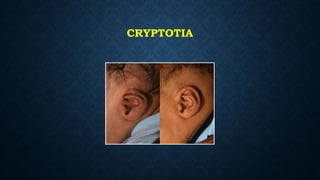
• Cryptotia : Cryptotia is a congenital ear
deformity in which the upper pole appears
buried beneath the mastoid skin.
• Ear cartilage framework that is partially
buried beneath the skin on the side of the
head.
CRYPTOTIA
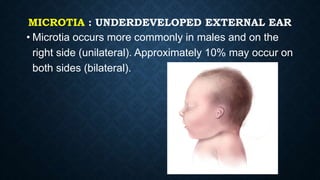
MICROTIA : UNDERDEVELOPED EXTERNAL EAR
• Microtia occurs more commonly in males and on the
right side (unilateral). Approximately 10% may occur on
both sides (bilateral).
MICROTIA : UNDERDEVELOPED EXTERNAL EAR
• Although causes of microtia and other ear
deformities are difficult to define, some theories
include a decreased blood supply to the developing
ear in-utero.
• Others have theorized certain medication taken by
the mother during pregnancy such as Accutane,
Thalidomide and retinoic acid. Environmental
factors have also been questioned.
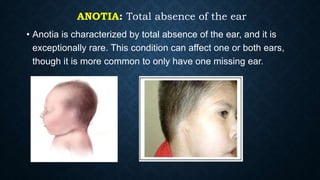
ANOTIA: Total absence of the ear
• Anotia is characterized by total absence of the ear, and it is
exceptionally rare. This condition can affect one or both ears,
though it is more common to only have one missing ear.
ANOTIA
•The cause of anotia is unknown. Up to 40
percent of patients may have an
associated syndrome such as Treacher
Collins or Goldenhar syndrome.
ANOTIA
Some recent findings suggest that women who
have diabetes before they become pregnant
and those with a diet lower in carbohydrates
and folic acid during pregnancy may be at an
increased risk of having a baby with anotia or
microtia (underdeveloped external ears).
TREATMENT
• Anotia is best treated by a multidisciplinary team
of specialists who are experienced in treating
this condition. This may include a plastic surgeon
for external ear reconstruction, an
otolaryngologist for inner ear and hearing
treatment , and a speech pathologist for speech
treatment.
TYPES OF EAR DEFORMITIES
•Traumatic ear deformities : Lacerations,
tears and bite injuries.
•Split earlobes : Occur gradually due to large
or heavy earrings
•Cauliflower ear : Abnormal cartilage forms
on top of the normal cartilage, resulting in
bulky misshapen ears.
TYPES OF EAR DEFORMITIES
•Ear keloids : Caused by excessive scar tissue
formation after minor trauma, most commonly
after ear piercing
•Ear hemangiomas : Most common benign
tumor of infancy, can occur anywhere on the
body, including the external ear and the
salivary gland in front of the ear.

Deformities of ear

  • 1.
    DEFORMITIES OF EAR Mr.ANILKUMAR B R M.sc Nursing Assistant Professor Medical- surgical Nursing
  • 2.
    OVERVEIW • Abnormal developmentor deformities of the ear anatomy can cause a range of complications, from cosmetic issues to hearing and development problems. • An estimated 6 to 45 percent of children are born with some sort of congenital ear deformity.
  • 3.
    • Some eardeformities are temporary. If the deformity was caused by abnormal positioning in the uterus or during birth, it may resolve as the child grows,. •Other ear deformities will need medical intervention – either nonsurgical or surgical – to correct the ear anomaly.
  • 4.
    ETIOLOGY OF EARDEFORMITIES •The causes of ear deformities are varied. Most ear deformities are congenital, meaning they are present from birth. In rare cases, children develop ear deformities from trauma or disease.
  • 5.
    ETIOLOGY OF EARDEFORMITIES •In some children, an ear deformity is a symptom of a genetic disorder that can affect multiple body systems, such as Goldenhar syndrome and CHARGE syndrome. •Ear deformities can be inherited or caused by genetic mutations.
  • 6.
    TYPES OF EARDEFORMITIES There are several varieties of congenital ear deformities, including: • Protruding ears: (also called prominent ears): Ears that, regardless of size, stick out more than 2 cm from the side of the head
  • 7.
    TYPES OF EARDEFORMITIES • Constricted ears ( Lop ear) : A variety of ear deformities where the helical rim is either folded over (also called lop ear), wrinkled, or tight. • A constricted ear is present when the ear does not have normal size and is missing some of the normal features of the ear. • The ear appears smaller than normal and often there is a folding forward and downward of the upper portion of the ear. This can range from mild to severe.
  • 8.
  • 9.
    TYPES OF EARDEFORMITIES • Cryptotia : Cryptotia is a congenital ear deformity in which the upper pole appears buried beneath the mastoid skin. • Ear cartilage framework that is partially buried beneath the skin on the side of the head.
  • 10.
  • 11.
    MICROTIA : UNDERDEVELOPEDEXTERNAL EAR • Microtia occurs more commonly in males and on the right side (unilateral). Approximately 10% may occur on both sides (bilateral).
  • 12.
    MICROTIA : UNDERDEVELOPEDEXTERNAL EAR • Although causes of microtia and other ear deformities are difficult to define, some theories include a decreased blood supply to the developing ear in-utero. • Others have theorized certain medication taken by the mother during pregnancy such as Accutane, Thalidomide and retinoic acid. Environmental factors have also been questioned.
  • 13.
    ANOTIA: Total absenceof the ear • Anotia is characterized by total absence of the ear, and it is exceptionally rare. This condition can affect one or both ears, though it is more common to only have one missing ear.
  • 14.
    ANOTIA •The cause ofanotia is unknown. Up to 40 percent of patients may have an associated syndrome such as Treacher Collins or Goldenhar syndrome.
  • 15.
    ANOTIA Some recent findingssuggest that women who have diabetes before they become pregnant and those with a diet lower in carbohydrates and folic acid during pregnancy may be at an increased risk of having a baby with anotia or microtia (underdeveloped external ears).
  • 16.
    TREATMENT • Anotia isbest treated by a multidisciplinary team of specialists who are experienced in treating this condition. This may include a plastic surgeon for external ear reconstruction, an otolaryngologist for inner ear and hearing treatment , and a speech pathologist for speech treatment.
  • 17.
    TYPES OF EARDEFORMITIES •Traumatic ear deformities : Lacerations, tears and bite injuries. •Split earlobes : Occur gradually due to large or heavy earrings •Cauliflower ear : Abnormal cartilage forms on top of the normal cartilage, resulting in bulky misshapen ears.
  • 18.
    TYPES OF EARDEFORMITIES •Ear keloids : Caused by excessive scar tissue formation after minor trauma, most commonly after ear piercing •Ear hemangiomas : Most common benign tumor of infancy, can occur anywhere on the body, including the external ear and the salivary gland in front of the ear.