CARDIAC EMERGENCY
 Prepared by
 Asso.Prof Mr. Vijayreddy .b.v
 M.Sc(N),PGDHA,PGCDE
 Medical-Surgical Nursing dept.
CARDIAC EMERGENCY
Myocardial infarction,
Angina pectoris,
Congestive cardiac failure,
sudden cardiac arrest,
cardiac tamponade,
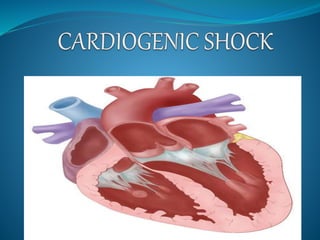
Cardiogenic shock.
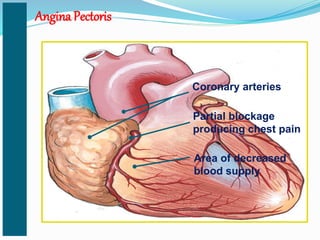
Angina Pectoris
Coronary arteries
Partial blockage
producing chest pain
Area of decreased
blood supply
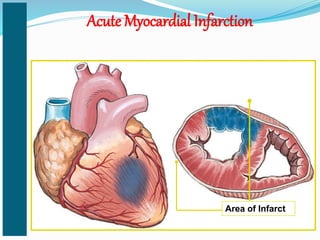
Acute Myocardial Infarction
Area of Infarct
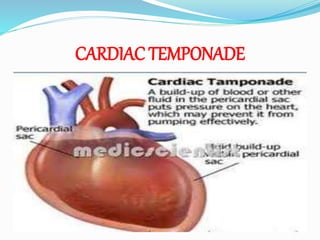
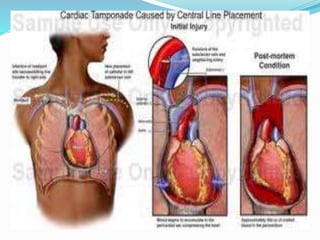
CARDIAC TEMPONADE
Sudden cardiac death
 When the heart ceases to beat
effectively and breathing soon ceases, a
person is said to have experienced
sudden cardiac death (SCD).
CONTD..
 In order to meet the criteria for this
diagnosis, the critical circulatory collapse
must be;
1) Unexpected,
2) It must relate in some manner to heart
problems, and
3) It should occur with minimal warning or
a complete absence of prelude symptoms.
CARDIAC ARREST
Cardiac arrest, also known as
cardiopulmonary arrest or circulatory
arrest, is the end of normal
circulation of the blood due to failure
of the heart to contract effectively.
Medical personnel may refer to an
unexpected cardiac arrest as a sudden
cardiac arrest (SCA).
CAUSES
Coronary heart disease
Non-ischemic heart disease
Cardiomyopathy, cardiac rhythm
disturbances, hypertensive heart
disease, congestive heart failure
CONTD…
Non-cardiac
The most common non-cardiac causes:
trauma, non-trauma related bleeding
(such as gastrointestinal bleeding,
aortic rupture, and intracranial
hemorrhage), overdose, drowning and
pulmonary embolism
MANAGEMENT
Early recognition
Early CPR
Early defibrillation
Medications- This includes the use of
epinephrine, atropine, and amiodarone.
Vasopressin overall does not improve or
worse outcomes but may be of benefit in
those with a systole especially if used early
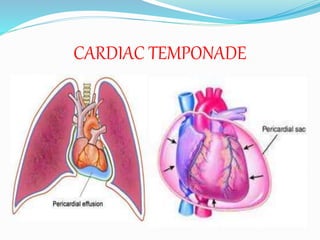
CARDIAC TEMPONADE
DEFINITION
Cardiac tamponade, also known as
pericardial tamponade, is an acute type
of pericardial effusion in which fluid
accumulates in the pericardium (the
sac in which the heart is enclosed).
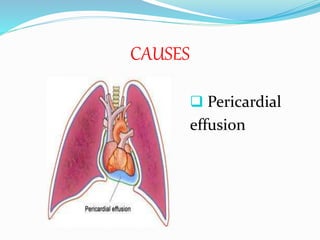
CAUSES
 Pericardial
effusion
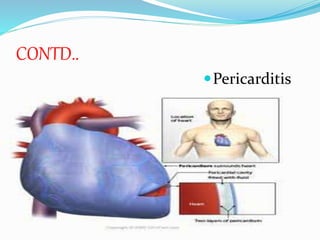
CONTD..
Pericarditis
OTHER POSSIBLE CAUSES
Heart tumors
Hypothyroidism
Kidney failure
Leukemia
CONTD..
Placement of central lines
Radiation therapy to the chest
Recent invasive heart procedures
Recent open heart surgery
Systemic lupus erythematous
MEANING
 Cardiogenic shock is characterized by a
decreased pumping ability of the heart
that causes a shock like state (i.e., global
hypo perfusion). It most commonly
occurs in association with, and as a direct
result of, acute myocardial
infarction(AMI).
Pathophysiology
AMI
↓
Dead myocardium does not contract
↓
Marked decrease in contractility
reduces the ejection fraction and
cardiac output.
↓
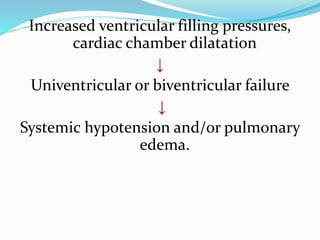
Increased ventricular filling pressures,
cardiac chamber dilatation
↓
Univentricular or biventricular failure
↓
Systemic hypotension and/or pulmonary
edema.
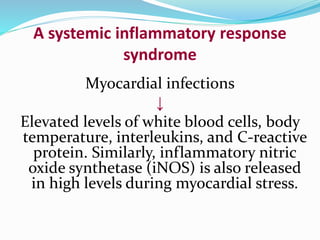
A systemic inflammatory response
syndrome
Myocardial infections
↓
Elevated levels of white blood cells, body
temperature, interleukins, and C-reactive
protein. Similarly, inflammatory nitric
oxide synthetase (iNOS) is also released
in high levels during myocardial stress.
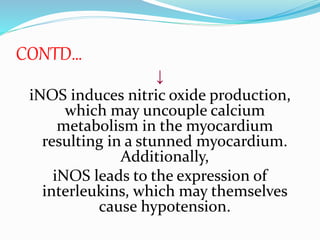
CONTD…
↓
iNOS induces nitric oxide production,
which may uncouple calcium
metabolism in the myocardium
resulting in a stunned myocardium.
Additionally,
iNOS leads to the expression of
interleukins, which may themselves
cause hypotension.
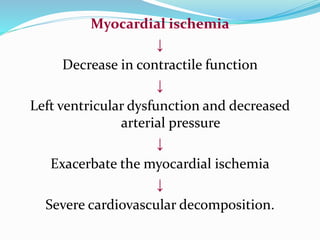
Myocardial ischemia
↓
Decrease in contractile function
↓
Left ventricular dysfunction and decreased
arterial pressure
↓
Exacerbate the myocardial ischemia
↓
Severe cardiovascular decomposition.
Other Pathophysiologically
mechanisms
 Papillary muscle rupture leading to
acute mitral regurgitation (4.4%);
 ventricular septal defect (1.5%)
 wall rupture (4.1%) as a
consequence of AMI.
 Right ventricular (RV) infarct, by
itself, may lead to hypotension and
shock because of reduced preload
to the left ventricle.
 Cardiac tamponade may result as
a consequence of Pericarditis,
uremic pericardial effusion, or in
rare cases systemic lupus
erythematous.
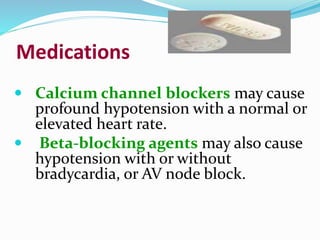
Medications
 Calcium channel blockers may cause
profound hypotension with a normal or
elevated heart rate.
 Beta-blocking agents may also cause
hypotension with or without
bradycardia, or AV node block.
CONTD..
Nitroglycerin, Angiotensin-
converting enzyme inhibitors,
opiate, and barbiturates can all cause
a shock state and may be difficult to
distinguish from Cardiogenic shock.
Clinical manifestations
The physical examination findings are
consistent with shock.
Patients are in frank distress
profoundly diaphoretic with mottled
extremities
visibly dyspneic
A- Airway usually is patent initially.
B- Breathing may be labored, with
audible coarse crackles or wheezing.
C-Circulation is markedly impaired.
Tachycardia, delayed capillary refill,
hypotension, diaphoresis, and poor
peripheral pulses are frequent findings.
CONTD…..
Signs of end-organ dysfunction (eg,
decreased mental function, urinary
output) may be present.
Diagnostic measures
History collection
General physical examination
Initial vital sign assessment
Neck examination may reveal jugular
venous distention
LV dysfunction, characterized by
pulmonary edema, can be auscultated as
crackles with or without wheezing.
Careful cardiac examination may reveal
mechanical causes of Cardiogenic shock.
 Loud murmurs may indicate a valvular
dysfunction, whereas muffled heart
tones with jugular venous distention
and pulsus paradoxus may suggest
tamponade (Beck triad).
CONTD..
A gallop may also be heard. The
presence of an S3 heart sound is
pathognomonic of congestive heart
failure. The presence of pulmonary
edema increases the likelihood of
Cardiogenic shock in the setting of
hypotension.
Lab Studies
 No one test is completely sensitive,
laboratory studies are directed at the
potential underlying cause.
Following are assessed in cases of
suspected cardiac ischemia:
CONTD..
 Cardiac enzymes (eg, creatine kinase,
troponin, myoglobin)
 CBC
 Electrolytes
 Coagulation profile (eg, Prothrombin
time, activated partial
thromboplastin time)
 An ABG may be useful to evaluate acid-
base balance because acidosis .
 Elevated serum lactate level is an
indicator of shock.
 Brain Natriuretic peptide (BNP) may be
useful as an indicator of congestive heart
failure and as an independent prognostic
indicator of survival.
A low BNP level may effectively rule
out cardiogenic shock in the setting of
hypotension.
Imaging Studies
Portable chest radiograph
Overall impression of the cardiac size
Pulmonary vascularity
Coexistent pulmonary pathology
A rough estimate of Mediastinum and
aortic sizes
Other Tests
 ECG
Helpful if it reveals an acute injury
pattern consistent with an AMI
 Echocardiogram
*To reveal a kinetic or dyskinetic areas of
ventricular wall motion.
*To reveal surgically correctable
causes, such as valvular dysfunction and
tamponade.
MANAGEMENT
Pre hospital Care: aimed at minimizing any
further ischemia and shock.
All patients require intravenous access, high-
flow oxygen administered by mask, and
cardiac monitoring.
Twelve-lead electrocardiography, The ED
physician, can thus be alerted, and may
mobilize the appropriate resources.
 Emergency Department Care:
Aim: making the diagnosis, preventing
further ischemia, and treating the
underlying cause.
 coronary artery bypass is the treatments of
choice within 90 minutes of presentation;
however, it remains helpful, as an acute
intervention, within 12 hours of
presentation.
 If not immediately available, thrombolytic
should be considered which is the second
best.
Treatment begins with assessment
and management of the ABCs.
Airway should be assessed for patency.
Breathing evaluated for effectiveness
and increased work of breathing.
Endotracheal intubation and
mechanical ventilation is considered
in patients with excessive work of
breathing.
Positive pressure ventilation may improve
oxygenation but may also compromise
venous return, preload, to the heart. In any
event, the patient should be treated with
high-flow oxygen.
supporting myocardial perfusion and
maximizing cardiac output.
 Intravenous fluids should be provided to
maintain adequate preload, guided by
central venous pressure or pulmonary
capillary wedge pressure monitoring .
Pharmacotherapy
Aim: To reduce morbidity and to prevent
complications.
Intravenous vasopressors provide Inotropic
support increasing perfusion of the
ischemic myocardium and all body tissues.
Extreme heart rates should be avoided
because they may increase myocardial
oxygen consumption
1. Dopamine may provide vasopressors
support. With higher doses, it has the
disadvantage of increasing the heart
rate and myocardial oxygen
consumption.
Dose:5-20 mcg/kg/min IV continuous
infusion.
 Increase by 1-4 mcg/kg/min q10-30min
to optimal response
 (>50% of patients have satisfactorily
responses with doses <20 mcg/kg/min)
2.Dobutamine, inamrinone (formerly
amrinone), or Milrinone may provide
Inotropic support. In addition to their
positive Inotropic effects, inamrinone
and Milrinone have a beneficial
vasodilator effect, which reduces
preload and after load.
Dose: 5-20 mcg/kg/min IV
continuous infusion.
3. Phosphodiestrase enzyme
inhibitors -improve cardiac output in
refractory hypotension and shock.
Milrinone and inamrinone (formerly
amrinone) may be used.
Loading dose: 50 mcg/kg IV over 10
min
Continuous infusion: 0.375-0.75
mcg/kg/min IV
4.Natrecor (nesiritide)
Should be used with caution in the
setting of Cardiogenic shock because it
has been shown to cause hypotension.
5.Vasodilators
Smooth-muscle relaxants and vasodilators
that can reduce systemic vascular
resistance, allowing more forward flow
and improving cardiac output.
6. Analgesics -- Pain control is essential
to quality patient care. It ensures
patient comfort and promotes
pulmonary toilet.
7. Natriuretic peptide
Nitrates and/or morphine excessive
use of either of these agents can
produce profound hypotension.
Neither of these options has been
shown to improve outcomes in
Cardiogenic shock
8.Diuretics :Cause diuresis to decrease plasma
volume and edema and thereby decrease cardiac
output BP.
The initial decrease in cardiac output causes a
compensatory increase in peripheral vascular
resistance. With continuing diuretic therapy,
extracellular fluid and plasma volumes almost
return to pretreatment levels.
Peripheral vascular resistance decreases below
that of pretreatment baseline.
Lasix: 40-80 mg/d IV/IM
 Intra-aortic balloon pump (IABP)
recommended for Cardiogenic shock
not quickly reversed with
pharmacologic therapy.
 It is also recommended as a
stabilizing measure combined with
thrombolytic therapy when
angiography and revascularization
are not readily available.
oIABP reduces LV after load and
improves coronary artery blood flow.
oAlthough this procedure is generally
not performed in the ED, planning is
essential, and early consultation with a
cardiologist regarding this option is
recommended.
o Although complications may occur in
up to 30% of patients, extensive
retrospective data support its use.
NURSING DIAGNOSIS
 Decreased cardiac output related to shock
as manifested by increased diastolic BP,
tachycardia, dry mucous membrane, pallor,
cyanosis, cool and clammy skin.
 Fear and anxiety related to severity of the
condition as manifested by verbalization of
anxiety about condition and fear of death or
withdrawal with no communication,
increase in heart and respiratory rate.
CONTD..
High risk for organ dysfunction related
to decreased tissue perfusion.
THANK YOU

Cardiac emergencies

  • 1.
    CARDIAC EMERGENCY  Preparedby  Asso.Prof Mr. Vijayreddy .b.v  M.Sc(N),PGDHA,PGCDE  Medical-Surgical Nursing dept.
  • 2.
    CARDIAC EMERGENCY Myocardial infarction, Anginapectoris, Congestive cardiac failure, sudden cardiac arrest, cardiac tamponade, Cardiogenic shock.
  • 3.
    Angina Pectoris Coronary arteries Partialblockage producing chest pain Area of decreased blood supply
  • 4.
  • 5.
  • 6.
    Sudden cardiac death When the heart ceases to beat effectively and breathing soon ceases, a person is said to have experienced sudden cardiac death (SCD).
  • 7.
    CONTD..  In orderto meet the criteria for this diagnosis, the critical circulatory collapse must be; 1) Unexpected, 2) It must relate in some manner to heart problems, and 3) It should occur with minimal warning or a complete absence of prelude symptoms.
  • 8.
    CARDIAC ARREST Cardiac arrest,also known as cardiopulmonary arrest or circulatory arrest, is the end of normal circulation of the blood due to failure of the heart to contract effectively. Medical personnel may refer to an unexpected cardiac arrest as a sudden cardiac arrest (SCA).
  • 9.
    CAUSES Coronary heart disease Non-ischemicheart disease Cardiomyopathy, cardiac rhythm disturbances, hypertensive heart disease, congestive heart failure
  • 10.
    CONTD… Non-cardiac The most commonnon-cardiac causes: trauma, non-trauma related bleeding (such as gastrointestinal bleeding, aortic rupture, and intracranial hemorrhage), overdose, drowning and pulmonary embolism
  • 11.
    MANAGEMENT Early recognition Early CPR Earlydefibrillation Medications- This includes the use of epinephrine, atropine, and amiodarone. Vasopressin overall does not improve or worse outcomes but may be of benefit in those with a systole especially if used early
  • 12.
  • 13.
    DEFINITION Cardiac tamponade, alsoknown as pericardial tamponade, is an acute type of pericardial effusion in which fluid accumulates in the pericardium (the sac in which the heart is enclosed).
  • 15.
  • 16.
  • 17.
    OTHER POSSIBLE CAUSES Hearttumors Hypothyroidism Kidney failure Leukemia
  • 18.
    CONTD.. Placement of centrallines Radiation therapy to the chest Recent invasive heart procedures Recent open heart surgery Systemic lupus erythematous
  • 20.
    MEANING  Cardiogenic shockis characterized by a decreased pumping ability of the heart that causes a shock like state (i.e., global hypo perfusion). It most commonly occurs in association with, and as a direct result of, acute myocardial infarction(AMI).
  • 21.
    Pathophysiology AMI ↓ Dead myocardium doesnot contract ↓ Marked decrease in contractility reduces the ejection fraction and cardiac output. ↓
  • 22.
    Increased ventricular fillingpressures, cardiac chamber dilatation ↓ Univentricular or biventricular failure ↓ Systemic hypotension and/or pulmonary edema.
  • 23.
    A systemic inflammatoryresponse syndrome Myocardial infections ↓ Elevated levels of white blood cells, body temperature, interleukins, and C-reactive protein. Similarly, inflammatory nitric oxide synthetase (iNOS) is also released in high levels during myocardial stress.
  • 24.
    CONTD… ↓ iNOS induces nitricoxide production, which may uncouple calcium metabolism in the myocardium resulting in a stunned myocardium. Additionally, iNOS leads to the expression of interleukins, which may themselves cause hypotension.
  • 25.
    Myocardial ischemia ↓ Decrease incontractile function ↓ Left ventricular dysfunction and decreased arterial pressure ↓ Exacerbate the myocardial ischemia ↓ Severe cardiovascular decomposition.
  • 26.
    Other Pathophysiologically mechanisms  Papillarymuscle rupture leading to acute mitral regurgitation (4.4%);  ventricular septal defect (1.5%)  wall rupture (4.1%) as a consequence of AMI.
  • 27.
     Right ventricular(RV) infarct, by itself, may lead to hypotension and shock because of reduced preload to the left ventricle.  Cardiac tamponade may result as a consequence of Pericarditis, uremic pericardial effusion, or in rare cases systemic lupus erythematous.
  • 28.
    Medications  Calcium channelblockers may cause profound hypotension with a normal or elevated heart rate.  Beta-blocking agents may also cause hypotension with or without bradycardia, or AV node block.
  • 29.
    CONTD.. Nitroglycerin, Angiotensin- converting enzymeinhibitors, opiate, and barbiturates can all cause a shock state and may be difficult to distinguish from Cardiogenic shock.
  • 30.
    Clinical manifestations The physicalexamination findings are consistent with shock. Patients are in frank distress profoundly diaphoretic with mottled extremities visibly dyspneic
  • 31.
    A- Airway usuallyis patent initially. B- Breathing may be labored, with audible coarse crackles or wheezing. C-Circulation is markedly impaired. Tachycardia, delayed capillary refill, hypotension, diaphoresis, and poor peripheral pulses are frequent findings.
  • 32.
    CONTD….. Signs of end-organdysfunction (eg, decreased mental function, urinary output) may be present.
  • 33.
    Diagnostic measures History collection Generalphysical examination Initial vital sign assessment Neck examination may reveal jugular venous distention LV dysfunction, characterized by pulmonary edema, can be auscultated as crackles with or without wheezing.
  • 34.
    Careful cardiac examinationmay reveal mechanical causes of Cardiogenic shock.  Loud murmurs may indicate a valvular dysfunction, whereas muffled heart tones with jugular venous distention and pulsus paradoxus may suggest tamponade (Beck triad).
  • 35.
    CONTD.. A gallop mayalso be heard. The presence of an S3 heart sound is pathognomonic of congestive heart failure. The presence of pulmonary edema increases the likelihood of Cardiogenic shock in the setting of hypotension.
  • 36.
    Lab Studies  Noone test is completely sensitive, laboratory studies are directed at the potential underlying cause. Following are assessed in cases of suspected cardiac ischemia:
  • 37.
    CONTD..  Cardiac enzymes(eg, creatine kinase, troponin, myoglobin)  CBC  Electrolytes  Coagulation profile (eg, Prothrombin time, activated partial thromboplastin time)
  • 38.
     An ABGmay be useful to evaluate acid- base balance because acidosis .  Elevated serum lactate level is an indicator of shock.  Brain Natriuretic peptide (BNP) may be useful as an indicator of congestive heart failure and as an independent prognostic indicator of survival. A low BNP level may effectively rule out cardiogenic shock in the setting of hypotension.
  • 39.
    Imaging Studies Portable chestradiograph Overall impression of the cardiac size Pulmonary vascularity Coexistent pulmonary pathology A rough estimate of Mediastinum and aortic sizes
  • 40.
    Other Tests  ECG Helpfulif it reveals an acute injury pattern consistent with an AMI  Echocardiogram *To reveal a kinetic or dyskinetic areas of ventricular wall motion. *To reveal surgically correctable causes, such as valvular dysfunction and tamponade.
  • 41.
    MANAGEMENT Pre hospital Care:aimed at minimizing any further ischemia and shock. All patients require intravenous access, high- flow oxygen administered by mask, and cardiac monitoring. Twelve-lead electrocardiography, The ED physician, can thus be alerted, and may mobilize the appropriate resources.
  • 42.
     Emergency DepartmentCare: Aim: making the diagnosis, preventing further ischemia, and treating the underlying cause.  coronary artery bypass is the treatments of choice within 90 minutes of presentation; however, it remains helpful, as an acute intervention, within 12 hours of presentation.  If not immediately available, thrombolytic should be considered which is the second best.
  • 43.
    Treatment begins withassessment and management of the ABCs. Airway should be assessed for patency. Breathing evaluated for effectiveness and increased work of breathing. Endotracheal intubation and mechanical ventilation is considered in patients with excessive work of breathing.
  • 44.
    Positive pressure ventilationmay improve oxygenation but may also compromise venous return, preload, to the heart. In any event, the patient should be treated with high-flow oxygen. supporting myocardial perfusion and maximizing cardiac output.  Intravenous fluids should be provided to maintain adequate preload, guided by central venous pressure or pulmonary capillary wedge pressure monitoring .
  • 45.
    Pharmacotherapy Aim: To reducemorbidity and to prevent complications. Intravenous vasopressors provide Inotropic support increasing perfusion of the ischemic myocardium and all body tissues. Extreme heart rates should be avoided because they may increase myocardial oxygen consumption
  • 46.
    1. Dopamine mayprovide vasopressors support. With higher doses, it has the disadvantage of increasing the heart rate and myocardial oxygen consumption. Dose:5-20 mcg/kg/min IV continuous infusion.  Increase by 1-4 mcg/kg/min q10-30min to optimal response  (>50% of patients have satisfactorily responses with doses <20 mcg/kg/min)
  • 47.
    2.Dobutamine, inamrinone (formerly amrinone),or Milrinone may provide Inotropic support. In addition to their positive Inotropic effects, inamrinone and Milrinone have a beneficial vasodilator effect, which reduces preload and after load. Dose: 5-20 mcg/kg/min IV continuous infusion.
  • 48.
    3. Phosphodiestrase enzyme inhibitors-improve cardiac output in refractory hypotension and shock. Milrinone and inamrinone (formerly amrinone) may be used. Loading dose: 50 mcg/kg IV over 10 min Continuous infusion: 0.375-0.75 mcg/kg/min IV
  • 49.
    4.Natrecor (nesiritide) Should beused with caution in the setting of Cardiogenic shock because it has been shown to cause hypotension. 5.Vasodilators Smooth-muscle relaxants and vasodilators that can reduce systemic vascular resistance, allowing more forward flow and improving cardiac output.
  • 50.
    6. Analgesics --Pain control is essential to quality patient care. It ensures patient comfort and promotes pulmonary toilet. 7. Natriuretic peptide Nitrates and/or morphine excessive use of either of these agents can produce profound hypotension. Neither of these options has been shown to improve outcomes in Cardiogenic shock
  • 51.
    8.Diuretics :Cause diuresisto decrease plasma volume and edema and thereby decrease cardiac output BP. The initial decrease in cardiac output causes a compensatory increase in peripheral vascular resistance. With continuing diuretic therapy, extracellular fluid and plasma volumes almost return to pretreatment levels. Peripheral vascular resistance decreases below that of pretreatment baseline. Lasix: 40-80 mg/d IV/IM
  • 52.
     Intra-aortic balloonpump (IABP) recommended for Cardiogenic shock not quickly reversed with pharmacologic therapy.  It is also recommended as a stabilizing measure combined with thrombolytic therapy when angiography and revascularization are not readily available.
  • 53.
    oIABP reduces LVafter load and improves coronary artery blood flow. oAlthough this procedure is generally not performed in the ED, planning is essential, and early consultation with a cardiologist regarding this option is recommended. o Although complications may occur in up to 30% of patients, extensive retrospective data support its use.
  • 54.
    NURSING DIAGNOSIS  Decreasedcardiac output related to shock as manifested by increased diastolic BP, tachycardia, dry mucous membrane, pallor, cyanosis, cool and clammy skin.  Fear and anxiety related to severity of the condition as manifested by verbalization of anxiety about condition and fear of death or withdrawal with no communication, increase in heart and respiratory rate.
  • 55.
    CONTD.. High risk fororgan dysfunction related to decreased tissue perfusion.
  • 56.