CARDIAC CYCLE AND JVP
DEPARTMENT OF MEDICINE
M V J MEDICAL COLLEGE & R H
CHAIRPERSION: PROF: DR
.SADASHIVAIAH
PRESENTATOR: DR.M.RAMESH
BABU
OUT LINE
INTRODUCTION
DEFINITION
ANATOMY OF THE HEART
NORMAL CADIAC CYCLE
CAUSES OF ALTERATION IN THE CARDIAC CYCLE
JVP DEFINITION
ANATOMY AND PHYSIOLOGY
MEASUREMENT OF JVP
WAVE FORMS OF J VP
ABNORMAL WAVE FORMS AND CONDITION
CAUSING IT
DEFINITION
The cardiac events that occur from the
beginning of one heart beat to the
beginning of the next are called the cardiac
cycle.
CARDIAC CYCLE CONTINUED….
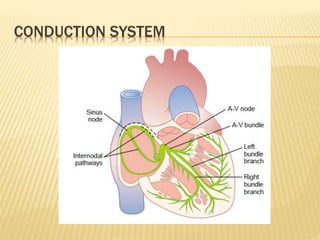
 Each cycle is initiated by spontaneous
generation of an action potential in the sinus
node.
 This node is located in the superior lateral
wall of the right atrium near the opening of
the SVC,and the action potential travels
from here to both atria and then through the
a-v bundle into the ventricles.
CONDUCTION SYSTEM
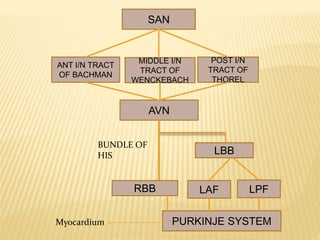
SAN
ANT I/N TRACT
OF BACHMAN
MIDDLE I/N
TRACT OF
WENCKEBACH
POST I/N
TRACT OF
THOREL
AVN
LBB
RBB LAF LPF
BUNDLE OF
HIS
PURKINJE SYSTEMMyocardium
CONTINUED..
 There is a delay of more than 0.1 sec during
the passage of the cardiac impulse from the
atria into the ventricles.
 This allow the atria to contract ahead of
ventricular contraction
 The atria acts as a primer pumps for the
ventricles.
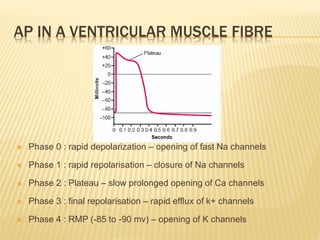
AP IN A VENTRICULAR MUSCLE FIBRE
 Phase 0 : rapid depolarization – opening of fast Na channels
 Phase 1 : rapid repolarisation – closure of Na channels
 Phase 2 : Plateau – slow prolonged opening of Ca channels
 Phase 3 : final repolarisation – rapid efflux of k+ channels
 Phase 4 : RMP (-85 to -90 mv) – opening of K channels
DIASTOLE AND SYSTOLE
 The caridac cycle consist of a period of relaxation
called diastole,during which the heart fills with the
blood, fallowed by a period of contraction called
systole.
 Duration of cardiac cycle is the reciprocal of the heart
rate.
 If H.R -72/min, the duration of c. cycle -1/72
beats/min – about 0.0139 min/beat,or 0.833sec/beat
 Duration of systole is 0.3 sec
 Duration of diastole is 0.5 sec
EFFECT OF HEART RATE ON DURATION OF
CARDIAC CYCLE
When heart rate increases, the duration of
cardiac cycle decreases , including the
contraction and relaxation phases.
The period of systole decreases but not by as
great a percentage as diastole.
The heart beating at a very fast rate does not
remain relaxed along enough to allow
complete filling of the cardiac chambers
before the next contraction.
ATRIA AS PRIMER PUMPS
 About 80% of the blood flows directly through
the atria into the ventricles even before the
atria contract.
 Atrial contraction usally cause an addition
20% filling of the ventricles.
 Normally atria has the capability of pumping
300-400% more blood than is required by the
resting body.
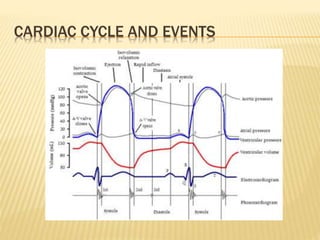
CARDIAC CYCLE AND EVENTS
EVENTS OF CARDIAC CYCLE
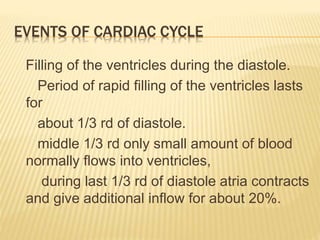
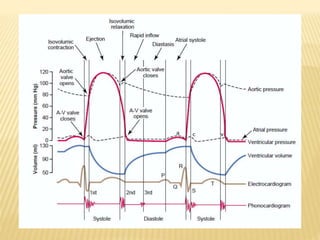
Filling of the ventricles during the diastole.
Period of rapid filling of the ventricles lasts
for
about 1/3 rd of diastole.
middle 1/3 rd only small amount of blood
normally flows into ventricles,
during last 1/3 rd of diastole atria contracts
and give additional inflow for about 20%.
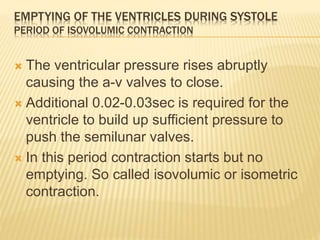
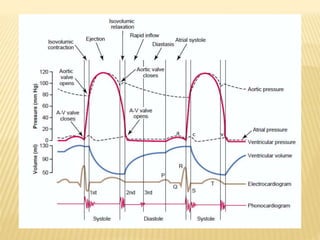
EMPTYING OF THE VENTRICLES DURING SYSTOLE
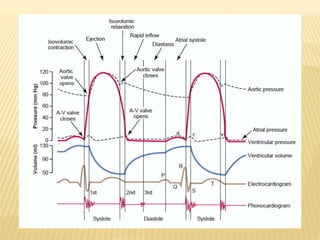
PERIOD OF ISOVOLUMIC CONTRACTION
 The ventricular pressure rises abruptly
causing the a-v valves to close.
 Additional 0.02-0.03sec is required for the
ventricle to build up sufficient pressure to
push the semilunar valves.
 In this period contraction starts but no
emptying. So called isovolumic or isometric
contraction.
PERIOD OF EJECTION
 When the L V pressure raises slightly >
80mm hg ( R V pressure >8mm hg ), the
ventricular pressure pushes the semilunar
valves open..
 Period of rapid ejection –70% during first
1/3rd remaining 30% emptying during next
2/3rd –period of slow ejection.
PERIOD OF ISOMETRIC RELAXATION
 At the end of systole,ventricular relaxation
begins suddenly,allowing both the R & L
intraventricular pressures to decrase rapidly.
 Elevated pressures in the large arteries
,immediately push blood backward towards the
ventricles, which snaps the semilunar valves to
close.
 Another 0.03-0.06sec requires for full relaxation
of the ventricles (isovolumic relaxation).
 A-v valves opens to begin a new cycle.
END DIASTOLIC VOLUME, END SYSTOLIC VOLUME &
SYSTOLIC VOLUME OUTPUT
 During diastole filling to about 110-120ml,this
volume called end diastolic volume.
 Ventricles emptying during systole ,the
decreases to about 70ml- called the stroke
volume output.
 Remaining volume in each ventricle about
40-50ml is called end systolic volume.
 The fraction of the end diastolic volume that
is ejected is called the ejection fraction
~60%.
CONT…
 When heart contracts strongly, the ESV can
be decreased to as little as 10-20ml.
 When large amount of blood flow into the
ventricles during diastole, the ventricular
EDV can become as great as 150-180ml in
healthy heart.
 By both Increasing EDV and decreasing
ESV,the stroke volume output can be
increased to more than double normal.
FUNCTIONS OF THE VALVES
 A.V. valves prevent blood flow from the
ventricles to atria during systole.
 Semilunar valves prevent blood flow from the
large arteries into ventricles during diastole.
 These valves open & closes passively,they
closes when back ward pressure gradient
pushes, opens when the gradient forces blood
in the forward direction
 Thin A.V valves require no backflow, semilunar
valves require rapid backflow for few mill.sec.
FUNCTIONS OF PAPILLARY MUSCLES
 The papillary muscles contract when the
ventricular walls contract, but they do not
help the valves to close.
 They pull the vanes of valves inward toward
the ventricles to prevent their bulging.
 If chorda tendinea ruptures the valves bulges
far backward,results in severe or lethal
cardiac incapacity.
SEMILUNAR VALVES
 The high pressures in the arteries at the end
of systole cause the semilunar valves to
snap to the closed position.,much softer
closer.
 Smaller openings ,the ejection through the
aortic and pulmanary valves is far greater
than that through the a-v valves.
 Strong yet pliable fibrous tissue base to
withstand the extra physical stress.
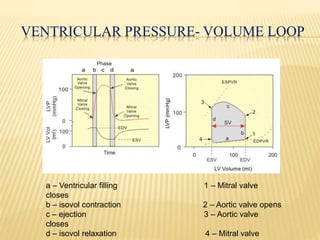
VENTRICULAR PRESSURE- VOLUME LOOP
a – Ventricular filling 1 – Mitral valve
closes
b – isovol contraction 2 – Aortic valve opens
c – ejection 3 – Aortic valve
closes
d – isovol relaxation 4 – Mitral valve
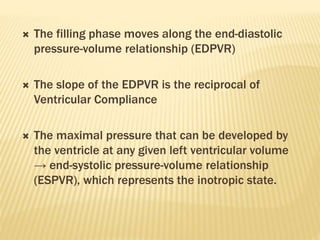
 The filling phase moves along the end-diastolic
pressure-volume relationship (EDPVR)
 The slope of the EDPVR is the reciprocal of
Ventricular Compliance
 The maximal pressure that can be developed by
the ventricle at any given left ventricular volume
→ end-systolic pressure-volume relationship
(ESPVR), which represents the inotropic state.
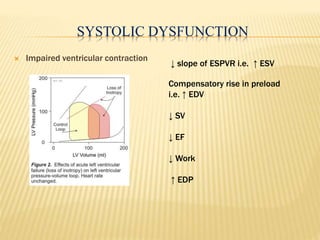
↓ slope of ESPVR i.e. ↑ ESV
Compensatory rise in preload
i.e. ↑ EDV
↓ SV
↓ EF
↓ Work
↑ EDP
 Impaired ventricular contraction
SYSTOLIC DYSFUNCTION
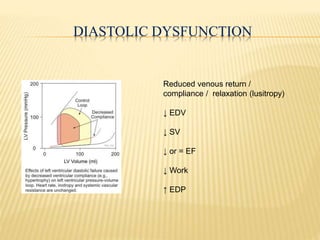
Reduced venous return /
compliance / relaxation (lusitropy)
↓ EDV
↓ SV
↓ or = EF
↓ Work
↑ EDP
DIASTOLIC DYSFUNCTION
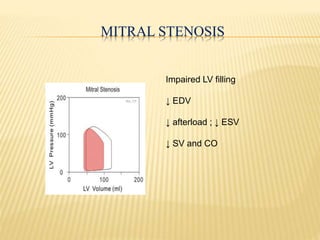
Impaired LV filling
↓ EDV
↓ afterload ; ↓ ESV
↓ SV and CO
MITRAL STENOSIS
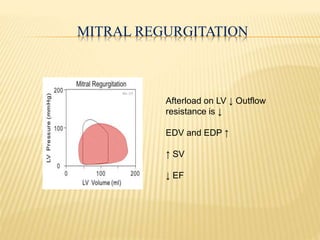
Afterload on LV ↓ Outflow
resistance is ↓
EDV and EDP ↑
↑ SV
↓ EF
MITRAL REGURGITATION
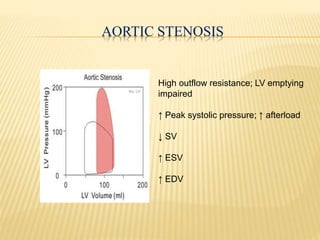
High outflow resistance; LV emptying
impaired
↑ Peak systolic pressure; ↑ afterload
↓ SV
↑ ESV
↑ EDV
AORTIC STENOSIS
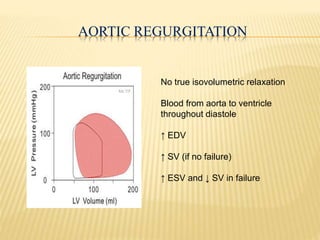
No true isovolumetric relaxation
Blood from aorta to ventricle
throughout diastole
↑ EDV
↑ SV (if no failure)
↑ ESV and ↓ SV in failure
AORTIC REGURGITATION
ECG TO THE CARDIAC CYCLE
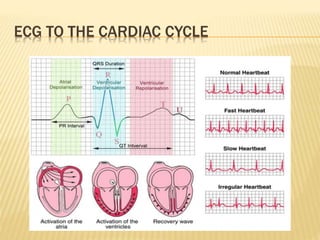
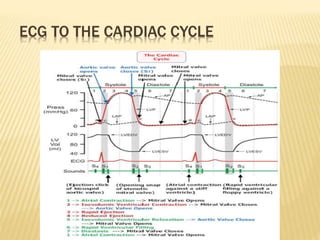
 In Atrial systole Heart sounds - S 4 – pathological. Vibration of the
ventricular wall during atrial contraction. Heard in ‘stiff’ ventricle like in
hypertrophy and in elderly. Also heard in massive pulmonary
embolism, cor pulmonale, TR
 In isometric contraction Heart Sounds – S1 : closure of the
AV valves. Normally split as mitral valve closure preceeds
tricuspid valve closure.
 In Ejection Heart sounds – none
 In Isovolumic relaxation Heart sounds – S2 : closure of the semilunar
valves. Normally split because aortic valve closes slightly earlier than the
pulmonary valve
Heart sounds - S3 - Pathological in adults. Seen in dilated congestive
heart failure, MI, MR, severe hypertension. Normal in children
DEFINITION
 Jugular Venous Pulse:
defined as the oscillating top of
vertical column of blood in right IJV that
reflects pressure changes in Right Atrium in
cardiac cycle.
 Jugular Venous Pressure:
Vertical height of oscillating column of
blood.
WHY INTERNAL JUGULAR VEIN?
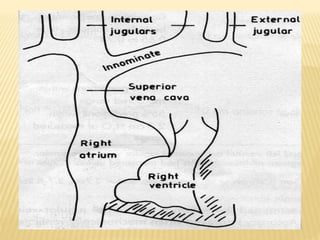
 IJV has a direct course to RA.
 IJV is anatomically closer to RA.
 IJV has no valves( Valves in EJV prevent
transmission of RA pressure)
 Vasoconstriction Secondary to hypotension
( in CCF) can make EJV small and barely
visible.
WHY RIGHT INTERNAL JUGULAR VEIN?
 Right jugular veins extend in an almost
straight line to superior vena cava, thus
favouring transmission of the haemodynamic
changes from the right atrium.
 The left innominate vein is not in a straight
line and may be kinked or compressed
between Aortic Arch and sternum, by a
dilated aorta, or by an aneurysm.
 The patient should lie comfortably during the examination.
 Clothing should be removed from the neck and upper
thorax.
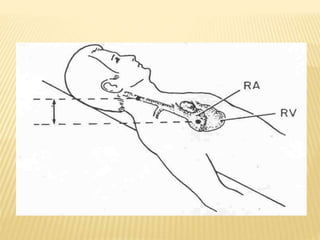
 Patient reclining with head elevated 45 °
 Neck should not be sharply flexed.
 Examined effectively by shining a light tangentially across
the neck.
 There should not be any tight bands around abdomen
METHOD OF EXAMINATION
 the level of venous pressure.
 the type of venous wave pattern.
OBSERVATIONS MADE
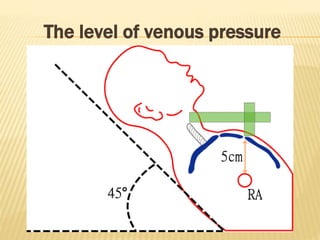
 Using a centimeter ruler, measure the vertical distance
between the angle of Louis (manubrio sternal joint) and the
highest level of jugular vein pulsation.
 The upper limit of normal is 4 cm above the sternal angle,.
 Add 5 cm to measure central venous pressure since right
atrium is 5 cm below the sternal angle.
 Normal CVP is < 9 cm H2O
THE LEVEL OF VENOUS PRESSURE
The level of venous pressure
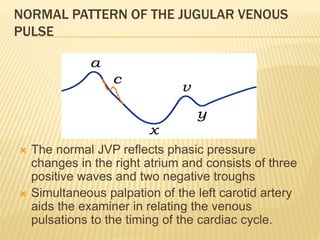
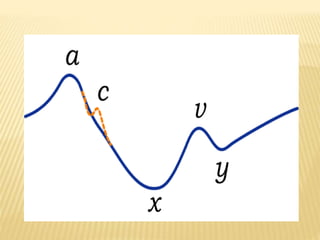
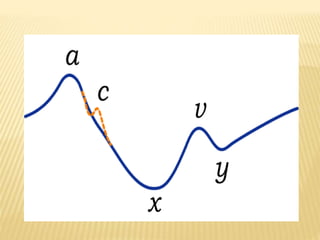
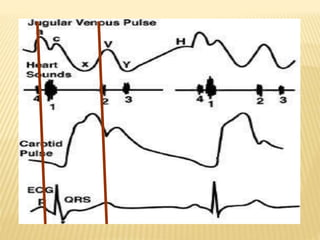
 The normal JVP reflects phasic pressure
changes in the right atrium and consists of three
positive waves and two negative troughs
 Simultaneous palpation of the left carotid artery
aids the examiner in relating the venous
pulsations to the timing of the cardiac cycle.
NORMAL PATTERN OF THE JUGULAR VENOUS
PULSE
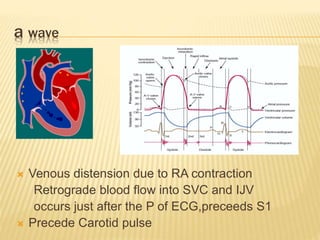
 Venous distension due to RA contraction
Retrograde blood flow into SVC and IJV
occurs just after the P of ECG,preceeds S1
 Precede Carotid pulse
a wave
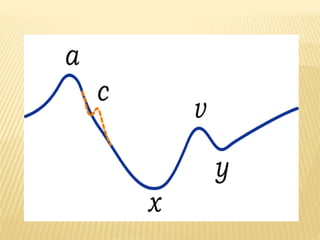
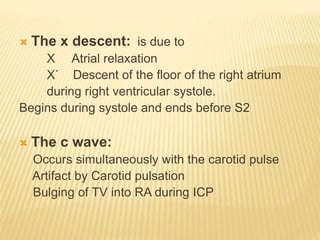
 The x descent: is due to
X Atrial relaxation
X` Descent of the floor of the right atrium
during right ventricular systole.
Begins during systole and ends before S2
 The c wave:
Occurs simultaneously with the carotid pulse
Artifact by Carotid pulsation
Bulging of TV into RA during ICP
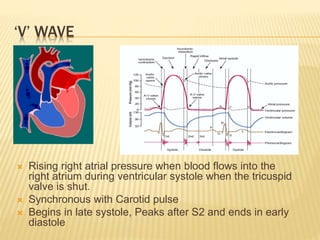
‘V’ WAVE
 Rising right atrial pressure when blood flows into the
right atrium during ventricular systole when the tricuspid
valve is shut.
 Synchronous with Carotid pulse
 Begins in late systole, Peaks after S2 and ends in early
diastole
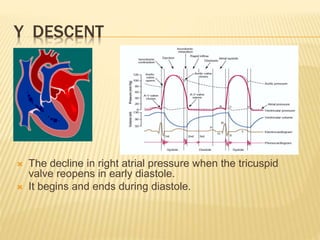
 The decline in right atrial pressure when the tricuspid
valve reopens in early diastole.
 It begins and ends during diastole.
Y DESCENT
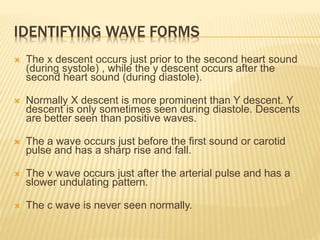
 The x descent occurs just prior to the second heart sound
(during systole) , while the y descent occurs after the
second heart sound (during diastole).
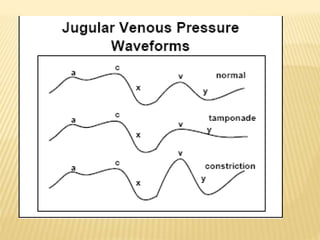
 Normally X descent is more prominent than Y descent. Y
descent is only sometimes seen during diastole. Descents
are better seen than positive waves.
 The a wave occurs just before the first sound or carotid
pulse and has a sharp rise and fall.
 The v wave occurs just after the arterial pulse and has a
slower undulating pattern.
 The c wave is never seen normally.
IDENTIFYING WAVE FORMS
A. Low jugular venous pressure
1. Hypovolaemia.
ABNORMALITIES OF JUGULAR VENOUS PULSE
1. Intravascular volume overload conditions
Right heart failure
Valvular Heart Disease with CCF
Cardiomyopathy with CCF
2. Constrictive pericarditis.
3. Pericardial effusion with tamponade
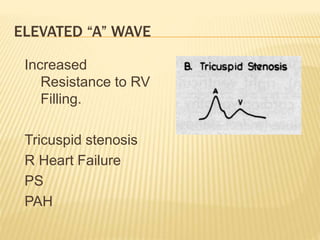
B. ELEVATED JUGULAR VENOUS PRESSURE
Increased
Resistance to RV
Filling.
Tricuspid stenosis
R Heart Failure
PS
PAH
ELEVATED “A” WAVE
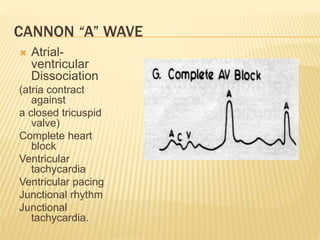
 Atrial-
ventricular
Dissociation
(atria contract
against
a closed tricuspid
valve)
Complete heart
block
Ventricular
tachycardia
Ventricular pacing
Junctional rhythm
Junctional
tachycardia.
CANNON “A” WAVE
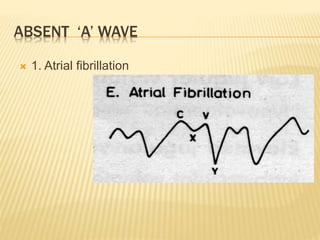
ABSENT ‘A’ WAVE
 1. Atrial fibrillation
1. Tricuspid regurgitation.
2. Right ventricular failure.
3. Restrictive cardiomyopathy.
4. Cor Pulmonale
ELEVATED “V” WAVE
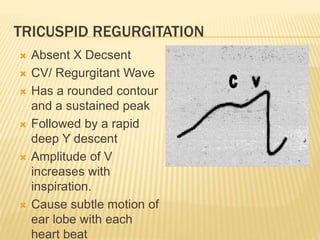
 Absent X Decsent
 CV/ Regurgitant Wave
 Has a rounded contour
and a sustained peak
 Followed by a rapid
deep Y descent
 Amplitude of V
increases with
inspiration.
 Cause subtle motion of
ear lobe with each
heart beat
TRICUSPID REGURGITATION
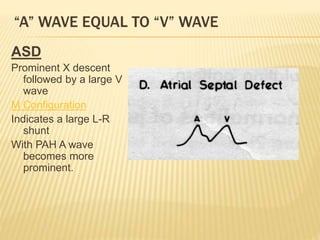
ASD
Prominent X descent
followed by a large V
wave
M Configuration
Indicates a large L-R
shunt
With PAH A wave
becomes more
prominent.
“A” WAVE EQUAL TO “V” WAVE
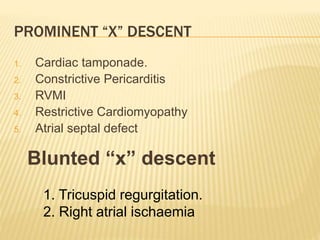
1. Cardiac tamponade.
2. Constrictive Pericarditis
3. RVMI
4. Restrictive Cardiomyopathy
5. Atrial septal defect
Blunted “x” descent
1. Tricuspid regurgitation.
2. Right atrial ischaemia
PROMINENT “X” DESCENT
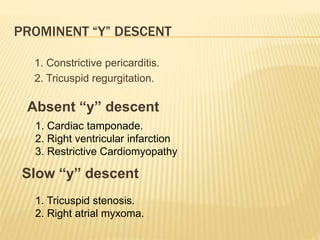
PROMINENT “Y” DESCENT
1. Constrictive pericarditis.
2. Tricuspid regurgitation.
Absent “y” descent
1. Cardiac tamponade.
2. Right ventricular infarction
3. Restrictive Cardiomyopathy
Slow “y” descent
1. Tricuspid stenosis.
2. Right atrial myxoma.
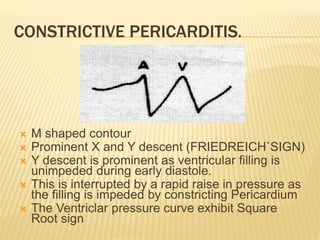
 M shaped contour
 Prominent X and Y descent (FRIEDREICH`SIGN)
 Y descent is prominent as ventricular filling is
unimpeded during early diastole.
 This is interrupted by a rapid raise in pressure as
the filling is impeded by constricting Pericardium
 The Ventriclar pressure curve exhibit Square
Root sign
CONSTRICTIVE PERICARDITIS.
 A positive response is defined by a sustained rise of more
than 3cm in jvp for at least 15s after release of the hand.
 Most common cause of a positive test is RHF
 Positive test in: Borderline elevation of JVP
Silent TR
Latent RHF
 False positive: Fluid overload
 False Negative: SVC/IVC obstruction
Budd Chiari syndrome
 Positive Test imply SVC and IVC are patent
ABDOMINO-JUGULAR REFLUX
Failure of decline in JVP during inspiration.
 Constrictive Pericarditis
 Severe RHF
 Restrictive Cardiomyopathy
 Tricuspid Stenosis
KUSSMAUL’S SIGN
BIBLIOGRAPHY
 Ganong’s textbook of Physiology
 Guyton’s book of Physiology
 Harrison’s principles of Internal Medicine
 Textbook of Cardiology by Jonathan
Abraham
 Hurst textbook of Cardiology
THANK YOU

Cardiac cycle and jvp

  • 1.
    CARDIAC CYCLE ANDJVP DEPARTMENT OF MEDICINE M V J MEDICAL COLLEGE & R H CHAIRPERSION: PROF: DR .SADASHIVAIAH PRESENTATOR: DR.M.RAMESH BABU
  • 2.
    OUT LINE INTRODUCTION DEFINITION ANATOMY OFTHE HEART NORMAL CADIAC CYCLE CAUSES OF ALTERATION IN THE CARDIAC CYCLE JVP DEFINITION ANATOMY AND PHYSIOLOGY MEASUREMENT OF JVP WAVE FORMS OF J VP ABNORMAL WAVE FORMS AND CONDITION CAUSING IT
  • 3.
    DEFINITION The cardiac eventsthat occur from the beginning of one heart beat to the beginning of the next are called the cardiac cycle.
  • 4.
    CARDIAC CYCLE CONTINUED…. Each cycle is initiated by spontaneous generation of an action potential in the sinus node.  This node is located in the superior lateral wall of the right atrium near the opening of the SVC,and the action potential travels from here to both atria and then through the a-v bundle into the ventricles.
  • 5.
  • 6.
    SAN ANT I/N TRACT OFBACHMAN MIDDLE I/N TRACT OF WENCKEBACH POST I/N TRACT OF THOREL AVN LBB RBB LAF LPF BUNDLE OF HIS PURKINJE SYSTEMMyocardium
  • 7.
    CONTINUED..  There isa delay of more than 0.1 sec during the passage of the cardiac impulse from the atria into the ventricles.  This allow the atria to contract ahead of ventricular contraction  The atria acts as a primer pumps for the ventricles.
  • 8.
    AP IN AVENTRICULAR MUSCLE FIBRE  Phase 0 : rapid depolarization – opening of fast Na channels  Phase 1 : rapid repolarisation – closure of Na channels  Phase 2 : Plateau – slow prolonged opening of Ca channels  Phase 3 : final repolarisation – rapid efflux of k+ channels  Phase 4 : RMP (-85 to -90 mv) – opening of K channels
  • 9.
    DIASTOLE AND SYSTOLE The caridac cycle consist of a period of relaxation called diastole,during which the heart fills with the blood, fallowed by a period of contraction called systole.  Duration of cardiac cycle is the reciprocal of the heart rate.  If H.R -72/min, the duration of c. cycle -1/72 beats/min – about 0.0139 min/beat,or 0.833sec/beat  Duration of systole is 0.3 sec  Duration of diastole is 0.5 sec
  • 10.
    EFFECT OF HEARTRATE ON DURATION OF CARDIAC CYCLE When heart rate increases, the duration of cardiac cycle decreases , including the contraction and relaxation phases. The period of systole decreases but not by as great a percentage as diastole. The heart beating at a very fast rate does not remain relaxed along enough to allow complete filling of the cardiac chambers before the next contraction.
  • 11.
    ATRIA AS PRIMERPUMPS  About 80% of the blood flows directly through the atria into the ventricles even before the atria contract.  Atrial contraction usally cause an addition 20% filling of the ventricles.  Normally atria has the capability of pumping 300-400% more blood than is required by the resting body.
  • 12.
  • 13.
    EVENTS OF CARDIACCYCLE Filling of the ventricles during the diastole. Period of rapid filling of the ventricles lasts for about 1/3 rd of diastole. middle 1/3 rd only small amount of blood normally flows into ventricles, during last 1/3 rd of diastole atria contracts and give additional inflow for about 20%.
  • 15.
    EMPTYING OF THEVENTRICLES DURING SYSTOLE PERIOD OF ISOVOLUMIC CONTRACTION  The ventricular pressure rises abruptly causing the a-v valves to close.  Additional 0.02-0.03sec is required for the ventricle to build up sufficient pressure to push the semilunar valves.  In this period contraction starts but no emptying. So called isovolumic or isometric contraction.
  • 17.
    PERIOD OF EJECTION When the L V pressure raises slightly > 80mm hg ( R V pressure >8mm hg ), the ventricular pressure pushes the semilunar valves open..  Period of rapid ejection –70% during first 1/3rd remaining 30% emptying during next 2/3rd –period of slow ejection.
  • 19.
    PERIOD OF ISOMETRICRELAXATION  At the end of systole,ventricular relaxation begins suddenly,allowing both the R & L intraventricular pressures to decrase rapidly.  Elevated pressures in the large arteries ,immediately push blood backward towards the ventricles, which snaps the semilunar valves to close.  Another 0.03-0.06sec requires for full relaxation of the ventricles (isovolumic relaxation).  A-v valves opens to begin a new cycle.
  • 20.
    END DIASTOLIC VOLUME,END SYSTOLIC VOLUME & SYSTOLIC VOLUME OUTPUT  During diastole filling to about 110-120ml,this volume called end diastolic volume.  Ventricles emptying during systole ,the decreases to about 70ml- called the stroke volume output.  Remaining volume in each ventricle about 40-50ml is called end systolic volume.  The fraction of the end diastolic volume that is ejected is called the ejection fraction ~60%.
  • 21.
    CONT…  When heartcontracts strongly, the ESV can be decreased to as little as 10-20ml.  When large amount of blood flow into the ventricles during diastole, the ventricular EDV can become as great as 150-180ml in healthy heart.  By both Increasing EDV and decreasing ESV,the stroke volume output can be increased to more than double normal.
  • 22.
    FUNCTIONS OF THEVALVES  A.V. valves prevent blood flow from the ventricles to atria during systole.  Semilunar valves prevent blood flow from the large arteries into ventricles during diastole.  These valves open & closes passively,they closes when back ward pressure gradient pushes, opens when the gradient forces blood in the forward direction  Thin A.V valves require no backflow, semilunar valves require rapid backflow for few mill.sec.
  • 23.
    FUNCTIONS OF PAPILLARYMUSCLES  The papillary muscles contract when the ventricular walls contract, but they do not help the valves to close.  They pull the vanes of valves inward toward the ventricles to prevent their bulging.  If chorda tendinea ruptures the valves bulges far backward,results in severe or lethal cardiac incapacity.
  • 24.
    SEMILUNAR VALVES  Thehigh pressures in the arteries at the end of systole cause the semilunar valves to snap to the closed position.,much softer closer.  Smaller openings ,the ejection through the aortic and pulmanary valves is far greater than that through the a-v valves.  Strong yet pliable fibrous tissue base to withstand the extra physical stress.
  • 25.
    VENTRICULAR PRESSURE- VOLUMELOOP a – Ventricular filling 1 – Mitral valve closes b – isovol contraction 2 – Aortic valve opens c – ejection 3 – Aortic valve closes d – isovol relaxation 4 – Mitral valve
  • 26.
     The fillingphase moves along the end-diastolic pressure-volume relationship (EDPVR)  The slope of the EDPVR is the reciprocal of Ventricular Compliance  The maximal pressure that can be developed by the ventricle at any given left ventricular volume → end-systolic pressure-volume relationship (ESPVR), which represents the inotropic state.
  • 27.
    ↓ slope ofESPVR i.e. ↑ ESV Compensatory rise in preload i.e. ↑ EDV ↓ SV ↓ EF ↓ Work ↑ EDP  Impaired ventricular contraction SYSTOLIC DYSFUNCTION
  • 28.
    Reduced venous return/ compliance / relaxation (lusitropy) ↓ EDV ↓ SV ↓ or = EF ↓ Work ↑ EDP DIASTOLIC DYSFUNCTION
  • 29.
    Impaired LV filling ↓EDV ↓ afterload ; ↓ ESV ↓ SV and CO MITRAL STENOSIS
  • 30.
    Afterload on LV↓ Outflow resistance is ↓ EDV and EDP ↑ ↑ SV ↓ EF MITRAL REGURGITATION
  • 31.
    High outflow resistance;LV emptying impaired ↑ Peak systolic pressure; ↑ afterload ↓ SV ↑ ESV ↑ EDV AORTIC STENOSIS
  • 32.
    No true isovolumetricrelaxation Blood from aorta to ventricle throughout diastole ↑ EDV ↑ SV (if no failure) ↑ ESV and ↓ SV in failure AORTIC REGURGITATION
  • 33.
    ECG TO THECARDIAC CYCLE
  • 34.
    ECG TO THECARDIAC CYCLE
  • 35.
     In Atrialsystole Heart sounds - S 4 – pathological. Vibration of the ventricular wall during atrial contraction. Heard in ‘stiff’ ventricle like in hypertrophy and in elderly. Also heard in massive pulmonary embolism, cor pulmonale, TR  In isometric contraction Heart Sounds – S1 : closure of the AV valves. Normally split as mitral valve closure preceeds tricuspid valve closure.  In Ejection Heart sounds – none  In Isovolumic relaxation Heart sounds – S2 : closure of the semilunar valves. Normally split because aortic valve closes slightly earlier than the pulmonary valve Heart sounds - S3 - Pathological in adults. Seen in dilated congestive heart failure, MI, MR, severe hypertension. Normal in children
  • 36.
    DEFINITION  Jugular VenousPulse: defined as the oscillating top of vertical column of blood in right IJV that reflects pressure changes in Right Atrium in cardiac cycle.  Jugular Venous Pressure: Vertical height of oscillating column of blood.
  • 37.
    WHY INTERNAL JUGULARVEIN?  IJV has a direct course to RA.  IJV is anatomically closer to RA.  IJV has no valves( Valves in EJV prevent transmission of RA pressure)  Vasoconstriction Secondary to hypotension ( in CCF) can make EJV small and barely visible.
  • 38.
    WHY RIGHT INTERNALJUGULAR VEIN?  Right jugular veins extend in an almost straight line to superior vena cava, thus favouring transmission of the haemodynamic changes from the right atrium.  The left innominate vein is not in a straight line and may be kinked or compressed between Aortic Arch and sternum, by a dilated aorta, or by an aneurysm.
  • 41.
     The patientshould lie comfortably during the examination.  Clothing should be removed from the neck and upper thorax.  Patient reclining with head elevated 45 °  Neck should not be sharply flexed.  Examined effectively by shining a light tangentially across the neck.  There should not be any tight bands around abdomen METHOD OF EXAMINATION
  • 42.
     the levelof venous pressure.  the type of venous wave pattern. OBSERVATIONS MADE
  • 43.
     Using acentimeter ruler, measure the vertical distance between the angle of Louis (manubrio sternal joint) and the highest level of jugular vein pulsation.  The upper limit of normal is 4 cm above the sternal angle,.  Add 5 cm to measure central venous pressure since right atrium is 5 cm below the sternal angle.  Normal CVP is < 9 cm H2O THE LEVEL OF VENOUS PRESSURE
  • 44.
    The level ofvenous pressure
  • 45.
     The normalJVP reflects phasic pressure changes in the right atrium and consists of three positive waves and two negative troughs  Simultaneous palpation of the left carotid artery aids the examiner in relating the venous pulsations to the timing of the cardiac cycle. NORMAL PATTERN OF THE JUGULAR VENOUS PULSE
  • 46.
     Venous distensiondue to RA contraction Retrograde blood flow into SVC and IJV occurs just after the P of ECG,preceeds S1  Precede Carotid pulse a wave
  • 48.
     The xdescent: is due to X Atrial relaxation X` Descent of the floor of the right atrium during right ventricular systole. Begins during systole and ends before S2  The c wave: Occurs simultaneously with the carotid pulse Artifact by Carotid pulsation Bulging of TV into RA during ICP
  • 50.
    ‘V’ WAVE  Risingright atrial pressure when blood flows into the right atrium during ventricular systole when the tricuspid valve is shut.  Synchronous with Carotid pulse  Begins in late systole, Peaks after S2 and ends in early diastole
  • 52.
     The declinein right atrial pressure when the tricuspid valve reopens in early diastole.  It begins and ends during diastole. Y DESCENT
  • 54.
     The xdescent occurs just prior to the second heart sound (during systole) , while the y descent occurs after the second heart sound (during diastole).  Normally X descent is more prominent than Y descent. Y descent is only sometimes seen during diastole. Descents are better seen than positive waves.  The a wave occurs just before the first sound or carotid pulse and has a sharp rise and fall.  The v wave occurs just after the arterial pulse and has a slower undulating pattern.  The c wave is never seen normally. IDENTIFYING WAVE FORMS
  • 55.
    A. Low jugularvenous pressure 1. Hypovolaemia. ABNORMALITIES OF JUGULAR VENOUS PULSE
  • 56.
    1. Intravascular volumeoverload conditions Right heart failure Valvular Heart Disease with CCF Cardiomyopathy with CCF 2. Constrictive pericarditis. 3. Pericardial effusion with tamponade B. ELEVATED JUGULAR VENOUS PRESSURE
  • 57.
    Increased Resistance to RV Filling. Tricuspidstenosis R Heart Failure PS PAH ELEVATED “A” WAVE
  • 58.
     Atrial- ventricular Dissociation (atria contract against aclosed tricuspid valve) Complete heart block Ventricular tachycardia Ventricular pacing Junctional rhythm Junctional tachycardia. CANNON “A” WAVE
  • 59.
    ABSENT ‘A’ WAVE 1. Atrial fibrillation
  • 60.
    1. Tricuspid regurgitation. 2.Right ventricular failure. 3. Restrictive cardiomyopathy. 4. Cor Pulmonale ELEVATED “V” WAVE
  • 61.
     Absent XDecsent  CV/ Regurgitant Wave  Has a rounded contour and a sustained peak  Followed by a rapid deep Y descent  Amplitude of V increases with inspiration.  Cause subtle motion of ear lobe with each heart beat TRICUSPID REGURGITATION
  • 62.
    ASD Prominent X descent followedby a large V wave M Configuration Indicates a large L-R shunt With PAH A wave becomes more prominent. “A” WAVE EQUAL TO “V” WAVE
  • 63.
    1. Cardiac tamponade. 2.Constrictive Pericarditis 3. RVMI 4. Restrictive Cardiomyopathy 5. Atrial septal defect Blunted “x” descent 1. Tricuspid regurgitation. 2. Right atrial ischaemia PROMINENT “X” DESCENT
  • 64.
    PROMINENT “Y” DESCENT 1.Constrictive pericarditis. 2. Tricuspid regurgitation. Absent “y” descent 1. Cardiac tamponade. 2. Right ventricular infarction 3. Restrictive Cardiomyopathy Slow “y” descent 1. Tricuspid stenosis. 2. Right atrial myxoma.
  • 65.
     M shapedcontour  Prominent X and Y descent (FRIEDREICH`SIGN)  Y descent is prominent as ventricular filling is unimpeded during early diastole.  This is interrupted by a rapid raise in pressure as the filling is impeded by constricting Pericardium  The Ventriclar pressure curve exhibit Square Root sign CONSTRICTIVE PERICARDITIS.
  • 67.
     A positiveresponse is defined by a sustained rise of more than 3cm in jvp for at least 15s after release of the hand.  Most common cause of a positive test is RHF  Positive test in: Borderline elevation of JVP Silent TR Latent RHF  False positive: Fluid overload  False Negative: SVC/IVC obstruction Budd Chiari syndrome  Positive Test imply SVC and IVC are patent ABDOMINO-JUGULAR REFLUX
  • 68.
    Failure of declinein JVP during inspiration.  Constrictive Pericarditis  Severe RHF  Restrictive Cardiomyopathy  Tricuspid Stenosis KUSSMAUL’S SIGN
  • 69.
    BIBLIOGRAPHY  Ganong’s textbookof Physiology  Guyton’s book of Physiology  Harrison’s principles of Internal Medicine  Textbook of Cardiology by Jonathan Abraham  Hurst textbook of Cardiology
  • 70.

Editor's Notes