an interesting case of
dysarthria
dr.arul selvan unit
presenter: dr.m.ramesh babu
brief history
• Mr.X 68 yrs old male presented with ℅
• Fever 2 days
• H/o LOC followed by fall in the washroom @ 7
am on 14/12/17
• After the fall patient started ℅ weakness in Rt.
UL&LL
• No h/o headache/neck pain/ jerky movements
of limbs/ stiffening of the limbs/ starring look/
irrelevant talks/ incontinence/ tongue bite
• H/o brief episodes of Dysarthria ( Saliavation-
Complete Mute - Dysarthria - Normal) next day
after the fall, lasts for 5-10 minutes, a/w
swallowing difficulty - mostly while eating the
food
• Took him to the local hospital - CT Brain was
done which showed SDH Rt. fronto-temporo-
parietal region
• Brought here for further evaluation
• Past History: H/o Rt. Hemiparesis - Ischemic
stroke 25 yrs back
• H/o C.N III palsy 4 yrs back ? Diabetic
• H/O Diabetes - 10 yrs
• H/o HTN - newly diagnosed
• Family H/o : Father had h/o CVA
• Personal H/o: Ex-smoker - left 5 yrs back
history summary
• Mr. X 68 yrs elderly male, DM/HTN/Ex
Smoker presented with fever 2 days, LOC
followed by head injury with weakness of Rt.
hemiparesis without facial involvement with
brief episodes of dysarthria, without jerky
movements, altered sensorium, irrelevant
talks, starring look, with h/o old Rt.
hemiparesis
• Possibilites:
• Seizure - Todd palsy
• Seizure at the onset of Stroke
• Cervical myelopathy with Seizure / TIA
• ?SDH - due compression effect
on examination
• GPE: well built and nourished
• NO P I C C L E
• No Neurocutaneous markers
• Vitals: BP: 140/90mmhg, PR- 84/min, Temp -
N
cns examination
• Patient conscious , alert, well oriented to time
/ place/person
• MMSE - 28/30
• Speech - fluency, comprehension, repetition ,
naming, reading, copying - N
• Pupils - B/L 3mm reactive
• Fundus: Normal
• EOM - full
• No facial lag
• Tongue and palate - normal
• Gag & Jaw reflex - N
• Motor system : Tone - spasticity Rt.side
• Power : 4/5 5/5
• 4/5 5/5
• DTR’S - Rt. BJ, SJ - Brisk
• Plantar : Extensor Rt. Flexor Lt.
• Sensory System - No deficit
• No cerebellar signs
• No meningeal signs
• No cervical pain or ROM
investigations
• CBC - N
• RFT - N
• LFT - N
• S.Na, K+ - N
• S.Cholesterol - 300mg/dl
• HbA1c - 11.9%
• Blood glucose- 386mg/dl
• CT Brain - SDH Rt. Fronto-temporo-parietal
region
• MRI C.Spine - C4-5, C5-6 disc bulging with
compression of C5/6 roots on R>L with facet
joint hypertrophy
• Patient treated with Inj.Levipil, Inj.Strocit,
T.Gabantin and Vitamins
• Pt. Improved in power within 2 days, No
further Dysarthric episodes - Discharged
• Again Readmitted on 22.12.2107 with ℅
Paroxysmal Dysarthria - 2 times lasting for 10-
15 times and recovers fully.
• No other associated symptoms
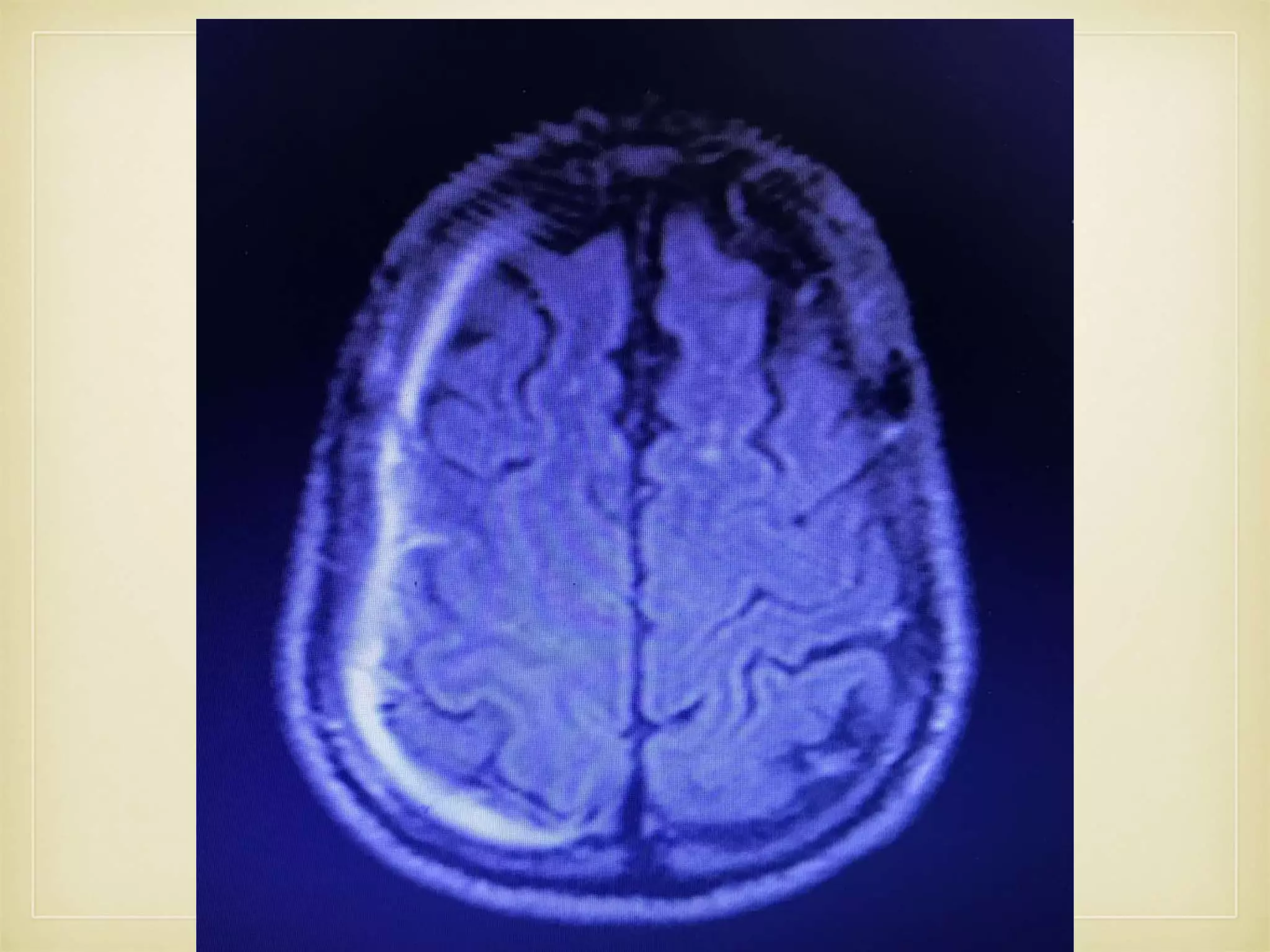
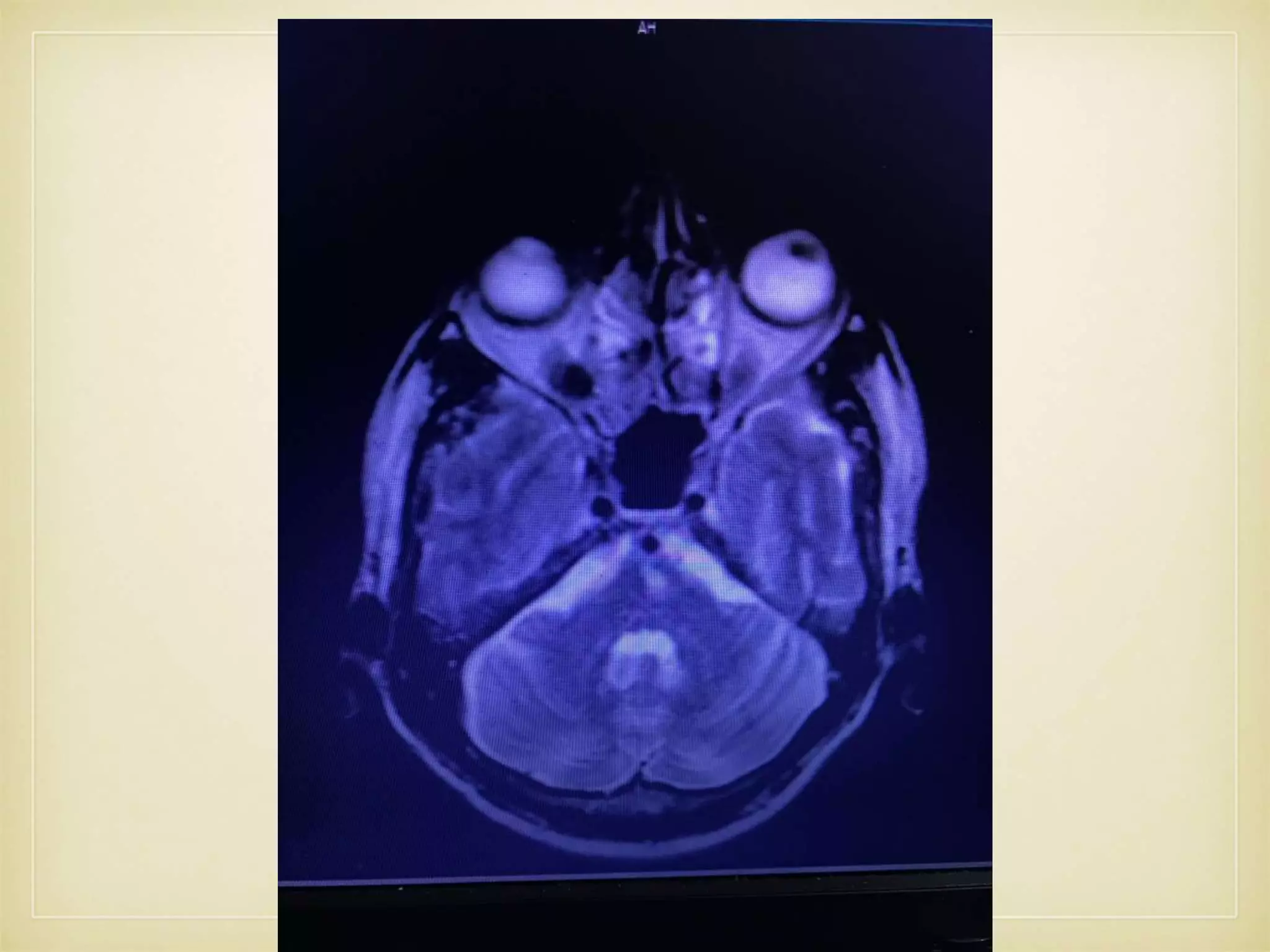
• Further evaluated with MRI brain and MRA
IMAGING
• Escalated Levipil dose - Not controlled
• Had 2 more brief episodes in Ward on the
same day
• Started on T. Ecosprin 75mg OD and
T.Clobazam 10mg BD
• No further episodes
• Discharged
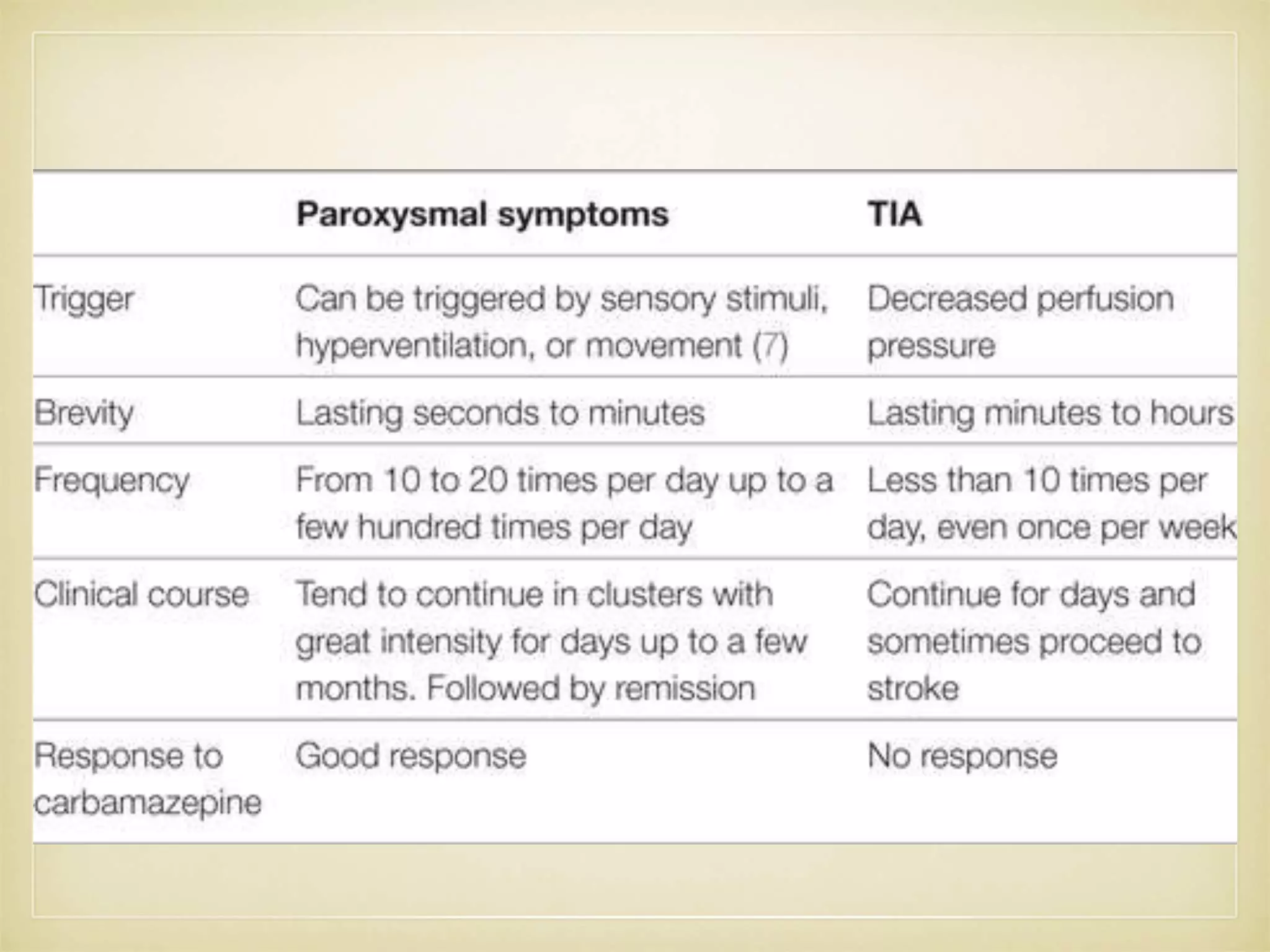
Paroxysmal dysarthria
• Seizure vs TIA ?Etiology
• ?Reflex seizure
• ? Due to SDH
• ? Hyperglycemia induced seizure
mechanism of paroxysmal
dysarthria• Following hypothesis as to the mechanism of the
paroxysmal attacks:
• The fact that the attacks are an early symptom
suggests that they may correspond to the earlier
stages of demyelination/ axonal injury
• During this phase it may well be that the axons,
though still capable of functioning normally in the
various facilitating and inhibiting systems, become
very vulnerable to changes in the internal environment
and that some minor, and reversible, change might
cause them temporarily to suspend function, which
they resume as the change passes off.
• Appears to be highly sensitive to the effects of
overbreathing. Since overbreathing is known to
decrease cerebral blood flow , small fall in the
blood supply producing, presumably, a minor
degree of hypoxia, to which damaged neurones
are abnormally sensitive.
• Biochemical and/or vascular changes responsible
for transient neurological disturbances,
• Emotion / stress - vasospasm - triggers
symptoms
Causes of Dysarthria
• Neurologic disorders with dysarthria as a
symptom:
• Stroke: cerebrovascular ischemic disorders
• - Cerebellar infarction
• - Lacunar infarction
• - Subcortical ischemic vascular dementia
• - Vertebrobasilar ischemia
• Epileptic disorders - Lingual epilepsia partialis
continua - Congenital bilateral perisylvian
syndrome with partial epilepsy - Benign
childhood epilepsy with centrotemporal spikes
• Trauma to the central nervous system
• Encephalitis - Encephalitis lethargica - Herpes
simplex encephalitis
• Brainstem disorders - Basilar-type migraine -
Brainstem encephalitis - Brainstem tumors -
Central pontine myelinolysis
• Drug-induced dysarthria:
• Antiepileptic drugs: phenytoin
• Anticancer agents: irinotecan
• Benzodiazepines
• Lithium neurotoxicity
• Neuroleptic drugs
• Paroxetine, a selective serotonin reuptake inhibitor
• Exposure to toxins and metals: • Mercury poisoning
• Botulism • Nerve agent poisoning
• Demyelinating diseases - Multiple sclerosis -
Pelizaeus-Merzbacher disease
• Myasthenia gravis
• Cranial nerve lesions - Aneurysms of
extracranial internal carotid artery
• Dysarthria in metabolic diseases with
neurologic manifestations: • 2-Hydroxyglutaric
aciduria • Ornithine transcarbamylase
deficiency
• THANK YOU

A Interesting case of Dysarthria

  • 1.
    an interesting caseof dysarthria dr.arul selvan unit presenter: dr.m.ramesh babu
  • 2.
    brief history • Mr.X68 yrs old male presented with ℅ • Fever 2 days • H/o LOC followed by fall in the washroom @ 7 am on 14/12/17 • After the fall patient started ℅ weakness in Rt. UL&LL
  • 3.
    • No h/oheadache/neck pain/ jerky movements of limbs/ stiffening of the limbs/ starring look/ irrelevant talks/ incontinence/ tongue bite • H/o brief episodes of Dysarthria ( Saliavation- Complete Mute - Dysarthria - Normal) next day after the fall, lasts for 5-10 minutes, a/w swallowing difficulty - mostly while eating the food • Took him to the local hospital - CT Brain was done which showed SDH Rt. fronto-temporo- parietal region • Brought here for further evaluation
  • 4.
    • Past History:H/o Rt. Hemiparesis - Ischemic stroke 25 yrs back • H/o C.N III palsy 4 yrs back ? Diabetic • H/O Diabetes - 10 yrs • H/o HTN - newly diagnosed • Family H/o : Father had h/o CVA • Personal H/o: Ex-smoker - left 5 yrs back
  • 5.
    history summary • Mr.X 68 yrs elderly male, DM/HTN/Ex Smoker presented with fever 2 days, LOC followed by head injury with weakness of Rt. hemiparesis without facial involvement with brief episodes of dysarthria, without jerky movements, altered sensorium, irrelevant talks, starring look, with h/o old Rt. hemiparesis • Possibilites:
  • 6.
    • Seizure -Todd palsy • Seizure at the onset of Stroke • Cervical myelopathy with Seizure / TIA • ?SDH - due compression effect
  • 7.
    on examination • GPE:well built and nourished • NO P I C C L E • No Neurocutaneous markers • Vitals: BP: 140/90mmhg, PR- 84/min, Temp - N
  • 8.
    cns examination • Patientconscious , alert, well oriented to time / place/person • MMSE - 28/30 • Speech - fluency, comprehension, repetition , naming, reading, copying - N
  • 9.
    • Pupils -B/L 3mm reactive • Fundus: Normal • EOM - full • No facial lag • Tongue and palate - normal • Gag & Jaw reflex - N
  • 10.
    • Motor system: Tone - spasticity Rt.side • Power : 4/5 5/5 • 4/5 5/5 • DTR’S - Rt. BJ, SJ - Brisk • Plantar : Extensor Rt. Flexor Lt. • Sensory System - No deficit • No cerebellar signs • No meningeal signs • No cervical pain or ROM
  • 11.
    investigations • CBC -N • RFT - N • LFT - N • S.Na, K+ - N • S.Cholesterol - 300mg/dl • HbA1c - 11.9% • Blood glucose- 386mg/dl
  • 12.
    • CT Brain- SDH Rt. Fronto-temporo-parietal region • MRI C.Spine - C4-5, C5-6 disc bulging with compression of C5/6 roots on R>L with facet joint hypertrophy
  • 13.
    • Patient treatedwith Inj.Levipil, Inj.Strocit, T.Gabantin and Vitamins • Pt. Improved in power within 2 days, No further Dysarthric episodes - Discharged
  • 14.
    • Again Readmittedon 22.12.2107 with ℅ Paroxysmal Dysarthria - 2 times lasting for 10- 15 times and recovers fully. • No other associated symptoms • Further evaluated with MRI brain and MRA
  • 15.
  • 23.
    • Escalated Levipildose - Not controlled • Had 2 more brief episodes in Ward on the same day • Started on T. Ecosprin 75mg OD and T.Clobazam 10mg BD • No further episodes • Discharged
  • 24.
    Paroxysmal dysarthria • Seizurevs TIA ?Etiology • ?Reflex seizure • ? Due to SDH • ? Hyperglycemia induced seizure
  • 26.
    mechanism of paroxysmal dysarthria•Following hypothesis as to the mechanism of the paroxysmal attacks: • The fact that the attacks are an early symptom suggests that they may correspond to the earlier stages of demyelination/ axonal injury • During this phase it may well be that the axons, though still capable of functioning normally in the various facilitating and inhibiting systems, become very vulnerable to changes in the internal environment and that some minor, and reversible, change might cause them temporarily to suspend function, which they resume as the change passes off.
  • 27.
    • Appears tobe highly sensitive to the effects of overbreathing. Since overbreathing is known to decrease cerebral blood flow , small fall in the blood supply producing, presumably, a minor degree of hypoxia, to which damaged neurones are abnormally sensitive. • Biochemical and/or vascular changes responsible for transient neurological disturbances, • Emotion / stress - vasospasm - triggers symptoms
  • 28.
    Causes of Dysarthria •Neurologic disorders with dysarthria as a symptom: • Stroke: cerebrovascular ischemic disorders • - Cerebellar infarction • - Lacunar infarction • - Subcortical ischemic vascular dementia • - Vertebrobasilar ischemia
  • 29.
    • Epileptic disorders- Lingual epilepsia partialis continua - Congenital bilateral perisylvian syndrome with partial epilepsy - Benign childhood epilepsy with centrotemporal spikes • Trauma to the central nervous system • Encephalitis - Encephalitis lethargica - Herpes simplex encephalitis • Brainstem disorders - Basilar-type migraine - Brainstem encephalitis - Brainstem tumors - Central pontine myelinolysis
  • 30.
    • Drug-induced dysarthria: •Antiepileptic drugs: phenytoin • Anticancer agents: irinotecan • Benzodiazepines • Lithium neurotoxicity • Neuroleptic drugs • Paroxetine, a selective serotonin reuptake inhibitor • Exposure to toxins and metals: • Mercury poisoning • Botulism • Nerve agent poisoning
  • 31.
    • Demyelinating diseases- Multiple sclerosis - Pelizaeus-Merzbacher disease • Myasthenia gravis • Cranial nerve lesions - Aneurysms of extracranial internal carotid artery • Dysarthria in metabolic diseases with neurologic manifestations: • 2-Hydroxyglutaric aciduria • Ornithine transcarbamylase deficiency
  • 32.