Coronary
Blood Flow
By
Dr. Safwat Ibrahim AlNahrawi
Cardiology Resident at National Heart Institute.
Introduction:
The coronary circulation is unique
in that the heart is responsible for
generating the arterial pressure
that is required to perfuse the
systemic circulation and yet, at the
same time, has its own perfusion
impeded during the systolic portion
of the cardiac cycle .
The balance between oxygen
supply and demand is a critical
determinant of the normal beat-to-
beat function of the heart.
Introduction
The importance of the coronary
circulation is that myocardial
contraction is closely related, so
when this relation is acutely
disrupted by diseases affecting
coronary blood flow the resulting
imbalance can immediately
precipitate a vicious cycle, whereby
ischemia-induced contractile
dysfunction precipitates
hypotension and further
myocardial ischemia.
Introduction
Introduction
Impaired
coronary
blood flow
(Ischemia)
Ischemia Induced
Contractile
Dysfunction
Hypotension
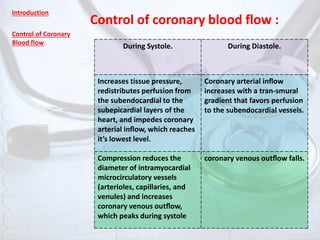
Control of coronary blood flow :
Introduction
Control of Coronary
Blood flow
During Diastole.During Systole.
Coronary arterial inflow
increases with a tran-smural
gradient that favors perfusion
to the subendocardial vessels.
Increases tissue pressure,
redistributes perfusion from
the subendocardial to the
subepicardial layers of the
heart, and impedes coronary
arterial inflow, which reaches
it’s lowest level.
coronary venous outflow falls.Compression reduces the
diameter of intramyocardial
microcirculatory vessels
(arterioles, capillaries, and
venules) and increases
coronary venous outflow,
which peaks during systole
Introduction
Control of Coronary
Blood flow
Introduction
Control of Coronary
Blood flow
Introduction
Control of Coronary
Blood flow
Introduction
Control of Coronary
Blood flow
Myocardial Oxygen Consumption
myocardial oxygen extraction is
maximal at rest (60% to 80% of
arterial oxygen content).
increase oxygen extraction to
increase oxygen delivery is limited
to sympathetic activation and acute
subendocardial ischemia.
So, the increases in myocardial
oxygen consumption are met by
proportional increases in coronary
flow.
Introduction
Control of Coronary
Blood flow
Myocardial Oxygen
Consumption
Myocardial Oxygen Consumption
The major determinants of
myocardial oxygen consumption are
heart rate
systolic pressure (or myocardial wall
stress)
left ventricular (LV) contractility.
Introduction
Control of Coronary
Blood flow
Myocardial Oxygen
Consumption
Coronary Autoregulation:
Regional coronary blood flow
remains constant as coronary artery
pressure is reduced below aortic
pressure over a wide range when
the determinants of myocardial
oxygen consumption are kept
constant.
Introduction
Control of Coronary
Blood flow
Myocardial Oxygen
Consumption
Coronary
Autoregulation
Coronary Autoregulation:
Resting coronary blood flow under
normal hemodynamic conditions
averages 0.7 to 1.0 mL/min/g and
can increase between four to five
fold during vasodilation.
coronary flow reserve
Introduction
Control of Coronary
Blood flow
Myocardial Oxygen
Consumption
Coronary
Autoregulation
Coronary Autoregulation:
coronary flow reserve
reduced when
• the diastolic time available for
subendocardial perfusion is
decreased (tachycardia)
• the compressive determinants of
diastolic perfusion (preload) are
increased.
Introduction
Control of Coronary
Blood flow
Myocardial Oxygen
Consumption
Coronary
Autoregulation
Coronary Autoregulation:
coronary flow reserve
anything that increases resting
flow, including:
• increases in the hemodynamic
determinants of oxygen
consumption (systolic pressure,
heart rate, and contractility)
• reductions in arterial oxygen
supply (anemia and hypoxia)
Introduction
Control of Coronary
Blood flow
Myocardial Oxygen
Consumption
Coronary
Autoregulation
Coronary Autoregulation:
coronary flow reserve
subendocardial ischemia in the
presence of normal coronary
arteries.
Introduction
Control of Coronary
Blood flow
Myocardial Oxygen
Consumption
Coronary
Autoregulation
Coronary Autoregulation:
Trans-mural variations In coronary
Blood flow:
Subendocardial flow occurs
primarily in diastole and begins to
decrease below a mean coronary
pressure of 40 mm Hg.
By contrast, subepicardial flow
occurs throughout the cardiac cycle
and is maintained until coronary
pressure falls below 25 mm Hg.
So, vulnerability of the sub-
endocardium to ischemia increased
Introduction
Control of Coronary
Blood flow
Myocardial Oxygen
Consumption
Coronary
Autoregulation
Coronary Autoregulation:
Trans-mural variations In coronary
Blood flow:
Introduction
Control of Coronary
Blood flow
Myocardial Oxygen
Consumption
Coronary
Autoregulation
Coronary Autoregulation:
Endothelium-Dependent
Modulation of Coronary Tone.
Epicardial conduit arteries do not
contribute significantly to coronary
vascular resistance.
arterial diameter is regulated by
• platelets paracrine factors
• circulating neurohormonal
agonists
• neural tone
• local control (vascular shear
stress).
Introduction
Control of Coronary
Blood flow
Myocardial Oxygen
Consumption
Coronary
Autoregulation
Coronary Autoregulation:
Endothelium-Dependent Modulation
of Coronary Tone.
The net effect of many of these
agonists is dependent on whether a
functional endothelium is present.
Introduction
Control of Coronary
Blood flow
Myocardial Oxygen
Consumption
Coronary
Autoregulation
Acetyl
choline
Endothelial
dependent
relaxing
factor (Nitric
oxide)
cGMP
Smooth
muscle
relaxation
Coronary Autoregulation:
Endothelium-Dependent Modulation
of Coronary Tone.
Nitric Oxide
(Endothelium-Derived Relaxing
Factor).
• produced in endothelial cells by
conversion of l-arginine to citrulline
by type III NO synthase (NOS).
• NO diffuse into Smooth muscle and
increase cGMP which increase
relaxation via decrease in
intracellular calcium
Introduction
Control of Coronary
Blood flow
Myocardial Oxygen
Consumption
Coronary
Autoregulation
• NO-mediated vasodilation is
enhanced by cyclic or pulsatile
changes in coronary shear stress.
• Chronic up regulation of NOS occurs in
response to episodic increases in
coronary flow (such as during exercise
training).
• NO-mediated vasodilation is impaired
in many disease states and in patients
risky for coronary artery disease
(CAD), (in CAD oxidative stress
generate superoxide anion which
inactivate NO).
This is the hallmark of impaired NO-
mediated vasodilation in
atherosclerosis, hypertension, and
diabetes
Introduction
Control of Coronary
Blood flow
Myocardial Oxygen
Consumption
Coronary
Autoregulation
Coronary Autoregulation:
Endothelium-Dependent Modulation of
Coronary Tone.
Endothelium-Dependent
Hyperpolarizing Factor (EDHF)
• endothelium-dependent mechanism
for selected agonists (bradykinin), as
well as shear stress–induced
vasodilation.
• produced by the endothelium,
hyperpolarizes vascular smooth
muscle and dilates arteries by opening
calcium-activated potassium channels
Introduction
Control of Coronary
Blood flow
Myocardial Oxygen
Consumption
Coronary
Autoregulation
Coronary Autoregulation:
Endothelium-Dependent Modulation of
Coronary Tone.
Prostacyclin
(vasodilator prostaglandins)
• Metabolism of arachidonic acid via
cyclooxygenase.
• Produce tonic coronary vasodilation
• inhibitors of cyclooxygenase do not
alter flow during ischemia distal to an
acute stenosis or limit oxygen
consumption in response to increases
in metabolism.
• This suggests that it is overcome by
other compensatory vasodilator
pathways.
Introduction
Control of Coronary
Blood flow
Myocardial Oxygen
Consumption
Coronary
Autoregulation
Coronary Autoregulation:
Endothelium-Dependent Modulation of
Coronary Tone.
Endothelin
(ET-1, ET-2, and ET-3)
• are peptide endothelium-dependent
constricting factors.
• Their constricting function is mediated by
binding to both ETA and ETB receptors.
• ETA-mediated constriction is caused by the
activation of protein kinase C in vascular
smooth muscle.
• ETB-mediated constriction is less
pronounced and counterbalanced by ETB-
mediated endothelium-dependent NO
production and vasodilation.
Introduction
Control of Coronary
Blood flow
Myocardial Oxygen
Consumption
Coronary
Autoregulation
Coronary Autoregulation:
Endothelium-Dependent Modulation of
Coronary Tone.
Endothelin
(ET-1, ET-2, and ET-3)
• Unlike the rapid vascular smooth
muscle relaxation and recovery
characteristic of endothelium-derived
vasodilators (NO, EDHF, and
prostacyclin), the constriction to
endothelin is prolonged.
• marginally involved in regulating
coronary blood flow in the normal
heart but concentrations increase in
diseases such as heart failure
Introduction
Control of Coronary
Blood flow
Myocardial Oxygen
Consumption
Coronary
Autoregulation
Coronary Autoregulation:
Endothelium-Dependent Modulation
of Coronary Tone.
Introduction
Control of Coronary
Blood flow
Myocardial Oxygen
Consumption
Coronary
Autoregulation
Coronary Vascular Resistance.
The resistance to coronary blood flow
can be divided into three major
components:
1-(R1) negligible conduit resistance .
• hemodynamically significant
epicardial artery narrowing (more
than 50% diameter reduction), the
fixed conduit artery resistance begins
to contribute an increasing
component to total coronary
resistance
• when severely narrowed (more than
90%), may reduce resting flow.
Introduction
Control of Coronary
Blood flow
Myocardial Oxygen
Consumption
Coronary
Autoregulation
Coronary Vascular
Resistance.
Coronary Vascular Resistance.
The resistance to coronary blood flow
can be divided into three major
components:
2- (R2) is dynamic : arises primarily from
microcirculatory resistance arteries and
arterioles. .
Differ according to the microcirculatory
resistance vessel sizes (20 to 400 µm in
diameter) and changes in response to
physical forces (intraluminal pressure
and shear stress), as well as the
metabolic needs of the tissue.
Introduction
Control of Coronary
Blood flow
Myocardial Oxygen
Consumption
Coronary
Autoregulation
Coronary Vascular
Resistance.
Coronary Vascular Resistance.
The resistance to coronary blood flow
can be divided into three major
components:
3- (R3) extravascular compressive
resistance:
• varies with time during the cardiac
cycle and is related to cardiac
contraction and systolic pressure of LV
• In heart failure, the elevated
ventricular diastolic pressure raise R3
impede perfusion of microcirculatory
vessels from elevated extravascular
tissue pressure during diastole.
Introduction
Control of Coronary
Blood flow
Myocardial Oxygen
Consumption
Coronary
Autoregulation
Coronary Vascular
Resistance.
Coronary Vascular Resistance.
Introduction
Control of Coronary
Blood flow
Myocardial Oxygen
Consumption
Coronary
Autoregulation
Coronary Vascular
Resistance.
R1 is epicardial conduit artery resistance, which normally is insignificant
R2 is resistance secondary to metabolic and autoregulatory adjustments
in flow and occurs in arterioles and small arteries
R3 is the time-varying compressive resistance that is higher in
subendocardial than subepicardial layers. In the normal heart
Coronary Vascular Resistance.
Microcirculation organization
Resistance vessel needs to dilate in an
orchestrated fashion:
• Epicardial arteries (<400 µm in diameter)
serve a conduit artery function, with diameter
primarily regulated by shear stress, and
contribute
little pressure drop (>5%) over a wide range
of coronary flow.
• resistance vessels can be divided into small
arteries (100 to 400 µm), which regulate their
tone in response to local shear stress and
luminal pressure changes (myogenic
response), and arterioles (<100 µm), which
are sensitive to changes in local tissue
metabolism and directly control perfusion of
the low-resistance coronary capillary bed.
Introduction
Control of Coronary
Blood flow
Myocardial Oxygen
Consumption
Coronary
Autoregulation
Coronary Vascular
Resistance.
Coronary Vascular Resistance.
Microcirculation organization
Introduction
Control of Coronary
Blood flow
Myocardial Oxygen
Consumption
Coronary
Autoregulation
Coronary Vascular
Resistance.
Coronary Vascular Resistance.
Microcirculation organization
Capillary density of the myocardium
averages 3500/mm2 (resulting in an
average intercapillary distance of 17
µm), which is greater in the
subendocardium than in the
subepicardium.
Introduction
Control of Coronary
Blood flow
Myocardial Oxygen
Consumption
Coronary
Autoregulation
Coronary Vascular
Resistance.
Coronary Vascular Resistance.
Microcirculation organization
Introduction
Control of Coronary
Blood flow
Myocardial Oxygen
Consumption
Coronary
Autoregulation
Coronary Vascular
Resistance.
Coronary Vascular Resistance.
Microcirculation organization
Flow-Mediated Resistance Artery
Control.
Coronary small arteries and arterioles
regulate their diameter in response to
changes in local shear stress (Flow-
induced dilation ) which is
endothelium-dependent and
mediated by NO.
Introduction
Control of Coronary
Blood flow
Myocardial Oxygen
Consumption
Coronary
Autoregulation
Coronary Vascular
Resistance.
Coronary Vascular Resistance.
Microcirculation organization
Myogenic Regulation
(Pressure-Mediated Resistance
Artery Control.
The myogenic response refers to the
ability of vascular smooth muscle to
oppose changes in coronary arterial
diameter, Thus vessels relax when
distending pressure is decreased
and constrict when distending
pressure is elevated.
Introduction
Control of Coronary
Blood flow
Myocardial Oxygen
Consumption
Coronary
Autoregulation
Coronary Vascular
Resistance.
Coronary Vascular Resistance.
Microcirculation organization
Metabolic Mediators of Coronary
Resistance Vessel Control.
Adenosine:
• It is released from cardiac myocytes when
the rate of ATP hydrolysis
exceeds its synthesis during ischemia.
• Its production and release also
increase with myocardial metabolism.
Adenosine has an extremely
short half-life (less than 10 seconds)
• Bind to A2 receptors on vascular smooth
muscle, increases (cAMP), and
opens KATP and intermediate calcium-
activated potassium channels dilating
vessels smaller than 100 µm.
Introduction
Control of Coronary
Blood flow
Myocardial Oxygen
Consumption
Coronary
Autoregulation
Coronary Vascular
Resistance.
Coronary Vascular Resistance.
Microcirculation organization
Metabolic Mediators of Coronary
Resistance Vessel Control.
Oxygen Sensing.
• Coronary flow increases in
proportion to reductions in arterial
oxygen content
(reduced Po2 or anemia)
• there is a twofold increase in
perfused capillary density in
response to hypoxia.
Introduction
Control of Coronary
Blood flow
Myocardial Oxygen
Consumption
Coronary
Autoregulation
Coronary Vascular
Resistance.
Coronary Vascular Resistance.
Microcirculation organization
Metabolic Mediators of Coronary
Resistance Vessel Control.
Acidosis.
• Arterial hypercapnia and acidosis
(Pco2) are potent stimuli that
produce coronary vasodilation
independent of hypoxia.
Introduction
Control of Coronary
Blood flow
Myocardial Oxygen
Consumption
Coronary
Autoregulation
Coronary Vascular
Resistance.
Coronary Vascular Resistance.
Microcirculation organization
Neural Control of Coronary Conduit and
Resistance Arteries.
Cholinergic Innervation
• Resistance arteries dilate to
acetylcholine,
resulting in increases in coronary flow.
• In conduit arteries, acetylcholine
normally
causes mild coronary vasodilation, the
net action of a direct muscarinic
constriction of vascular smooth
muscle counterbalanced by an
endothelium dependent vasodilation
(NO)
Introduction
Control of Coronary
Blood flow
Myocardial Oxygen
Consumption
Coronary
Autoregulation
Coronary Vascular
Resistance.
Coronary Vascular Resistance.
Microcirculation organization
Neural Control of Coronary Conduit and
Resistance Arteries.
Sympathetic Innervation
• At basal conditions, there is no resting
sympathetic tone in the heart and thus
there is no effect of denervation on resting
perfusion.
• During sympathetic activation, coronary
tone is modulated by norepinephrine
released from myocardial sympathetic
nerves, as well as by circulating
norepinephrine and epinephrine.
Introduction
Control of Coronary
Blood flow
Myocardial Oxygen
Consumption
Coronary
Autoregulation
Coronary Vascular
Resistance.
Coronary Vascular Resistance.
Microcirculation organization
Neural Control of Coronary Conduit and
Resistance Arteries.
Sympathetic Innervation
• In conduit arteries, sympathetic stimulation
leads to alpha1 constriction & B-mediated
vasodilation.
net effect is to dilate epicardial coronary
arteries.
(concomitant flow-mediated vasodilation )
• coronary resistance vessel tone are complex
and dependent on the net actions of beta1-
mediated increases in myocardial oxygen
consumption, direct beta2-mediated coronary
vasodilation, and alpha1-mediated coronary
constriction.
Introduction
Control of Coronary
Blood flow
Myocardial Oxygen
Consumption
Coronary
Autoregulation
Coronary Vascular
Resistance.
Coronary Vascular Resistance.
Microcirculation organization
Neural Control of Coronary Conduit
and Resistance Arteries.
The neural control mechanism produces
transient vasodilation before the build
up of local metabolites during exercise
and prevents the development of
subendocardial ischemia during abrupt
changes in demand.
Introduction
Control of Coronary
Blood flow
Myocardial Oxygen
Consumption
Coronary
Autoregulation
Coronary Vascular
Resistance.
Thanks

Coronary blood flow (basics)

  • 1.
    Coronary Blood Flow By Dr. SafwatIbrahim AlNahrawi Cardiology Resident at National Heart Institute.
  • 2.
    Introduction: The coronary circulationis unique in that the heart is responsible for generating the arterial pressure that is required to perfuse the systemic circulation and yet, at the same time, has its own perfusion impeded during the systolic portion of the cardiac cycle . The balance between oxygen supply and demand is a critical determinant of the normal beat-to- beat function of the heart. Introduction
  • 3.
    The importance ofthe coronary circulation is that myocardial contraction is closely related, so when this relation is acutely disrupted by diseases affecting coronary blood flow the resulting imbalance can immediately precipitate a vicious cycle, whereby ischemia-induced contractile dysfunction precipitates hypotension and further myocardial ischemia. Introduction
  • 4.
  • 5.
    Control of coronaryblood flow : Introduction Control of Coronary Blood flow During Diastole.During Systole. Coronary arterial inflow increases with a tran-smural gradient that favors perfusion to the subendocardial vessels. Increases tissue pressure, redistributes perfusion from the subendocardial to the subepicardial layers of the heart, and impedes coronary arterial inflow, which reaches it’s lowest level. coronary venous outflow falls.Compression reduces the diameter of intramyocardial microcirculatory vessels (arterioles, capillaries, and venules) and increases coronary venous outflow, which peaks during systole
  • 6.
  • 7.
  • 8.
  • 9.
  • 10.
    Myocardial Oxygen Consumption myocardialoxygen extraction is maximal at rest (60% to 80% of arterial oxygen content). increase oxygen extraction to increase oxygen delivery is limited to sympathetic activation and acute subendocardial ischemia. So, the increases in myocardial oxygen consumption are met by proportional increases in coronary flow. Introduction Control of Coronary Blood flow Myocardial Oxygen Consumption
  • 11.
    Myocardial Oxygen Consumption Themajor determinants of myocardial oxygen consumption are heart rate systolic pressure (or myocardial wall stress) left ventricular (LV) contractility. Introduction Control of Coronary Blood flow Myocardial Oxygen Consumption
  • 12.
    Coronary Autoregulation: Regional coronaryblood flow remains constant as coronary artery pressure is reduced below aortic pressure over a wide range when the determinants of myocardial oxygen consumption are kept constant. Introduction Control of Coronary Blood flow Myocardial Oxygen Consumption Coronary Autoregulation
  • 13.
    Coronary Autoregulation: Resting coronaryblood flow under normal hemodynamic conditions averages 0.7 to 1.0 mL/min/g and can increase between four to five fold during vasodilation. coronary flow reserve Introduction Control of Coronary Blood flow Myocardial Oxygen Consumption Coronary Autoregulation
  • 14.
    Coronary Autoregulation: coronary flowreserve reduced when • the diastolic time available for subendocardial perfusion is decreased (tachycardia) • the compressive determinants of diastolic perfusion (preload) are increased. Introduction Control of Coronary Blood flow Myocardial Oxygen Consumption Coronary Autoregulation
  • 15.
    Coronary Autoregulation: coronary flowreserve anything that increases resting flow, including: • increases in the hemodynamic determinants of oxygen consumption (systolic pressure, heart rate, and contractility) • reductions in arterial oxygen supply (anemia and hypoxia) Introduction Control of Coronary Blood flow Myocardial Oxygen Consumption Coronary Autoregulation
  • 16.
    Coronary Autoregulation: coronary flowreserve subendocardial ischemia in the presence of normal coronary arteries. Introduction Control of Coronary Blood flow Myocardial Oxygen Consumption Coronary Autoregulation
  • 17.
    Coronary Autoregulation: Trans-mural variationsIn coronary Blood flow: Subendocardial flow occurs primarily in diastole and begins to decrease below a mean coronary pressure of 40 mm Hg. By contrast, subepicardial flow occurs throughout the cardiac cycle and is maintained until coronary pressure falls below 25 mm Hg. So, vulnerability of the sub- endocardium to ischemia increased Introduction Control of Coronary Blood flow Myocardial Oxygen Consumption Coronary Autoregulation
  • 18.
    Coronary Autoregulation: Trans-mural variationsIn coronary Blood flow: Introduction Control of Coronary Blood flow Myocardial Oxygen Consumption Coronary Autoregulation
  • 19.
    Coronary Autoregulation: Endothelium-Dependent Modulation ofCoronary Tone. Epicardial conduit arteries do not contribute significantly to coronary vascular resistance. arterial diameter is regulated by • platelets paracrine factors • circulating neurohormonal agonists • neural tone • local control (vascular shear stress). Introduction Control of Coronary Blood flow Myocardial Oxygen Consumption Coronary Autoregulation
  • 20.
    Coronary Autoregulation: Endothelium-Dependent Modulation ofCoronary Tone. The net effect of many of these agonists is dependent on whether a functional endothelium is present. Introduction Control of Coronary Blood flow Myocardial Oxygen Consumption Coronary Autoregulation Acetyl choline Endothelial dependent relaxing factor (Nitric oxide) cGMP Smooth muscle relaxation
  • 21.
    Coronary Autoregulation: Endothelium-Dependent Modulation ofCoronary Tone. Nitric Oxide (Endothelium-Derived Relaxing Factor). • produced in endothelial cells by conversion of l-arginine to citrulline by type III NO synthase (NOS). • NO diffuse into Smooth muscle and increase cGMP which increase relaxation via decrease in intracellular calcium Introduction Control of Coronary Blood flow Myocardial Oxygen Consumption Coronary Autoregulation
  • 22.
    • NO-mediated vasodilationis enhanced by cyclic or pulsatile changes in coronary shear stress. • Chronic up regulation of NOS occurs in response to episodic increases in coronary flow (such as during exercise training). • NO-mediated vasodilation is impaired in many disease states and in patients risky for coronary artery disease (CAD), (in CAD oxidative stress generate superoxide anion which inactivate NO). This is the hallmark of impaired NO- mediated vasodilation in atherosclerosis, hypertension, and diabetes Introduction Control of Coronary Blood flow Myocardial Oxygen Consumption Coronary Autoregulation
  • 23.
    Coronary Autoregulation: Endothelium-Dependent Modulationof Coronary Tone. Endothelium-Dependent Hyperpolarizing Factor (EDHF) • endothelium-dependent mechanism for selected agonists (bradykinin), as well as shear stress–induced vasodilation. • produced by the endothelium, hyperpolarizes vascular smooth muscle and dilates arteries by opening calcium-activated potassium channels Introduction Control of Coronary Blood flow Myocardial Oxygen Consumption Coronary Autoregulation
  • 24.
    Coronary Autoregulation: Endothelium-Dependent Modulationof Coronary Tone. Prostacyclin (vasodilator prostaglandins) • Metabolism of arachidonic acid via cyclooxygenase. • Produce tonic coronary vasodilation • inhibitors of cyclooxygenase do not alter flow during ischemia distal to an acute stenosis or limit oxygen consumption in response to increases in metabolism. • This suggests that it is overcome by other compensatory vasodilator pathways. Introduction Control of Coronary Blood flow Myocardial Oxygen Consumption Coronary Autoregulation
  • 25.
    Coronary Autoregulation: Endothelium-Dependent Modulationof Coronary Tone. Endothelin (ET-1, ET-2, and ET-3) • are peptide endothelium-dependent constricting factors. • Their constricting function is mediated by binding to both ETA and ETB receptors. • ETA-mediated constriction is caused by the activation of protein kinase C in vascular smooth muscle. • ETB-mediated constriction is less pronounced and counterbalanced by ETB- mediated endothelium-dependent NO production and vasodilation. Introduction Control of Coronary Blood flow Myocardial Oxygen Consumption Coronary Autoregulation
  • 26.
    Coronary Autoregulation: Endothelium-Dependent Modulationof Coronary Tone. Endothelin (ET-1, ET-2, and ET-3) • Unlike the rapid vascular smooth muscle relaxation and recovery characteristic of endothelium-derived vasodilators (NO, EDHF, and prostacyclin), the constriction to endothelin is prolonged. • marginally involved in regulating coronary blood flow in the normal heart but concentrations increase in diseases such as heart failure Introduction Control of Coronary Blood flow Myocardial Oxygen Consumption Coronary Autoregulation
  • 27.
    Coronary Autoregulation: Endothelium-Dependent Modulation ofCoronary Tone. Introduction Control of Coronary Blood flow Myocardial Oxygen Consumption Coronary Autoregulation
  • 28.
    Coronary Vascular Resistance. Theresistance to coronary blood flow can be divided into three major components: 1-(R1) negligible conduit resistance . • hemodynamically significant epicardial artery narrowing (more than 50% diameter reduction), the fixed conduit artery resistance begins to contribute an increasing component to total coronary resistance • when severely narrowed (more than 90%), may reduce resting flow. Introduction Control of Coronary Blood flow Myocardial Oxygen Consumption Coronary Autoregulation Coronary Vascular Resistance.
  • 29.
    Coronary Vascular Resistance. Theresistance to coronary blood flow can be divided into three major components: 2- (R2) is dynamic : arises primarily from microcirculatory resistance arteries and arterioles. . Differ according to the microcirculatory resistance vessel sizes (20 to 400 µm in diameter) and changes in response to physical forces (intraluminal pressure and shear stress), as well as the metabolic needs of the tissue. Introduction Control of Coronary Blood flow Myocardial Oxygen Consumption Coronary Autoregulation Coronary Vascular Resistance.
  • 30.
    Coronary Vascular Resistance. Theresistance to coronary blood flow can be divided into three major components: 3- (R3) extravascular compressive resistance: • varies with time during the cardiac cycle and is related to cardiac contraction and systolic pressure of LV • In heart failure, the elevated ventricular diastolic pressure raise R3 impede perfusion of microcirculatory vessels from elevated extravascular tissue pressure during diastole. Introduction Control of Coronary Blood flow Myocardial Oxygen Consumption Coronary Autoregulation Coronary Vascular Resistance.
  • 31.
    Coronary Vascular Resistance. Introduction Controlof Coronary Blood flow Myocardial Oxygen Consumption Coronary Autoregulation Coronary Vascular Resistance. R1 is epicardial conduit artery resistance, which normally is insignificant R2 is resistance secondary to metabolic and autoregulatory adjustments in flow and occurs in arterioles and small arteries R3 is the time-varying compressive resistance that is higher in subendocardial than subepicardial layers. In the normal heart
  • 32.
    Coronary Vascular Resistance. Microcirculationorganization Resistance vessel needs to dilate in an orchestrated fashion: • Epicardial arteries (<400 µm in diameter) serve a conduit artery function, with diameter primarily regulated by shear stress, and contribute little pressure drop (>5%) over a wide range of coronary flow. • resistance vessels can be divided into small arteries (100 to 400 µm), which regulate their tone in response to local shear stress and luminal pressure changes (myogenic response), and arterioles (<100 µm), which are sensitive to changes in local tissue metabolism and directly control perfusion of the low-resistance coronary capillary bed. Introduction Control of Coronary Blood flow Myocardial Oxygen Consumption Coronary Autoregulation Coronary Vascular Resistance.
  • 33.
    Coronary Vascular Resistance. Microcirculationorganization Introduction Control of Coronary Blood flow Myocardial Oxygen Consumption Coronary Autoregulation Coronary Vascular Resistance.
  • 34.
    Coronary Vascular Resistance. Microcirculationorganization Capillary density of the myocardium averages 3500/mm2 (resulting in an average intercapillary distance of 17 µm), which is greater in the subendocardium than in the subepicardium. Introduction Control of Coronary Blood flow Myocardial Oxygen Consumption Coronary Autoregulation Coronary Vascular Resistance.
  • 35.
    Coronary Vascular Resistance. Microcirculationorganization Introduction Control of Coronary Blood flow Myocardial Oxygen Consumption Coronary Autoregulation Coronary Vascular Resistance.
  • 36.
    Coronary Vascular Resistance. Microcirculationorganization Flow-Mediated Resistance Artery Control. Coronary small arteries and arterioles regulate their diameter in response to changes in local shear stress (Flow- induced dilation ) which is endothelium-dependent and mediated by NO. Introduction Control of Coronary Blood flow Myocardial Oxygen Consumption Coronary Autoregulation Coronary Vascular Resistance.
  • 37.
    Coronary Vascular Resistance. Microcirculationorganization Myogenic Regulation (Pressure-Mediated Resistance Artery Control. The myogenic response refers to the ability of vascular smooth muscle to oppose changes in coronary arterial diameter, Thus vessels relax when distending pressure is decreased and constrict when distending pressure is elevated. Introduction Control of Coronary Blood flow Myocardial Oxygen Consumption Coronary Autoregulation Coronary Vascular Resistance.
  • 38.
    Coronary Vascular Resistance. Microcirculationorganization Metabolic Mediators of Coronary Resistance Vessel Control. Adenosine: • It is released from cardiac myocytes when the rate of ATP hydrolysis exceeds its synthesis during ischemia. • Its production and release also increase with myocardial metabolism. Adenosine has an extremely short half-life (less than 10 seconds) • Bind to A2 receptors on vascular smooth muscle, increases (cAMP), and opens KATP and intermediate calcium- activated potassium channels dilating vessels smaller than 100 µm. Introduction Control of Coronary Blood flow Myocardial Oxygen Consumption Coronary Autoregulation Coronary Vascular Resistance.
  • 39.
    Coronary Vascular Resistance. Microcirculationorganization Metabolic Mediators of Coronary Resistance Vessel Control. Oxygen Sensing. • Coronary flow increases in proportion to reductions in arterial oxygen content (reduced Po2 or anemia) • there is a twofold increase in perfused capillary density in response to hypoxia. Introduction Control of Coronary Blood flow Myocardial Oxygen Consumption Coronary Autoregulation Coronary Vascular Resistance.
  • 40.
    Coronary Vascular Resistance. Microcirculationorganization Metabolic Mediators of Coronary Resistance Vessel Control. Acidosis. • Arterial hypercapnia and acidosis (Pco2) are potent stimuli that produce coronary vasodilation independent of hypoxia. Introduction Control of Coronary Blood flow Myocardial Oxygen Consumption Coronary Autoregulation Coronary Vascular Resistance.
  • 41.
    Coronary Vascular Resistance. Microcirculationorganization Neural Control of Coronary Conduit and Resistance Arteries. Cholinergic Innervation • Resistance arteries dilate to acetylcholine, resulting in increases in coronary flow. • In conduit arteries, acetylcholine normally causes mild coronary vasodilation, the net action of a direct muscarinic constriction of vascular smooth muscle counterbalanced by an endothelium dependent vasodilation (NO) Introduction Control of Coronary Blood flow Myocardial Oxygen Consumption Coronary Autoregulation Coronary Vascular Resistance.
  • 42.
    Coronary Vascular Resistance. Microcirculationorganization Neural Control of Coronary Conduit and Resistance Arteries. Sympathetic Innervation • At basal conditions, there is no resting sympathetic tone in the heart and thus there is no effect of denervation on resting perfusion. • During sympathetic activation, coronary tone is modulated by norepinephrine released from myocardial sympathetic nerves, as well as by circulating norepinephrine and epinephrine. Introduction Control of Coronary Blood flow Myocardial Oxygen Consumption Coronary Autoregulation Coronary Vascular Resistance.
  • 43.
    Coronary Vascular Resistance. Microcirculationorganization Neural Control of Coronary Conduit and Resistance Arteries. Sympathetic Innervation • In conduit arteries, sympathetic stimulation leads to alpha1 constriction & B-mediated vasodilation. net effect is to dilate epicardial coronary arteries. (concomitant flow-mediated vasodilation ) • coronary resistance vessel tone are complex and dependent on the net actions of beta1- mediated increases in myocardial oxygen consumption, direct beta2-mediated coronary vasodilation, and alpha1-mediated coronary constriction. Introduction Control of Coronary Blood flow Myocardial Oxygen Consumption Coronary Autoregulation Coronary Vascular Resistance.
  • 44.
    Coronary Vascular Resistance. Microcirculationorganization Neural Control of Coronary Conduit and Resistance Arteries. The neural control mechanism produces transient vasodilation before the build up of local metabolites during exercise and prevents the development of subendocardial ischemia during abrupt changes in demand. Introduction Control of Coronary Blood flow Myocardial Oxygen Consumption Coronary Autoregulation Coronary Vascular Resistance.
  • 45.