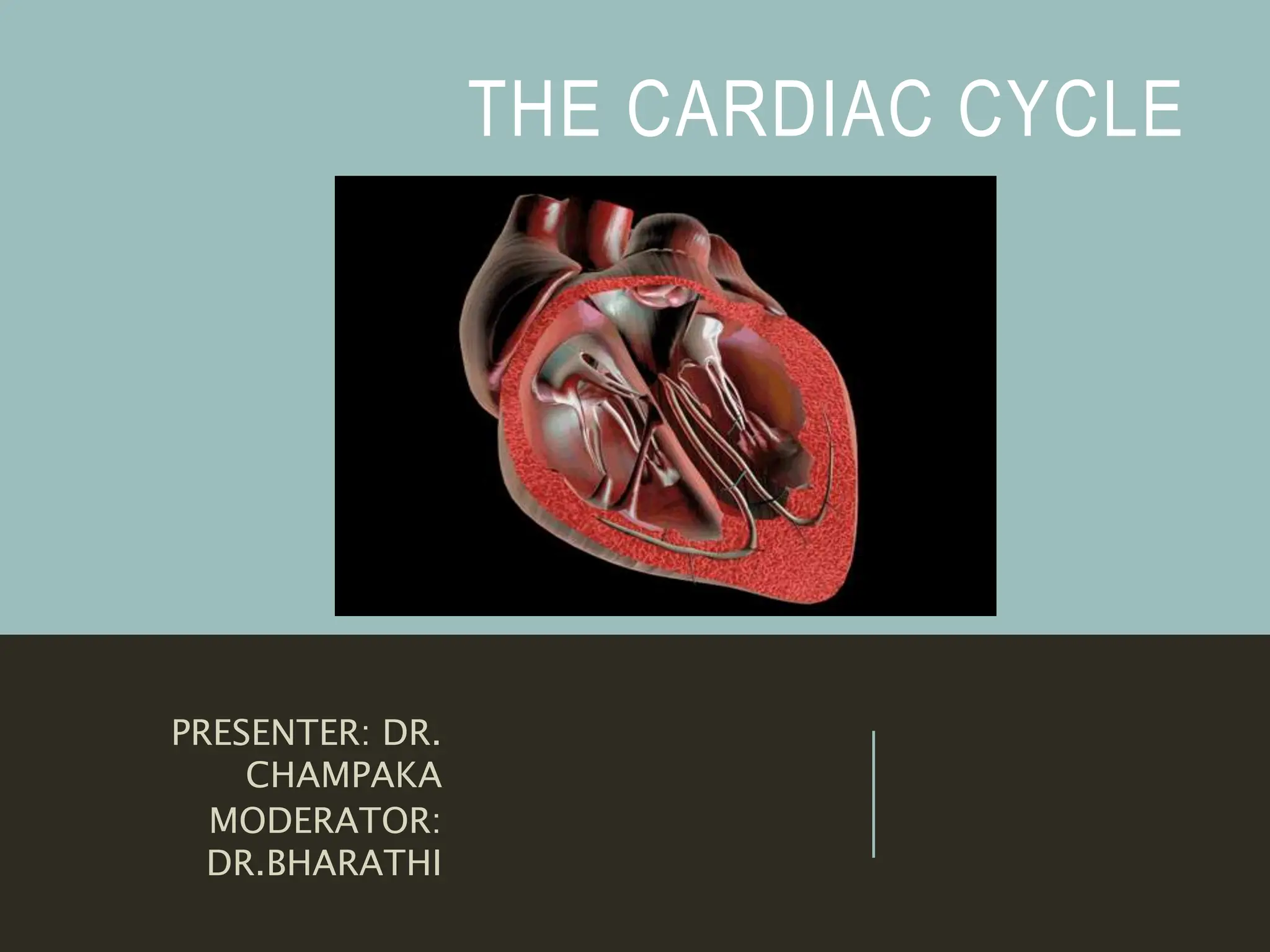
THE CARDIAC CYCLE
PRESENTER: DR.
CHAMPAKA
MODERATOR:
DR.BHARATHI
DEFINITION
The cardiac cycle is the performance of
the human heart from the beginning of one
heartbeat to the beginning of the next.
It is a series of coordinated electromechanical
events that result in the ejection of blood from the
heart into the great vessels
MECHANISM
Each cycle is initiated by the spontaneous generation of an
action potential in the sino atrial node.
This node is located in the superior lateral wall of the right
atrium near the opening of the superior vena cava, and the
action potential travels from here rapidly through both atria and
then through the A-V bundle into the ventricles.
MECHANISM
Because of this special arrangement of the
conducting system from the atria into the
ventricles, there is a delay of more than 0.1
second during passage of the cardiac impulse
from the atria into the ventricles.
This delay allows the atria to contract ahead
of ventricular contraction, thereby pumping
blood into the ventricles before the strong
ventricular contraction begins. Thus, the atria
acts as primer pumps for the ventricles, and
the ventricles in turn provide the major source
of power for moving blood through the body’s
MECHANISM
The A-V valves (i.e., the tricuspid and mitral valves )
prevent backflow of blood from the ventricles to the atria
during systole,
And the semilunar valves (i.e., the aortic and pulmonary
artery valves ) prevent backflow from the aorta and
pulmonary arteries into the ventricles during diastole.
ACTION POTENTIAL
The types of action potential in the heart can be separated into
two categories:
1) Fast-response action potentials, which are found in the His-
Purkinje system and atrial or ventricular cardiomyocytes and
2) Slow-response action potentials, which are found in the
pacemaker cells in the SA and AV nodes.
THE CARDIAC CYCLE CONSISTS
OF
Electrical events ( generation of impulses, conduction
of the wave, ECG )
Mechanical events ( relaxation & contraction of atria &
ventricle )
WIGGERS’ DIAGRAM
Wiggers elegantly illustrated the mechanical,electrical
and acoustic events of the cardiac cycle.
His diagram depicts the aortic,ventricular and atrial
pressure tracings with concomitant ECG,ventricular
volume and auscultatory findings
WIGGERS’ DIAGRAM
PHASES OF THE CARDIAC
CYCLE
1. Phase of Atrial contraction
2. Phase of Isovolumic (isometric) contraction
3. Phase of rapid ejection
4. Phase of reduced ejection
5. Protodiastolic phase of the ventricle
6. Isovolumic (isometric) phase of relaxation of the ventricle
7. Rapid filling phase of the ventricle
8. Diastasis
PHASE OF ATRIAL CONTRACTION
75% of the blood flows
directly into the ventricles even
before the atria contracts.
Then atrial contraction causes
an additional 25-30% filling of
the ventricles which we also
call as “ATRIAL KICK”.
Pathologically fourth heart
sound (S4) can be heard.
FUNCTIONS OF VENTRICLES AS
PUMPS
 3 BASIC EVENTS :-
1. LV contraction
2. LV relaxation
3. LV filling
LV CONTRACTION
Can be divided into :-
Phase of isovolumic (isometric) contraction
Phase of rapid ejection
Phase of slow ejection
PHASE OF ISOVOLUMIC
(ISOMETRIC) CONTRACTION
As the ventricular contraction begins, the ventricular pressure
rises causing AV valves to close.
Then an additional 0.02-0.03 sec is required for the ventricle
to build up sufficient pressure to open the semilunar valves
against the pressure in aorta and pulmonary artery.
Therefore during this period, contraction is occurring in the
ventricle, but there is no emptying.
This term is not strictly true because there is apex to base
shortening & circumferential elongation.
1ST Heart sound is heard (S1)
PHASE OF RAPID EJECTION
When LV pressure rises
slightly above 80 mmHg and
RV pressure above 8 mmHg,
the ventricle pushes the
semilunar valves to open.
70% of the blood emptying
occur during first 1/3rd of the
period of ejection k/a PERIOD
OF RAPID EJECTION.
PHASE OF SLOW EJECTION
Rest 30% of blood emptying occur during the next 2/3rd of the
period of ejection k/a PHASE OF SLOW EJECTION.
VENTRICULAR VOLUME
Amount of blood ejected by each ventricle per stroke at
rest is 70-90 ml.
End diastolic ventricular volume is 130 ml
Therefore, end systolic ventricular volume is 50 ml.
Ejection fraction = 65%
The ejection fraction is a valuable index of ventricular
function.
LV RELAXATION
 Comprises of 5 phases :-
1. Early diastole (Protodiastole)
2. Late diastole (Period of isovolumic relaxation)
3. Rapid filling phase
4. Slow filling phase
5. Atrial systole
EARLY DIASTOLIC PHASE
At the end of the systole,
the already falling
ventricular pressure drops
more rapidly. This period
is k/a Protodiastole.
Lasts for 0.04 sec.
PHASE OF ISOVOLUMIC
(ISOMETRIC) RELAXATION
 Phase of late diastole
 AV valves & semilunar valves are closed.
 The ventricle muscle continues to relax for
another 0.03-0.06 sec.
 The ventricle volume does not change .
 The ventricular pressure falls rapidly back
to their low diastolic level.
 2nd Heart sound is heard (S2) due to
semilunar valve closure.
RAPID VENTRICLE FILLING
PHASE
 The A-V valves open due to the moderately increased
pressure in the atria.
 The blood flows rapidly into the ventricle.
 It is seen in first 1/3rd of the diastole.
 Ventricular volume – increases steeply.
 3rd heart sound is heard (S3)
DIASTASIS
During middle 1/3rd of the diastole, only small
amount of blood flows into the ventricle k/a diastasis.
This is the blood that continues to flow into the atria
through the veins & directly passes into the
ventricles.
Time – 0.2 sec
ECG – phase between end of T waves & next P wave.
During the last 1/3rd of the diastole, the atria contracts &
provides an additional 25% of blood to the ventricles.
Time – 0.1 sec
CENTRAL VENOUS
PRESSURE WAVEFORM
DISORDERS ASSOCIATED
WITH CHANGES IN CVP
WAVES
A Wave:
•Absent A wave: Atrial fibrillation
•Prominent A waves: First-degree A-V Block
•Giant A waves: Tricuspid stenosis, Right atrial myxoma,
Pulmonic stenosis,Pulmonary hypertension
•Cannon A Wave: A-V Dissociation,Ventricular
Tachycardia
X Descent
•Absent or diminished X Descent: Tricuspid regurgitation,
cardiomyopathy
•Prominent X Descent: Conditions causing giant A Waves
(i,e:Tricuspid stenosis, Right atrial myxoma, pulmonic
stenosis,pulmonary hypertension)
V Wave
•Large C-V Waves :Tricuspid regurgitation,Constrictive
pericarditis
Y Descent
• Absent Y Descent: Cardiac tamponade
•Slow Y Descent: Tricuspid stenosis, right atrial myxoma,
and other causes of giant A wave
•Rapid Y Descent-constrictive pancarditis, severe right heart
failure tricuspid regurgitation, atrial septal defects
RELATIONSHIP OF THE
ELECTROCARDIOGRAM TO THE
CARDIAC CYCLE
The electrocardiogram shows the P, Q, R, S, and T
waves.
These are electrical voltages generated by the heart
and recorded by the electrocardiogram from the
surface of the body.
 The P wave is caused by the spread of depolarization through
the atria and is followed by atrial contraction, which causes a
slight rise in the atrial pressure curve immediately after the
electrocardiographic P wave.
 About 0.16 second after the onset of the P wave, the QRS
waves appear as a result of electrical depolarization of the
ventricles, which initiates contraction of the ventricles and
causes the ventricular pressure to begin rising. Therefore, the
QRS complex begins slightly before the onset of ventricular
systole.
 Finally, the ventricular T wave represents the stage of
repolarization of the ventricles when the ventricular muscle
fibres begin to relax. Therefore, the T wave occurs slightly
before the end of ventricular contraction.
CARDIAC CYCLE AND
HEART SOUNDS
TIMINGS IN CARDIAC CYCLE
Although events on the 2
sides of the heart are similar
, they are somewhat
asynchronous.
RA systole precedes LA
systole.
Contraction of RV starts
after that of LV.
However since pulmonary
artery pressure is lower than
the aortic pressure , RV
ejection begins before LV
ejection.
TIMINGS IN VENTRICULAR
SYSTOLE
1. Isovolumetric contraction – 0.05 sec
2. Rapid ejection phase – 0.10 sec
3. Reduced ejection phase – 0.15 sec
4. TOTAL = 0.3 sec
TIMINGS IN VENTRICULAR
DIASTOLE
1. Protodiastole – 0.04 sec
2. Isovolumic relaxation – 0.06 sec
3. 1st rapid filling phase – 0.10 sec
4. Diastasis – 0.20 sec (depends on HR)
5. Last rapid filling phase – 0.10 sec
TOTAL = 0.5 sec
TIMINGS OF ATRIAL
FUNCTION
Atrial diastole – 0.7 sec
Atrial systole – 0.1 sec
PRESSURE - VOLUME
DIAGRAM
PRESSURE - VOLUME
DIAGRAM
Phase I: Period of Filling
Phase II: Period of Isovolumic Contraction
Phase III: Period of Ejection
Phase IV: Period of Isovolumic Relaxation
THANK
YOU!!

CARDIAC CYCLE-The cardiac cycle is the performance of the human heart from the beginning of one heartbeat to the beginning of the next.

  • 1.
    THE CARDIAC CYCLE PRESENTER:DR. CHAMPAKA MODERATOR: DR.BHARATHI
  • 2.
    DEFINITION The cardiac cycleis the performance of the human heart from the beginning of one heartbeat to the beginning of the next. It is a series of coordinated electromechanical events that result in the ejection of blood from the heart into the great vessels
  • 3.
    MECHANISM Each cycle isinitiated by the spontaneous generation of an action potential in the sino atrial node. This node is located in the superior lateral wall of the right atrium near the opening of the superior vena cava, and the action potential travels from here rapidly through both atria and then through the A-V bundle into the ventricles.
  • 4.
    MECHANISM Because of thisspecial arrangement of the conducting system from the atria into the ventricles, there is a delay of more than 0.1 second during passage of the cardiac impulse from the atria into the ventricles. This delay allows the atria to contract ahead of ventricular contraction, thereby pumping blood into the ventricles before the strong ventricular contraction begins. Thus, the atria acts as primer pumps for the ventricles, and the ventricles in turn provide the major source of power for moving blood through the body’s
  • 5.
    MECHANISM The A-V valves(i.e., the tricuspid and mitral valves ) prevent backflow of blood from the ventricles to the atria during systole, And the semilunar valves (i.e., the aortic and pulmonary artery valves ) prevent backflow from the aorta and pulmonary arteries into the ventricles during diastole.
  • 6.
    ACTION POTENTIAL The typesof action potential in the heart can be separated into two categories: 1) Fast-response action potentials, which are found in the His- Purkinje system and atrial or ventricular cardiomyocytes and 2) Slow-response action potentials, which are found in the pacemaker cells in the SA and AV nodes.
  • 8.
    THE CARDIAC CYCLECONSISTS OF Electrical events ( generation of impulses, conduction of the wave, ECG ) Mechanical events ( relaxation & contraction of atria & ventricle )
  • 9.
    WIGGERS’ DIAGRAM Wiggers elegantlyillustrated the mechanical,electrical and acoustic events of the cardiac cycle. His diagram depicts the aortic,ventricular and atrial pressure tracings with concomitant ECG,ventricular volume and auscultatory findings
  • 10.
  • 11.
    PHASES OF THECARDIAC CYCLE 1. Phase of Atrial contraction 2. Phase of Isovolumic (isometric) contraction 3. Phase of rapid ejection 4. Phase of reduced ejection 5. Protodiastolic phase of the ventricle 6. Isovolumic (isometric) phase of relaxation of the ventricle 7. Rapid filling phase of the ventricle 8. Diastasis
  • 12.
    PHASE OF ATRIALCONTRACTION 75% of the blood flows directly into the ventricles even before the atria contracts. Then atrial contraction causes an additional 25-30% filling of the ventricles which we also call as “ATRIAL KICK”. Pathologically fourth heart sound (S4) can be heard.
  • 13.
    FUNCTIONS OF VENTRICLESAS PUMPS  3 BASIC EVENTS :- 1. LV contraction 2. LV relaxation 3. LV filling
  • 14.
    LV CONTRACTION Can bedivided into :- Phase of isovolumic (isometric) contraction Phase of rapid ejection Phase of slow ejection
  • 15.
    PHASE OF ISOVOLUMIC (ISOMETRIC)CONTRACTION As the ventricular contraction begins, the ventricular pressure rises causing AV valves to close. Then an additional 0.02-0.03 sec is required for the ventricle to build up sufficient pressure to open the semilunar valves against the pressure in aorta and pulmonary artery. Therefore during this period, contraction is occurring in the ventricle, but there is no emptying. This term is not strictly true because there is apex to base shortening & circumferential elongation. 1ST Heart sound is heard (S1)
  • 16.
    PHASE OF RAPIDEJECTION When LV pressure rises slightly above 80 mmHg and RV pressure above 8 mmHg, the ventricle pushes the semilunar valves to open. 70% of the blood emptying occur during first 1/3rd of the period of ejection k/a PERIOD OF RAPID EJECTION.
  • 17.
    PHASE OF SLOWEJECTION Rest 30% of blood emptying occur during the next 2/3rd of the period of ejection k/a PHASE OF SLOW EJECTION.
  • 18.
    VENTRICULAR VOLUME Amount ofblood ejected by each ventricle per stroke at rest is 70-90 ml. End diastolic ventricular volume is 130 ml Therefore, end systolic ventricular volume is 50 ml. Ejection fraction = 65% The ejection fraction is a valuable index of ventricular function.
  • 19.
    LV RELAXATION  Comprisesof 5 phases :- 1. Early diastole (Protodiastole) 2. Late diastole (Period of isovolumic relaxation) 3. Rapid filling phase 4. Slow filling phase 5. Atrial systole
  • 20.
    EARLY DIASTOLIC PHASE Atthe end of the systole, the already falling ventricular pressure drops more rapidly. This period is k/a Protodiastole. Lasts for 0.04 sec.
  • 21.
    PHASE OF ISOVOLUMIC (ISOMETRIC)RELAXATION  Phase of late diastole  AV valves & semilunar valves are closed.  The ventricle muscle continues to relax for another 0.03-0.06 sec.  The ventricle volume does not change .  The ventricular pressure falls rapidly back to their low diastolic level.  2nd Heart sound is heard (S2) due to semilunar valve closure.
  • 22.
    RAPID VENTRICLE FILLING PHASE The A-V valves open due to the moderately increased pressure in the atria.  The blood flows rapidly into the ventricle.  It is seen in first 1/3rd of the diastole.  Ventricular volume – increases steeply.  3rd heart sound is heard (S3)
  • 23.
    DIASTASIS During middle 1/3rdof the diastole, only small amount of blood flows into the ventricle k/a diastasis. This is the blood that continues to flow into the atria through the veins & directly passes into the ventricles. Time – 0.2 sec ECG – phase between end of T waves & next P wave.
  • 24.
    During the last1/3rd of the diastole, the atria contracts & provides an additional 25% of blood to the ventricles. Time – 0.1 sec
  • 26.
  • 28.
    DISORDERS ASSOCIATED WITH CHANGESIN CVP WAVES A Wave: •Absent A wave: Atrial fibrillation •Prominent A waves: First-degree A-V Block •Giant A waves: Tricuspid stenosis, Right atrial myxoma, Pulmonic stenosis,Pulmonary hypertension •Cannon A Wave: A-V Dissociation,Ventricular Tachycardia
  • 29.
    X Descent •Absent ordiminished X Descent: Tricuspid regurgitation, cardiomyopathy •Prominent X Descent: Conditions causing giant A Waves (i,e:Tricuspid stenosis, Right atrial myxoma, pulmonic stenosis,pulmonary hypertension)
  • 30.
    V Wave •Large C-VWaves :Tricuspid regurgitation,Constrictive pericarditis Y Descent • Absent Y Descent: Cardiac tamponade •Slow Y Descent: Tricuspid stenosis, right atrial myxoma, and other causes of giant A wave •Rapid Y Descent-constrictive pancarditis, severe right heart failure tricuspid regurgitation, atrial septal defects
  • 31.
    RELATIONSHIP OF THE ELECTROCARDIOGRAMTO THE CARDIAC CYCLE The electrocardiogram shows the P, Q, R, S, and T waves. These are electrical voltages generated by the heart and recorded by the electrocardiogram from the surface of the body.
  • 32.
     The Pwave is caused by the spread of depolarization through the atria and is followed by atrial contraction, which causes a slight rise in the atrial pressure curve immediately after the electrocardiographic P wave.  About 0.16 second after the onset of the P wave, the QRS waves appear as a result of electrical depolarization of the ventricles, which initiates contraction of the ventricles and causes the ventricular pressure to begin rising. Therefore, the QRS complex begins slightly before the onset of ventricular systole.  Finally, the ventricular T wave represents the stage of repolarization of the ventricles when the ventricular muscle fibres begin to relax. Therefore, the T wave occurs slightly before the end of ventricular contraction.
  • 34.
  • 35.
    TIMINGS IN CARDIACCYCLE Although events on the 2 sides of the heart are similar , they are somewhat asynchronous. RA systole precedes LA systole. Contraction of RV starts after that of LV. However since pulmonary artery pressure is lower than the aortic pressure , RV ejection begins before LV ejection.
  • 36.
    TIMINGS IN VENTRICULAR SYSTOLE 1.Isovolumetric contraction – 0.05 sec 2. Rapid ejection phase – 0.10 sec 3. Reduced ejection phase – 0.15 sec 4. TOTAL = 0.3 sec
  • 37.
    TIMINGS IN VENTRICULAR DIASTOLE 1.Protodiastole – 0.04 sec 2. Isovolumic relaxation – 0.06 sec 3. 1st rapid filling phase – 0.10 sec 4. Diastasis – 0.20 sec (depends on HR) 5. Last rapid filling phase – 0.10 sec TOTAL = 0.5 sec
  • 38.
    TIMINGS OF ATRIAL FUNCTION Atrialdiastole – 0.7 sec Atrial systole – 0.1 sec
  • 39.
  • 40.
    PRESSURE - VOLUME DIAGRAM PhaseI: Period of Filling Phase II: Period of Isovolumic Contraction Phase III: Period of Ejection Phase IV: Period of Isovolumic Relaxation
  • 41.