Shama Praveen
Department of physiology
Cardiac Cycle
Definition
Events in Cardiac Cycle
(a) Atrial systole
(b) Ventricular systole
(c) Ventricular diastole
(d) Atrial diastole
Atrial pressure changes
during cardiac cycle- JVP
Record
ECG changes during cardiac
cycle
Objectives
20XX presentation title 3
Definition
The sequence of changes in the pressure
and blood flow in the CVS in between the
two subsequent cardiac contractions is
known as cardiac cycle.
Duration of a cycle- 0.8 sec
Events in the cardiac cycle
 All 4 chambers are relaxed and filled with blood due to venous return.
 AV valves are open atrium and ventricle of each side are in continuity and the pressure in each
cavity is almost identical.
 Events :
 ATRIAL SYSTOLE,
 ATRIAL DIASTOLE,
 VENTRICULAR SYSTOLE &
 VENTRICULAR DIASTOLE.
Atrial Systole
20XX presentation title 5
• Contraction phase (0.1 sec)
Contraction of atria propels some additional blood
into ventricles (approx. 30ml).
 its contraction narrows orifices of superior and
inferior vena cava and pulmonary veins and the
inertia of blood moving towards the heart tends to
keep blood in it.
Right atrial pressure-4-6 mmHg
Left atrial pressure- 7-8mmHg
20XX presentation title 6
VENTRICULAR SYSTOLE
 2 major phases:
Isovolumetric ventricular contraction(0.05 sec):
 As the atrial contraction phase passes off, ventricular contraction begins and ventricular pressure
rises above atrial pressure very rapidly causing closure of the A-V valves with production of the first
heart sound (HS1)
 Intraventricular pressure rises sharply as the myocardium presses on the blood in the ventricle.
 0.05 sec until pressure in right and left ventricles exceeds the pressure in aorta (80mmHg) and
pulmonary artery (10mmHg) and get opened.
 During this phase, AV valves bulge into atria, causing a small but sharp rise in atrial pressure.
 During this phase, although contraction is occurring in the ventricles but there is no emptying;
therefore it is called isovolumetric ventricular contraction.
 Ventricular systole proper
20XX presentation title 7
 Duration: 0.25.
 Associated with ejection of blood out of ventricles.
 Opening of semilunar valves occurs.
 This opening follows ejection phase. This phase is subdivided into 3 divisions:
 Initial phase: Rapid Ejection phase (0.1sec)
 The intraventricular pressure rises to maximum (LV:120mmHg, RV<25mmHg) causing rapid
increase in the output of ventricular volume.
 Approx.2/3 of the stroke volume is ejected.
 Summit : Curve is reached when aortic or pulmonary artery pressure actually
rises above ventricular pressure.
 Final phase: Slow ejection phase(0.15sec)
 The ventricular pressure decreases as the ventricular contraction begins to subside with slow
ejection.
 The AV valves pulled down by contractions of the ventricular muscle and atrial pressure drops.
 EDV – 130ml, at the end of systole ESV- 50ml
 Ejection fraction: Percentage of EDV that is ejected with each heartbeat is called ejection fraction.
Valuable measure of ventricular function.
ROWAN MURPHY ELIZABETH MOORE
20XX presentation title 9
Ventricular diastole
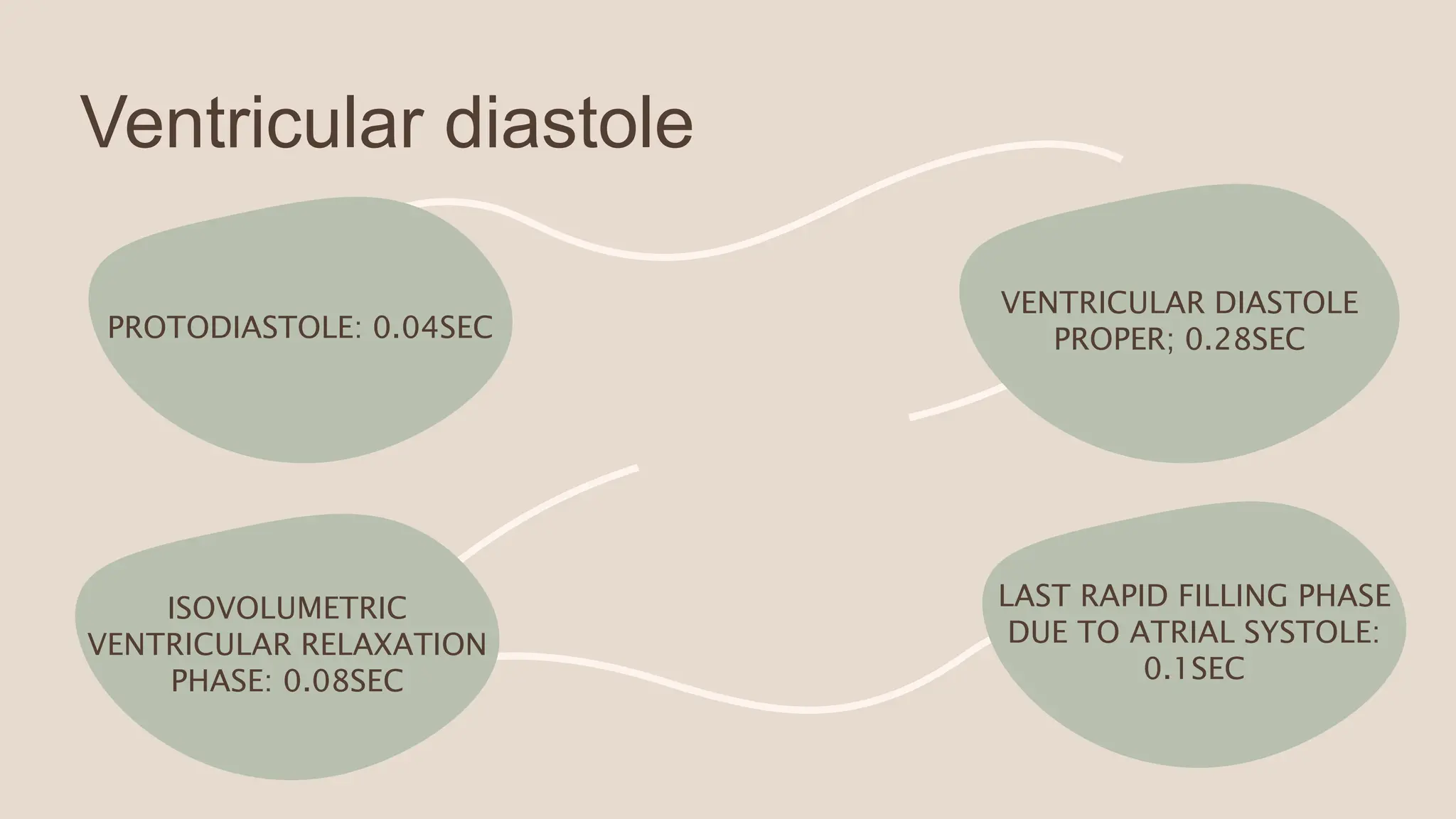
PROTODIASTOLE: 0.04SEC
ISOVOLUMETRIC
VENTRICULAR RELAXATION
PHASE: 0.08SEC
VENTRICULAR DIASTOLE
PROPER; 0.28SEC
LAST RAPID FILLING PHASE
DUE TO ATRIAL SYSTOLE:
0.1SEC
20XX presentation title 11
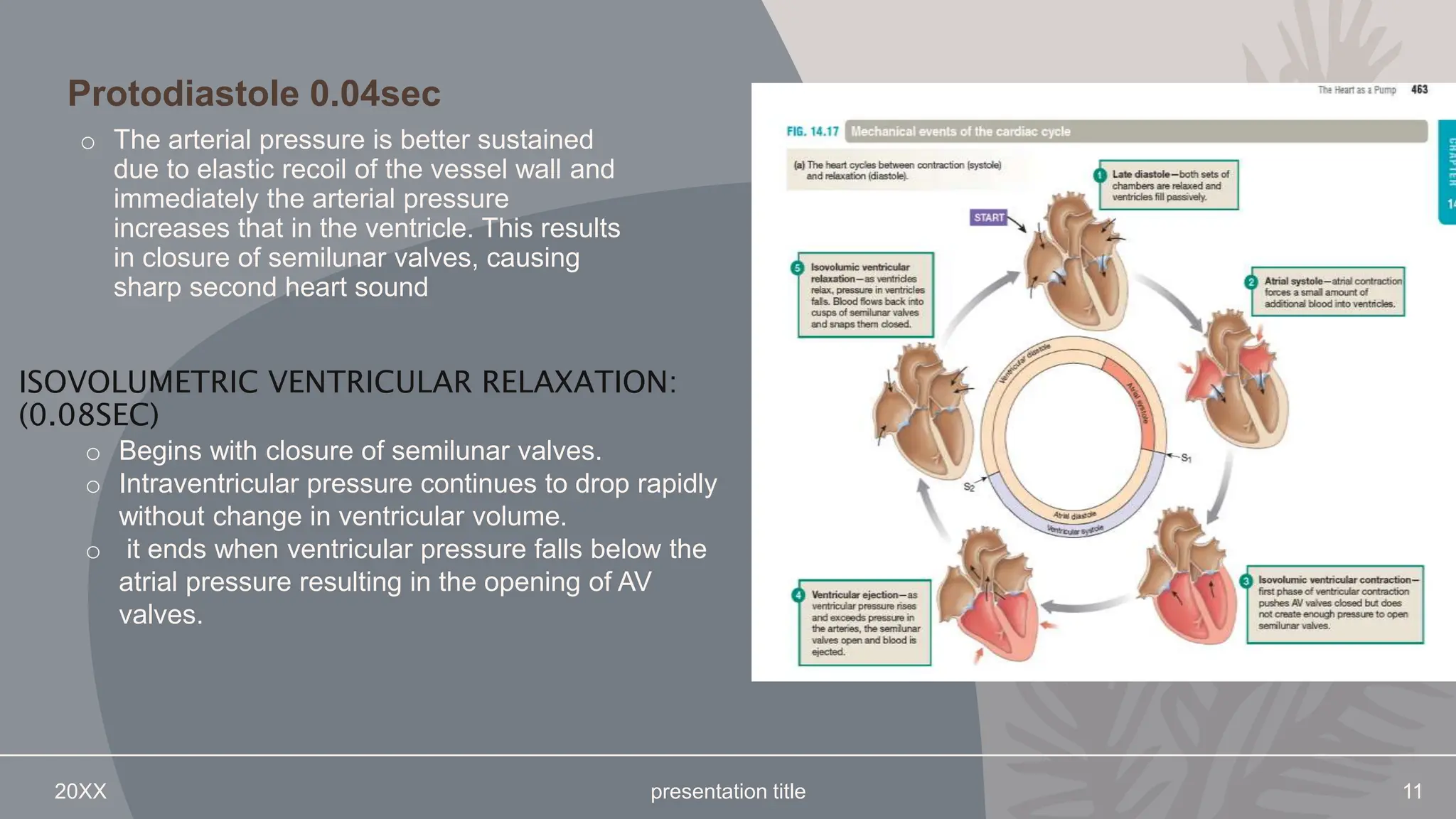
o The arterial pressure is better sustained
due to elastic recoil of the vessel wall and
immediately the arterial pressure
increases that in the ventricle. This results
in closure of semilunar valves, causing
sharp second heart sound
ISOVOLUMETRIC VENTRICULAR RELAXATION:
(0.08SEC)
o Begins with closure of semilunar valves.
o Intraventricular pressure continues to drop rapidly
without change in ventricular volume.
o it ends when ventricular pressure falls below the
atrial pressure resulting in the opening of AV
valves.
Protodiastole 0.04sec
20XX presentation title 12
o Approx. 70% of ventricular filling occurs passively during this phase.
o It has 2 divisions:
 Initially rapid filling:
 By opening of AV valves and it occurs for 0.1-0.12sec.
 Pressure in ventricles remain low
 Finally, slow filling:
 Called diastasis
 It is due to continuous venous return filling both atrium and
ventricle.
o Due to atrial systole
 LAST RAPID FILLING PHASE
VENTRICULAR DIASTOLE PROPER
ATRIAL DIASTOLE (0.7sec)
 Atrial muscle relax n atrial pressure gradually increases due to continuous venous
return to drop to almost zero mmHg with the opening of AV valves.
 Pressure rises again during the phase of diastasis and follows ventricular pressure.
20XX presentation title 13
20XX presentation title 14
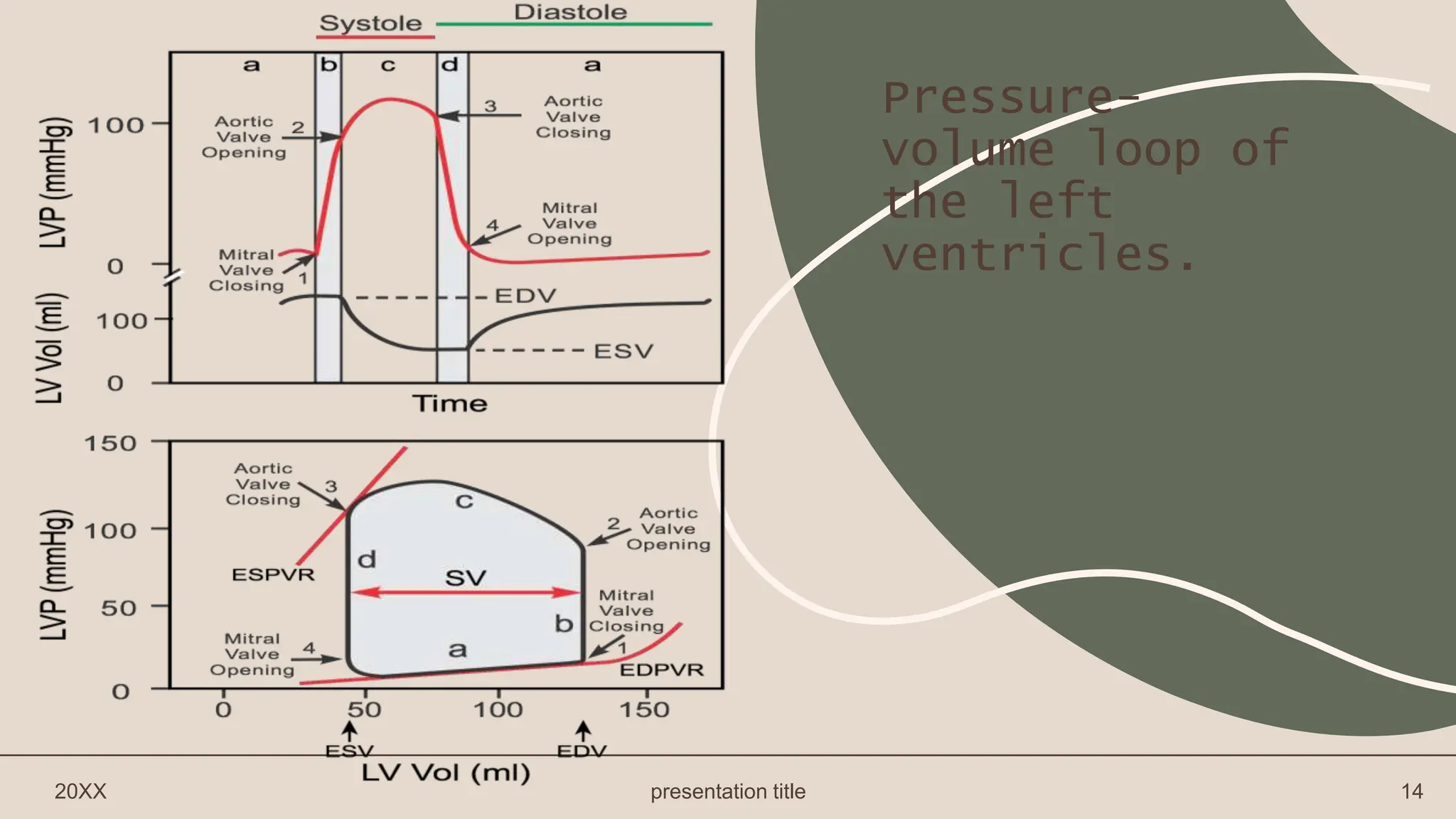
Pressure-
volume loop of
the left
ventricles.
The pressure wave expands the arterial walls as blood travels
and the expansion is palpable as the pulse.
The strength of the pulse is determined by the pulse pressure
and bears
Little relation to the mean pressure.
The dicrotic notch, a small oscillation on the falling phase of the
pulse wave caused by vibrations set up when the aortic valve
snaps shut, is visible if the pressure wave is recorded but is not
palpable at the wrist.
The pulmonary artery pressure curve also has a dicrotic notch
produced by the closure of pulmonary valve.
20XX presentation title 15
Arterial pulse
There is no valve at the junction of the superior vena cava
and the right atrium, therefore right atrial pressure are
transmitted to the jugular vein the neck, producing 3
characteristic waves
1. ‘a wave’ :due to atrial systole
2. ‘c wave’ : By bulging of tricuspid valve into right
atriumduring isovolumetric ventricular contraction phase.
3. ‘v wave’ : Due to rise in atrial pressure before tricuspid
valve opens during diastole
Absence of c wave indicate incompetent tricuspid valve.
Therefore, blood will flow from right ventricle into RA during
ventricular systole. This is associated with turbulence of
blood flow (called murmur).
20XX presentation title 16
Jugular venous pressure record
20XX presentation title 17
Record of electrical changes generated
with each heart beat.
 ‘p’ wave- due to atrial depolarization and
occurs before atrial systole.
 ‘Q’ ‘R’ & ‘S’ waves together constitute
the QRS complex and due to ventricular
depolarization. It occurs before
ventricular systole.
 ‘T’ wave is due to ventricular
repolarization . It co-exists with closure
of semilunar valves.
20XX presentation title 18
ECG changes during cardiac cycle
 HS1: Due to closure of AV valves and marks onset of ventricular systole.
 Low pitch, frequency:30-40/sec, producing a loud sound. (LUBB)
 Best heard over mitral and tricuspid areas.
 It coexists with R wave of ECG
o HS2: Due to closure of semilunar valve and marks onset of ventricular diastole.
o High pitch, frequency: 150-200/sec, producing a sharp sound. (DUP)
o Best heard over pulmonary aortic areas.
o It co-exists with the end of T wave of ECG.
 HS3: Due to vibrations of the cardiac walls produced by the rapid filling phase of the ventricles
during ventricular diastole proper.
 HS4: Due to atrial systole, characterized by low frequency and low amplitude.
20XX presentation title 19
Heart sounds
thank you

Cardiac Cycle.pptx

  • 1.
    Shama Praveen Department ofphysiology Cardiac Cycle
  • 2.
    Definition Events in CardiacCycle (a) Atrial systole (b) Ventricular systole (c) Ventricular diastole (d) Atrial diastole Atrial pressure changes during cardiac cycle- JVP Record ECG changes during cardiac cycle Objectives
  • 3.
    20XX presentation title3 Definition The sequence of changes in the pressure and blood flow in the CVS in between the two subsequent cardiac contractions is known as cardiac cycle. Duration of a cycle- 0.8 sec
  • 4.
    Events in thecardiac cycle  All 4 chambers are relaxed and filled with blood due to venous return.  AV valves are open atrium and ventricle of each side are in continuity and the pressure in each cavity is almost identical.  Events :  ATRIAL SYSTOLE,  ATRIAL DIASTOLE,  VENTRICULAR SYSTOLE &  VENTRICULAR DIASTOLE.
  • 5.
    Atrial Systole 20XX presentationtitle 5 • Contraction phase (0.1 sec) Contraction of atria propels some additional blood into ventricles (approx. 30ml).  its contraction narrows orifices of superior and inferior vena cava and pulmonary veins and the inertia of blood moving towards the heart tends to keep blood in it. Right atrial pressure-4-6 mmHg Left atrial pressure- 7-8mmHg
  • 6.
    20XX presentation title6 VENTRICULAR SYSTOLE  2 major phases: Isovolumetric ventricular contraction(0.05 sec):  As the atrial contraction phase passes off, ventricular contraction begins and ventricular pressure rises above atrial pressure very rapidly causing closure of the A-V valves with production of the first heart sound (HS1)  Intraventricular pressure rises sharply as the myocardium presses on the blood in the ventricle.  0.05 sec until pressure in right and left ventricles exceeds the pressure in aorta (80mmHg) and pulmonary artery (10mmHg) and get opened.  During this phase, AV valves bulge into atria, causing a small but sharp rise in atrial pressure.  During this phase, although contraction is occurring in the ventricles but there is no emptying; therefore it is called isovolumetric ventricular contraction.
  • 7.
     Ventricular systoleproper 20XX presentation title 7  Duration: 0.25.  Associated with ejection of blood out of ventricles.  Opening of semilunar valves occurs.  This opening follows ejection phase. This phase is subdivided into 3 divisions:  Initial phase: Rapid Ejection phase (0.1sec)  The intraventricular pressure rises to maximum (LV:120mmHg, RV<25mmHg) causing rapid increase in the output of ventricular volume.  Approx.2/3 of the stroke volume is ejected.  Summit : Curve is reached when aortic or pulmonary artery pressure actually rises above ventricular pressure.  Final phase: Slow ejection phase(0.15sec)  The ventricular pressure decreases as the ventricular contraction begins to subside with slow ejection.  The AV valves pulled down by contractions of the ventricular muscle and atrial pressure drops.  EDV – 130ml, at the end of systole ESV- 50ml  Ejection fraction: Percentage of EDV that is ejected with each heartbeat is called ejection fraction. Valuable measure of ventricular function.
  • 8.
  • 9.
  • 10.
    Ventricular diastole PROTODIASTOLE: 0.04SEC ISOVOLUMETRIC VENTRICULARRELAXATION PHASE: 0.08SEC VENTRICULAR DIASTOLE PROPER; 0.28SEC LAST RAPID FILLING PHASE DUE TO ATRIAL SYSTOLE: 0.1SEC
  • 11.
    20XX presentation title11 o The arterial pressure is better sustained due to elastic recoil of the vessel wall and immediately the arterial pressure increases that in the ventricle. This results in closure of semilunar valves, causing sharp second heart sound ISOVOLUMETRIC VENTRICULAR RELAXATION: (0.08SEC) o Begins with closure of semilunar valves. o Intraventricular pressure continues to drop rapidly without change in ventricular volume. o it ends when ventricular pressure falls below the atrial pressure resulting in the opening of AV valves. Protodiastole 0.04sec
  • 12.
    20XX presentation title12 o Approx. 70% of ventricular filling occurs passively during this phase. o It has 2 divisions:  Initially rapid filling:  By opening of AV valves and it occurs for 0.1-0.12sec.  Pressure in ventricles remain low  Finally, slow filling:  Called diastasis  It is due to continuous venous return filling both atrium and ventricle. o Due to atrial systole  LAST RAPID FILLING PHASE VENTRICULAR DIASTOLE PROPER ATRIAL DIASTOLE (0.7sec)  Atrial muscle relax n atrial pressure gradually increases due to continuous venous return to drop to almost zero mmHg with the opening of AV valves.  Pressure rises again during the phase of diastasis and follows ventricular pressure.
  • 13.
  • 14.
    20XX presentation title14 Pressure- volume loop of the left ventricles.
  • 15.
    The pressure waveexpands the arterial walls as blood travels and the expansion is palpable as the pulse. The strength of the pulse is determined by the pulse pressure and bears Little relation to the mean pressure. The dicrotic notch, a small oscillation on the falling phase of the pulse wave caused by vibrations set up when the aortic valve snaps shut, is visible if the pressure wave is recorded but is not palpable at the wrist. The pulmonary artery pressure curve also has a dicrotic notch produced by the closure of pulmonary valve. 20XX presentation title 15 Arterial pulse
  • 16.
    There is novalve at the junction of the superior vena cava and the right atrium, therefore right atrial pressure are transmitted to the jugular vein the neck, producing 3 characteristic waves 1. ‘a wave’ :due to atrial systole 2. ‘c wave’ : By bulging of tricuspid valve into right atriumduring isovolumetric ventricular contraction phase. 3. ‘v wave’ : Due to rise in atrial pressure before tricuspid valve opens during diastole Absence of c wave indicate incompetent tricuspid valve. Therefore, blood will flow from right ventricle into RA during ventricular systole. This is associated with turbulence of blood flow (called murmur). 20XX presentation title 16 Jugular venous pressure record
  • 17.
  • 18.
    Record of electricalchanges generated with each heart beat.  ‘p’ wave- due to atrial depolarization and occurs before atrial systole.  ‘Q’ ‘R’ & ‘S’ waves together constitute the QRS complex and due to ventricular depolarization. It occurs before ventricular systole.  ‘T’ wave is due to ventricular repolarization . It co-exists with closure of semilunar valves. 20XX presentation title 18 ECG changes during cardiac cycle
  • 19.
     HS1: Dueto closure of AV valves and marks onset of ventricular systole.  Low pitch, frequency:30-40/sec, producing a loud sound. (LUBB)  Best heard over mitral and tricuspid areas.  It coexists with R wave of ECG o HS2: Due to closure of semilunar valve and marks onset of ventricular diastole. o High pitch, frequency: 150-200/sec, producing a sharp sound. (DUP) o Best heard over pulmonary aortic areas. o It co-exists with the end of T wave of ECG.  HS3: Due to vibrations of the cardiac walls produced by the rapid filling phase of the ventricles during ventricular diastole proper.  HS4: Due to atrial systole, characterized by low frequency and low amplitude. 20XX presentation title 19 Heart sounds
  • 20.