By :- Baljinder Singh
M Sc MSN
Benefits of using the nursing
process for client
 Continuity of care
 Prevention of duplication
 Individualized care
 Standards of care
 Increased client participation
 Collaboration of care
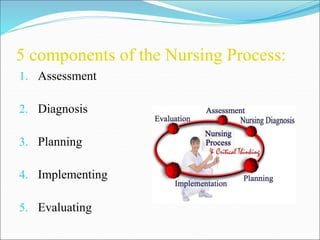
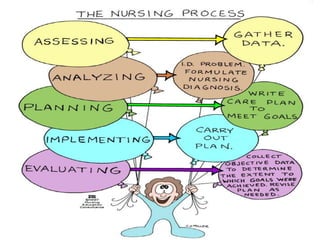
5 components of the Nursing Process:
1. Assessment
2. Diagnosis
3. Planning
4. Implementing
5. Evaluating
1st Component of the Nursing Process-
ASSESSMENT:
The first step in the
nursing process
involves the following:
 Collecting data.
 Validating data.
 Organizing data.
 Interpreting data.
 Documenting data
ASSESSMENT
Assessment is obtain information about a patient
response to health concerns/illness and their ability to
manage these health care issues
Purpose of Assessment
To establish a database concerning a client’s
physical, psychosocial, and emotional health.
To identify health-promoting behaviors as well as
actual and/or potential health problems.
Types of Assessment
 Comprehensive - Provides baseline data including
complete health history and current needs assessment.
 Focused - Limited in scope in order to focus on a
particular need or concern or potential risk.
 Ongoing - Includes systematic monitoring and
observation related to specific problems.
Sources of Data
 Primary Source: The client.
 Secondary Source: The client’s family members,
other health care providers, and medical records.
Types of Data
 Subjective: Data from client’s (and sometimes family’s)
point of view. Includes feelings, perceptions, and
concerns. Collected by the interview.
 Objective: Also called signs. Observable and
measurable data obtained through physical
examination and laboratory and diagnostic testing.
METHOD OF DATA COLLECTION
 Observation
 Interview that can be Directive or Non directive
 Physical examination:-
->Inspection
->Palpation
->percussion
->Auscultation
Validating Data
Validation prevents omissions, misunderstandings,
and incorrect inferences and conclusions.
Organizing Data
Collected information must be organized to be
useful.
Data Clustering is a useful tool to identify issues.
Interpreting Data
Three critical components:
 Distinguishing between relevant and irrelevant
data
 Determining whether and where there are gaps in
the data
 Identifying patterns of cause and effect
Documenting Data
Assessment data must be recorded and reported.
Accurate and complete recording of assessment
data is essential for communicating information to
health care team.
NURSING Diagnosis
 A medical diagnosis is a clinical judgment by the
physician that determines a specific disease, condition
or pathological state.
 According to “NANDA” nursing diagnosis is a clinical
judgment about individual, family, or community
responses to actual or potential health problems/life
processes.
Diagnostic Analysis
Data
validatio
n
Data
Clustering
Analysis &
Interpretation
of data
Identification
of clients need
Formulation of
Nursing Diagnosis
A.Analysis and Interpretation
Of Data:
After completing the
nursing assessment, the nurse proceeds to the
process of forming appropriate nursing diagnosis.
In the assessment phase, data are initially
collected from a variety of source and validated. The
nurse then applies reasoning and begins to look for
patterns in the assessment data.
1. Identify Abnormal Data And Strengths:
Identifying abnormal
findings and strengths requires the nurse to have
and use a knowledge base of anatomy and
physiology, psychology and sociology.
2. Cluster The Data: In this step the nurse looks at
the identified abnormal findings and strengths
for cues that are related. Both abnormal cues and
strength cues should be clustered and a particular
nursing framework should be used as a guide
when possible.
B. Draw inferences and
identify the problem
 Nurse will identify the client health problem and
determine what you can treat independently. i.e
something that nurse would intervene and treat
independently. Another purpose of this step is the
referral of identified problems for which the nurse
cannot prescribe the definitive treatment. E.g. diabetic
client who is having trouble with understanding the
exchange diet. Although the nurse has knowledge in
this area so she can advice about diet.
C. Propse possible nursing diagnosis:- After
identifying health problem nurse has to
frame nursing diagnosis, nursing diagnosis
may be wellness diagnosis, risk diagnosis or actual
diagnosis.
Types of Nursing Diagnosis
 Actual nursing diagnosis: A problem exists; it is
composed of the diagnostic label, related factors, and
signs and symptoms.
 Risk nursing diagnosis: A problem does not yet exist,
but special risk factors are present.
 Wellness nursing diagnosis: Indicates client’s desire to
attain higher level of wellness in some area of function.
Nursing Diagnosis is a Two-Part
Statement
 A problem statement or diagnostic label that
describes the client’s response to an actual or
potential health problem or wellness condition.
 And the etiology - the related cause or contributor
to the problem.
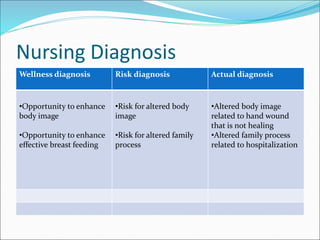
Nursing Diagnosis
Wellness diagnosis Risk diagnosis Actual diagnosis
•Opportunity to enhance
body image
•Opportunity to enhance
effective breast feeding
•Risk for altered body
image
•Risk for altered family
process
•Altered body image
related to hand wound
that is not healing
•Altered family process
related to hospitalization
Nursing Diagnosis Questions
 Are there problems here?
 If so, what are the specific problems?
 What are some possible causes?
 Is there a situation involving risk factors?
 What are the risk factors?
 What are the client’s strengths?
 What data are available to answer these
questions?
 Is more data needed?
 If so, what are the possible sources of further
data?
Advantages Of Nursing
Diagnosis
 : Nursing diagnosis is advantageous for both
nurses and clients:-
 1. They facilitate communication among nurse about
the client‘s level of wellness and assist in discharge
planning.
 2. Nursing diagnosis helps in prioritizing the client‘s
needs.
Cont…
 3. nursing diagnosis are also used for charting in the
progress notes, writing referrals and providing
effective transition of care from one unit to another,
from one clinic to another or from the hospital to
community.
 4. Nursing diagnosis can also serve as focus for quality
improvement. When focusing the nursing diagnosis
the reviewer can determine whether nursing care was
correct and delivered according to standards of
practice.
 5. Nursing diagnosis is beneficial for the client and
family.
Nursing process, Nursing Diagnosis

Nursing process, Nursing Diagnosis

  • 1.
    By :- BaljinderSingh M Sc MSN
  • 2.
    Benefits of usingthe nursing process for client  Continuity of care  Prevention of duplication  Individualized care  Standards of care  Increased client participation  Collaboration of care
  • 3.
    5 components ofthe Nursing Process: 1. Assessment 2. Diagnosis 3. Planning 4. Implementing 5. Evaluating
  • 5.
    1st Component ofthe Nursing Process- ASSESSMENT: The first step in the nursing process involves the following:  Collecting data.  Validating data.  Organizing data.  Interpreting data.  Documenting data
  • 6.
    ASSESSMENT Assessment is obtaininformation about a patient response to health concerns/illness and their ability to manage these health care issues
  • 7.
    Purpose of Assessment Toestablish a database concerning a client’s physical, psychosocial, and emotional health. To identify health-promoting behaviors as well as actual and/or potential health problems.
  • 8.
    Types of Assessment Comprehensive - Provides baseline data including complete health history and current needs assessment.  Focused - Limited in scope in order to focus on a particular need or concern or potential risk.  Ongoing - Includes systematic monitoring and observation related to specific problems.
  • 9.
    Sources of Data Primary Source: The client.  Secondary Source: The client’s family members, other health care providers, and medical records.
  • 10.
    Types of Data Subjective: Data from client’s (and sometimes family’s) point of view. Includes feelings, perceptions, and concerns. Collected by the interview.  Objective: Also called signs. Observable and measurable data obtained through physical examination and laboratory and diagnostic testing.
  • 11.
    METHOD OF DATACOLLECTION  Observation  Interview that can be Directive or Non directive  Physical examination:- ->Inspection ->Palpation ->percussion ->Auscultation
  • 13.
    Validating Data Validation preventsomissions, misunderstandings, and incorrect inferences and conclusions.
  • 14.
    Organizing Data Collected informationmust be organized to be useful. Data Clustering is a useful tool to identify issues.
  • 15.
    Interpreting Data Three criticalcomponents:  Distinguishing between relevant and irrelevant data  Determining whether and where there are gaps in the data  Identifying patterns of cause and effect
  • 16.
    Documenting Data Assessment datamust be recorded and reported. Accurate and complete recording of assessment data is essential for communicating information to health care team.
  • 17.
    NURSING Diagnosis  Amedical diagnosis is a clinical judgment by the physician that determines a specific disease, condition or pathological state.  According to “NANDA” nursing diagnosis is a clinical judgment about individual, family, or community responses to actual or potential health problems/life processes.
  • 18.
    Diagnostic Analysis Data validatio n Data Clustering Analysis & Interpretation ofdata Identification of clients need Formulation of Nursing Diagnosis
  • 19.
    A.Analysis and Interpretation OfData: After completing the nursing assessment, the nurse proceeds to the process of forming appropriate nursing diagnosis. In the assessment phase, data are initially collected from a variety of source and validated. The nurse then applies reasoning and begins to look for patterns in the assessment data.
  • 20.
    1. Identify AbnormalData And Strengths: Identifying abnormal findings and strengths requires the nurse to have and use a knowledge base of anatomy and physiology, psychology and sociology.
  • 21.
    2. Cluster TheData: In this step the nurse looks at the identified abnormal findings and strengths for cues that are related. Both abnormal cues and strength cues should be clustered and a particular nursing framework should be used as a guide when possible.
  • 22.
    B. Draw inferencesand identify the problem  Nurse will identify the client health problem and determine what you can treat independently. i.e something that nurse would intervene and treat independently. Another purpose of this step is the referral of identified problems for which the nurse cannot prescribe the definitive treatment. E.g. diabetic client who is having trouble with understanding the exchange diet. Although the nurse has knowledge in this area so she can advice about diet.
  • 23.
    C. Propse possiblenursing diagnosis:- After identifying health problem nurse has to frame nursing diagnosis, nursing diagnosis may be wellness diagnosis, risk diagnosis or actual diagnosis.
  • 24.
    Types of NursingDiagnosis  Actual nursing diagnosis: A problem exists; it is composed of the diagnostic label, related factors, and signs and symptoms.  Risk nursing diagnosis: A problem does not yet exist, but special risk factors are present.  Wellness nursing diagnosis: Indicates client’s desire to attain higher level of wellness in some area of function.
  • 25.
    Nursing Diagnosis isa Two-Part Statement  A problem statement or diagnostic label that describes the client’s response to an actual or potential health problem or wellness condition.  And the etiology - the related cause or contributor to the problem.
  • 26.
    Nursing Diagnosis Wellness diagnosisRisk diagnosis Actual diagnosis •Opportunity to enhance body image •Opportunity to enhance effective breast feeding •Risk for altered body image •Risk for altered family process •Altered body image related to hand wound that is not healing •Altered family process related to hospitalization
  • 27.
    Nursing Diagnosis Questions Are there problems here?  If so, what are the specific problems?  What are some possible causes?  Is there a situation involving risk factors?  What are the risk factors?  What are the client’s strengths?  What data are available to answer these questions?  Is more data needed?  If so, what are the possible sources of further data?
  • 28.
    Advantages Of Nursing Diagnosis : Nursing diagnosis is advantageous for both nurses and clients:-  1. They facilitate communication among nurse about the client‘s level of wellness and assist in discharge planning.  2. Nursing diagnosis helps in prioritizing the client‘s needs.
  • 29.
    Cont…  3. nursingdiagnosis are also used for charting in the progress notes, writing referrals and providing effective transition of care from one unit to another, from one clinic to another or from the hospital to community.  4. Nursing diagnosis can also serve as focus for quality improvement. When focusing the nursing diagnosis the reviewer can determine whether nursing care was correct and delivered according to standards of practice.  5. Nursing diagnosis is beneficial for the client and family.